Retail Trust Acquires Visalia Marketplace Shopping Center

The former Uhlmann Offices shopping center on Hwy 198 at Demaree in Visalia has been sold. Anchored by Kmart and Save Mart, the center has entitlements to add an additional 60,000 sf of retail space.

Spokesman for the buyer, Thompson National Properties’s REIT,  Ronnie Miranda, says they are”working with a prospect to fill the space but that it is too early to discuss.”

“We would not have bought the center unless we were optimistic about  its future. The best is yet to come.”

TNP Strategic Retail Trust, Inc. a public non-traded Real Estate Investment Trust(REIT) that invests in grocery and drug-store anchored, multi-tenant retail properties announced June 26 the completion of the company’s 20th acquisition, Visalia Marketplace, a 200,794-square-foot retail center located in Visalia, Calif.

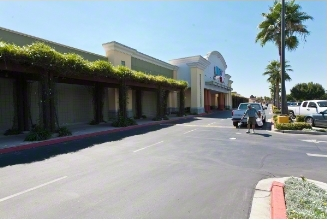
Visalia Marketplace was recently renovated in 2008. The center is 92 percent leased and anchored by Save Mart Supermarkets and Kmart. Other national and regional tenants include Starbucks, Brandman University and Great Clips.

The anchor tenants have long-term leases, with Save Mart Supermarket’s lease expiration at the end of 2028 and Kmart’s lease expiration in 2024.

“We believe we have found exceptional value in this property, acquiring it for $1.8 million less than an appraised value established by KeyBank in June 2012,” said Steve Corea, senior vice president of acquisitions for Thompson National Properties. “Further, this property has the zoning and land parcels to add 60,000 square feet of additional leasable area and has excellent freeway frontage and minimal lease rollover during the next five years.”

About TNP Strategic Retail Trust, Inc.
TNP Strategic Retail Trust, Inc. is a publicly registered non-traded REIT that invests in grocery and drug-store anchored, multi-tenant necessity retail properties, located primarily in the Western United States, and real estate related assets, including investment in or origination of mortgage, mezzanine, bridge and other loans related to commercial real estate. TNP Strategic Retail Trust has acquired 20 shopping centers in 14 states containing more than 2.1 million square feet at an overall purchase price of approximately $259 million. For more information regarding TNP Strategic Retail Trust, please visit www.tnpsrt.com.

About Thompson National Properties, LLC
Thompson National Properties, LLC (TNP) is an international real estate advisory company, specializing in the creation and management of real estate investment funds. TNP uses a variety of investment structures to fit the needs of its investors, which are designed for both institutional and high net worth individual investors. Thompson National Properties is also a leader in both property and asset management and receivership services, a key element in any successful commercial real estate investment in today’s lender-driven marketplace.

Headquartered in Irvine, California, Thompson National Properties was founded in April 2008 and has six regional offices. As of June 26, 2012, Thompson National Properties manages a portfolio of 153 commercial properties, in 30 states, totaling approximately 17.6 million square feet, on behalf of over 5,600 investor/owners with an overall purchase value of $2.1 billion.

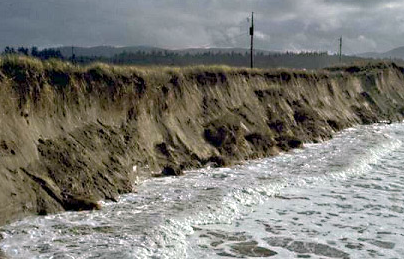
Sea Level Rise Report an Important Tool For Policy

This month Cal/EPA Secretary Matt Rodriquez released the following statement regarding the release of the National Research Council’s report, Sea-Level Rise for the Coasts of California, Oregon, and Washington: Past, Present, and Future.

“This study provides key findings on how sea level rise will impact the future of California’s environment and economy. The information will help guide California as we continue implementing and developing environmental policies to mitigate and adapt to climate change while, at the same time improving our economy now and in the future,” said Secretary Rodriquez.

The report underscores the importance of California implementing climate laws like AB 32 to reduce greenhouse gases and its effect on the environment. California’s climate laws are addressing both the sources of emissions as well as ways to adapt our infrastructure.
Executive Order S-13-08 directed state agencies to plan for sea-level rise and coastal impacts, and it also requested the National Research Council (NRC) to establish a committee to assess sea-level rise to inform the state efforts.

The Natural Resources Agency’s Department of Water Resources administered the contract with the NRC and Cal/EPA’s State Water Resources Control Board (State Water Board) provided 20 percent of the funding. Both Agencies have been working to craft policies that help mitigate and adapt to California’s changing climate. The State Agencies work through the Climate Action Team coordinating efforts on both fronts.

The study specifically notes that California’s coastline is most sensitive to sea level rise below Cape Mendocino – and rising ocean waters could affect the most populated areas of the California coast.
Projected impacts of sea level rise on California are outlined below and in the report.
 2030: 4cm to 30 cm rise in sea level (1.5 inches to 11.8 inches)
 2050: 15 cm to 60 cm rise in sea level (5.9 inches to 23.6 inches)
 2100: 42 cm to 166 cm rise in sea level (16.5 inches to 65.3543 inches)

“California’s beaches and coastline are vital to our state’s economy. This report reinforces why it’s so critical that we continue to plan to make sure important programs like beach monitoring and coastal protections for sensitive ecosystems and wetlands are fine-tuned to anticipate sea level rising,” said State Water Board Chair Charlie Hoppin.

Sea level rise influences several important State Water Board priorities and will serve as a valuable planning resource to refine critical long-range environmental considerations in program areas ranging from wetlands protections, to beach water quality monitoring, and Bay Delta inflow and outflow concerns.

The report notes that wetlands are important to help protect the coast from sea level rise. The State Water Board is considering a new policy on wetlands designed to protect and enhance California’s wetlands which in turn could serve as an effective deterrent to the impact of sea level rise, particularly in Central and Southern California.
The State Water Board has a two-decade long history of providing loans and grants for the
construction of publicly-owned facilities such as wastewater treatment plants, sewage systems,  and storm water treatment and collection basins (water recycling) through the Clean Water State Revolving Fund (CWSRF).

Because of the long-term planning that goes into this infrastructure (50+ years of service life in some cases), this report will be part of the ongoing planning and siting of future infrastructure by the State Water Board so that any projected impacts of sea level rise do not interfere with the performance and viability of these important projects.

Ongoing Water Board activities related to water pollution, storm water reuse, capture and diversion of pollution carried by storm waters into areas of special biological significance will also have to account for rising sea level. Rising sea levels may pose additional challenges to the state in these efforts.

Beach water quality monitoring is overseen by the State Water Board in coordination with local counties. Sea level rise may impact monitoring locations and constituents. California has the most extensive and comprehensive monitoring and regulatory program for beaches in the nation.

Finally, the Bay Delta Plan — short for the State Water Board’s San Francisco Bay/Sacramento-San Joaquin Delta Estuary Water Quality Control Plan — can determine the amount and timing of water entering and moving through the Delta. Sea level rise is one of the many factors that must be considered by the State Water Board as it updates the plan’s objectives.

Transparent Solar Cells For Windows Generate Electricity

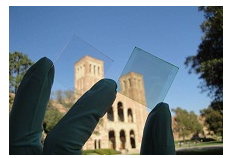
UCLA researchers have developed a new transparent solar cell that is an advance toward giving windows in homes and other buildings the ability to generate electricity while still allowing people to see outside. Their study appears in the journal ACS Nano. 

The UCLA team describes a new kind of polymer solar cell (PSC) that produces energy by absorbing mainly infrared light, not visible light, making the cells nearly 70% transparent to the human eye. They made the device from a photoactive plastic that converts infrared light into an electrical current.

“These results open the potential for visibly transparent polymer solar cells as add-on components of portable electronics, smart windows and building-integrated photovoltaics and in other applications,” said study leader Yang Yang, a UCLA professor of materials science and engineering, who also is director of the Nano Renewable Energy Center at California NanoSystems Institute (CNSI). 

Yang, who is also the holder of the Carol and Lawrence E. Tannas, Jr., Endowed Chair in Engineering, added that there has been intense world-wide interest in so-called polymer solar cells. “Our new PSCs are made from plastic-like materials and are lightweight and flexible,” he said.

“More importantly, they can be produced in high volume at low cost.” 

Polymer solar cells have attracted great attention due to their advantages over competing solar cell technologies. Scientists have also been intensely investigating PSCs for their potential in making unique advances for broader applications. Several such applications would be enabled by high-performance visibly transparent photovoltaic (PV) devices, including building-integrated photovoltaics and integrated PV chargers for portable electronics. 

Previously, many attempts have been made toward demonstrating visibly transparent or semitransparent PSCs. However, these demonstrations often result in low visible light transparency and/or low device efficiency because suitable polymeric PV materials and efficient transparent conductors were not well deployed in device design and fabrication.

A team of UCLA researchers from the California NanoSystems Institute, the UCLA Henry Samueli School of Engineering and Applied Science and UCLA’s Department of Chemistry and Biochemistry have demonstrated high-performance, solution-processed, visibly transparent polymer solar cells through the incorporation of near-infrared light-sensitive polymer and using silver nanowire composite films as the top transparent electrode. The near-infrared photoactive polymer absorbs more near-infrared light but is less sensitive to visible light, balancing solar cell performance and transparency in the visible wavelength region. 

Another breakthrough is the transparent conductor made of a mixture of silver nanowire and titanium dioxide nanoparticles, which was able to replace the opaque metal electrode used in the past. This composite electrode also allows the solar cells to be fabricated economically by solution processing. With this combination, 4% power-conversion efficiency for solution-processed and visibly transparent polymer solar cells has been achieved.

“We are excited by this new invention on transparent solar cells, which applied our recent advances in transparent conducting windows (also published in ACS Nano) to fabricate these devices,” said Paul S.Weiss, CNSI director and Fred Kavli Chair in NanoSystems Sciences. 

Study authors also include Weiss; materials science and engineering postdoctoral researcher Rui Zhu; Ph.D. candidates Chun-Chao Chen, Letian Dou, Choong-Heui Chung, Tze-Bin Song and Steve Hawks; Gang Li, who is former vice president of engineering for Solarmer Energy, Inc., a startup from UCLA; and CNSI postdoctoral researcher Yue Bing Zheng.

The study was supported by the Henry Samueli School of Engineering and Applied Science, the Office of Naval Research, and The Kavli Foundation.

UCLA Newsroom

Is California Eucalyptus The Target Of Biological Terrorism?

Over the years, Timothy Paine, professor in the UC Riverside Department of Entomology, has become increasingly convinced that someone or some group has brought a series of pests from Australia to California to get rid of California’s eucalyptus trees, according to a story on NPR’s All Things Considered.

“You can find alternative explanations for all of this, no question about it,” Paine said. “This is something we think is likely to have happened, but we don’t have a smoking gun.”

Paine’s suspicions were raised by introductions of 16 eucalyptus pests over the past 25 years. The pests were introduced a few at a time in batches from different regions Down Under.

“They would be from Queensland, or they would be from New South Wales, or South Australia,” he says.

The demise of eucalyptus in California, where they aren’t native species, isn’t Paine’s greatest worry.

“But if you’re talking about a major food crop, or a disease organism, the prospects are very, very disturbing,” he said.

News Briefs Around Tulare County

How about a dog with that carwash? Business owner Salim Tahir wants to open a drive-thru car wash and a Wienerschnitzel eatery near Mary’s Vineyard shopping center on Noble.The project would be located on a island between 198 and Noble across from KFC.You want sauerkraut with that shine?

Some signs of life in the Valley’s new homebuilding business. Visalia’s chief building official Greg Adams says they are processing three new home subdivisions this month,the first time in a while builders have submitted new tract plans.”They are pre-selling the homes before they build them” notes Adams, a way that clearly reduces the risk.Mangano Co is processing a 74 lot subdivision on 14.6 acres called Tumblerose on Linwood. In Lemoore two homebuilders have acquired mothballed new home tracts expecting the town to grow because of the NAS Lemoore expanding.

Lennar Fresno leads the builders pack with 65 new homes permitted so far this year in Tulare County followed by McMillin and Smee each with about 25 so far this year. Permits for 261 new homes have been issued to date compared to 315 this time last year, according to Construction Monitor.

American Tire Co wants to build a 7000 sf service center and store on So Mooney at 3921 S Mooney according to a plan filed with City of Visalia this week.  Fast growing Discount Tire and America’s Tire are two names for one nationwide company. The firm started in Michigan in 1960 and has since spread from coast to coast with over 800 stores

In Shape Fitness will remodel the former 24Hr Fitness facility in back of the Sequoia Mall in Visalia according to a plan filed with the City of Visalia. The 20,400 sf building has been vacant for several years. As they remodel the space the company, who already has 3 locations in town, will open a space in the new location to market membership. It is considered likely the firm will close their nearby Caldwell Ave gym when the new larger space on Mooney at Caldwell opens

Central Valley hospitality industry recovery is not as strong as it is statewide in June with Fresno being the only metro ares in California reporting a decline, year-over-year, in hotel occupancy – 0.8% lower. Smith Travel Research reports occupancy in the Tulare/Visalia metro region was 1.5% higher and Bakersfield was up 12.2%. The state average was was up 6.5%. RevPAR for the three local metro area were all up, with Fresno at 1.6%,Visalia at 2.4% and Bakersfield at 18.5%.

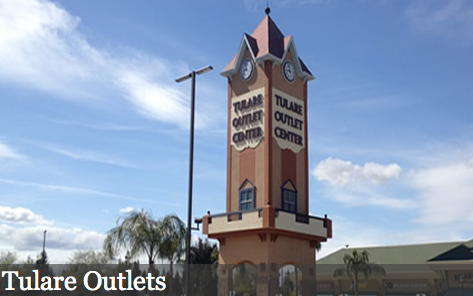
Bakersfield likes to shop, with this community being the most important source for customers visiting the Tulare Outlet Mall according to a recent report given to the Visalia City Council. This 226,000-square-foot outlet mall anchored by a Polo Ralph Lauren Factory store with other brand name soft goods outlets reported to have maintained a 98 percent occupancy rate since opening in 1995 in northeast Tulare. The primary trade area  encompasses 30-miles.”The center receives greater support from residents in the Bakersfield area (approximately 71 percent of visitation) than the Fresno area (approximately 19 percent of visitation)“ says the report.

Water customers in Visalia have reduced their consumption of water in the past few years but in order for private purveyor CalWater to come out on the deal,they have applied to the PUC to increase water rates phased-in over 3 years.The typical residential customer’s monthly bill would increase by $4.37 or 14.3% in 2014, followed by additional increases of $4.93 or 14.1% in 2015, and $0.91 or 2.3% in 2016 according to their filing. Most costs of operating the water system are fixed, regardless of the level of usage. “With lower water usage in your area, rates then have to be increased to cover these fixed costs”  reasons CalWater.

SLO Tourism Up In June

More visitors stayed in San Luis Obispo County in June at local hotels. Smith Travel Research shows SLO County accommodations sold 11.4% more rooms in June than the same month the year before.RevPAR was up a strong 13.8% while occupancy was up 8.9%. Occupancy stood at 76.5% compared to 70.3% in June 2011.

Statewide, hotel occupancy increased from 72.2% in June 2011 to 76.9%. Bay Area cities led the state with the strongest performance in RevPAR. Santa Barbara County occupancy was up 5% while Monterey County recorded an increase of 11.2%. Occupancy increased in every metro area in the state except Fresno where it was down 0.8%.

SLO Jobless Rate Spikes

San Luis Obispo County’s unemployment rate was up in June to 8.5% from a revised 7.8% in May but down from June 2011 when it was 9.6%.

While farm jobs were higher from May to June 2012 by 900 there were 1600 fewer nonfarm jobs. The largest loss came in the category of “other services”  and government. But farm jobs were up 20%.
On a positive note, construction jobs were up 600 year over year and trade jobs were up 500 along with 500 more hospitality jobs based on tourism. Total year over year gain in new nonfarm jobs add up to 1400.

California’s Jobless Rate Decreases to 10.7 %… Nonfarm Payroll Jobs Increase By 38,300

California’s unemployment rate decreased to 10.7 percent
in June, and nonfarm payroll jobs increased by 38,300 during the month for atotal gain of 475,300 jobs since the recovery began in September 2009, according to data released by the California Employment Development Department (EDD) from two separate surveys.

The U.S. unemployment rate was unchanged in June at 8.2 percent.\

In May, the state’s unemployment rate was 10.8 percent, and in June 2011, the unemployment rate was 11.9 percent. The unemployment rate is derived from a federal survey of 5,500 California households.

Nonfarm jobs in California totaled 14,326,700 in June, an increase of 38,300 jobs over the month, according to a survey of businesses that is larger and less variable statistically. The survey of 42,000 California businesses measures jobs in the economy. The year-over-year change (June 2011 to June 2012) shows an increase of 279,100 jobs (up 2.0 percent).

EMPLOYMENT AND UNEMPLOYMENT IN CALIFORNIA
The federal survey of households, done with a smaller sample than the survey of
employers, shows a decrease in the number of employed people. It estimates the number of Californians holding jobs in June was 16,484,000, a decrease of 17,000 from May, but up 326,000 from the employment total in June of last year.
The number of people unemployed in California was 1,974,000 – down by 20,000 over the month, and down by 213,000 compared with June of last year.

Seven categories (construction; trade, transportation and utilities; information; financial activities; professional and business services; leisure and hospitality; and other services) added jobs over the month, gaining 46,600 jobs. Trade, transportation and utilities posted the largest increase over the month, adding 9,400 jobs.

PAYROLL EMPLOYMENT DETAIL (SEASONALLY ADJUSTED)
EDD’s report on payroll employment (wage and salary jobs) in the nonfarm industries of California totaled 14,326,700 in June, a net gain of 38,300 jobs since the May survey.

This followed a gain of 45,900 jobs (as revised) in May.
Seven categories (construction; trade, transportation and utilities; information; financial activities; professional and business services; leisure and hospitality; and other services) added jobs over the month, gaining 46,600 jobs. Trade, transportation and utilities posted the largest increase over the month, adding 9,400 jobs.

Beacon Economics offered the following analysis:

For the second consecutive month, California made up nearly half of all jobs gains in the U.S. From May to June the state added a seasonally adjusted 38,300 nonfarm jobs. Total private employment fared slightly better, adding 38,800 positions in June.
On an annual basis California also continues to outpace the nation. From June 2011 to June 2012 the state added back nearly 280,000 jobs, a growth rate of 2% for the year. The U.S. grew by only 1.4% over the same time period. Moreover, remove public sector job losses, and California’s numbers improve even more with 313,900 private sector jobs added back, for a 2.6% growth rate from June 2011 to June 2012.
The state’s unemployment rate also ticked down slightly from 10.8% to 10.7%, although the labor force also contracted, indicating that some workers have ended their job search and left the labor market. Still, year-over-year, California’s unemployment rate has fallen 1.2 percentage points from 11.9% in June 2011 to 10.7%in June 2012 – a much faster decline than in the nation overall where unemployment fell by 0.9 percentage points on a year-over-year basis during the same time period.
The Information sector was the fastest growing industry from May to June, adding 5,600 jobs (1.3% growth rate). Most of those gains came from Los Angeles and Orange Counties, as opposed to tech heavy Silicon Valley, indicating that more of the information jobs were in media and publishing as opposed to software development and production.
In absolute terms, the bulk of the most recent job gains came from the Trade, Transport, and Utilities sector, which posted a month-over-month increase of 9,400 jobs (0.3% growth rate). This sector has grown steadily since the recession, keeping in line with the state’s high level of export growth and trade activity over the past year. Construction and Professional and Business Services employment also performed well month-over-month, adding 8,100 and 7,800 jobs, respectively.
Southern California took the lead in job growth this month, with Los Angeles County alone adding 20,100 jobs. San Diego County followed with a 9,300 job gain, and Orange County posted an additional 8,000 nonfarm positions. While this appears to be a major acceleration in job growth for the southern part of the state, it is in all likelihood a statistical “catchup.” The EDD has consistently revised its employment estimates upwards over the past few quarters, and while that does indicate a growing economy, the current bump is most likely a revision that is making up for what seemed like sluggish growth during the winter months.

Consultant Nixes Hwy 99 Shopping Center… Supports Adding So Mooney Retail Zone

Draft plan would add large shopping center at Hwy 99 and Caldwell

Sacramento consultant firms Plescia & Co. and Gruen Gruen + Associates have filed a report with the City of Visalia assessing the  regional retail lands need for the community going forward. The report comes after a blue ribbon committee of Visalians have pushed for a  more aggressive opening up of regional retail commercial land opportunities including Hwy 99 for a shopping center as the city finalizes its 2030 General Plan Update.
The idea has sharply divided both the community and the Visalia City Council. The report amounts to a second opinion that will be considered by the General Plan Update Committee at their meeting July 26 and likely next month at a council session.
Here are some key findings of the report released July 12 that appears to offer a middle course on the pace and location of new development.
Visalia/Mooney Get Stronger

The City of Visalia has continued to capture more sales from shoppers living outside of Visalia than it has lost through leakage of sales to retailers located outside the community. Visalia’s capture of Tulare County’s annual retail sales has slightly increased over the past 10 years from approximately 42.9 percent in 2000 to 43.4 percent in 2010. While some Tulare and Kings County communities have added some large format, big box and / or general merchandise retailers, they lack the depth and variety of the retailers and retail environments present on Mooney Boulevard in Visalia.

Despite this growth of retail space in surrounding Tulare and Kings County communities, the Mooney Boulevard Corridor actually enhanced its position as the dominant retailing location within the city  and Tulare County despite competing supply additions elsewhere with the share of countywide sales going from 20 percent in 2000 to 22 percent in 2010. Also, the Corridor’s share of citywide sales increased from 42 percent in 2000 to 47 percent of total citywide sales in 2010.

Vacancy On Mooney

Approximately 200,000 to 250,000 square feet of the inventory of commercial spaces of at least 12,000sf on the Mooney Boulevard is currently vacant. The vacancy rate on Mooney fell from the peak during the Great Recession from  20 percent in 2009 to 12.3 percent in early 2012.
Approximately 441,000 square feet of previously vacant commercial retail space was re-occupied from 2009 to mid-2012 with approximately 836,000 square feet (net) of new development from 2002 to mid-2012.
The City of Visalia’s current General Plan includes approximately 47 acres of vacant land area designated for Regional Retail Commercial use on the Mooney Boulevard Corridor. However, some of these designated properties (along Stonebrook for example) may not appeal to regional retail users or uses requiring direct frontage and visibility and ideal access to Mooney.Only approximately 11 acres east of Lowe’s could accommodate  Regional Retail Commercial use appears to be suitable to the preferences of regional retail space users, say the consultants.

Growth In Demand

The report suggests unmet demand should grow to 1.45 million sf in Visalia by 2020 and 2.35 million sf by 2030. As it is, the report says the are just 300,000 sf of vacant or infill  space available on Mooney. The report does not address filling some of that demand away from Mooney – on 198 or Dinuba Blvd, for example. Mooney amounts to half the city’s retail sales so perhaps half of the that expected demand might be satisfied elsewhere in town.

Nevertheless, the report concludes that “the forecast additional retail demand exceeds the current capacity of vacant land and retail space to support additional regional retail uses within the Mooney Boulevard Corridor.”

Recommendations

.
“The City of Visalia should encourage the expansion of existing and development of future complementary clusters of retail goods and services, lodging facilities, and institutional educational and healthcare uses that reinforce each other and serve to extend the trade area served or the frequency of visitation to the Mooney Corridor.”

Regional Commercial Development South of Visalia Parkway

The consultant suggests the City of Visalia consider designating and rezoning a portion of the land area along Mooney Boulevard south of Visalia Parkway( south of Packwood Creek shopping center) currently designated Regional Retail Reserve as Regional Commercial – initially the area between Visalia Parkway and Avenue 274 (the 30-acre parcel located on the southwest intersection and a 40-acre area located at the southeast intersection of Visalia Parkway and Mooney Boulevard) within three to five years after the adoption of the Visalia 2030 General Plan Update.

The recommendation would result in opening up additional land area increasing retail location choices and enhancing the retail synergy within the Mooney Boulevard Corridor, they say.

Development of the proposed Regional Commercial land use designation area further south along Mooney Boulevard between Avenue 274 and Avenue 272 should  happen later as the General Plan envisions.

Specialty Regional Retail at Highway 99 and Caldwell Avenue

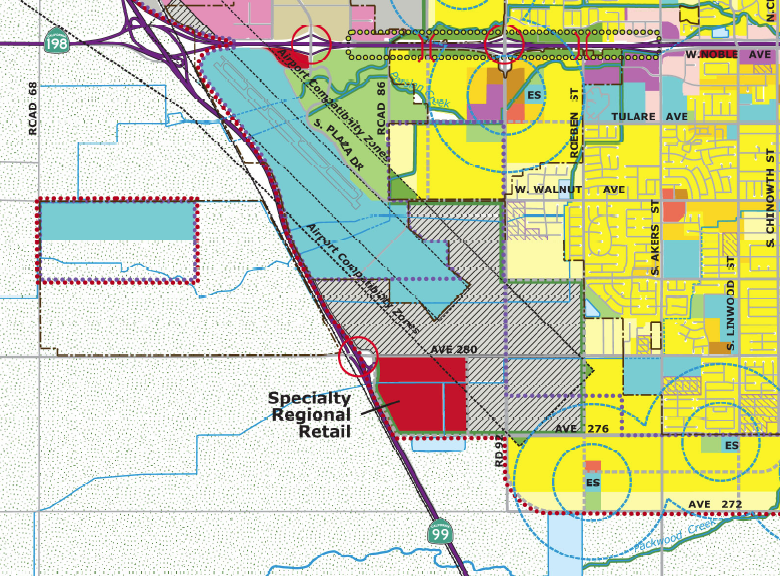
The proposed designated Specialty Regional Retail area (175 acres) at the southeast intersection of State Highway 99 and Caldwell Avenue could potentially support approximately 1.5 million square feet of additional new commercial development. However, given the retail supply demand analysis presented in the report, “sufficient unmet demand is unlikely to arise in the next 20 years to support two major retail agglomerations similar to that established on Mooney Boulevard within Visalia.”

In addition, the Highway 99 and Caldwell Avenue intersection is currently void of and will require significant and costly major infrastructure including roadways, facilities and utility improvements (including reconstruction of the existing highway interchange) that would be needed to accommodate development of the subject area.

Regarding the Hwy 99 plan the report concludes”This location should not be reserved for general regional retail, because allowing retail agglomeration on this site that mirrors the retail mix on Mooney Boulevard could potentially adversely affect the long-term economic and commercial vitality of the Mooney Boulevard Corridor.”

However,the consultant did not rule out the idea of attracting a particular specialty retailer (IKEA for example) to this site saying”We recommend that the City of Visalia consider establishing policies in the context of the Visalia 2030 General Plan Update that positions this location in the long term to capture true regional iconic destination retail uses or possibly uses such as educational institutions that derive unique advantages from highway accessibility.

Around Tulare County…AT&T,Algae,Visalia Med Clinic

New AT&T Hub In Visalia Industrial Park

Telecom company AT&T will set up a regional service center in the Visalia Industrial Park in coming months with an expected 60 to 70 employees. The office will serve customer needs for a variety of services including broadband, mobil and fixed telephone.

Realtor Doug Burr says the company will lease a 24,000 sf building on 1.7 acres at 8945 W Goshen Ave, currently empty. The company filed for tenant improvements to build out an office in about half the warehouse space this week.The building is owned by investor Danny Freitas.

“They will be dispatched to work around the county for AT&T’s bundled services” expects Burr. ”They need parking for about 75 trucks.”

The Dallas-based firm is the 7th largest company in the United States by total revenue.

Tulare Algae Farm Breaking Ground

Pacific Algae Oil has leased four acres next to the Tulare city treatment plant to build a pilot production plant that would turn algae into oils to be used for bio-jet fuel. The company uses CO2 generated from the city’s fuel cell operations and piped to to the growing area. The algae grow in tubes and are seeded to tubs where the CO2 is bubbled. Before the oil is extracted the algae are netted and dried on racks.

The pilot project has university research interest says city public works director Lew Nelson so the project has a student labor supply.

Nelson says  the company broke ground on the project this week.He expects plenty of visitors since “algae farming has worldwide interest.”

Visalia Medical Will Double Sized of Walk-In Clinic

Visalia Medical Clinic is doubling the size of its ‘Quick Care’ walk-in clinic this summer says CFO Russ Desch.”We have plenty of demand from both our Visalia Medical patients and outside patients for urgent care type service that does not require a long wait or appointment.”

The clinic is also remodeling its lobby to to accommodate patient flow he says.

“Visalia has a shortage of primary care physicians ” notes Desch and a clinic setting is a lot more cost effect and better than getting care at the hospital ER.”

Desch says Kaweah Delta herself is building several new urgent care centers in Visalia as well ”to take the pressure off of their ER.”

Under the new health care law getting regular care through a primary physician in private office or clinic setting will be encouraged.

“We should be open in fall when the sniffles and colds become a problem once again.”

The remodeling work is valued at $560,000.