Solar Power Ramped Up at Five California Prisons

Discounted power saves tax dollars, curbs greenhouse emissions. (Solar panels at Delano prison pictured.)

The California Department of Corrections and Rehabilitation (CDCR) today announced that solar energy fields that generate electrical power for four of its prisons are now running at full capacity, thereby reducing greenhouse gas emissions and saving $45 million in energy costs over the next 20 years.

“These solar fields benefit the environment and show a responsible stewardship of taxpayer dollars,” CDCR Secretary Matthew Cate said. “These solar fields will prevent a billion pounds of greenhouse gases from being emitted to the air and make the prisons less reliant on power generated by natural gas and nuclear sources.” A dedication ceremony was held today at North Kern State Prison, one of the institutions powered by solar energy.

Approximately 56,000 solar panels, which generate 14 megawatts of power, were constructed adjacent to the four prisons at no cost to taxpayers by Sun Edison Corp.  In return, CDCR purchases the electrical power from Sun Edison at discounted rates, which results in reduced energy costs. (14 megawatts of power is roughly equivalent to the energy required to power at least 45,000 homes.)

In addition to North Kern State Prison in Delano, solar fields are generating power for Chuckawalla Valley and Ironwood state prisons in Blythe and the California Correctional Institution in Tehachapi.  A fifth field of photovoltaic panels are currently under construction at California State Prison, Los Angeles in Lancaster and an expansion of the Tehachapi field will add approximately 3.3 megawatts of power by early 2013.

The State of California also has awarded contracts to Sun Edison to construct an additional 20 megawatts of solar capacity at other prisons in Northern California.  Those sites are still being evaluated and have the potential to reduce CDCR’s electrical costs by an additional $45 million over 20 years.

The solar fields are part of CDCR’s “Going Green Initiative” which includes recycling and water conservation projects that improve energy efficiency in all 33 prisons by reducing electricity and natural gas use. All of the energy saving projects are paid for without the use of state general fund tax dollars and are financed with low- or no-interest loans, such as those from Federal American Recovery and Reinvestment Act funding.

More Signs Of Recovery In Tulare County Economy

Kirkland’s home decor store

More Signs Of Recovery: Tulare County’s unemployment rate dropped to 14.1%, the lowest since September 2008 before this “great recession” hit.The rate dropped from 15% in August 2012 and 15.4% in September 2011. By category,the biggest jump year over year is 300 more jobs in the local hospitality industry.

And Housing Stirs: Visalia home building permits for new single family homes are up 31% from the same time last year as a few home builders are busy. Home grown Mangano Homes is proposing to build the first new home subdivision in the city permitted in a couple years says planner Brandon Smith. The project, a 73 unit  subdivision called Tumblerose will heard by the Planning Commission Nov 13.The subdivision is located at Riggin and Linwood.

Retail Too: National home decor retailer Kirkwoods will open later this month in a 7000 sf building in line with Target at the Packwood Creek shopping center says the center’s developer Patrick Orosco. Tennessee-based Kirkwoods has 300 stores across the country. Orosco tells an interesting story.”We actually built this building four years ago for Kirkwoods but the downturn in the economy sunk the plans and Kirkwoods themselves went through a restructuring.Now they are back and its kind of emblematic of how the economy is recovering and amazing we had the same vacant building ready for them four years later.” Orosco says there are active tenant negotiations going on now for existing space left in the south Mooney center and says stay tuned for more.

KELLER WILLIAMS LAUNCHES COMMERCIAL REAL ESTATE DIVISION IN TULARE/KINGS COUNTIES


Kevin Land

Keller Williams Realty is expanding its operations in Tulare and Kings Counties by launching a commercial real estate division. The launch of this division will allow Keller Williams to become a more diversified real estate company to meet the needs of all current and future clients.

Keller Williams Realty – Tulare and Kings County Chief Executive Officer Brian Icenhower said the launch comes at a great time because the commercial market is showing signs of rebounding in the South Valley, there is an eager workforce, existing business incentives, and great communities.

Icenhower said one important component of launching the commercial department was hiring the right person to lead the division.  Kevin Land, a Tulare County native, is the new director of the commercial real estate division for Tulare and Kings County. Land has specialized in commercial real estate for the last 8 years with CBRE/CB Richard Ellis in Fresno. 

 “I’m excited to come back to Tulare County and serve my community by helping clients expand and relocate their businesses in this region,” Land said.

Icenhower said Keller Williams is excited to welcome Kevin to its team.

“Kevin has already shown the dedication to grow the commercial division and has become a huge asset to the company in a short amount of time,” Icenhower said.

Land earned a business degree in Real Estate/Land Economics from CSU, Fresno’s Sid Craig School of Business in 2005.

KW Commercial is the 6th largest real estate company in the nation. KW Kings & Tulare Counties is Central Southern California’s largest and highest producing real estate company with offices in Visalia, Tulare, Porterville and Hanford. For more information, visit Keller Williams Realty online at kwtularecounty.com I (559) 733-4100.

SLO Unemployment Falls To 7.4%

The EDD reports that the unemployment rate in the San Luis Obispo County was 7.4 percent in September 2012, down from a revised 8.2 percent in August 2012, and below the year-ago estimate of 9.1 percent. This compares with an unadjusted unemployment rate of 9.7 percent for California and 7.6 percent for the nation during the same period.

SLO County’s jobless rate spiked in 2009 with the start of the great recession and is just now has dropped to pre-recession levels. In September 2008 the unemployment rate was 6.1% but by September 2009 that rate had climbed to 9.2%.

Looking closer the number of new jobs climbed from 102,800 in September 2011 to 105,300 in September 2012 with 2900 new non farm jobs but 400 fewer farm jobs. The county now sports 1000 more jobs than year ago in the hospitality sector and 600 more doing construction.

Year over year the number of unemployed in the county dropped from 12,700 to 10,500

Almond Shipments Climb 25%

The crop year report for almonds is in and it’s a record. US domestic almonds shipments of 48.3 million pounds were 11% ahead of 2011 while export shipments (91.4 million pounds ) were up 34%. Total shipments were 139.6 billion pounds or 25.2%.  Early 2012-2013 shipments are showing a slight decline so far from the record pace but it is early in the season.

The big boost is from exports of California nuts.Top destination was China.A US Trade report last month on South China’s almond consumption indicates that U.S. almonds remain among the top imported items. Shelled almond  imports increased 269% in 2012 due to favorable prices relative to other imported tree nuts.

Hard Hit Dairy Operators Have Some Hope For Relief

Central Valley dairy operators are on the streets of Sacramento again this week demanding the state adjust the price they get for their milk from the state’s cheese makers who gobble up about half the supply.

One dairy tweeter says “Gov. Brown / Karen Ross: We’ll be at your office steps Oct. 18th @ 11:00 a.m. Bigger and Louder ! Your hands are stained with our industries Blood,Sweat,Tears and Generations of hard work to build California’s #1 Ag industry which you choose to destroy on YOUR inactions.
It’s in your stained hands to act. Give our industry a fair fight, we need our 4b milk price in parity with class 3 which is required by law.”

The state formula used to pay dairymen for their milk undervalues milk to the tune of $200,000 a month to the average dairy for the past 12 months argues Hanford dairyman Joaquin Contente who is speaking at this weeks rally

But CDFA ag secretary Karen Ross has already turned down petitions to adjust the formula as well as others to reconsider the May CDFA decision.CDFA has a tough balancing act to insure both the supply of milk and profit margins of the state’s huge cheese making industry remain healthy.

At the moment nobody could argue the dairy operators are a healthy bunch right now.

Empty Barns

Western United Dairymen CEO Michel Marsh says 100 dairies may go out of business this year as low prices for milk earlier this year and record high prices for feed along with years of debt are making herd dispersal auctions and more empty barns commonplace. That’s happening right now around Kings and Tulare counties, the nations biggest dairy region.

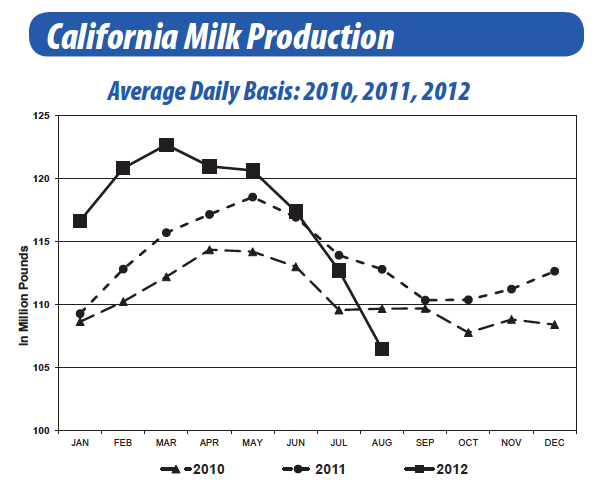
In a fast moving story the region is producing of months less milk and there are worries there could be far less.
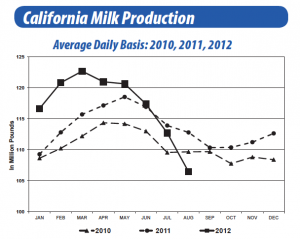
A recent CDFA report says in August Kings County milk production was down nearly 10 % compared to the same month a year before.Statewide we were down 5.8%.

Contente who ships milk to co-op Land O Lakes in Tulare says LOL is receiving about 6 to 7% less milk every day than a year ago due to cow liquidation – dairies being shut through bankruptcy or lender pressure. Another big co-op CDI is down millions of pounds as well, the two largest state players. CDFA reported a decline 29% in nonfat milk production in August, a huge product for the export market.

The decline in the local milk supply has a face to it as long time dairy operators throw in the towel including Tulare County dairyman Warren Hettinga who sold off his cows at his 4 locations this past month including all rolling stock and farm equipment.

Kings County’s John Camara with 75 year in the dairy business sold off  his herd this week,October 16 at the Overland Sales yard in Hanford.
“Every time I turn around there is another neighbor dairy going out.” shrugs Contente.

While a state price adjustment won’t fix all the problems by a long shot, Contente says “we’ve been subsidizing the cheese business since the 1980s when the state order helped attract the big cheese plants that were built like Leprino in Lemoore.”

Another dairy blogger from Kings County, the Dairy Goddess, recently pointed to a September lawsuit against CDFA on the same issue.

“On September 4th a lawsuit was filed against the CDFA . We dairy farmers have asked three times for a fair price for our milk. Three times we have been denied. Secretary Ross is not following  the law. The law is very clear, “the price announced by CDFA must be in reasonable alignment with prices paid for comparable milk produced and sold around the country”. This law has not been followed. California dairy farmers have continued to be paid $2.00 per hundred weight less for our milk than our neighboring states. That is 20 million dollars we have been robbed.”
Some Hope

Despite all the bluster, a lawsuit and administration bashing – behind the scenes there appears to be some serious discussions and maybe a realization of how bad it is out there.

In the past few weeks a high level meeting said to include Ross, a representative of Governor Brown and leadership from dairy producers has offered a glimmer of of hope says Western United Dairymen  president Tom Barcellos of Porterville.”At least we are still talking” says Barcelleos whose industry group represents 60% of milk produced. “I think Ross became aware of some facts she did not know about”says another source.

One mega development in the past few weeks has been the bankruptcy filing of Fresno-based Zacky Farms who employs about 1000 workers but is, like the dairy industry, dependent on feed from the Midwest where drought has cut supply and raised the cost of feed to red ink levels. The collapse of a major player in California ag is sobering even as the number of dairy bankruptcies this summer has skyrocketed. Fresno bankruptcy attorney Riley Walter reported earlier this year.”This is just a bloodbath. In the past 18 months I have been worked on 58 dairy bankruptcies.”

Of course it’s not just formal bankruptcies you have to look at.Banks are feeling the pressure when strapped dairymen are not paying their bills and are calling some loans say industry leaders,forcing the liquidation of assets.

But rumors that a major dairy lender, Wells Fargo, has pulled the plug on the dairy industry are not true says Bill Hoover, Business Development Officer for Wells Fargo in Visalia.

“When a dairyman says Wells Fargo is getting out of the dairy business he may be referring to his own business, but not the business.”

“We still have a healthy dairy portfolio of over $1 billion dollars and much smaller portfolio that is not so healthy” adds Hoover.”For us it is definitely not going to be lights out on the dairy business.”

Hoover adds that they continue to work with some local dairymen who are downsizing but working to stay in the business while others are getting out, selling their land,often to farmers who want to plant trees.

Feed Issue

Asked why the California dairy industry doesn’t plant more of their own feed like Wisconsin instead of depending on a distant region for its feed supply both Contente and Barcellos point to the cost of land in the Valley and huge demand for more profitable crops.

“Where I am standing now, on field crop land I am surrounded by land that has been recently purchased and will be soon planted to to pistachios. It’s worth $15,000 an acre,far more than we can pay to grow more feed.”Ironically, a few decades ago it was dairies relocating from the LA Basin that pushed out cotton and field crop farmers.

Still some dairymen like Barcellos grow most of their own feed and with some experimentation other grains,canola and sorghum could help supplement  the increased corn being grown in California (up 30% this year) where unlike the Midwest, the drought has not been so severe. Still comparison to Wisconsin have to admit because they are in a federal system they get about $2 per cwt more for their milk. That brings us back to Karen Ross.

All the trouble in the livestock industry whether dairy or poultry is putting the hurt on local feed vendors and other suppliers like Western Milling in Goshen who supplies both Zacky and area dairies.The bankruptcy filing by Zacky indicates some $6 million owed to Western Milling .”All these problems spill over to the vendors” says Hoover, and the banks obviously. Don’t forget the economy. Don’t forget those cheese makers.To quote a phrase”Got Milk?”

Maybe that’s what secretary Ross may be seeing – the unraveling of the states’ largest industry if some relief is not offered, at least for a while.


Biz Briefs: Gas,Avos & Lumber

California gas prices are down 17 cents since they spiked up more than 50 cents early this month says Gas Buddy.A few Fresno stations are selling regular for $3.99 this week ( the lowest in the state) while the state average is $4.50. says the online service.

In California and across the U.S. refinery problems and tight supplies in some locations caused gasoline prices to surge earlier this month to the highest prices since the spring. “But the switch to a less expensive winter grade of gasoline, weak refinery demand and increase of supplies in certain areas caused gasoline prices to start coming down. An unexpected increase in U.S. gasoline supplies in the past week could cause pump prices to fall even further “says an AP report.Gas demand is down from a year ago and supplies rose last week says the US Energy Information Service.
In California the state energy commission reports margins for sale of gasoline by week. In two weeks the refining margin of the cost to make gasoline rose from 57 cents to $1.22 as of October 8, even as the price the refiner paid for crude fell.
Cheaper avocados, good for those Holiday parties are here with more coming although the trend may hurt California growers prices.That’s because  this fall’s Mexican avocado crop is double what it was last year. California production is winding down until next spring.

Despite the conventional wisdom that suggests lower prices are good for the economy , the rebound in the housing market this fall is lifting lumber prices – good if your are selling lumber or if you just want to see the economy thrive. Rising home values and more sales  added to predictions of a strong upcoming remodeling season by Harvard University this week suggests  the home improvement market(as well as appliance and furniture sales)  should fare well in coming months. After being in the $200 range for almost two years – lumber futures now stand at $320 – rising from $280 in October. Higher lumber prices will stimulate more production and investment, good for jobs.

PG&E Awarded $1 Million for Energy Storage Research

SACRAMENTO – The California Energy Commission today approved a $1 million research grant to Pacific Gas & Electric Company (PG&E) to demonstrate a compressed air energy storage (CAES) plant.

“In order to meet California’s renewable energy goals, it is critical that we invest in energy storage research,” said Energy Commission Chair Dr. Robert B. Weisenmiller. “This project is expected to reduce greenhouse gas emissions, improve grid reliability, and lower electric power system costs.”

The San Francisco-based utility company will verify the performance of advanced, CAES technology to provide support to the state’s electric grid. The project will use excess wind energy to compress air into depleted natural gas reservoirs within PG&E’s territory. The stored compressed air will be used to generate electricity during high demand periods.

The first phase of the project aims to establish costs and benefits of the technology, and validate system reliability and durability to select a suitable site for the plant in California. When completed, the facility will be the third CAES plant operating in the world, and the first on the West Coast.

The Energy Commission grant will provide a cost share for the first phase of the project costing $50 million. The remaining balance will be paid for by the U.S. Department of Energy and other funding sources.

Commissioners also approved a $200,000 grant to the University of California, Berkeley to develop a guidebook on Building Efficiency Standards benefits for Local Governments as it pertains to natural gas efficiency standards. The project will document the environmental, economic, and equity costs and benefits of mandatory and voluntary natural gas efficiency standards, both for new buildings and for retrofits of existing commercial and residential structures.

Funding for the projects come from the Energy Commission’s research and development program. The program supports public interest research and development that helps improve the quality of life in California by bringing environmentally safe, reliable, and affordable energy services and products to the marketplace.

Funds will be paid to the grantees upon receipt of invoices.

Hollywood to *Camp Out* in Sequoia National Park/ Casting Call for Movie Extras

Want to be in a real Hollywood movie? Here*s your chance.

Producers will hold a casting call for a feature film from 10a.m. *
noon this Saturday, October 19, at the Tulare County Library Main
branch, located at 200 W. Oak Street in Visalia. The casting call will
be held upstairs in the library*s *blue room.*

Written by Andrew Rothschild, directed by Andy Landen, and produced by
Ashleigh Phillips, Giles Andrew and Jessica Latham, the movie “Sequoia
National Park”  tells the story of 21-year-old Reilly MacGrady. She*s
like any other teenager, an angelic face obscured by various failed
attempts at severity: a nose ring, dyed black hair, heavy eyeliner.

She also has the requisite teenage contempt for her parents, though in
this case, not entirely misguided. Left unsupported in the face of
cancer, Reilly takes control and decides to take her own life in Sequoia
National Park, Reilly*s favorite place in the world and the place of
her last happy memory. On the way, she meets a boy, Ogden, who disrupts
her plan and her conviction to not stick around. Meanwhile, her
dysfunctional family races against the clock to reach her in time.

*Sequoia (the movie) is painfully funny and honest,* said Latham,
who will be in Visalia to hold a casting call for several acting roles
in the film and to finalize some last minute film locations details.
*It*s a story about life and love and how the very relationships
that tear us apart might also be the only thing that can save us.*

Director Andy Landen said the scenic beauty of Sequoia and Kings Canyon
National Parks and the Sierra Nevada mountains made shooting this film
on location in Tulare County the logical creative choice.

*Not only is Sequoia National Park a gorgeous setting cinematically,
the park has an ethereal, magical feel to it,* Landen said.  *There
is an energy *a pulse amongst those giant trees. I can see why our
protagonist Reilly ultimately finds her salvation in Sequoia.*

Landen was born in a small town in the Canadian province of Ontario and
completed an MFA in directing at the University of Southern
California*s Film School.  While at film school, he won the
prestigious Coca-Cola Filmmakers Award, which saw his short shown in
over 30,000 movie theaters in the US. Landen loves to create visually
stunning, character driven films that blend drama with humor and speak
to the truth about life and beauty that can be found in all of its
awkward, sad and happy moments.

The film *Sequoia National Park* has already found a lot of local
support from the Tulare County Film Commission.

*We are interested in this production for several reasons,* said
Eric Coyne, Tulare County Film Commissioner. *While still considered a
fairly low-budget production, a significant amount of that money will be
spent here locally on lodging, meals and other supplies.

*This film also specifically calls out where it takes place, and
showcases Sequoia National Park, the community of Three Rivers, rural
Tulare County and Visalia.*

Currently the film is in its final stages of pre-production, and is
looking for a number of key essentials:

–       30-40 local actors, males and females between the ages of 18 to
70 from all walks of life, willing to be in the film and act as extras.

Producers plan to hold casting “auditions” from 10 a.m. * noon on
Saturday, October 20 at the Tulare County Library Main branch, located
at 200 W. Oak Street in Visalia. The casting call will be held upstairs
in the library*s *blue room.*

People interested in auditioning, but who either can*t come to this
Saturday*s casting call or don*t want to wait until then, can submit
a digital head shot and their resume by email to:
sequoiaextras@gmail.com

*The producers say they will consider people who are not formally
trained as actors to appear as extras in the film,* Coyne said.
*Just email a good picture of yourself, with name, address and
phone number, and a brief statement about why you want to be in the film
and why you think they should consider you for a role. This is a good
opportunity, because while extras will not be paid for appearing, I
understand they will be credited in the film. That doesn*t always
happen.*

Rain & Snow On The Way!

Both Central Coast and Central Valley weather forecasters are predicting a few wet days next week.

Coastal forecaster John Lindsey says (0n 10/18) ”  A strong cold front will move down the California coastline on Monday.
This cold front will pass the Central Coast Tuesday morning with strong to gale force (25- to 38-mph) with higher gust southeasterly
winds and rain. At this time, rainfall amounts should range between
0.75 and 1.00 inches. Rain showers are forecast on Tuesday afternoon
through Wednesday.

Not only will this be the first widespread rain of the season for
California, but it will probably be the first big snow for the
Sierra. Snow levels are forecast to get down to 5,000-feet or
lower across the Sierra by Tuesday and Wednesday with over a foot
or more of snow possible from the storm.

This cold front could be followed by another one late next week
before fair weather returns over the following weekend and through
the end of October.”

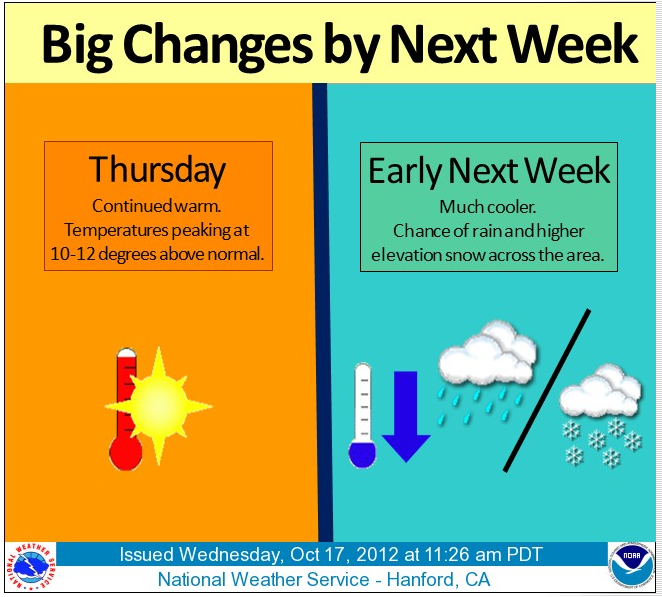
According to the National Weather Service,Hanford  – this current heat will give way to moisture.

“THURSDAY IS EXPECTED TO BE THE WARMEST DAY WITH TEMPERATURES 8-13 DEGREES ABOVE NORMAL FOR MID OCTOBER. THE RIDGE WILL BEGIN TO BREAK DOWN FRIDAY AS A TROUGH OF LOW PRESSURE DROPS OUT OF THE GULF OF ALASKA. THIS WILL BRING INCREASING ONSHORE FLOW THROUGH THE WEEKEND WITH TEMPERATURES COOLING TO NEAR NORMAL BY SUNDAY. THIS TROUGH ALSO KICK THE CLOSED LOW OFF THE BAJA COAST EASTWARD AND INTO ARIZONA BY SUNDAY NIGHT.

THE MAIN ENERGY WITH THE TROUGH WILL REMAIN TO OUR NORTH THROUGH
THE WEEKEND. THEN THE LOW WILL DEEPEN FURTHER AS THE CLOSEDLOW
OFF BAJA IS EJECTED EASTWARD. ECMWF/GFS AND ENSEMBLE MODELS
SHOWING INCREASING CERTAINTY ON POSSIBLE PRECIPITATION OVER
CENTRAL CALIFORNIA AS EARLY AS MONDAY AFTERNOON AND CONTINUING
THROUGH TUESDAY AND WEDNESDAY. THERE ARE TIMING AND STRENGTH
DIFFERENCES WITH THIS SYSTEM BETWEEN THE GFS AND ECMWF…SO TIMING OF THE BEST CHANCE OF PRECIPITATION IS UNCERTAIN. BUT BOTH MODELS INDICATE A WETTER AND UNSETTLED PERIOD FOR THE FIRST HALF OF NEXT WEEK.”