STATE NEW CAR SALES JUMP 34%

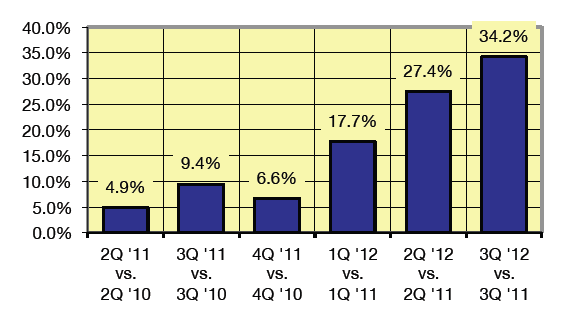
Sales increases by quarter according to the CNCDA

The new vehicle market in California continued to recover during the summer of 2012, with new registrations increasing a significant
34.2 percent in the Third Quarter versus a year earlier. It was the 14th consecutive year-over-year quarterly increase says the California New Car Dealers Association.
Primary reasons for the big increase include: release of pent up demand, easing credit conditions, strong trade in values, and improving supplies of top-selling models from Japanese manufacturers. The annual increase from 2011 to 2012 is now projected to approach 23%.

Other key trends in the state market:
• Chrysler was the brand with the largest percentage increase
during the first nine months of this year- Up 109%.
• Korean, Japanese, European, and Detroit Three brand registrations
each increased by more than 19 percent.
• Passenger car share increased 1.9 share points. SUVs were
down 1.8 points.
• The State market was up 26.3 percent in the first nine months of
2012, higher than the 14.5 percent increase in the Nation.

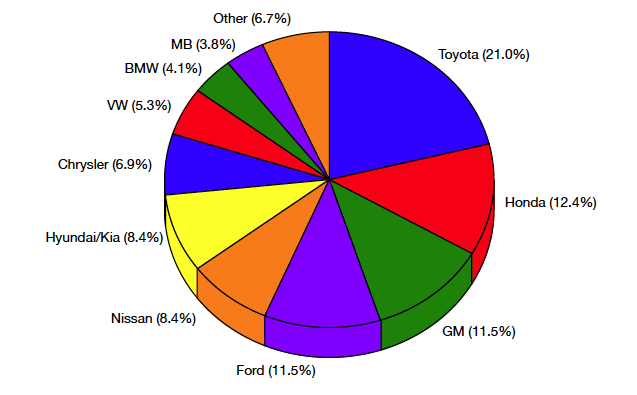
In California Toyota retained top market share at 21% followed by Honda,GM and Ford.

In full size truck sales the Ford F Series retains top market share at 33.7%. The Prius remains top selling car followed closely by Honda Civic.

The recovery in car sales in the state means sales of 1.58 million light vehicles this year compared to 1.17 million units in 2010 and 1.29 million last year.

California Foreclosure Activity Lowest Since Early 2007…SLO COUNTY DROPS 50%

La Jolla, CA.–Three and a half years after peaking, the number of California homes entering the foreclosure process fell last quarter to the lowest level since the early stages of the housing bust. Mortgage default filings hit their lowest point since first-quarter 2007, due in large part to a stronger economy and housing market and more short sales, a real estate information service reported.
A total of 49,026 Notices of Default (NoD) were recorded on residential properties during the third quarter. That was down 10.2 percent from 54,615 for the prior three months, and down 31.2 percent from 71,275 in third-quarter 2011, according to San Diego-based DataQuick.
SLO Down 50%
In our reading area San Luis Obispo County foreclosures are down a whopping 50% for the  third quarter dropping from 246 to 123 year over year.
Central Valley Counties Down 33%
In Tulare County and other Central Valley counties where the foreclosures have been much higher the trend is the same with Notices of Default down from 866 for the 3rd quarter of 2011 to 636, a 27% reduction. Overall the numbers in the Central Valley dropped 33%.
Booming Bay Area counties like Marin were down 58%, Santa Clara was down 54%.
Even beat up Fresno registered a big drop of 41%.

Down Two Thirds Since Peak
Last quarter’s number was the lowest since 46,760 NoDs were recorded in first-quarter 2007. NoDs peaked in first-quarter 2009 at 135,431. DataQuick’s NoD statistics go back to 1992.
“A foreclosure happens when a homeowner owes more on the property than the property’s worth. Otherwise it could be sold and the mortgage paid off. So foreclosures go up when home values go down. Prices in most areas today are up significantly from their low point in early 2009,” said John Walsh, DataQuick president.
“Additionally, during the past year, we’ve seen short sales overtake the foreclosure process as the procedure of choice to deal with homeowner distress. That may change after New Year’s because the temporary ‘debt forgiveness” feature in the tax code is set to expire as part of the so-called ‘fiscal cliff’,” he said.
The median price paid for a California home last quarter was $300,000, which was 32.2 percent off the $227,000 bottom in first-quarter 2009, DataQuick reported.
Short sales – transactions where the sale price fell short of what was owed on the property – made up an estimated 26.0 percent of statewide resale activity last quarter. That was up from an estimated 24.0 percent the prior quarter and up from 22.9 percent of all resales a year earlier. The estimated number of short sales last quarter rose 19.0 percent from a year earlier.
Foreclosure resales accounted for 20.0 percent of all California resale activity last quarter, down from a revised 27.8 percent the prior quarter and 34.2 percent a year ago. The figure peaked at 57.8 percent in the first quarter of 2009. The level of foreclosure resales – homes foreclosed on in the prior 12 months – varied significantly by county last quarter, from 5.5 percent in San Francisco County to 35.5 percent in Sutter County.
NoD filings fell last quarter across all home price categories. But mortgage defaults remained far more concentrated in California’s most affordable neighborhoods. Zip codes with third-quarter 2012 median sale prices below $200,000 collectively saw about 8 NoDs filed for every 1,000 homes in those zip codes, while the ratio was about 5 NoDs filed per 1,000 homes for zip codes with $200,000 to $800,000 medians. For the group of zip codes with median sale prices above $800,000, there were just under 2 NoDs filed per 1,000 homes.
Most of the loans going into default are still from the 2005-2007 period: the median origination quarter for defaulted loans is still third-quarter 2006. That has been the case for three years, indicating that weak underwriting standards peaked then.
The most active “beneficiaries” in the formal foreclosure process last quarter were Bank of America (8,061), JP Morgan Chase(6,713) and Wells Fargo (5,780).
The trustees who pursued the highest number of defaults last quarter were ReconTrust Co (mostly for Bank of America and Bank of New York), Quality Loan Service Corp (Bank of America) and NDEx West (Wells Fargo).
On primary mortgages, California homeowners were a median eight months behind on their payments when the lender filed the Notice of Default. The borrowers owed a median $16,414 on a median $315,000 mortgage.
On home equity loans and lines of credit in default, borrowers owed a median $4,779 on a median $78,804 credit line. The amount of the credit line that was actually in use cannot be determined from public records.
San Diego-based DataQuick monitors real estate activity nationwide and provides information to consumers, educational institutions, public agencies, lending institutions, title companies and industry analysts. Notices of Default are recorded at county recorders offices and mark the first step of the formal foreclosure process.
Although 49,026 default notices were filed last quarter, they involved 48,257 homes because some borrowers were in default on multiple loans (e.g. a primary mortgage and a line of credit).
Of the state’s larger counties, mortgages were least likely to go into default in San Francisco, San Mateo and Santa Clara counties. The probability was highest in Madera, Riverside and Yuba counties.
On average, homes foreclosed on last quarter took 7.9 months to wind their way through the formal foreclosure process, beginning with an NoD. That’s up a tad from an average of 7.7 months the prior quarter and down from 9.9 months a year earlier.
Trustees Deeds recorded (TDs), or the finalized loss of a home to the formal foreclosure process, totaled 22,949 during the third quarter. That was up 5.0 percent from 21,851 for the prior quarter, and down 41.0 percent from 38,895 for third-quarter 2011. The all-time peak was 79,511 in third-quarter 2008. The state’s all-time low was 637 in the second quarter of 2005, DataQuick reported.
Just as with mortgage default filings, foreclosures remained far more concentrated in the state’s most affordable neighborhoods. Zip codes with third-quarter 2012 median sale prices below $200,000 collectively saw 4.8 homes foreclosed on for every 1,000 homes in existence. That compares with 2.0 foreclosures per 1,000 homes for zip codes with medians from $200,000 to $800,000, and less than one foreclosure per 2,000 homes in the group of zip codes with over-$800,000 medians.
While 1.48 million of California’s roughly 8.71 million houses and condos have been involved in a foreclosure proceeding the past five years, 847,067 have gone through the whole foreclosure process. The other 633,000 were either sold, or the payments were brought current.
At formal foreclosure auctions held statewide last quarter, an estimated 39.4 percent of the foreclosed properties were bought by investors or others who don’t appear to be lender or government entities. That was up from an estimated 39.2 percent the previous quarter and up from 31.0 percent a year earlier, DataQuick reported.

Chevron Solar Saves Cities

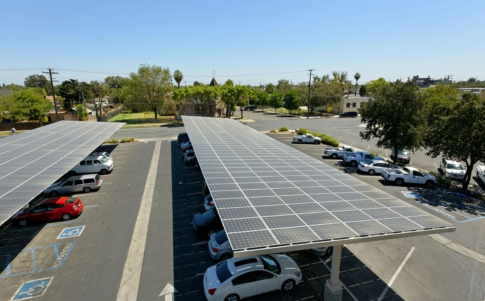
Solar parking lot at Hanford Library

First appearing in Fresno Business Journal-

Oil company biggie Chevron Corporation is also big in solar and continues to build an impressive portfolio in the Central Valley in saving cities and other public agencies big time on their power bills.Turns out the number two US oil company is also one of the nation’s largest installers of solar energy systems for education and government institutions. Who knew?

This week , the Chevron subsidiary, Chevron Energy Solutions(CEC), is busy pitching the City of Lemoore city council to install solar panels at 8 city well/pump sites that would generate 70% of the electricity consumed at those scattered locations. Adding up the units they require 2.4MW of power, a number that is higher than earlier estimated because of the need to reduce arsenic levels in city water.

City administrative analyst Lauren Apone says although the CEC project will cost the city $9.1 million to be financed over 30 years, the net savings would be $25.1 million in power they don’t have to buy for the city’s Water and Sewer Funds.

Already, the city has used Chevron Energy Solutions to improve energy efficiencies at their big Cinnamon Municipal Complex with solar systems as well as solar panels on the city police department parking building.These units are already generating about 10% more electricity than had been anticipated says a city staff report.The $3.9 million project authorized in 2008 did the following:

• Solar systems on roof of Cinnamon Municipal Complex and a solar parking shade
structure at the Police Department
• Lighting upgrades at 8 facilities
• Major HVAC upgrades at 2 facilities
• Roof replacement of Cinnamon Municipal Complex
• Wastewater circulation system installation
• Weather based irrigation system installation at four parks

In June 2012 the city also agreed to have Chevron replace 1200 street lights in town with LED lights.

CEC is duplicating these energy saving efforts across California. Company projects number in the hundreds.

SF-based CEC has been busy in the Central Valley working recently with 13 Central Valley public agencies on energy saving projects,mostly solar, with a total saving in excess of $60 million,not including this Lemoore deal expected to be approved this week.Here is the customer list and the savings according to CES.

City of Hanford $4.3 million
City of Lemoore Phase 1 $3.9 million
City of Lemoore Phase 2 $0.7 million
City of Delano $3.4 million
City of Dinuba $4.0 million
County of Kings Phase 1 $3.0 million
County of Kings Phase 2 $8.4 million
County of Kings Phase 3 $4.1 million
County of Tulare $7.3 million
Fresno State University $12.0 million
State Center Community College District, Fresno $2.5 million
Lemoore Union High School District $3.0 million
USPS Fresno $1.7 million

A sister company Chevron Technology Ventures, (CTV) , evaluates and demonstrates emerging technologies. In October 2011, CTV launched a unique demonstration project to test the viability of using solar energy to enhance oil production. The Coalinga, California, project uses more than 7,600 mirrors to focus the sun’s energy onto a solar boiler. The steam it generates is injected into oil reservoirs to increase production. The project is the largest of its kind in the world.

Tulare County Biz Briefs

August Hotel Occupancy Up In Visalia: South Valley tourism is looking up. Occupancy at Visalia metro area hotels was up 4.2% in August compared to the same month a year ago and Bakersfield was up 4.6% – while Fresno bucked the trend and was down 2.6% says Smith Travel Research. The latest numbers for Visalia are an improvement in the trend line year to date -down 1.1 in occupancy. But August, the biggest travel time of the year, saw the Visalia metro area with 71.9% occupancy compared to 69% in August 2011 and 5.7% more rooms sold.

Sierra Club Filing Lawsuit Against County General Plan: The Kern Kaweah chapter of the Sierra Club is filing a lawsuit Sept 28 says their attorney Babak Naficy, claiming that the County’s General Plan Update, adopted Aug 30, violates the requirements of California’s General Plan law and the California Environmental Quality Act. The advocate group Tulare County Citizens For Responsible Growth “recently made a $10,000 donation to support the Sierra Club’s Tulare County General Plan legal fund” the Three Rivers-based group wrote on their website.The organization supports directing growth into existing communities and protecting agricultural land and open space.

VWR Can Start Shipping From Visalia: Despite an appeals court ruling against the City of Visalia, the 500,000sf VWR International distribution center opposed by the Teamsters Union, can open their doors for business says city attorney Alex Peltzer. ”Our understanding  is that they are days away from a final OK by our building department for a certificate of occupancy” says Peltzer. They have a temporary certificate now, he says, and once the final is Ok’d, the pharmaceutical company could begin shipping product right away.While the Teamsters got a Fresno appeals court to agree to have a lawsuit reinstated in Tulare County Superior Court ,the union’s request to order an injunction on operations was thrown out. The company is closing several unionized facilities prompting the lawsuit claiming the city did not properly follow CEQA rules.The facility will employ 100.

California August Milk Production Falls 5.8%: Those hot August days helped reduce milk production in California in August by 5.8% compared to the same month in 2011 while across the US production fell 0.2% says USDA. The California reduction came despite the fact USDA said there were 10,000 more cows milking than a year ago, just opposite the conventional wisdom who said there was massive liquidation. The decline in production is welcome in that it appears to have improved prices. Cheese on the CME hit $2 this week, the highest level since July a year ago. That’s the best news of the year for hard hit dairy operators who have faced both sky-high feed costs and low milk prices for much of this year. Also, corn is down from $8.40 a bushel to $7.40 in the past month.

Coalinga,Taft & Delano Expect To House LA County Inmates

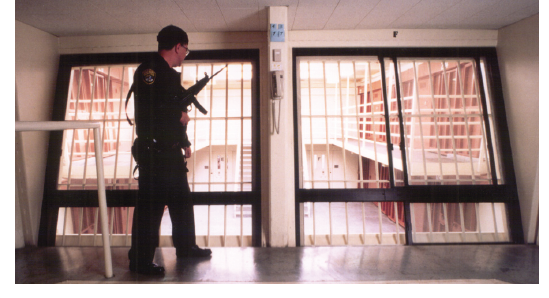
On September 25 the LA County Board of Supervisors approved a $75 million plan to relocate 512 low security inmates to a vacant correctional facility in Taft,in the southern San Joaquin Valley, cutting LA’s daily prisoner housing cost by more than half. The move comes as Los Angeles seeks to close its violence-plagued Men’s Central Jail and relocate up to 3000 inmates in several phases.

“We believe Coalinga is next in line” says that Fresno County community city manager Darrel Pyle, adding that Coalinga city staff is already in advanced discussions with LA County to accept another round of prisoners next year relocating up to 526 of them to the vacant Claremont Correctional Facility. The complex has been closed for more than a year after the city lost a Department of Corrections contract. That loss has had the city scrambling to find new inmates to  fill the place.

Also in line is the City of Delano Correctional Facility, says Pyle, with all three cities moving to forge a Joint Powers Authority to help manage costs.

The LA deal would bring some 98 jobs back to Coalinga – lost last summer as well as an estimated $11.5 million in economic activity estimates Pyle.

The backfilling of these vacant corrections’ facilities comes as local jurisdictions including Los Angeles have had to shoulder the burden of the court mandated transfer or release of thousands of prisoners that have impacted local jails that are now overflowing – including Fresno.

The state prison population peaked at 173,000 in 2006 but saw a gradual decrease to 163,000 in late 2010. Even so, California penal institutions were operating at 175% of their design capacity. Poor health care delivery prompted the U. S. Supreme Court to order the transfer or release of more than 30,000 prisoners within two years. Now,Governor Brown’s realignment of the criminal justice system has accelerated the prison population’s decrease.
In response to the Supreme Court mandate, California now sends many lower-level offenders to local custody instead of to state prison. Since the advent of realignment on October 1, 2011, the total in-custody prison population has fallen by 12%, from 161,000 to 141,000 at the end of February 2012.

If the pressure is on at local jails like LA and Fresno – some places like Coalinga and Avenal in western Kings County have seen a decline in city income because of the loss in state funding and correctional jobs.

Avenal city administrator Steve Sopp says in the past three years the state prison population in town has declined from 7500 to 4500 with losses to the city of revenue and jobs.

If the inmates are not in state prison they are now in overcrowded local jails with officials like Fresno police chief Jerry Dyer having to handle the spillover into the streets and an increase in crime.

This summer Fresno reported an increase of 50% in homicides with Dyer pointing in interviews to a failing criminal justice system and bad economy as contributing factors.

A recent news report said” The Fresno County jail’s door has swung open again. Just days after opening a new floor of the jail, the sheriff’s office has started releasing inmates again because the place is too full.”

Back in Coalinga, city manager Pyle says the city expects up front funding from LA County to upgrade the Coalinga facility to handle more inmates.

LA County has offered Taft nearly $500,000 at the outset of the contract to pay start-up expenses says Pyle.LA county is now paying $112.84 per day to house the inmates that will cost them $61 per day in Taft.

Travel: Airport Passengers Up In California.

Allegiant now flies from Fresno,Santa Maria and Monterey to both Las Vegas and Honolulu.

The latest news for California airports is mostly good  for the industry crawling back from the recession.

Passenger numbers were up at SFO in July by 8.7% and 10.2% year to date. Domestic was up 12.2% while international rose 4.5%. The Bay Area’s economy appears to be the strongest in the state.

At LAX passenger numbers were up 1.96% and 3.3% year to date.

At Fresno Air Terminal 130,000 passengers were counted- a record for any month. That’s an increase of 4.3% over the same month a year ago, and a 5% year-to-date increase on new flights departing from Fresno.

In Bakersfield July saw 24,194 total passengers compared to 22,010 in July 2011, a 10% jump.

At the San Luis Obispo airport August numbers are in they are up  for the firt time in many months  – up 1.5% to 24,845 compared to August 2011. The numbers fell 1.3% in July.

More Hydro Power For San Joaquin & Kaweah Rivers

Friant Dam,near Fresno

More hydroelectric power is being planned for both the San Joaquin River at Friant Dam and on the Kaweah River at Terminus Dam.

At Friant, the 8 member water districts who own the Friant Power Authority plan to upgrade a 2MW power plant on the San Joaquin River by another 7MW to utilize the higher flows of water that are heading down the river as part of  the restoration process. The dam already has two other hydropower plants flows that go both north on the Madera Çanal and south on the Friant Kern, each in operation since 1986.

Friant water officials have said with reduced flows not being diverted   both north and south due to the legal settlement to help salmon restoration they would be losing some $2.7 million annually in power revenues that help the water districts. Instead, more water is being released down river.

In the works since the settlement was put in place in 2006 the $25 mili project is going out to bid for the equipment to build a new 7MW facility adjacent to the existing 2 MW River Outlet Powerhouse.The renewable energy project is slated to be on line in summer 2014 says Orange Cove ID engineer Fergus Morrissey.

”We have our FERC license,the power has been sold and all approvals are in place.”

On the Kaweah River a $15 million hydro project would add 9MW of  electricity generating capacity to the 20MW Terminus power project alredy in place according to a preliminary permit application filed with the Federal Energy Commission (FERC) in July.

“We have flows coming out of the dam that sometimes exceed our capacity to capture them” says Gene Kilgore of Kaweah power Authority, owned 75% by Kaweah Delta Water conservation district and 25% by Tulare Irrigation District.  The power plant can utilize flows up to 1500cfs now says Kilgore but they want to be able to handle peak flows of 2500 to 2800cfs he says.

The FERC notice “gives us the right to move forward on the project” but it is not a final OK that will still require several years to finalize.In fact Kilgore says it starts the process for his group to do a formal feasibility study.

Even more daunting however is the project will require a ruling by the State Water Resources Board to utilize  the water even though they want only to utilize the existing supply, essentially borrow the water for a short period and plan no appropriation. “But that could take 5 years” he shrugs.

The power plant would be upgraded from 20MW to 29MW of power.Its nameplate power was last increased in2004 form 17MW upon the completion of the dam enlargement project.

Currently the electricity is sold to SCE but once the 9MW comes on line the number of potential buyers are numerous since the power market has opened up and will likely continue to do so.

Kilgore adds “federal officials are really pushing more hydro power where there is an opportunity ” because renewable power offers fewer greenhouse gas emissions.

UCLA Anderson Forecast Predicts Slow Growth This Year / Faster Growth Expected by 2014

Los Angeles, September 20, 2012 – The UCLA Anderson Forecast says that Gross Domestic Product (GDP) growth in the U.S. will remain tepid throughout 2012. In its third quarterly report of 2012, the Forecast expects to see 1.3% growth for the third quarter of this year and 1.5% growth in the fourth. In 2013, the outlook is for growth above 2%, but 2014 “could very well put the run rate of GDP growth in excess of 3%, as economic activity is buoyed by strength in residential and nonresidential construction and a rebound in export growth.”

In California, the current forecast reflects the national forecast with continued, but slightly slower gains in employment through 2012, with faster-paced growth throughout the forecast period, which runs through 2014. This uptick in growth will result in a breakthrough to single-digit unemployment.

In his September Forecast report, UCLA Anderson Forecast Senior Economist David Shulman labels current conditions in the U.S. as “the muddle through economy,” noting that the economy continues to limp along at a very sluggish pace as it has since the low point of the “Great Recession” in mid-2009. Shulman notes that real GDP growth has been in the 1-3% channel and is now operating at the lower end of that range.

Shulman says this tepid growth, combined with a structural adjustment in the economy, has caused employment gains to be modest, resulting in an unemployment rate above 8% for three and a half years. “With several quarters of 1-2% growth ahead of us we do not expect the unemployment rate to dip below 8% on a quarterly basis until the first quarter of 2014,” writes Shulman. “Simply put, job growth on the order of 160,000 a month in 2013 will not be sufficient to make any real dent in the unemployment rate. However, as job growth accelerates to 200,000 a month in 2014, the unemployment rate will begin to meaningfully improve.”

Shulman’s optimism about 2013 and 2014 is buoyed by what he calls “the lone bright spot in the economy,” the long awaited rebound in housing construction. “Led by multi-family construction, housing starts are ramping up from 612,000 units in 2011 to 763,000 units this year and just under one million units in 2013. By 2014, we anticipate that housing starts will be in excess of 1.3 million units (and) the growth in housing will account for about a full percentage point in GDP growth by 2014.” Shulman says the strength in housing is underpinned by gradually rising home prices, record low mortgage rates, improved household formations and modest employment growth.

On the flip side, Shulman warns that if Congress and the President fail to agree to an end of year compromise on taxes and spending, the economy could fall off the “fiscal cliff”, leading to a downturn in 2013.

The California Forecast

In the California report, Senior Economist Jerry Nickelsburg examines how California’s exports and their volumes affect employment growth in the state. After establishing that exports are an important part of the California economy (if exports of goods were an independent sector, it would be one of the state’s top five), Nickelsburg’s analysis reveals that “while California’s exposure to the international economy is substantial, the sensitivity of the California economy to international risk is only marginally above the national risk.”

The current California forecast calls for the state’s unemployment rate to be at 7.9% and within 0.4% of the U.S. rate by the end of the forecast period. The forecast for 2012 calls for employment growth of 1.8%, 1.6% and 2.4% in 2012, 2013 and 2014 respectively. Payrolls will grow more steadily at 1.7%, 1.5% and 2.3% for the three forecast years. The unemployment rate will hover around 10.7% through 2012 and average 9.8% throughout 2013. In 2014, the forecast says the unemployment rate will drop to 8.5%, just shy of a percent higher than in the U.S.

Fighting Childhood Obesity In The Central Valley

'The irony here is that their parents may harvest vegetables in the fields -- some of the richest agricultural land anywhere in the world -- but their children rarely share in this bounty,' de la Torre said

Curbing obesity among Mexican-heritage children in California’s Central Valley is the focus of a new center set to open its doors Thursday in the Fresno County town of Firebaugh.

Called “Ninos Sanos, Familia Sana” (Healthy Children, Health Family), the center is a collaborative effort of the University of California, Davis, the University of California Cooperative Extension, and local communities and organizations.

“Opening this center really gives us an opportunity to work with the community — to be there for children and families and show we are committed to promoting good nutrition and physical activity,” said Adela de la Torre, professor of Chicana/o studies and director of the Center for Transnational Health at UC Davis. “We want to help them learn the best approaches to preventing obesity now and in the long term.”

Part of a five-year, $4.8 million study aimed at identifying effective approaches to combating obesity, the center will address a problem that affects more than four in 10 children born to parents of Mexican heritage, putting them at greater risk of early diabetes, high blood pressure and heart disease.

Planning for the study, which is funded by the U.S. Department of Agriculture, began last year. The study will conclude in 2016.

During the study, 400 Firebaugh children and their families will receive practical tools, education and incentives to help them eat healthy diets and get sufficient exercise. Interventions will include:

  • $25 monthly in vouchers for families to buy fruits and vegetables at participating markets;
  • classroom instruction for children on nutrition and physical activity;
  • 10 family education nights per year in which parents will learn how to select and use fresh ingredients to prepare healthy meals for themselves and their children; and
  • twice-yearly health screenings to monitor weight, blood pressure, body-mass index, skinfold thickness and waist circumference.

At the same time, 400 children and families in the town of San Joaquin will receive:

  • twice-yearly health screenings
  • a series of forums designed to assist parents in supporting their children’s education

The San Joaquin community will also benefit from these outreach
activities:

  • UC Davis will collaborate with area schools to enrich the science curriculum.
  • A community mural project will depict the rich cultural heritage and history of the community. (The mural, painted on an outdoor wall of a community learning center in San Joaquin, will be unveiled on Sunday, Sept. 16).

At the study’s conclusion, de la Torre and her research colleagues will have data to show whether the food vouchers and health education programs tested in Firebaugh are effective, using San Joaquin as a control. San Joaquin families and schools will then receive much of the same intervention used in Firebaugh, with assistance from UC Cooperative Extension specialists.

Both Firebaugh and San Joaquin are located in Congressional District 20, an area with the nation’s lowest human development index, an international measurement of wellbeing based on longevity, standard of living and other factors.

“The irony here is that their parents may harvest vegetables in the fields — some of the richest agricultural land anywhere in the world — but their children rarely share in this bounty,” de la Torre said. “We need to provide better access to fresh vegetables and fruit in stores and teach these families how to prepare these foods in easy and convenient ways, to make these good foods part of their lives. That is what this program is about.”

An agricultural economist, de la Torre has studied Latino health issues in the U.S. and Mexico for more than 25 years.

Throughout the study, an advisory committee made up of school, community and parent representatives from each community will provide feedback on program strategies, approaches, concerns and solutions to the barriers that prevent children from maintaining healthy weights.

Participants include parents who have volunteered to have their families take part; grocery stores; health professionals (Sablan Medical Clinics); a nonprofit, community-based program of promotoras, or outreach workers (Proteus, Inc.); school teachers and administrators (Firebaugh-Las Deltas Unified School District and Golden Plains Unified School District in San Joaquin).

Also participating are about 20 educational specialists, economists, nutritionists, psychologists, physicians, and graduate and undergraduate students from UC Davis and the University of California Cooperative Extension.

Lucia Kaiser, Cooperative Extension specialist in the UC Davis Department of Nutrition and a co-investigator on the study, said:

“This project is an exciting opportunity for UC Davis and UC Cooperative Extension to pull a multidisciplinary team of social scientists, nutritionists and other professionals to work in partnership with an underserved community to prevent a pressing health problem — childhood obesity.”

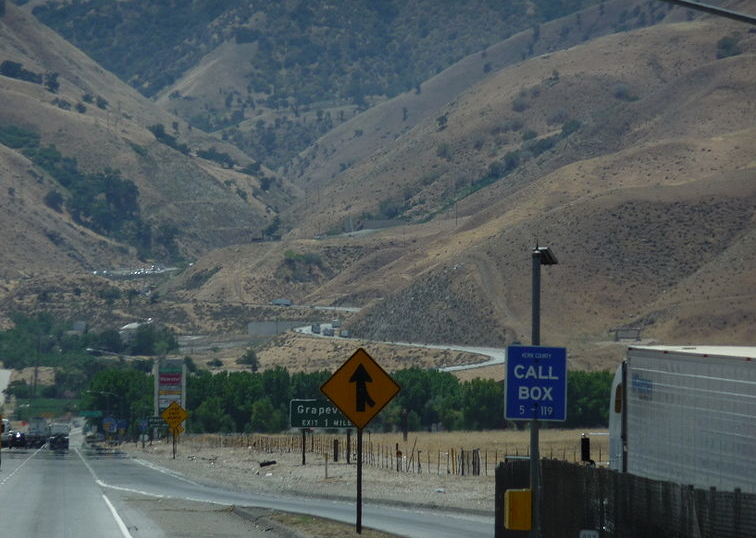
Grapevine Set For Outlet Project

Tulare’s factory outlet mall will be getting some competition in the south Valley.The ICSC reports the following:
“Tejon Ranch Company and the Rockefeller Group have agreed to partner in the development of the Outlets at Tejon Ranch, a 316,601-sf outlet project planned near Bakersfield, Calif. The site for the center will be at one of California’s busiest highway junctions, Interstate 5 and Highway 99. The center will serve the 3.2 million residents living in Bakersfield and northwest Los Angeles County’s affluent communities of Santa Clarita, Valencia, Castaic, Lancaster and Palmdale.
The property is interesting: at 270,000 acres, it is the largest single piece of private property in the state of California. To get an idea of the expanse, the movie Out of Africa was filmed there.
“Tejon is leasing up very quickly,” said Lisa Wagner, principal of EWB Development, which is handling leasing on the project. “Bakersfield is oil and gas and beautiful homes and a wonderful lifestyle – it even has the top Starbucks in the country.”
The Rockefeller Group was founded more than 80 years ago to develop Rockefeller Center in New York. The company is now a wholly-owned subsidiary of Mitsubishi Estate Co. Ltd., which has completed eight outlet centers in Japan with Simon Property Group.”