559 BIZ BLOG: Stimulating News – 10 Reasons to BE HAPPY

After a rough week for the market the sun came out this weekend with new reports that ought you make people more optimistic coming into the Holiday season. Let me count the ways.
1.A report this weekend says the US economy grew faster than we thought this summer with several respected economists now estimating  that the US GDP in the 3rd quarter did not grow by an anemic 2% as estimated a month ago, but 3.2%  We will know for sure November 29.
2.This news is driven in part by a report a few days earlier that the U.S. trade deficit narrowed to its lowest level in nearly two years as exports rose in September to a record high.
3.The worse is over in Europe says another weekend news report with the DAX market up 18% for the year.
4.US election is over and there was a clear victor so that oft mentioned ”uncertainty”about what policies will govern the US in coming years will be far fewer. ObamaCare will stay as will Green Energy support. Yes, we know some taxes will be higher and some will stay low but the economy is not going off any cliff but ramping up.
5.US Consumer confidence climbed to a five-year high in November  with Michigan  consumer sentiment index rising “to 84.9, the fourth straight increase and the highest since July 2007, from 82.6 in October. Economists projected an initial reading of 82.9 for November, according to the median estimate of 71 economists surveyed by Bloomberg.”
6. On Saturday another report says “ China’s sharp economic downturn has ended after trade and consumer spending improved in October but the world’s second-largest economy is not ready for a recovery and exporters face tough conditions, officials said Saturday. The economy should be able to meet the government’s 7.5 percent growth target this year, the chairman of the country’s planning agency told a news conference during a congress of the ruling Communist Party.”
7. Good News For California Schools As Prop 30 Passes. “California voters chose to pass a tax increase on the wealthy and a sales tax increase of a quarter of a cent in a 54 to 46 vote on Prop 30, a ballot initiative designed to bring funding to both K-12 education and curb tuition increases in the state’s higher education system.
“I know some people had some doubts, had some questions – can you really go to people and ask them to raise their tax?” Gov. Jerry Brown (D) said at an election event near the state capitol on Tuesday, according to the San Francisco Chronicle. “Let’s raise our taxes for students, for our schools, for our California dream.”
8. Recovering Real Estate Market: “Home prices and home sales both showed strong annual growth during the third quarter, according to the latest report by the National Association of Realtors. The national median existing single-family home price jumped 7.6 percent from a year ago, to $186,100 — the strongest year-over-year increase for any quarter since first-quarter 2006, when prices were up 9.4 percent from the previous year.
Sales of existing homes rose 10.3 percent during the third quarter, to a seasonally adjusted annual rate of 4.68 million, up from 4.25 million a year ago.
Median prices posted annual gains in 120 of 149 metros tracked, up from 110 metros showing gains in the second quarter of 2012 and 39 metros with price appreciation during the third quarter of 2011.”
9. Gas prices in California continue a downward plunge even after the election with average sales price in the state haven dropped almost 90 cents in a month.
10. More Jobs Advertised:The US West had a total of 1,102,700 online job advertisements in October 2012, an increase of 7,700 from September 2012 to October 2012. The Conference Board reports; “California, the largest State, gained 1,200 in October and was up 67,300, or 14.5 percent, in the first ten months of 2012.”

Business Briefs / State & Valley

Sales Up Statewide

The State Board of Equalization collected $1.86 billion in general fund sales and use tax revenue last month, surpassing the state’s $1.74 billion budget estimate.
“This is good news for the State of California,” said SBE member  George Runner. “Let’s hope that stronger tax revenues are a reflection of a recovering economy rather than merely the result of higher prices.”
Runner noted that October’s revenues came from sales taking place prior to the gas price spike of early October. Retailers must file returns monthly, quarterly or annually depending on the size of their business.
According to Runner, the state’s year-to-date general fund sales and use tax revenues are now meeting projections. From July 1 through October 31, the state received $6.5 billion in revenue, narrowly exceeding the state’s budget projection.

Energy News
– New York’s ConED Buying Another Solar Farms in Tulare County. Consolidated Edison Development has completed another purchase of a Tulare County solar-power project – the  20MW White River project in western Tulare county. The company already purchased two other nearby projects bringing the total to nearly 100MW.
– Solar power facilities may qualify for a partial exemption on sales tax says the state Board of Equalization this week even if if the power generated goes to the grid.

Water

-The City of Visalia is considering trading recycled effluent to the Tulare Irrigation District in exchange for Sierra run-off surface water from a canal. The surface water would replenish groundwater that feeds Visalia’s wells. The city is processing a environmental document.

-Tulare Lindsay Strathmore Irrigation District is connecting the rural colony of Tonyville tot he City of Lindsay’s water system according to an environmental notice. Tonyvile is an impoverished community of few blocks northeast of Lindsay.

Plaza interchange in Visalia under construction

Lindsay uses surface water from the Friant Kern canal as its key water supply with much of the surrounding ag land high in nitrates.

Roads

-Visalia’s Plaza Ramp Closure Moved to Nov. 27 . Significant progress on the Plaza Drive Interchange Project continues, although the closure of the eastbound on-ramp to State Highway 198 has been moved to Tuesday, Nov. 27. The delay avoids the busy Thanksgiving holiday and forecasted inclement weather conditions. The temporary traffic signal at the 3-way-stop at the Hurley/Shirk intersection was completed today in anticipation of the closure and will help with traffic flow during this time frame.

Tulare / Kings Retail RoundUp

In Hanford the city council will offer sales tax incentives to Costco to locate at store on the east side of town.The council passed two resolutions this week.One resolution expands the Incentive Program to allow developers to receive sales tax incentive funds if a new retailer has sales in excess of $23 million a year. The developer for the project located at Hwy 198 and Hwy 43 is Fresno’s Kashian Group. A second resolution extends a reduction in Impact Fees for Development Projects for an additional 12-month period. The reduction will remain at 30% for Water, Wastewater System, Storm Water, Refuse and Recycling and Transportation Impact Fees. The city is already processing an environmental impact report for the potential 58 acre retail complex, now farmland.

In Lemoore it appears Walmart may be throwing in the towel on their big plan.After years of delay, construction of a new Walmart Supercenter near the college is stalled again after the big retailer restarted a new EIR earlier this year but has not responded to city questions for months now. City planner Holly Smyth says a month ago Walmart who owns the 21 acre site, put up a For Sale sign on the parcel.

In both Tulare and Visalia, Bakersfield-based Smileland is proposing infill sites to put up new dental centers in retail districts.In Tulare they have filed for a permit to remodel the former Blockbuster at 1407 Hillman,reportedly buying the property. In Visalia, the company is buying two long vacant parcels on mid Mooney Blvd to erect a new dental clinic with extra leasable space. The Mooney properties have been sore thumbs on the strip for several decades, an old transmission shop and cabinet shop next to IHOP. Smileland will be 2 story, 8000sf .

Also on Mooney in Visalia, Shiekh Shoes, a leading specialty retailer of lifestyle footwear and apparel with more than a 134 stores is preparing to file remodeling plans for the former Copeland Sports building on Tulare and Mooney. The 14,700sf space has been vacant for years and had attracted interest from Fresh & Easy who are now out of the picture. Sheikh has stores in California, Nevada, Texas, Arizona, New Mexico, Washington and Oregon.Its product selection is aimed at the teenaged urban market, featuring athletic footwear and apparel from brands like Nike, Jordan, Adidas, Reebok, K-Swiss, Sketchers, Lacoste, Converse, and DC Shoes including many exclusive products not sold by other retailers. Shiekh Shoes also manufactures and sells its own brand of footwear, which is only available through its stores and website.Most locations like two in Fresno, are at malls.

More Mooney Moves; The Visalia Staples store on South Mooney will relocate to a downsize location in the same Dick Sporting Goods-anchored shopping center according to a plan filed with the City of Visalia. The office supply retailer submitted tenant improvement plans on a smaller 17,000 sf storefront next to Dicks enabling them to vacate their larger 29,000 sf store just south.Sources say the vacated space will provide a chance for a new retailer to Visalia to locate here.

Visalia Eateries Come & Go; This week, Bravo Farms opened their new “Smokehouse – Modern Barbeque” on Willis, the site of the old Wagon Wheel Steakhouse. Led by chef Jonathan Van Ryn,Bravo Farms will also open its new Kettelman City gift shop and ice cream parlor next year. Closing recently is El Presidente restaurant and bar on Santa Fe, a long time Visalia Mexican eatery.

Dollar Wars: Small town retail continues strong in Tulare County now coming to Ivanhoe, population 800 north of Visalia, with plans filed to construct a new Family Dollar Store at the corner of Ave 328 and Rd 168. Meanwhile competitor Dollar General has filed plans for a new store in Woodlake along Naranjo. Woodlake already has a Family Dollar.The same two competitors will soon go head to head in nearby Farmersville and Tulare as well.

California’s Export Trade Continues To Slip

November 8, 2012 – LOS ANGELES, CALIFORNIA – Despite improving economic conditions here in California, worldwide fall-out from Europe’s economic straits and a decelerating pace of growth in Asia took their toll on California’s export trade in September, according to an analysis by Beacon Economics of foreign trade data released this morning by the U.S. Commerce Department.

The value of goods shipped abroad by California businesses in September totaled $12.87 billion, a nominal decline of 4.5% from the $13.47 billion recorded in September 2011. (Adjusting for inflation and seasonal variations, the fall-off was also 4.5%.)

California’s exports of manufactured goods totaled $8.42 billion, down 1.9% from the $8.58 billion recorded last September. Non-manufactured exports (chiefly raw materials and agricultural products) fell by 9.6% from $1.67 billion to $ 1.51 billion, while re-exports shrank 9% from $3.23 billion to $2.94 billion.

A nearly 20% year-over-year drop in exports of industrial machinery (including computers) in September was partially offset by strong gains in shipments of medical equipment and aerospace components. Exports of fruits and nuts were up 7.6%.

Manufacturing’s share of California’s merchandise export trade now accounts for about 65%, down from 71% in 2008 and from 78% at the height of the dot com boom in 2000.

Shipments to the Pacific Rim countries of Asia were down by 5.1% in September, including a 4.5% drop in shipments to China.

On the other hand, trade was up with Canada, Taiwan, Singapore, Brazil, and the United Kingdom. Ironically, despite the continent’s travails, California exporters did eke out a 1.8% increase in shipments to the European Union in September.

This suggests that Europe’s troubles are not the primary cause of slowing export growth, and because the European Central Bank recently stepped up to backstop Europe’s major banks, the worst of the European crisis is likely behind us. Today, the European Union accounts for 16.6% of California’s exports, down from 19.9% in pre-recession 2008.

Despite the decline in trade in September, California’s exporters continue to exceed the inflation-adjusted pace they set in 2008, the peak pre-recession year for the state’s merchandise export trade. “Whether that will remain true through the year’s final quarter is exceedingly uncertain,” said Jock O’Connell, Beacon Economics’ International Trade Adviser. Still, initial indications of nationwide export activity shows that trade could have an upward influence on the revised 3rd quarter GDP figures when they are released.

While many had hoped that California’s export trade would resume the rate of growth experienced during 2009 and 2010 and stimulate the state’s economic recovery, creating large numbers of jobs, those accelerated growth rates were due in part to a rebound from the large contraction in exports during the Great Recession and were unlikely to persist at such high levels. Part of the reason growth in exports has slowed is due to global economic concerns, but the slowdown can also be attributed to ‘catching up’.

Among other risks, O’Connell pointed to the unknowns accompanying China’s current change in political leadership. “Even as the transition process unfolds in Beijing over the next few days, the economic policies that Xi Jinping will pursue are far from scrutable,” O’Connell said.

Beacon Economics’ analysis also notes a new forecast from the European Commission that expects gross domestic product to shrink 0.3% for the European Union. Growth in 2013 is expected to be a less than inspiring 0.4%. Those figures represent a significant downgrade of the Commission’s expectations.

This week also brought reports that business and consumer confidence in Europe in October fell to their lowest levels in three years, while unemployment rates moved higher. Still, this shows that the majority of risks in the U.S. economy have shifted from internal issues to external concerns, which stands in stark contrast to the economic woes during the downturn.

Nearly 28% of California’s export trade is with Mexico and Canada, two nations whose economic fates are intrinsically linked to the U.S. economy (which continues to move forward in terms of employment and GDP growth).

Banco de Mexico Governor Agustin Carstens said on Wednesday that the Mexican central bank expects growth of between 3.5% and 4.0% in 2012 and in the 3% to 4% range in 2013, although he warned that Mexico’s economy would suffer if U.S. lawmakers fail to turn back from the “fiscal cliff” – an estimated $600 billion in tax increases and spending cuts set to occur in January.

That warning was echoed in Canada, California’s second largest export market, where Canadian Finance Minister Jim Flaherty and Bank of Canada Governor Mark Carney both pledged on Wednesday to take action to support the economy if a shock from the U.S. threatened to plunge the country’s economy into recession.

The view at Beacon Economics continues to be that policymakers will reach a compromise before things are allowed to come to a head—especially now that the U.S. Presidential election is behind us. It is also important to remember that going one day over the “fiscal cliff” will not bring about a sharp, or any, decrease in economic activity – it would have to continue for a longer period. It is doubtful that our re-elected leaders in Washington will squabble for months and allow the nation to dip back into recession it.

Visalia Biofuel Innovator Inks Two Deals

Edeniq’s Visalia pilot plant

Visalia-based Edeniq has inked two deals this month that will utilize company technology to increase production of biofuel and other refined products at two California ethanol plants helping to make them more profitable. Both deals have been previewed by Sierra2theSea in past articles.
In Stockton, Pacific Ethanol announced it will use Edeniq technology to extract corn oil by the second quarter of 2013 improving the margins of their operation. “Our Stockton plant is the second of our facilities to implement corn oil separation technology, and we expect to soon award contracts for our two other Pacific Ethanol plants.”said CEO Neil Koehler. Corn oil is used  for cooking and it is also a feedstock used for biodiesel. The Calgren ethanol plant in Tulare County extracts corn oil in their operation.
Also this week, Aemetis, Inc., an advanced fuels and renewable chemicals company, has entered into an agreement to install Edeniq technology at the Aemetis Advanced Fuels Keyes plant in California. Aemetis will install Edeniq’s proprietary Cellunators(TM) to boost ethanol yields and will conduct large-scale commercial testing of Edeniq’s cellulosic ethanol Pathway(TM) platform.
Edeniq’s Cellunator(TM) technology produces sugars by milling corn and other plant materials into “right-sized” particles of feedstock that can be more easily converted. Edeniq is installing Cellunators(TM) at Aemetis’ Keyes, California facility, which currently produces 60 million gallons of ethanol annually. Aemetis is also one of three ethanol producers working with Edeniq on the company’s Pathway platform, a patented process that integrates enzymes with the Cellunator(TM) technology to produce cellulosic ethanol using the existing plant infrastructure. Aemetis is testing the commercial feasibility of the Pathway(TM) platform on site at their plant.
“The relationship with Edeniq will allow us to further expand our production of advanced biofuels,” said Eric McAfee, Chairman and CEO of Cupertino, California based Aemetis, Inc. “The addition of Edeniq’s technology is expected to immediately improve our ethanol yield, and allow us to produce cellulosic ethanol at commercial scale by upgrading the existing corn ethanol production facility. Edeniq’s technology will help us lead the transition to next generation, lower carbon, lower cost biofuels derived from a variety of renewable feedstocks such as grasses, agricultural residues, and purpose-grown energy crops.”
Edeniq owns and operates a demonstration-scale production facility in Visalia, California, which is currently converting a range of cellulosic feedstock into low-cost cellulosic sugars and cellulosic ethanol. In June, Edeniq received a $3.9 million grant from the California Energy Commission (CEC) as part of California’s Alternative and Renewable Fuel and Vehicle Technology Program.

Election Could Mean Green Light For Green Projects In Central California

Results of the presidential election should boost the spirits of supporters of green energy and green transportation projects in Central California. Critics on the other hand are disappointed but not giving up on thwarting these “boondoggles.”

“Without his $8 billion in High Speed Rail stimulus, half of which has gone to California, it’s unlikely that construction would be taking place on the first segment of the project next year” admits high speed rail fan and blogger Robert Cruickshank, pointing to Obama’s key role in the huge Central Valley project.

One group who had vowed to float a new voter referendum to stop the state project pulled the plug on the idea a few days ago  with an inadequate number of signatures hoping pending lawsuits will do the trick. Meanwhile, Valley rail critic, House GOP representative Jeff Denham,one of the loudest opponents in Congress, has won reelection so the debate will continue.

State lawmakers have already approved spending $5.8 billion, including $2.6 billion in state rail bond funds, to begin construction of the line hoping to curb pollution in the Valley with 200mph bullet trains.

Obama vs Romney

If Romney had been elected this week it seems clear he would end all efforts to build such a high speed rail system having already called for an end to Amtrak subsidies.

Meanwhile, candidate Romney had also vowed to pull the plug on green energy projects in the US including several billion in loan guarantees on solar,clean coal and wind projects being proposed or already being built in Central California.

Mitt Romney’s presidential campaign came out against extension of the wind industry tax credits vowing to let it “expire” and also claiming that about half of $90 billion pledge in tax breaks for green energy have gone to companies that went belly up like now-bankrupt solar panel manufacturer Solyndra.
But the real number is only three of the 33 companies that received DOE loans have failed, representing under 2 percent of  federal money budgeted.
A recent advertisement from the Romney campaign suggested such stimulus money was a boondoggle but FactCheck.org – responded by highlighting several Central California projects.
”The Romney ad targets the solar company SunPower, saying: “More than a billion dollars in loan guarantees. Lost half a billion last year. Laying off workers.” The FactCheck response continues.
“On Sept. 30, 2011,  SunPower got a $1.2 billion loan guarantee to build the California Valley Solar Ranch Project, a 250-megawatt solar plant in San Luis Obispo County, Calif. And SunPower reported an operating loss of $534 million last year. But after that, the ad’s case starts to fall apart.
Before any federal funds were released, SunPower sold the project to NRG Energy. So NRG is the owner of the loan guarantees and the company responsible for repaying them. SunPower is now the lead contractor on the project.
Despite its losses, SunPower is financially solvent, and– as the same KGO-TV report cited in the Romney ad notes — the company’s new majority stockholder is Total, “a French company that ranks among the top oil and energy companies in the world.”
As for SunPower layoffs, according to a public filing with the SEC last November, the company did announce that it would be laying off 85 employees. But as was the case with First Solar, most of those layoffs were overseas, and represented a small fraction of the company’s global workforce. In its public filing, the company stated that it was consolidating or closing facilities in Europe “in response to reductions in European government incentives, primarily in Italy, which have had a significant impact on the global solar market.” The number of layoffs ended up being less, a company spokeswoman told us, and together with newly created jobs, the net reduction was 41 jobs.
More important, the jobs related to the DOE-backed California Valley Solar Ranch( in San Luis Obispo) are unaffected. According to SunPower, more than 350 workers are currently constructing the solar power plant. The plant, company officials said, will begin generating 25 megawatts of power by September, and when completed will generate enough electricity to power 100,000 California homes (and is already contracted to do so).”


Bigger Than Anything
A similar tale surrounds First Solar who also has sold their SLO project with the loan guarantee money never touched and the huge green project under construction. Such government loan guarantees are common in plenty of businesses including small business lending and housing including the now famous auto bailout that helped Obama win Ohio.
Between the two huge green energy projects, San Luis Obispo has added about 1600 jobs and the county’s unemployment rate has dropped to 7.4% The two large commercial solar plants are set to produce 800 megawatts of power – enough to power 260,000 homes.
These deals have firm contracts in place to buy the power. The SLO Tribune pointed out a few weeks ago ”The California Valley Solar Ranch will be in the top 10 solar plants in the world, said Fong Wan, PG&E’s vice president of energy procurement. The utility has contracted to buy both plants’ electricity for the next 25 years.
“When combined, they are clearly bigger than anything in the world,” Wan said.”
Looking at the US energy loans eighty-seven percent of the DOE funds were used to back loans to power generation projects, mostly solar and wind, which otherwise would have had a difficult time accessing financing. A relatively small portion of this money went to fund technology start-ups – including Solyndra.

Regarding the wind tax credits there is no doubt they have worked well points out the LA Times.” Since its enactment in 1992, wind generation in the United States has grown from almost zero to about 47,000 megawatts, according to a study done by Lawrence Berkeley National Laboratory for the Energy Department.”

Obama critics had also counted on Romney pulling the plug on Obamacare “on day one” that will also not happen now – instead offering health insurance to thousands in Central California who do not have health insurance.

One of the biggest green energy projects important to help cut greenhouse gases that cause global warming and rising sea levels is the voter approved California High Speed Rail project supported big time by Democrats in both the White House and Sacramento state house.

Again a major focal point right now is the Central Valley.

Funded and awaiting the green light to start construction on a 28 mile section (Madera-Fresno) of a 110 mile stretch between Madera and Bakersfield next year, opponents are doing everything they can in court to derail the project or at least slow this train down.

A lawsuit to halt work on the project comes from several Farm Bureau led entities with Sacramento Superior Court Judge Timothy Frawley scheduling a hearing for Nov. 16. Frawley will hear a request from the plaintiffs for a preliminary injunction to stop construction due to what they call the deficiencies in the CEQA process.

Opponents hope to  delay the project long enough to kill the Federal funding. But in CEQA law the bar is set fairly high, say attorneys, for a judge to allow an injunction especially if it could kill it.

In September Obama ordered CHSR  to be fast tracked.

But clearly, the huge project faces delays in any case.

California High Speed Rail Authority CEO Jeff Morales who worked for both Chicago Transit and Cal Trans before joining the CHSRA this summer recently announced the Authority would postpone opening construction bids due earlier this month, on the 28 mile segment north of Fresno until January 15.

Morales said the five consortiums vying to build the line “are serious and asking all the right questions” suggesting the delay will likely result in more competitive bids on the state’s largest public works project with the 110 mile segment expected to cost between 1.2 billion to $1.8 billion. He expects construction on this 28 mile segment to start next June.

Meanwhile,the next segment in the Valley is Fresno – Bakersfield  where the draft EIR has now closed comments as of October 19 with the Authority anticipating certification of this EIR in mid-2013.

Morales says with CEQA certification of this Fresno to Bakersfield span we would find out which alignment through Kings County will be selected and If Tulare/Kings gets a station or not and the preferred location for the planned 1500 job heavy maintenance station.

In an additional boost to Californian a state law will require the trains be built in-state.

More Lawsuits

In the most recent comments submitted to the Authority, Visalia has asked the CHSRA to select the east-of-Hanford route to locate the station closer to the big population centers in Tulare County.

Kings County has commented that it fears loss of Amtrak service to Hanford noting that Hanford is the third busiest stop on the San Joaquin line. “The loss of a station in Hanford would mean a yearly loss of 90,000+ Amtrak riders. At an average ticket price of $50, this would mean a loss of $4,500,000 yearly. If the average ticket cost of $100 is used, it would be a loss of $9,000,000 yearly. Add in the loss of revenue from hotel rooms, food, gas, rental cars, and merchandise, and the yearly loss is considerably more. The EIR-EIS indicates that existing riders would shift to HST service as it becomes available. Based on existing Amtrak ticket prices and the estimated cost of HST, it is unlikely that most riders would shift.”

While the City of Hanford did not want the high speed route to go through their town that put the track out on Kings County farm land.

Kings County is siding with farmers here who oppose the project.The Kings County Farm Bureau is preparing to file a similar lawsuit to Merced and Madera’s Farm Bureaus over concerns about HSR’s impact on farmland along the proposed Fresno-to-Bakersfield route says their program director Diana Peck. They say 13 dairies in the county are in the path of the train.


 

New Study to Examine Ecological Tipping Points in Hopes of Preventing Them

October 30, 2012

A healthy kelp forest,<br>photographed near San Clemente<br>Island in California.<br>Credit: Ron H. McPeak/UC Regents*
Click for downloadable image
A healthy kelp forest,
photographed near San Clemente
Island in California.
Credit: Ron H. McPeak/UC Regents*

An urchin barren, pictured,<br>is the result of unchecked population<br>growth among sea urchins,<br>causing destructive and widespread<br>grazing of kelp forests.<br>Credit: Ron H. McPeak/UC Regents*
Click for downloadable image
An urchin barren, pictured,
is the result of unchecked population
growth among sea urchins,
causing destructive and widespread
grazing of kelp forests.
Credit: Ron H. McPeak/UC Regents*

(Santa Barbara, Calif.) –– Predation by otters keeps urchin populations in check, allowing kelp –– a favorite food of urchins –– to flourish. But what if otters were harvested to near extinction for their fur? The resulting overabundance of urchins would decimate the kelp forest, leaving little food or shelter for fish and invertebrates. And so it may go, as declines in these species are likely to affect others.

Such is the potential trickle-down effect on the food chain of even subtle shifts in a single species –– tipping points that can induce wholesale, sometimes irreversible change to entire ecosystems. Examples of these ecological thresholds and unintended consequences are many –– the otter-urchin scenario occurred in Alaska and California –– but solutions are few. Some UC Santa Barbara researchers hope to change that.

A new project of scientists at UCSB’s National Center for Ecological Analysis and Synthesis (NCEAS) and partners aims to synthesize existing research on tipping points in marine ecosystems and conduct case studies to devise a set of early warning indicators and management tools that may help to predict, even prevent, threatened systems from falling off the precipice.

“We know that thresholds in marine ecosystems can lead to rapid changes in their ability to support activities and services that people value, but we seldom have information about how human actions are affecting these things –– and how close we might be to those tipping points,” said Carrie Kappel, associate project scientist and lead principal investigator (PI) on the study.

The NCEAS team of Kappel and co-PIs Ben Halpern and Kimberly Selkoe –– with partners at Stanford’s Center for Ocean Solutions, the Environmental Defense Fund, and the National Oceanographic and Atmospheric Administration (NOAA) –– have been awarded $3.1 million from the Gordon and Betty Moore Foundation for the soon-to-launch study, “Ecosystem Thresholds and Indicators for Marine Spatial Planning.”

“This is an ambitious project that addresses really critical issues in natural resource management and protecting and managing our oceans effectively,” said Halpern, director of UCSB’s Center for Marine Assessment and Planning. “We’re looking at how natural ecosystems respond to changes in human pressure, or to climate change, and what the effects are on the human community. I think people sometimes forget that we are managing these systems not just for the sake of creating bureaucracy and regulations. We have an interest in keeping ecosystems healthy and sustainable not just for nature’s sake, but because we, as humans, fundamentally value and depend upon them.”

Among the core focuses of the four-year project is identifying advance indicators of threshold shifts, which could include water quality, an abundance or lack of certain species, and even rates of disease, according to co-PI Selkoe, a marine ecologist and NCEAS associate scientist. Ascertaining such early warning signals, she said, will improve the monitoring capabilities of ecosystem managers and potentially enable them to prevent threshold shifts –– or at least be better prepared.

“We may or may not be able to really know how fast we’re approaching a threshold shift, but if managers are conscious of these shifts they can be more prepared and cognizant of the possibilities,” Selkoe explained. “There may be a lot of cases of climate change combined with ocean cycle changes that nothing people can do will prevent. There’s a lot beyond our control, which probably means we need to manage more conservatively. The marine resource management world is moving toward these strategies, toward incorporating big picture thinking and comprehensive approaches that will require coordination across sectors –– managers need more tools to operate at that scale.”

While the first phase of the project will be centered on existing data and models, the second phase will involve a more in-the-trenches approach. Deep-dive case studies and engagement with active marine managers and policy makers are intended to “get the folks on the ground involved from the very beginning, so that the tools we develop can be as useful as possible to the people who are actually doing this work,” said Kappel. “We want to give managers tools that help them to maximize the delivery of benefits to people, while protecting the ecosystem and minimizing the risk that it will be tipped into a different state.

“Our coasts and our oceans are becoming increasingly crowded, and more and more people depend upon them,” she added. “Inevitably, there’s this problem of increasing competition for limited ocean resources. We need to be able to proactively plan for how we’re going to use those resources and do it in a way that allows them to be sustainable for the long run. If we are unaware of the potential cliffs you can fall off in the ecosystem dynamics, we run the risk of diminishing benefits to people and of changing ecosystems forever.”

Other researchers on the study include Larry Crowder and Meg Caldwell at Stanford’s Center for Ocean Solutions; Rod Fujita at EDF; and Phil Levin, with NOAA.

The Gordon and Betty Moore Foundation, established in 2000, seeks to advance environmental conservation, patient care, and scientific research. The goal of the Marine Conservation Initiative is to achieve healthy marine ecosystems in North America that support sustainable use. For more information, please visit http://www.moore.org.

*Acquisition and digitization of the Ronald H. McPeak collection was made possible with funding from the National Science Foundation to the Santa Barbara Coastal Long Term Ecological Research project.

Left Coast: How California Counties Voted For President

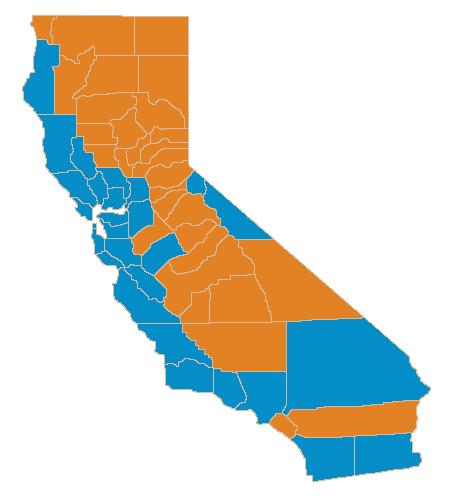
Blue:Obama, Orange: Romney

If Ohio was mostly a Red State on the map -watching election returns this week, it was those northern counties that hugged Lake Erie that turned it Blue for Mr Obama this year.What is it about water?

The California map tells the story. Coast counties in the Golden State voted in favor of President Obama this time around while inland counties mostly voted for Romney. As of this writing, Obama is ahead by about 2 million votes in the state.

In the S2S reading area (using unofficial results) despite a GOP majority, San Luis Obispo County went for Obama 47,893 to 46,598 – mighty close. In Fresno County the vote was 80,859  to 75,313 in favor of Romney even with a Democratic majority.Fresno had just a 39% turnout compared to 52% statewide average.

In Kern County it was 99,840 to 64,690 votes for Mr Romney with a  a 41% to 35% GOP registration advantage. In Kings County with a 45% to 35% GOP advantage, Romney won 17,184 to 12,282. In Tulare County with a 44% to 34% GOP majority, Romney won 58% to 40%.

In the north Valley, Sacramento along with Yolo as well as San Bernardino in the Southland were inland counties that bucked the Red State trend of most of the Central Valley, favoring Obama. The biggest surprise in the Valley – Merced County went blue 52% to 46%.The county has a 43% to 34% Demo majority.

With Passage of Proposition 30, California State University to Roll Back Tuition

System avoids $250 million additional cut, but funding still down $1 billion

(November 7, 2012) – The California State University will avoid a $250 million mid-year budget cut after voters’ approval of Proposition 30, and will start the process of rescinding the $249 per semester tuition fee increase already in place. With the passage of Proposition 30, CSU’s budget will essentially remain flat for the remainder of this fiscal year, but state funding is still approximately $1 billion less than several years ago. 

”We are hopeful that the passage of Proposition 30 will be the beginning of the state’s reinvestment in higher education,” said CSU Chancellor Charles B. Reed. “The long term benefits of additional revenue can only be realized if higher education is once again a priority. The state needs to start making up for the devastating budget cuts of the past several years, and focus on higher education as a driver of California’s economic future.”

The CSU Board of Trustees had previously approved a contingency plan to rescind a $249 per semester tuition fee increase that took effect for the fall 2012 term. Annual tuition fees for full-time undergraduate students will now revert back to $5,472 – the same rate as in the 2011-2012 academic year. Students will either be credited, refunded or receive a reconfigured financial aid package to account for the revised tuition fee rates. 

Campus enrollments will also remain constant for fall 2013. The system had held applications from new students pending the outcome of Proposition 30, which has a direct impact on funded enrollment targets. Campuses will immediately begin to review applications for new student admissions for the fall.

Milk Co-ops Plead For Relief One More Time

On election’s eve California’s strapped dairy operators are back at CDFA’s ag secretary’s front door pleading for a change in the milk pricing formula in California that might offer them ”emergency” relief.

Informed sources insist that after being rebuffed several times, the latest petition just might bear fruit.

This latest request for a public hearing, the third this summer,was filed November 2 and penned by the state’s three big dairy co-ops,California Dairies, Dairy Farmers Of America and Land O Lakes. They ask for the so-called 4b price formula to be adjusted higher for a 12 month period. Ross has yet to respond but has announced that she would take a good look.

The Secretary has 15 days to respond to the petition’s hearing request. If a hearing is granted, it could be held as early as December 1.

The petition lays out how feed cost have gone up about 55% since 2010 and the cost of feed makes up 70% of the cost of making milk. Impacted severely by the Midwest drought this year the letter concludes that while there is merit in forging a “strong foundation and a viable dairy industry … our members need to survive in the short term first.”

A closed door meeting a few weeks ago with ag secretary Karen Ross,a representative of the governor and producer leaders may have set the stage for this latest attempt,the third in a matter of months, to adjust the milk formula for cheese,that accounts for about half the milk produced in California.

Ross has a tough balancing act in considering the price paid by cheese makers to California’s milk producers. The state wants to offer incentives to the state’s big cheese industry to accept the higher cost of doing business here offset with a slightly lower cost of milk than they can get elsewhere.

California‘s dairymen are the nation’s low cost producers but the drought this year has rejiggered the economics such that an estimated 100 dairies have called it quits this year alone, many solid multi-generation operations held in high regard. Big dairy counties like Kings are reporting about 10% less milk being produced and San Bernardino is down 11% in September vs a year earlier.

In recent months the scale of the suffering has been overwhelming  and Ross may now be ready to compromise rather than just say no once again.

California’s newly formed 28-member Dairy Future Task Force — composed of dairy producers, processors and cooperatives — held its first meeting late last month to address immediate and long-term challenges facing the state’s dairy industry last month in a meeting attended by Ross. Ross announced the panel’s creation earlier this summer, after hearing a petition by producer groups to adjust the state’s whey factor in Class 4b minimum milk pricing formula. The action came in the face of skyrocketing drought-related feed costs, forcing many producers into bankruptcy.

Secretary Ross issued a statement following the task force’s meeting: “The Dairy Future Task Force is made up of dairy producers, processors and cooperatives asked to come together to find common ground upon which they can build a new, more stable and contemporary path for the dairy industry. The first session, held October 23-24, provided an opportunity to agree on a common fact base and develop a sense of what the group wants to accomplish in the coming months. The task force achieved alignment around a shared vision for the future of the California dairy industry, which is a significant accomplishment and a key step toward long-term success. ”

Expedited Review
“Based on the discussion of concepts for potential short-term solutions, CDFA anticipates receiving a petition shortly and will evaluate it on an expedited basis. I very much look forward to working with the talented and passionate producers and processors who are willing to provide leadership to this very important sector of the agricultural community,” added Ross.
Ross also faces a lawsuit from some producers (not the petitioners) and has seen several noisy rallies held on her front steps in Sacramento in the past few months where the rhetoric got pretty rough.

The good news- milk commodity prices are rising.

One of the groups who has sued CDFA, California Milk Producers, say that the latest October figures show cheese makers paid $19.43 per hundredweight -” a vast improvement over the recent prices (in fact, it’s the highest Class 4b price reported since 2007), but a steep discount that cheese makers in Federal Milk Marketing Orders paid last month –  $21.02 per hundredweight, a whopping $1.59 per hundredweight above the California Class 4b price. Using a
conservative estimate of 1.3 billion pounds of milk equates to more than $20,000,000”  difference the group says.

California cheese makers are a huge engine for the state’s economy  but you can not make cheese if you don’t… Got Milk.

If this does not work, the state’s dairy co-ops may be ready to try a federal marketing order the co-ops announced this week while another group plans to work on legislation.