SLO Jobless Rate Falls Again

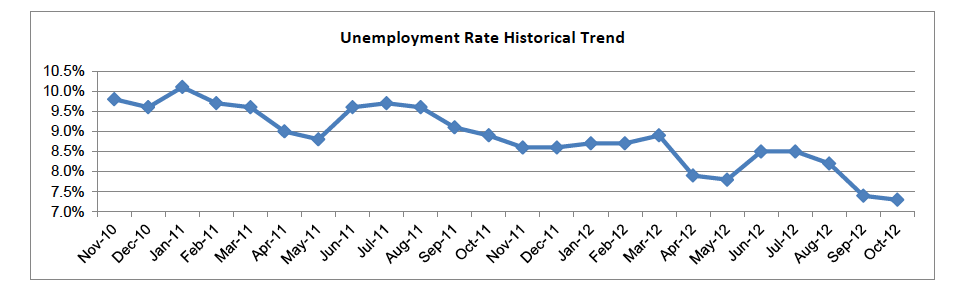
The unemployment rate in the San Luis Obispo County was 7.3 percent in October 2012, down from a revised 7.4 percent in September 2012, and below the year-ago estimate of 8.9 percent. This compares with an unadjusted unemployment rate of 9.8 percent for California and 7.5 percent for the nation during the same period.

A closer look at the numbers show the number of people looking for work has grown with the labor force up by more than 3000 year over year and  2000 in the past month.Year over farm jobs are down 300 while non-farm jobs are up 2300.

Year over year the number of jobs in construction are up 11.5%,up 6% in the hospitality business and up near 19% in state education.

Cunha: Obama Election Boosts Chances For Farm Labor Solution

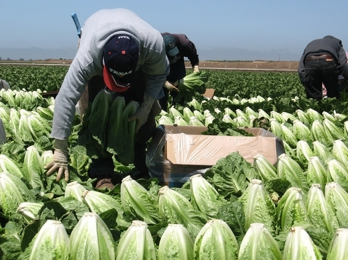
Valley farmers may have voted 3 to1 against Mr Obama but ironically it was Obama’s big win that appears to have shaken up the GOP and boosted chances agriculture may be finally getting what they want – a legal workforce. So says a key ag industry advocate – Manuel Cunha, who heads up Nisei Farmers League.

”The GOP go their head handed to them” in the election that saw Obama win the Latino vote 71% to 27% for Mr Romney. ”If Romney had won we would have a far more difficult task ahead of us now.”

During the Republican primary process Romney seemed to move to the right on immigration, something that didn’t sit well with many Latino voters. To avoid repeating the mistake – with the election results in their hands- Republicans appear to be considering working on immigration reform as House Speaker John Boehner has now signaled. “This issue has been around far too long,” he said. “A comprehensive approach is long overdue, and I’m confident that the president, myself, others can find the common ground to take care of this issue once and for all.”Boehner told ABC a few days ago.
”Kevin McCarthy is on board too” expects Cunha speaking of the Valley-based number 3 GOP leader in the House.
Only days after the election, a top Democrat and Republican announced that they hope to start debate this year. Sen. Charles Schumer of New York and Republican Sen. Lindsey Graham of South Carolina said they will restart immigration reform talks that collapsed two years ago
Because momentum is now strong, Cunha expects “wording on a new bi-partisan bill will be ready to pass in the first 90 days in 2013.”

Cunha is working on a unique strategy to gain more backing for the ideas to support both the normalizing of current undocumented residents who have been living here as well as a guest worker plan.

“We call it the 3Bs’”

The list includes perhaps some strange bedfellows. 1.Bible – evangelicals and traditional religious groups supporting humane treatment of families. 2. Business – that includes agriculture who want a work program and 3.Badges – law enforcement who want to see this issue off their backs.

Cunha says if “all 12 million undocumented is too much to tackle in the first round” his group supports a “phased approach” that would back the Dream Act (opposed by the GOP in the past) and allowing residents with no criminal record but who have lived here for say, 20 years, to apply for citizenship, for example.

Regarding potential support from advocacy groups like the United Farmworkers, Cunha says”the front door is open” to continue to work with immigrant advocates like the UFW on a consensus. Cunha and UFW both backed Ag Jobs a few years back, the last attempt to forge a coalition.

Cunha add that Sen Diane Feinstein will play a key role in coming negotiations and that his group -Immigration Forum, will be working with the Senator and working across the aisle “to stop stonewalling on this issue.”

In 2012 California farmers complained they were having trouble getting enough labor with some saying new arrivals are not coming from Mexico,afraid to cross the border because of drug cartel activity near the borders. Also, farmers said more workers are now going into construction, food service or hotels so there’s more competition in finding farm laborers.

The Western Growers Association this summer told CNBC its members were reporting a 20 percent drop in laborers this year. “Stronger border controls are keeping workers from crossing into the U.S. illegally, and the current guest worker program is not providing enough bodies.”

Cunha himself said earlier this summer that he expected there would not be enough workers to harvest the raisins but later, after the harvest, suggested a smaller raisin crop this year insured an adequate supply of labor.

In May the PEW Hispanic Center released a report that said “The largest wave of immigration in history from a single country to the United States has come to a standstill. After four decades that brought 12 million current immigrants—most of whom came illegally—the net migration flow from Mexico to the United States has stopped and may have reversed, according to a new analysis of government data from both countries by the Pew Hispanic Center, a project of the Pew Research Center.
The standstill appears to be the result of many factors, including the weakened U.S. job and housing construction markets, heightened border enforcement, a rise in deportations, the growing dangers associated with illegal border crossings, the long-term decline in Mexico’s birth rates and broader economic conditions in Mexico.”
Those who wanted a stronger border first – can perhaps declare victory allowing immigration reform, to use an Obama phrase – go forward.

Study: Less Snowpack in California Could Become a New Normal

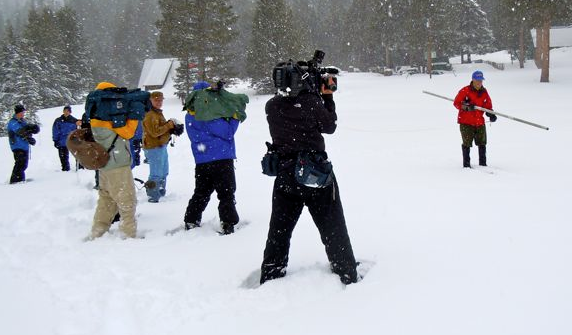
measuring snowpack

Submitted by Matt Williams on Tue, 11/13/2012

Snowpack in California likely will shrink noticeably during the next 30 years and could, paradoxically, result in increased risk of flooding as well as less water available for agriculture, according to a climate change study from Stanford University researchers.
Published in the journal Nature Climate Change, the study led by climate researcher Noah Diffenbaugh forecasts big challenges ahead for the Western U.S. and California in a projection of Northern Hemisphere snowpack through the 21st century.
There will be less water available for irrigation and farming in the summer and more springtime runoff that levees and dams will have to contend with.
“The Western U.S. exhibits the strongest increases in the occurrence of extremely low snow years in response to global warming,” Diffenbaugh explained in a story posted by the Stanford Woods Institute for the Environment. This phenomenon also will be accompanied by low snow accumulation. “It also exhibits some of the strongest decreases in runoff that occurs during the growing season.” Diffenbaugh is a center fellow and assistant professor in Stanford’s Department of Environmental Earth System Science.
The researchers used climate modeling techniques that integrated predicted future data using past data on average and extreme rates of precipitation, accumulation and runoff from 1976 to 2005. The researchers found that continued emissions of greenhouse gases such as carbon dioxide will result in “substantially” reduced snowpack during the next few decades so that low snow years could become the new normal (more than 80 percent of the time) by 2070 in the Western U.S., Alpine Europe, Central Asia and downstream of the Himalayas and Tibetan Plateau.
“Our results suggest that global warming will put increasing pressure on both flood control in the cold season and water availability in the dry season, and that these changes are likely to occur in some of the most densely populated and water-stressed areas of the planet,” Diffenbaugh said.
Hydroelectric production, recreation industries dependent on snow and water, and ecosystems also could suffer, the researchers said.
View an abstract and buy the full study published in Nature Climate Change

State Budget Situation Improved Sharply

The state’s economic recovery, prior budget cuts, and the additional, temporary taxes provided by Proposition 30 have combined to bring California to a promising moment: the possible end of a decade of acute state budget challenges says the state Legislative Analyst’s office.
Our economic and budgetary forecast indicates that California’s leaders face a dramatically
smaller budget problem in 2013-14 compared to recent years. Furthermore, assuming steady
economic growth and restraint in augmenting current program funding levels, there is a strong
possibility of multibillion-dollar operating surpluses within a few years.

The Budget Forecast

Projected $1.9 Billion Budget Problem to Be Addressed by June 2013. The 2012-13 budget
assumed a year-end reserve of $948 million. Our forecast now projects the General Fund ending
2012-13 with a $943 million deficit, due to the net impact of (1) $625 million of lower revenues
in 2011-12 and 2012-13 combined, (2) $2.7 billion in higher expenditures (including $1.8 billion
in lower-than-budgeted savings related to the dissolution of redevelopment agencies), and (3) an
assumed $1.4 billion positive adjustment in the 2010-11 ending budgetary fund balance. We also
expect that the state faces a $936 million operating deficit under current policies in 2013-14. These
estimates mean that the new Legislature and the Governor will need to address a $1.9 billion
budget problem in order to pass a balanced budget by June 2013 for the next fiscal year.

Surpluses Projected Over the Next Few Years. Based on current law and our economic
forecast, expenditures are projected to grow less rapidly than revenues. Beyond 2013-14, we
therefore project growing operating surpluses through 2017-18—the end of our forecast period.
Our projections show that there could be an over $1 billion operating surplus in 2014-15,
growing thereafter to an over $9 billion surplus in 2017-18. This outlook differs dramatically
from the severe operating deficits we have forecast in November Fiscal Outlook reports over the
past decade.

Algae Based B-20 Being Sold In Bay Area

Propel Fuels and Solazyme have partnered to launch the nation’s first publicly available algae-derived biodiesel at Propel stations across the Bay Area.
In this month-long pilot program, Solazyme’s high quality algae-based SoladieselBD will be offered in a B20 blend for the same price as conventional diesel fuels. This groundbreaking fuel will be available exclusively at Propel’s Clean Fuel Points in Redwood City, San Jose (North 1st Street), Berkeley, and Oakland.
Propel’s B20 is made of 20% SoladieselBD (an algae-derived biodiesel made by Solazyme) and 80% petroleum diesel. Domestically produced from micro algae that efficiently convert sugars into renewable oil, SoladieselBD is a clean-burning, precision quality fuel that is compatible with all diesel vehicles.
Testing undertaken by the National Renewable Energy Laboratory (NREL) shows that, in a 20% blend, SoladieselBD significantly outperforms ultra-low sulfur diesel in total hydrocarbons (THC), carbon monoxide (CO) and particulate matter tailpipe emissions. This includes an approximate 30% reduction in particulates, a 20% reduction in CO and an approximate 10% reduction in THC.

Edeniq Announces Cellulosic Demonstration Plant with Brazil Partner


Innovative technology will demonstrate production of low cost cellulosic sugars from sugar cane bagasse

VISALIA, California. November 14, 2012 – Edeniq, a biomaterials and sustainable fuels technology company, today announced that it has begun engineering and construction of a bagasse to sugars demonstration-scale plant together with its partner, Usina Vale, a Brazilian sugar and ethanol producer. The demonstration plant will produce cellulosic sugars from sugarcane bagasse, the fibrous by-product of sugarcane juice extraction. Cellulosic sugars will be converted into ethanol at the site, showcasing how sugarcane mills can increase ethanol production economically with Edeniq’s patented bolt-on technologies. The plant will handle up to 20 tons per day of bagasse and will be co-located at Usina Vale’s ethanol and sugar production site in São Paulo State, Brazil.

Edeniq and Usina Vale cooperated to conduct a feasibility study to evaluate the economics of integrating Edeniq’s technology into Usina Vale’s plant to produce cellulosic ethanol. After the successful results of the feasibility study, Edeniq and Usina Vale signed a collaboration agreement under which they are jointly funding the bagasse to sugars demonstration-scale plant, which will be a first of its kind in the region. Co-locating the demo plant at Usina Vale’s commercial site will accelerate the technology scale-up from demo to full-scale, and the technology will then be deployed at affiliated ethanol plants.

“Brazil has a large and growing demand for ethanol” said Pedro Augusto Menezes de Toledo Florencio, CEO of Usina Vale. “We believe Edeniq’s technology will allow us to increase ethanol production in a very economical way, allowing us to meet the growing demand of our customers and our country.”

Edeniq’s technologies efficiently break down biomass to liberate cellulosic sugars that can be converted into ethanol and other products. Edeniq owns and operates a fully integrated two ton per day pilot plant in Visalia, California, in partnership with Logos Technologies, which is currently in operation converting cellulosic feedstock into low-cost cellulosic sugars and cellulosic ethanol. Key to the process is Edeniq’s proprietary Cellunator™, which mechanically pre-treats biomass so that it can be more easily converted to sugars, increasing sugar yield and thus driving an increase in ethanol yield. The Brazil plant will also include the company’s proprietary reactor design for continuous enzymatic conversion of biomass to sugar.

“Through this partnership with Usina Vale, we are further demonstrating our model of increasing the efficiency, scalability and sustainability of biofuels through low capital and operating cost technologies that can be integrated directly into existing ethanol production sites,” said Brian Thome, President and CEO of Edeniq. “Edeniq is developing the lowest cost route to cellulosic sugars, which will lead to low cost ethanol production for our partners like Usina Vale.”

Southland Home Sales Up 18%, Median Price Up 17%

November 13, 2012

La Jolla, CA—Southern California home sales rose sharply in October as move-up buyers joined investors, shifting the mix of homes selling up a notch as foreclosure resales hit a five-year low. The median price paid for a home rose nearly 17 percent from a year earlier, a real estate information service reported.

A total of 21,075 new and resale houses and condos sold in Los Angeles, Riverside, San Diego, Ventura, San Bernardino and Orange counties last month. That was up 18.0 percent from 17,859 sales in September, and up 25.2 percent from 16,829 sales in October 2011, according to San Diego-based DataQuick.

Last month’s sales were the highest for the month of October since 22,132 homes sold in October 2009, though they were 11.1 percent below the October average of 23,709 since 1988, when DataQuick’s statistics begin. The low for October sales was 12,913 in 2007, while the high was 37,642 in 2003.

The median price paid for a home in the six-county Southland was $315,000 last month, the same as in September and up 16.7 percent from $270,000 in October 2011. The September and October medians are the highest since the median was $330,000 in August 2008. The Southland median has risen or held steady month-to-month for nine consecutive months and has increased year-over-year for the past seven months.

The median price and other price measures are rising mainly for two reasons: First, higher demand, triggered largely by ultra-low mortgage rates, has coincided with a dwindling supply of homes for sale, which pushes prices up. Second, this year there’s been a big change in the types of homes selling: Discounted foreclosures are a smaller share of sales, while move-up homes are a larger share, which puts upward pressure on the median price.

“Watching the market rebalance itself is fascinating. In some categories and in some neighborhoods, demand outstrips supply, pushing up prices. In other areas, the market is still largely dormant. Low interest rates are a huge factor, where mortgages are available, which they aren’t for a lot of potential buyers,” said John Walsh, DataQuick president.

The Southland’s lower-cost areas continued to post the weakest sales compared with last year. The number of homes that sold below $200,000 fell 11.2 percent year-over-year, while sales below $300,000 dipped 0.3 percent. Sales in these more affordable markets have been hampered by the slowdown in foreclosure activity, which results in fewer foreclosed properties listed for sale, as well as the high percentage of homeowners who still owe more than their homes are worth, meaning they can’t sell and move on.

While inventory and sales have declined in many of these lower-cost areas, higher demand has pushed prices up. In October, price levels for the lowest-cost third of Southern California’s housing stock rose 17.0 percent year-over-year, while they rose 6.2 percent in the middle and 8.1 percent in the top third.

Sales rose sharply in most mid- to-higher-cost markets in October. Sales between $300,000 and $800,000 – a range that would include many move-up buyers – jumped 41.5 percent year-over-year. October sales over $500,000 rose 55.2 percent year-over-year, while sales over $800,000 rose 52.4 percent compared with October 2011.

Last month 23.3 percent of all Southland sales were for $500,000 or more, down slightly from 23.9 percent in September, which was a four-year high, and up from 17.9 percent a year earlier.

Foreclosure resales – properties foreclosed on in the prior 12 months – accounted for 16.3 percent of the Southland resale market last month. That was down from 16.6 percent the month before and 32.8 percent a year earlier. Last month’s level was the lowest since it was 16.0 percent in October 2007. In the current cycle, the foreclosure resales hit a high of 56.7 percent in February 2009.

Short sales – transactions where the sale price fell short of what was owed on the property – made up an estimated 26.0 percent of Southland resales last month. That was down slightly from an estimated 27.6 percent the month before and up from 25.4 percent a year earlier.

Credit conditions didn’t appear to change much in October, though the share of purchase loans that were “jumbo” hovered near a five-year high.

Jumbo loans, mortgages above the old conforming limit of $417,000, accounted for 21.1 percent of last month’s purchase lending, down a hair from 21.4 percent the prior month and up from 14.6 percent a year earlier. In recent months the jumbo share has been the highest since December 2007, when jumbos made up 21.7 percent of the purchase loan market. In the months leading up to the credit crunch that struck in August 2007, jumbos made up close to 40 percent of the market.

With interest rates on fixed 30-year loans so low, and aversion to risk in the marketplace so high, the use of adjustable-rate mortgages (ARMs) remains extraordinarily low in an historical context. Last month 6.0 percent of Southland home purchase loans were ARMs, compared with 5.8 percent in September and 6.9 percent a year earlier. Since 2000, a monthly average of about 33.1 percent of Southland purchase loans were ARMs.

The most active lenders to Southland home buyers last month were Wells Fargo with 8.4 percent of the market, IMortgage.com with 2.6 percent and Prospect Mortgage with 2.4 percent.

Investors continue to account for an unusually large share of all sales.

Absentee buyers – mostly investors and some second-home purchasers – bought a near-record 28.0 percent of the Southland homes sold last month. That was up from 27.7 percent the prior month and up from 25.4 percent a year earlier. The record was 29.9 percent in February this year, while the monthly average since 2000 is 17.6 percent. Last month’s absentee buyers paid a median $245,000, up 22.5 percent from a year earlier.

Buyers paying with cash accounted for a near-record 32.1 percent of October home sales, down insignificantly from 32.2 percent the month before and up from 30.0 percent a year earlier. Cash purchases peaked at 33.7 percent of all sales this February, and since 2000 the monthly average is 16.8 percent. Cash buyers paid a median $250,000 last month, up 21.1 percent from a year ago.

Home flipping edged higher again. Last month 6.1 percent of all homes sold had sold twice on the open market within a six-month period, up from 5.5 percent in September and 3.7 percent a year earlier.

Government-insured FHA loans, a popular low-down-payment choice among first-time buyers, fell to a more-than-four-year low in terms of their share of all purchase lending. Last month FHA loans accounted for 25.2 percent of all purchase mortgages, down from 25.5 percent the month before and 31.9 percent a year earlier. The October FHA share was the lowest since July 2008, when it was 24.4 percent. The declining market share for FHA loans reflects tighter qualifying standards implemented in recent years as well as the difficulties first-time buyers are having competing with investors.

DataQuick monitors real estate activity nationwide and provides information to consumers, educational institutions, public agencies, lending institutions, title companies and industry analysts.

The typical monthly mortgage payment Southland buyers committed themselves to paying last month was $1,115, down from $1,127 the month before and up from $1,040 a year earlier. Adjusted for inflation, last month’s typical payment was 53.1 percent below the typical payment in the spring of 1989, the peak of the prior real estate cycle. It was 61.6 percent below the current cycle’s peak in July 2007.

Indicators of market distress continue to move in different directions. Foreclosure activity, while above long-term averages, continues to drop and is far below peak levels. Financing with multiple mortgages is very low, and down payment sizes are stable, DataQuick reported.

Dual Income Couples Fueling Housing Market

ORLANDO (November 10, 2012) – Dual income households are comprising a greater portion of the housing market and helping sales recover, according to an annual study released today.

The 2012 National Association of Realtors® Profile of Home Buyers and Sellers continues a long-running series of large national NAR surveys evaluating the demographics, preferences, motivations, plans and experiences of recent home buyers and sellers.  The responses are heavily representative of owner-occupants and do not include most investors.

Sixty-five percent of all buyers are married couples, 16 percent are single women, 9 percent single men, 8 percent unmarried couples and 2 percent other; percentages of single buyers were slightly higher in 2011. However, just two years ago, 58 percent of buyers were married, 20 percent were single women, 12 percent single men and 7 percent unmarried couples; the overall market share of single buyers declined a total of 7 percentage points over the past two years.  Before 2010, the market shares moved within a very narrow range, generally a percentage point or two.

Paul Bishop, NAR vice president of research, said the study is painting a clearer picture of the impact of mortgage limitations.  “We’ve known for some time that stringent mortgage credit standards have been holding back home sales, but these findings show single buyers have been hurt the most over the past two years.  Total home sales would be 10 to 15 percent higher without these unnecessary headwinds,” he said.

“The continued growth in married couples as single buyers shrink demonstrates that households with dual incomes are more successful in obtaining a mortgage.  However, given the historically favorable housing affordability conditions, most single-income buyers could also purchase a home and stay well within their means, if lending requirements were more sensible,” Bishop said.

First-time home buyers* edged up to a 39 percent market share in the past year from 37 percent in the 2011 study.  Long-term survey averages show that four out of 10 buyers are typically first-time buyers, who are critical to a housing recovery because they help existing home owners to sell and make a trade.

The study shows the median age of first-time buyers was 31 and the median income was $61,800.  The typical first-time buyer purchased a 1,600 square-foot home costing $154,100, while the typical repeat buyer was 51 years old and earned $93,100.  Repeat buyers purchased a median 2,100-square foot home costing $220,000.

The median downpayment for all home buyers was 9 percent, ranging from 4 percent for first-time buyers to 13 percent for repeat buyers. “First-time buyers historically make small downpayments, but repeat buyers like to put down 20 percent if they can to avoid paying mortgage

Perspective On Central Coast Farm Labor

By Mark Bolda

One of the increasing challenges for strawberry and canberry businesses on the Central Coast in California has been the persistant shortage of labor.  Many large operations over this past year reported a shortage of 10 to 15% of workers with some smaller farms reporting even higher percentages.
My prediction is that this shortage will continue to persist, and as a matter of fact may become more pronounced in the years to come.  I base this assertion on two theses, the first being changing demographics and an improving economy in Mexico affecting the dynamics of labor immigration and the second having to do with competition for labor coming from strengthening rental markets and improved conditions for home building in the United States.
Much of the information for the post below comes from the excellent and prescient article written several years ago by Dr. Philip Martin at UC Davis regarding Mexico USA migration.
http://giannini.ucop.edu/media/are-update/files/issues/v8n2.pdf
The Labor Immigration Dynamic from Mexico:
Many of the people involved in the success of the California berry business come from Mexico and without them we will not do well.
However, the changing economic and demographic situation in Mexico should be understood when thinking forward who is going to continue to do all the tough and complex work of planting, growing and picking our crops of strawberries, raspberries and blackberries.
Let us consider the drivers of immigration from Mexico in the past and the future:
According to some academics, one of the major causes of immigration to the United States was the disruption to the rural economy of Mexico by the North American Free Trade Act (NAFTA) put into force January 1, 1994. By some estimates, the economic effects of NAFTA displaced some 1.4 million rural Mexicans, and in the five years following about half of them made their way to the US.  That such a large number of people were displaced at one time from their homeland is tragic, but it did mean that a large number of people not unfamiliar with tough and demanding farm work showed up for work at US agricultural concerns in the years following the implementation of NAFTA.
Now in 2012, to start to understand the changing immigration picture, we should not be unaware that in Mexico, as in many places around the world, the demographics are changing, especially in reference to decline of population growth.  The population growth rate in Mexico has dropped from 1.5% in 2000 to 1.1% in 2012.
To gain meaning from this number in terms of what it would mean for immigration from Mexico, one would want to cast this population growth rate against the current economic growth rate.  Mexico has a vibrant economy with productivity growth rate of above 3%, and it is doing well in adapting to the global economic order of the 2010’s.  Reforms are currently moving through the legislature and more are promised by the incoming administration of Enrique Peña Nieto, including opening the oil sector, simplification of the tax code and labor market reform to further improve the prospects for economic growth. Drawing on all of this, the Central Bank of Mexico estimates GDP growth of 3.5-3.6% for 2013.   The economy of Mexico has been growing and will continue to grow faster than the US (forecast 2013 GDP growth 2%) and this can be to some extent be understood by comparing the performance of each country’s stock market index (Figure 1 below).
In this economic scenario, one would expect labor (read jobs) growth to be in the range of 1- 1.3%.  So population growth of 1.1%, which of course drives labor force growth, has already fallen below the higher end of the rate of employment growth.  An employment growth rate matching or exceeding labor force growth means there is no reason anybody should be lacking for work.  Perhaps there will be mismatches in skill level and available work, but there is no denying an increasing abundance of work will be a factor in reducing emigration, and could even be a cause of some immigration back to Mexico.
Improving Real Estate and Construction Conditions in the US:
We all know that strengthening rents give impetus for investors to come into the market (especially in an environment of extremely low bond yields), creating eventual demand for the construction of additional office, retail and residential space.  Looking to a good proxy for rental markets, real estate investment trusts (REIT’s, corporate entities specializing in real estate), represented by the second chart for the REIT index below, we see that the demand for rental income and subsequently the market valuations of these companies has been rising since the middle of 2009.
Additionally, after a very tough stretch caused by a credit driven over- supply of houses, the fortunes of American home builders have made a turn for the better.  Indeed, the price of an index composed of the shares of publicly owned homebuilders (Figure 3 below) has been moving strongly upwards for the last year. Knowing that the equity markets think forward, we can assert that what happens on Wall Street tends to be a good predictor of what is to happen on Main Street 6 to 12 months from now. Homebuilders are going to be building again in 2013.
What does all this have to do with the labor force working in berries?  A lot as a matter of fact.  Rising rents and the subsequent creation of demand for residential and other construction will pull workers away from agriculture because construction work tends to be higher paying (albeit substantially more cyclical as the last 2003 – 2009 boom and bust has shown).  Simply put, construction going forward will compete for workers.
In consideration of the above, I think it very difficult to see how immigration of laborers from Mexico will return to the levels experienced in the last two decades.  Population growth there is falling, the NAFTA led displacement has run its course, and the economy there is surging forward and generating a lot of jobs.
In addition to the strong economic and employment picture in Mexico, the US housing market is starting to pick up again on the shoulders of a strong rental market and will compete with berry businesses for this already shrinking pool of labor.

Weather Watch: Skiing By Thanksgiving?

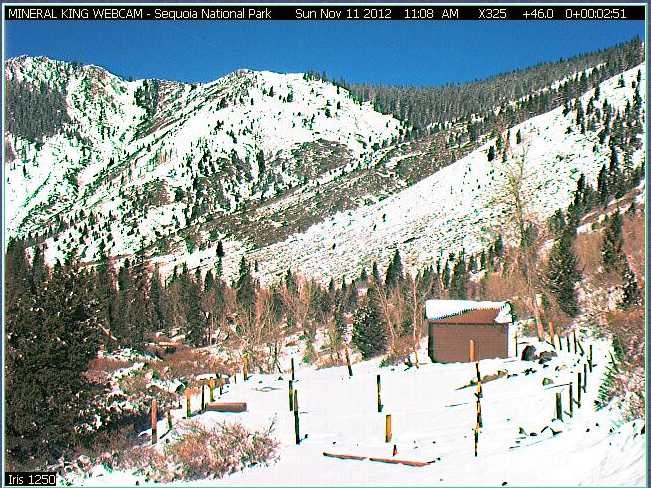
Mineral King Valley this past weekend

The winter storm door appears to have opened nearing mid-month in California with the 10 day forecast for Redding near Lake Shasta(the base of our hydraulic empire) showing likely rain for 7 of the 10 days coming up. Further south things are less optimistic with the best chances for rain coming next weekend (Nov 18/19).

On the Central Coast PG&E forecaster John Lindsey says today to expect some showers Thursday and Friday but that that “longer range charts and models are advertising a significant low-pressure system with increasing southerly winds and rain on Sunday into next Monday.”

NWS Hanford talks about the two systems as well saying snow levels in the Sierra on Thursday will remain at 8k ft with mountain areas receiving a quarter to half an inch of precip.

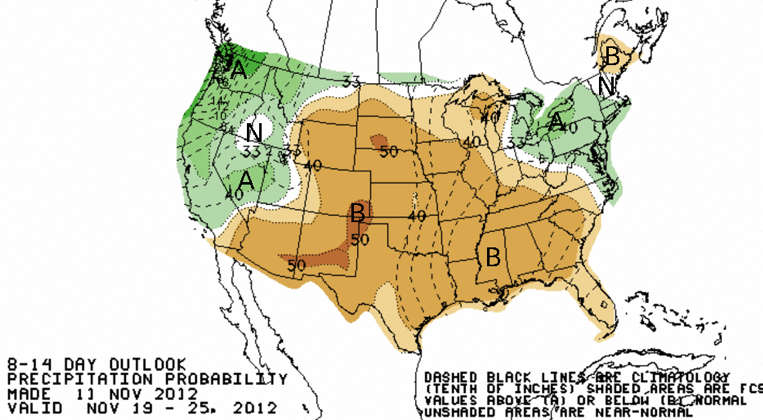
8 to10 day forecast

Some Ski Resorts Open

Several  California ski resorts are already open and more expect to open in the next week, always good news this time of year.

Mammoth Mountain along Hwy 395 is open and Boreal in Tahoe is now operating as are Bear Mountain, Snow Summit and Mountain High resorts in southern California that opened today in honor of Veterans Day. Tahoe’s Squaw Valley and Northstar expect to open on the 16th.

In the Central Sierra a snowstorm turned Shaver Lake into a ‘winter wonderland’ this weekend. At nearby China Peak “We are into some real good snow making conditions right now so that’s going to help and hopefully some more storms in the horizon,” Paul Gray of China Peak Resort told the Fresno ABC station.

The China Peak website suggests a Thanksgiving opening is more likely.”10-12 inches of new snow this week, and very cold temps for snowmaking give optimism for an early opening! Unless we receive significant snow this week (week of 11/12) the only thing we might open on November 17-18 would be one of our beginner moving carpets, so we’d have something in the base area only for beginners and those who want to get started on their skiing or snowboarding life with our Learn-to-Ski & Ride packages!

If we don’t see lots of snow this coming week, but we get some snow and continued snowmaking opportunities we’ll look to hopefully open Chair 6, mid way up the mountain, serving one low intermediate run (Sundown Ridge) by Friday, November 23, so stay tuned!”
Further south our picture from this weekend snow shows a dusting of snow in Mineral King Valley from their webcam with Big Meadows cross country ski area getting 3.6 in of precip so far this water season and over 2 inches this month.Further south, Quaking Aspen has over 3 inches so far this season and received 0.40 inches on November 11 alone.
It’s a start to hopefully a better water year,not just for skiers but all water users.
Weak El Nino?
Forecasters have saying that chances for a wetter winter in California have been scaled back after an early EL Nino weather pattern call this summer boosted hopes coming from the NOAA”s Climate Prediction Center. “While the tropical ocean and atmosphere may resemble a weak El Niño at times, it is now considered less likely that a fully coupled El Niño will develop,” NOAA experts wrote in a Nov. 8 update. “Therefore, the previous El Niño Watch has been discontinued as the chance of El Niño has decreased. While the development of El Niño, or even La Niña, cannot be ruled out during the next few months, ENSO-neutral is now favored through the Northern Hemisphere winter 2012-13.”

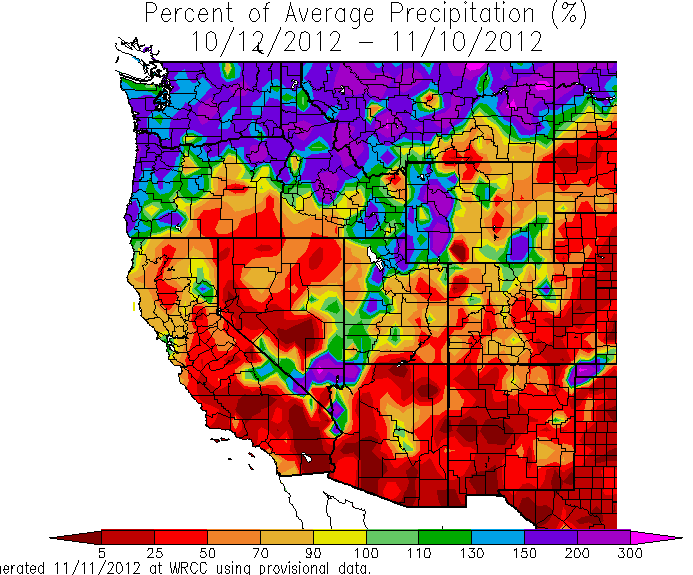
winter so far. Low precip in southern California but lots in Pacific Northwest

So far this season it is the Pacific Northwest that is seeing above average rainfall,an El Nino pattern.

Shrinking Snowpack?
Longer term,climate change is likely to alter the volume and timing of the runoff in California says new report released this week.
Stanford University researchers say climate change will shrink mountain snow pack but speed early runoff in more years according to their model,CMIP5.
“One clear result is that western North America shows the most rapid and largest response to the continued emissions of greenhouse gases when it comes to early snowmelt and spring runoff,”researcher Noah Diffenbaugh told the Chronicle this week.”The result, he and his colleagues say, will be less runoff water for irrigation during the season when California’s high-value crops need it most for growing, and also more early.”
The study concludes“We find that the CMIP5 global climate model ensemble exhibits an imminent shift towards low snow years in the Northern Hemisphere, with areas of western North America, northeastern Europe and the Greater Himalaya showing the strongest emergence during the near-term decades and at 2 °C global warming. The occurrence of extremely low snow years becomes widespread by the late twenty-first century, as do the occurrences of extremely high early-season snowmelt and runoff (implying increasing flood risk), and extremely low late-season snowmelt and runoff (implying increasing water stress). Our results suggest that many snow-dependent regions of the Northern Hemisphere are likely to experience increasing stress from low snow years within the next three decades, and from extreme changes in snow-dominated water resources if global warming exceeds 2 °C above the pre-industrial baseline.”

Guess you better save up that precious water and lower your footprint.