
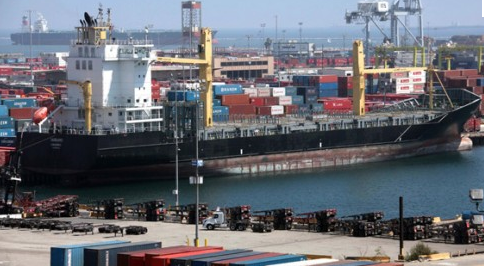
November 8, 2012 – LOS ANGELES, CALIFORNIA – Despite improving economic conditions here in California, worldwide fall-out from Europe’s economic straits and a decelerating pace of growth in Asia took their toll on California’s export trade in September, according to an analysis by Beacon Economics of foreign trade data released this morning by the U.S. Commerce Department.
The value of goods shipped abroad by California businesses in September totaled $12.87 billion, a nominal decline of 4.5% from the $13.47 billion recorded in September 2011. (Adjusting for inflation and seasonal variations, the fall-off was also 4.5%.)
California’s exports of manufactured goods totaled $8.42 billion, down 1.9% from the $8.58 billion recorded last September. Non-manufactured exports (chiefly raw materials and agricultural products) fell by 9.6% from $1.67 billion to $ 1.51 billion, while re-exports shrank 9% from $3.23 billion to $2.94 billion.
A nearly 20% year-over-year drop in exports of industrial machinery (including computers) in September was partially offset by strong gains in shipments of medical equipment and aerospace components. Exports of fruits and nuts were up 7.6%.
Manufacturing’s share of California’s merchandise export trade now accounts for about 65%, down from 71% in 2008 and from 78% at the height of the dot com boom in 2000.
Shipments to the Pacific Rim countries of Asia were down by 5.1% in September, including a 4.5% drop in shipments to China.
On the other hand, trade was up with Canada, Taiwan, Singapore, Brazil, and the United Kingdom. Ironically, despite the continent’s travails, California exporters did eke out a 1.8% increase in shipments to the European Union in September.
This suggests that Europe’s troubles are not the primary cause of slowing export growth, and because the European Central Bank recently stepped up to backstop Europe’s major banks, the worst of the European crisis is likely behind us. Today, the European Union accounts for 16.6% of California’s exports, down from 19.9% in pre-recession 2008.
Despite the decline in trade in September, California’s exporters continue to exceed the inflation-adjusted pace they set in 2008, the peak pre-recession year for the state’s merchandise export trade. “Whether that will remain true through the year’s final quarter is exceedingly uncertain,” said Jock O’Connell, Beacon Economics’ International Trade Adviser. Still, initial indications of nationwide export activity shows that trade could have an upward influence on the revised 3rd quarter GDP figures when they are released.
While many had hoped that California’s export trade would resume the rate of growth experienced during 2009 and 2010 and stimulate the state’s economic recovery, creating large numbers of jobs, those accelerated growth rates were due in part to a rebound from the large contraction in exports during the Great Recession and were unlikely to persist at such high levels. Part of the reason growth in exports has slowed is due to global economic concerns, but the slowdown can also be attributed to ‘catching up’.
Among other risks, O’Connell pointed to the unknowns accompanying China’s current change in political leadership. “Even as the transition process unfolds in Beijing over the next few days, the economic policies that Xi Jinping will pursue are far from scrutable,” O’Connell said.
Beacon Economics’ analysis also notes a new forecast from the European Commission that expects gross domestic product to shrink 0.3% for the European Union. Growth in 2013 is expected to be a less than inspiring 0.4%. Those figures represent a significant downgrade of the Commission’s expectations.
This week also brought reports that business and consumer confidence in Europe in October fell to their lowest levels in three years, while unemployment rates moved higher. Still, this shows that the majority of risks in the U.S. economy have shifted from internal issues to external concerns, which stands in stark contrast to the economic woes during the downturn.
Nearly 28% of California’s export trade is with Mexico and Canada, two nations whose economic fates are intrinsically linked to the U.S. economy (which continues to move forward in terms of employment and GDP growth).
Banco de Mexico Governor Agustin Carstens said on Wednesday that the Mexican central bank expects growth of between 3.5% and 4.0% in 2012 and in the 3% to 4% range in 2013, although he warned that Mexico’s economy would suffer if U.S. lawmakers fail to turn back from the “fiscal cliff” – an estimated $600 billion in tax increases and spending cuts set to occur in January.
That warning was echoed in Canada, California’s second largest export market, where Canadian Finance Minister Jim Flaherty and Bank of Canada Governor Mark Carney both pledged on Wednesday to take action to support the economy if a shock from the U.S. threatened to plunge the country’s economy into recession.
The view at Beacon Economics continues to be that policymakers will reach a compromise before things are allowed to come to a head—especially now that the U.S. Presidential election is behind us. It is also important to remember that going one day over the “fiscal cliff” will not bring about a sharp, or any, decrease in economic activity – it would have to continue for a longer period. It is doubtful that our re-elected leaders in Washington will squabble for months and allow the nation to dip back into recession it.