SLO BUILDING NOT SLOW

New Home Building In SLO County Way Up
Commercial Surges Too

Home builders in San Luis Obispo county responded to the improving real estate market by permitting 350 new homes in 2012 compared to just 106 in 2011. The value of all new single family homes jumped from $32.4 million in 2011 to $117.2 million in 2012 according to Construction Monitor.

The busiest market in the county was in the Nipomo unincorporated area where Shea Homes permitted 62 new homes, making it the busiest general contractor in the county. Next was Paso Robles with 40 sfh permits issued,24 of them by builder Wathen Castanos, the county’s second largest home builder.

The City SLO permitted 30 new homes and Arroyo Grande permitted 20. Pismo approved 13 new homes and Morro Bay 8. There was some  home building activity in Cayucos  and Templeton.

Mangano Homes, formerly one the largest builders in Tulare County, is now poised to be a bigger player in home building in SLO City in 2013.

The company’s president Andy Mangano  announced that “Mangano Homes, Inc. of San Luis Obispo has been engaged by Resmark Land and Housing and its investors to construct the Serra Meadows residential neighborhood. Serra Meadows is located on Prado Road just east of Higuera in San Luis Obispo, and will consist of a single‐family neighborhood totaling 177 homes as well as commercial property.

Mangano Homes anticipates that production will commence in Spring 2013. The company’s first priority will be completing infrastructure improvements including the work on Prado Road.

Countywide in the residential category – solar projects shined in 2012 with 426 – mostly roof top projects – valued at $86 million vs 93 projects valued at $1.5 million in 2011.

Commercial Pick Up

In the commercial category activity picked up in the office sector with  38 projects valued at $15 million in 2012 compared to 12 projects valued at $1.2 million.There were 18 motel projects valued at $1.4 million compared to 7 – worth $533,000 in 2011. Other sectors that showed big gains were 110 retail building projects valued at $12.8 million vs 34 at $7.5 million in 2011.

Industrial projects surged as well in 2012 with 88 at $119 million in value vs 33 for $17.8 million.

Don’t forget ag building that included 86 buildings for $16.4 million vs 31 ag buildings in 2011 valued at $3 million.

Total commercial valuation for 2012 was lower than 2011 ( $447 million vs  $977 million) because of the mega-solar projects in the Carrizo Plain that were first permitted in that year, valued at $901 million.

Fresh & Easy: “No Plan To Close Stores”

February 4, 2013
On January 31st,  Fresh and Easy sent an email to the members of our Friends of Fresh & Easy Rewards program updating them on the various news stories circulating about their stores.  The company has announced  a restructuring due to poor financial performance but  there is no news about a sale.  Below is what they sent.
“Dear friend,
Thank you for being a fan of Fresh & Easy. We wanted to reach out to you to address numerous news and online reports about the future of our stores.
Our parent company Tesco is conducting a strategic review of Fresh & Easy – they’re looking at all options to find the best outcome for the neighborhood market that you – and we – have come to love. While we don’t know exactly what that outcome will be, or if Tesco will continue to own the company, we’re confident that Fresh & Easy can continue to be your favorite market.
We want to assure you: we don’t have plans to close stores. We’re still committed to providing delicious, wholesome and affordable food every day. We’re still Fresh & Easy; open for business with everything that you enjoy about our store, with even more exciting things to come. That’s why we’re going to keep on fighting the good food fight.
Now, more than ever, we appreciate your energy in our stores and being able to share a smile with you. We look forward to seeing you soon and thank you for your continued support.
The Fresh & Easy Team”

Ag Beat: Tomato /Chocolate Milk / Bees

Middle California – More Tomatoes Per Acre
Farmers are coaxing more crop per acre from Valley fields. Witness the processing tomato industry that is yielding near 50 tons per acre in 2012 compared to 38 in 2002, 33 tons in 1992, 26.5 in 1982 and 17 tons per acre back in 1967. The value of processing tomatoes from about 200,000 to 250,000 acres of land has jumped about 10-fold in this time. Farmers expect to harvest 13 million tons this year, the most since 2009.The total acreage planted to this crop has fallen from around 317,000 acres to 258,000 – much of it in Kings and Fresno counties.Fresno County produces about 40% of the crop by itself.The yields in Fresno and Kern county exceed 55 tons per acre, highest in the state.

California grows 96% of the US crop, almost all machine harvested.
But this winter a drought in China who typically is a  big producer of tomato paste has hurt  global supply and is expected to be down 11% this year putting the squeeze so to speak  on ketchup prices in world markets but not likely in the US .
Americans consume three-fourths of their tomatoes in processed form. U.S. consumption of processed tomatoes began a steady climb that accelerated in the late 1980s with the rising popularity of pizza, pasta, and salsa.

California Produces Half US Vegetables

California produced about half the value of all vegetables grown in the US in 2012 says USDA. California accounted for 49% of the production.

Chocolate Milk Loses High Fructose Corn Syrup

Dean Foods has introduced a reformulation of its popular brand of chocolate milk, TruMoo. The new product, which hit shelves in January 2013, contains 35 percent less total sugar than the leading chocolate milk competitor, and has 40 percent less sugar than its previous formula and no high fructose corn syrup.
In a 2012 MilkPEP survey of more than 1,000 moms of school-aged children, 85% report feeling positively about the benefits chocolate milk provides their children.
“Together, these nutrients help strengthen bones and build and repair muscles,” said Willow Jarosh MS, RD of C&J Nutrition. “And a low-fat chocolate milk with no high fructose corn syrup and very little added sugar is a practical way to get kids the nutrients they need without all the sugar they don’t, and from a source moms can trust.”
Critics of chocolate milk helped get the beverage pulled from school cafeterias in past years saying there was too much sugar in the drink.
Busy As Bees:
Trucks carrying beehives are crisscrossing the state in preparation for the spring bloom, but their cargo may be a little lighter. Beekeepers say their colonies are smaller, in part due to a poor winter last year that didn’t produce enough food to keep the bees healthy. The U.S. Agriculture Department reports that the bees’ annual work on the state’s farms will begin in almond orchards, where 1.6 million honeybee colonies will be needed to pollinate the crop.

More California Dairies Closing?

With only a a little relief from the CDFA on prices – California dairy leaders are worried more Central Valley milk shippers will be closing their barn doors and selling off their cows. CDFA Secretary Ross decided late last month to raise the minimum price paid to dairymen only 25 cents disappointing the farmers. Since then” I’ve seen more announcements of herd sales” shrugs Western United Dairymen president Tom Barcellos of Porterville.

These dairy operators were hoping for an 80 cent to $1 bump in the price the state’s processors including cheese makers must pay on an emergency basis for the next 6 months.Dairymen call the 25 cents a drop in the bucket.

In the meantime “we lost that much on the CME” market in recent days where dairy futures are traded says Hanford dairyman Joaquin Contente. California milk prices rise and fall with the price of of dairy commodities in Chicago.

Those prices have been falling since the New Year with 500 lb barrel of cheddar that went for $2/lb last October fetching about $1.54 today.

At the same time feed costs are staying high at $7.36 per bushel for corn on the futures market until the new Midwest crop comes in next summer. The drought has also hurt hay prices and availability with Valley alfalfa hay going for $300 a ton. Lots of hay was exported keeping prices up and China is expected to buy double what they bought last year. All eyes are on rain forecasts for this summer in the Midwest to see if there will be another drought year. It was dry this winter hurting the winter wheat crop.

Dairy Body Count

Testimony at the most recent CDFA hearing on the subject suggests more dairymen threw in the towel recently. Some of that testimony includes a body count of lost dairies.

– From DFA:  Data from Frazer LLP shows net income losses per cwt. for first six months at $0.92/cwt. in Kern County, $1.75/cwt. in San Joaquin area, and $2.24/cwt. in Southern California.
-Have seen abnormal exodus in farm counts within the co-op Dairy Farmers of America membership in 2011 (20 farms went out of business) and 2012 (34 farms have failed or exited).
Western United Dairymen testified – Just within WUD, 50 dairy sell outs occurred in the last eight months.
California Dairies co-op testified – The cost of feed makes up nearly 70 percent of the cost of producing milk. California witnessing an unprecedented drop off in milk production: September 2012 was the lowest month of milk production since 2005, about 13 percent lower than the peak month.
California Dairy Campaign testified- Estimated that more than 100 dairies will close their doors in 2012, more than in the devastating year 2009.
Land O Lakes co-op testified -In 2012, 43 LOL member farmers have discontinued milking.
Fresno bankruptcy attorney Walter Riley testified – Over last two years have worked with 60 dairymen and their families who have
experienced extreme financial pressure due, in part, to low milk prices.

This month the Overland Stockyard in Hanford has a full scheduled of dairy herd sales announced, several “complete dispersals”.

In Tulare County, milk production was down 1.4% in November says CDFA. The state’s dairies are selling nearly 4% less fluid milk to  consumers this year.( but nearly 10% more organic milk).Cheese consumption was up 0.01% through November and butters sales are  6% higher.

Losing Their Shirt

CDFA says the average price paid producers in 2012 was $16.39 per cwt compared to $18.63 in 2011. At the same time CDFA says dairy farmers cost of production in the South Valley in the 3rd quarter was $20.12 per hundred lbs weight (CWT).That compares cost of $18.54 for the same period in 2011.

The numbers don’t lie, dairymen say, they are losing their shirt.

If California dairymen are complaining about the low price they get for their milk,so are NY dairymen this month ,a newspaper reports. NY dairy operators say they can’t sell their milk because California milk prices undercut them.

“A large part of California’s dairy edge stems from its milk pricing system, which is set by the state, rather than using the federal milk pricing system that most states utilize, including New York. Dairy farmers in California are often paid up to several dollars less per hundred pounds — about 12 gallons — of milk than farmers in New York. In December, preliminary average milk prices paid to farmers were $18.80 per hundred pounds of milk in California, according to the USDA’s National Agricultural Statistics Service. Farmers in New York received $22.20 per hundred pounds of milk in the same month.”

At next weeks Tulare Farm show a panel of dairy experts from around California will weigh in on the idea of abandoning the California system and joining the federal program like New York.

SLO News / Pop Projections / Cambria Restaurant / Camp Roberts

Population Study: Grey SLO County Turning Brown

San Luis Obispo’s population mix will change in coming years says a new state Finance Department demographic report. At just under 270,000 people in 2010, the county will grow to 274,000 by 2015 , around 288,00 in 2020 and 353,000 by 2060.

As of 2010 in SLO County there were 56,309 Hispanics and 191,725 Whites. By 2060 there will be 173,000 Whites, a decrease from today, and over 136,000 Hispanics.

The median age of a resident of SLO County will rise from 39.5 to 40.5 in 2060.That compares to a county with more Hispanics like Tulare County where the median is 29. About half the population in SLO county – 133,000 residents are age 40 or older.

Across California there were nearly 10 million baby-boomers in 1990,the majority being White. The White baby-boomer population is now aging into
retirement and all will likely retire in the next two decades.But as the SLO figures show – that White Baby Boomer trend will end. Hispanics will be moving toward a majority here as well as the rest of the state where it is happening much sooner.

click to enlarge

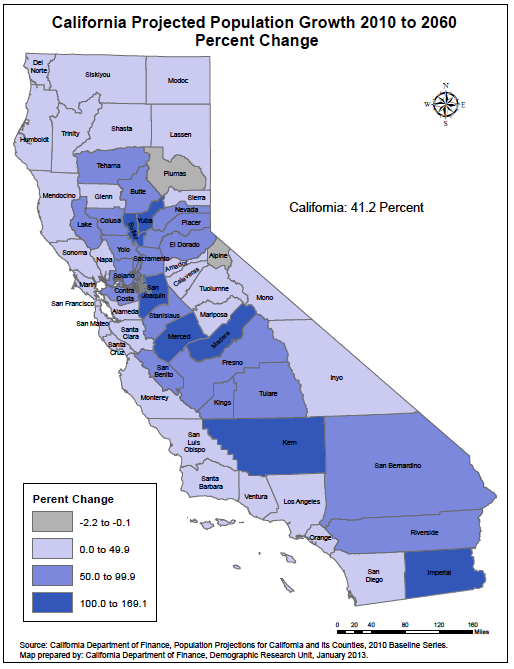
The latest California projection series indicates that the Hispanic population will be even with the number of non-Hispanic Whites by mid-2013. Early in 2014, the Hispanic population will become the plurality in California for the first time since California became a state.

Southern California will lead the State’s growth over the next 50 years (2010 to 2060),growing by 8.3 million to 31 million in population. For this report, in the interest of geographic simplicity, Southern California includes San Luis Obispo, Santa Barbara,Kern, San Bernardino, Ventura, Los Angeles, Orange, Riverside, San Diego, and Imperial counties.

California’s population will cross the 50 million mark in 2049 and grow to nearly 52.7 million by 2060, according to the new population projections released by the Department of Finance.
This population gain – nearly 15.4 million between 2010 and 2060 – would exceed the current populations of either Illinois or Pennsylvania, and would represent enough new residents to currently rank as the fifth largest state in the Union. The 2060 population will be 39 percent higher than the state’s most recent 2012 population estimate.

Camp Roberts Gets Perimeter Fence Upgrade

The United States Army, represented by the Network Enterprise Technology Command/9th Army Signal Command (NETCOM) and U.S. Army Garrison, Presidio of Monterey (POM), is proposing to expand the existing perimeter fence around the CAMP Roberts Satellite Communications (SATCOM) site. The fence would be expanded to the west of its current location; extending about 1 mile longer and encompassing approximately 57 acres of additional land outside the existing perimeter fence. Additional structures would include security lighting and cameras on the interior side of the fence, and a 40-foot-wide clear zone would be established along the fence

Cambria Eatery Under Construction
Construction of a new restaurant/bar at the former Hamlet location in north Cambria is underway at 7432 Exotic Garden Dr. The building permit is for Centrally Grown Inc to build 6664 sf of buildings on the site valued at $800,000. The permit was issued in December.
According to their website Centrally Grown, owned by Dave Robertson, is a” 3+ acre site located on scenic California Coast Highway 1 between the artist haven-town of Cambria and Hearst Castle State Monument.  The new home of Centrally Grown is the former Hamlet restaurant and exotic gardens, a popular local landmark that had fallen into financial difficulties in the last decade.” The Hamlet closed this time last year.
Robertson purchased the place in 2012 for $2.47 million. He says the new complex should employ 30 to 40.
The website continues that “Robertson will revitalize the site and build on its rich tradition as he showcases Centrally Grown products with a healthy bistro, flatbed produce market, working gardens and small mercantile along with creating a venue for local entertainers and artists. us a  will initially focus on reducing waste associated with food production, processing, packaging, transport and consumption; reducing chemicals in food, body and land and creating a smaller environmental footprint and a healthier community.  All products developed by Centrally Grown will be locally sourced from sustainable production and will reflect impeccable quality.”
Robertson says that the new loft restaurant  will offer” California cuisine and world-inspired fare in a modern atmosphere. Feel free to bring lunch up from the deli for a casual afternoon, or join us for dinner while the sun sets over the breathtaking Pacific Ocean.”
The eatery’s’ website says expect to visit their new eatery in Spring 2013. The company is already catering its fare.
Robertson’s career successes include 26 different business ventures that have paved the way for his most ambitious project to date: the creation of the Centrally Grown brand, based on the Central Coast of California.

February News Updates / Forecasts For Weather & Gas Prices

NOAA sees dry weather pattern

Forecasters See Little Relief From Dry Weather Pattern
The dry weather pattern has enveloped California in the New Year appears to be continuing well into mid February. California forecasters say a little rain shower and some little snow should falll this week,Thursday and Friday including over Donner Pass and parts of the San Joaquin Valley.
But Accuweather says” it doesn’t appear that the storminess will last all that long this time around with another zone of high pressure expected to build into the West by next weekend.”
SLO forecaster JohnLindsey agreEs offerinG this scenario to his readers today.
“An area of low pressure will drop out of the Gulf of Alaska and  move toward the Central Coast on Thursday night. Rain showers will cross San Luis Obispo County on Friday. The primary uncertainty with the forecast is the amount of moisture associated with the system, which will dictate how much precipitation is produced.
At this time, rainfall amounts will be light with only about a tenth of an inch expected. Snow levels will fall rapidly down to near 2,500 feet as this system moves through. However, only a few inches of snow will fall.”

Dry conditions will return Saturday and will persist through the entire following week as high pressure dominates our weather.

But The NWS Hanford  suggests some uncertainty over the punch of the storm but that rain is likely with very cold temps and thunderstorms that could hit the area Friday.

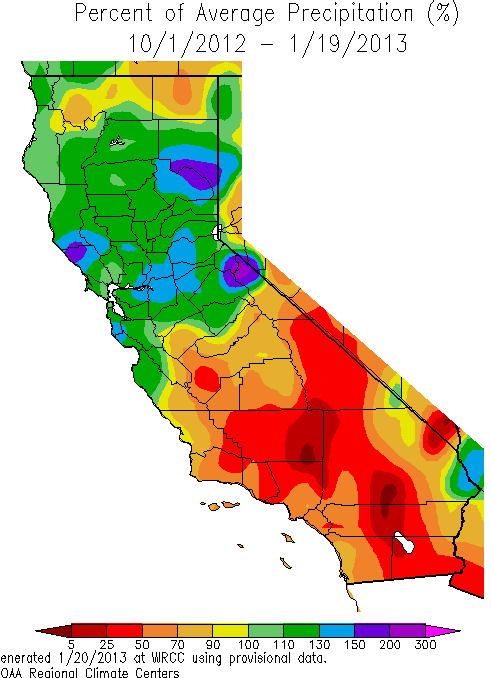
Abundant rainfall earlier this winter across the state helped drive rain totals through the New Year to well above average( 200% in December) in northern California and the San Joaquin Valley. Today the DWR says the Northern California rain index sits at 128% of average precip with nearly 35 inches in in the bucket.We would be “average” if we got 50 in by the end of this water year. There has been virtually no precipitation in this New Year. This map tells the story of this water year-wet in the north and dry in the middle and south.

click to enlarge

The Climate Prediction Center  that rain likelihood from Feb 11-17 shows well below average chance in North and Central California (see map).

Gas Price Spike Temporary?

Gas prices in California have spiked up 30 cents in the past month.Avenal and Lompoc in the S2S region have some of the state’s lowest priced stations at $3.35. This week the state average gas price is nearing $4. AAA reported that wholesale prices spiked 50 cents last week.

But fear not says Visalia oil company exec Walt Dwelle who sees the price jump as “an aberration. It’s temporary and it won’t be long before they head back down.” Dwelle says refinery issues are to blame for the latest run up but that “demand continues to be soft.”

Several observers including OPIS’s Tom Kloza have predicted gas prices will fall in 2013. “They will wobble higher the first of the year.”  But Kloza says the there will be lots of crude coming to market in 2013.

The average price of a gallon of gasoline in 2013 will fall 5 percent to $3.44, according to the Energy Department.

EIA expects that falling crude prices will help national average regular gasoline retail prices fall from an average $3.63 per gallon in 2012 to annual averages of $3.44 per gallon and $3.34 per gallon in 2013 and 2014, respectively.

SLO Biz Beat / Median Price Climbs / Paso Building Booms

SLO Median Price Rises

San Luis Obispo homes sold for a median price of $414,600 compared to around $391,000 in November and  around $367,000 in December 2011.The figures for existing homes according to the California Association of Realtors show a rebound in prices here as well as much of California. The statewide median was $366,930 compared to $289,000 a year ago – a jump of 27%.

Sales were also up in SLO County,11% higher for the month and 11.3% year over year.

Santa Barbara’s  median price climbed 41% year over year in December to $588,000.

12 Ave building in Paso Robles will house Artisan Restaurant

Paso Robles Building Permits Boomed In 2012

Fueled by growth in  dining and the wine and beer industries Paso Robles enjoyed a good year for building permit activity in 2012.
In 2012 the city permitted 40 new homes compared to just 18 in 2011. The total value of all permits was $30 million vs $9 million in 2011. Some 22 retail and dining permits were issued by the city vs 5 for all of 2011. There were 29 solar projects permitted in 2012 vs  5 for 2011. All figures courtesy Construction Monitor.

Permits include projects underway now including a 40,000sf expansion for the Firestone Walker Brewery for ITS bottling operation  along Hwy 101.The permits includes an addition of 72 parking places for their new restaurant.

New in January is a permit to do tenant improvements for Artisan Restaurant in Paso Robles at 839 12th Ave valued at $800,000. NK Builders who are also the owners of the building are doing the work that includes a raised  concrete dining patio encroaching on the walkway,the first eatery in town to do permanent street side dining along the sidewalk. The highly regarded Artisan Restaurant is currently at 1401 Park Ave in Paso Robles. NK Builders has constructed a 13,600sf  half block building on 12th.

News Nuggets Around Tulare/Kings… Sales Tax / Second Amendment / Hotel Biz

Visalia Sales Tax Growth Near 16 Percent

Visalia sales tax figures reported for the latest four quarters and released in December 2012 show cash receipts of $18 million vs $15.5 million for the four quarters reported in December 2011. The $2.5 million increase amounts to about 16%. City finance chief Eric Frost says the figures don’t tell the whole story since the cash receipts are three quarters  of what the city ends up receiving.But the tend lines are clear,sales tax  is up and up more strongly than in the past 5 years.

The number actually fell during the recession year of 2008 -2009,stayed level from 2009-10 and climbed from $14 million to 15.5 million by December 2011. Now that pace has accelerated.

The $18 million figure compares to a budget amount of $16.4 million.But if the multi-year recession had not pulled the rug out on sales growth in the city, the figure should be closer to $21.8 million says the city using a straight trend line from 2006.

Both retail sales,building materials,and vehicle sales -the three major sectors have shown recovery in the past year.Car registrations in California have increased 25% says the California New Car Dealer Assn.


weapons used in Sandy Hook killings

Lemoore Council To Vote On Pro-Gun Resolution

Below is the text of a staff report regarding a resolution in support of the second amendment and against proposals pending in Congress to limit gun ownership to be heard by the Lemoore City Council February 5. Senator Dianne Feinstein has been leading the charge to ban so called assault weapons and  large ammunition clips as well as proposing universal background checks.

During the December 18, 2012 Council Meeting, Council Member Rodarmel requested
that an item be placed on a future agenda to consider a resolution in support of the
Second Amendment to the United States Constitution. The Second Amendment was
adopted on December 15, 1791 as part of the Bill of Rights and the original hand-written
document, which is on display at the National Archives in Washington D.C., reads as
follows:
A well regulated Militia, being necessary to the security of a free State,
the right of the people to keep and bear Arms, shall not be infringed.
The purpose of the Second Amendment is to protect the right of the people to possess
and carry firearms. This interpretation was established by two landmark Supreme Court
decisions. In 2008, District of Columbia v. Heller, the Court ruled that the Second
Amendment protects an individual’s right to possess a firearm, unconnected to service in
a militia, and to use that arm for traditionally lawful purposes, such as self-defense within the home. However, the ruling was silent as to whether the law pertains to the States.

In 2010, McDonald v. Chicago, the Court ruled that the Second Amendment applies
equally to the States and Federal Government. The following link provides commentary
on the background leading to the Second Amendment, the Court cases, definitions, etc.
http://en.wikipedia.org/wiki/Second_Amendment_to_the_United_States_Constitution.
Attached for Council’s consideration, is Resolution No. 2013-01, which supports the
Second Amendment and the rights of our citizens to keep and bear firearms for the
defense of life, liberty, and property as intended by the Founding Fathers of the United
States of America, and which opposes any action that infringes upon the rights listed.
For many, the ownership of firearms also provides for the personal enjoyment of target
practice, competitions, hunting, and collecting of guns.

Also attached is a letter written by U.S. Marine Joshua Boston to Senator Dianne
Feinstein opposing gun control, and news reports and a letter from Fresno County
Sheriff, Margaret Mims, to the White House expressing her opposition to “useless gun
control legislation.”

Tulare County Hotels Enjoy Good Holiday
Hotel occupancy was up in the Tulare/Visalia area in December according to Smith Travel, the second strong month in a row. Rooms sold were up 8.6% year over year and occupancy was up 7% to 44.2%.
Not that it has been easy in this business. The Comfort Suites 50 room hotel in Tulare is on the market for $2.99 million after a foreclosure action.

Regional Water Supply Could Help North Tulare County Towns

click to enlarge

Some of the worst drinking water problems in the county are in the north in a number of small “disadvantaged” communities like Cutler,Orosi, East Orosi, Sultana, Seville and Monson. Water with high nitrates and DBCP contamination,probably most from agricultural applications – has forced schools and communities to buy bottled water. The extent of the problem has caught the attention of the national media in the past few months including a November NY Times story that recounts that at one time Tulare County identified 15 “non-viable” communities in the 1970s based on a prediction that mechanical harvesters would soon replace the farm workers who lived in places without public water and sewer services and the best solution was for folks to move.
But instead of waiting for these towns to disband or help provide a solution one by one -there is now some new optimism over a regional approach to deliver clean water though farm water purveyor Alta Irrigation District with Tulare County as the lead agency.

Northern Tulare County has a cluster of small farm worker communities with tainted water

Making this possible Alta district, based in Dinuba, has built two new water recharge basins near Traver that have captured storm water to add to their annual supply says Alta manager Chris Kapheim. Because of the new supply the district has budgeted stored water behind Pine Flat Dam to provide a surface water supply for the potential project.One idea is to transfer the water along the Friant Kern canal to a site for new regional water treatment plant perhaps near East Orosi where the canal runs, says water engineer Dennis Keller who is helping on the project and sits on the county Water Commission.

Kapheim notes that over the years Alta’s role” has evolved to one with a better understanding and ability to address local water quality issues and implement regional solutions” to manage the scarce water supply. The idea could be a win-win for agriculture and the farm worker communities of the Alta district.

An additional benefit of delivering surface water to those communities will be the reduction in groundwater pumping in the Cutler-Orosi area of the District, thereby reducing the stress on the existing aquifer.

In 2007, Alta Irrigation District, Cutler Public Utilities District, and Orosi Public Utilities District signed an MOU to jointly fund a $75,000 water supply study to evaluate water quality and to recommend options for providing potable water in the Cutler-Orosi area.

With the help of the county, this CDPH feasibility study is in a phase 2 stage to study if the regional water project could also provide good drinking water for Monson,Yettem and Seville suffering the same bad ground water problem.

Alta’s Kapheim says by using a regional solution, the District is able to address multiple solutions in different areas, i.e., storm water utilization enhanced recharge in Traver and reduced groundwater pumping through the use of surface water for drinking water in the Cutler-Orosi area – now other nearby towns as well.

Studies have found that separate solutions for each community that treat groundwater are too expensive.The latest study underway will gauge the cost of a joint water project project and how they could be connected. Surface water would be blended with groundwater to meet standards.  Eventually, there  would be a Prop 218 vote by the communities. Recently Seville and Yettem were added to the  feasibility study to completed by mid-2014.
One estimate puts the capital cost at $17 million.

In this region nitrates have closed wells in many of these systems over the past few years as contamination levels continue to rise in existing wells. Cutler PUD has had to close numerous wells due to nitrate contamination and now relies on a well with DBCP over legal limits says East Orosi’s two wells are closed due to nitrates, notes advocate group Community Water Center.

A UC Davis study has suggested most of problem is due to leaching of farm fertilizer and chemicals. Now,Alta ID, a a farm-based water suppler, has decided it is their role to do more than irrigate farmland,but help manage a solution to tainted groundwater.
For Tulare County a potential long term solution will help these communities to grow economically, attract business instead of just waiting for the next delivery from the water truck.

Immigration Reform: Central Calif Residents…. Out Of The Shadows?

UC Berkeley photo

California has more unauthorized immigrants than any other state, about 2.6 million of the nation’s 11 million; they make up 7 percent of the total California population and 9 percent of the state’s labor force says a July 2011 Public Policy Institute of California study. The report estimates that Tulare County as of 2008 had about 29,000 undocumented people or just under 7% of the population.

Now a bipartisan immigration reform plan gaining support in Congress could change their status this year. Farm leaders like Manual Cunha says leadership in the Senate led by Democrats Chuck Schumer and Dianne Feinstein and the GOP’s Marco Rubio of Florida point “in the most positive direction I’ve seen in years.” Not only is President Obama made a commitment, “The time is now.” he offered in a Nevada speech,but the House GOP leadership including the Valley’s Kevin McCarthy of Bakersfield may be “ready to deal” says Cunha.

Cunha points to leadership by GOP’s rising star Marco Rubio from a farm state who has come to understand the time is right.”I think the country’s taking a much bigger risk by not doing anything,” Rubio observed in the past few days.

This week Tulare County congressman Devin Nunes chimed in. “Our immigration system is broken and needs to be overhauled from top to bottom. We need reform that both secures the border and ends the unacceptable status quo, in which there are millions of people living and working in the shadows. If the Senate bill accomplishes those two goals, it will be a good starting point for discussion.”

The outlines of a plan include a pathway to citizenship for undocumented immigrants, a streamlined legal immigration system, better enforcement and tighter border security.
Cunha predicts a bill will be launched in the Senate and get to the House by April and on to the President’s desk by June.

The stars seem to be aligned between traditional rivals like the California grower community and the UFW as well on the major points of legislation.

“We thank this bipartisan group of Republicans and Democrats for understanding that a roadmap to citizenship is essential to any immigration reform plan. We also endorse the proposal’s commitment to strong labor protections as part of any future flow program and allowing temporary workers who have worked in this country for many years to earn green cards,” said UFW’s Arturo S. Rodriguez recently.

Cunha says immigrants who have been living here for years will be able to gain legal status and not worry they or their families will be suddenly hauled away. Instead, they would be able to  enter the US legally and safely without  being exploited by ‘coyotes’ or put in danger by the drug cartel. For farmers worried again this year about worker shortages “we will finally get a legal workforce and not live in fear of government audits” adds Cunha.

“It’s not just bad for [undocumented workers], it’s bad for the entire economy, because all the businesses that are trying to do the right thing that are hiring people legally…” said Obama in his speech in Nevada this week.
Both Farm Bureau and Western Growers have expressed support for the framework which will also includes a foreign workers (guest worker) plan.

So what changed? Cunha says “it is simple – the election results”  have pushed more Republicans to look at the problem in a new way. In the past a majority of GOP have emphasized what their 2012 party platform said opposing “any form of amnesty” for people who intentionally violate immigration law, saying amnesty “rewards and encourages more law breaking.”

The LA Times reported this week that 4 GOP state legislators have announced support as well including Katcho Achadjian (R-San Luis Obispo).