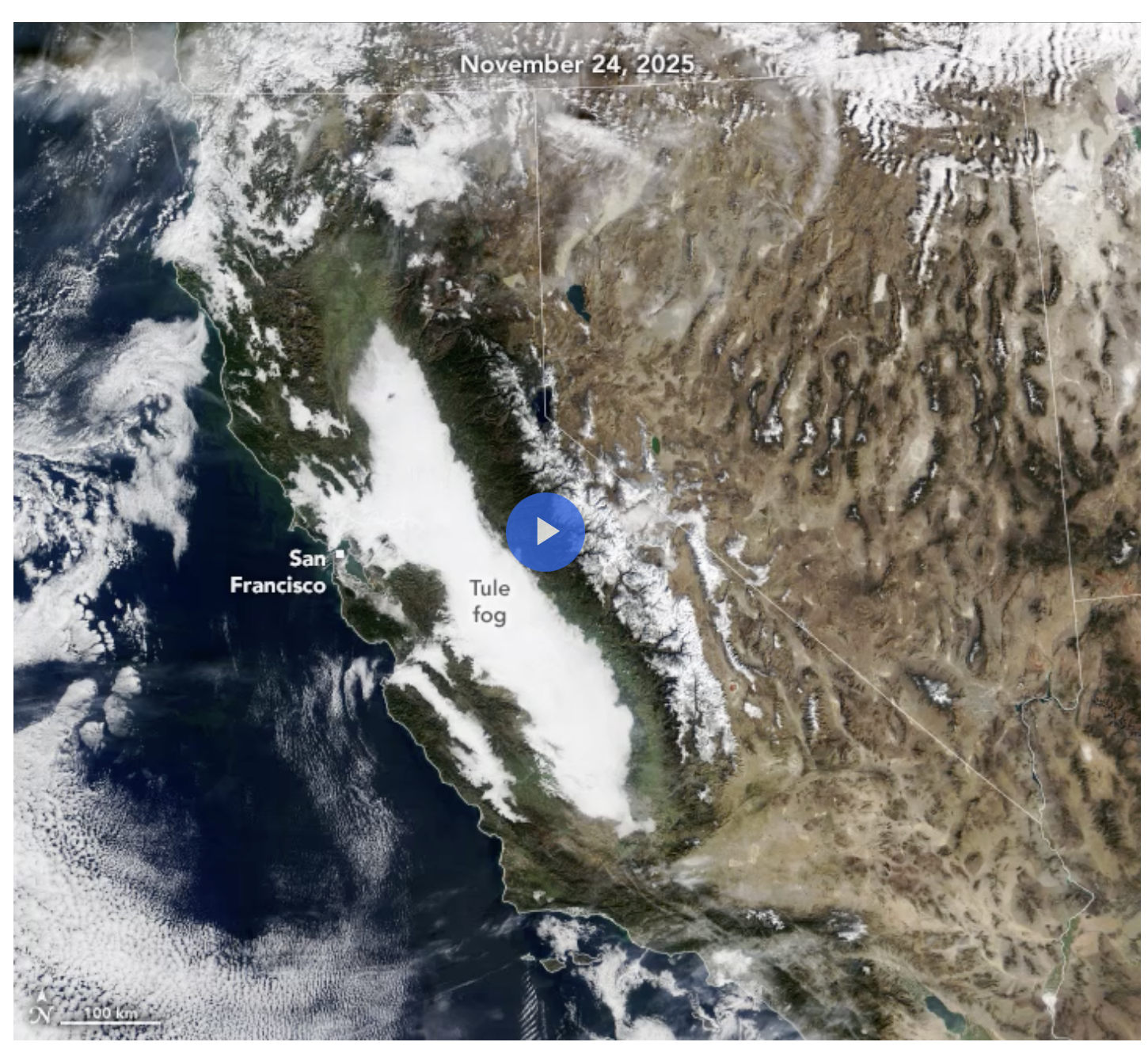
Going on three weeks, the Central Valley has been shrouded in Tule fog that could finally clear with a wet pattern coming into the state in late December. The extent of the fog that spreads over 400 miles is documented by this NASA satellite photo. and has spawned widespread news reports. The clouds tend to form in the SJ Valley in colder months when winds are light and soils are moist.
A wet XMAS for California
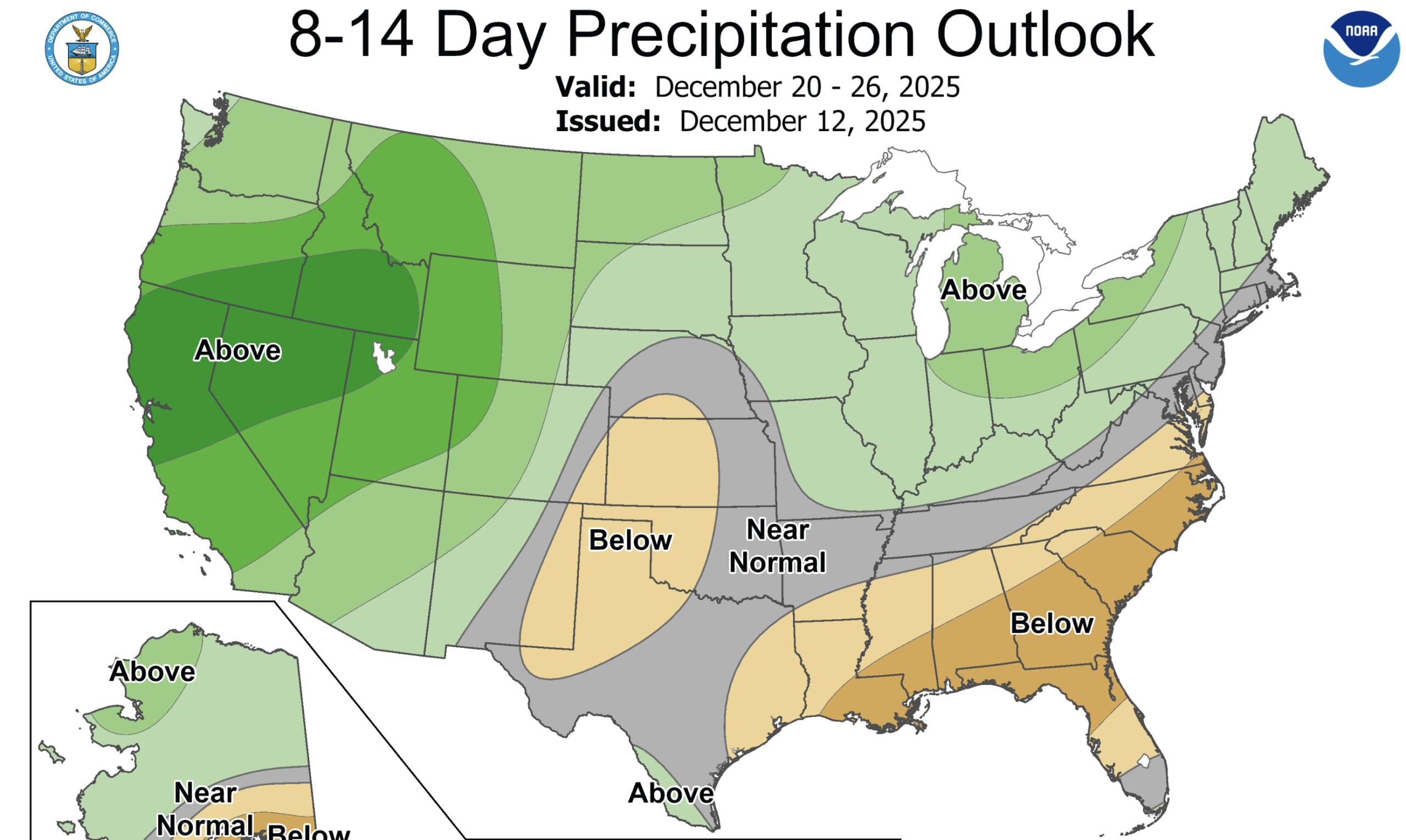
A pattern change is expected by next weekend as storms displace the famous blob of high-pressure that has been sitting off the coast blocking incoming systems or steering them to the north. A series of storms will be coming into the state in multiple waves dropping precipitation, particularly in the central and northern Sierra. The storms could be warm, continuing the pattern of low snowpack so far this year in the western US. The Climate Prediction Center published this map to show where precipitation is likely to fall..
Snow Drought Takes Hold Across the West
Water Year 2026 precipitation to date is near or above median for many parts of the West. However, much warmer-than-normal temperatures caused precipitation to fall as rain instead of snow across many basins, leading to snow drought despite wetter-than-normal conditions across most of the West. Nearly every major river basin in the West experienced a November among the top 5 warmest on record. Snow drought is most severe across much of the Sierra Nevada in California, the Cascade Range in Washington and Oregon, the Blue Mountains of Oregon, and the Great Basin in Nevada, with snow water equivalent (SWE) in most of these basins at less than 50% of median.
Here is the latest statewide snowpack report showing N Calif is just 6% of average to date.
Cold and wet weather is needed to improve snowpack conditions. Sierra ski resorts are hoping it chills out after an early start to the season. Chin Peak closed this week but hopes to reopen next Saturday with colder weather expected.
Cheap gas for California: So far in the fourth quarter, California gasoline is the dog that hasn’t barked. Once predicted to command $1-$2/gal above CME RBOB, Los Angeles gasoline is trading for 6cts/gal UNDER January RBOB futures. Supportive of some $3.25/gal or lower pump prices. Oil Analyst Tom Kloza
The avian flu is devastating marine mammal populations. A new survey finds that nearly half of breeding females in the world’s largest population of southern elephant seals were killed by the virus.NPR notes that concerns about bird flu mostly focus on infected livestock and humans, but it’s also reached marine mammals in some of the world’s most remote areas. Of course elephant seals use the beaches of the Central Coast for birthing and mating.
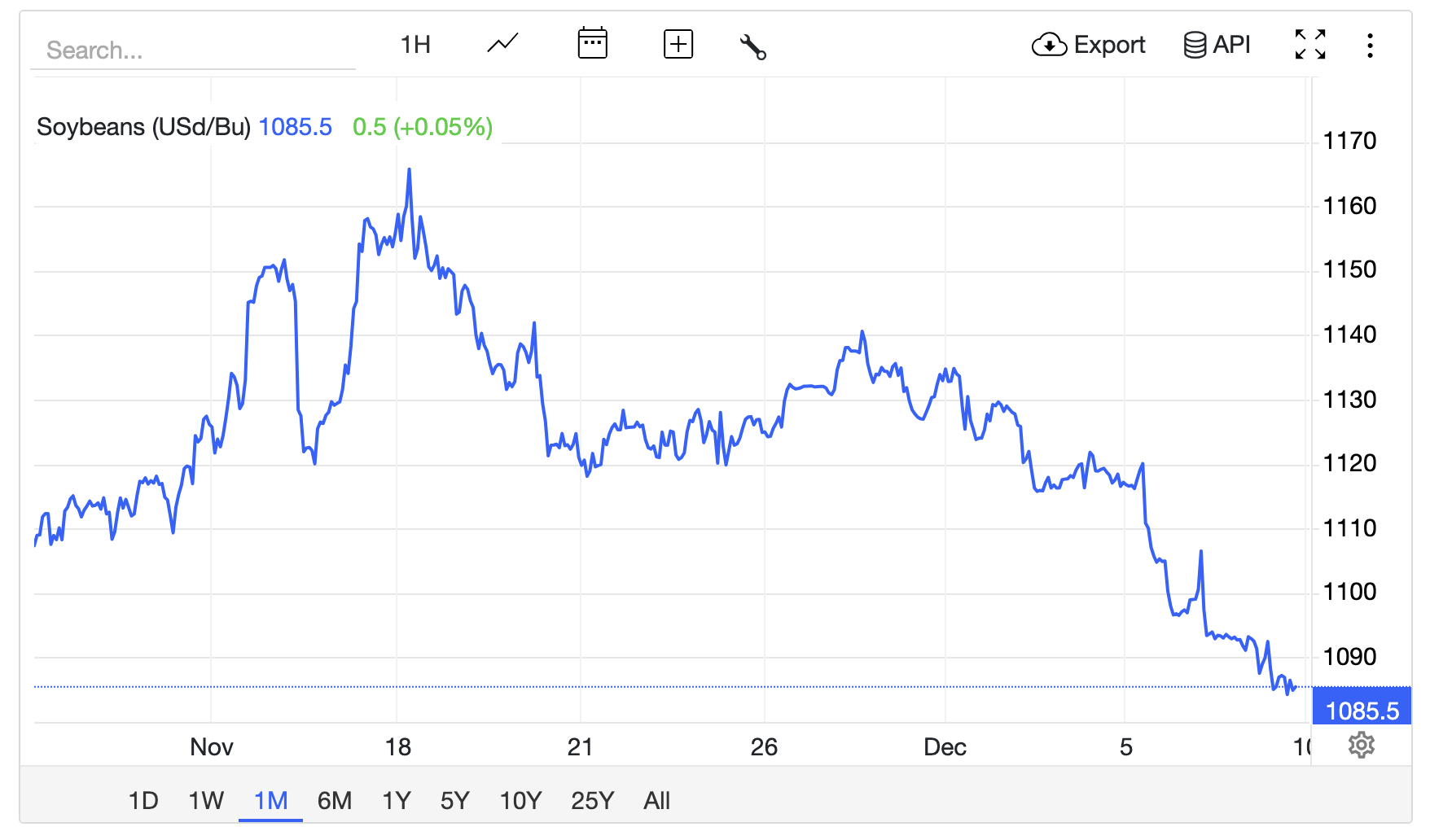
China is not buying our soybeans as fast as Mr. Trump had promised. So far they have purchased only 3,000,000 tons of a promised 12,000,000 tons by the end of this year. Now a Trump aide suggests that they won’t be buying the promised amount until “the end of the growing season.”Instead of doing sales, Trump is now offering a $11 million subsidy to help prop up the farm economy. Soybean futures have dropped nearly a dollar since mid February.
Closures:LA appliance store closes – blame tariffs?
Howard’s Appliance store closes 17 store LA chain. The appliance retailer is a 100% employee-owned company who suddenly closed this month said to have been impacted by tariffs.New tariffs imposed in mid-2025 on imported steel, aluminum, and finished appliances (like washing machines, refrigerators, and ovens) raised prices by an estimated 5-10% for consumers. Also Howard Miller clock and furniture company is closing permanently after 100 years selling off its inventory through early 2026 according to reports. The shutdown is attributed to tough economic factors like a struggling housing market, inflation, and tariffs, impacting their ability to remain sustainable. They are holding a going-out-of-business sale for their final products. Brazil-based JBS owned Swift Beef Co in Riverside CA is closing their plant laying off 372 workers according to a state WARN report. Another worn report filed this week says Palo Verde Hospital in Blythe California will close laying off 62 employees. The report says the closure is permanent.
Hot Rolled Steel fell to $904.03 daily but is up 6.73% in the past month and up 31.21% compared to the same time last year.HRS is used in Structural framing (I-beams, channels) for buildings and bridges, railroad tracks, vehicle frames, and heavy equipment and sheet metal, tubing, and parts requiring significant shaping.
U.S. coffee prices have hit record highs, with ground coffee prices up over 40% year-over-year in some instances.
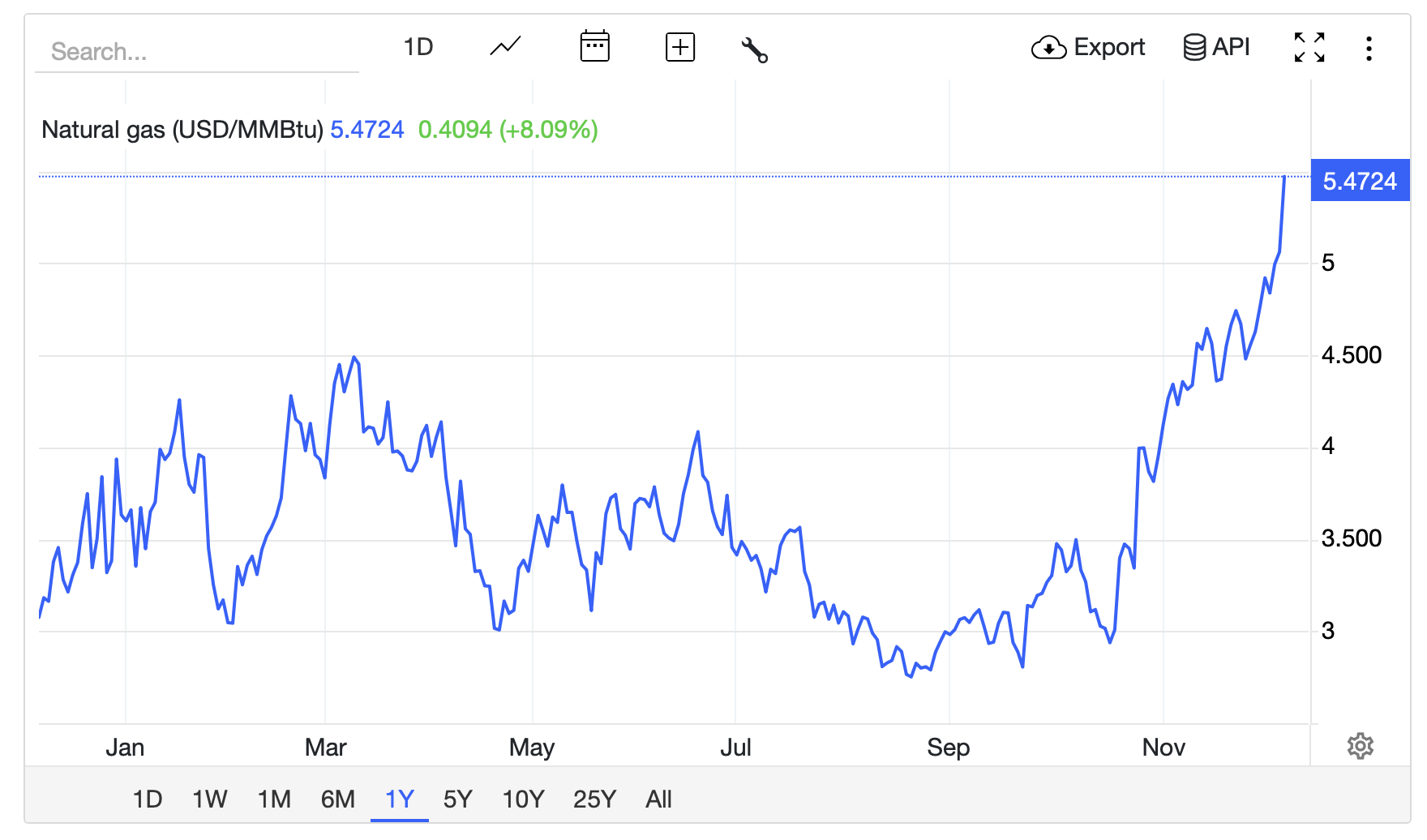
US natural gas futures were above the $5/MMBtu mark, hovering at three-year highs and soaring 70% since the lows from mid-October and up 78% since January amid a backdrop of soaring export demand and an expected cold winter.Natural gas prices affect electricity prices and is used to generates about 40% of US electricity.
Live Cattle rose to 226.20 USd/Lbs on December 5, 2025, up 2.14% from the previous day. Over the past month, Live Cattle’s price has risen 3.39%, and is up 20.82% compared to the same time last year.
Fertilizer Price Index is at a current level of 140.52, up from 139.55 last month and up from 119.72 one year ago.That ‘s up 17.37% from a year earlier
The Clerk-Recorder has certified SLO County’s results for the November 4, 2025, Statewide Special Election. With a countywide participation rate of 67%, SLO is 4th out of the 58 counties in turnout. SLO County voted in favor of Prop 50 on the statewide ballot that will allow redistricting in the state. The vote in the county was 54.71% Yes and 45.29% No. SLO turnout was 67%.“We are really proud of SLO County voters for the 67 percent turnout countywide,” said Clerk-Recorder Elaina Cano. “That’s 17 percent higher than the statewide average of 50 percent and puts us at the fourth highest turnout among all 58 counties.” Los Osos went blue by more The vote in Los Osos was more one sided coming in at around 73% in favor according to published results from its five precincts, nearly three quarters. The vote was 2548 Yes to 957 No. One precinct in Los Osos logged an 88% vote in favor. Turnout in Los Osos was better than the county average coming in at 74% behind Cambria who posted a 77% turnout rate. Supervisorial District 2 led the county in turnout at 71%.
Statewide, the highest percent in favor counties were Marin and Alameda, both at 80% approval.On other side of the ledger Lassen County voted 80% No in opposing the Democratic party led measure. In SLO County many of the Paso Robles precincts registered more No votes., Back in SLO County turnout among Democrats was 73% while GOP voters had a 68% turn out.
Spud farmers join many other ag commodities suffering from overproduction, high expenses
see related story in ag section
Farmers naturally pivot toward bountiful production if they have a choice. They tend to make too much of their product.But that can lead to oversupply. And low prices.
This month Idaho potato farmers are in this same leaky boat.
Idaho newspaper The Power County Press says that the state’s farmers net income fell 30% over the past two years according to USDA. “Farm input costs like fertilizer and seed hit record highs in 2024. Potato prices dropped from $6.54 to $4.40 per 100 pounds year over year. Revenue from hay, hops, barley, and wheat also declined sharply statewide.”
The North American Potato Grower Return Index “shows that Idaho farmers this year are receiving an average of $1.97 for each 100 pounds of potatoes they produce, after transportation and other expenses are factored in. That’s compared to $7.19 in 2024.” The article says the break-even point for Idaho potato farmers right now is about $9 per 100 pounds of potatoes they produce, said NAPM owner Ben Eborn- much less than what it costs to grow them.
Idaho now joins the club- the hurt club seen in the vast Midwest farm fields, among tractor dealers across the US and here in the orchards and vineyards of California. The Golden State has seen this play out in its top crops from almonds to grapes, cotton to walnuts where the supply has exceeded demand resulting in low prices and red ink Now our farms are reducing their acreage in search of profitability.
The best example of this is grapes – the second highest grossing crops grown in California. We produce 99% of the table grapes in the US. Also the state is the number one producer of wine in the United States and it is around Fresno where most raisins come from.
For years California growers expanded their acreage peaking in 2018/19 with about 925,000 acres planted including 635,000 acres of wine grapes. Since then farmers started pulling their vines due to low returns especially in wine grapes. As of this fall all grapes (table/raisin/wine) plantings are down to 710,000 acres – a decline of 215,000 acres from the peak. Wine grape farmers have been urged by industry leaders led by Allied Grape Growers to continue to pull acreage to right size the crop to meet reduce demand, now impacted by the inscrutable habits of a new generation that no longer favors wine (what’s wrong with the guys) and actually wants to reduce all alcohol.For 2026, Allied is urging farmers pull 50,000 more wine grape acres to about 500,000 which would be down 135,000 acres from 2019.
“There’s no doubt you should pull them out” urges a message by the industry group.But last year, Allied says grape growers reduced their acreage by only 20,000 acres as a result of new plantings that offset some of the total pulled. Farmers suffered when about 300,000 tons of California wine grapes went un-harvested in 2024 made worse by the fact that some wineries chose to import foreign concentrate instead of buying local product. Added to the misery in the Central Valley, both the raisin farmers and cherry growers had a lousy year.
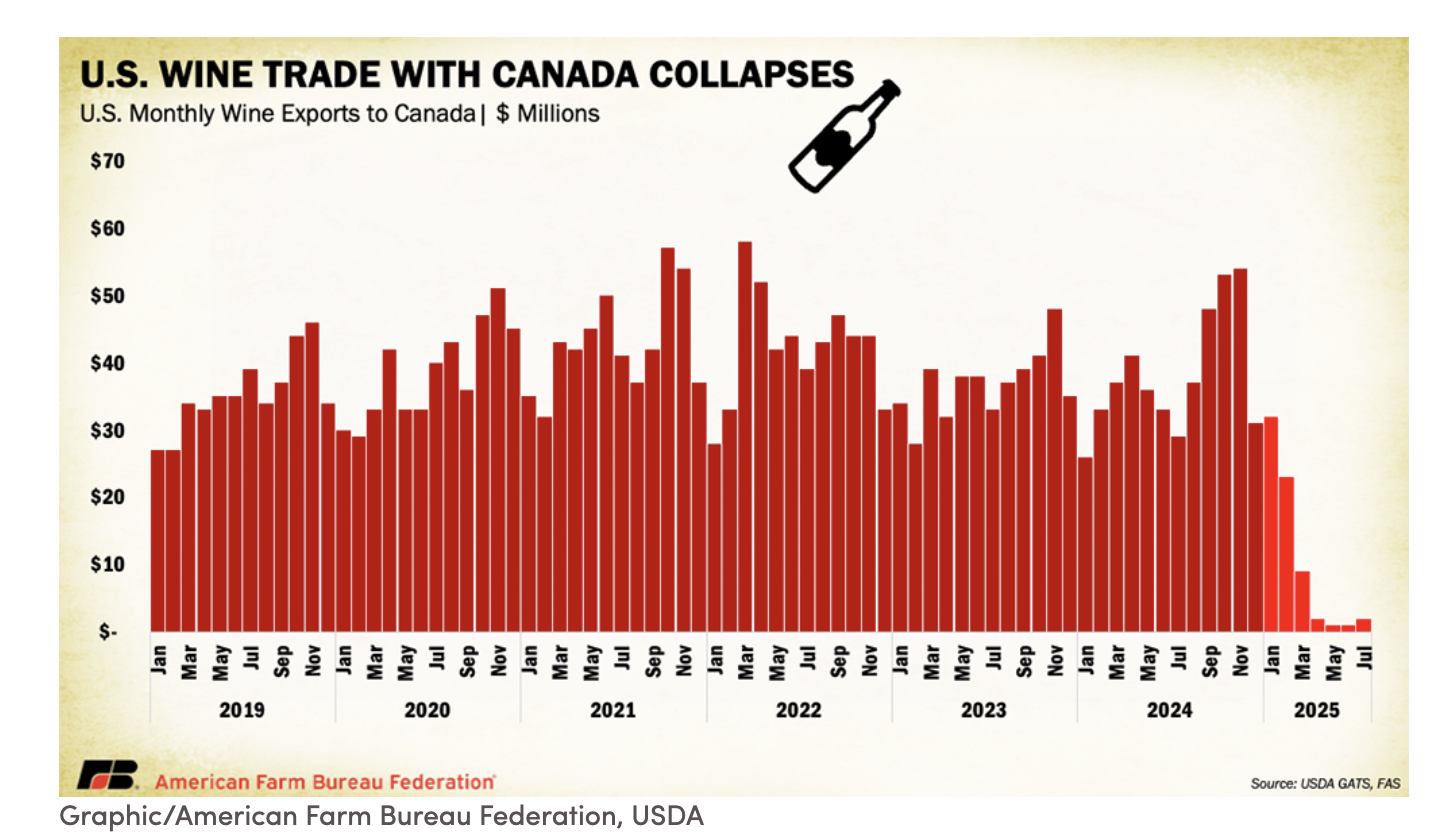
We haven’t even touched on the impact of President Trump’s tariffs on the wine industry, but the effect has been severe, particularly from the loss of a large export customer like Canada that has imposed a retaliatory tariff on liquor from the US.
Sometimes you feel like a nut
A similar trend has shaped the almond industry with farmers increasing their acreage year after year until the past few. In the year 2000 California had some 585,000 planted acres growing to 680,000 acres of almonds in 2005, 825,000 in 2020 and 1.6 million acres in 2020, the peak. Since then, the acreage has declined for four years in a row down to about 1.5 million acres currently. The new permanent plantings replaced annual field crop acreage like cotton and now require a dedicated water supply despite the huge variation in rainfall in California from the year to year. A field survey by Land IQ reports that around 51,805 acres of almond orchards will be removed at the end of this crop year adding to the nearly 67,000 acres removed during the 2023–24 period, based on Land IQ’s November 2024 estimate. These removals contribute to a broader trend of declining total and non-bearing acreage across the state over the past three years.The industry depends on exports that have been become embroiled in the trade war conflict.
The Farm Bureau reports the almond industry has been under financial stress. From 2019 to 2023, the average almond price declined to $1.81 per pound, down from $3.05 per pound during 2014–2018. Meanwhile, cost and return studies from the University of California show operating expenses increased roughly 40% between 2019 and 2024, while gross returns fell 36%, pushing net returns into negative territory. In the Sacramento Valley, net returns above total costs shifted from a modest $205 per acre gain in 2019 to a $4,280 per acre loss by 2024, leaving many operations unable to service debt or absorb high irrigation and input costs. During this period, an estimated 66,000 acres of almond orchards—about 5% of total growing area—were removed, as prolonged negative returns forced growers to idle or tear out orchards rather than continue producing at a loss.
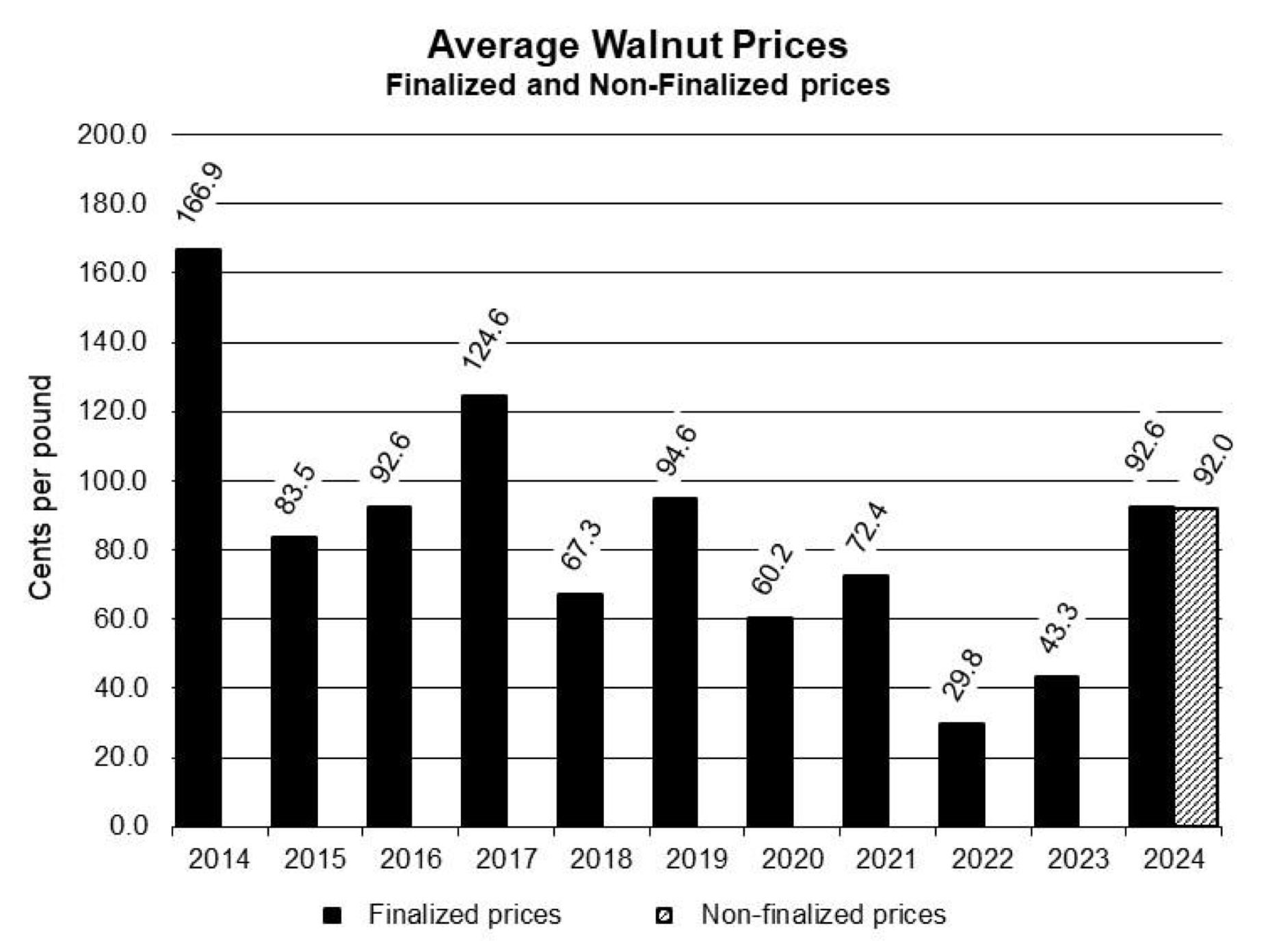
Another crop that has seen reduce acreage due to low prices are walnuts. Walnut farmers in 2022 receive just $.30 per pound for their crop rising to $.43 in 2023 and rising to $.92 in 2024. That’s still far lower than walnut prices a few years back. Farmers have reduced walnut acreage from about 441,000 acres in 2021 to about 370,000 acres today – a decline of 70,000 acres. The industry expects that they will be profitable although the export market continues to be a problem with India imposing a tariff of 30% on walnuts and in China, where the tariff is 60%.
Adding it up – between grapes, almonds and walnuts – farmers have reduced their excess plantings by 400,000 acres.With few other options available – what do you farm?
Adding it up – between grapes, almonds and walnuts – farmers have reduced their excess plantings by 400,000 acres.
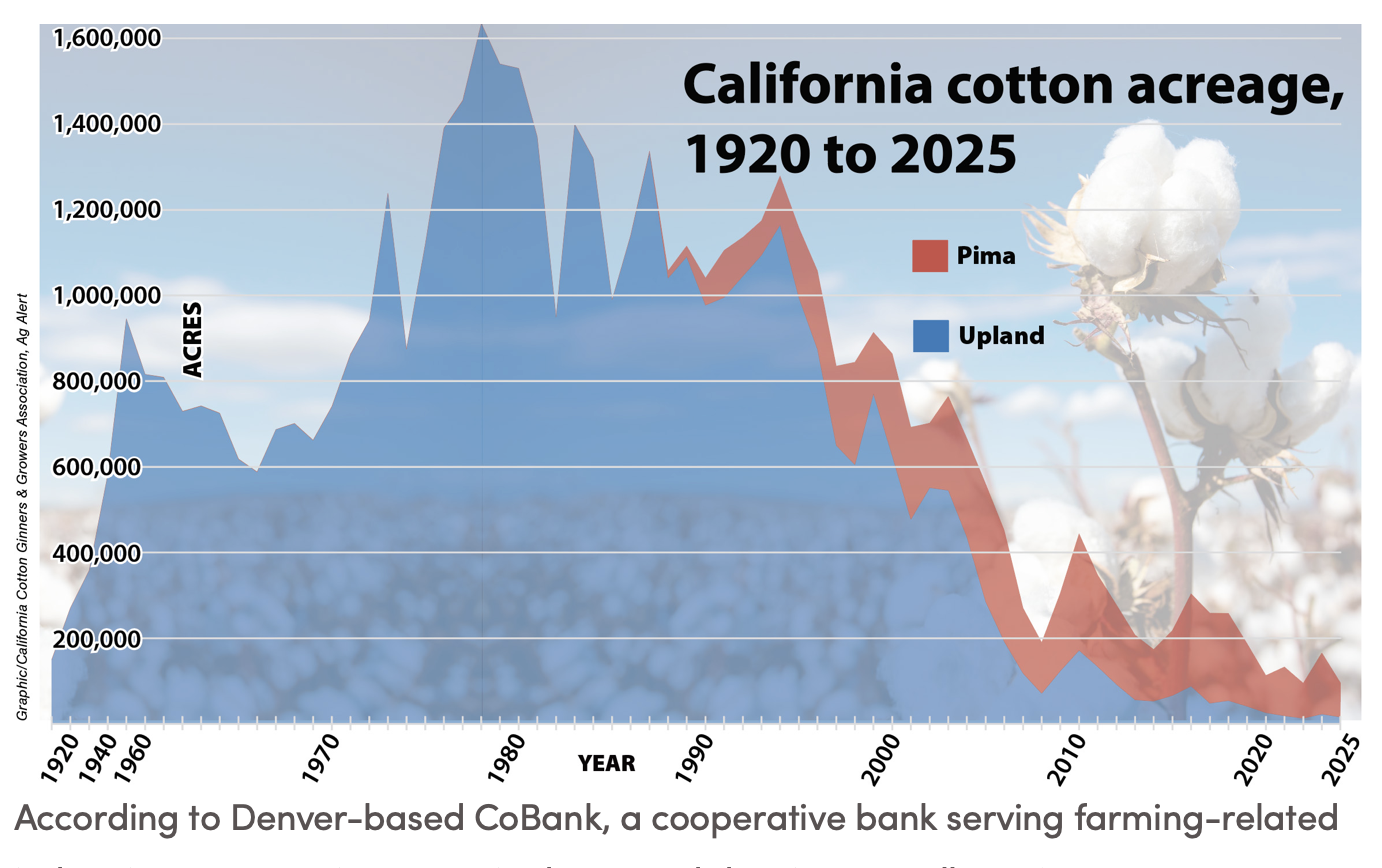
Still another California crop under pressure or worse is cotton, According to the Farm Bureau,Roger Isom, CEO of the California Cotton Ginners and Growers Association, said cotton farmers face one of the worst markets in memory. In terms of acres planted and low demand, he said 2025 will be the second or third worst year on record since the CCGGA was founded in 1920.
“We (California) produce 90% of the nation’s pima cotton, and prices are stagnant,” Isom said. “Upland cotton is at 85 to 90 cents a pound right now. That’s the same darn price as when I started 30 years ago. It’s tough out there for our farmers.” Isom said the stagnant-at-best cotton market has also hurt the revenue streams of businesses that support farmers, such as trucking companies and cotton gins. For example, Fresno County was the top cotton-producing county in the United States 20 years ago and had 26 gins in operation to handle the harvest. Now, he said, Fresno County is not even in the top 150 cotton-producing counties and has just one gin.
“Ten thousand jobs just went away,” Isom said.
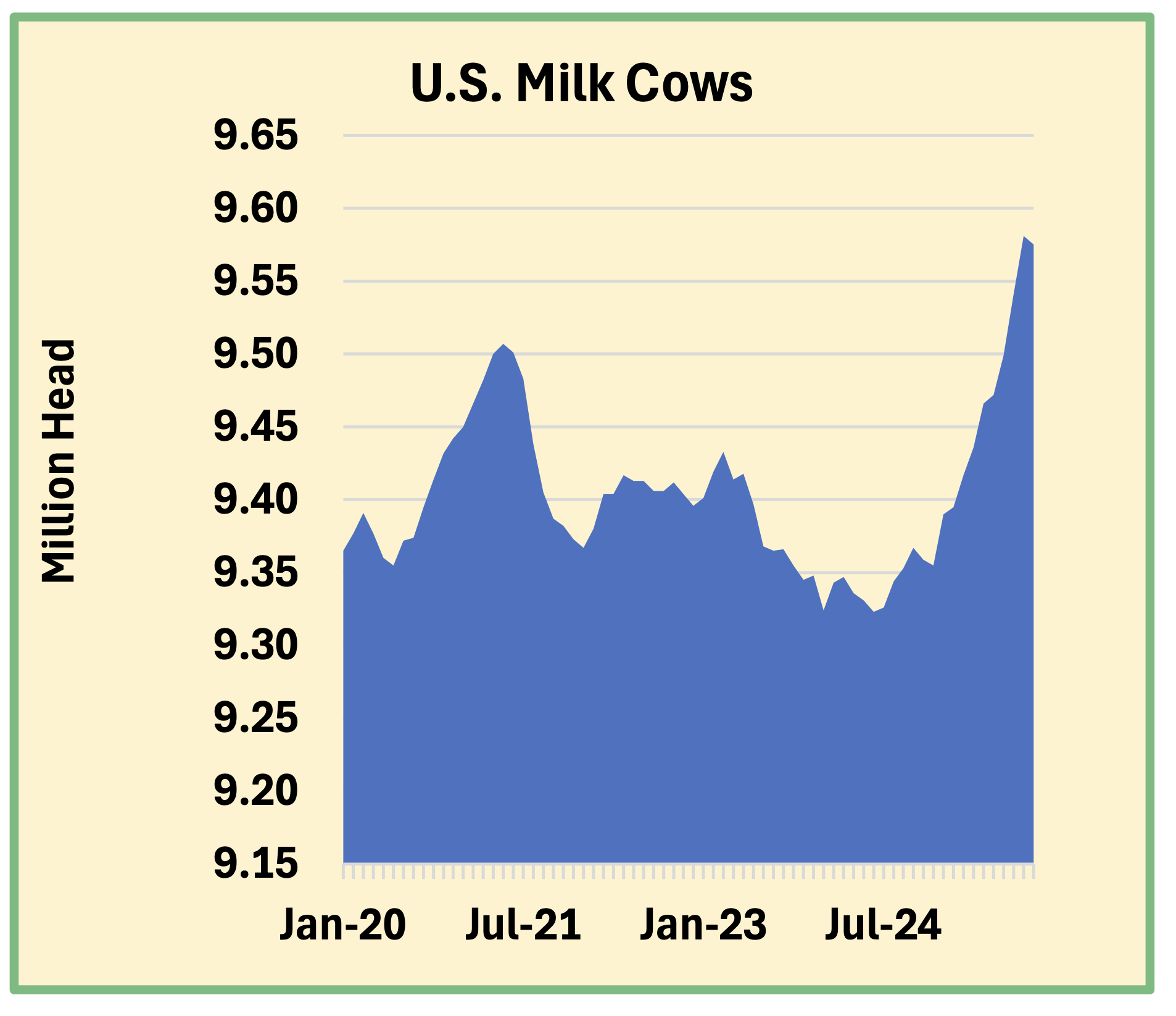
Meanwhile the states top crop -milk- is also under pressure in late 2025 suffering a huge decline in price based on oversupply- more cows- nationwide. Class 111 milk prices were $21 per cwt in January but now are around $16.90. Class IV milk was $20.70 in January but it dropped to $13.67 in December. Most of the milk marketed is in this class. Farmers have added more milk cows to their herd creating what is being called a “gush “of supply according to a recent market bulletin.California milk supply was up 6.9% in October.
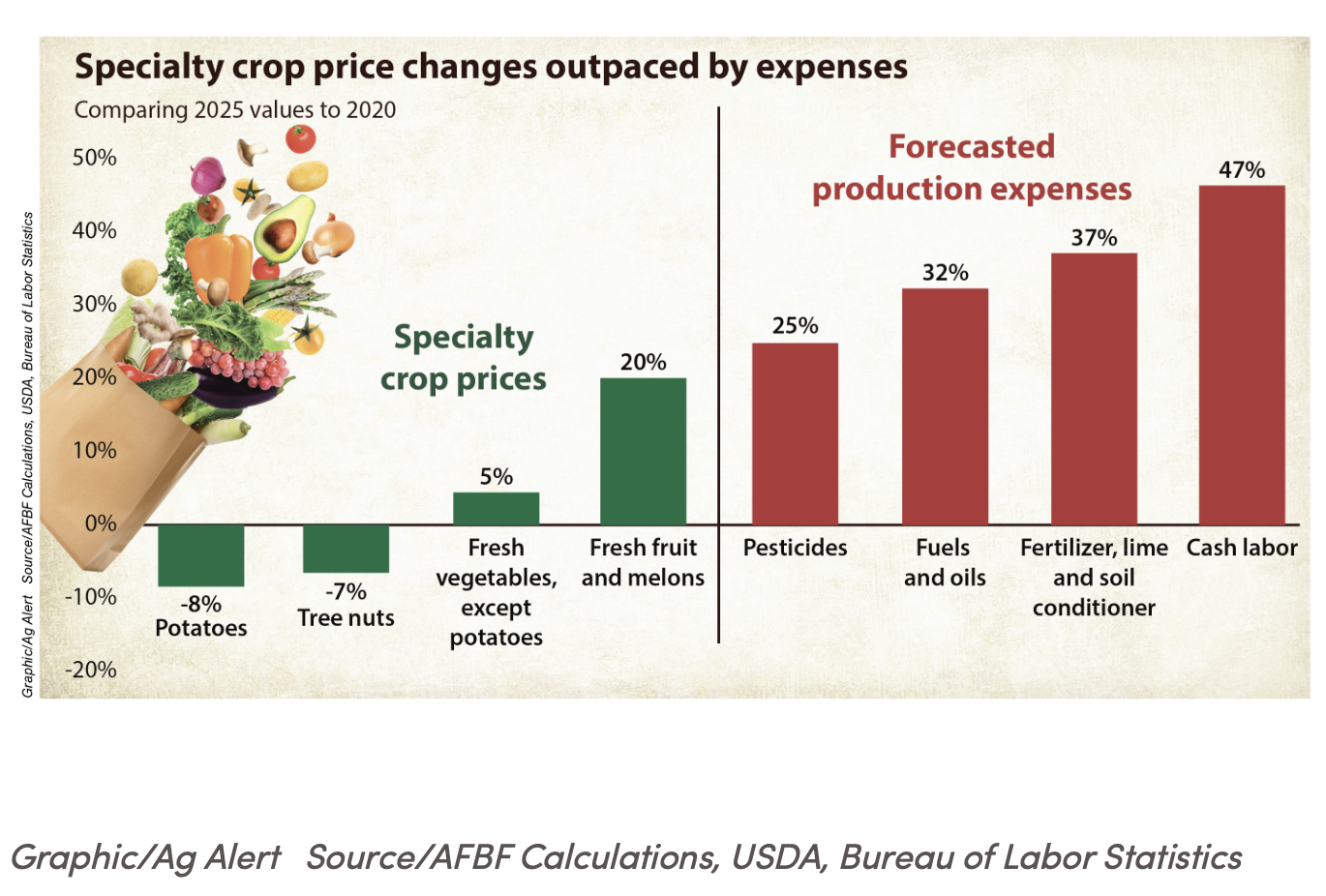
This week Ag Alert pointed to the low price for tree nuts but higher expenses for labor, fertilizer and pesticides. They added that potato prices are down as well.
Back on potatoes, the oversupply is impacted by other factors like increased harvest yields that can help boost supply without more acres allowing a grower to meet a contract on fewer acres.But the state’s farmers did over plant back in 2023 adding out 12% more acres. Now there is an oversupply.
Better yields tuned out well in processing tomatoes in California where the acreage has dropped from 300,000 acres in 1975 to 200,000 acres in 2025. But production has increased from about 7,000,000 tons to 11,000,000 tons in 2024. This is due to the fact that yield per acre has doubled even as water use has declined with the implementation of drip irrigation that has increased productivity. Farmers can make some money but only if they have a contract. Oversupply in this industry has still impacted a number of processors that have gone out of business in Central Valley in the past several years like Del Monte.
California Farm Bureau points out another factor- change in consumer preference that has affected the wine industry and now the craft beer business. And as everybody knows the in the potato industry more than half the spuds are these days frozen for fresh fries. Hey, did you know that none other than Thomas Jefferson was first to serve french fires in America offering them to guests at the White House.
Fears of $15 billion loss for corn farmers Nov 26,2025
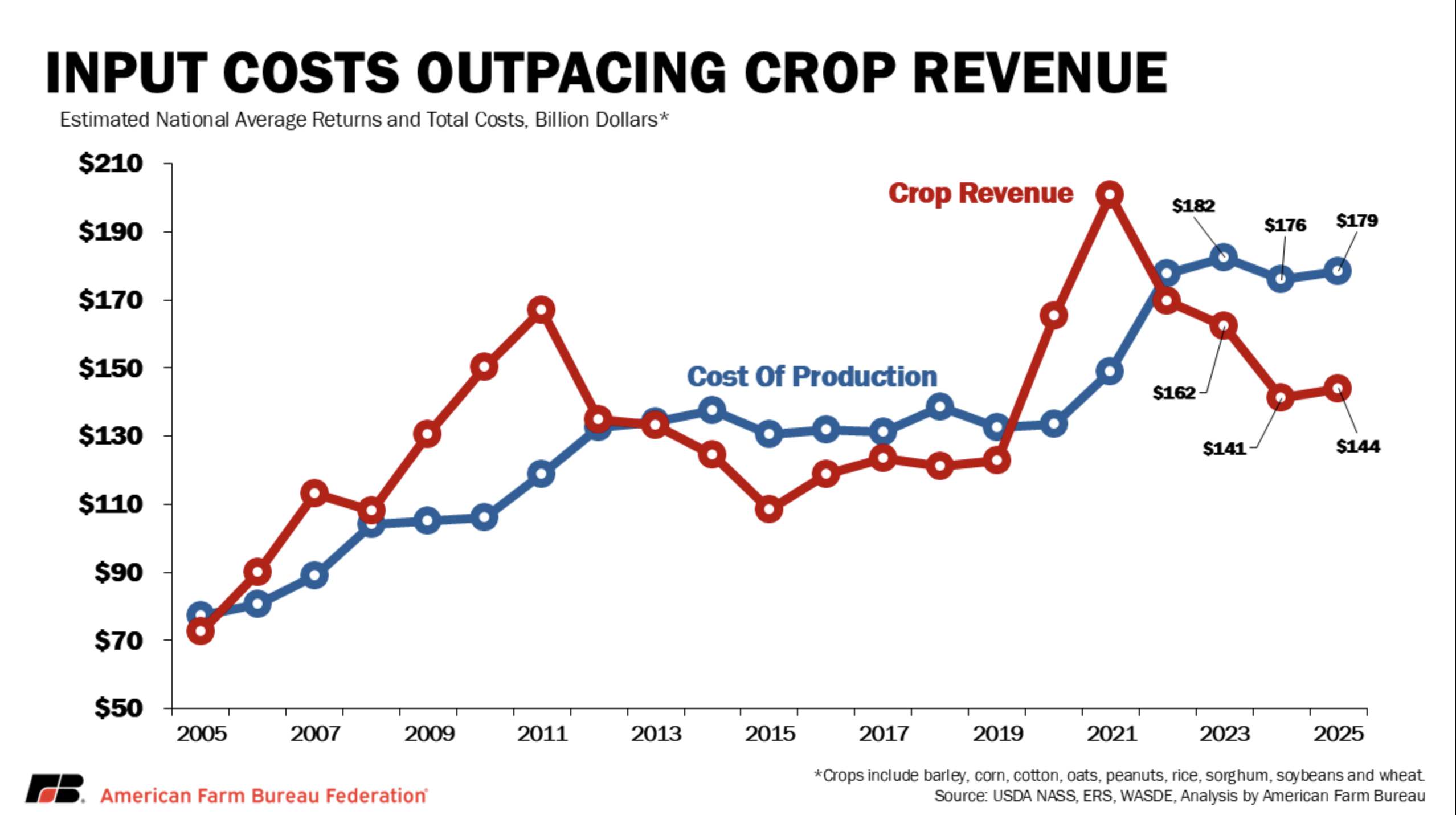
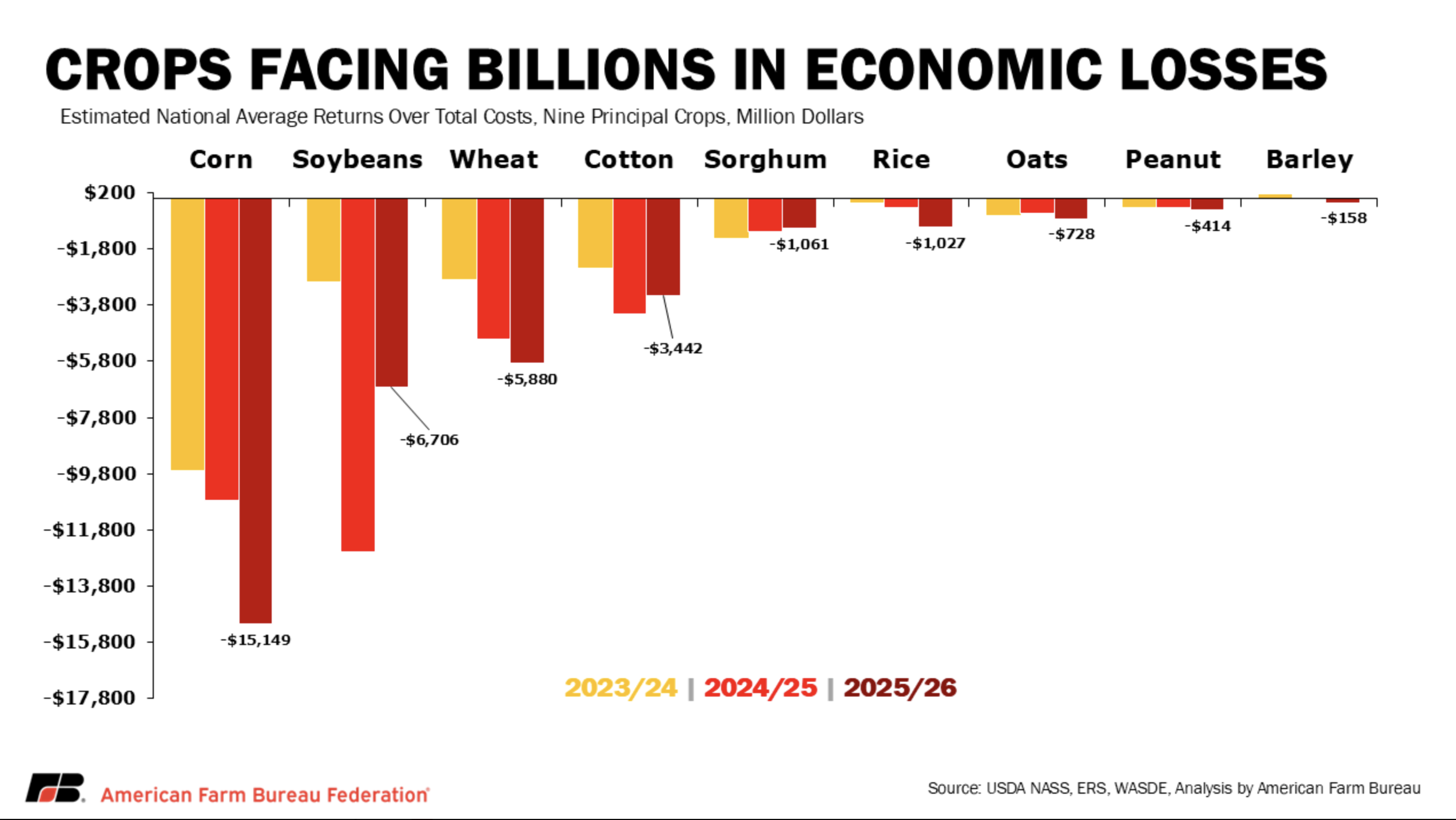
The American Farm Bureau is sounding the alarm about Midwest farmers’ financial strain. A recent podcast noted “As the Chinese backed out of the market, that put further pressure on prices. As farmers were harvesting a crop, many of them didn’t have storage and had to sell at harvest-time lows. So even though we’ve got a framework in place, and the Chinese are starting to buy product, for a lot of growers, the economic benefits of these frameworks may come too late.” In general low crop prices and higher input costs are bleeding red ink in the US ag sector. But now farmers switched to corn expected to build a surplus that will lead to huge new losses. That is happening since China typically buys close to half of the soybeans grown in the U.S. But the ongoing trade war means farmers in the Midwest must consider other options — and none are as profitable. “Due largely to the Chinese falling short of their Phase 1 soybean commitments, and more recent trade uncertainty, farmers across the Corn Belt pulled back on soybean acres and instead planted nearly 100 million acres of corn. At an average total cost (including fixed and variable operating costs) of putting the crop in the ground of approximately $900 an acre, corn farmers committed nearly $90 billion to sow a crop this spring. Now, even with an expected record yield of 186 bushels per acre and a $4 per bushel national average price, the return over total cost is estimated at a loss of over $150 per acre, with total losses nationwide eclipsing $15 billion.” That is just corn.
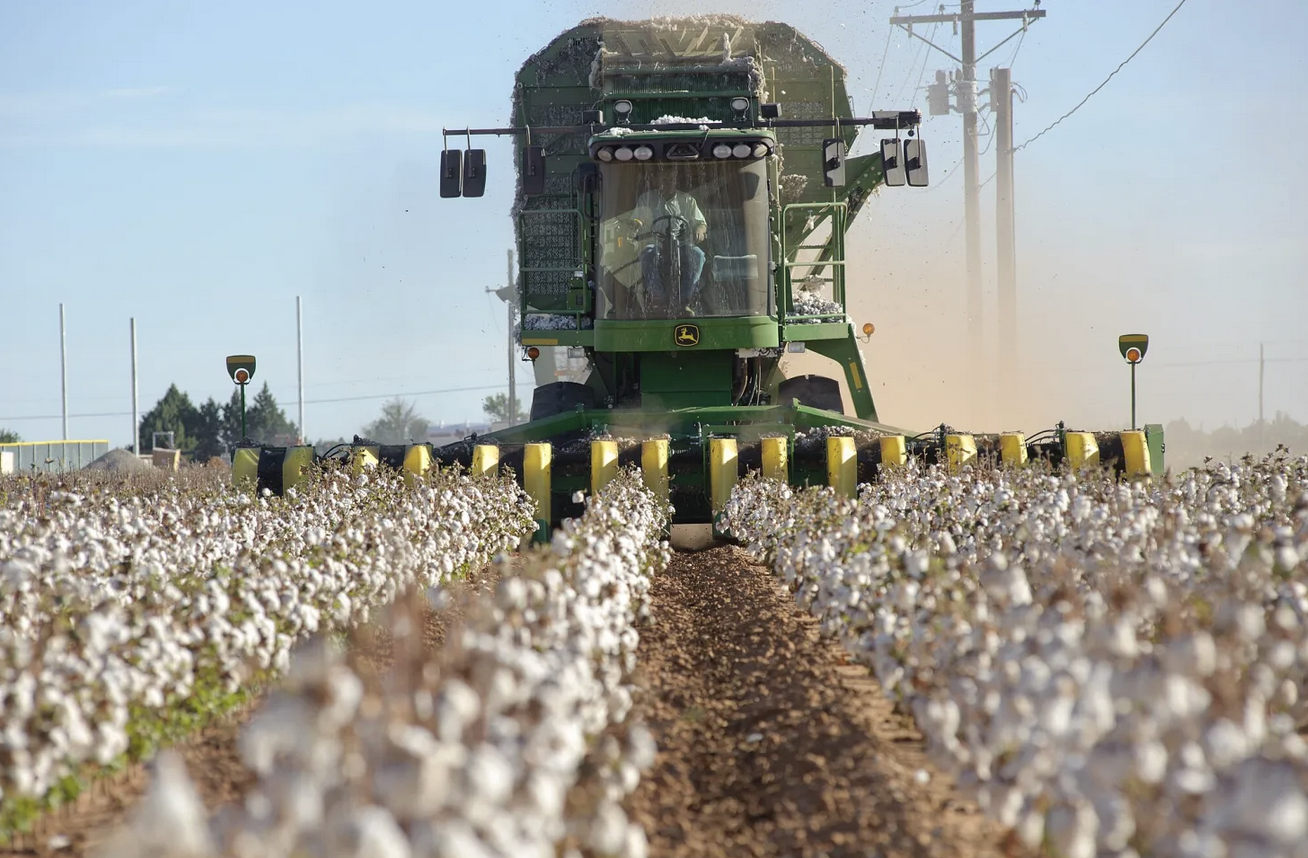
A harvester is in place at a Merced County cotton field to continue picking the 2025 pima cotton crop. California farmers planted 91,000 acres of pima and nearly 16,000 acres of upland cotton this year—a 33% decline in total cotton acreage from 2024 as the industry faces one of the worst markets in memory, according to the California Cotton Ginners and Growers Association.
Jeff Mancebo spends his Sundays doing the bills for his family farm in the Merced County town of Dos Palos, an NFL game sometimes flickering in the background. This year, Mancebo and hundreds of other cotton farmers in the Golden State are getting pummeled like a slow, aging quarterback under an all-out blitz.
The 68-year-old lifelong cotton farmer said his production of harvested Hazera and pima cotton will match low global demand. With cotton prices around the world continuing to stagnate, Mancebo said he planted fewer acres of cotton than he did in 2024, while his grain, almonds and pistachios keep his farm afloat.
“I’m a pretty conservative guy,” Mancebo said. “Cotton used to keep the tree business going, and now it’s the reverse. When there’s a good cotton year, I don’t go out and buy a bunch of stuff. I just roll with it.”
Mancebo said he planted 550 acres of Hazera and pima this year, down from his normal 800-900 acres. He said prices of pima cotton—a premium variety usually much sought after for higher-end clothing, sheets and towels—need to be more than $2 a pound for farmers to break even. But prices have hovered between $1.25 and $1.50 a pound in 2024 and 2025. So, he planted fewer acres than before and now sits at the dinner table paying bills that have become tougher to cover.
Mancebo is not alone.
Roger Isom, CEO of the California Cotton Ginners and Growers Association, said cotton farmers face one of the worst markets in memory. In terms of acres planted and low demand, he said 2025 will be the second or third worst year on record since the CCGGA was founded in 1920.
“We (California) produce 90% of the nation’s pima cotton, and prices are stagnant,” Isom said. “Upland cotton is at 85 to 90 cents a pound right now. That’s the same darn price as when I started 30 years ago. It’s tough out there for our farmers.”
Isom said California cotton farmers produce 600,000 bales in an average year, but that production will drop to an estimated 400,000 bales in 2025.
California farmers planted 91,000 acres of pima and 15,968 acres of upland cotton this year—a 38% drop in pima but a 30% increase in upland from 2024, the CCGGA reported. Overall, cotton acreage declined 33% from last year, the CCGGA said. Kings County continues to lead in plantings, with 47,753 of the state’s 106,968 acres.
Isom said the CCGGA has been on the front lines in the battle over California water restrictions. He also serves as CEO of the Western Agricultural Processors Association and president of the Agricultural Energy Consumers Association, focusing on legislative and regulatory efforts in Sacramento—particularly those affecting water flowing through the Sacramento-San Joaquin Delta.
“We always want to protect as many of the water rights as we can,” Isom said, “because that means healthy soil for all of our farmers.”
Merced County farmer Mancebo said he has an advantage over many of the cotton growers outside his Dos Palos farming region: The Central California Irrigation District in which he farms has a variety of water rights that were grandfathered in almost a century ago.
Mancebo said he pays a lot less for an acre-foot of water than farmers outside the CCID. He said he pays a Tier 1 price of $18 an acre-foot, which also covers water to irrigate his almond and pistachio trees, which are approximately in the middle of their productive lives.
“Water is not much of a worry for us under these normal conditions,” Mancebo said. “But fertilizer, labor and fuel are so much higher that there’s just no way we could plant upland (cotton) and get way less than a dollar a pound.
“We had a good, clean pima harvest last year with about 85% at Grade 1 (best),” he continued. “What I’ve been hearing from the gin manager is the cotton has been great this year, so I expect the same results or better this year. Quality is great, but the demand is down.”
California cotton acreage 1920-2025According to Denver-based CoBank, a cooperative bank serving farming-related industries, cotton prices remain depressed despite a smaller U.S. crop.
The bank said a slowing global economy continues to affect clothing and apparel sales, pushing cotton prices lower. Cumulative U.S. export commitments of upland cotton were down 18% year-over-year as of mid-September, CoBank reported—a concern for U.S. cotton farmers, as 80% of the cotton crop is typically exported.
The U.S. Department of Agriculture estimated the 2025-26 cotton crop at 13.22 million 480-pound bales, down 8% from the previous harvest.
Isom said the stagnant-at-best cotton market has also hurt the revenue streams of businesses that support farmers, such as trucking companies and cotton gins. For example, Fresno County was the top cotton-producing county in the United States 20 years ago and had 26 gins in operation to handle the harvest. Now, he said, Fresno County is not even in the top 150 cotton-producing counties and has just one gin.
An arson fire gutted the popular Downtown Visalia eatery Alejandra’s Mexican Restaurant in May 2022 shocking the owners and their large staff as well as the community.
Long wait
Now 42 months later, a long wait indeed, owner Roque Salinas says they will finally reopen as of Monday November 17 after the rebuilding of the family-owned restaurant known for its authentic Mexican cuisine including award-winning margaritas and their home-made salsa and chips.
Roque says the long wait came as the project was buried in technical issues that were finally resolved.Never give up hope.
Located just down the block from the Fox Theater at 314 W Main Street in Visalia the fire started in a dumpster behind the theater gutting businesses to the north including Alejandra’s Mexican Restaurant, Jimmy Johns Pizza, and Decor To Adore Visalia ca.
Owners Roque and Socorro Salinas launched their business in March 1993, in a small space in the strip center at Willis and Murray streets. Roque cooked and Socorro waited on tables. They moved to the current much larger 100-plus seat eatery in February 1996 as the city’s Downtown renaissance took off. Fans from all over Tulare and Kings Counties flocked here to savor the unique flavors dished up.The restaurant is named for Roque’s daughter.
Known for authentic Mexican food, specialties include pork dishes, fajitas, burritos, enchiladas, and chile verde.The remodeled place also features a full bar and patio dining.
Amazingly,” the whole kitchen staff is back and some of the front faces will be familiar” says Roque.
Your electric power costs keep climbing says Trump’s energy agency
Overall U.S. wholesale electricity prices are expected to continue rising next year, the US Energy Information Administration said in its latest short-term energy outlook, published this month. The agency forecast the load-weighted average of the 11 regional wholesale prices it tracks to be $47/MWh in 2025 — 23% higher than the 2024 average — and to reach $51/MWh in 2026, another 8.5% increase. Driving the rise in wholesale prices next year is primarily a projected 45% increase at the Electric Reliability Council of Texas-North pricing hub. “Natural gas prices tend to be the biggest determinant of power prices,” the EIA said. “But in 2026, the increase in power prices in ERCOT tends to reflect large hourly spikes in the summer months due to high demand combined with relatively low supply in this region.”
A solar/battery project looks to offset hefty electric bills at wastewater facility
Officials at the Rincon del Diablo Municipal Water District in the past week formally unveiled plans to build a solar canopy array and battery energy storage project at the Harmony Grove Village Water Reclamation Facility in Escondido Calif. The reclamation facility runs up a power bill of about $5,000 each month and the solar-plus-battery project will help offset the wastewater treatment center’s energy costs.The 302-kilowatt solar array with 559 panels atop a canopy will generate electricity to help run the treatment facility that recycles more than 180,000 gallons of wastewater on a daily basis.The solar-plus-battery project expects to break ground next month and is scheduled to be up and running by next summer. Clint Baze, the water district’s general manager, said the project will cost about $3.2 million, but a $1.2 million grant from the federal government’s Inflation Reduction Act will reduce the overall price tag.“After 20 years, it will pay for itself,” Baze said, given the anticipated savings on the treatment plant’s monthly electric bills.-San Diego Union
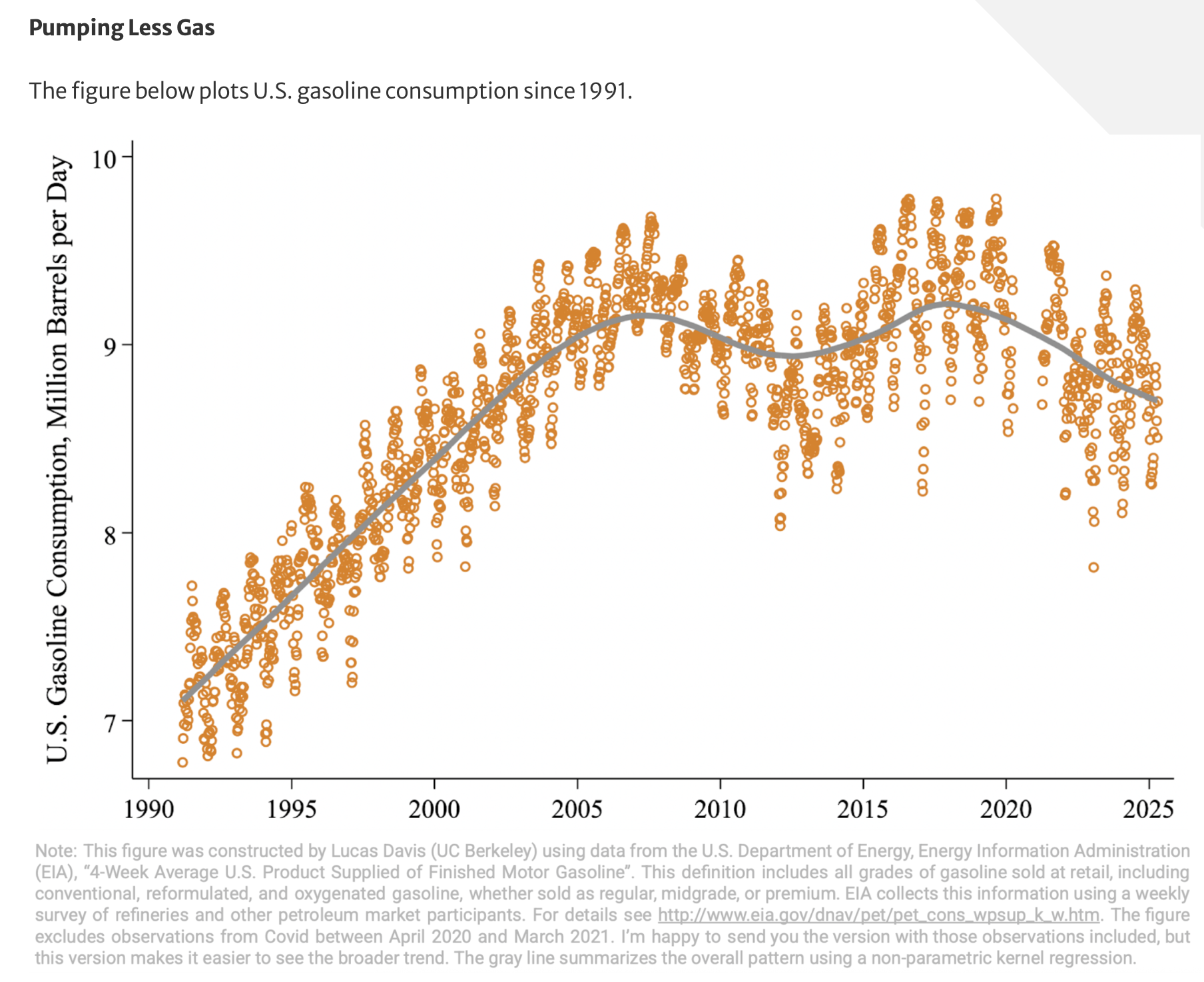
Is U.S. Gasoline Consumption Declining?
Electric vehicles and other factors are leading drivers to use less gasoline.
U.S. Gasoline consumption has increased steadily for decades. Between 1945 and 2007, there were 54 years with gasoline consumption increases, and only 9 years with gasoline consumption decreases. There really has been only one direction – up, and up, and up.
But that trend has changed recently. For today’s blog, I want to dig into the data on U.S. gasoline consumption. The U.S. population keeps growing, light trucks and SUVs are more popular than ever, and gasoline prices have mostly been below $4 per gallon. So you might have expected continued growth.
Yet for the last six years, U.S. gasoline consumption has trended downward. The overall decline is modest (about 5%), but stands in sharp contrast to previous decades, and is widespread across four-of-five U.S. regions.
It is always hard to know whether trends like this will continue, but it makes more sense to me now why refinery owners are cautious about the future, and why policymakers are scrambling to make up for lost gas tax revenues.-Energy Institute Blog
When leaders in Los Osos California want to solve a perplexing problem, need to figure out the town’s complicated water shortage dilemma or make improvements benefiting the community, they turn to chief explainer Ron Munds, general manager at the Los Osos Community Services District – the closest thing we have a city government in this unincorporated coastal community.
The 71 year-old Munds has been at the helm of the CSD since 2019 and now has told his board that he plans to retire next year. Last week, the board hired a consultant to start a search for a new general manager.
Ron Munds
A resident of Los Osos and CalPoly grad, Ron has no plan to leave the community. “We’ve lived here since 1975.” Munds says the CSD hopes to have a GM on board by April allowing Munds to help in the transition with his own contract up in August.
Arguably Munds is the go-to guy for all things water where he has formulated a strategy to use less groundwater – the only source of drinking water, pursue alternatives such as the use of more recycled water to irrigate our schools and parks and relocating water wells further east from the bay to reduce seawater intrusion. Perhaps his biggest project in the works now is connecting the community for the first time to an alternative source of new water – to the State Water Project that serves other nearby communities, including Morro Bay. Just in the past month the CSD board approved spending over $800,000 to launch the engineering of a 2.5 mile pipeline that will connect to the existing State Water project at So. Bay Blvd and Highway 1. Munds has also been active in seeking funding from both federal and state agencies to help out with the $10 million cost. The so-called Water Supply Resiliency Intertie Project could bring in 200 to 600 acre-feet of water annually. The basin uses about 1800 acre-ft of groundwater yearly, for now the only game in town.
Lesson from San Luis Obispo
This is not Munds’ first rodeo working to convince a community they should depend less on groundwater despite the expense of an alternative source. Munds worked on a team at the City of San Luis Obispo that had been suffering multi-year droughts starting in 2012 and earlier. Munds and water officials convinced city residents to put up with more expensive water rates for several years to help pay for what was to be the city’s salvation, constructing and connecting to a 45-mile pipeline to Lake Nacimiento – now the city’s top water source. The city decided to turn off most of their water pumps after a lawsuit accused groundwater pumping of causing subsidence – land sinking causing property damage along LOVR. One 2015 news article summarized “About 25 years ago in San Luis Obispo, Calif., an over dependence on groundwater became a destructive and expensive problem for the city.”
Nacimiento Pipeline
Munds experience with water also includes a stint with the County of San Luis Obispo as the Utilities Division Manager. He came to Los Osos with some 30 years of water management experience under his belt.
A strategy of long term conservation also plays a role in both SLO and Los Osos. San Luis Obispo’s water consumption has significantly decreased over the years, with a current annual usage of around 4,700 acre-feet compared to the late 1980s at 8,000 acre-feet. In Los Osos there has been a drop in water pumping, while not as dramatic, falling from 2200 acre-ft in 2015 to 1690af in the latest 2024 Basin Management report. Still that is not enough.
Munds remembers advising the Los Osos CSD board when he came to work in 2019 of his long range plan to hook up the community – as he did in SLO – to an outside source to cut down on year to year supply volatility and droughts. He brought with him that plan knowing that like SLO – the much smaller Los Osos pipeline project would take time to become reality.”It’s already been underway for 6 and 1/2 years”, he notes. “The vision is long term. We need to look 40 years out “he observes. Munds hints he may work on the pipeline project even after he steps down from the position in hopes to be under construction in a few years.
Munds frequently finds himself in the middle of the never-ending debate over growth, with the latest news – the controversy over whether water pumping in the community is allowing more seawater intrusion and what to do about it. Munds frequently offers the idea that the additional water supply will be a” insurance policy” not a vehicle for lots of growth but quality of life issues – just”so you can count having a vegetable garden in your backyard.”
Recently the 35-year building moratorium here has been lifted following the approval of the Los Osos Community Plan. That plan allows for growth by addressing previous concerns about water supply, wastewater treatment, and habitat protection but limits new construction to a 1% annual growth rate for residential units and less. It requires new development to connect to the water recycling facility.But now the Basin Management group made up of the three water purveyors including the CSD and the County have voted not to approve any growth in 2026 after a new study said seawater intrusion was underway.The County BOS alone will make the final decision.
An aside: if reduced pumping on the land would push harder against the sea, the rise in worldwide seawater levels are a bigger problem even Munds can’t solve, although don’t tell him he can’t.
Not just water
The CSD and Ron Munds don’t just work on water issues. The agency also seeks more recreational and park land in the community and has been active in a proposal to buy the mothballed Sunnyside School property in an upcoming referendum. CSD has been playing a more active role in guiding improvements in town like pickleball courts given that the county has often disappointed residents and of course, right now faces budget issues of their own.
The CSD and Mr. Munds is also struggling with the high cost of firefighting and emergency services currently working on a plan of possibly coordinating the service with the City of Morro Bay.
Recently, the CSD and the county celebrated the connection of three local Los Osos schools and parkland to recycled water from the wastewater treatment plant that will now replace water wells that have been irrigating grounds at Los Osos Community Park, Monarch Elementary School and the Los Osos Middle School.Plans are in the works to add recycled water to the Los Osos Elementary School as well as the vacant Sunnyside School once it is acquired by a community group led by the CSD, another one of those Ron Munds good deed projects.
Trusted partner
Los Osos community leader Deborah Howe, chair of the Los Osos Community Advisory Council says ” Ron is such an important partner for so many projects in the community.”
“He is trusted, caring and compassionate. I see him all over town including ringing the Christmas bells at the local grocery store to raise money for the hungry.”
“Working directly with him, Ron has been instrumental in the current effort to acquire Sunnyside school. Glad to hear he will still be part of our community.”