Trade Deficit Falls On Exports

According to the  the May 2012 U.S. International Trade in Goods and Services report, U.S. goods and services exports in May 2012 increased 0.2 percent from April 2012 to reach $183.1 billion, with record exports in total services ($52.4 billion), and foods, feeds, and beverages ($11.8 billion).

Exports of U.S. goods and services through the first five months of 2012 were up 5.7 percent, or $48.6 billion, from the same period of 2011 to reach $908.7 billion.
Acting U.S. Secretary of Commerce Rebecca Blank said “U.S. exports posted their second-highest level on record in May despite some tough economic conditions abroad, confirming the progress we are making on the path to achieving the President’s goal of doubling exports by the end of 2014,” said Acting U.S. Commerce Secretary Rebecca Blank. “But there’s much more work to do, and we must keep up efforts to support manufacturers and the auto and transportation industries, including supporting President Obama’s continued efforts to leveling the playing field so that American businesses and workers can compete, win and sell their products around the world to create good-paying American jobs. We are on track toward exceeding last year’s export total of $2.1 trillion, which supported 9.7 million jobs.  One of the bright spots in manufacturing exports has been motor vehicle and parts, which reflects the overall resurgence of cars and trucks made in the United States. ”

Making cars


In May 2012, the monthly U.S. goods and services trade deficit improved by 3.8 percent to $48.7 billion when compared to April 2012. This reflected a $1.6 billion decrease in the goods trade deficit.
 U.S. goods and services exports year-to-date through the first five months of 2012 were up 5.7 percent or $48.6 billion from the same period of 2011 to reach $908.7 billion.
 In May 2012, the average import price per barrel of crude oil was $107.91 per barrel, slightly down from the $109.94 per barrel recorded in April 2012. The decrease in the value of crude oil imports in May 2012 was due entirely to the decrease in price, as the quantity of crude oil imports in May (272.3 million barrels) was up slightly from the quantity imported in April (270.0 million barrels).
TRADE SPOTLIGHT: Transportation Month
 The United States exports a great deal of manufactured goods. Through May 2012, manufactured goods are up nearly 9 percent to $556.5 billion as compared to the same period in 2011. Nearly one-fifth (18 percent) of those goods are transportation equipment.
 Transportation equipment (including aerospace products and parts, automotive vehicles and parts, ships and boats, railroad rolling stock, recreational vehicles, motorcycles and bicycles) accounted for the largest category of U.S. merchandise exports, amounting to $218 billion in 2011

SLO Marathon Delivers $3 Million Economic Impact

 According to a report compiled by SLO based Productive Impact LLC, the inaugural San Luis Obispo marathon and half-marathon had a $3 million economic impact in San Luis Obispo County. The race was held  in April.Using data from an online survey of race participants, the study estimates that nearly 80% of the $3 million resulted from spending by the 3,143 participants and their supporters on items such as lodging, food, souvenirs, gas and event preparation. The remaining 20% represents the operational costs for the organizer.The study also estimates that 55% of participants were non-local and brought an average of three additional people with them to the event. These visitors stayed in the area an average of 1.33 days, generating a total of $37,903 in transient occupancy tax within the County. Event participants also generated $85,153 in sales tax.

Working with regional partners to promote recreational activities – such as the marathon – is one of the strategies recommended in the Economic Development Strategic Plan.  The success of the marathon is an example of how these types of events contribute to the quality of life in SLO and benefit the local economy.

Gas Price Watch: Still Falling

California average gas prices continue to fall approaching mid-July to $3.65 per gallon, down from $4.35 in mid-May. Some stations in the state are as selling as low as $3.33 this wee with the lowest prices in our reading area as follows:

SLO:Costco $3.67. Bakersfield:$3.49 at FoodsCo.Tulare:$3.54 at Super Stop. Visalia:$3.58 at Costco.Hanford: $3.53 at Chevron.  Fresno:$3.45 at Fast Trip. Info courtesy Gas Buddy.

The July 9 California Energy Commission gasoline report says: Still holding the downward trend, falling for a seventh week, Regular is lower then the previous week. Dropping several cents, over last weeks price.

The average price in California for regular gasoline decreased 15.4-cents from the previous week. The average statewide price for regular was $3.733. Mid-grade and premium prices decreased as well.
The national average for self-serve regular is at $3.411, down 2.6 cents from the previous week.This is 32.2 cents lower than the price of regular in California.


New NOAA Report Examines Climate Conditions

 –Warmer & Saltier Ocean

The lead character of the 2011 climate story was a double dip La Niña, which chilled the Pacific at the start and end of the year. Many of the 2011 seasonal climate patterns around the world were consistent with common side effects of La Niña.
Worldwide, 2011 was the coolest year on record since 2008, yet temperatures remained above the 30 year average, according to the 2011 State of the Climate report released online today by NOAA. The peer-reviewed report, issued in coordination with the American Meteorological Society (AMS), was compiled by 378 scientists from 48 countries around the world. It provides a detailed update on global climate indicators, notable weather events and other data collected by environmental monitoring stations and instruments on land, sea, ice and sky.
“2011 will be remembered as a year of extreme events, both in the United States and around the world,” said Deputy NOAA Administrator Kathryn D. Sullivan, Ph.D. “Every weather event that happens now takes place in the context of a changing global environment. This annual report provides scientists and citizens alike with an analysis of what has happened so we can all prepare for what is to come.”
Two back-to-back La Niñas, each characterized by cooler-than-average water temperatures in the eastern equatorial Pacific, affected regional climates and influenced many of the world’s significant weather events throughout the year. These included historic droughts in East Africa, the southern United States and northern Mexico. La Niña conditions contributed to an above-average tropical cyclone season in the North Atlantic hurricane basin and a below-average season in the Eastern North Pacific. It was also associated with the wettest two-year period (2010–2011) on record in Australia, which was particularly remarkable as the wet conditions followed a decade-long dry spell.

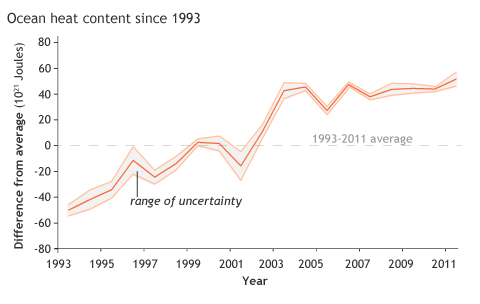
La Niña chilled the eastern tropical Pacific in 2011, but ocean heat content nearly everywhere else was above the long-term average. Maps and trend graphs of 8 additional are available from climate.gov.
The Arctic continued to show more rapid changes than the rest of the planet. Sea ice shrank to its second smallest “summer minimum” extent on record during 2011, as older ice (four to five years old) reached a new record minimum at more than 80 percent below average. Overall, glaciers around the world continued to lose mass. Loss from Canadian Arctic glaciers and ice caps were the greatest since measurements began in 2002.
The report used 43 climate indicators to track and identify changes and overall trends to the global climate system. These indicators include greenhouse gas concentrations, temperature of the lower and upper atmosphere, cloud cover, sea surface temperature, sea level rise, ocean salinity, sea ice extent and snow cover. Each indicator includes thousands of measurements from multiple independent datasets.
Highlights:
-Warm temperature trends continue: Four independent datasets show 2011 among the 15 warmest since records began in the late 19th century, with annually-averaged temperatures above the 1981–2010 average, but coolest on record since 2008. The Arctic continued to warm at about twice the rate compared with lower latitudes. On the opposite pole, the South Pole station recorded its all-time highest temperature of 9.9°F on December 25, breaking the previous record by more than 2 degrees.
-Greenhouse gases climb: Major greenhouse gas concentrations, including carbon dioxide, methane, and nitrous oxide, continued to rise. Carbon dioxide steadily increased in 2011 and the yearly global average exceeded 390 parts per million (ppm) for the first time since instrumental records began. This represents an increase of 2.10 ppm compared with the previous year. There is no evidence that natural emissions of methane in the Arctic have increased significantly during the last decade.
-Arctic sea ice extent decreases: Arctic sea ice extent was below average for all of 2011 and has been since June 2001, a span of 127 consecutive months through December 2011. Both the maximum ice extent (5.65 million square miles, March 7) and minimum extent (1.67 million square miles, September 9) were the second smallest of the satellite era.
-Ozone levels in Arctic drop: In the upper atmosphere, temperatures in the tropical stratosphere were higher than average while temperatures in the polar stratosphere were lower than average during the early 2011 winter months. This led to the lowest ozone concentrations in the lower Arctic stratosphere since records began in 1979 with more than 80 percent of the ozone between 11 and 12 miles altitude destroyed by late March, increasing UV radiation levels at the surface.

NOAA’s State of the Climate in 2011 report was published today by the Bulletin of the American Meteorological Society. For more, visit NOAA’s State of the Climate 2011 webpage

Download here. (Credit: NOAA). 

Sea surface temperature & ocean heat content rise: Even with La Niña conditions occurring during most of the year, the 2011 global sea surface temperature was among the 12 highest years on record. Ocean heat content, measured from the surface to 2,300 feet deep, continued to rise since records began in 1993 and was record high.
Ocean salinity trends continue: Continuing a trend that began in 2004 and similar to 2010, oceans were saltier than average in areas of high evaporation, including the western and central tropical Pacific, and fresher than average in areas of high precipitation, including the eastern tropical South Pacific, suggesting that precipitation is increasing in already rainy areas and evaporation is intensifying in drier locations.
The report also provides details on a number of extreme events experienced all over the globe, including the worst flooding in Thailand in almost 70 years, drought and deadly tornado outbreaks in the United States, devastating flooding in Brazil and the worst summer heat wave in central and southern Europe since 2003.
The 2011 State of the Climate report is peer-reviewed and published annually as a special supplement to the Bulletin of the American Meteorological Society. The report is part of a suite of climate services NOAA provides government, business and community leaders so they can make informed decisions. It was edited by Jessica Blunden, Ph.D., and Deke Arndt of NOAA’s National Climatic Data Center. The full report can be viewed online. The report highlights are available online.


Visalia Hwy 99 Widening To Begin

With $46.6 million in funding approved by the state Transportation Commission June 27, CalTrans is wasting no time to begin work to widen Highway 99 to 6 lanes around the 99/198 interchange.”We hope to start the 4 mile stretch from the town of Goshen toward Caldwell as soon as November” say project manager Phillip Sanchez.

Sanchez says the Fresno CalTrans office has four segments of 99 being widened through Tulare County with the stretch from Kingsburg to Goshen well underway. Two others are programed to start up after this latest 4 mile segment that includes the Visalia airport frontage is completed, in about 2 and one half years.

The next leg south is Caldwell Ave to Tagus.

“Hopefully the funds will be there to continue the widening one after another.”

Tulare County Association of Governments director Ted Smalley credits a partnership with CalTrans that had kept design work and right of way acquisition ahead of construction monies to be ready to build whenever funds are available.  Savings from some other regional projects help fund this one as bids continue to very competitive.

Construction of the widening at 99 at 198 will coordinate well with the completion of the 198 expressway between 99 and Hanford that will also improve connections and safety along the biggest crossroads in Tulare/Kings counties. The expressway should be complete this November after some delay over nesting birds say CalTrans.

Sanchez says Hwy 99 near198 gets an average of 53,000 vehicles a day of which about one quarter are big-rig trucks. That compares to around 39,000 vehicles a day in more rural parts of the county like around Pixley.

“We expect Hwy 99 traffic to double in the next 25 years.”

Bakersfield Highway 99 traffic far busier however with an average daily vehicle count of 142,000 he says.

Besides the safety factor, improving the freeway interchanges and highways around Visalia/Goshen should help move the large volume truck traffic in and out of the Visalia Industrial Park, a key draw for industry.

Coming in a few years, a new interchange at Betty Dr.

Rival Airline Wants To Serve Visalia

SeaPort Airlines who operates over 150 daily scheduled flights in Arkansas, Kansas, Missouri, Oregon, Tennessee, Texas, and Washington has made an application to the Department of Transportation to serve Visalia starting this fall under the Essential Air Service program

The Oregon-based airline has been talking with Visalia officials in recent weeks about their proposed air service that would be an alternative to the current operator, Great Lakes Airlines.‘We are in the process of recommending one or the other to the Department of Transportation” says Visalia airport manager Mario Cifuentes. The recommendation is due August 1 to the federal agency who will make the final decision. Two city council members serve with staff on the committee that makes the recommendation.

Seaport would require the DOT to increase the current subsidy by $100,000 annually, says Cifuentes, an added hurdle forhrt airline as rthe EssentialAir service remains controversial and under the microscope in a political year.

Cifuentes says Seaport’s plan is to operate small 9 passenger planes that would offer Visalians daily service to Oakland, Burbank and San Diego with one plane running a circuit each day.

If the airline was selected over Great Lakes, the connection to LAX, currently with 2 daily flights,would be lost notes Cifuentes,a connection long sought by Visalia. Previously the city had daily flights  only to Ontario in the Southland.

For now Visalia is served by Cheyene,Wyoming-based Great Lakes with flights to both Las Vegas and LAX.

However, sources say Great Lakes could drop Las Vegas but offer three daily flights to LA from Visalia instead of just two.Cifuentes says LA is much more important for business connections as well as to access connecting flights around the world compared to the leisure market in Las Vegas.

“That would be a plus” says Cifuentes since “flight frequency is so important to travelers, particularly business travelers.”

“Three flights a day to and from LAX offers more choice and options for people who miss a flight” making it more convenient to travel from Visalia. Great Lakes does code sharing with both United and Frontier making it convenient to to use Visalia to reach whatever destination a traveler needs without a price penalty.

Ridership with Great Lakes has improved in the past year from about 5 passengers a day to 10.5 says Cifuentes.”We had a flight with 17 passengers a few days ago, all with connecting flights.” The planes have 19 seats.

The Essential Air Service program remains under fire from conservative critics like Tom McClintock who represents part of Fresno County, who delivered these remarks on the House floor a few days ago.

“This program shells out nearly $200 million a year – including $114 million of direct taxpayer subsidies – to support empty and near-empty flights from selected airports in tiny communities – most of which are just a few hours’ drive from major airports.

A reporter recently investigating this waste took one of these flights from Ely Nevada and was the only passenger on the flight. Our constituents paid $1.8 million for this air service that carried just 227 passengers during the entire year! Ely is a three and a half hour drive from Salt Lake City International Airport.”

Because of press accounts and the political focus on the Ely market, sources say the ESA will likely drop  that community from service freeing up the Great Lakes plane that homebases there.

Bad news for Ely may be good news for Visalia.

Ag Update

2011 Crop & Livestock Report to be presented July 24Tulare County’s 2011 Annual Crop and Livestock Report will be presented to the Board of Supervisors on Tuesday, July 24. Copies of the report will be available during the presentation and posted online.
The Agricultural Commissioner, Marilyn Kinoshita, will present the report and offer brief comments regarding its contents.

Corn Crop Sizzles: Drought in the cornbelt continues this week and prices are heading to $8 a bushel for July corn and $7.30 for September. That’s’ high enough to hurt both the livestock industry and ethanol makers,some of who are idling plants.Late today USDA reported that just 40% of the corn crop was in good to excellent condition,down from 48% a week ago and 69% this time last year. USDA also said 30% of the corn crop was now in very poor to poor condition compared to 22% just a week ago.

Short Chinese Garlic Crop
The Packer newspaper reports that a” short, lower-quality Chinese garlic crop should open the door for California producers, who report good yields and excellent quality.
The combination of a big, high-quality crop from California and a short crop from China could produce a milestone in the 2012-13 marketing season, said Jim Provost, president of West Grove, Pa.-based I Love Produce.
“I’ve been hoping for a year where California exports garlic to China,” Provost said. “This could be it.”


Soup Maker Campbell Buys Bakersfield’s Bolthouse Farms

The worlds’ largest soup maker has purchased a Bakersfield company that grows carrots, makes salad dressing and refrigerated drinks.The price tag, $1.55 billion.
Campbell Soup Company (NYSE:CPB) announced this week that it has entered into an agreement to acquire Bolthouse Farms from a fund managed by Madison Dearborn Partners, LLC, a private equity firm.
Founded in 1915, Bolthouse is a vertically integrated food and beverage company focused on developing, manufacturing and marketing proprietary, high value-added natural, healthy products. The company has leading market positions in fresh carrots and super-premium beverages in the U.S., along with a growing presence in refrigerated salad dressings.
The company employs more than 2100 in Kern County.
Campbell says the acquisition of Bolthouse will provide them with significant presence and a new platform for expansion in the rapidly growing, $12-billion market for packaged fresh foods. The addition of Bolthouse’s market-leading super-premium refrigerated beverages will complement Campbell’s successful “V8” beverage business and will create one of the industry’s largest healthy beverage platforms, with annual sales of approximately $1.2 billion.
Bolthouse’s strong market position in fresh carrots in the U.S. and Canada will also provide an attractive opportunity for growth with value-added products in healthy snacking. Between Bolthouse and rival Grimmway Farms of Kern, the two produce about 90% of the state carrot crop.
Denise Morrison, Campbell’s President and Chief Executive Officer, said, “Bolthouse is a great strategic fit with Campbell. Its business platforms, capabilities and culture are well aligned with the core growth strategies we announced last year. Its strong position in the high-growth packaged fresh category complements our chilled soup business in North America, and offers exciting opportunities for expansion into adjacent packaged fresh segments that respond directly to powerful consumer trends

New Report Sees Trucking Gains Through 2023

Arlington, Va. – After a significant dip during the Great Recession, and a mild economic recovery, the U.S. freight economy, particularly for trucking, is projected to grow significantly in the years ahead, according to American Trucking Associations’ U.S. Freight Transportation Forecast to 2023.

The Forecast, a product of collaboration between ATA, IHS Global Insight and Martin Labbe Associates, lays out the current state of the freight economy where trucking is the leading mode of transportation and projects an even more robust role for trucks in the future.

“The trucking industry continues to dominate the freight transportation industry in terms of both tonnage and revenue, comprising 67% of tonnage and 81% of revenue in 2011,” ATA Chief Economist Bob Costello wrote in this year’s forecast.

Overall, total freight tonnage is expected to grow by 21% by 2023, and revenue for the freight transportation industry is projected to rise 59% in that same timeframe. Trucking’s share of the tonnage market will rise over 2 percentage points to 69.6% by 2023, while the industry’s share of freight revenues will increase to 81.7% from 80.9%.

In other surface modes, rail’s overall share of tonnage will fall to 15% in 2023 from 15.7% in the baseline year of 2011. However, intermodal tonnage will rise 6.2% a year between 2012 and 2017, and then 5.4% annually through 2023.

Domestic waterborne tonnage will show very modest growth between now and 2023 – growing 1% annually through 2023. Domestic airfreight tonnage is slated to grow over 4% annually during the forecast period.

Kings County News Update

Appeal Denied In Waste Management Suit: On July 3, 2012, the Fifth District Court of Appeal affirmed a trial court decision , denying challenges filed by El Pueblo Para El Aire Y Agua Limpio against the Kings County Board of Supervisors and Chemical Waste Management, Inc. The petition for writ of mandate challenged the Subsequent EIR prepared for the County’s approval of an expansion of the Kettleman Hills Facility, which is one of only two currently active permitted hazardous waste disposal facilities in California. The petition alleged that the project’s health-related impacts were not adequately analyzed, the daily truck traffic baseline was inflated, and the cumulative impacts analysis did not analyze all existing operations at KHF as related projects.

First New SAR Helicopter At NAS Lemoore: A Search and Rescue (SAR) helicopter touched down at Naval Air Station Lemoore for the first time in years last month.
The Sikorsky MH-60S Seahawk is the first of three helicopters that will comprise the new SAR unit.  With the establishment of the new unit, NAS Lemoore will soon be able to provide search and rescue capabilities to support the open water training requirements of the 15 strike fighter squadrons based at the air station.
“The SAR unit gives us the ability to take care of our own personnel and aircraft when they operate over the Pacific Ocean’s training ranges,” said Capt. Eric Venema, NAS Lemoore Commanding Officer.
The training ranges off the coast of central California have been under-utilized because of the cold water temperatures.   The SAR unit will also cover inland training ranges.
The helicopter was transferred to NAS Lemoore from Helicopter Sea Combat Squadron Six based at NAS North Island.  About 30 active-duty Navy personnel will be assigned to the unit that will be operational in October.
Hanford Costco? A Fresno based developer has filed a General Plan Amendment with the City of Hanford to develop a 500,000 sf shopping center anchored by “discount club” retailer, presumably a Costco. The application for a 58 acre parcel at the northwest corner of Hwy 198 and Hwy 43 includes the 150,000 sf store and second major anchor.
Costco is not named as the tenant and there is some doubt the retailer would select that site or even come to town.Comments on the project were due to city July 3. A hearing will be scheduled.
Hanford’s Wastewater Treatment Solar Farm is under construction this summer. The one megawatt solar farm cost $4.3 million to construct but  an agreement with Chevron Energy Solutions is a lease purchase agreement. The city received $1.64 million California Solar Initiative funding to be used to help pay for the project and savings from the power not purchased will add up to$89,000 a year to the city, explains staffer John Doyel. In year 16 through 20 the city will save over $500,00 each year.The city owns the unused property next to their WWT plant. Hanford joins other Valley cities using solar to offset power costs at their WWT plants including Tulare,Dinuba and soon Visalia.
City of Lemoore is in the process of approving new residential projects including one of the few towns of its size with several active new home subdivisions. Also this summer the city is expected to approve a new180 unit apartment complex in town reflecting investor expectation the town will grow as the  Navy air based continues to adds more people.
Kings Waste and Recycling Authority will gain title to 22 acre owned by the city of Lemoore south of their waste water treatment plant.That site was to be leased to Full Circle Energy for installation of a solar farm but the company defaulted on the agreement. As of July 25 the 22 acres will revert to KWRA as part of an earlier in JPA agreement.