Consumer Watchdog Tells So Cal Drivers Fill Up Now

Gas Prices To Rise Quickly As Major Refiners Switch to Summer Blend And Raise Prices On Their Dealers By 37 Cents Over Night

2/25/2016-
Screen Shot 2016-02-03 at 9.58.49 AMLos Angeles, CA — The nonprofit group Consumer Watchdog today warned Southern California drivers that they would be facing sticker shock at their gasoline pumps beginning this weekend as the state’s biggest oil refiners raised wholesale prices charged to station owners by 37 cents.
The price hike accompanies the transition to summer blends of gasoline, which are being delivered by oil refiners to branded gasoline stations beginning today.  Street prices will begin rising as of today.
“Drivers in Southern California should fill up now because gasoline prices are going up quickly and not coming back down for a while,” said Consumer Watchdog president Jamie Court. “Oil refiners made billions extra last year because of our pain at the pump and after a short respite the pain is going to continue. What’s remarkable is that the four major oil refiners all raised the prices to their branded stations, 75% of the Southern California market, in unison and by nearly the same amount. When four refiners control nearly 80% of the gasoline production and 75% of the stations in the area this market is rigged for refiners’ profit and drivers’ pain.”
Consumer Watchdog said that deals could still be had at Costco and unbranded independent stations for the next few days, but that prices at branded stations would have to change with deliveries of gasoline beginning today.  If oil refiners raise prices by 37 cents, those costs have to be passed on to drivers or station owners will be under water, Consumer Watchdog said.
The gasoline market that the major refiners trade large amounts of gasoline on, known as the spot market, jumped 50 cents on February 24th, from 68 cents per gallon to $1.18 per gallon.
As of today, California gasoline prices are still 68 cents higher than the U.S. average. The coming price spike will grow that gap and continue to fuel record profits for oil refiners in the state, said Consumer Watchdog.

PG&E Offers New Solar Program

February 11,2016-

SAN FRANCISCO, Calif. — Pacific Gas and Electric Company (PG&E) today launched PG&E’s Solar Choice program, extending the option for 100 percent solar power to customers who are not planning to install rooftop solar panels. Customers can purchase half or all of their electric power from solar energy locally sourced in Northern and Central California, reducing their carbon footprint and driving the development of new solar resources within the state.
Screen Shot 2016-01-26 at 12.38.52 PMApproximately half of U.S. households and businesses are unable to install rooftop solar due to space, lack of sun exposure or ownership limitations1. For a modest charge, PG&E’s Solar Choice program extends solar access and benefits to residential and business customers regardless of their location or ability to physically install rooftop solar. As the program develops, the solar energy purchased by customers will be sourced from new solar projects built by developers across PG&E’s service area, bringing new green jobs to Northern and Central California.
“PG&E’s Solar Choice program is all about giving customers more choice and control over their energy, and bringing the benefits of solar to our communities. Our customers already enjoy some of the cleanest power in the country. Now, they can directly contribute to bringing more renewable energy onto the electric grid – a win for our customers and for California,” said PG&E Senior Vice President and Chief Customer Officer Laurie Giammona.
PG&E’s Solar Choice can help renters, homeowners, businesses and cities meet their own sustainability, clean energy or climate goals. Additionally, participating organizations could qualify for LEED points for green building leadership as well as the U.S. Environmental Protection Agency’s (EPA) Green Power Partnership for electricity generated from renewable resources.
Kelly Slater Wave Company is one of the first California businesses to partner with PG&E’s Solar Choice to go 100 percent solar, purchasing renewable energy with zero greenhouse gas emissions and lowering their carbon footprint. The company is powering their new wave technology and high-performance training center in California’s Central Valley.
“We are committed to encouraging sustainable development at any site using our technology. As part of this commitment, we are pleased that our first site in Central California is 100 percent powered by solar energy through PG&E’s Solar Choice. This program allows Kelly Slater Wave Company to not only be a pioneer in wave technology, but also in supporting sustainable power initiatives as we act environmentally through an alternative to installing solar panels and fulfill our vision of building the best man-made wave,” said Noah Grimmett, General Manager of Kelly Slater Wave Company.
PG&E recently announced that all of its operations service centers – nearly 100 facilities in Northern and Central California – will be 100 percent powered by solar energy through PG&E’s Solar Choice program.
PG&E’s Solar Choice is part of the company’s ongoing commitment to support the growth of solar and enable customers to reduce greenhouse gas emissions from their electricity usage. To date, more than 55 percent of the energy PG&E delivers to customers comes from sources that emit no greenhouse gases. PG&E has already connected more than 215,000 solar customers to the grid and anticipates that PG&E’s Solar Choice program will extend access to solar to approximately 40,000 additional homes and businesses across the company’s service area.
PG&E’s Solar Choice program is Green-e® Energy Certified. Green-e Energy is the nation’s leading independent consumer protection program for renewable energy, and sets environmental and consumer-protection standards established by the nonprofit Center for Resource Solutions.
Customers can visit www.pge.com/solarchoice to learn more about the new program. View the online tool for more details on the monthly charge and environmental impact associated with signing up for PG&E’s Solar Choice.
About PG&E

Reversible Solid Oxide Fuel Cell Demonstrated at Navy Base

02/04/16

From Naval Facilities Engineering Command Engineering and Expeditionary Warfare Center Public Affairs

“Combined with a solar photovoltaic array, a SOFC system generates electricity, potable water, and heat with only two inputs, sunshine and seawater.

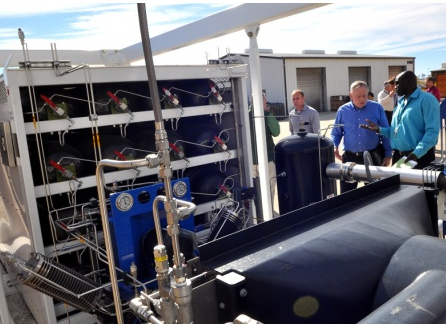
PORT HUENENE, Calif. (NNS) — The first live demonstration of the 50 kW (scalable to 400 kW) reversible Solid Oxide Fuel Cell (SOFC) system was held at the Naval Facilities Engineering Command, Engineering and Expeditionary Warfare Center (NAVFAC, EEWC), at Naval Base Ventura County, Port Hueneme, Jan. 28.

The manufacturers of the system, Boeing, Huntington Beach and Sunfire, Dresden, Germany, operated the system and answered questions from the attending NAVFAC EXWC personnel.

”The SOFC is a most promising technology for both remote islands and expeditionary applications,” said Michael Cruz, EXWC project manager. “Combined with a solar photovoltaic array, a SOFC system generates electricity, potable water, and heat with only two inputs, sunshine and seawater.”

The system is the largest of its kind using a technology called a “reversible solid oxide fuel cell” to store energy from renewable resources (including wind and solar), producing clean, zero-emissions electricity.

The system generates, compresses and stores hydrogen. When the grid demands power, it operates as a fuel cell, consuming the stored hydrogen to produce electricity. This technology is unique in being able to both store energy and produce electricity in a single system, making the technology “reversible.”

This first unit was commissioned on the Southern California Edison power grid at Boeing’s Huntington Beach, California, facility before being installed for further testing on the Navy’s ‘microgrid’ at the NAVFAC, EXWC.

Screen Shot 2016-02-06 at 11.29.55 AM

More Californians Hitting the Road

February 4,2016-

2014-15 Gasoline Consumption Increase Largest in More Than a Decade

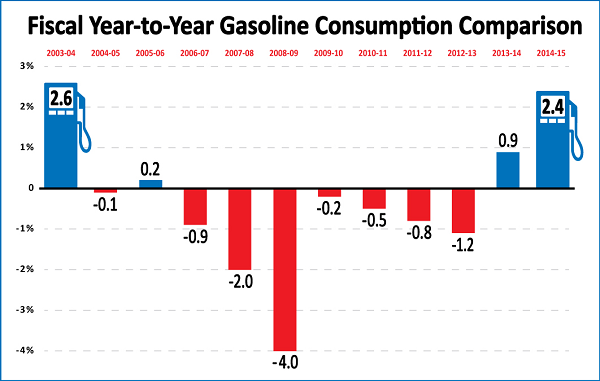
Screen Shot 2016-02-04 at 8.20.49 AMSacramento – The California State Board of Equalization (BOE) announces gasoline consumption in the state rose 2.4 percent during fiscal year (FY) 2014-15, the largest yearly increase since FY 2003-2004 (increase of 2.6 percent). The rise in fuel consumption signals a strengthening California economy, with cheaper gas prices encouraging more vehicle travel.

Chairman: “The increase in gasoline consumption shows more people are working and families can afford more road trips now,” said BOE Chairman Jerome E. Horton.

Vice Chair: “Lower gas prices means Californians can do more with less,” said Vice Chair George Runner. “With more Californians back on the road, it’s time for the governor and Legislature to prioritize improving our infrastructure without raising taxes.”

Ma: “Working families need a break. Lower gas prices put less of a strain on their household budgets,” said Board Member Fiona Ma.

Harkey: “California’s economy is improving and getting stronger every day. Lower gas prices are a driving factor behind our state’s improving economy,” said Board Member Diane Harkey.

In FY 14-15, Californians consumed 14.921 billion gallons of gasoline, a 2.4 percent increase from 14.574 billion in FY 13-14. During FY 14-15 California’s average price of gasoline was $3.42 per gallon, a decline of 12.8 percent from the average price of gasoline of $3.92 in FY 13-14. During FY 14-15, diesel consumption rose 2.5 percent, following a 3.5 percent jump in FY 13-14.

Fiscal year gasoline consumption data is calculated from July 1, 2014 – June 30, 2015. The trend of rising gasoline consumption continued into the third quarter of 2015 (July – September), increasing 2.7 percent from the third quarter of 2014. Third quarter diesel consumption rose 1.3 percent.

In FY 14-15, BOE gasoline revenue estimates for sales and use taxes and excise taxes came in at $1.470 billion for sales and use tax and $5.371 billion for excise tax. In FY 14-15, BOE diesel revenue estimates for sales and use taxes and excise taxes were $830.2 million for sales tax and $357.7 million for excise tax.

Employment and Economic Factors

After taking a significant recession-era hit, California’s economy has bounced back up to the seventh largest in the world as the state’s gross domestic product reached $2.3 trillion in 2014, according to the U.S. Bureau of Economic Analysis (June 2015). Despite the ongoing drought, the agricultural sector grew in 2014 as well as economic growth in fields spanning information technology consulting to construction-related engineering, architecture, and manufacturing.

More Californians are finding employment and driving to work, according to BOE’s chief economist. In California, non-agricultural employment rose 3.0% in the third quarter of 2015 compared to the 2014 third quarter, according to the Employment Development Department.

The BOE reported that gasoline consumption in the state rose 2.4 percent during fiscal year 2014-15.

15 Tulare/Visalia Stations Offer Gas Below $2

February 3,2016-

Screen Shot 2016-02-03 at 9.58.49 AMNine Tulare gas stations and six in Visalia are offering regular for under $2 today according to Gas Buddy. Statewide the cheapest gas in the state is in Delano where they are selling gasoline for $1.85. Statewide the average price has dropped to $2.56 from $2.89 a month ago. Meanwhile wholesale prices are up almost 20 cents in the past few days suggesting that falling prices may come to an end.

Recurrent Plans New 150MW Solar Farm in Kings County

January 26,2016-

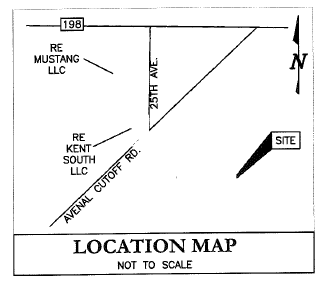
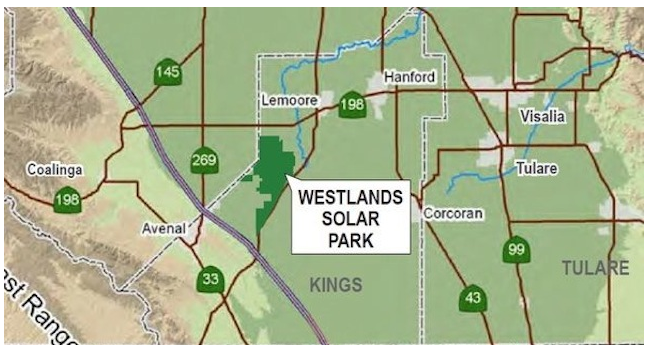
Screen Shot 2016-01-26 at 6.43.06 AM Screen Shot 2016-01-26 at 12.38.52 PMThe Kings County Community Development Agency has received an application for a land development permit that proposes to establish a 150 Megawatt (MW) photovoltaic solar energy generating facility to be constructed on approximately 2,427 acres. The project site is located southeast of Avenal Cutoff Road between Kent Avenue and Lansing Avenue near Lemoore and the navy base.
The project being built by Recurrent Energy would construct another utility-scale solar farm adjacent several other already built by the same firm. That includes Mustang Solar 1,a 100MW project under construction and Kent South ,a 20MW completed Recurrent project along the Avenal Cutoff – what is becoming Kings County’s solar highway.Also nearby on Ave 25 is Orion solar,a 20MW farm already in operation.
Unlike the other solar farms SF-based Recurrent is planning to add a utility-scale energy storage facility as part of the project that could store energy at night.
In total Recurrent’s solar footprint in this part of Kings County will add up to nearly 300MW.
The new Mustang 2 project is expected to be processed on a negative declaration and be built this year. A public hearing on their CUP application is expected soon.The project is being built on land owned by Westlake Farms’ Ceil Howe, who has been impacted by the multi-year drought with lack of an adequate water supply to grow crops on this land.

LA Wholesale Gasoline Down To $1 A Gallon

January 26,2016-

Screen shot 2012-06-09 at 7.35.08 AMLos Angeles RBOB gasoline futures are down to $1 a gallon today having now dropped from $1.65 in December and $2.68 as of July 2105.The wholesale price was $3 in February 2013. The price drop, fueled by $30 a a barrel oil,is finally reducing retail prices at the pump in California to below $2 a gallon at a few stations including one in  both Tulare and Fresno as of today selling for  $1.99 according to Gas Buddy. The state joins the rest of the nation who has seen a steady decline in retail gas prices.

Nationwide AAA reports that tumbling crude oil prices around the world have helped send the national retail average price for gasoline to its lowest mark since February 2009. Retail averages have fallen for 63 of the past 74 days, for a total savings of 34 cents per gallon, reaching today’s price of $1.88 per gallon. Gas prices are down seven cents per gallon on the week, which is the fastest pace gas prices have dropped since the middle of November. Motorists typically enjoy falling gasoline prices in early winter due to decreased demand for gasoline and that also is helping to push prices downwards. Despite recent declines, the national average price of gas is only 18 cents per gallon cheaper than a year ago since prices also were very low in early 2015.

Around California Gas Buddy is reporting that Lodi is sporting the lowest price in the state at $1.89. In our reading area the lowest price in Visalia is at Costco selling regular for $2.09. San Luis Obispo’s  lowest is at Costco selling for $2.59.

The average California price is down to $2.65 having dropped about 30 cents this month with room to drop lower if the RBOB futures are any guide having plunged 68 cents this month.That could mean widespread gasoline availability below $2 a gallon in coming weeks.

If lower oil and gasoline prices are good news for California motorists, in Kern County its a another story. The Bakersfield Californian reports that  lower oil revenues will be hitting local government hard.
“Assistant County Administrative Officer Nancy Lawson, who builds the county’s budget each year, said Kern is bracing for a $35 million drop in property tax money — $10 million of which will hit the Kern County Fire Department directly.”

In addition job losses in  he oil industry in Kern County are numbering in the thousands in recent months.

Energy Commission Staff Recommends Killing Application For $4 Billion South Valley Hydrogen Plant

December 22,2015-

A 7-year-old plan to make hydrogen from petroleum coke in Kern County with a $4 billion dollar price tag may still be under study by the US Department of Energy but staff at the California Energy Commission(CEC) who must approve the project – have lost patience.

HECA 2  2015-12-22 at 11.53.00 AMThe controversial project, Hydrogen Energy of California (HECA) has already received some $286 million in federal support to study the idea that would have sequestered CO2 from burning petroleum coke to make the hydrogen.The plant would have made 1 million tons of fertilizer each year the proponent,SCS Energy said.

On December 15 the staff of the CEC recommended the agency terminate the application as soon as early January when a deadline to move forward or not was to expire. Staff suggested SCS had not resolved key issues such as where the CO2 would go- when they were supposed to.“It is reasonable to estimate that a well-defined, complete project will not be forth coming until 2017 or even 2018.”

“ HECA has not met the requirements, and will not be able to meet the requirements of the July 3, 2015 Committee Order. Staff recommends that the project be terminated rather than continue to be held in suspense.”

It will be up to the board of the state energy commission to make a decision.

The company who is proposing the project says delays associated with the finalization of the CO2 off-take agreement are key.  As of. December 2015, HECA proposed buying its own CO2 and burying it directly into the rocks below its site. If this were to go ahead it would eliminate the need for a”off-take” agreement which is one of the main reasons for the project delay. Occidental Petroleum had previously agreed to buy the CO2.

The CEC staff report noted that “HECA also set forth a plan to perform extensive site characterization and site specific geological analysis from January 2016-December 2016 to assess the viability of the project site to sequester and store CO2.” The CEC staff says once the company completes the study to sequester the CO2 they could re-apply for new permit but that this seems several years away.

The Sierra Club had opposed the project citing air emissions and water issues. They pointed to the “ enormous pollution that 350 daily truckloads of coal would have brought to Kern County.”

HECA 1 2015-12-22 at 11.52.15 AM

Renewable Energy Tax Breaks Should Boost Central California Economy

December 21,2015
Congress passed and the President signed important tax breaks for the renewable power industry the week before Christmas that should boost the pace of Central California solar,wind and biofuel projects and add thousands of jobs well after the tinsel comes down.
In the same legislative package – Congress abolished what was a 40-year ban on oil exports as the GOP and Democrats did a bit of old fashion horse trading. This should also be a boost to the ailing Valley oil industry who has lately been shedding jobs locally.

Solar

Screen Shot 2015-12-21 at 12.07.36 PMThe renewable energy incentives include a 5-year solar investment tax credit (ITC) extension ,a 30% federal tax credit that has helped thousands of Californians pay for their rooftop solar system.In the Central Valley there has been a rooftop solar boom with a three-fold increase  in the past two years.According to Construction Monitor residential solar systems installed in the Central Valley including Fresno,Kings, Madera and Tulare Counties adds up to 11,717 homes so far this year at $119 million.That compares to 3843 homes for $46 million in 2013. Utility-scale commercial solar projects in the same region were 81 in 2013 adding up to $112 million but this year they number 213 projects and add up to $145 million.
Now look for the trend to continue.
The Solar Energy Industries Association released a statement saying  “Thanks to the ITC, solar energy will add 220,000 new jobs by 2020, and with this extension, the solar industry can achieve its pledge of employing 50,000 veterans. Clean solar energy will cut emissions by 100 million metric tons and replace dozens of dirty power plants. Importantly, in the follow up to the Paris accord, this establishes the United States as a model for the reduction of greenhouse gases.
“A five-year extension of the ITC will lead to more than $133 billion in new, private sector investment in the U.S. economy by 2020. And much of this growth will come from small businesses, which make up more than 85 percent of America’s 8,000 solar companies.
“Solar power in this nation will more than triple by 2020, hitting 100 gigawatts. That’s enough to power 20 million homes and represents 3.5 percent of U.S. electricity generation.

Wind

Screen Shot 2015-12-19 at 11.41.25 AMUnlike solar – wind energy tax credits had expired at the end of 2014 until last weeks’s vote after uncertainty slowed new projects.
“We’re going to keep this American wind-power success story going,” said Tom Kiernan, CEO of the American Wind Energy Association (AWEA). Kiernan said the agreement will give the industry a break from the boom and bust cycles that have caused serious disruption in the market in the past.
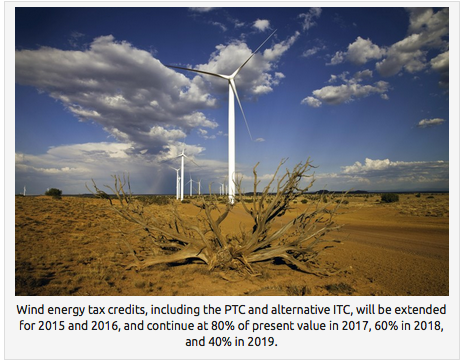
As a result, the wind energy PTC and alternative ITC will now be extended for 2015 and 2016, and continue at 80% of present value in 2017, 60% in 2018, and 40% in 2019. As before, the rules will allow wind projects to qualify so long as they start construction before the end of the period.
The performance-based PTC has helped more than quadruple wind power in the U.S. since 2008 – up from 16,702 megawatts (MW) installed at the start of 2008 to 69,470 MW by the third quarter of 2015. This is enough power to supply over 18 million American homes.
It has encouraged research and development, construction of factories in the U.S. and maximum productivity, helping reduce the cost of American wind power by 66 percent in six years. Iowa, South Dakota, and Kansas all now rely on wind for more than 20 percent of their electricity; nine other states are over 10 percent. The recent “Wind Vision” report by the U.S. Department of Energy says America as a whole is on track to get 20 percent of its electricity from wind by 2030.
Today’s 73,000 jobs in wind energy can grow to 380,000 jobs by then, DOE projected.
Kern County’s Tehachapi area is California’s largest wind energy production site with 3236 MW installed and 4731 turbines in place.
Wind energy could easily and cost-effectively contribute 20% of California’s electricity supply by 2030 say advocates.

Biofuel

Efforts to wean US drivers from greenhouse producing petroleum-based fuel will get a boost as well as the package included a retroactive extension through next year of a $1/gal blenders tax credit for biodiesel and a $1.01/gal production tax credit for cellulosic biofuels. Those credits had expired at the end of 2014. This will encourage both biodiesel and cellulosic ethnaol production.
Both fuels get a state of California incentive as well from the ARB’s Low Carbon Fuel Standard(LCFS) that kicks in as of 2016.California has legislated a significant increase in the use of sustainable biofuels, with a large share likely to be imported from out of state. Biomass provides liquid transportation fuels (4 billion gallons of renewable diesel or gasoline in 2030) or biogas (over 50% of natural gas demand is supplied with biogas by 2030.
Already the Central Valley has several advanced biofuel production facilities including  Pacific Ethanol’s Stockton plant now making cellulosic ethnaol for the first time with the help of of Edeniq of Visalia. Pacific Ethanol plans to do the same at their Madera plant.  In the past few weeks a new biodiesel plant began operation in western Fresno County.

Central Valley Favored     

Screen Shot 2015-12-21 at 12.10.42 PMIn a related matter the CPUC regulatory staff rejected las week  requests by utilities to increase fees and cut payments for rooftop solar customers.
“Combined with the historic Paris climate agreement, long-term certainty for the ITC sends a strong signal to the marketplace that investment in clean energy is the right way to drive continued economic growth and job creation,” SolarCity CEO Lyndon Rive said in an e-mailed statement.
Another key measure that is likely to favor more large Central Valley solar farms is the effort by the CPUC, CEC and CAISO to implement a new policy on the placement of transmission facilities in the state.Through the Central Valley Solar Project initiative – the state‘s key power development agencies are expected to favor the Central Valley’s westside to help meet the new 50% portfolio goal for renewable energy generation through the electric utilities.The policy would direct developers for solar farms to utilize the dry,spent farmland in places like the  Westlands Water District where a record high 206,000 acres of agricultural land was fallowed in 2014. This area is favored by environmental and wildlife interests who want to see fewer pristine lands in the desert used for this purpose.Already there are perhaps 20 large solar projects expected to be built  in the next few years in Kern, Kings, Tulare and Fresno  Counties offering construction jobs to residents idled de to the drought.
–

Proposed Wind Farm Gets Good Reception In Morro Bay

December 16,2105-

Screen Shot 2015-12-11 at 11.07.46 AMAn ambitious plan to erect a 1000 megawatt floating wind farm some 20 miles off the Central Coast near Morro Bay got a surprisingly good reception at a public meeting in this coastal community last week. At the end of the two hour session most in the audience of 100 people clapped.

Principals with the Seattle company, Trident Winds, proposing the renewable energy project said there were few environmental issues affecting the project although it is early in the game. President Alla Weinstein said it will take 5 to 7 years before it get up to 33 agency permits in place to move forward. What they feel are non-issues include not much impact on birds this far out to sea.  Ms Weinstein remarking  that “the sea birds seem to be smarter than land birds” on avoiding obvious hazards. Nor is there big concern,so far,  from fishing interests after the Trident group promised to avoid popular fishing areas off the coast.Nor are there significant noise, vibration or viewscape issues they claim, although one member of the audience thought the lights from the 600-ft high turbines might be seen from shore even though they are 20 to 40 miles away and the 100 units are about a half mile apart.

The preferred site is to the north of Morro Bay – closer to Cambria

Screen Shot 2015-12-16 at 5.29.46 PM

If the major hurdles are not environmental, making a deal to hook up to the grid appears to be the biggest obstacle to the project going forward. Consider the financing? Who is going to invest in Trident Winds if they cannot bring the offshore power to the California electric grid without building a whole new transmission line.

Key to the Trident plan is the desire to hook up to the existing PG&E substation that feeds the big transmission lines heading east of Morro Bay. But someone else has dibs on that privilege for now.

For now Houston-based Dynegy,whose mothball power plant is for sale, has the right to inject 650MW into the transmission lines there. But not forever. The matter is regulated by the state Independent System Operator(ISO).

“We want to be next in the ISO queue to interconnect “says Trident vp Eric Markell. He adds that If Dynegy or a successor, does not apply for new permits soon – their 36 month grace period with the ISO will expire unless they propose a new power use. The clock started ticking when the plant ceased making power, the city says that date is  January 2013. So it will expire in January 2016 or if the date was 2014-it would be 2017,not very far off.

Markell remarked that Trident held a recent meeting with Dynegy some 3 weeks ago and they told him the idled power plant “was under contract” to be sold. After Markell told that to the crowd – Morro Bay City Manager David Buckingham told those assembled that as far as the city knows – that there was no contract to sell in place.

One thing for sure.The old power plant would be all liability without the right to use the connecting substation.So Dynegy is clearly under the gun to make an arrangement with somebody.

That somebody may be Trident.

Mr Markell explains that Dynegy is moving forward with the ISO on Houston company’s plan to utilize their right to inject power into the substation with their wave energy idea but that Trident hopes to work with Dynegy and “move into their shoes” using what he considers to be the more promising wind technology instead.”We expect the ISO may extend Dynegy’s right to use their priority standing longer than the 36 month period and we take that as good news. ”

Translation: Trident believes they can work cooperatively with Dynegy to be first in line to tap the PG&E substation.

For now, Morro Bay seems impressed with Trident’s openness, says Eric Endersby, the city harbor director. “Unlike some others we have seen they are not trying to do this behind closed doors.”

The next thing we might see is Trident make an official application to the key lead agency the federal Bureau of Ocean Energy Management (BOEM) for a lease of the ocean floor.”We hope to have it filed by mid January “ says Markell.

Trident will also be watching discussion of a proposed new marine sanctuary off the Morro Bay coast and its impact, if any, on a wind energy farm if it would be adopted. NOAA staff are coming to Morro Bay on Wednesday, January 6, for an informational town hall meeting on the proposed marine sanctuary to be held at 6PM at the Veterans Hall in Morro Bay.