Diablo Canyon Will Close By 2025

June 21,2016-

PG&E employs about 2,000 people in San Luis Obispo County including 1,500 of whom work at the Diablo Canyon plant
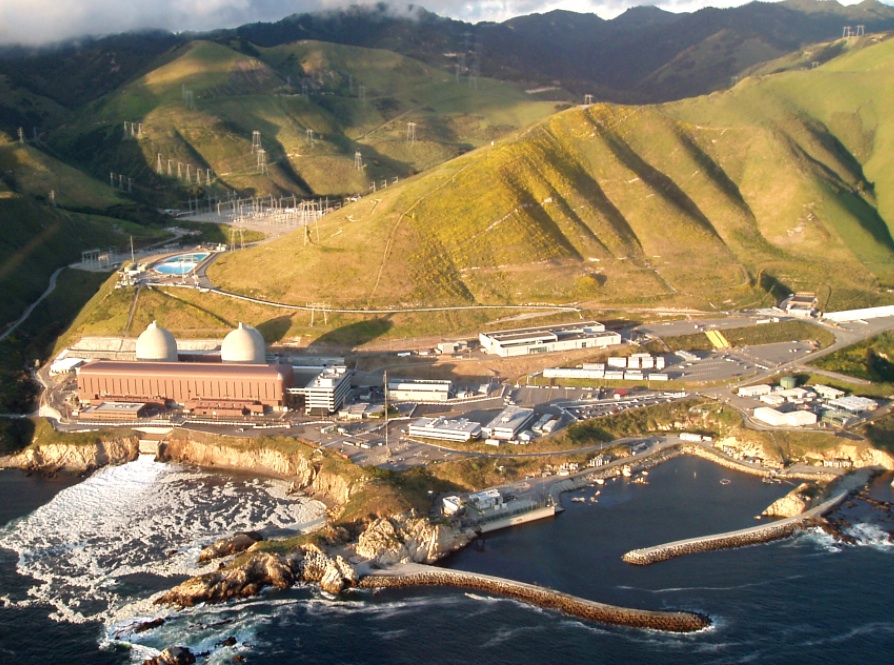
Diablo Canyon 2016-06-21 at 6.55.48 AMAn historic agreement has been reached today between Pacific Gas and Electric, Friends of the Earth, and other environmental and labor organizations to replace the Diablo Canyon nuclear reactors, the state’s only nuclear power plant, with greenhouse-gas-free renewable energy, efficiency and energy storage resources. PG&E acknowledged the agreement hailed by environmental groups.
Friends of the Earth says the agreement provides a clear blueprint for fighting climate change by replacing nuclear and fossil fuel energy with safe, clean, cost-competitive renewable energy.
The agreement says that PG&E will renounce plans to seek renewed operating licenses for Diablo Canyon’s two reactors — the operating licenses for which expire in 2024 and 2025 respectively. In the intervening years, the parties will seek Public Utility Commission approval of the plan which will replace power from the plant with renewable energy, efficiency and energy storage resources.
By setting a certain end date for the reactors, the nuclear phase out plan provides for an orderly transition. In the agreement, PG&E commits to renewable energy providing 55 percent of its total retail power sales by 2031, voluntarily exceeding the California standard of 50 percent renewables by 2030.
“This is an historic agreement,” said Erich Pica, president of Friends of the Earth. “It sets a date for the certain end of nuclear power in California and assures replacement with clean, safe, cost-competitive, renewable energy, energy efficiency and energy storage. It lays out an effective roadmap for a nuclear phase-out in the world’s sixth largest economy, while assuring a green energy replacement plan to make California a global leader in fighting climate change.”
A robust technical and economic report commissioned by Friends of the Earth served as a critical underpinning for the negotiations. The report, known as “Plan B,” provided a detailed analysis of how power from the Diablo Canyon reactors could be replaced with renewable, efficiency and energy storage resources which would be both less expensive and greenhouse gas free. With the report in hand, Friends of the Earth’s Damon Moglen and Dave Freeman engaged in discussions with the utility about the phase-out plan for Diablo Canyon. NRDC was quickly invited to join. Subsequently, International Brotherhood of Electrical Workers Local 1245, Coalition of California Utility Employees, Environment California and Alliance for Nuclear Responsibility partnered in reaching the final agreement. The detailed phase out proposal will now go to the California Public Utility Commission for consideration. Friends of the Earth (and other NGO parties to the agreement) reserve the right to continue to monitor Diablo Canyon and, should there be safety concerns, challenge continued operation.
The agreement also contains provisions for the Diablo Canyon workforce and the community of San Luis Obispo. “We are pleased that the parties considered the impact of this agreement on the plant employees and the nearby community,” said Pica. “The agreement provides funding necessary to ease the transition to a clean energy economy.”

PG&E employs about 2,000 people in San Luis Obispo County including 1,500 of whom work at the Diablo Canyon plant

Green Energy Future For Kings County?

May 12,2016-

Screen Shot 2016-05-12 at 3.09.55 PMFarm-Based Group Gets Energy Commission Grant

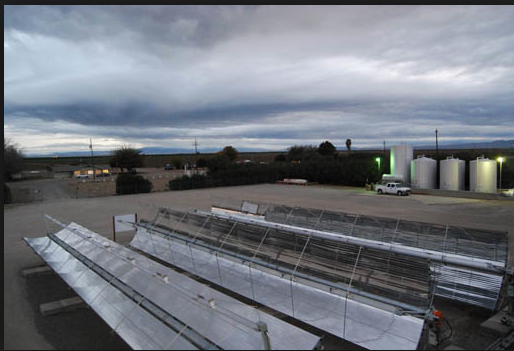
Near the Fresno/Kings county line at Biodico’s Westside Facility at Red Rock Ranch, the world’s first biofuel production facility that operates entirely on renewable heat and power generated on-site, went online late last year. They produce 20 million gallons of biodiesel per year with multi-feedstock. “Our new facility in the San Joaquin Valley produces economically and environmentally viable biobased fuel and energy for local farmers and truckers, and creates new jobs in the community,” says Biodico President and founder, Russ Teall.
Teall says the company is scheduled to receive $1.17 million grant from the California Energy Commission at their next meeting to help local farmers work toward the realty of a ‘zero net-energy farm’. Their pilot plan would take the 1300 acre farm near Five Points to provide a model of how a farmer can tap feedstock and technology,lay out the path to get the permits and offer alternatives to get financial incentives to make the farm self-sufficient in energy. Sources could include wind,solar,waste digestion and gasification. Teall points to the problem of disposing of wood waste these days with closure of the biomass plants in the Valley by gasification of wood chips on the farm.Also farmers are now allowed to use net-metering to offset their PG&E bill on multiple meters.
Biodico is working with a number of collaborators including NAS Lemoore, about 5 miles from the plant, who has vowed to use biodiesel for ground-based vehicles as an alternative to diesel. Teall adds that the F-35s can not use biodiesel because the fighter planes must be able to go to minus 50 degrees.
Biodico made news earlier this year with their promise to hire 10 interns this summer to work at the facility to get training in alternative energy production.West Hills is another collaborator.

West Hills Works With Quay Valley

West Hills Community College District has entered into an agreement with GROW Holdings to be a part of the Quay Valley project, a 7,200 acre master planned community in Kings County which could help to provide students with job training, employment and educational opportunities. Planned as a showcase, Quay Valley will feature 26,000 new “smart” homes for an estimated 80,000 residents, the world’s first full scale people moving Hyperloop transit system, resorts and entertainment opportunities, businesses, the newly established California Institute of Sustainability and Innovation and a University Research Park. In the works is a Green Collar Job Training Program for students interested in learning about particular clean-tech and green-tech career fields. Preliminary figures from the developer estimate that a total of 6,000 permanent jobs would be created for phase one of the project alone, which is scheduled to open in 2019.

Reclamation Increases Friant Water Supply Allocation To 65 Percent

The Bureau of Reclamation announced an additional increase in the water supply allocation to the Friant Division contractors of their Class 1 water from 50 to 65 percent in the past week,on improved water conditions above Fresno.This is the third increase in supply announced since the April 1, 30 percent estimate.

Corcoran Council Urges Yes Vote On Measure K

The Corcoran City Council has urged the county’s voters to vote Yes on Measure K, a one quarter cent addition in sales tax that will go into effect only if the State of California Proposition 30 one quarter cent expires December 31, 2016. “This is not a new tax” and overall your taxes do not go up, they emphasize ”This 1/4 Cent Sales Tax MAINTAINS Kings County sales tax at

Pixley Ethanol Plant Has New Product To Sell – Electricity

May 9,2016-

Screen Shot 2016-05-07 at 12.37.42 PMCalgren Renewable Fuels in Pixley, the county’s only ethanol plant, has  invested in key co-products to sell over the years as it cranks out 58 million gallons of  fuel ethanol each year. The plant was the state’s first when it was built in 2009.

Today they also sell 400,000 tons per year of distiller’s grain – animal feed to local dairies and feedlots as well as 1.5 million gallons of corn oil that serves local poultry producers and bio-diesel facilities. Another company French-owned Air Liquide captures carbon dioxide emissions from the ethanol plant. The carbon dioxide recovered is then purified and liquefied to meet the specifications for food and beverage makers  who want to quickly freeze and preserve their products.
Calgren uses dairy manure biogas, made at their new digester to fire the boilers at their refinery – turning a waste product into a useful low carbon fuel with the heat generated also making electric power, a so called cogeneration process.As a byproduct of that process the dried manure solids that are discharged at the back end of the digester cycle are trucked back to a dairy every day to be used as bedding for the herd.

Now Calgren is adding another byproduct of the process – electricity generated from this expanded cogeneration operation. The company produces 11 megawatts of electric power – used in the manufacturing process – to run their refinery. The plant is now more than self sufficient and has never even been connected to the electric grid says company president Lyle Schlyer.
Now starting next month for the first time Calgren will be selling excess power to Southern California Edison to the tune of 5 megawatts – enough to light up close to 900 homes, all the housing units in Pixley. Schlyer says Calgren has been working toward the goal of selling power to the utility and finally the law and regulatory rules are helping it to happen.

Charging Stations Set For Hwys 99 & 5

May 6,2016-

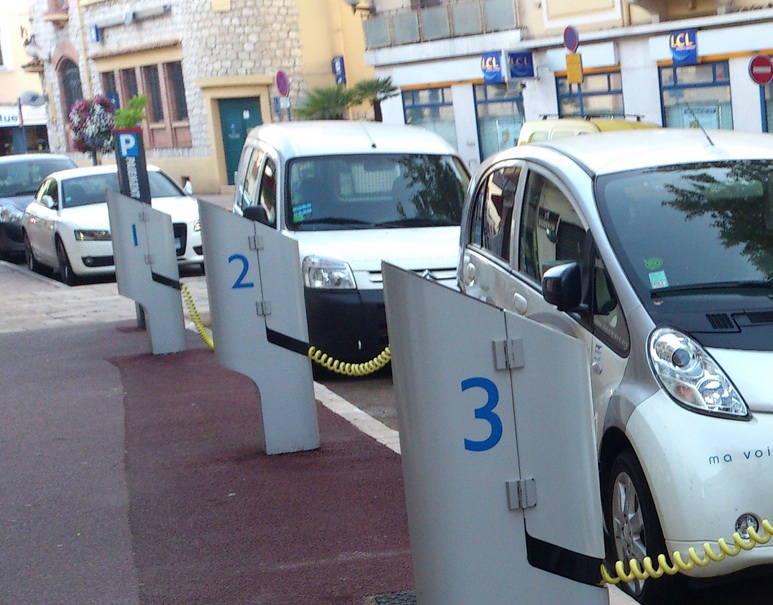
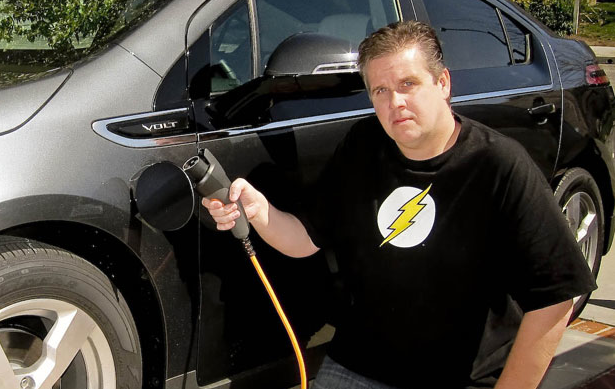
EV Connect  2016-05-03 at 1.11.43 PMElectric car charging stations are in he works along on both Hwy 99 and Hwy 5  including the south Valley by the end of next year.The California Energy Commission has approved nearly $9 million in grants for the installation of DC fast chargers along major state freeways and highways to allow electric vehicle drivers to travel from San Diego to the Oregon border without worrying about running out of energy.

In our part of the state EV Connect was funded along Hwy 99 from Wheeler Ridge north. Another firm – Charge Point has been selected to build along Hwy 5.

Along 99 the preliminary plan calls for charging stations in Selma at the Home Depot, in Visalia at Staples on Caldwell/Mooney,in Delano at at Home Depot and two sites in Bakersfield at the Flying J and at a hotel.

Along Hwy 5 stations are funded at the Grapevine,at the Buttonwillow exit,at Harris Ranch at Hwy 198,Santa Nella and Lathrop

Statewide,the stations will offer fast chargers at 41 sites along major routes on Interstate 5, Highway 99 and Highway 101. Fast chargers allow vehicles to fully charge in 20 to 30 minutes. Additionally, 40 sites will have one Level 2 charger, which charge electric cars in about four to six hours.

Cars include plug in hybrids, electric cars and Tesla models that can use the public chargers with an adapter.

California has a a fleet of about 200,000 electric vehicles sold since 2011. State officials hope continued incentives to buy electric cars, longer life batteries and the construction of  more charging stations will help convince more consumers to buy these clean air vehicles.
The state gives permission for single-occupant vehicles with a Clean Air Vehicle Sticker to use high occupancy vehicle lanes, as well as rebates of up to $5,000 for new zero emission or plug-in hybrid light-duty vehicles.

The trend of electric vehicles getting bigger batteries and thus longer ranges continues with the recent announcement that the 2017 BMW i3 will come with a 33-kWh battery good for 114 miles of range.
According to Wikipedia as of March 2016, there were 26 highway legal plug-in cars available in the American market from over a dozen car manufacturers, plus several models of electric motorcycles, utility vans and neighborhood electric vehicles (NEVs). California has nearly 3000 charging stations.

SunEdison Undertakes Chapter 11 Reorganization

Secures $300 Million in New DIP Financing
Screen Shot 2016-04-21 at 1.24.39 PMMARYLAND HEIGHTS, Mo., April 21, 2016 /PRNewswire/ — SunEdison, Inc. (NYSE: SUNE) (the “Company”) today announced that it has commenced a process to restructure its balance sheet and position the Company for the future.  To facilitate this restructuring, SunEdison and certain of its domestic and international subsidiaries have filed voluntary petitions for reorganization under chapter 11 of the U.S. Bankruptcy Code in the Bankruptcy Court for the Southern District of New York.
SunEdison’s publicly-traded yieldcos, TerraForm Power (NASDAQ: TERP) and TerraForm Global (NASDAQ: GLBL), are not part of the filing.
“Our decision to initiate a court-supervised restructuring was a difficult but important step to address our immediate liquidity issues,” said Ahmad Chatila, SunEdison chief executive officer. “The court process will allow us to right-size our balance sheet and reduce our debt, providing the opportunity to support the business going forward while focusing on our core strengths. It also will facilitate our continued work towards transforming the Company into a more streamlined and efficient operator, shedding non-core assets as well as taking other steps to help us get the most value out of our technological and intellectual property. As a result of this process, we expect that SunEdison will be in an even better position over the long term to utilize our capabilities in the renewable energy sector in service of our customers, business partners, and employees.”
SunEdison has secured commitments for new capital totaling up to $300 million in debtor-in-possession (DIP) financing from a consortium of first and second lien lenders. Subject to Court approval, these financial resources will be made available to the Company to support its continuing business operations, minimize disruption to its worldwide projects and partnerships, and make necessary operational changes.
The new financing will support day-to-day operations during the reorganization, including:
Proceeding with work on ongoing projects, both in the U.S. and elsewhere;
Paying wages and benefits for employees;
Continuing to provide services to customers;
Paying vendors and suppliers in the ordinary course for goods and services provided on or after the date of the chapter 11 filing; and
Complying with all regulatory obligations.
SunEdison has made customary filings, including first day motions, with the Court, which, if granted, will help ensure a smooth transition into chapter 11 without business disruption.  The motions are expected to be addressed by the Court promptly following the filing, and include, among other things, a request for approval of the debtor-in-possession financing, as well as requests for authority to make wage and salary payments, continue various benefits for employees, honor certain customer programs, and other relief in order to continue the day-to-day operations of SunEdison.
Additional information on the restructuring can be found at www.restructuringupdates.com

Energy Commission Funds Electric Vehicle Chargers On Major State Routes

Also Continues to Fund Research to Bring Clean Energy Technologies to Market

Screen Shot 2016-04-13 at 3.41.20 PMSACRAMENTO – The California Energy Commission today approved nearly $9 million in grants for the installation of DC fast chargers along major state freeways and highways to allow electric vehicle drivers to travel from San Diego to the Oregon border without worrying about running out of energy.

The grants went to four companies: Chargepoint Inc., EV Connect Inc., NRG EV Services LLC. and Recargo, Inc., which will install 61 DC fast chargers at 41 sites along major routes on Interstate 5, Highway 99 and Highway 101. Fast chargers allow vehicles to fully charge in 20 to 30 minutes. Additionally, 40 sites will have one Level 2 charger, and one site will have two Level 2 chargers. Level 2 chargers allow most vehicles to go from zero to full charge in four to eight hours.

Several plug-in electric vehicle charging networks currently operate in metropolitan areas. However, private industry has been hesitant to develop sites along highway corridors.

Commissioners also approved an additional $12.6 million in funding to the Natural Gas Vehicle Incentive Project (NGVIP), which offers incentives for the purchase of natural gas vehicles. This funding will help reduce the current wait list as well as fund future applications. The University of California, Irvine, administers the program. Last year the Energy Commission allocated more than $11 million to recipients to purchase natural gas vehicle for use in California for at least three years. These incentives can help fleet managers replace aging gasoline and diesel vehicles with cleaner alternatives.

Around Kings County

New Solar Farm Rises In Avenal

NY-based ConEdison continues to build and own utility-size solar farms in the Central Valley including nine in Tulare/Kings counties.The latest under construction is in Avenal city limits, the first there. This is a 20MW,150 acre project valued at $18.5 million.City Community Development Director Fernando Santillan says this will help the city’s tax revenues.It is located along Hwy 33 near the airport.
Of course Avenal is well known as the site of the state’s first large utility-scale solar project at 45 MW built in 2011.The facility, located in county jurisdiction, was built by the Ryan Company, the same contractor building the current project.

Canadian Firm Buys Kings Peaker Plants

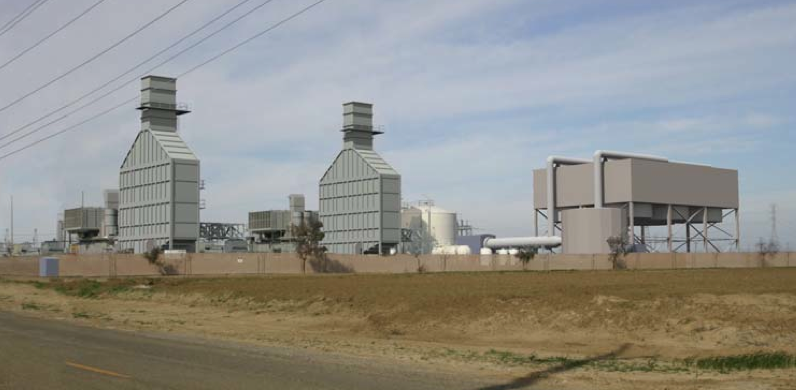
Screen Shot 2016-04-13 at 12.36.17 PMThis month the California Energy Commission gave approval to Canadian-based AltaGas to buy three gas fired power plants in California including two in Kings County. All were owned by GWF. They include the 97-MW Hanford plant and the 96-MW Henrietta near NAS Lemoore. They are ‘peaker plants’ – able to start up to full power in a matter of minutes to supply electricity to the grid at times of urgent need, like hot summer days. Both plants are contracted to PG&E. AltaGas paid $642 million to acquire the three power plant that also include a larger facility in Tracy.

Westlands Solar Park Urges Central Valley Transmission Upgrades

March 18,2016-

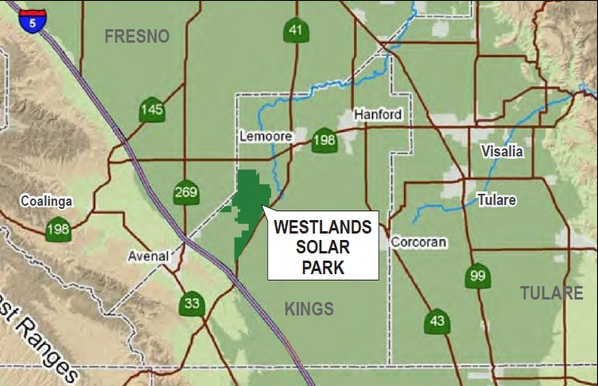
Screen Shot 2016-03-18 at 11.57.55 AMWestlands Solar Park (WSP),a Visalia-based solar development group, is urging regulators to build transmission infrastructure to connect the increasing load of solar power projects in and around Westland Water District.The group is meeting this month with California energy regulators who are discussing how and where to meet the state’s 50% goal for renewable energy. Working in partnership with the water district the landowner-based group says there are pending master plans for 6500MW within the water district and 3000MW in the Central Valley in the state CAISO interconnection queue.The Westlands Water District is expecting to use some 20,000 acres of retired farmland to be sold to solar developers.

But “transmission planning in the San Joaquin Valley is lacking“ points out WSP spokesman Daniel Kim at a March 16 California Energy Commission workshop. He says Kings County alone has 1060MW of pending as well as approved utility-size solar projects. They argue the mid-state location and the lack of environmental impacts make it a good place to connect more solar to the state’s grid.

More Than $400 Million In Solar Construction Underway In Southern Tulare County

Screen Shot 2016-02-29 at 7.01.41 AMFebruary 29,2016-
Tulare County has issued permits for $422 million in utility-scale solar power projects recently. Both projects are in the southern part of the county.
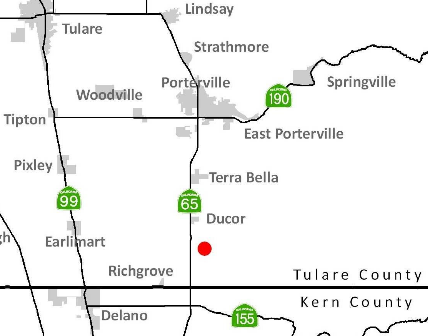
Permits for 4 projects near Ducor owned By ConEdison are underway valued at $290 million The project has been in the works for several years but are only going to construction now.It total around 80 megawatts approved as four phases.
Also the Tulare Solar Center valued $132 million is underway south of Ducor – east of State Route 65 and south of Avenue 24,is currently dry land farmed. The total megawatts is 32 MW with multiple ownership.When complete all phases of the project will total 80MW.

PG&E Achieves Major Renewable Energy Milestone

February 28,2016-

Screen Shot 2015-12-21 at 12.07.36 PMPG&E, one of the cleanest utilities in the nation, announced today (Feb. 25) that the renewable energy it delivers to its customers has reached nearly 30 percent.
California and PG&E continue to set the pace as national leaders in clean energy and greenhouse gas reductions. State goals called for an average of 23.3 percent Renewables Portfolio Standard between 2014 and 2016. PG&E far surpassed that target, serving 29.5 percent of its retail electricity sales with renewable power in 2015. Additionally, PG&E is well ahead of schedule in meeting the state’s 33 percent target by 2020.

As PG&E’s Solar Choice program develops, the solar energy purchased by customers will be sourced from new solar projects built by developers across PG&E’s service area.
When looking at the company’s entire energy portfolio, more than 58 percent of the electricity that PG&E delivers to its customers comes from greenhouse gas-free resources when including large hydroelectric and nuclear energy.
Geisha Williams, president, PG&E Electric, said she is proud of the company’s track record as a clean energy leader and this latest achievement.
“The clean energy transformation that began with energy efficiency programs in the 1970s has made quantum leaps through new technologies like solar and wind energy, which are part of the green power we deliver to our customers every day,” Williams said. “We’ve made great progress on renewable energy and we aren’t done yet. We stand ready to help Governor Brown deliver on the new goal of 50 percent renewables by 2030 because we want to demonstrate to other states that a clean energy future is achievable, and essential for future generations.”
PG&E delivers a renewable power mix of solar, wind, geothermal, bio-power and small, eligible-renewable hydroelectric energy. That diverse portfolio has helped PG&E achieve a carbon emissions rate that is two-thirds cleaner than the national utility average. The company also leads the nation in having connected more than 215,000 customers with rooftop solar to the grid.
PG&E is expanding its clean energy portfolio as large renewable energy projects come on line after years of development, and PG&E customers are enjoying a surge of greener electricity. The company’s new Solar Choice offering gives customers the option to lower their carbon footprint and purchase 50 percent or 100 percent of their electricity from solar power, without the need to install panels.
Also, PG&E has been named one of the nation’s greenest utilities in the annual Global Top 100 ranking by Energy Intelligence’s New Energy. The rankings are based on carbon emissions and renewable energy.
Late last year, the company signed on to a White House initiative aimed at rallying U.S. businesses around the need to take action on climate change, and joined Gov. Jerry Brown and the California delegation at the United Nations’ climate talks in Paris.