CalBio & Dairy Farmers Partner with Chevron on Dairy Biomethane Fuel Projects

Screen Shot 2019-06-20 at 7.04.40 AMSAN RAMON, Calif./VISALIA, Calif., June 18, 2019 – Chevron U.S.A. Inc. and California Bioenergy LLC (“CalBio”) today announced a joint investment in a holding company with California dairy farmers to produce and market dairy biomethane as a vehicle fuel in the state. The holding company, CalBioGas LLC, secured funding from Chevron to build infrastructure for dairy biomethane projects in California’s San Joaquin Valley, adding to the investment from dozens of dairy farmers. Chevron will also provide services to bring this product into the California vehicle fuels market.

This combination of Chevron, CalBio and California dairy farmers working together to produce and market dairy biomethane demonstrates Chevron’s commitment to find creative, cost-effective solutions to achieve compliance with California’s Low Carbon Fuel Standard (LCFS). Manure storage on dairy farms results in the release of methane, a highly potent greenhouse gas. CalBio brings technology, operational experience and capital to help dairy farmers build digesters and methane capture projects to convert this methane to a beneficial use as renewable natural gas (RNG). Chevron has signed an agreement to provide funding for as many as 18 digesters across three geographic “clusters” in Kern, Tulare and Kings counties. Once complete, these projects will significantly mitigate the dairies’ methane emissions and help make them among the most environmentally efficient and sustainable in the world.

The clusters of digesters have been awarded California Department of Food and Agriculture grants, which must be augmented with additional capital to complete the projects. Chevron is excited about the RNG opportunity and pleased to be actively investing along with farmers through CalBioGas. The dairy biomethane projects are designed to send dairy biogas to a centralized processing facility where it will be upgraded to RNG and injected into the local gas utility’s pipeline. The RNG is then marketed as an alternative fuel for heavy-duty trucks, buses, and eventually off-road and farm equipment. “CalBio is honored to be supported by some of California’s leading dairy farmers and to have Chevron, California’s largest energy company, helping us expand the development of clean, renewable compressed natural gas (R-CNG) production across the state,” said N. Ross Buckenham, CalBio’s chief executive officer. “These projects bring so many win-wins that would not be possible without our farmers’ and Chevron’s support. While helping the environment by reducing greenhouse gases, these projects also help create local jobs and improve local air quality by producing ultra-clean fuel for new R-CNG engines.” Chevron is investing in opportunities to address GHG emissions challenges and progress lower-carbon technologies, and RNG is a component of its renewable strategies. “CalBioGas represents exactly the sort of targeted investment we will make to achieve LCFS compliance and also to test the viability of alternate fuel sources,” said Mike Vomund, vice president for Chevron Americas Products – West. “As a proud California company, we are pleased that local communities in the state will benefit from this investment and we look forward to the opportunities ahead with CalBioGas.”

Kings County solar projects advance

-June 25,2019-

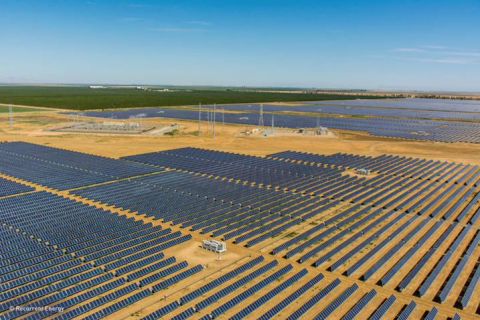
Recurrent's Mustang Solar project
Recurrent’s Mustang Solar project

A sea of solar panels

Several giant solar projects are progressing toward construction this summer in Kings County along the Avenal Cutoff near I-5.

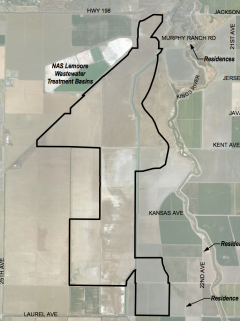
Kings County’s top planner Chuck Kinney says Recurrent Energy’s RE Slate project, a 2500 acre,300MW solar farm will be the subject of a public hearing, likely in August The project’s draft EIR was released in the past few weeks. RE Slate would be the county’s largest solar farm.The review period for the project ends July 16. The coming sea of solar panels would stretch some 10 miles in the old lakebed of Kings County (see map).

Recurrent's planned RE Slate project
Recurrent’s planned RE Slate project

Recurrent Energy plans to own or lease the land for the Avenal Cutoff facility from its owners Westlake Farms, Westlands Water District and Sandridge Partners.

Kinney says a second big solar project being filed by Westlands Solar Park – a 250MW project called Aquamarine that will likely be the subject of a permit hearing perhaps by September. The big renewable energy project sits on 2500 acres, also near the Avenal Cutoff.

Westlands Solar Park is actively working on permitting of two additional meg-solar projects nearby.

Westlands Solar Blue has filed a preliminary application at the beginning of this year for a 250MW project on 1950 acres located on Laurel in western Kings County.

The same developer filed for a project called Chestnut, a 150 MW solar farm on 980 acres located between the Avenal Cutoff and Hwy 41.

Westlands Solar Park has stated they hope to phase-build up to 2000MW of power in the area in the Westlands Water District on salt damaged land no longer fit for farming. They hope to have 700MW on line by 2021.

The concept is to site solar farms on spent ag land with few environmental impacts. The plan has gained widespread political support in California looking to minimize more solar farms on pristine land in the California desert even as the state moves toward using near 100 percent renewables in the future.

Together with the Recurrent project the four pending solar farms would add up to nearly 1000MW – comparable in output to a nuclear power plant.

The August hearing for Recurrent’s RE Slate will detail plans for the project with construction expected to begin as early as October 2020 and could occur in phases. Project construction is expected to take 14 months.

RE Slate would also feature the state’s largest solar storage system-a 300-MW energy storage system (ESS) with a 4-hour capacity or approximately 1,200 MW hours, consisting of battery or flywheel enclosures and electrical cabling and equipment. California utilities must procure 1,325 MWs of energy storage by 2020.

RE Slate would operate year-round to generate solar electricity during daylight hours and would store and dispatch power at the storage facility during both daylight and non-daylight hours. The anticipated operating life of the facility is up to 40 years. The solar facility would include an estimated 3 million to 5 million solar modules.

Community choice aggregators will buy the power

Last fall Recurrent Energy signed two 15-year power purchase agreements with Silicon Valley Clean Energy and Monterey Bay Community Power for a 150 megawatt solar power system with 180 megawatt-hours of battery storage. This joint procurement effort represents the largest contracted solar-plus-storage project in California to date.

Power for these communities organized as Community Choice Aggregators will be supplied from Recurrent Energy’s Slate photovoltaic-plus-storage project to be built in Kings County. The project is scheduled to reach commercial operation in 2021, and the energy represented by the contracts is enough to power 37,500 homes, providing Silicon Valley Clean Energy with 55 percent of the energy, and Monterey Bay with the other 45 percent of the combined output.
If approved by Kings County, the big project will join a half dozen other solar projects built or in the works nearby on both sides of the Avenal Cutoff Road. That includes the two Mustang projects (Mustang and Mustang Two), as well as the Kent and pending Westland Aquamarine project, as discussed earlier. This will create virtually a sea of solar panels on both sides of the road in the next few years that connects I-5 to NAS Lemoore.

San Francisco-based Recurrent Energy has developed four operating solar projects in the county and is developing two additional projects, including the Slate project. They are owned by Canadian Solar who purchased the company from Sharp in 2015. Canadian Solar, besides being a major developer of solar farms, is one of the three top solar panel makers in the world.

_

Hanford Dairyman’s Electric Idea

-May 11,2019-

From Milk Producers Council

Innovation in feed mixing leads to cleaner air, lower costs and better feed

Screen Shot 2019-05-11 at 12.00.25 PMDriving home one afternoon, dairy farmer Philip Verwey started thinking about changes he could make to improve air quality. His on-road brainstorm led to changes that cut the dairy’s tractor-related emissions substantially, the equivalent of taking 7,800 passenger cars off the road.
“I thought maybe I could convert my diesel-powered feed-mixing operation to electric,” said Verwey, who milks 9,000 cows in Hanford, California. “I was aware of a pilot program at the air district that provided incentive funding for reducing emissions. We did the research, calculated the reductions and applied for the program.”
Philip Verwey Farms’ diesel-to-electric conversion was one of 56 funding applications – and the only dairy related project – to the San Joaquin Valley Air Pollution
Control District’s Technology Advancement Program. His idea:
Rather than blending feed ingredients for his cows in a mixing
The electric feed mixer is powered by electricity generated on the dairy from a manure digester. In addition to producing enough energy to meet the dairy’s electricity needs, 3,000 additional homes can be powered.
The electric feed mixer reduces oxides of nitrogen emissions from 22 tons annually to just 2, saving 90,000 gallons of diesel.
7,800
The number of cars one would need to remove from the road for equal emissions reductions to those achieved by the Philip Verwey Farms electric feed mixer conversion.
wagon powered by a diesel tractor, he would blend using an electric stationary mixer. This change significantly reduced the amount of run time by his diesel engines, lowering diesel consumption by 71% per month.
“In addition to being good for the environment, the change provided other positive benefits,” Verwey said. “Our feeding time went from 20 hours a day to seven and the texture and composition of the feed improved, which is good for our cows.”
Verwey’s idea reduced oxides of nitrogen (NOx) emissions by 90%, providing the inspiration and model for other dairy farmers to take similar action.
“The air district saw the success of our project and the positive difference it makes in air quality,” Verwey said. “That led to an expanded program that will fund up to 75% of the cost of future conversions to electric mixers for dairy feed.”
To date, 15 California dairy farms have submitted applications to the new program and four dairies are now under contract to begin converting their feed mixers to electricity. Combined with Philip Verwey Farms, the overall emissions reduction is roughly equivalent to removing 19,300 passenger vehicles from the road.
“I’m a true believer that you have to produce what the public wants, and that includes being green,” Verwey said. “We’re also doing that in a way that makes economic sense, which benefits everyone.

Energy Commission offers SLO city $3 mil loan to generate electricity

-May 10,2019-

City water utility could be a ‘net exporter’ of renewable power

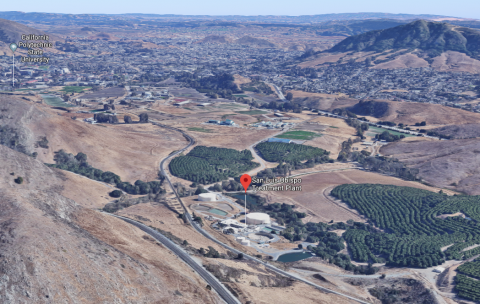
The California Energy Commission is offering the City of San Luis Obispo a $3 million loan for a 261.4 kilowatt (kW) solar photovoltaic system as well as a 264 kW hydro-electric generation system – both located at the city water treatment plant on Stenner Creek Rd behind Cal Poly.

Screen Shot 2019-05-09 at 1.09.41 PMBy generating their own power at the treatment facility SLO could earn savings of $266,863 annually compared to their current power bill, says a Commission report. Furthermore the loan could be paid back in 11.2 years while the facility generates renewable power for many more years after.

The Energy Commission is expected to approve the loan May 15.

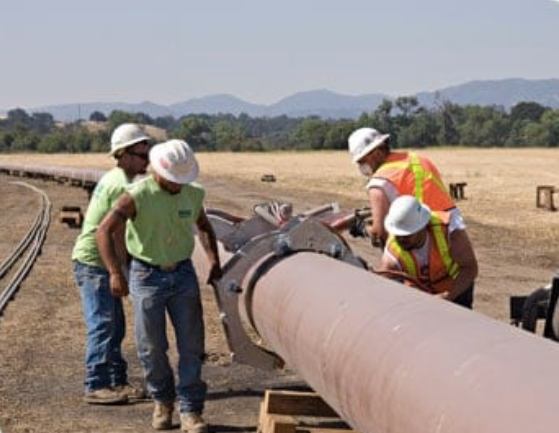
The hydroelectric portion of the project taps water from Lake Nacimiento, 45 miles away, that comes to SLO by pipeline.The city wants to add an inline turbine-generator on the Nacimiento pipeline that delivers an allocation of 5,482 acre feet a year to our kitchen taps. Now that water – that falls from Cuesta Ridge to the city plant, will generate electricity.

Pictured right: SLO will genrate hydro power from pipeline that descends from Cuesta Ridge from Nacimiento. Below:location of water treatment plant near the rail bridge on Stenner Rd.

The proposed energy efficiency project will go to the San Luis Obispo council July 2 for their approval says Utilities Director Aaron Floyd.

In 2017, the City spent over $2 million on electricity. For its part, the Utilities Department spends approximately $1.2 million each year for electricity; one of the largest users being the Water Division. The Water Division treats and delivers an average of 4.9 million gallons of water each day at an annual electricity cost of $625,000.

A “Major City Goal” is defined as the most important, highest priority goals for the City has been to achieve a “net-zero carbon City”, and implementing cost-effective measures. The project will largely meet the goal to cut greenhouse gases at the utility division says a 2018 report.

Extra power expected

That staff report says the reduced energy use created by the proposed efficiencies combined with the energy generated by the identified renewable energy systems will exceed all of the City’s water utility’s current annual electricity consumption by nearly 775,000 kWh or 24%, signifying that the water utility will be a net exporter of electricity.

The water treatment plant is not to be confused with the city wastewater treatment plant at Hwy 101 and Prado, itself going through a planned rebuilding to include renewable power.

Screen Shot 2019-05-09 at 1.14.55 PM

BLM SEEKS COMMENTS ON HYDRAULIC FRACTURING IMPACTS 

-May 7,2019-

Expansion proposed in Kings County 

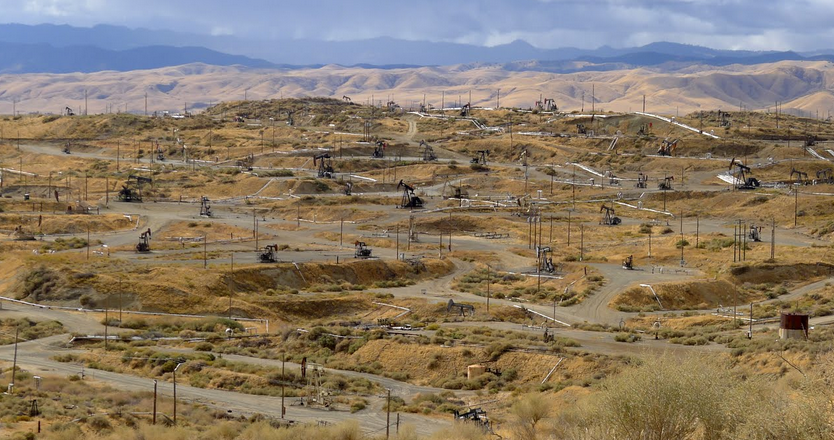
Screen Shot 2019-05-07 at 12.19.32 PMBAKERSFIELD, Calif. – The Bureau of Land Management (BLM) is seeking public comments on a Draft Supplemental Environmental Impact Statement (EIS) analyzing the potential impacts of  additional hydraulic fracturing associated with oil and gas development on public lands in Fresno, Kern, Kings, Madera, San Luis Obispo, Santa Barbara, Tulare and Ventura counties. The 45-day public comment period begins on April 26 and ends on June 10. In th San Luis Obispo area meeting will behold May 22, 2019 at the Embassy Suites by Hilton, 333 Madonna Road in San Luis Obispo from 6-8 p.m.

If approved the President Trump-backed plan would open an additional one million acres in Central California for additional drilling and fracking. Environmental groups opposes the plan.“Trump’s plan would unleash a fracking frenzy that puts California’s people and wildlife in harm’s way,” said Clare Lakewood, a senior attorney at the Center for Biological Diversity. “This administration is dead set on letting oil and gas companies dig up every last drop of dirty fuel. Putting these public lands back at the mercy of the fossil fuel industry would be a huge blow to our state’s future.”

“The San Joaquin Valley has the worst air quality in the U.S. and experiences severe groundwater depletion and contamination,” said Nayamin Martinez, director of the Central California Environmental Justice Network. “These problems are only going to be exacerbated if oil extraction and fracking are allowed on public lands. 

But proponents say additional drilling will supply motorists with fuel and create additional jobs. 

One the biggest players in the San Joaquin oil and nat gas business is California Resources Corporation (CRC) – the largest oil and natural gas exploration and production company in California. on a gross-operated basis. The Company, formerly Occidental  petroleum,  controls approximately 2.3 million acres spanning the state’s four major oil and gas basins. They  operate in 46 fields the San Joaquin Valley including in the Kettleman Hills area where they tell Kings Co officials and municipalities they want to expand. One their largest operations is in the huge Elk Hills Field near Bakersfield.

Coal Towers Tumble to Make Way for Offshore Wind Hub

-May 6,2019-

From ENR

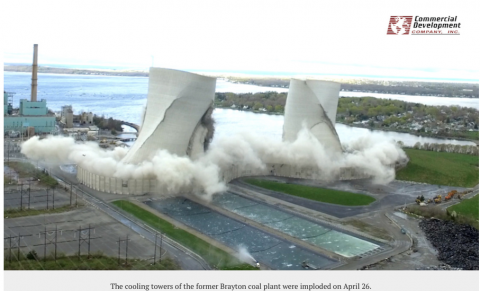
The cooling towers of the former Brayton coal plant were imploded on April 26.

Screen Shot 2019-05-06 at 11.56.37 AM

Photo courtesy of Commercial Development Company.

A remnant of New England’s coal-fired past came crashing down on April 27, when two, 500 ft cooling towers were demolished in Somerset, Mass. It took 10 seconds and cost $1 million to reduce to rubble the towers that cost $600 million and took four years to build.

It will take another three months to crush the rubble left from the towers and spread it across the 308-acre lot where it will be used as the base for the repurposed site.

The 1,530-MW Brayton Point plant, commissioned in 1963, was the largest coal-fired plant in New England and the last coal plant in Massachusetts.

At one point, coal fueled about 25% of Massachusetts’ electric power but fell to about 6% by 2016.

After New England’s electricity market was deregulated in the 1990s, Brayton Point faced an increasingly tough economic environment in New England’s competitive wholesale power market, and the plant became a liability for a succession of owners, passing in 2005 from an affiliate of California utility Pacific Gas and Electric to Dominion Energy of Richmond, Va., which spent billions of dollars adding environmental controls before selling Brayton to private equity firm Energy Capital Partners in 2013.

In 2015, Energy Capital Partners included Brayton Point in a $3.3 billion bundle of generating assets it sold to merchant generator Dynegy, which ran Brayton for two years before shutting it down. Dynegy sold Brayton Point to Commercial Development Co. (CDC) of St. Louis, Mo., for an undisclosed sum. A press report put the price at $8.5 million, citing local deed and tax records, a figure CDC declined to confirm.

“Brayton Point seems like just one more tombstone in a graveyard of old power plants brought down by various factors, not the least of which are lower power prices driven by falling natural gas prices, low to – in some cases – negative demand growth, and increasing renewable energy adoption,” analyst Paul Patterson with Glenrock Associates, says.

CDC is now turning the site into the Brayton Point Commerce Center, which it calls “a world class logistics port, manufacturing hub, and support center” for the offshore wind sector. “It is a milestone in the region’s transition from coal to renewable energy,” CDC spokesman John Kowalik says.

Brayton Point Commerce Center, CDC’s subsidiary for the new venture, has yet to sign an agreement with a new tenant but is in negotiations with several companies, Stephen Collins, executive vice president of CDC, says.

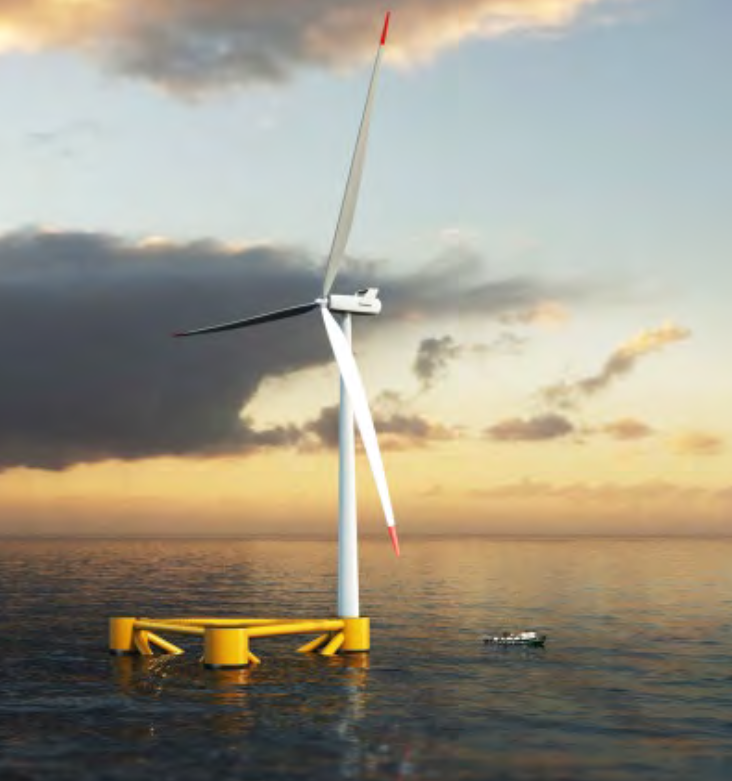
Twelve global firms vie to develop Central Coast offshore wind

-May 6,2019-
Screen Shot 2019-05-02 at 6.44.00 AMMajor international companies from around the world want to develop offshore wind energy along the Central Coast.

In April the federal Bureau of Ocean Energy Management (BOEM)  released a list of companies that BOEM determined were “  legally, technically, and financially qualified to hold an Outer Continental Shelf (OCS) renewable energy commercial lease.”

BOEM offered this call for applications last October and now the world has responded

BOEM offered a chance to take the first step on a future bid to develop offshore wind off three area in California – two of them off the Central Coast. The three specific sites were off Humboldt in northern California and off Morro Bay and Diablo Canyon in our neck of the woods.

Twelve of the companies want to develop projects off the Central Coast, some targeting both Morro Bay and off Diablo Canyon and two more off the Humboldt area. All have good wind speed offshore where giant turbine would be erected.

The parties who submitted interest and where they are based – is listed here. All have US affiliates but all of them also have overseas partners.

Many of the applicants are huge European players, some state affiliated, including  those from Germany,England,Ireland, Portugal,Spain, France,Denmark and Norway as well as US and Canadian renewable energy firms, all with plenty of wind experience.

Screen Shot 2019-05-03 at 11.58.32 AM

Here’s the list according to BOEM.

• Algonquin Power Fund (America), Inc.-Canada
• wpd Offshore Alpha, LLC- Germany
• Avangrid Renewables, LLC -Spain
• Castle Wind, LLC- partner from Germany
• Cierco Corporation- United Kingdom
• EDF Renewables Development, Inc.-France
– EDP Renewables North America, LLC-France
– E C & R (eON) Development, LLC- Germany
– Equinor Wind US, LLC-froley Statoil -Norway
– Mission Floating Wind, LLC=partner Denmark
• Northland Power America, Inc, Canada
– Mainstream Renewable Power, Inc. Ireland

The impressive list of applicants ”shows just how much industry interest is out there ” remarks BOEM spokesperson John Romero.

But Romero adds there remain plenty of hurdles before we see anything happen.

BOEM will next begin the environmental study of specific sites but the existing list of locations could be pared down, he says. The study might take a year to complete, he estimates.

The elephant in the room remains the US Navy that Romero says offered no comment during the recent comment period earlier this year on BOEM’s plan. ”They still have not said if they will oppose any lease.” The Dept of Defense has said the West Coast waters are vital of US Navy operations but have also indicated some possible flexibility that a small section could be carved out, that applicant, like Castle Wind (formerly Trident) are counting on.

Another huge hurdle is that Pacific Ocean seabed, unlike other offshore wind areas around the world is very deep, some 2000 feet down where the floating wind turbines would be tethered compared to 200 feet off the Atlantic shore where BOEM has leased number of sites. None of the 12 companies has experience this deep.

Even if all these problems are mastered, connecting offshore wind to the soon-to-be retired nuclear power site at Diablo Canyon while it is being decommissioned and is still hot will be a challenge, to say the least. Energy companies want to continue to connect to the transmission infrastructure from Diablo that links to the Western US as do the lines at Morro Bay. Then too there is the PG&E bankruptcy and what that means for Diablo Canyon.

Humboldt has its own challenges including the fact that the region is isolated from California’s population centers as well as facing a competing project from an onshore wind farm that could be online much sooner than it will take to permit an offshore wind project.

 Renewables pass coal 

April 30,2019-

April is shaping up to be momentous in transition from coal to renewables Signs of a tipping point in national power-generation mix

The future of the U.S. electricity generation industry may have arrived, and it is not good news for struggling coal-fired generating plants.

Screen Shot 2019-04-30 at 5.42.22 AMThis month, for the first time ever, the renewable energy sector (hydro, biomass, wind, solar and geothermal) is projected to generate more electricity than coal-fired plants, which totals about 240 gigawatts (GW) of still-operating capacity. According to data published this month in the Energy Information Administration (EIA) Short-Term Energy Outlook, renewables may even trump coal through the month of May as well.

As the chart below indicates, the EIA sees renewable generation topping coal-fired output sporadically this year, and again in 2020. The estimates in the EIA outlook show renewable energy generating 2,322 and 2,271 thousand megawatt-hours (MWh/day) per day in April and May, respectively. This would top coal’s expected output of 1,997 and 2,239 thousand MWh/day during the same two months.

California oil patch price reaches $70 

-April 21,2019-
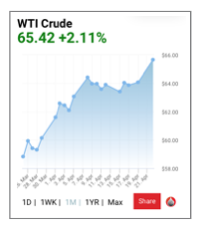
Screen Shot 2019-04-22 at 6.42.43 AMChevron is selling oil from its big Midway Sunset oil field in Kern Country for $70 a barrel today, up from just $50 at the start of 2019.

WTI crude is spiking higher today based on news reports that President Tump will clamp down on all oil exports from Iran.

California motorists are already facing pain at the pump this spring according  to AAA. The California average price for unleaded is $4.03 today, up from a $3.43 month ago. California prices are over $4 a gallon for the first time in five years.  Diesel ushers are getting no relief at $4.07 a a gallon – up from $3.84 a  gallon a month ago.

With the summer driving season ahead of us, expect prices to head higher. But oil expert Tom Kloza tweets “The coast is not yet clear, but the foreign gasoline will help. I stand by my prediction which suggests Easter Sunday prices in L.A. will be higher than prices on Memorial Day.”

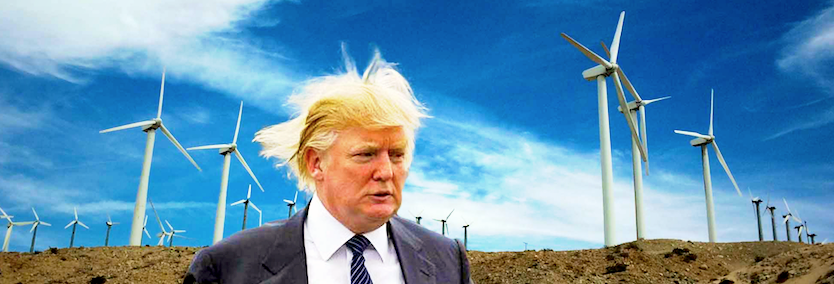
Trump’s view on wind energy

from press reports

-April 5,2019-
Screen Shot 2019-04-05 at 12.56.14 PMDES MOINES – Iowa Sen. Chuck Grassley – a champion of the wind energy tax credit – said President Donald Trump’s comments that wind turbines cause cancer were “idiotic” in a call with reporters Wednesday.
“I’m told that the White House respects my views on a lot of issues,” Grassley said. “(Trump’s) comments on wind energy – not only as a president but when he was a candidate – were, first of all, idiotic, and it didn’t show much respect for Chuck Grassley as the grandfather of the wind energy tax credit.”
Speaking at a Republican fundraiser Tuesday night, Trump discussed wind turbines and energy policy.
“If you have a windmill anywhere near your house, congratulations, your house just went down 75% in value,” he said. “And they say the noise causes cancer. You tell me that one, OK?”
There is no evidence showing the sound from wind turbines causes cancer.
More: Do wind farms cause cancer? Some claims Trump made about the industry are just hot air
Iowa is a national leader in wind energy, and it was the first state to generate more than 30% of its electricity through wind power, according to the Iowa Environmental Council.
Grassley, a Republican, has been a vocal supporter of the industry.
On Wednesday, shortly after calling the president’s comments “idiotic,” Grassley’s office sent out a news release trumpeting his bipartisan appeal for more federal wind energy funding. The appeal was co-signed by Oregon Democratic Sen. Jeff Merkley along with several senators running for president as Democrats, including Sens. Kamala Harris of California, Kirsten Gillibrand of New York, Amy Klobuchar of Minnesota, Elizabeth Warren of Massachusetts, and Bernie Sanders of Vermont.
Trump has been critical of wind turbines throughout his career as a politician and as a businessman, arguing they would obstruct the views from his golf course.