California new vehicle sales expected to be down 2% in 2019

Would be third annual decline

Electric Vehicle Registration Up Sharply in 2018

California new car sales were 2 million units in 2018 and 2019 is expected to continue trending down to about 1.96 million new vehicle registrations says the California New Car Dealers Assn.

This would be the third year in a row for declining sales.

Californians are still favoring trucks and SUVs over cars and the smaller car market in the state is down to 21%.

Statewide, 2018 car sales declined 10% in 2018 vs 2017 while light truck sales were up 5%. Car sales fell more sharply across the US declining by 13% while truck sales were up 6.9%.

The passenger car market in California came in at 44.8 % of the new vehicles sold vs just 31% in the US. Truck sales in the state are now over 1 million units annually.

Screen Shot 2019-03-07 at 2.42.01 PM

Tesla takes off

Electric vehicles sold well in California in 2018 -up from 2% of all sales in 2017 to 4.7% in 2018.

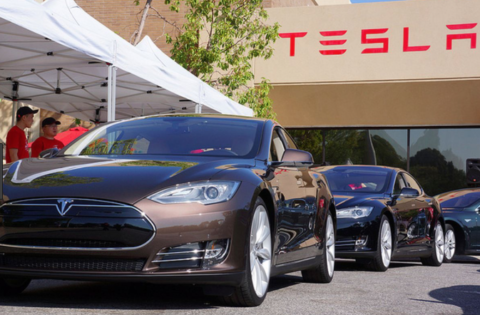
Adding the hybrid/electric category together they reach 12% of all sales in 2018. Tesla showed the fastest growth in the state, up 100% from 2017. Tesla sold over 70,000 cars in  California in 2018 vs 19,000 in 2017.

All-electric vehicles saw the biggest market share increase in the state mostly thanks to the introduction of the Tesla Model 3.

This year more new all-electric vehicles including Audi e-tron and Kia Niro EV will become available.

Paso Robles School District Moves to Zero Emission Buses

Porterville’s GreenPower Buses is supplier

Screen Shot 2019-03-01 at 5.58.29 AMLos Angeles, California February 5, 2019 – GreenPower Motor Company Inc. (TSX-V: GPV) (OTCQX: GPVRF) (“GreenPower”) announced today that Paso Robles Joint Unified School District has ordered a GreenPower Synapse Type-D all-electric School Bus.The buses are assembled in Porterville California where Green Power has a 50,000sf plant.

GreenPower is working with several dozen other districts across the State of California to usher in a new standard in the zero emissions market.

Paso Robles Joint Unified School District has a total enrollment of nearly 7,000 students in 11 schools and operates a fleet of over 30 school buses across California’s central coast. The district will become a regional leader and an early adopter of zero emission technology, proving that they put their student’s health and community well being at the top of their priority list. This purchase will be made by taking advantage of a $220,000 HVIP voucher, provided by the California Air Resources Board (“CARB”). The remainder of the purchase price will be covered by the San Luis Obispo County Air Pollution Control Districts school bus grant program.
“Our purpose-built zero emissions Synapse school bus has generated a lot of excitement during our recent demonstrations,” said Ryne Shetterly, Vice President of Sales and Marketing. “This all- electric school bus provides a safe, reliable and emission-free option for schools looking to help improve air quality for their communities while reducing operational cost at the same time.
The GreenPower Synapse Type-D battery electric bus line is the industry’s first purpose-built, zero emissions school bus to become commercially available. It is available as a fully ADA accessible school bus or a with a seating layout of up to 90 passengers.

Energy Storage: Next Game Changer

from Clean Tech-

February 6,2019-

With the rise of variable renewable generation, storage is poised to become big business

Screen Shot 2019-02-06 at 6.47.40 AMEverybody agrees that storage is turning into big business, and soon, but exactly how big and how soon? According to a report released in Nov 2018 by Bloomberg New Energy Finance (BNEF) the global energy-storage market will surge to a cumulative 942 GW by 2040 requiring a hefty investment of $620 billion. Sharply falling battery costs is a key driver of the projected boom, as is the pressing need to smooth out the output of renewable generation. BNEF says the capital cost of utility-scale lithium-ion storage systems is likely to fall another 52% by 2030.

But like much else in electricity markets these days, cost isn’t the only or even the main driver of future demand growth – it is the mandatory rise of renewables. Governments the world over are requiring ever higher percentages of renewables while pushing for more electric vehicles (EVs) and solar PVs.

According to BNEF’s Yayoi Sekine, “Costs have come down faster than we expected. … Batteries are going to permeate our lives.”

The implications of cheaper batteries are far-reaching, upending multiple industries and helping spur technologies necessary to help fight climate change. Batteries will power the EVs while also boosting the value of solar and wind power, both inherently variable resources.

BNEF highlights two important storage markets:

▪China, which is investing in massive battery manufacturing capacity; and

▪California, which has a mandatory 100% renewable electricity target for 2045 as well as a number of other measures such as storage capacity.

In places like California and Hawaii, both moving towards a 100% renewable future by 2045, massive new storage capacity will undoubtedly be required along with other means of shifting midday’s sun to evening hours or for cloudy days. Wind, the other major renewable contender, is equally variable.

Among other highlights, BNEF says:

▪Cumulative energy-storage deployments are forecast to exceed 50 GWh by 2020, a significant acceleration from last year’s projection;

▪By 2040, storage capacity may reach 7% of the world’s installed capacity;

▪The Asia-Pacific region will be home to 45% of total installations on a MW basis by 2040 with another 29% spread across Europe, Middle East and Africa with the remainder in the Americas;

▪The majority of storage capacity will be utility-scale until the mid-2030s with behind-the-meter applications at businesses, industrial sites and residential sector overtaking utility-scale thereafter; and

▪Leading the pack will be China, US, India, Japan, Germany, France, Australia, South Korea, and the UK. South Korea, currently a dominant market player, will be overtaken by the US early in the 2020s – both to be eclipsed by China.

Average New-Car Prices Up More Than 4 Percent According to Kelley Blue Book

Related Auto News: CNBC 
General Motors is planning to layoff roughly 4,000 workers in North America starting Monday ahead of the company’s fourth-quarter earnings report, according to two people briefed on the matter.

The reductions come as the largest U.S. automaker undergoes a massive restructuring announced by CEO Mary Barra in November. GM is halting production at five plants in North America and cutting 14,000 jobs as it realigns its workforce and plants to produce more electric vehicles. –


IRVINE, Calif., Feb. 1, 2019 /PRNewswire/ — The analysts at Kelley Blue Book today reported the estimated average transaction price for a light vehicle in the United States was $37,149 in January 2019. New-vehicle prices increased $1,481 (up 4.2 percent) from January 2018, while decreasing $643 (down 1.7 percent) from last month.

Screen Shot 2019-02-01 at 7.37.37 AM“There are several factors contributing to strong average transaction prices, which climbed 4 percent year-over-year,” said Tim Fleming, analyst for Kelley Blue Book. “First, Tesla has approached BMW and Mercedes-Benz U.S. sales numbers in recent months with even stronger transaction prices. Also, full-size trucks are more popular than they have been for over a decade, and the new Chevrolet Silverado, GMC Sierra and Ram 1500 pickups helped drive prices up.”

The shift away from passenger cars also is ongoing, and these buyers are either moving up to small utility segments or looking at used vehicles instead. While Cox Automotive expects new-car sales to slow in 2019, the good news for the industry is transaction prices remain strong without help from huge

Subaru had another strong month, as average transaction prices rose more than 5 percent, with the Crosstrek improving most at 7 percent. In addition, the redesigned Forester posted a 3 percent improvement year-over-year. The new Ascent SUV is helping the brand with average transaction prices close to $40,000. Finally, the Outback, now in the last year of its generation, was down 1 percent.

On the other hand, Hyundai-Kia prices fell nearly 1 percent for the month. Hyundai climbed 2 percent, but Kia dropped 1 percent. Hyundai was helped most by the refreshed Tucson, up 4 percent, and the new Veloster continues to impress, rising 9 percent. Kia was hurt most by the Soul, which was down 5 percent, as the next generation will be launching soon. The Genesis brand also fell 5 percent, following the introduction of the G70 sedan as the new entry point in its lineup.

U.S. coal consumption in 2018 expected to be the lowest in 39 years

 EIA: Coal consumption to fall 4% in 2018 and 8% in 2019.

Source: U.S. Energy Information Administration/ American Railroads

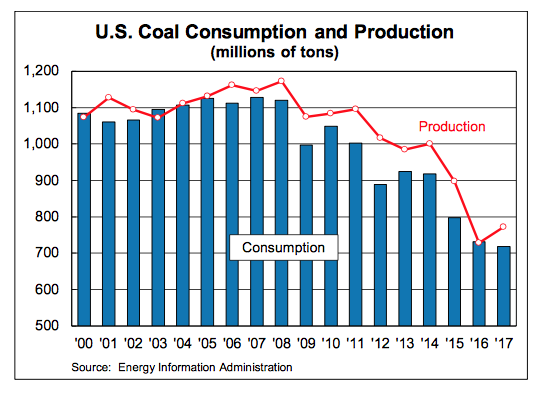
Screen Shot 2019-01-30 at 5.36.54 AMEIA expects total U.S. coal consumption in 2018 to fall to 691 million short tons (MMst), a 4% decline from 2017 and the lowest level since 1979. U.S. coal consumption has been falling since its peak in 2007, and EIA forecasts that 2018 coal consumption will be 437 MMst (44%) lower than 2007 levels, mainly driven by declines in coal use in the electric power sector.

The electric power sector is the nation’s largest consumer of coal, accounting for 93% of total U.S. coal consumption between 2007 and 2018. The decline in coal consumption since 2007 is the result of both the retirements of coal-fired power plants and the decreases in the capacity factors, or utilization, of coal plants as increased competition from natural gas and renewable sources have reduced coal’s market share.

In 2007, coal-fired capacity in the United States totaled 313 gigawatts (GW) across 1,470 generators. By the end of 2017, 529 of those generators, with a total capacity of 55 GW, had  retired. So far in 2018, 11 GW of coal-fired generating capacity has retired through September, and another 3 GW are expected to retire in the final three months of the year, based on data reported to EIA by plant owners and operators. If these plants retire as planned, 2018 will be the second-highest year for coal retirements. Another 4 GW of capacity are planning to retire by the end of 2019.

Only one, relatively small, new coal-fired generator with a capacity of 17 megawatts is expected to come online by the end of 2019. The decline in coal-fired capacity is expected to further reduce coal consumption: EIA’s latest Short-Term Energy Outlook expects power  sector coal consumption to fall 4% in 2018 and 8% in 2019.

Association of American Railroads report

Screen Shot 2019-01-30 at 5.46.49 AMOne of the main drivers of coal retirements is the price of coal relative to natural gas. Natural gas prices have stayed relatively low since domestic natural gas production began to grow in 2007. This period of sustained, low natural gas prices has kept the cost of generating electricity with natural gas competitive with generation from coal. Other factors such as the age of generators, changes in regional electricity demand, and increased competition from renewables have led to decreasing coal capacity.

U.S. coal consumption in 2017 was 717 million tons, down 1.9 percent from 2016’s 731 million tons and 36.4 percent lower than the 2007 peak of 1.13 billion tons. In 2017, 92.7 percent of U.S. coal consumption was for electricity generation; 2.4 percent was to produce coke; and 4.8 percent was for other purposes, including combined heat and power plants.

How Lemoore became cheapest place to buy gas 

December 27,2018-
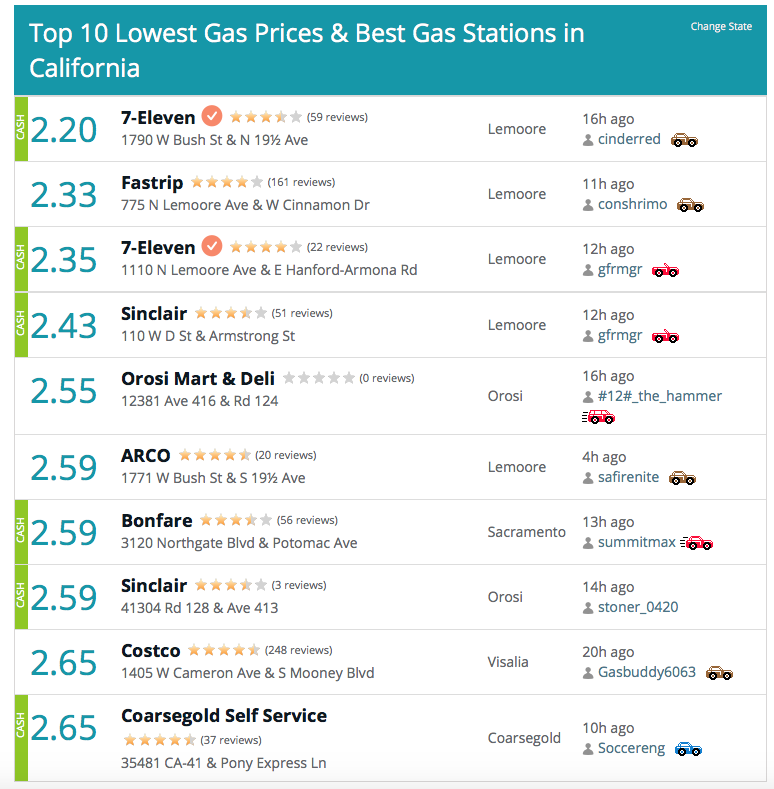
Screen Shot 2018-12-25 at 6.48.53 AMThe website Gas Buddy reports that the small Central Valley town of Lemoore is the cheapest place to buy gas this holiday season. The 7 -Eleven in town is selling regular today for $2.20 per gallon, best price in the state says the Gas Buddy website.

That compares  to what most Californians have been paying – an average of $3.27 a gallon or more. Many stations are  still posting gas near $4 despite a huge drop in oil prices from $ 70 a barrel in August to about $45 this week.

Competition for your gas dollar has grown in the past few years offering more suppliers, larger stations and more of them. For some reason, it’s all happening in Lemoore.

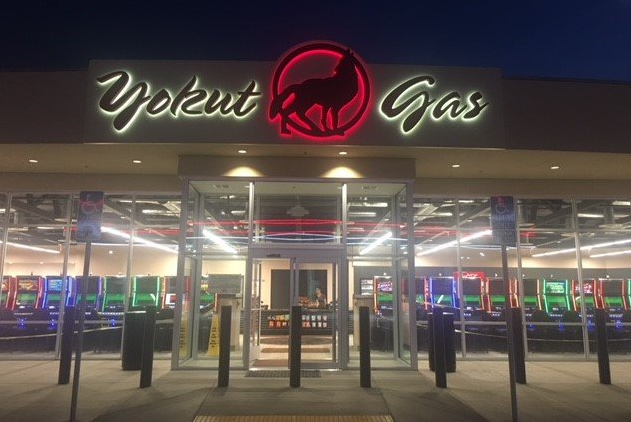
Screen Shot 2018-12-27 at 7.11.43 AMOne new player in Lemoore’s gas price derby is the new Yokut Gas station that opened early 2018 and offers 24 pumps to go with 24 slot machines. The place is big  at 8000sf- big for  any station.Operated by the Tachi tribe they can offer below market prices in part because  they don’t have to pay state taxes on the fuel they sell.Fuel is not the only profit center where there is a tax advantage for tribes.That price break includes tobacco, sales tax and  casino gambling.

Today Yokut Gas is selling regular for $2.46, still not the lowest in town. The region has another tough new competitor in Costco in Hanford that is selling regular today at $2.69 – pushing all the little guys to compete or go home.

Other Indian-owned stations in the Central Valley include Chukchansi Crossing Fuel Station & Travel Center in Coarsegold and the Tule Indian Tribe stations in Porterville and near Avenal.

While many gas stations were closing a decade ago, facing leaking underground tanks – todays newer gas stations are much larger than the old corner station, now offering a bunch more for your pit stop, filling up on more than gas.

An example of the new larger stations are the several new Arco outlets in Visalia and the south Valley being built by one developer.Also we are stopping at more  of those huge truck stops  the sprawl over   10 to 15 acres like then prosed Flying J station next to Loves in Tulare and a similar size one in Goshen  now under construction.

There are even some new players in the gasoline supply game  as well this year including Pemex Oil (Mexico based) with a new station in Hanford and Sinclair Gas that is opening new stations in California including in Orosi now, and competing on price.

Then there are the establishment players like Chevron with seven locations in the Hanford /Lemoore  area that offer gas but with no discount despite that big drop in the price of oil in the past several months.Still selling gas at $3.70 at some of their locations you would end up paying $10 to 15 more to fill your tank than at the cheaper stations. They make sure they are convenient however – jus around the corner.

The good news as 2018 turns to 2019 is that Americans generally are spending less this month on gas. ”Americans are spending $225 million less every day on gasoline than they did some 75 days ago”  remarks a Gas Buddy analyst.

Building a house out of hemp

December 22,2018-

Building my first hemp concrete house – The advice I would have liked to know before

by NHA

Interview with Serge Bolduc, a Canadian house builder

By Simon Leclerc

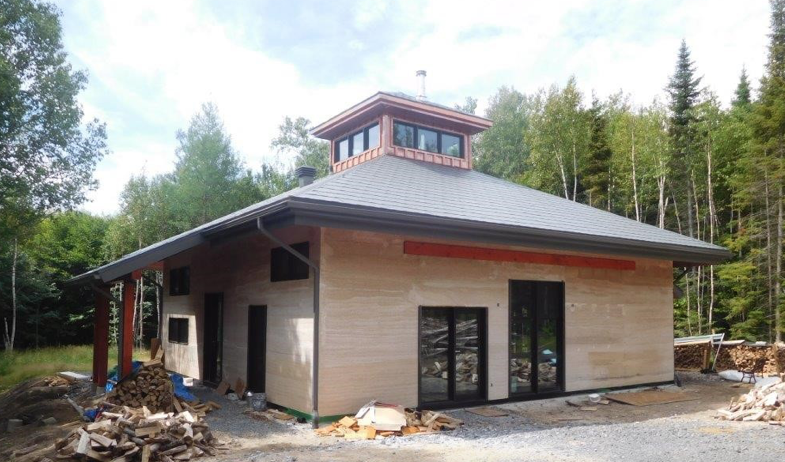
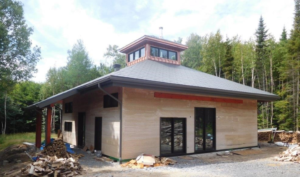
Simon Leclerc: We are located in front of a beautiful house that you are building here in Quebec, Canada, using hemp concrete for the walls and the floor. You have 21 years of experience as a builder, and this is the first time you have used hemp formwork. What made you accept this new challenge?
Screen Shot 2018-12-22 at 6.51.06 AM Screen Shot 2018-12-22 at 6.50.53 AMSerge Bolduc: I’ve known hemp since I was young, but a few years ago I visited a sugar shack in Canada that was built with hemp concrete. When I entered the house, I felt like I was outside, as if the house was merged with its environment. I am a very sensitive person and I felt as if the whole house was organic, with very little transformed material. It was a great feeling.

When my client approached me with his hemp house project, I was very happy to accept this contract and to discover this matter closely that made me feel so good. But since I had never worked with hemp before, it was really a new challenge for me.

Simon Leclerc: The house I see behind is not typical. Even if the construction is not finished yet, what did you learn from this specific experience?

Serge Bolduc: Each project has its unique peculiarity, but this one was very special, because the house has high walls and a large fenestration. These specificities made the project more difficult to evaluate and plan. The time scheduling was an ongoing challenge.

I found in Canada a hemp expert with 13 years of experience (Gabriel Gauthier, Artcan) who agreed to supervise the construction of the walls and the floor and take responsibility for them. This person had experience in a project like mine. He knew the right recipe to use and how to build the hemp structure (mix of hemp shive, clay powder, lime and water). He oversaw the construction of the walls, which were compacted with the help of friends and family members of the client to reduce project costs.

Before starting the work, we evaluated the time of construction of the walls, but it took twice longer as expected. Because compacting walls is a demanding job, we have struggled to find friends and family members willing to commit long enough. So we continually trained new ones, which slowed down the construction considerably.

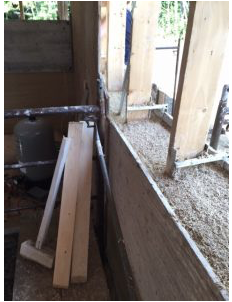
To build the walls, workers must stack and pound hemp concrete mixes into the formwork with a fork designed for this purpose. These people must be sturdy, but they do not need to be specifically qualified for the job. It takes at least half a day to learn how to do the job well, and it can be learned on the spot. The rotation of the people who came to help was therefore our main challenge.

If I redid this project, I would ask everyone to commit for at least two days in a row, and even more if possible.

Simon Leclerc: Were there other elements, along with the rotation of the people who came to help, that slowed down the project?

Serge Bolduc: Usually, when I make a floor, I place 2 or 3 inches of rigid insulation on the ground (Styrofoam sheets) and I pour a concrete floor over it. But in this case, my client wanted to have both feet on the ground, to feel a direct contact with the earth (he only wanted organic matter under his feet). So we replaced the rigid insulation with 8 inches of hemp concrete mix, the same recipe as for the walls.

Because we have a very low temperature during winter in Canada, we could not let the air circulate under the floor to facilitate drying, as is the case in a warm environment. So this floor alone took 7 months to dry, much more than for the walls.

If I started again, we would use geothermal ventilation (Canadian well) to accelerate drying. This is the conclusion my expert and I arrived at, as it would allow the floor to dry on both sides (top and bottom).

Simon Leclerc: How did your client manage the deadlines?

Serge Bolduc: My client was in no hurry to settle in his house, which greatly facilitated the construction process. I would not have been able to meet tight construction time requirements due to the large number of unknown elements associated with a first hemp construction. This flexibility over time allowed us to go through each step properly.

Simon Leclerc: Would the hemp concrete recipe change in a cold environment?

Serge Bolduc: No, it would not change. In all condition, the goal is to obtain a mixture of hemp concrete as dry as possible. The drier it is initially, the harder it will be to compact in the walls, but the faster it will dry.

At one point in our assembly, it became easier to compact the concrete mix in the formwork and our expert stopped the construction. This was because the recipe contained too much water. It had to be rebalanced before restarting production.

Simon Leclerc: With Canadian building regulations requiring all employees on a construction site to be licensed professionals, how are hemp workers fitting?

Serge Bolduc: Since no one in the construction sector is specifically qualified to supervise the building of hemp concrete walls, the hired expert will be tolerated on a construction site. It will be possible to demonstrate that he does not occupy the functions of skilled workers. For the others who will help him to compact the mixture in the formwork, they must be volunteers (friends, families).

All this remains an area not completely defined, but tolerated by the system in place. Since this work is very specific, my expert has never had a problem with the regulations.

Simon Leclerc: You will soon be adding a coating to the hemp walls. Is it different from any other wall?

Serge Bolduc: It’s the same. Once we reach a certain level of humidity (my expert manages the percentage), hemp walls are considered dry. We can then add the coating. For this specific project, we will add a coating of lime and sand of 3/16 inches thick. My client will soon choose the final color. Many shades are available because color pigments can be added if we do not find a sand color that we like.

Simon Leclerc: For the structure of the house, does hemp need specificity or do you build it like any other structure?

Serge Bolduc: We used 2 x 6 beams for the structure of the house, but instead of spacing them 16 inches apart, we spaced them 24 inches apart. Then my hemp expert added extensions on each side of the beams to a total thickness of 12 inches so we could get R-25 insulation, which is the standard here in Canada.

Simon Leclerc: So with a house that would be built in a warmer environment, is it conceivable that the thickness of hemp walls would be less?

Serge Bolduc: Yes, absolutely. The level of insulation requirements in such environment would certainly be lower. The Canadian standard is R-25, and hemp offers an insulation performance of R-2 per inch (so 12 inches thick required, plus coating).

Simon Leclerc: If you’d start the same project again, what would you do differently to facilitate construction?

Serge Bolduc: As I said, because we worked with the client’s friends and family who came to help compact the concrete mix, it was difficult to really plan the duration of the project. So if I did it again, I would expect twice the time for every step of hemp construction. This would ease the pressure on the overall calendar.

Simon Leclerc: Is there anything else you would do differently?

Serge Bolduc: I would mandate an inventive person to create a mechanical way to pound more easily the mixture of hemp concrete in the formwork walls. If such a tool existed, it would have greatly facilitated our work.

Simon Leclerc: In order to properly consider such project, what should a person planning to build with hemp concrete consider?

Serge Bolduc: First of all, this person must make sure that he/she has many friends and family members ready to commit to his/her project, in addition to the expert responsible for supervising the construction. These people have to be in good shape, because it’s endurance work, and they have to give their time for at least two days in a row (ideally more), not just for a few hours to come and see how things are going. Otherwise, it will slow down the entire team because it takes time to train people properly and make sure they are effective.

I also recommend planning twice as many people as those who confirm their presence. Again, because they have other commitments elsewhere, they may not be available the day you need them and you do not want to slow down the entire team.

Simon Leclerc: Knowing the challenges you had with this house, why would anyone choose hemp concrete today?

Serge Bolduc: Those who choose hemp for their home are looking for organic materials that give them the feeling of living outdoors. I have never felt this elsewhere, except in a log house. You only have organic matters between the living area and the outside.

Hemp is one of the most compatible products you can find for humans. You can extract the oil, proteins and make clothes with fiber. It requires very little water and grows like grass. In addition, no vermin are attracted to hemp because of the silica it contains (mice, ants, etc.).

Those who want to live in an organic environment will choose hemp. They will have the feeling of being merged with the landscape around their house, without synthetic material. Not possible to be more natural. It’s a great way to connect with nature.

SUMMARY and ADVICE

– Make sure to hire a hemp expert who has experience in a project like yours. Many challenges will be encountered along the way and being able to find solutions in small details will make a big difference at the end.

– Anticipate larger delays than expected.

– Expect more friends and family members than you need and who will have confirmed their presence.

– If you can afford it, hire some professional workers too, in addition to your expert and the friends and family members. If you pay for them, national standards require that they be licensed professionals.

– Do not have a tight schedule, as drying may take longer than expected.

GreenPower buses launch Porterville plant

December 22,2018-

Screen Shot 2018-12-22 at 6.32.21 AMGreenPower Motor Company Inc. (TSXV: GPV) (OTCQX: GPVRF) (“GreenPower” or the “Company”) has announced that its manufacturing facility in Porterville, California is ready for production. In August 2018, the Company entered into a four-year lease with a three-year option for a facility with over 50,000 square feet in the City of Porterville as a manufacturing and assembly center. The Company has now set up this facility for production of EV Stars and the EV Star Plus models.

“This manufacturing facility will allow us to deliver EV Stars built with the efficiency and quality that comes Made in America,” said Brendan Riley, President of GreenPower. “We’ve ordered the initial parts and components to build the first tranche of EV Stars commencing in December. By the end of 2019, we plan on producing 25 EV Stars per month with total production of over 200 EV Stars for 2019.”

The EV Star is an all–electric, zero emission, 25-foot bus that seats up to 19 passengers, with an operational range of 120 to 150 miles on a single charge. The EV Star Plus is a wider body model that can accommodate multiple ADA spots with a curb side wheelchair lift. The EV Star can be charged with Level 2 and DC Fast Charging systems. These versatile vehicles can be used for micro-transit services, para-transit, vanpool, shuttle, school, employee transportation, tourist operations or cargo transport. The EV Star and EV Star Plus are great choices for cities, transit agencies and local organizations with a mandate to reduce emissions.

The Company presently has orders for over 40 EV Star and EV Star Plus Min-eBuses.

Long-Term Extension of the Biodiesel Tax Incentive

California ramps up use of the biofuel

November 28,2018-

Screen Shot 2018-11-28 at 8.44.06 AMThe House Ways & Means Committee released a proposal this week to extend several expired tax credits, including the biodiesel and renewable diesel tax incentive. The National Biodiesel Board  said  they welcomes the proposal for a multi-year extension of this important incentive; it would keep the credit at its current rate of $1.00 per gallon for 2018 through 2021 but gradually reduce it to $0.33 per gallon by 2024 and then allow it to expire.

Made from an increasingly diverse mix of resources such as recycled cooking oil, soybean oil and animal fats, biodiesel is a renewable, clean-burning diesel replacement that can be used in existing diesel engines without modification. It is the nation’s first domestically produced, commercially available advanced biofuel.Using biodiesel can result in a a 50% reduction in diesel particulate emissions

In late September the California Air Resources Board (CARB) today approved changes to the Low Carbon Fuel Standard (LCFS) designed to make the program a more versatile, comprehensive tool in the fight against climate change.

Last year, the LCFS resulted in more than two billion gallons of petroleum and natural gas being replaced with cleaner, renewable transportation fuels.

The standard currently requires a 10 percent reduction in the “carbon intensity” of California’s transportation fuels by 2020. Carbon intensity is determined by the amount of carbon emitted throughout a fuel’s entire life cycle, from extraction or production to combustion.

The amendments approved today by the Board require a 20 percent reduction in carbon intensity by 2030, the most stringent requirement in the nation. The new requirement aligns with California’s overall 2030 target of reducing climate changing emissions 40 percent below 1990 levels by 2030, which was set by Senate Bill 32 and signed by Governor Brown in 2016.

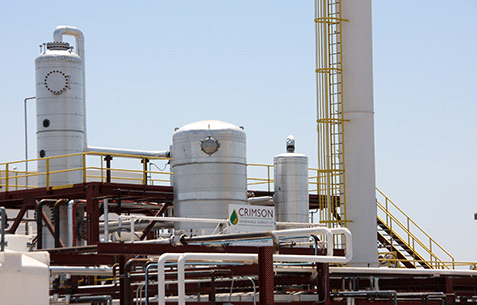
Bakersfield’s Crimson Renewables has been expanding its operation, the state’s largest, to make more of the biofuel.

New vehicle sales down in 2018

Electric vehicle market  share rises 

November 21,2018-

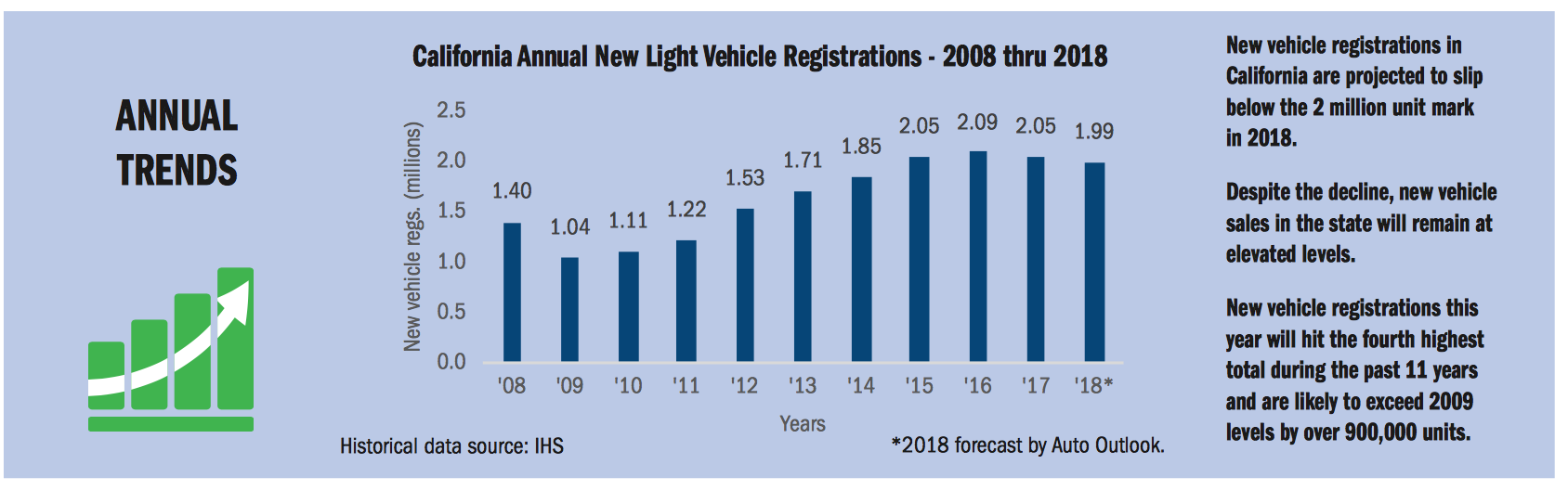
Screen Shot 2018-11-21 at 7.34.48 AMSACRAMENTO, CA – The California new vehicle market declined 2.7 percent during the first nine months of this year, while the U.S. market was essentially unchanged.

According to the California Auto Outlook Third Quarter 2018, California light truck sales continue to increase, by 5.2 percent from 2017, while passenger car registrations have fallen by 10.6 percent below this time last year. While California sales reflect the national preference for light trucks over passenger cars, the trend is more pronounced across the country with US light truck sales increasing by 7.6 percent and US passenger car sales falling by 13.2 percent. The outlook was released November 20.

The California new vehicle market declined for the sixth consecutive quarter in 3Q 2018 versus a year earlier, down 3.6% year to date.

“While California new vehicle sales are expected to be slightly below 2 million units this year, we continue to be encouraged that California sales are steady and remain at elevated levels. Even if the market is slightly declining, we need to keep perspective that this is a natural trend for a market that has seen significant, consistent growth over the course of several years,” said California New Car Dealers Association Chairperson, Taz Harvey of Dublin Mazda

click to enlarge
click to enlarge

YTD through September light truck registrations in the state increased 5.2 percent, while passenger cars fell 10.6 percent.

Light truck market share in California was 54.5 percent vs. 68.2 percent in the Nation.

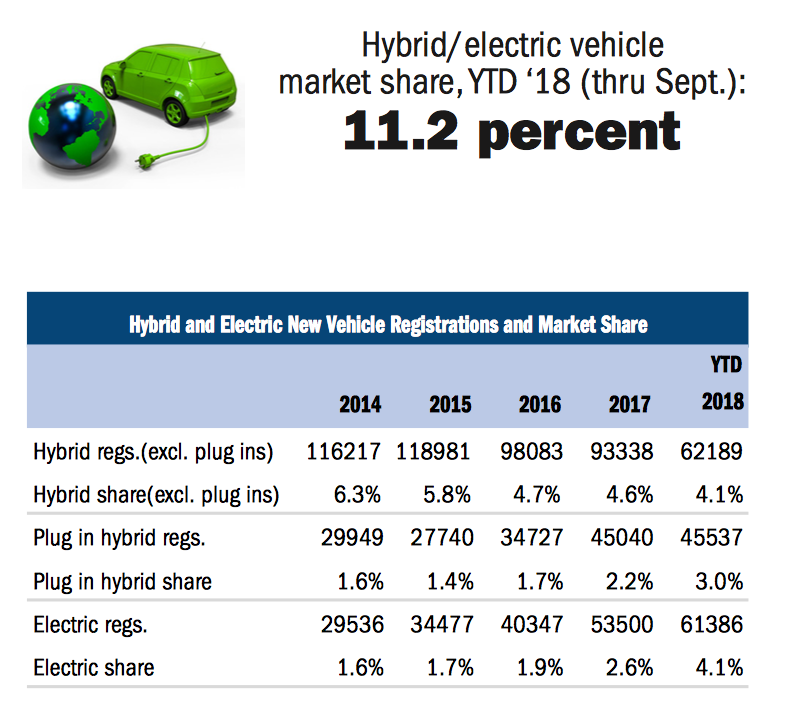
The electric vehicle market share continues to increase throughout the state, making up 11.2 percent of the market, year to date. This is a 4 percent increase during the first nine months of 2018. However, not every powertrain is seeing this increase, hybrid vehicles continue to see a decline year over year, from 4.6 percent in Q3 2017 to 4.1 percent year to date.

Screen Shot 2018-11-21 at 6.49.54 AM


Additionally, 13 of the top 20 brands in California saw light truck sales increase, paced by Volkswagen with an increase of  more than 100 percent compared to  this time last year.