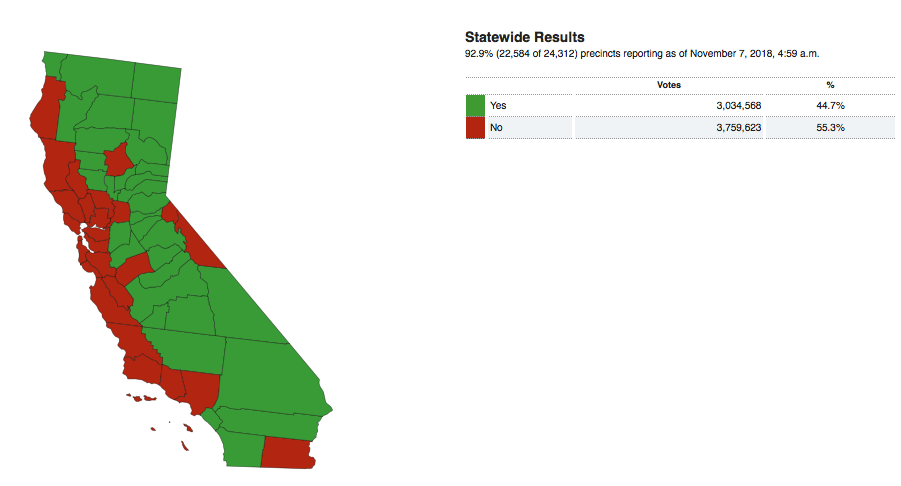
Proposition 6 on the California ballot this week went down to defeat by a 55% to 45 % vote according to the latest statewide numbers. The proposition if it had ben approved wouldhave repealed the most recent gas tax increase implemented last November Interior counties mostly approvedthe repeal but the more populated coastal counties, where gridlock is a way of life, prevailed. Some urban counties like Alameda voted 73% ‘No’ while Valley-based Kings County voted ‘Yes’ on 6 by an emphatic 61%.
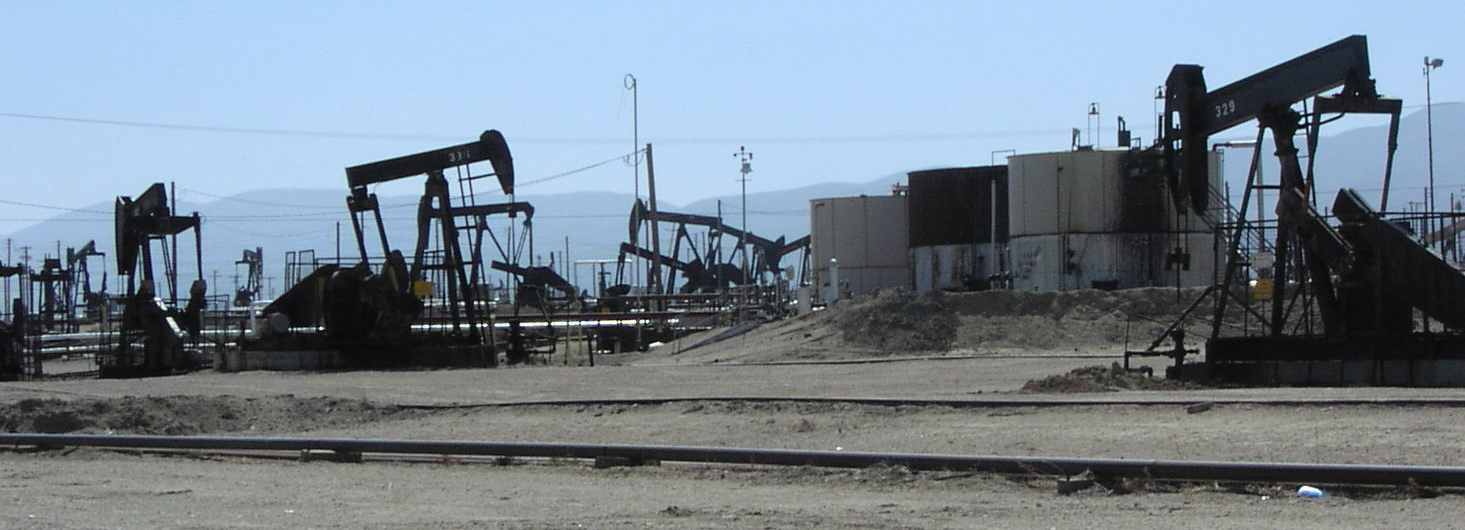
On October 3 Midway Sunset oil prices from Kern County reached $80 barrel according to Chevron who posts the price daily. This week, a month later ,they are to down $68 reflecting the drop in WTI oil prices in US markets. Not that it has made any difference at the pumps in the state. AAA says the average gas price in California is less than a penny different than a month ago at $3.76 gallon. Now there appears to an oversupply of crude.”The magnitude of recent selling is strongly suggesting that global oil demand is weaker than expected as a result of tariff issues, especially between the U.S. and China,” said Jim Ritterbusch, president of Ritterbusch & Associates.
Fresno County sees new utility-scale solar plans
Three new solar projects in Fresno County are moving forward this fall. A new notice of preparation was released for Scarlet Solar Energy Project , a 400MW project near Tranquility at Hwy 33 and Manning Ave. The project is being built by Recurrent Energy.
Another NOP was filed recently for South Lake Solar, a 585 acre project that will produce 180,000 megawatt-hours of renewable energy annually. The project would be an up to 80-MW PV solar energy facility with associated on-site substation, inverters, fencing, roads, and supervisory control and data acquisition system. The proposed energy storage components would include an up to 80 MW AC max capacity energy storage (battery) system.
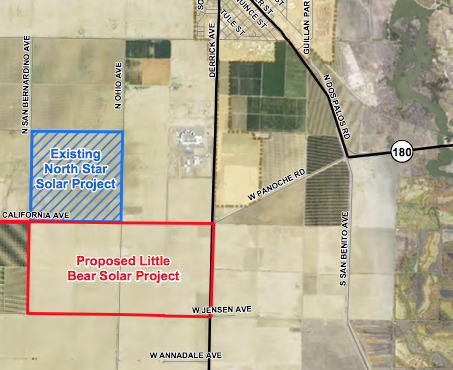
Lastly the Little Bear Solar Project released their final notice to construct a 180-MW PV electricity generating facility and associated infrastructure on 1288 acres of private agricultural lands in western Fresno County, on Hwy 33 south of Mendota.The applicant is First Solar.
Kings solar project to get hearing
Kings County Planning Commission will hear a request for a Conditional Use Permit November 5 for American Kings Solar who proposes to construct a 128 MW solar PV power generating facility on 874 acres of private lands. Formerly known as GWF Energy’s Henrietta Solar proposed in 2010, the development now carries the name American Kings Solar. First Solar acquired the right to build the project in 2015. It just across Highway 198 from NAS Lemoore.
The facility will also include battery storage up to approx. 500 MW hours, which will be used to optimize power to the grid, such as charging the batteries when excess electrical generation is available and supplying power to the grid when electrical demand is high.
Thank the toilet for water savings
Throughout the western U.S., water conservation is in the toilet.
And that’s a good thing.
Since the 1990s, a strange phenomenon has played out in arid western urban areas. Populations are booming while overall water use is staying the same or going down. The trend is clear in Denver, Albuquerque, N.M., Las Vegas, San Diego and Phoenix: Cities are growing and using less water in the process.
It’s impossible to give credit to one single solution, but one could make a strong case that the MVP award for water conservation efforts should go to the modern toilet.
The toilet is the single largest user of water in the home. It uses more than the washing machine, the dishwasher, the shower or the kitchen faucet. About a quarter of all water that enters a home will flow through the toilet according to a 2016 study. Each day the average toilet will use about 33 gallons of water.
That might sound like a lot, but it’s a big improvement. In 1999 the average toilet guzzled more than 45 gallons of water daily.
The story of how the toilet became the unsung hero of water conservation includes an act of Congress, some elbow grease and logs of miso paste.
Out with the old
Theresa MacFarland lives in a historic two-story house in Longmont, Colo., with her husband and two kids. Built in 1928, their home has all the vintage touches: hardwood floors, big windows, wood detailing and one really old toilet.
A little stamp on the bowl says it was built in the 1950s. MacFarland points it out to her 4-year-old daughter Althea.
That toilet has been there longer than daddy and I have been alive.
Teresa MacFarland, mother and Colorado home owner
“That toilet has been there longer than daddy and I have been alive,” she says. “Probably longer than grandma and grandpa have been alive.”
As aging toilets are wont to do, it started acting up. So MacFarland contacted Resource Central, a Boulder-based conservation group and asked for help installing a new, more water-friendly model. Neka Sunlin showed up with the latest in toilet technology. Sunlin oversees the group’s toilet replacement program, Flush for the Future.
“We guesstimate this one is using about five gallons a flush,” she says about the old toilet. “The new one uses less than one.”
The number and value of solar building permits in Tulare County continues to be strong but markedly lower than the past few years, in fact down by around two-thirds.
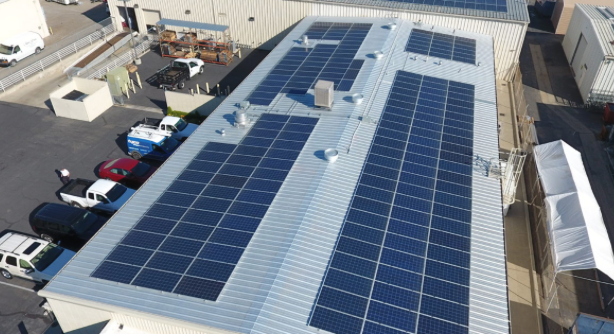
Through October 25 of this year the value of all solar permits, both residential and commercial add up to $56.3 million. There were 1776 residential solar permits taken out so far this year according to Construction Monitor.
By comparison there were 2042 permits for the same period in 2017 with a total valuation of both of residential and commercial solar permits totaling $89.3 million.
Those 2017 numbers are down from 2016 when solar valuation was even higher – reaching $157 million including 2662 residential permits. The big jump in 2016 in value came from commercial solar projects that reached $105 million.
In 2015 the numbers were more modest coming in at $112 million.
Despite the slowdown, solar array construction activity in the county remains strong adding up to $56.3 million so far this year in the county out of $438 million for all building activity.
Industry sources says that the U.S. solar industry is bouncing back after being slowed by the 30% tariff on imported solar modules and cells, imposed in 2018. Still the installed cost per watt for residential solar continues to decline.
The Lawrence Berkeley National Laboratory says the national median installed price of residential PV at the end of 2017 was $3.70/W and has dropped to $3.50/W by Q2 2018.
Meanwhile more than 100 California dairy farms have also installed solar energy systems to meet their energy needs and help the state meet its clean energy goals.
The joint venture firm applying to the government to build an ocean wind farm 30 miles off the Central Coast is holding two public meetings to go over progress on their pending application.
Joint venture partners Trident Winds Inc. & EnBW GMBH, who will now go by the name of Castle Wind, will hold a public session Thursday October 11 from 6-8 pm at the Morro Bay Community Center,1001 Kennedy Way, East and West Auditoriums in Morro Bay.
On Friday October 12 the firm will hold a second meeting in Cambria from 7-9 pm at the Veterans Memorial Building,1000 Main Street, Cambria.
Making a presentation will be Alla Weinstein, founder & CEO of Trident Winds, and former founder & CEO of Principle Power, Inc., developer of a floating offshore wind support structure, the WindFloat. Also, Maren Raubenheimer Manager O&M for Offshore Wind Facilitator. Lastly – Brad Britton, MPA, BSEE, Principal & Founder of Britton Coaching & Consulting.
The federal Bureau Of Ocean Management (BOEM) and the State of California have initiated the competitive planning and leasing process for possible future leasing for offshore wind development off California.
A key meeting in September brought together many of the players who have a stake in what could be a new energy source for the Golden State.BOEM has since announced they would be moving forward on possible development of up to 4 different areas off our coast including sites off of both Morro Bay/Cambria and west of Diablo Canyon and off Humboldt in northern California. News is expected as soon as November on more specifics of what area if any might be considered by the Navy and Department of Defense who have blocked the idea so far but have recently suggested some flexibility.
The Castle Wind jolt venture is no the only company seeking a permit to build offshore.But they appear to be the only one who is working, at least publicly, with existing ocean stakeholders like the local fishing industry and City of Morro Bay, an approach that may find favor with regulators.
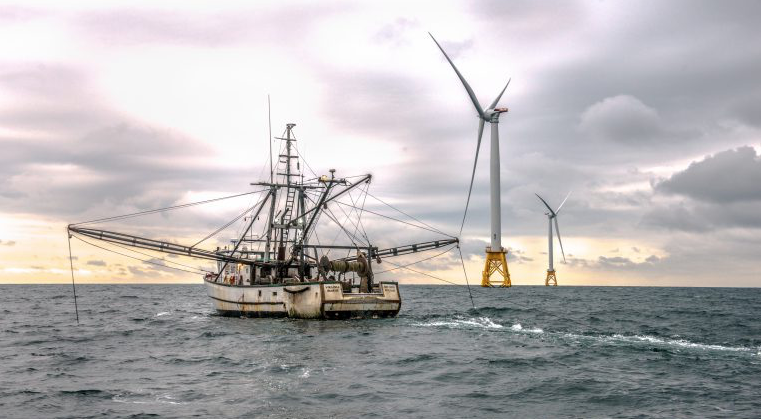
This week the Morro Bay Commercial Fisherman’s Organization, the Port San Luis Commercial Fishermen Association, and Castle Wind LLC joint venture entered into a mutual benefits agreement intended to minimize the impacts a future offshore wind project on the local commercial fishing industry.
In their new release this week Castle Wind argues that “California’s offshore wind is an abundant, local, renewable energy resource that will help California achieve its climate and renewable energy goals, while providing a critical diversity in the energy supply. California has some of the most ambitious climate and renewable energy goals in the world, with Governor Brown’s recent signing of legislation calling for California’s energy supply to be carbon neutral by 2045.”
Castle Wind says they are planning to develop an offshore wind project with a grid connection in Morro Bay that will generate up to 1,000 megawatts, providing clean energy for over 300,000 households.
While offshore wind helps to meet the state’s clean energy requirements, create well-paying sustainable jobs for the duration of the project operations, it also brings new economic and tax revenue benefits to the city of Morro Bay.
“However, as with any energy project, it may have an impact on the local community“ admits the company.
“The commercial fishing industry is a significant part of the Central Coast communities and economy. Castle Wind has been working closely with the local commercial fishing organizations for over two years to develop means to minimize the anticipated impacts in the vicinity of the planned offshore wind project. Castle Wind has voluntarily agreed to enter into the first of its kind mutual benefits agreement with the commercial fishing organizations to minimize the anticipated impacts to the commercial fishing communities, while opening new business opportunities for the fishing industry.
“We appreciate that Castle Wind LLC has reached out to the local fishing community to find a solution that is workable for both of us. This agreement is the first of its kind and will set a could be used as an example for other fishing communities to address their specific issue. We wanted to make sure it was right for the fishermen, so we spent a lot of time discussing our
options with Morro Bay and Port San Luis Obispo fishing organizations and Castle Wind LLC until we finally came to an understanding that should work for all. We are now more confident going forward that this agreement will ensure that the needs of the commercial fishermen are taken into consideration with the installation of an offshore wind farm in our local waters,” said Tom Hafer, President of MBCFO, speaking on behalf of both organizations.”
Update: On 10/4 Chevron posted a price of $80.57 for Midway Sunset. Valley crude oil is expected to reach $80 barrel this week as WTI climbed over the $75 level Monday. WTI is up over 44% in the past year as the US pushes to limit oil exports from Iran while it pumps at record level in the US.Rig count is up by 113 compared to last year across the US.
U.S. crude prices surged on Monday to a four-year high as West Texas Intermediate crude oil was up $2.05, or 2.8 percent, at $7 Brent crude was up over $85.
Chevron will post the price of its Valley-pumped Midway Sunset oil Tuesday, likely to break the $80 threshold, the highest since October 2014.
Higher priced crude has pushed up the price of gasoline about 15 cents last month. In California a the price is some 64 cents higher than a year ago.
EIA says that U.S. #crudeoil exports increased by nearly 80%, from the first half of 2017 to the first half of 2018 and set a new monthly record of 2.2 million barrels per day in June. Much of it went to Asia.
While the Atlantic Eastern seaboard is humming with a formidable pipeline of offshore wind projects, it’s been pretty quiet off the Pacific Coast of California this year. But that’s not because of a lack of interest here.
The Department of Energy said as of 2017 the US offshore wind project pipeline along the East Coast had reached a total of 25,464MW of capacity across 13 states, including the 30MW Block Island Wind Farm off Rd Island that was commissioned in 2016 where they could finally turn off those diesel generators to keep the lights on.
off the the European coast
Although the US Department of Defense (DOD) appears ready to live with offshore wind along the Atlantic Coast, there has been distinct chill in the air over plans to erect wind turbines off the Pacific’s California Coast.
As we wrote last January the US Navy,really the DOD, published a map that shows virtually all of the California coast in a red zone, meaning those sectors were “not compatible” with Navy operations and “off limits” to ocean wind farms.
Sounded an awful lot like “no-go.”
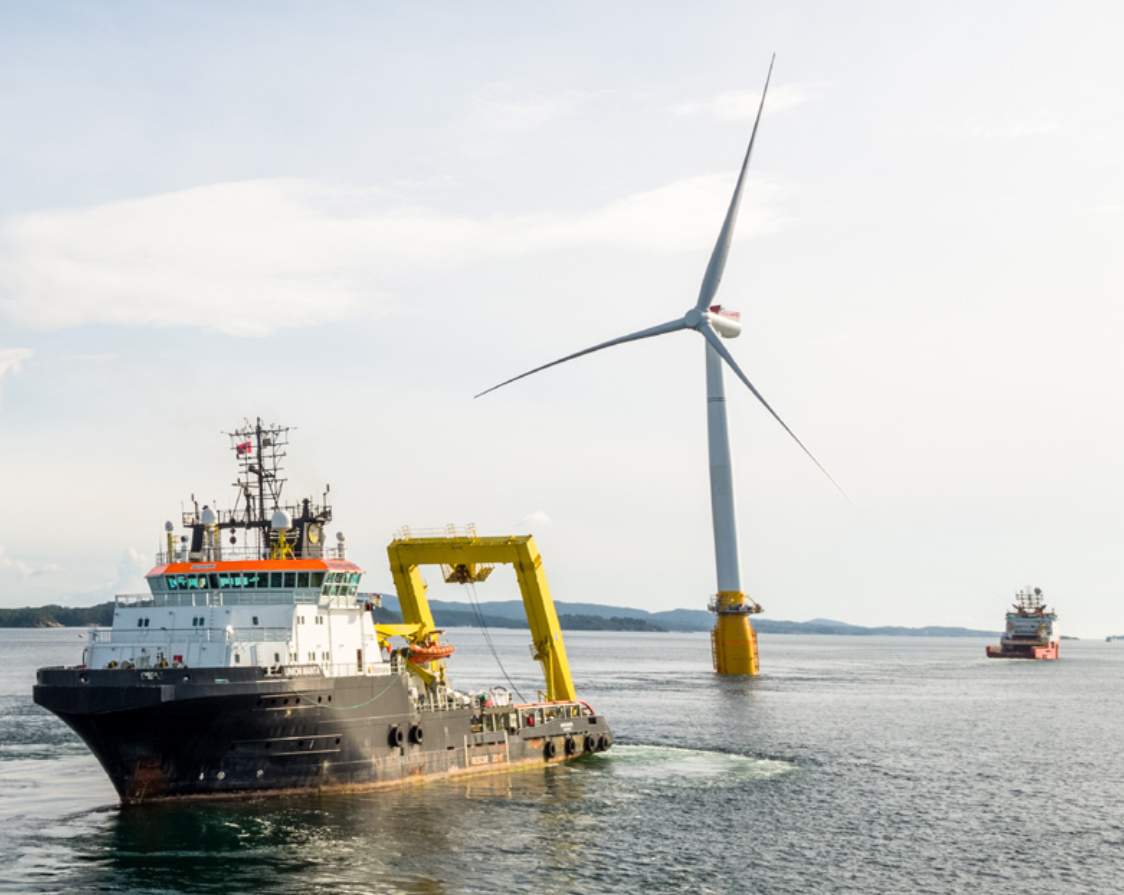
That appeared put the kibosh on development plans that received a lot of attention along the Central Coast promoted by Seattle-based Trident Winds and other companies to build up to a 1000 megawatts of offshore wind power with giant 700ft floating wind turbines, out of view – some 30 miles off the Cambria coast.
Trident started working with government agencies over 3 years ago on the ambitious plan but has been stymied, at least to date.
Unlike the Atlantic where wind turbines can anchor to the seabed, the best wind area out here is in federal waters that stretch 3 to 200 miles out, at several thousand foot depth requiring floating wind technology. That technology has been getting real world testing off the coast of Europe where a handful of companies are now generating power. A surge in new, larger offshore wind installations in Europe in 2017 is said to dramatically show the viability of a technology that has come of age. Europe is now home to more than 4,000 offshore wind turbines.
Now some those same European companies are looking here.
Despite a lack of news around here it turns out that behind the scenes, activity in California has been bubbling along after all; ”quite a bit of it” says Morro Bay city administrator Eric Endersby.
Endersby has been working to help Trident find a home in Morro Bay to launch the multimillion dollar project that would tie into the grid here – where the mothballed Dynegy power plant has sat idle since 2014.
Art of the possible
The gatekeeper for the Department of Defense for any renewable energy project off the coast is Steve Chun, Community Plans and Liaison Officer Navy Region Southwest, based in San Diego.
Chun in an interview this week said there “has been meetings with wind development interests on an active basis” in the past few months including two groups recently. Interest, he says, has been brisk.
”We have now received proposals to build wind farms at 14 different offshore sites to date.”
Instead of a flat ‘no’ Chun remarks that “the Department of Defense is trying to see just what the art of the possible is.”
Also behind the scenes, California represented by the California Energy Commission and the federal Bureau of Ocean Management (BOEM) have been waiting for DOD to work out its policy. Now for the first time in a year the BOEM/California Intergovernmental Renewable Energy Task Force plans to hold a public meeting in Sacramento on September 17 confirms spokesman Scott Flint.
Mr Chun, Gov Brown’s energy commission officials and BOEM staff will be meeting along with lots of industry players, a number of them with international ties.
International players
Case in point is Trident Winds itself, who now has new German partner as of June. EnBW North America and Trident Winds have formed a joint venture to advance the Morro Bay offshore wind project off the central coast of California with a grid connection in Morro Bay, it was announced this summer.
With 336 megawatts in operation, 610 megawatts under construction and an additional 900 megawatts under development, EnBW is becoming one of the leading developers and operators of offshore wind farms they say.” With a view to long-term growth, EnBW will invest over 5 billion euros in further expansion of renewables” they recently announced.
Now with a partner with operational experience, turbines already generating power and substantial capital to build a huge project, Trident’s joint venture may be ready for the next step.
For 2 years Trident has working with BOEM on what will be a competitive leasing of waters in the federal jurisdiction once the DOD and State of California a sign-off on pre-approved locations.
Asked about the coming September 17 meeting Trident Winds CEO Alla Weinstein says she is hopeful that “BOEM will announce designated wind areas and commence with the sales process shortly.”
Morro Bay plays a roll
Morro Bay’s Endersby says in the meantime, Trident has been meeting with the Morro Bay fishing community and appears to have an agreement in principle that would allow the turbines to be placed at a site away from the most important fishing areas.
In addition Endersby says the City of Morro Bay, eager to secure the economic development benefits, and Trident want to sign a MOU “sometime in September or October” that would help the company in the bidding process and demonstrate local backing for their application with BOEM once the process moves forward.
Norwegian energy giant Statoil also has also expressed interest and is thought to be ready to put up a competitive bid. They have spent little time in Morro Bay meeting with locals however.
Weinstein makes the point that Trident’s record of local cooperation and consultation should matter – saying she hopes “that the voice of the stakeholders will be given equal value to the value of money in selecting the winner of the auction.”
But what if DOD says ‘no’ after all?
“Either way we think Trident will move forward relocating out of DOD jurisdiction into the National Marine Sanctuary area off Monterey Bay if needed. Trident has held some discussions with them that seem favorable” says Endersby.
Another player who declines to be identified wants to build a small pilot project like they did off Rd Island to connect to the Central Coast figuring this would be substantially easier, quicker and more certain than a mega-project that could be stalled in any manner of ways.
Meanwhile other parts of California are in the running to host offshore wind farms, notably in the windy Humboldt area where a community-based utility,The Redwood Coast Energy Authority, is working with a Portuguese company, Principle Power, on a plans to displace a nat gas fired power plant in town that supplies all their power now. Redwood, like the state of California, favors and gives priority to renewable power over fossil fuel power. DOD’s Mr Chun says this area is being discussed as well even though the new Navy map also is colored red off the north coast too.
Now in a twist a new player Terra-Gen, with major wind power holdings in California already, wants to build an onshore wind farm capable of producing up to 135 megawatts of electricity, enough to power the 63,000 households in isolated Humboldt County. Humboldt’s current power source is Humboldt Bay Power Plant, which is powered by natural gas and diesel that produces 163MW. Terra-Gen is working with Humboldt’s Community Choice Aggregate, the Redwood Coast Energy Authority to see if a contract between the power producer and the power purchaser, can be developed.
If this land-based renewable project is built, the area will likely not need offshore wind with little infrastructure available to take what would be surplus power to the wider California grid and major urban centers in the state.
That’s an advantage that the Central Coast has, proximity to the state’s big north/south grid system. We are tied in with millions of dollars of already installed transmission lines and substations that just happen to be located to accept new offshore wind power. That is because the seaside Morro Bay power plant is kaput and the ocean-front Diablo Canon nuclear power plant soon will be.
By the way, just what will happen to the infrastructure at Diablo Canyon will be discussed at the upcoming Diablo Canyon facilities repurposing workshops to be held at Atascadero City Hall at 6500 Palma Ave.
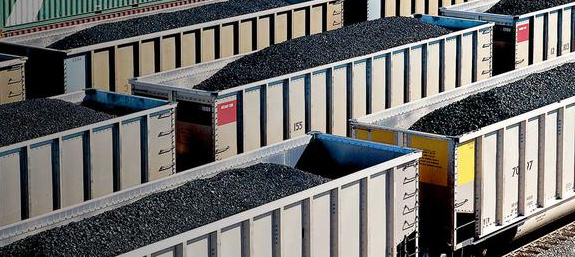
Union Pacific reports rail shipments of coal year to date by the company is down 7 percent compared to the year before. This is despite President Trump’s effort to boost the industry.
More coal has been going overseas in the past few years even as US utilities are using less to generate power. But Trumps tariff battle may now hurt exports further.
This month Turkey hiked its import tax on US thermal coal to 13.7 percent, from an initial 5 percent, thwarting Washington’s plans to boost its coal exports to the country in the near term.
West Virginia University
A West Virginia University study suggests that U.S. tariffs on imports and retaliatory measures by other countries are likely to slow down the growth of coal exports, especially for coal producers in the Appalachian region.
“Export demand has accounted for nearly all of the improvement in production over the past two years or so due to significant increases in coal shipments to India, Brazil, Ukraine and a few other countries. This has enabled Southern West Virginia to account for a majority of growth in statewide coal output in recent quarters. By contrast, domestic demand has remained negative, but more so for mines in Northern West Virginia, as the US electric power sector transitions away from coal-fired generation over to natural gas.”
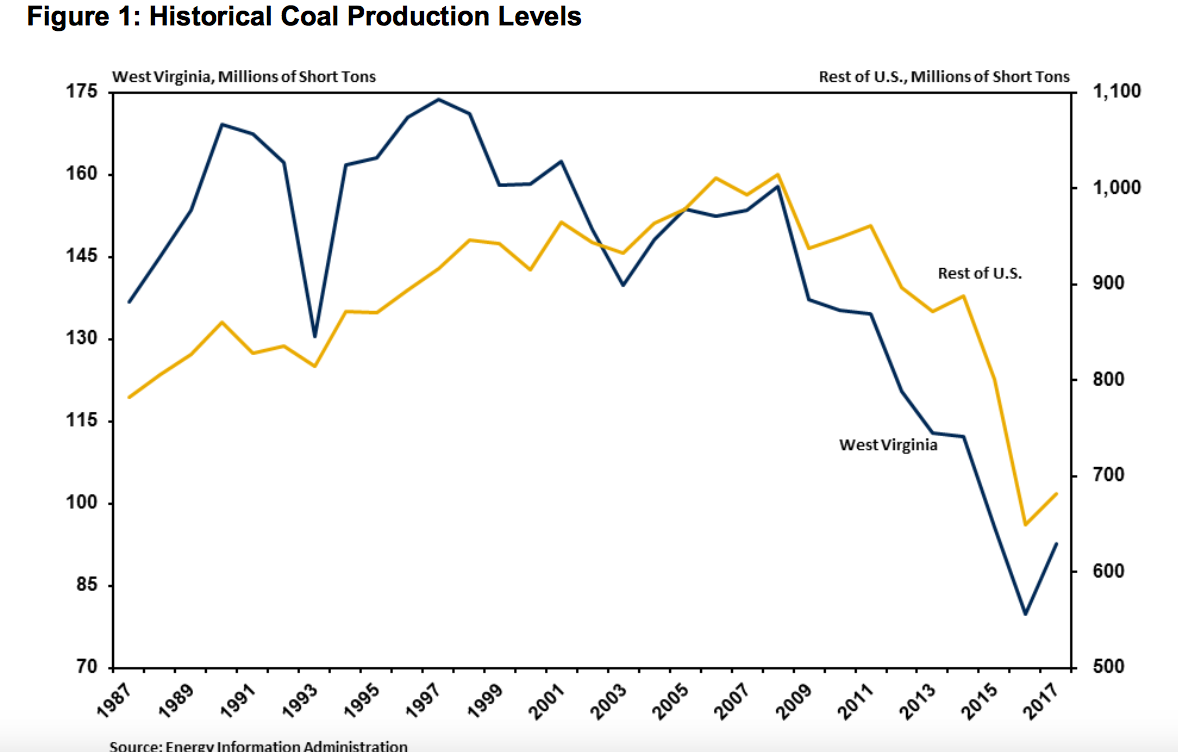
Short-Term Forecast: The baseline forecast calls for coal production to total approximately 91 million short tons in 2018, which represents a slight drop versus 2017 levels. Overall state output is expected to decline 3 percent annually over the next two years, leaving mined coal tonnage at just over 85 million by the end of the decade. Weakening export activity will likely drive most of the anticipated drop in production through 2020, but the retirement and/or conversion of several gigawatts worth of coal-fired generating capacity that sources coal from West Virginia mines will also account for some of this decline.
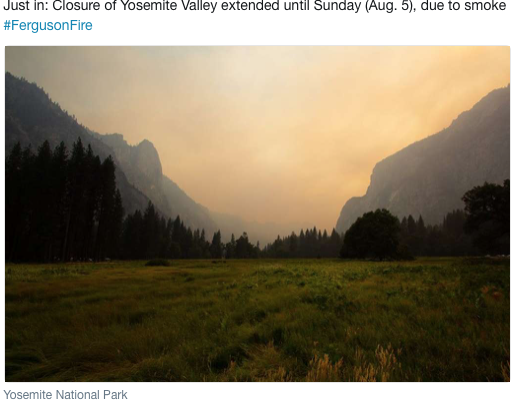
Due to increased fire activity in the areas adjacent to and in Yosemite National Park, park administrators and fire managers have made the decision to extend the current park closures due to the Ferguson Fire “indefinitely” they say in a weekend news release.
The wildfire, one of a dozen impacting much of the state, has now charred over 90,000 acres.
Over the past 48 hours, fire has touched all of the roads used to access Yosemite Valley, burning dead and downed trees that can become very explosive and fall without warning. There are also significant terrain hazards for firefighters. These hazards, along with extreme fire behavior and frequent weather changes, have made this an extremely difficult fire fight, officials say.
Since the Ferguson Fire began on Friday, July 13, 2018 park visitors, employees, local businesses and communities have all been affected.The fire has cleared the West’s most popular national park of all visitors that typically would number over 600,000 in a month, if not for the disaster.
Trump Blames Water Diversion For California Fires
President Donald Trump Sunday said California wildfires are made “so much worse” by allowing “massive amount” of water to be diverted to the ocean. Here is his tweet.
“California wildfires are being magnified & made so much worse by the bad environmental laws which aren’t allowing massive amount of readily available water to be properly utilized. It is being diverted into the Pacific Ocean. Must also tree clear to stop fire spreading!”
Is Yosemite burning because water is being diverted into the Pacific?
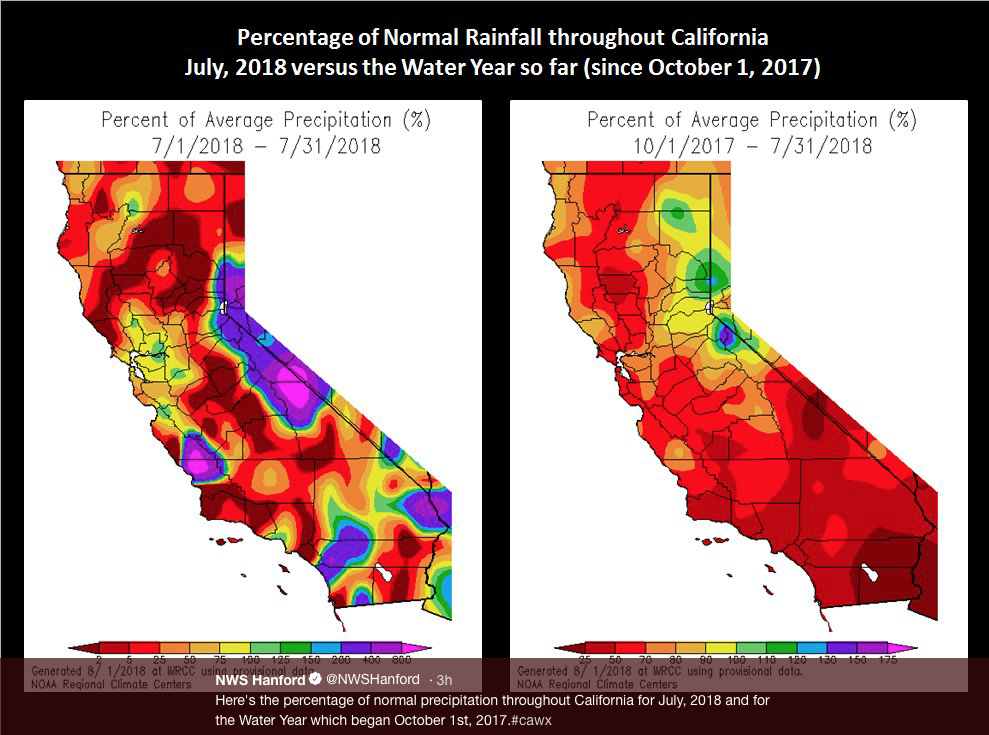
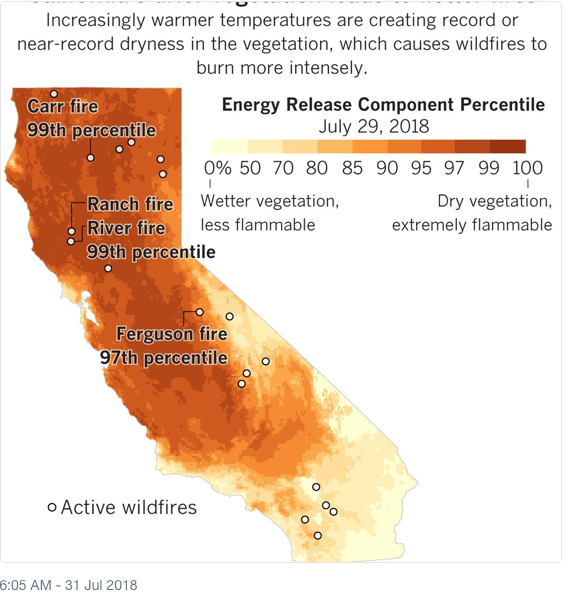
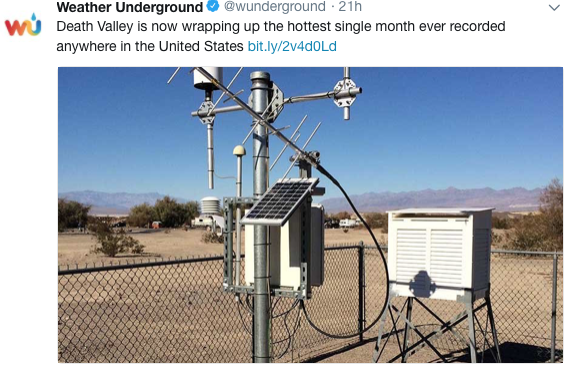
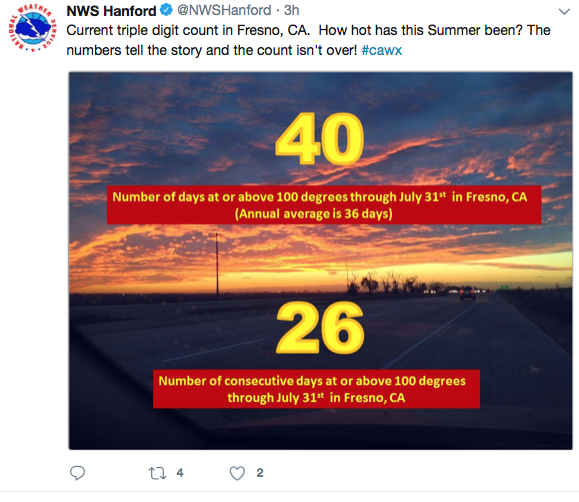
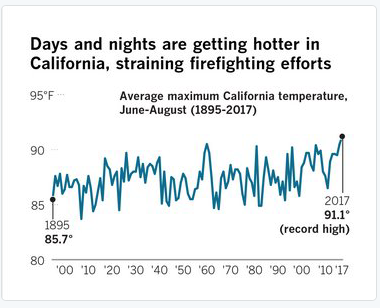
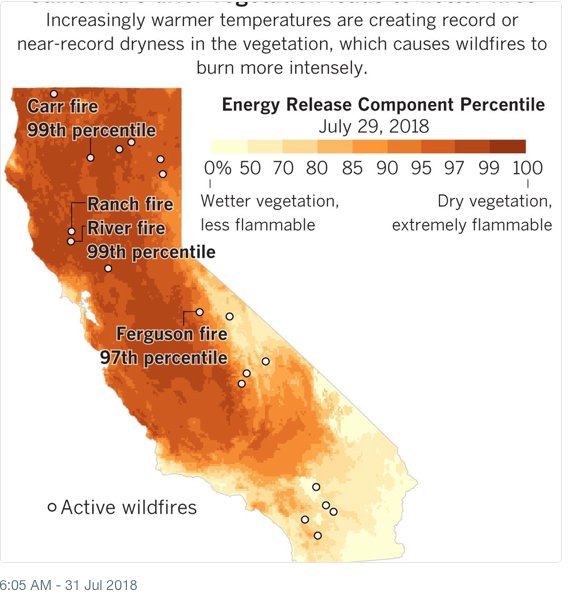
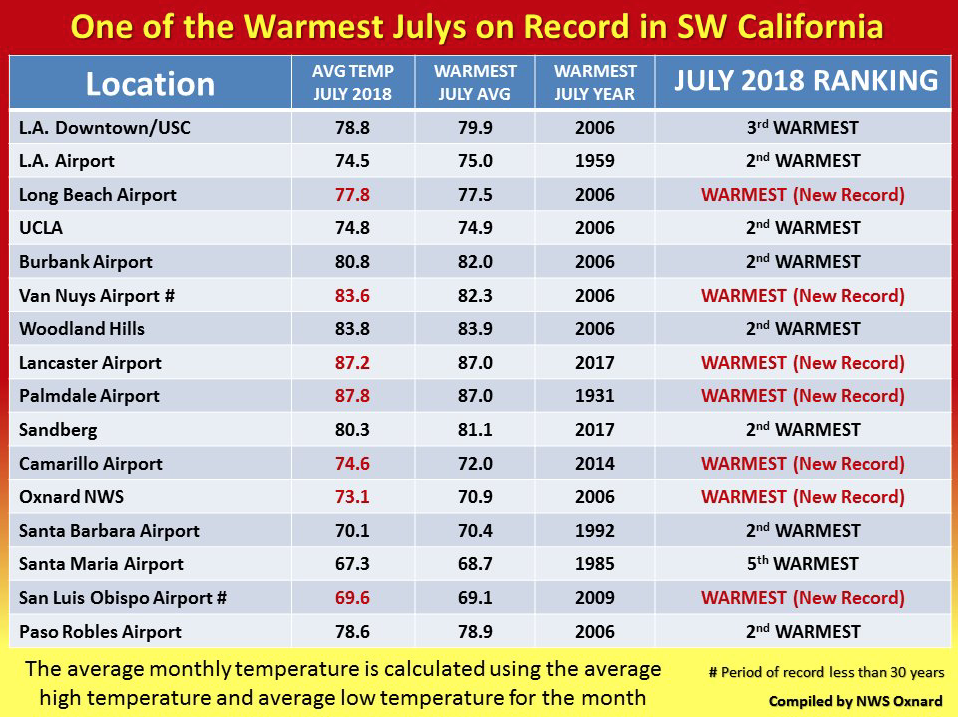
Mr Trump does not mention a record 30 days above 100 degree temps across much of California, bone-dry vegetation, years of drought, or climate change. Unheard of weather events, like 143 mph vortex winds in northern California are also playing a part in these hellish turn of events.
Water diversion?
Nor is he seem to be aware of the fact that water has been diverted from the Merced and Tuolumne Rivers for irrigation and drinking water for decades. That includes construction of several dams including at Hetch Hetchy reservoir that provides drinking water for San Francisco delivered unfiltered by pipeline. There, the O’Shaughnessy Dam, completed in 1938, makes possible the 117-billion-gallon reservoir that supplies drinking water to 2.4 million Bay Area residents and hydro-electric power generated by two plants downstream.
The Merced River flows through Yosemite Valley and was protected as a National Wild and Scenic River by Congress in 1987. It flows free until it reaches Lake McClure outside the national park boundaries near Mariposa. There it provides over one million acre feet supply to the Merced Irrigation District which provides northern Merced County farms with water for irrigation through its approximately 800-mile network of canals as well as generating 94MW of power.
Boggles the mind
Reacting to the President’s statement LeRoy Westerling, a UC Merced professor specializing in wildfire and climatology told a newspaper;
“On the water side, it boggles the mind,” he said. “We do manage
all of our rivers in California, and all the water is allocated
many times over. So I’m not sure what he was recommending.
“Even if we eliminated all habitat for riparian species and fish,
and allowed saltwater intrusion into the delta and set up a
sprinkler system over the state, that wouldn’t compensate for
greater moisture loss from climate change.”
Sea-surface reading of 78.6 ℉ – highest in 102 years of measurements
News media members film seawater temperature measurements at Scripps Pier, Aug. 2, 2018
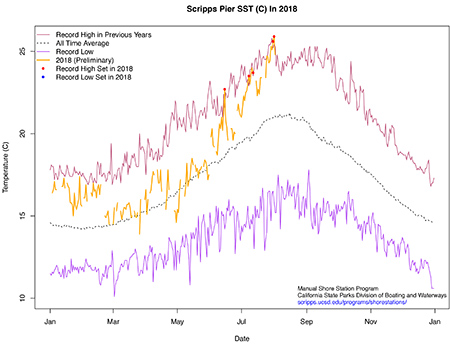
On Aug. 1, researchers at Scripps Institution of Oceanography at the University of California San Diego logged the warmest sea-surface temperature at the Ellen Browning Scripps Memorial Pier since records began in August 1916.
The record of 25.9℃ (78.6℉) followed a string of days in which individual daily records of sea-surface and seafloor temperatures had been set at the pier. It surpassed the previous record of 78.4°F (25.8°C) set on July 30, 1931 during an unusually warm period that year.
Scripps researchers have taken sea-surface temperature and salinity readings at the pier since 1916. In 1925, they began taking seafloor water temperature measurements as well.
The daily collection of data is still done by hand and is maintained by the Shore Stations program at Scripps. The program now includes nine stations on the California coast that measure seawater temperature and salinity, its budget funded by the California State Parks Department of Boating and Waterways. In addition to the manual measurements taken daily, the Shore Stations Program also maintains continuous automated measurements of temperature, salinity, chlorophyll and pressure at the pier as part of the Southern California Coastal Ocean Observing System.
The ocean region off Southern California has been experiencing anomalously warm temperatures for the past week and other observational networks farther off the coast have reported record or near-record temperatures as well.
Researchers said that the record warmth is consistent with similar records for high temperatures set on land as well as a torrent of extreme weather in 2018. This is how global warming will play out, said Scripps scientists: Records related to heat and intense weather will become easier to break having been given a boost from anthropogenic climate change that has added about 1℃ to ocean temperatures over the past century.
“Like other climate change trends, background warming enhances the probability and magnitude of extreme events,” said Scripps oceanographer and Shore Stations principal investigator Reinhard Flick.
Physical oceanographer Dan Rudnick administers a Scripps program that employs gliders to make ocean temperature profiles to points nearly 100 miles off the California coast as well as in other regions around the world. He has noticed a similar warming throughout the current that travels along the coast in recent years though no records have been broken so far.
Rudnick is one of several Scripps researchers who has tracked an uptick in ocean temperatures related to El Niño, a phenomenon characterized by the movement of warm waters to the eastern equatorial Pacific Ocean, which often affects water temperatures off California. The rise began in 2014, just before an intense El Niño bore down on the West Coast the following year. In times past, the pattern would have been for ocean water temperatures to return to historical averages following the event but that hasn’t been the case.
“It looks like we took a step up during 2014-2016 from which we have not completely recovered,” said Rudnick.
The Coastal Data Information Program (CDIP) also tracks sea-surface temperature through a network of wave-measuring buoys deployed throughout U.S. waters, including 14 in Southern California. Near-record high temperature readings for this time of year have been recorded across the Southern California array during the past few weeks. The Scripps Nearshore Buoy, located approximately a half-mile off the coast of La Jolla, recorded its second highest sea-surface temperature of 79.7 degrees on Aug. 1, second only to a reading from Sept. 2015, an El Niño year.
Shore Stations researchers added that seasonal maximum surface temperatures are generally reached in August each year, so new records may be set if warm coastal ocean conditions persist or intensify over the next few weeks.
Here are the latest posts by weather authorities and forecast for cooler weather by this weekend.
NWS Hanford: High pressure over the region will maintain above normal temperatures and a small threat of thunderstorms over the Sierra Nevada for the next couple of days. By later in the week,the high pressure ridge will shift to the east and cooler onshore flow will move into the region, bringing a cool down through the weekend.