Hoover Dam to become battery?

from CleanTechnica

City Of Los Angeles Wants To Turn Hoover Dam Into World’s Largest Pumped Energy Storage Facility

July 26th, 2018 by


The Hoover Dam, which is made from 3.25 million cubic yards of cement and more than 150 million pounds of iron and steel, is capable of retaining up to 29 million acre-feet of water in Lake Mead. That’s equivalent to capturing two years of the entire flow of the Colorado River. The stored water is the lifeblood of many cities and towns in the American southwest.

Hoover Dam

As part of the dam, there are 17 hydroelectric turbines that collectively generate around 4 billion kilowatt-hours of electricity per year. That electricity is distributed to the states of Arizona and Nevada, the City of Los Angeles, Southern California Edison, the Metropolitan Water District of Southern California, and the cities of Glendale, Burbank, Pasadena, Riverside, Azusa, Anaheim, Banning, Colton, and Vernon. Boulder City, Nevada, which was created to house the workers who built the dam, also gets its electricity from the dam.

Advantages Of Pumped Hydro Storage

Hydroelectric power has many advantages. It is renewable and has no carbon emissions, but there is a catch. After the water passes through the turbines, it is discharged into the Colorado River and can no longer be used to make electricity until it is absorbed by the atmosphere, blown by prevailing winds upstream of the dam, falls as rain, and is redeposited in Lake Mead to begin the process all over again.

According to the New York Times, the Los Angeles Department of Water and Power has a better idea. It wants to build a pumping station about 20 miles downstream from Hoover Dam, recapture some of the water, and pump it back into Lake Mead where it can be used to generate more electricity once again. The proposed plan would cost about $3 billion.

The problem is that California has so much renewable energy available now, thanks in large measure to aggressive state mandated policies, that much of its is “constrained.” That’s utility industry speak for having to give it away or simply let it go to waste. In some cases, utilities in California actually pay other utility companies to take the excess electricity off their hands.

Why Not Use Battery Storage?

Why not store it all in some of Elon Musk’s grid scale batteries? Simply put, pumped hydroelectric storage is cheaper than battery storage, at least for now. Lazard, the financial advisory and asset management firm, estimates utility scale lithium-ion batteries cost 26 cents per kilowatt-hour compared with 15 cents for pumped hydro storage.

“Hoover Dam is ideal for this,” Kelly Sanders, an assistant professor of civil and environmental engineering at the University of Southern California tells the New York Times. “It’s a gigantic plant. We don’t have anything on the horizon as far as batteries of that magnitude.”

Sri Narayan, a chemistry professor at USC, says his studies of lithium ion batteries show they simply aren’t ready to store the loads needed to manage all of the wind and solar power coming online. “With lithium ion batteries, you have durability issues. If they last five to 10 years, that would be a stretch, especially because we expect to use these facilities at full capacity. It has to be 10 times more durable than it is today.” He says pumped hydro is preferable because it is a technology that has been tested and proven over decades of use.

The Devil Is In The Details

We reported recently on the permitting process a solar developer is going through in Westhampton, Massachusetts. That struggle is child’s play compared to what the LA Department of Water & Power plan will require. For one thing, Hoover Dam sits on federal land and is operated by the Bureau of Reclamation, which is part of the Interior Department. Environmentalists are concerned about the big horn sheep that graze below the dam.

Eric Garcetti, mayor of Los Angeles, is a strong advocate for clean energy. “Our challenge is: How do we get to 100 percent green?” he asks. “Storage helps. There’s no bigger battery in our system than Hoover Dam.” But LA Water & Power has made some enemies of late, people who could stand in the way of the Hoover Dam pump station proposal. Remember the words of TIP O’Neill about all politics being local? Oh, yeah. Big time.

Old Wounds Are Still A Problem

When the LA Department of Water & Power elected to shut down a coal-fired generating station in Laughlin, Nevada in 2006, 500 people lost their livelihoods and the local economy was devastated. People haven’t forgotten. “There’s nothing going on in California with power that has given people who are dealing with them any comfort,” says Nevada senator Joseph Hardy. “I think from a political standpoint, we would have to allay the fears of California, Nevada and Arizona. There will be a myriad of concerns.”

Some of those concerns involve aesthetics. Many people how live in the area or use the waters below the dam for sporting and recreational purposes are not thrilled about 20 miles of large diameter pipes cluttering up their view. And no politics in the American southwest are more fraught with conflict and danger than who gets to use the water in the lower Colorado River. Without that water, Phoenix and Los Angeles would shrivel back into desert communities. Farmers in both states are utterly dependent on water from the river for irrigation. LA officials will be pressed hard to prove their plan will not reduce the amount of available water.

Multi-state concerns. Federal jurisdictional issues. Old scores to be settled. Los Angeles has a tough road ahead if it wants to turn Hoover Dam into a giant battery. But there is hope. Mayor Garcetti says he is open to ideas that will benefit the entire region. “I’m all open ears to what their needs are.”

For his part, Senator Hardy says he is ready and willing to meet with Los Angeles officials to make the project successful, though he is skeptical of big city promises. The closure of the power plant in Laughlin still stings, more than a decade later. “The hurdles are minimal and the negotiations simple, as long as everybody agrees with Nevada,” he says. “It would be nice if there was a table that they would come to. I’ll provide the table.” Step into my garden, said the spider to the fly.


Plunging Fiat sales leave its American future in doubt

from CNN

Update: Now Fiat CEO Sergio Marchionne is stepping down due to health problems

by Chris Isidore   @CNNMoney
July 3, 2018: 3:45 PM ET

This is what a trade war looks like

Screen Shot 2018-07-22 at 6.53.02 AM

Hardly anyone in America wants to buy a Fiat.
Fiat’s US sales are down 44% this year. The brand has sold just a third as many cars in 2018 as it did during the first six months of 2014, Fiat’s recent high-water mark. Americans bought far more Alfa Romeos than Fiats this year. 
”You look at sales and wonder why the brand is still here,” said Rebecca Lindland, analyst for Cox Automotive.
The company sells four models in America: The Fiat 500, the 500L and 500X, which are three different vehicles, and the Spider. All are subcompact cars, which are falling out of favor with American customers.
As sales fall, Fiat Chrysler (FCAU) has pulled spending for its small car brand. The company made clear it wants to emphasize trucks and SUVs over sedans going forward. Fiat, Dodge and Chrysler brands are collectively slated to receive just 25% of of the company’s investment spending — the lion’s share will go to Ram and Jeep.
Related: Things don’t look good for Dodge and Chrysler
“Nobody is making much of any money on cars, especially small, cheap cars,” said Michelle Krebs, analyst for AutoTrader.
Fiat could face an additional hurdle: the Trump administration’s threat to impose tariffs on imported cars, particularly on those from Europe. That could significantly raise the price of Fiats — potentially the final straw for an automaker already moving in another direction.
Related: Every US-made car is an import. That’s bad news for automakers
Fiat rescued Chrysler from bankruptcy in 2009. The Italian brand returned to the US market two years later, following a three-decade absence.
The brand never took off in the United States. Without, much demand or commitment from the company, many dealers probably don’t want to continue giving their own resources and floor space to selling Fiats.
“There’s not the demand for cars and there’s not much profit in them, especially for dealers,” said Krebs.
But the dealers have paid the dealership rights, and made investments to sell the brand. The company’s decision whether or not to kill the Fiat brand in the United States may come down to the dealership math.
“It could all depend on how much it is to buy them out,” said Lindland. “If you’re sitting there as a dealer, you’ll want some sort of reparations.”
Only 13 American dealerships sell Fiat as their only Fiat Chrysler brand. Most of Fiat’s nearly 400 US dealerships also sell Chryslers, Dodges, Jeeps and Rams. About 100 sell Alfa Romeos.

Energy Watch: Diesel, Freight Costs & Yogurt

July 18,2018-

California diesel prices averaged just under $4 gallon this week according to the California Energy Commission. Prices are $1.10 a gallon more than they were a year earlier.

How big an impact was the tax increase?

For diesel fuel as of last November, the California excise tax jumped by 20 cents per gallon to 36 cents, and the sales tax rose 13 percent from 9 percent. The sales tax increase amounted to about 12 cents per gallon. That puts the total increase of taxes in the state to an additional 28 cents used to fix roads and fund transportation projects. That increase amounts to about 25% of that $1.10 increase we are feeling, impacting the cost of shipping in and out of the Golden State.

Freight costs are impacting industries across the nation. This is a July 2018 article in the trucking industry publication Freight Waves. It brings together the impacts of transport costs coupled with reduced demand for milk food products like yogurt.

Citing freight costs, declining sales, General Mills to cut 625 jobs

Screen Shot 2018-07-18 at 7.35.37 AMGeneral Mills (NYSE: GIS), home of over 100 household brands including Yoplait, Cheerios, Nature Valley, and Pillsbury, has seen an increase in sales in some areas, but an overall decline in profit, leading to an anticipated slashing of 625 jobs.
The Minneapolis-based manufacturer announced its plan to eliminate the positions by the end of 2019, according to a report by Reuters. The company cites a desire to “reduce costs amid slowing sales of its Yoplait yogurt, as well as rising commodity and freight expenses.” In March, FreightWaves’ Zach Strickland covered General Mills’ CEO Jeff Harmening’s announcement that the company saw “an unprecedented rise in logistics costs” and was “a quarter late in reacting” to the change.
In June, FreightWaves’ John Paul Hampstead followed up on the story, adding that “General Mills had to quadruple its reliance on the trucking spot market in that quarter.” Harmening explained: “North American freight spot prices were near 20-year highs in February. Higher freight costs are impacting our raw material prices [and] the cost to ship materials from our suppliers to our factories has risen significantly. And we’ve seen higher prices in some key
commodities including grains, fruits and nuts, further heightening the inflationary dynamic.”
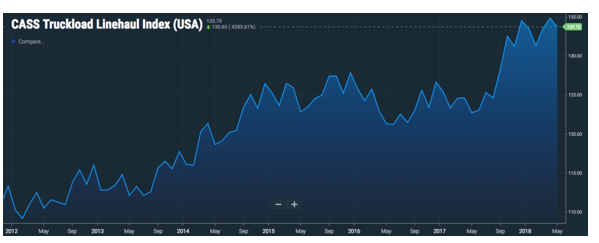
Looking at the Cass Truckload Linehaul Index, a proprietary index that measures market fluctuations in per mile truckload linehaul rates, there was an 8% jump in costs from August to December 2017. In the 24 months preceding, costs were relatively flat, moving slightly down 0.34% from August 2015.


Screen Shot 2018-07-18 at 7.32.14 AM
SONAR CASS TRUCKLOAD LINEHAUL INDEX (CTRI.USA). 
In its fiscal 2018 results released June 27, General Mills recorded “more than $150 million in restructuring and impairment costs” and a 13% profit decline to $354.4 million despite a 2.2% sales increase to $3.89 billion.
“In the fourth quarter of 2018, we approved global cost savings initiatives designed to reduce administrative costs and align resources behind high growth initiatives. These actions will affect approximately 625 positions,” the release stated. The changes are said to be part of “several multi-year restructuring initiatives designed to increase our efficiency and focus our business behind our key growth strategies,” according to General Mills.
Cuts are nothing new for General Mills—in 2016, following a period of “declining U.S. sales,” General Mills eliminated 1,400 positions worldwide, according to reporting by Fortune. “Last month, General Mills reported an overall 2.8% increase in retail sales for its fiscal fourth quarter, but U.S. retail sales still decline[d] 12% in that period.” The company—as of May 2017—employed 38,000 people across the globe.
This announcement follows news reported by the Wall Street Journal that U.S. yogurt sales have declined “5% in its fourth quarter” this year. General Mills has also raised prices on its products, beginning to sell “smaller boxes of cereal at a higher price-per-ounce.” Still, General Mills has attempted to adapt to consumers who are “turned off by artificial colors and sweeteners” by introducing “an all-natural, lower-calorie yogurt that it hopes will bring back customers” looking for healthier options.

What’s up with gas prices? Gas Buddy says hang on to your wallet

July 9,2018-

Screen Shot 2018-07-09 at 6.44.46 AMOil has surged over 10% just in time for summer’s busiest travel holiday, costing motorists over $1 billion more than last year,” said Patrick DeHaan, head of petroleum analysis for GasBuddy. “All the ingredients exist for the national average to inch closer to $3 per gallon, just in time for the second half of the summer. Undoubtedly, the second half of the summer will be pricier than the first, thanks to OPEC’s production increase falling short of expectations, sanctions to be placed back on Iran by November and falling U.S. oil inventories. And to rub some salt in the wound, hurricane season is still upon us, adding more guesswork to where gas prices might spend the second half of the summer. Make no mistake, it won’t be pretty, not nearly as “pretty” as the first half of the summer. Be ready for volatility and likely higher prices at the pump in July and August.”

Meanwhile CNBC reports that “The Oil Price Information Service’s Tom Kloza recently estimated that prices could surge another 10 percent this summer — a rally that could hit consumers at the gas pumps.
“We can get into the $80s for Brent again, and I think we could get to $80 for WTI,” the firm’s global head of energy analysis said on CNBC’s “Futures Now.”

Kloza, who accurately called the 2015 oil collapse, reiterated his bullish case for oil three days after the commodity hit its highest price since 2014. However, he rolled back the odds of an oil shock to $100 this year.”

Visalia’s CalCom Solar Rebrands as CalCom Energy

June 27, 2018 (Visalia, CA) – CalCom Solar expands on its leadership in solar for agriculture and water with a name change indicative of the company’s long-term strategy.

Screen Shot 2018-07-02 at 7.34.22 AMJune 27, 2018 (Visalia, CA) – CalCom Solar expands on its leadership in solar for agriculture and water with a name change indicative of the company’s long-term strategy. CalCom Energy, launching this week with a rebranded web site and identity, more aptly reflects the company’s focus on providing integrated energy solutions to the agriculture, water and utility markets.
“We’re at a crossroads where the water-energy-food nexus is intricately intertwined,” explained Dylan Dupre, President & CEO of CalCom Energy. “We are more than just a solar company.   We are developing innovative distributed energy solutions to reduce the energy-dense activities of food production, drastically decrease water use, and ultimately shrink our carbon footprint. Our name change reflects our commitment to this work.”
CalCom has been at the forefront of renewable energy in California, earning a spot in the prestigious Inc. 500 Top 25 for two years running. The company leads the industry in the number of commercial solar interconnections in PG&E’s territory (www.calssa.org).
CalCom’s announcement coincides with positive news across the clean energy sector. In California, Senate Bill 700 makes its way through key committees of the California Legislature. The bi-partisan supported bill aims to expand energy storage incentives to $1.3 billion with a five-year extension of the Self-Generation Incentive Program (SGIP) through 2026. In addition, Bloomberg New Energy Finance recently estimated that battery storage will reshape the energy system, enabling solar and wind to account for half of all global electricity generation by 2050 (2018 New Energy Outlook).
“We are on the cusp of a new era where clean energy will rapidly eclipse fossil fuels as the primary source of power generation,” Dupre remarked. “Over the next 10 years the costs of renewable generation will continue to fall, and with the arrival of affordable battery technology, the entire energy landscape is shifting. For the first time in history we will be able to cost-effectively generate, store and move energy intelligently across the grid — which will completely transform the energy landscape and move us closer to the future of a distributed architecture for the utility smart grid.”
Already, CalCom agriculture customers like D’Arrigo Bros. of California have adopted a distributed energy resources approach that includes large-scale PV, energy storage, and utility billing monitoring and analytics. D’Arrigo is adding two large (528 kW / 520 kW) batteries at their cooling facility to reduce demand charges and load-shift energy to different time of use (TOU) utility rate periods. They will also provide backup power to critical loads.

Higher oil prices likely to ramp up pain at the pump

June 27,2108-

Update: Valley Crude hits $76.06 June 29

Screen Shot 2018-06-27 at 7.56.35 AMHigher WTI crude prices as well as San Joaquin Valley crude cost increases are expected to boost gasoline prices at the pump in California, just time for the July 4 holiday driving season.

As of June 27  Chevron’s Midway Sunset ( San Joaquin  Valley) crude is being priced at over $73 a barrel, a high for the month. Gas prices have been declining a few cents in California for the past several weeks. Now it looks like they’ll be heading back up. ( update $75.40 as of 6/28 – high of the year.

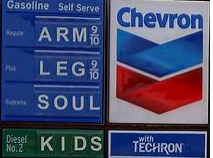
Many stations are selling regular for $4 a gallon.

Energy analysts say OPEC’s decision to ramp up oil production in coming weeks did not do enough to satisfy demand forecasts. In addition President Trumps announcement that oil companies shouldn’t buy Iranian crude will limit supply and drive up oil prices.

Nevertheless, the federal Energy Information Agency this week estimated that gasoline prices will remain lower than the May 28 price for the rest of the summer.

Just this week as well a ballot measure to repeal the 12-cent tax per gallon in California will be on the ballot this November.

The measure would take away transportation taxes and fees approved by the Legislature last year under SB1, said to raise $5 billion per year to pay for the state’s roads and bridges.

The ballot measure, if approved will remove a 12 cent per gallon increase in the state’s gas excise tax and the 20 cent per gallon increase on diesel fuel.

Before the increase was in place late last October the average price of gasoline in California was $3.06 per gallon according to the California Energy Commission. After the 12-cent increase was put into effect, pump prices rose and today they average $3.66 a gallon – an increase of 60 cents. That means 80% of the increase at the pump this past 8 months is for fuel company margins and the price of crude, vs any tax increase.

.

Ramp-up in Antarctic ice loss speeds sea level rise

Ice losses from Antarctica have tripled since 2012, increasing global sea levels by 0.12 inch (3 millimeters) in that timeframe alone, according to a major new international climate assessment funded by NASA and ESA (European Space Agency).

According to the study, ice losses from Antarctica are causing sea levels to rise faster today than at any time in the past 25 years. Results of the Ice Sheet Mass Balance Inter-comparison Exercise (IMBIE) were published Wednesday in the journal Nature.

The late summer sun sets over mountains and icebergs around Adelaide Island, Antarctic Peninsula, as 24-hour daylight gives way to the long polar night of winter.
The late summer sun sets over mountains and icebergs around Adelaide Island, Antarctic Peninsula, as 24-hour daylight gives way to the long polar night of winter. Credit: BAS/Hamish Pritchard

“This is the most robust study of the ice mass balance of Antarctica to date,” said assessment team co-lead Erik Ivins at NASA’s Jet Propulsion Laboratory (JPL). “It covers a longer period than our 2012 IMBIE study, has a larger pool of participants, and incorporates refinements in our observing capability and an improved ability to assess uncertainties.”

This latest IMBIE is the most complete assessment of Antarctic ice mass changes to date, combining 24 satellite surveys of Antarctica and involving 80 scientists from 42 international organizations.

The Antarctic Peninsula from the air: although the mountains are plastered in snow and ice, measurements tell us that this region is losing ice at an increasing rate.
The Antarctic Peninsula from the air: although the mountains are plastered in snow and ice, measurements tell us that this region is losing ice at an increasing rate. Credit: University of Durham/Pippa Whitehouse

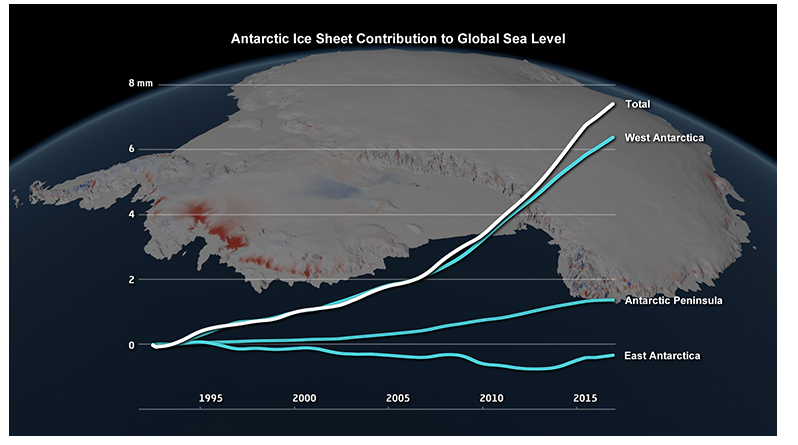
The team looked at the mass balance of the Antarctic ice sheet from 1992 to 2017 and found ice losses from Antarctica raised global sea levels by 0.3 inches (7.6 millimeters), with a sharp uptick in ice loss in recent years. They attribute the threefold increase in ice loss from the continent since 2012 to a combination of increased rates of ice melt in West Antarctica and the Antarctic Peninsula, and reduced growth of the East Antarctic ice sheet.

Prior to 2012, ice was lost at a steady rate of about 83.8 billion tons (76 billion metric tons) per year, contributing about 0.008 inches (0.2 millimeters) a year to sea level rise. Since 2012, the amount of ice loss per year has tripled to 241.4 billion tons (219 billion metric tonnes) – equivalent to about 0.02 inches per year (0.6 millimeters) of sea level rise.

Crevasses near the grounding line of Pine Island Glacier, Antarctica.
Crevasses near the grounding line of Pine Island Glacier, Antarctica. Credit: University of Washington/I. Joughin

West Antarctica experienced the greatest recent change, with ice loss rising from 58.4 billion tons (53 billion metric tons) per year in the 1990s, to 175.3 billion tons (159 billion metric tons) a year since 2012. Most of this loss came from the huge Pine Island and Thwaites Glaciers, which are retreating rapidly due to ocean-induced melting.

At the northern tip of the continent, ice-shelf collapse at the Antarctic Peninsula has driven an increase of 27.6 billion tons (25 billion metric tons) in ice loss per year since the early 2000s. Meanwhile, the team found the East Antarctic ice sheet has remained relatively balanced during the past 25 years, gaining an average of 5.5 billion tons (5 billion metric tons) of ice per year.

Antarctica’s potential contribution to global sea level rise from its land-held ice is almost 7.5 times greater than all other sources of land-held ice in the world combined. The continent stores enough frozen water to raise global sea levels by 190 feet (58 meters), if it were to melt entirely. Knowing how much ice it’s losing is key to understanding the impacts of climate change now and its pace in the future.

“The datasets from IMBIE are extremely valuable for the ice sheet modeling community,” said study co-author Sophie Nowicki of NASA’s Goddard Space Flight Center. “They allow us to test whether our models can reproduce present-day change and give us more confidence in our projections of future ice loss.”

The satellite missions providing data for this study are NASA’s Ice, Cloud and land Elevation Satellite (ICESat); the joint NASA/German Aerospace Center Gravity Recovery and Climate Experiment (GRACE); ESA’s first and second European Remote Sensing satellites, Envisat and CryoSat-2; the European Union’s Sentinel-1 and Sentinel-2 missions; the Japan Aerospace Exploration Agency’s Advanced Land Observatory System; the Canadian Space Agency’s RADARSAT-1 and RADARSAT-2 satellites; the Italian Space Agency’s COSMO-SkyMed satellites; and the German Aerospace Center’s TerraSAR-X satellite.

Tom Wagner, cryosphere program manager at NASA Headquarters, hopes to welcome a new era of Antarctic science with the May 2018 launch of the Gravity Recovery and Climate Experiment Follow-on (GRACE-FO) mission and the upcoming launch of NASA’s Ice, Cloud and land Elevation Satellite-2 (ICESat-2).

“Data from these missions will help scientists connect the environmental drivers of change with the mechanisms of ice loss to improve our projections of sea level rise in the coming decades,” Wagner said.

PG&E Signs on First Community Solar Project for Regional Renewable Choice Program

May 13,2018-

Screen Shot 2017-01-15 at 8.29.15 AMSAN FRANCISCO–(BUSINESS WIRE)–Pacific Gas and Electric Company (PG&E) today announced it has signed on the first community solar project for its Regional Renewable Choice program with the renewable energy developer ForeFront Power. The program allows all customers, including renters and those who can’t install solar, the option of purchasing up to 100 percent solar energy without having to install private rooftop solar panels.
“The Regional Renewable Choice program is part of our ongoing commitment to support the growth of solar and other renewable energy sources in California. This program enables our customers to reduce greenhouse-gas emissions from their electricity usage and allows them to directly be a part of California’s clean energy future”
Tweet this
Approximately half of U.S. households and businesses are unable to install rooftop solar due to space, lack of sun exposure or ownership limitations.1 The Regional Renewable Choice program gives residential and business customers – including those who rent – an easy way to participate in solar without installing or maintaining solar panels.
“The Regional Renewable Choice program is part of our ongoing commitment to support the growth of solar and other renewable energy sources in California. This program enables our customers to reduce greenhouse-gas emissions from their electricity usage and allows them to directly be a part of California’s clean energy future,” said Vincent Davis, PG&E’s senior director of Customer Energy Solutions.

More solar in Kings County

May 10,2018-

Another huge solar farm proposed for Avenal Cutoff

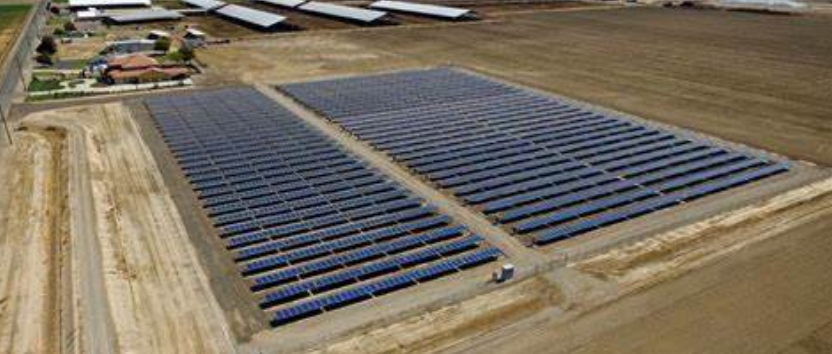
Screen Shot 2018-05-10 at 12.27.34 PMSF-based First Solar has filed for a conditional-use permit to build a 300-megawatt solar farm on 2103 acres.The project, named Daylight Legacy Solar, is being proposed along the Avenal Cutoff, following on the filing of another 300mw project by Recurrent Energy, RE Slate, last month nearby. The proposal continues a trend of construction of solar farms on water-short farmland in the western part of Kings County.

The First Solar project located at 20630 Nevada Ave could be in service by 2021 says First Solar manager Louis DeRosa in an April 18 letter. Both the First Solar and Recurrent plans are the largest proposed yet in the county and each includes a battery storage component.

The renewable energy projects continue to pile up in this sun baked part of California with solar projects built or in the works approaching 2000 megawatts, equivalent in megawatts to power generated by Diablo Canyon nuclear power plant, about to be decommissioned. Kings solar farms would now cover some 19,000 acres.

The Kings County Planning Commission has yet to schedule a date for a hearing on the Daylight project.

 Kings County to install solar at government parking lots

Screen Shot 2018-05-10 at 12.28.49 PMKings County plans to contract with a solar company Engie, to build solar projects at the various county-owned locations.The cost will be approximately $19.4 million, but their installation is projected to save approximately $31.1 million in energy costs over the 30-year life of the project. Solar carports and ground amounted arrays at the Government Center and the Road Yard will shade vehicles as well as  house solar panels and energy storage components. There would  be a 500 kW energy storage system to reduce peak hour charges. Engie would maintain the system under a power purchase agreement (PPA).

ENGIE Services U.S. (formally Opterra Energy Services and Chevron Energy Solutions) is the largest independent electricity producer in the world, and the third largest retail electricity supplier in the United States. A PPA is a financial agreement where a developer arranges for the design, permitting, financing and installation of a solar energy system on a customer’s property. The developer sells the power generated to the host customer at a fixed rate that is typically lower than the local utility’s retail rate.

Tulare County this month is signing a similar agreement with the same company.

Gas prices up again

The average price in California for regular gasoline increased 6.5-cents from the previous week says the California Energy Commission now up to $3.63 a gallon.

City of Visalia to get first electric buses by fall

April18,2108-

Screen Shot 2018-04-16 at 2.55.35 PMThe City of Visalia will purchase three 40-foot electric buses to replace compressed natural gas buses currently running. The electric buses are a first for Visalia as California municipalities and school districts work to follow mandates to switch to all-electric fleets to reduce both pollution and greenhouse gases.

Visalia has a fleet of 80 buses that are to be converted by 2029 to an all-electric, zero-emission fleet.

The three buses cost $3.16 million funded through various grants. The city will purchase the buses from Proterra Inc, selected by the Air Resources Board for this grant. The buses are expected to be in service this fall.

Transit administrator Carmen Quevedo says the grant dates from 2015. Asked why the city did not work with GreenPower buses of Porterville to buy the transit vehicles made now in Tulare County? The answer is the grant predates GreenPower coming to the area. She says in the future, buses may be purchased from GreenPower now that they are in operation here.

GreenPower opened some assembly operations in Porterville in recent days.

Quevedo says the city will still have to work to come up with a strategy to cheaply power-up the electric buses.