
July 18,2018-
California diesel prices averaged just under $4 gallon this week according to the California Energy Commission. Prices are $1.10 a gallon more than they were a year earlier.
How big an impact was the tax increase?
For diesel fuel as of last November, the California excise tax jumped by 20 cents per gallon to 36 cents, and the sales tax rose 13 percent from 9 percent. The sales tax increase amounted to about 12 cents per gallon. That puts the total increase of taxes in the state to an additional 28 cents used to fix roads and fund transportation projects. That increase amounts to about 25% of that $1.10 increase we are feeling, impacting the cost of shipping in and out of the Golden State.
Freight costs are impacting industries across the nation. This is a July 2018 article in the trucking industry publication Freight Waves. It brings together the impacts of transport costs coupled with reduced demand for milk food products like yogurt.
Citing freight costs, declining sales, General Mills to cut 625 jobs
 General Mills (NYSE: GIS), home of over 100 household brands including Yoplait, Cheerios, Nature Valley, and Pillsbury, has seen an increase in sales in some areas, but an overall decline in profit, leading to an anticipated slashing of 625 jobs.
The Minneapolis-based manufacturer announced its plan to eliminate the positions by the end of 2019, according to a report by Reuters. The company cites a desire to “reduce costs amid slowing sales of its Yoplait yogurt, as well as rising commodity and freight expenses.” In March, FreightWaves’ Zach Strickland covered General Mills’ CEO Jeff Harmening’s announcement that the company saw “an unprecedented rise in logistics costs” and was “a quarter late in reacting” to the change.
In June, FreightWaves’ John Paul Hampstead followed up on the story, adding that “General Mills had to quadruple its reliance on the trucking spot market in that quarter.” Harmening explained: “North American freight spot prices were near 20-year highs in February. Higher freight costs are impacting our raw material prices [and] the cost to ship materials from our suppliers to our factories has risen significantly. And we’ve seen higher prices in some key
commodities including grains, fruits and nuts, further heightening the inflationary dynamic.”
Looking at the Cass Truckload Linehaul Index, a proprietary index that measures market fluctuations in per mile truckload linehaul rates, there was an 8% jump in costs from August to December 2017. In the 24 months preceding, costs were relatively flat, moving slightly down 0.34% from August 2015.
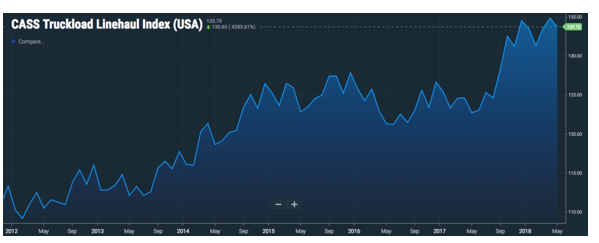
SONAR CASS TRUCKLOAD LINEHAUL INDEX (CTRI.USA).
In its fiscal 2018 results released June 27, General Mills recorded “more than $150 million in restructuring and impairment costs” and a 13% profit decline to $354.4 million despite a 2.2% sales increase to $3.89 billion.
“In the fourth quarter of 2018, we approved global cost savings initiatives designed to reduce administrative costs and align resources behind high growth initiatives. These actions will affect approximately 625 positions,” the release stated. The changes are said to be part of “several multi-year restructuring initiatives designed to increase our efficiency and focus our business behind our key growth strategies,” according to General Mills.
Cuts are nothing new for General Mills—in 2016, following a period of “declining U.S. sales,” General Mills eliminated 1,400 positions worldwide, according to reporting by Fortune. “Last month, General Mills reported an overall 2.8% increase in retail sales for its fiscal fourth quarter, but U.S. retail sales still decline[d] 12% in that period.” The company—as of May 2017—employed 38,000 people across the globe.
This announcement follows news reported by the Wall Street Journal that U.S. yogurt sales have declined “5% in its fourth quarter” this year. General Mills has also raised prices on its products, beginning to sell “smaller boxes of cereal at a higher price-per-ounce.” Still, General Mills has attempted to adapt to consumers who are “turned off by artificial colors and sweeteners” by introducing “an all-natural, lower-calorie yogurt that it hopes will bring back customers” looking for healthier options.