Shell making low-carbon energy, fuel investments

April11,2018-

from California Energy Commission

Screen Shot 2018-04-11 at 6.26.50 PMEighteen months ago, Royal Dutch Shell opened a new division dedicated to exploring opportunities in low-carbon power and transportation fuel. It’s a business strategy focused on survival.

Known mainly as an oil and natural gas company, Shell is taking the long view, said Marc van Gerven, vice president of solar at Shell’s New Energies Division, during a March 29 talk at the California Energy Commission.

“Society is starting to ask us for these solutions and we are trying to move with society, along the path of the energy transition,” he said.

Between 2018 and 2020, Shell intends to spend between $1 to $2 billion of its $25 to $30 billion in annual capital investments in what van Gerven called “emerging opportunities” – projects adjacent to the company’s core assets that help it evolve with the energy market.

These ventures are now the purview of the New Energies division, which has based its U.S. operations in San Francisco. The division is focusing on new fuels and renewable electricity, which plays a major role in a technically possible, but challenging path developed by Shell to achieve the goals of the Paris Agreement.

Power will hopefully become a “new business pillar for Shell in decades to come,” van Gerven said.

Shell has started by investing in commercially viable technologies like offshore wind and solar.

At the Port of Stockton, the company built a photovoltaic project to provide onsite solar power to its fuels distribution terminal. While the project is only expected to produce more than 300,000 kilowatt hours each year, it provided development and permitting experience that informed efforts to build another solar project at a Shell facility in Australia, van Gerven said.

In January, Shell expanded its solar offerings by becoming the largest shareholder of Silicon Ranch, a Tennessee-based solar energy developer that contracts with utilities, solar cooperatives, municipal utilities, and commercial and industrial customers.

Through the New Energies division, Shell is also investing in alternative, low-carbon fuels and technology, including infrastructure for electric and hydrogen fuel-cell cars. The company has received funding from the Energy Commission’s Alternative and Renewable Fuel and Vehicle Technology Program to build several hydrogen refueling stations at its gas stations in California.

Kings County’s Largest Solar Farm Planned

March 28,2018-

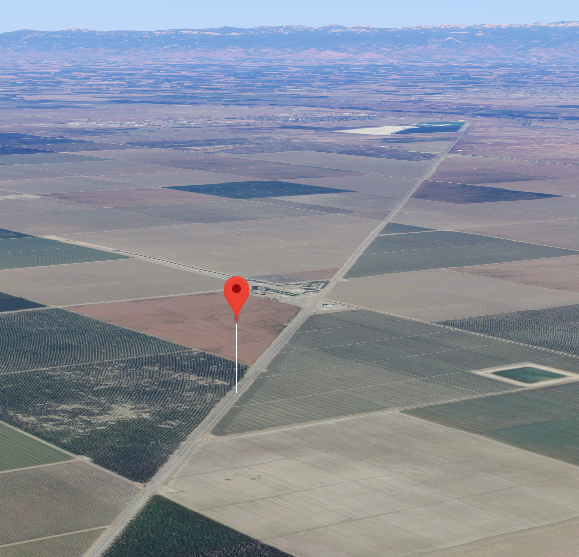
Screen Shot 2018-03-28 at 9.41.06 AMAvenal Cutoff, that dusty road known for cotton bales and tomato trucks, the fastest route to the prison and unwelcome alkali dust storms is getting a makeover reputation – as the Central Valley’s Solar Highway, now with plans filed for Kings County’s largest solar farm.

The RE Slate solar farm, another Recurrent Energy project, was submitted earlier this year at 16289 Avenal Cutoff road. At 300 megawatts, the project will sprawl over 2731 acres on land mostly fallowed today. Up to five million solar panels will cover this wrap-around energy farm (it surrounds the Mustang solar project) and will span from Hwy 198 in the north some 4.5 miles south to Laurel and 2 miles in width at the widest point on Kent Ave.

Sea of solar panels

The big project will join a half dozen other solar project built or in the works nearby on both sides of the Avenal Cutoff road.That includes the two big Mustang projects, as well as the Kent and Westland Aquamarine projects the will create virtually a sea of solar panels on both sides of the road in the next few years that connects I-5 to NAS Lemoore.

SF-based Recurrent has nine solar projects in the county.They are owned by Canadian Solar who purchased  the company from Sharp in 2015. Canadian Solar, besides being a major developer of solar farms, is one of the three top solar panel makers in the world.

It is a market Kings County would like to continue to cultivate.

Coincidence or not, a solar panel manufacturer is said to be looking at a possible siting of a manufacturing plant in Kings County included on a list of prospects from the Kings EDC. Code-named Project Nomad – the plant, if built, would boast 700 jobs.

Recurrent plans to lease the land for the Avenal Cutoff facility from its owners Westlake Farms, Westlands Water District and Sandridge Partners.

Project includes energy storage

Besides solar arrays, Recurrent will add 3000 MW of power storage, enough to store 1200 megawatt hours on-site, using batteries or flywheel technology says their application to the county.

Construction of the Slate solar farm will start in the third quarter of 2019 and last 19 months using as many as 561 workers.


pic caption: dusty road getting a solar makeover

New York Unveils Offshore Wind Master Plan

From Oilprice.com
By Precise Consultants – Feb 07, 2018, 12:00 PM CST

Remember “The Simpsons” episode where Homer scoffs at the idea that one animal could provide all his favorite meat: bacon, ham, pork chops? “Yeah right, Lisa,” he chortles, “a wonderful, magical animal.” Well, the pig is to Homer what offshore wind turbines are to New York State.
New York Governor Andrew Cuomo just launched the 60-page New York State Offshore Wind Master Plan, detailing the state’s commitment to wind power and the expected gains from seeing it through:
• 2,400 MW offshore energy will power in excess of 1.2 million homes
• It will employ up to 5,000 people
• The state’s port infrastructure will be enhanced
• $15 million will be committed to training the required workforce
• The industry will be worth $6 billion in a decade
• Support the city’s goal of sourcing half of its power from renewables by 2030 (equivalent to taking 1 million cars off the road)
• Health benefits from cleaner air worth $400 million
The report is the product of two years of extensive research and is supplemented by 20 studies. The authors assessed every aspect of the plan, from cable installation, pipelines, manufacturing turbines and developing the wind farms, to wider environmental issues like the impact on birds, bats and sea life.
The result: a proposal for a 1 million acre site, 21 miles from land, due south of the Great South Bay. “For the vast majority of the time, turbines would have no discernible or visible impact for a casual viewer on the shore,” the report states. By locating so far out, the projects could avoid or minimize potential conflicts for shipping lanes, the fishing industry and wildlife.
Related: Most Big Banks Are Now Bullish On Oil
The plan acknowledges that a considerable amount of work must happen, and sets up a number of working groups to “define strategies and activities that could help members engage effectively in offshore wind energy development.” One proposal involves a workshop with leading marine scientists who will convene to assess marine ecosystem protections, develop best working practices and consider the creation of a fund to enable the projects to go ahead while providing adequate support for the environment.

Carbajal Requests Navy Briefing On Central Coast Wind Exclusion Areas

February 1,2018-

Screen Shot 2018-01-23 at 7.51.02 AMSan Luis Obispo, CA – Today, Rep. Salud Carbajal (CA-24), member of the House Armed Services Committee (HASC), requested a briefing from the U.S. Navy on wind exclusion areas off the Central Coast of California. The Navy recently released a map designating roughly 36,000 square miles of ocean on the Outer Continental Shelf, as incompatible with Navy operational activities. Included in the excluded area, were areas of interest for proposed wind-energy projects identified by the federal Bureau of Ocean Energy Management (BOEM) and the California Energy Commission (CEC) joint offshore wind task force.

The federal Bureau of Ocean Energy Management (BOEM) began planning for the potential leasing of ocean tracts for wind energy projects in 2016, and during the process, requested input from the Navy. Carbajal’s letter asks for briefing updates regarding potential “site-specific” exclusions regarding study areas off the Central Coast. According to the National Renewable Energy Laboratory (NREL), areas off the west coast of the United States hold promising renewable energy potential.

As the decommissioning of the Diablo Canyon Power Plant (DCPP) moves forward, Carbajal has prioritized efforts to mitigate the economic impact to the region. In Congress, Carbajal has advocated for renewable energy incentives and job retraining programs to offset the loss of jobs and revenue on the Central Coast.

A copy of the letter can be found here and the full text is below:

The Honorable Richard V. Spencer

Secretary of the Navy

1000 Navy Pentagon, Room 4D652

Washington, DC 20350-1000


Dear Secretary Spencer:


I am writing to you today in regard to proposed offshore wind projects off of Morro Bay, California.  It is my understanding that the Navy recently published a map which shows that the Morro Bay project is located within the Department of the Navy’s “wind exclusion areas” indicating that it would be “not compatible” with Navy operations.


As a former Marine and member of the House Armed Service Committee, I understand the importance of taking the necessary steps to prevent and minimize any impacts on military operations.  I am aware that the Department of the Navy is currently conducting a “site-specific” study to determine whether there are locations that may have previously been designated as “not compatible” which can now accommodate wind-energy projects.   I would like to request a briefing that addresses the following:


  • When the Navy plans to finish the site-specific study;
  • What factors the Navy considers when designating a “wind exclusion area”;
  • Why the Morro Bay area, specifically, was designated as a “wind exclusion area”; and
  • Which current and future operations could be impacted by pursuing a wind-energy project off Morro Bay.


As I am sure you will understand, this issue is of great concern to the Central Coast of California, as it will further ensure energy security for the region.  Furthermore, the project is expected to create a significant number of jobs and result in other economic benefits for the community.  As the Representative for California’s 24th Congressional District, I urge the Department of the Navy to work with all stakeholders to create more opportunities to advance energy security. Thank you for your consideration and I look forward to your response.


Sincerely,


Salud O. Carbajal

Member of Congress

This Hearst ranch has raised cattle since 1865, now it also powers Apple’s headquarters

From CNBC

January 21,2018-

Anita Balakrishnan | @MsABalakrishnan

• The historic Hearst cattle ranch has become a hybrid solar farm for Apple’s Cupertino campus.
• The ranch claims to be the nation’s largest single-source provider of grass-fed beef.
• The project is still expanding, with the second phase of the 2.5 million solar panels being installed this year.
Apple has disrupted its fair share of industries over the years — but cattle ranching is usually not mentioned as one of them.
Nonetheless, the historic Hearst cattle ranch (yes, the Hearsts of magazine fame) has become a hybrid solar farm for Apple, merging the world of tech with a centuries-old trade.
Hearst Ranches takes up 150,000 acres in two properties on the border of San Luis Obispo County, and has raised cattle since 1865. Each cow there weighs about 1,200 pounds.

The ranch claims to be the nation’s largest single-source provider of grass-fed beef, and is available either year-round or seasonally in Southern California Whole Foods Market locations (which, of course, is now owned by Apple-rival Amazon).

Hearst’s 3,000-head cattle operation at Jack Ranch itself is markedly old West: “There is a code among cowboys that transcends copyrights, technology, and other manifestations of culture that some folks may consider ‘modern,'” the website says. “The cowboy way is simple….. It may sound like a bygone era, but it is our reality.”

But 150 years after George Hearst bought the ranch, it took on a new, ultra-modern function: A 2,900-acre solar farm, which until now has been contracted by Apple to run the company’s Cupertino headquarters.
It wasn’t easy to get the job, Hearst said in a statement, as it was “a huge, unbelievable construction project,” but the long summer stretches of 115-degree heat helped seal the deal.

r
“Steve Hearst knew Steve Jobs and provided valuable support,” said Benoit Allehaut, director at Capital Dynamics, which recently acquired this solar project from First Solar. “Apple had the choice between multiple projects but selected California Flats to supply their power demand. First Solar used their panels and managed the construction.”

This plant’s solar arrays, when operational, will track the arc of the sun. Credit: First Solar
Apple CEO Tim Cook said in 2015 that the company would contribute $850 million to build the solar farm, which also aims to provide enough energy for 60,000 homes.
“We know in Apple that climate change is real. The time for talk is passed,” he said at that time, according to Reuters. “The time for action is now.”
The project is still expanding, with the second phase of the 2.5 million solar panels being installed this year, to provide energy offset for California customers. According to Hearst, “cowboys of Jack Ranch have been outnumbered by construction workers as the 280-megawatt solar project heads into its final month.”

When fully operational, the project will generate enough clean solar energy to serve the needs of about 100,000 average homes per year, displacing over 109,000 metric tons of carbon dioxide (CO2) annually based on the PG&E grid—the equivalent of taking about 22,000 cars off the road.
“There is an excellent synergy between the ranching operation and the project,” Allehaut. “This solar farm will provide revenues to Hearst for the next 35 years which is an additional stream of revenue for Jack Ranch.”
But even as Heart’s core media business changes, the revenue was not the only draw of the project, which has been in the works since the early 2000s.
“It was the right thing to do for us, it was the right thing to do for the planet and it is certainly the right thing to do for the Jack Ranch,” Hearst said.
Hearst and Apple share more than just energy: Apple’s new “spaceship” campus, which is powered by the solar panels, was designed by the same architect that designed Hearst Tower in New York City.

Tulare Co:Texas firm will build big solar project with battery storage

January 17,2018-

Screen Shot 2017-12-07 at 5.42.27 PMConstruction giant Lend Lease with offices in Texas, has its eye on Tulare County where it plans to build a 70 megawatt solar farm with a 50 megawatt battery storage facility.The new power project, one of the largest in the county, will be built on 378 acres west of Hwy 65 and north of Terra Bella.

The new application was heard by the county Project Review Committee in early January.

The company hopes to break grounded in late 2020 and be in service in late 2021 says spokesperson John DeLibero.

The energy project would tie into the grid at a nearby SCE substation.

Power from the battery storage unit can be used to provide electricity when the sun is not shining, Pairing the two energy systems is increasingly popular in California looking to stabilize the load around the clock. This would be the first such dual project in the county.

Lend Lease “plans approximately 400 MW of additional projects across multiple locations in California” says DeLibero

In the US, Lend Lease, among its other construction projects, develops, builds and finances utility-scale solar and storage projects developing renewable solutions to suit the specific needs of large investor owned utilities, municipal and power cooperatives, and corporations.

Founded in Sydney in 1958 by Dutch immigrant and innovator Dick Dusseldorp, Lend Lease was born out of a vision to create a company that could successfully combine the disciplines of financing, development and investment. Headquartered in Sydney, Australia, Lend Lease has approximately 12,000 employees internationally.

In California the company is a major developer and builder of large mixed-use projects including one in Downtown LA.

PG&E touts green projects in 2017

December 29,2107

source PG&E

PG&E’s clean energy and sustainability initiatives were recently recognized by the 2017 Newsweek Green Rankings, which named the company as the greenest energy provider in the nation and the fourth greenest company overall.

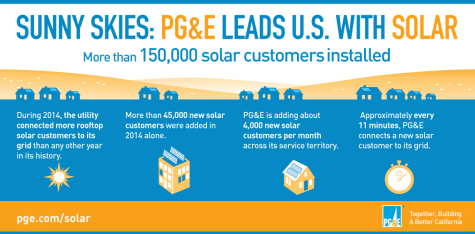
Screen Shot 2017-12-29 at 7.01.47 AMNearly 70 percent of the electricity PG&E delivers to its customers comes from greenhouse gas-free resources.
It’s no surprise since the company has demonstrated an ongoing commitment to sustainability as the world deals with the very real threat of climate change.
“Creating a sustainable energy future is at the core of PG&E’s vision,” said Geisha Williams, PG&E Corporation CEO and president. “This ranking reflects our progress in protecting the environment as we build a safe, reliable, affordable and clean energy future for our customers and communities. As we observe the real and present impacts of climate change, we are more motivated than ever to continue that work today and into the future.”
Other examples of how PG&E remained committed to clean energy in 2017:
▪ In March, the company announced it had achieved a renewable energy milestone with nearly 70 percent of the electricity PG&E delivered to its customers in 2016 coming from greenhouse gas-free resources. PG&E delivered an average of 32.8 percent of its electricity that year from renewable resources including solar, wind, geothermal, biomass and hydroelectric sources. That’s more than a 3 percent increase in just one year and the highest percentage yet for the state’s largest combined natural gas and electric company. A total of 69.3 percent of PG&E’s electric power mix is from nuclear, large hydro and renewable sources of energy.
▪ PG&E also launched the Better Together Resilient Communities grant program, a shareholder-funded initiative that will invest $2 million over five years to support local climate resilience planning efforts.
▪ In April, announced a call for proposals for renewable energy developers to build new projects for a clean energy program available to PG&E customers. The sites are for PG&E’s Regional Renewable Choice program, which will expand renewable energy access by enabling customers to work directly with developers of new renewable projects.
▪ In May, the company announced that the cost for customers to participate in PG&E’s Solar Choice program has dropped by 30 percent for residential customers and nearly 50 percent for some business customers. PG&E continues to invest in the program (launched in 2016) with new solar infrastructure by renewable developers.

▪ In September, in a move designed to remove obstacles and encourage low-income customers to consider electric vehicles, PG&E announced a new pilot program in partnership with Valley Clean Air Now and the International Brotherhood of Electrical Workers Local 684 and 100 to provide free electrical panel upgrades to encourage electric vehicle ownership in underserved communities. The PG&E Corporation Foundation will provide $75,000 in shareholder funds to cover the cost of upgrading home service panels — a commonly cited obstacle to electric vehicle adoption. The IBEW will perform the site surveys, planning and panel installation for customers who qualify for the program.
▪ In June, PG&E announced that customers driving vehicles using compressed natural gas, who have CNG accounts and fill up at PG&E stations, will be eligible for a new rebate. The new rebate is part of California’s statewide Low Carbon Fuel initiative, which aims to reduce transportation-related greenhouse gas emissions by encouraging the adoption of clean fuels like compressed natural gas.

And in December, PG&E said it will explore — through a technology demonstration project — will the viability of a clean energy system powering a home in the case of a power outage or during a demand response event. For the project, PG&E created a demonstration home energy system that includes private rooftop solar panels, battery energy storage, and an electric vehicle retrofitted to support two-way energy flow.

Fresno to see 50MW energy storage facility

December 22,2017-
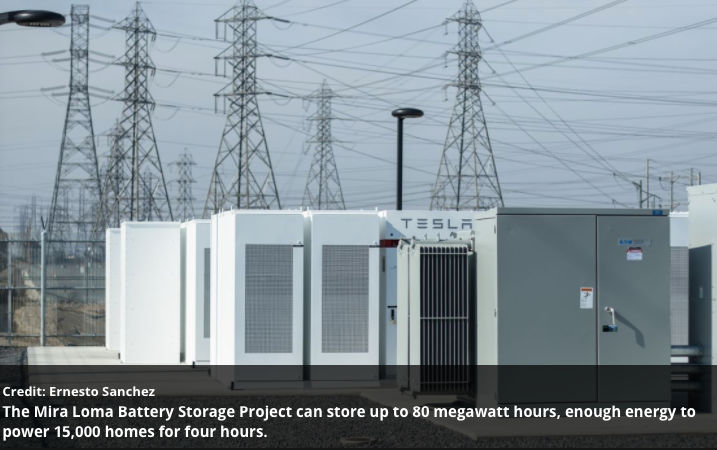
Screen Shot 2017-12-22 at 8.56.46 AMBattery storage for renewable energy is becoming more important in California although most projects so far, are small. Battery technology allows the capture and storage of energy during times of reduced demand for use during times of high demand. That saves costs for the user when supply is low, for example when the the sun is not out or the wind does not blow.

On December 1 PG&E filed plans withe California Public Utilities Commission to buy stored power from six new projects totaling 165 MW.

One of those is a new 50MW battery storage project in Fresno, what would be one of the state’s largest stand-alone lithium ion facilities.

PG&E plans to buy battery storage power to be delivered back to the grid during times of peak demand when their system is congested.

The utility has an agreement to connect to three facilities in this part of the state, all located  in Central and Northern California including the largest one in the Fresno area. That is the 50 MW/200 MWh Kingston project.

All 3 are owned by Enel, an Italian energy firm.

Also contracted will be the 25 MW/100 MWh Cascade project in Stockton and the 10 MW/40 MWh Sierra project in Jamestown.

The projects are developed with Sovereign Energy Storage, an independent developer of large-scale utility battery energy storage projects, and are expected to be operational by 2023, pending review and approval by the California Public Utility Commission as well as local and regulatory agencies.

The three projects will contribute to the expansion of Enel’s energy storage portfolio, which includes both stand-alone battery storage systems, as well as projects combining storage with both thermal and renewable sources.

California Public Utility Commission has a state goal of adding 1.3 GW of energy storage by 2024.

Storage plays an increasingly important role for California energy companies as they work to achieve the state’s ambitious clean energy goals. By the end of 2017, PG&E forecasts that about 33 percent of its retail electric deliveries will come from renewable sources. Energy storage will help integrate many of those resources, such as wind and solar, which are intermittent or provide peak output during times of low demand.

Energy storage has been a part of PG&E’s power mix for decades, starting with the Helm’s Hydro-electric Facility and continuing with pilot projects such as the 2MW Battery Storage Pilot at the Vacaville Substation and the 4MW Yerba Buena Battery Energy Storage System located on the property of Silicon Valley storage technology company HGST.

Battery storage gained notoriety when California suffered the worst natural-gas leak in U.S. history, resulting in low volume of  gas for peak power generation around L.A. and San Diego. Responding to the emergency the state deployed 100 megawatts of storage at several sites in only six months, developed by Tesla.

Energy Briefs: Tax bill saves green tax credits / Nat gas price / More

December 20,2017

Tax bill saves green tax credits

From Inside Climate News

Screen Shot 2017-12-20 at 3.34.51 PMThe booming renewable energy industry breathed a wary sigh of relief as Congress voted this week on a sweeping tax bill that ended up preserving critical tax credits for wind energy, solar power and electric vehicles, though the industry still has concerns about other provisions.
As lawmakers worked over the past week to resolve issues between the House and Senate versions of the bill, the clean energy industry kept a keen eye out for details of the legislation, including provisions from the original House bill that would have weakened or eliminated the tax credits for renewables.
By rejecting that approach, Republicans sent a message that they won’t back attempts to kneecap ongoing growth in renewables, despite pressure from the oil and gas industry to scale back incentives for clean energy. The credits have stoked growth in wind and solar, which for the first time this year provided 10 percent of the country’s electricity, while jobs in clean energy are among the fastest growing in the country.

US energy intensity decreases
Source EIA

The energy intensity of U.S. manufacturing continued to decrease, according to data released today from the U.S. Energy Information Administration’s (EIA) Manufacturing Energy Consumption Survey (MECS). From 2010 to 2014, manufacturing fuel consumption rose 4.7%, while real gross output increased at 9.6%—or more than twice that rate—resulting in a 4.4% decrease in energy intensity.

Nat gas prices keep dropping on oversupply
From oilprice.com

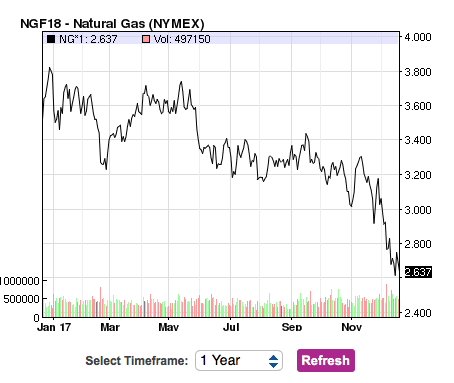
Screen Shot 2017-12-20 at 2.51.44 PMThe shale revolution actually started with natural gas production, which turned upward in about 2006. Oil production began to rise in 2009, but along with it came associated natural gas. Just as the surge of shale oil production contributed to the collapse of oil prices, the surge of natural gas production – both from dedicated natural gas drilling and from associated gas production – collapsed natural gas prices.

Edwards AF Base to get 600MW solar project

A developer is requesting a franchise agreement with the County of Kern to facilitate the construction, and operation of an up to 3,500 acres 600 MW solar facility. The project would be supported by a 230-kV overhead/underground transmission corridor.
The project’s permanent facilities would include up to 2 million solar panels, service roads, security fencing, a power collection system, battery storage, communication cables, overhead and underground transmission lines, electrical switchyards, a substation, and an operations and maintenance facility.

Unlocking millions of dollars in state incentives for solar power

Research by GRID Alternatives and UCLA quantifies benefits of installing solar power on affordable housing

UCLA NEWS

Colleen Callahan |

Solar panels

GRID AlternativesResidents in affordable housing could collectively save $11.6 million annually on their utility bills rooftop if solar panels were installed, according to a new report.

Karina Guzman is both property manager and resident of a low-income housing complex for working families in Southern California. Even with the job and relatively affordable rent, Guzman worries about paying her electricity bills. But relief is coming from what she found to be a surprising source: solar panels recently installed on 17 of the 27 buildings in her complex.

The solar panel system will offset the cost of powering lights and other needs in common areas as well as help residents lower their electricity bills. “I can’t wait for the solar panel to help me pay a credit card bill, and maybe even save for a vacation,” Guzman said.

Low-income households typically spend higher percentages of their incomes on energy costs and thus stand to benefit most from utility bill savings due to solar power generated on their homes. Yet, while Los Angeles County is a national leader in the adoption of residential solar, the homes of low-income households account for less than 1 percent of residential solar capacity across the county, according to new research by the UCLA Luskin Center for Innovation and the nonprofit organization GRID Alternatives. This may change.

The study found that cities in Los Angeles County could soon unlock millions of dollars annually in state incentives for residential solar on affordable housing.

Starting in 2018, California will offer a solar rebate program targeted at putting solar panels on the roofs of affordable housing developments. With an annual budget of up to $100 million, the Solar on Multifamily Affordable Housing program “could make a big difference toward reversing the current inequity in the distribution of residential solar systems,” said Michael Kadish, executive director of GRID Alternatives Los Angeles, which makes renewable energy technology and job training accessible to underserved communities.

The program, along with smaller existing state solar rebate programs such as the Low-Income Weatherization Program available for large multifamily residences located in disadvantaged communities across the state, will encourage the installation of solar systems that help affordable housing residents’ reduce their utility bills.

But there is a catch.

Residents of affordable housing and other multifamily dwellings can only take advantage of state solar incentive programs if their utility offers a virtual net metering policy allowing residents to receive credits from the system. Virtual net metering is a common billing mechanism that allows multiple parties to share the financial benefits of a single solar power system.

Southern California Edison offers virtual net metering, but that’s not the case with municipally owned utilities in cities such as Los Angeles, Burbank, Glendale and others in the county. Without virtual net metering, there is no real mechanism for residents of multifamily dwellings, including affordable housing, to access the financial benefits of solar.

“Now is a good time for the city of Los Angeles ― which we identified as having the largest share of rooftop solar potential — 62 megawatts — and rebate-eligible rooftop solar potential in the region ― to consider removing the policy barrier that is currently preventing myriad residents of multifamily dwellings from realizing the benefits of residential solar,” said J.R. DeShazo, director of the UCLA Luskin Center for Innovation and chair of the department of public policy in the UCLA Luskin School of Public Affairs.

After researchers calculated the potential benefits of adding 115 megawatts of rooftop solar power throughout Los Angeles County on the more than 1,100 affordable housing properties that would qualify for a solar rebate, this is what they found:

  • $11.6 million annually in utility bill savings for residents in affordable housing
  • $4.9 million annually in savings for owners of affordable housing properties
  • $220.6 million in funding from state programs to spur local economic development
  • 1,800 job years (one year of full-time work or the equivalent) created
  • More than 3,800 job training opportunities and nearly 31,000 job training hours that could be strategically targeted to encourage an equitable clean energy workforce