Largest Solar Energy Project at Kern County’s Belridge Oilfield

December 8,2017

Aera Energy to install first-of-its-kind solar project to reduce oilfield emissions
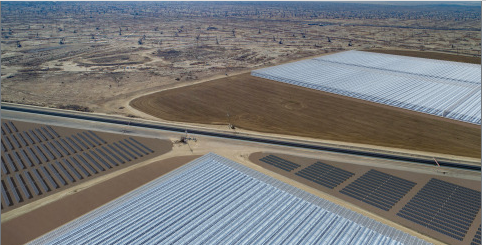
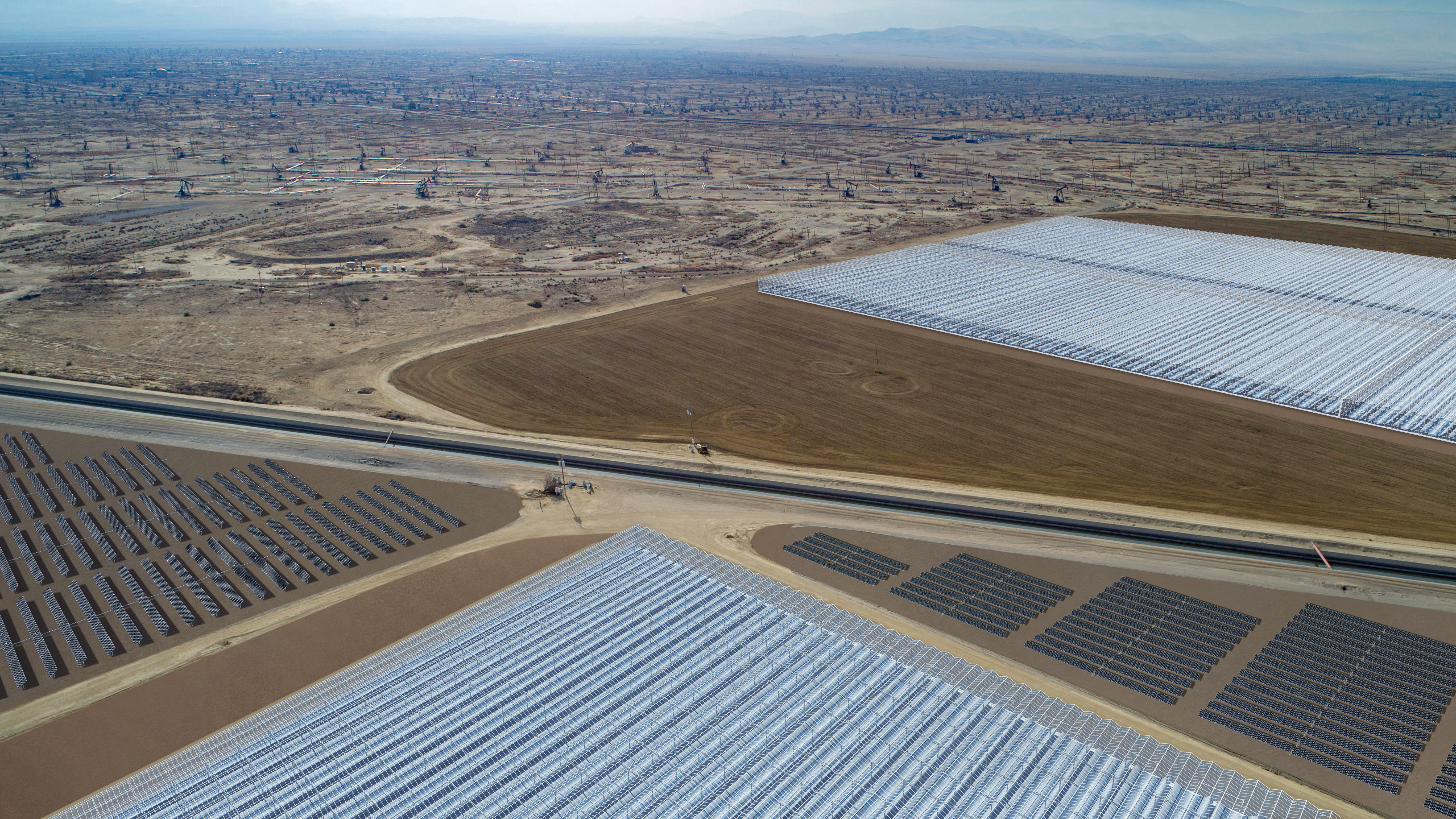
Screen Shot 2017-12-08 at 9.07.10 AMArtist rendering of Aera and GlassPoint’s Belridge Solar project, the first of its kind in the world to use solar steam and solar electricity to power oilfield operations. (Photo: Business Wire)

BAKERSFIELD, Calif.–(BUSINESS WIRE)–Aera Energy, one of California’s largest oil and gas producers, and GlassPoint Solar, the leading supplier of solar energy for the oil and gas industry, today announced plans to build California’s largest solar energy project.

Located at the Belridge oilfield west of Bakersfield, the integrated solar project will be the first of its kind in the world to use solar steam and solar electricity to power oilfield operations, efficiently reducing the field’s carbon emissions. Once complete, the Belridge Solar project will deliver the largest peak energy output of any solar plant in California.

“Our local energy producers continue to invest in cutting edge innovation and compete globally to provide needed energy resources for our nation in an environmentally responsible way”

“Aera is committed to safe, responsible operations and is thrilled to extend our environmental leadership by using solar to power our production. Adding solar energy at Belridge allows us to continue to lead the way in the safest, most environmentally responsible energy extraction there is,” said Aera Energy President and CEO Christina Sistrunk. “The people of California are counting on us to help them get to school and work each day, allow their businesses to grow and thrive and help get California-grown food on their dinner tables. We are proud to be an active part of California’s low carbon future and lead the industry by adopting bold solutions to deliver valuable energy, more efficiently while protecting the environment.”

Belridge Solar will consist of an 850 MWt solar thermal facility, producing 12 million barrels of steam per year, and a 26.5 MWephotovoltaic facility that will generate electricity. The solar-generated steam and electricity will reduce natural gas currently used onsite in oilfield operations.

The facility is projected to save more than 376,000 metric tons of carbon dioxide emissions per year, offsetting the equivalent of 80,000 cars, more than one-third of the cars in Bakersfield today. The project is also expected to create hundreds of direct and indirect jobs in California throughout the oil and gas supply chain and supporting industries.

“GlassPoint is thrilled to partner with Aera to scale our solar oilfield technology in California and deliver meaningful carbon reductions. By harnessing the power of the sun to produce oil, oil operators can efficiently reduce emissions using advanced technology, creating long-term benefits for the local economy and environment,” said Sanjeev Kumar, GlassPoint SVP, Americas. “Our partnership with Aera demonstrates the growing energy convergence where renewables and traditional energy leaders are working together to address some of the biggest challenges of our time.”

Aera and GlassPoint plan to break ground on the Belridge Solar plant in the first half of 2019. The project is expected to start producing steam and electricity as early as 2020.

“Our local energy producers continue to invest in cutting edge innovation and compete globally to provide needed energy resources for our nation in an environmentally responsible way,” said 34th District Assemblyman Vince Fong. “Our community will benefit greatly from the added jobs that further boost our local economy. Aera continues to be an exemplary energy partner.”

“By harvesting the power of the sun, Aera Energy is leading us into the future of energy reliability and sustainability,” said 32ndAssemblyman Rudy Salas. “The exciting new Aera Energy and GlassPoint Solar project will have a positive impact locally and globally, using cutting edge technology to create jobs and grow the economy while conserving valuable resources and reducing carbon emissions,” he added.

GlassPoint’s solar technology provides low-cost renewable energy for extracting heavy oil, which accounts for half of California’s crude oil production. Heavy oil is produced by injecting steam in to the reservoir to heat the oil so it can be pumped to the surface. This process, known as thermal Enhanced Oil Recovery (EOR), typically generates steam using natural gas. By harnessing the sun’s thermal energy to replace the combustion of natural gas, GlassPoint is enabling Aera to reduce its energy consumption and carbon footprint at Belridge.

In 2011, GlassPoint unveiled its first commercial project with Berry Petroleum in Kern County. Following the success of the pilot project, GlassPoint scaled its technology overseas in Oman and is currently constructing Miraah, a landmark project with Petroleum Development Oman (PDO). Once complete, Miraah will produce over one gigawatt of peak thermal energy, making it one of the world’s largest solar plants of any kind.

About Aera Energy LLC

Aera accounts for about 25% of the state’s oil production. The oil we produce allows millions of Californians to travel to work every day, businesses to grow and thrive and California-grown food to arrive at dinner tables. We live in the communities where we work, which includes Kern, Ventura, Monterey and Fresno counties. We’re working to redevelop a historic oilfield in northern Santa Barbara County. And just like our neighbors’ safety is our safety, their success is also our success. We’re proud to support local communities through jobs, partnerships and investments to build stronger neighborhoods and cities together. California is powered by oil. Aera is powered by safety, innovation and community.

For more information, visit www.aeraenergy.com

About GlassPoint Solar

GlassPoint Solar is the leading supplier of solar energy to the oil and gas industry. The global oil and gas industry consumes an amount of energy equal to 10% of its own production, making it one of the biggest markets for renewable energy. Operating worldwide from the Middle East to California, GlassPoint’s enclosed trough technology delivers the lowest cost energy to power oilfield operations. By harnessing sunshine, instead of burning natural gas or other fuels, GlassPoint helps oil producers reduce operating expenses while significantly cutting greenhouse gas emissions.

GlassPoint is one of the fastest-growing solar companies in the world with more than one gigawatt of solar oilfield projects under construction. The World Economic Forum recently recognized GlassPoint as a 2016 Technology Pioneer for its role in enabling more economical and sustainable oil production.

For more information, visit GlassPoint.com

For more information on Belridge Solar plant, visit Glasspoint.com/belridge

Contacts

Antenna Group for GlassPoint Solar
Kimberly Setliff, 415-977-1942
glasspoint@antennagroup.com
or
for Aera Energy, LLC
Louis Amestoy, 661-665-5426
Lamestoy@aeraenergy.com

GLASSPOINT SOLAR

Release Summary

Aera Energy and GlassPoint Solar announce plans to build Belridge Solar project, first of its kind in the world.

Release Versions

Contacts

Antenna Group for GlassPoint Solar
Kimberly Setliff, 415-977-1942
glasspoint@antennagroup.com
or
for Aera Energy, LLC
Louis Amestoy, 661-665-5426
Lamestoy@aeraenergy.com
California To Get Half Its Power From Renewables By 2020

November 15,2017-

Screen Shot 2017-09-26 at 6.17.45 AMA new report from the California Public Utilities Commission forecasts that the state will get 50% of its power needs met from renewables like solar and wind power by 2020 – 10 years earlier than the law requires. Further, it says that between 2008 and 2016, the price of utility-scale solar contracts reported to the CPUC have gone down 77%, and between 2007 and 2015 reported prices of wind contracts have gone down 47%.

Wind & Solar Capacity Climb

November 9,2017-
Screen Shot 2017-08-06 at 8.28.35 AMUS wind electricity generating capacity at the end of 2016 was
82 gigawatts (GW) says the Energy Information Agency. EIA
expects wind capacity additions in the forecast to bring total wind
capacity to 88 GW by the end of 2017 and to 96 GW by the end
of 2018.

Regards solar, total utility-scale solar electricity generating
capacity at the end of 2016 was 22 GW. EIA expects solar
capacity additions in the forecast will bring total utility-scale solar
capacity to 27 GW by the end of 2017 and to 31 GW by the end
of 2018.

California is the undisputed leader in solar energy production with
an installed capacity of nearly 14 GW at end of 2016.

Governor Jerry Brown has set an overall goal of adding 20,000
MW (20 GW) of renewable generation in California by 2020,
composed of 8,000 MW of large-scale renewable generation and
12,000 MW of renewable distributed generation including both
solar and wind.

Lemoore charged up over charging stations

November 8,2107-

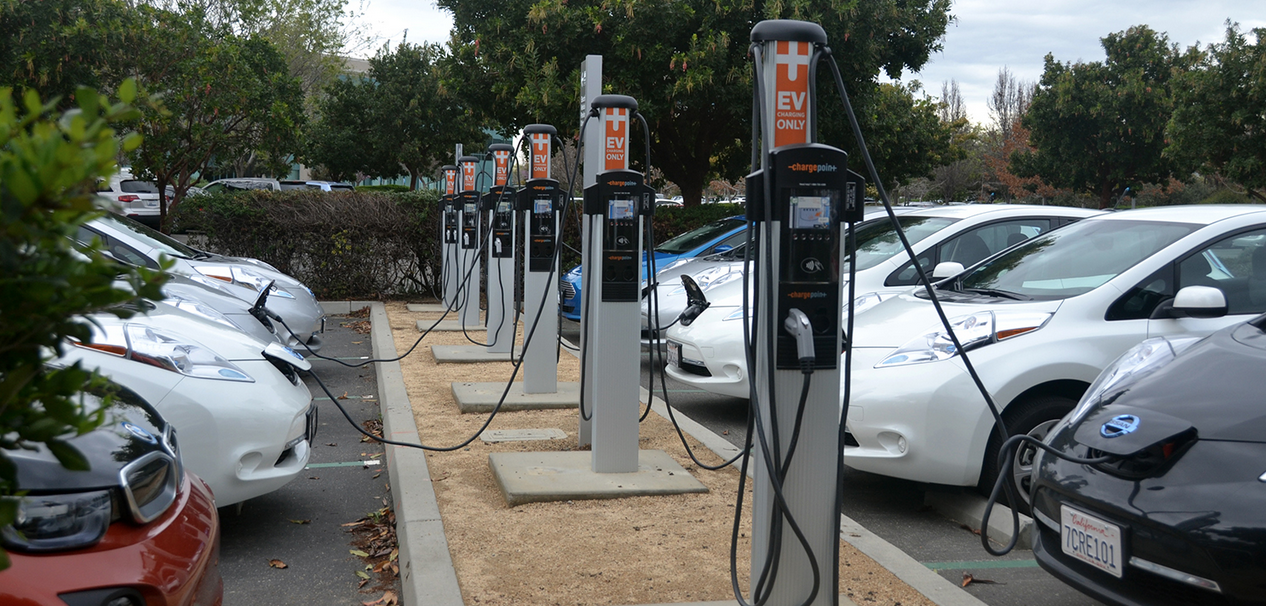
Screen Shot 2017-11-08 at 2.30.02 PMChargePoint company says they are helping more people choose to drive electric. The company was recently awarded a California Energy Commission grant to develop, own, and operate high-speed EV charging stations along key highway corridors in California.
Now they want to install a station in Lemoore the city council heard at a study session last month. Staff says an agreement with the company its expected in coming weeks.

Within the next 2-5 years the amount of EV drivers in the community will increase rapidly believes Bothe the company and the state. At no cost to the City of Lemoore, Charge Point plans to install and maintain 10 total parking spaces with the initial installation of 2-4 high-speed EV chargers and 1 dual port Level 2 charger. It serves drivers wanting to make a 30min – 1 hr stop; compatible with all electric vehicles. Level2 charging ports charge time is between 1 – 3 hours.
The development is expected to make Lemoore a popular stop along Hwy 41 and increase visitation to Downtown Lemoore. ChargePoint would own, operate, and maintain the stations at their own expense over a 15 year term (option to auto renew).

The station may be located at the city parking lot on E Street near the depot.

Challenge Dairy Refrigerated Truck Uses Solar To Keep Cool / 100 Solar Dairies

November 8,2017-

Screen Shot 2017-11-08 at 2.22.32 PMChallenge Dairy Products is working with the San Joaquin Valley Air Pollution Control District in Fresno to test a solar-powered, zero-emissions commercial Transport Refrigeration Unit, powered through a new technology called Rayfridgeration.

Instead of using particulate laden diesel fuel, the truck stores and refrigerates dairy products on delivery routes, using roof-mounted solar panels in the day time and an auxiliary battery that is charged at night. As a back-up, the electrical system is also capable of charging the battery while the vehicle is running. Challenge Dairy has been testing the Rayfridgeration truck since April 2017, and it is exceeding expectations so far, they report.

Challenge expects to fit their entire fleet with the new, cleaner technology.


Over 100 California Dairies Employ Solar

Screen Shot 2017-11-08 at 2.25.25 PMMore than 100 dairy farms across the state are using solar energy panels, with a total energy capacity of more than 77 megawatts (MW). Many of these dairy farms have a solar energy capacity of 1 MW or more says Dairy Cares.

Electric Truck Unveiled

Daimler unveils its electric truck weeks ahead of Tesla’s big debut

It’s called the E-Fuso Vision One and can carry 11 tons up to 220 miles before recharging.
Daimler AG

We’ve known for awhile that Tesla was set to unveil its electric truck this fall; it’s currently set for November 16th, after a few delays. But Daimler AG has stolen its thunder by announcing a new heavy-duty electric truck today, another indication that Daimler is increasingly seeing Tesla as one of its main rivals.

The truck is called the E-Fuso Vision One. Bloomberg reports that it can carry up to 11 tons a distance of 220 miles before it needs a recharge. This model is just a prototype, but the company says it can have the truck on sale within four years in the US, Japan and Europe. It’s ideal for shorter trips between cities, rather than cross-country hauling.

Tesla was set to unveil its truck tomorrow, October 26th, but the company delayed the announcement because of Model 3 production issues. It’s worth mentioning that even that date was delayed, as the original reveal was targeted for September. You can bet that Elon Musk is not thrilled with Daimler AG today.

Report Shows Wind and Solar Generation Up While Natural Gas Use Down

September 26,2017-

Screen Shot 2017-09-26 at 6.17.45 AMThere is no surprise on the latest report about electricity capacity and generation from the California Energy Commission: California continues moving away from fossil fuels as the state’s renewable energy portfolio expands.

“California’s policies are moving us towards more clean, reliable and affordable energy,” said California Energy Commission Chair Robert B. Weisenmiller. “Significant progress had been made in the electricity sector. We need to expand the use of clean energy to remove dirty, carbon fuels from the transportation sector.”

The tracking progress report compares “electric power capacity” and “electric power generation” over the past 16 years. Capacity reflects the total capability of various types of facilities to generate electricity while generation shows the actual generation of electricity produced.

Natural gas remained the largest portion of in-state installed capacity although it has declined in recent years. Meantime, solar and wind have increased. In 2016, solar photovoltaic capacity was 8,618 megawatts (MW) and solar thermal capacity was 1,249 MW. That’s enough electricity to power more than 3 million average California homes. The recent expansion of utility-scale photovoltaic solar included new projects in Kern, Riverside and San Bernardino counties.

Weather played a factor when looking at electricity generation in 2016. California’s hydroelectric generation doubled in 2016 as a result of storms and improved snowpack conditions. As hydroelectric generation increased, natural gas-fired electric generation decreased. At the same time, there was significant double-digit growth in both solar photovoltaic generation and wind generation. Total in-state solar generation increased nearly 32 percent from 2015. Wind generation increased nearly 11 percent

Nearly 400MW In Works

German Firm Plans 1600Acre Westside Solar Project

Also – First Solar Working On Large Mendota Project

The Central Valley’s westside continues to get new large solar farm applications that include two new projects totaling near 400 megawatts in Fresno County – both in the Westlands Water District.

German Project

Screen Shot 2017-09-17 at 7.04.53 AMOn land leased from the Woolf family, the county is processing an application to build a 1600 acre solar project near the Kings/Fresno county line. A scoping session is planned for Wednesday, September 27, 2017 – 6:00 p.m. to 8:00 p.m. Keenan Community Center, 17094 Myrtle Street, Huron, CA 93234

German-based EC&R Solar Development, LLC has submitted three CUP Applications (CUP 3562, 3563, and 3564) to allow the construction and operation of a 150 MW solar PV generation facility, a 20 MW solar PV generation facility, and a 20 MW energy storage facility. The parent company is one of the largest investor owned utilities in the world.

The project site, called Fifth Standard Solar Project Complex, is located on 12 parcels totaling 1,593.52 acres, located west of South Lassen Ave, north of West Jayne Ave, east of South Lake Ave, and west of West Gale Ave – about 3 miles south of Huron.

Like many recent applications this project will have a storage component. Storage systems can assist grid operators in more effectively integrating intermittent renewable resources into the statewide grid and can assist utilities in their efforts to meet energy storage goals mandated by the California Public Utilities Commission says their application. A 20 MW energy storage facility, on five acres, with a four-hour discharge duration would be constructed. The storage system would consist of battery or flywheel banks housed in enclosures, as well as buried electrical conduit.

The applicant – E.ON Climate & Renewables (EC&R), headquartered in Essen, Germany, is responsible for E.ON’s large-scale renewable energy activities. E.ON currently operates over 9 GW of renewable capacity including large hydro. Since its formation in 2007, EC&R has invested more than 9 billion Euros, including more than $5 billion in the U.S solar and wind facilities.They own a 20MW project in Southern California.

Little Bear Near Mendota

Screen Shot 2017-09-18 at 7.50.21 AM
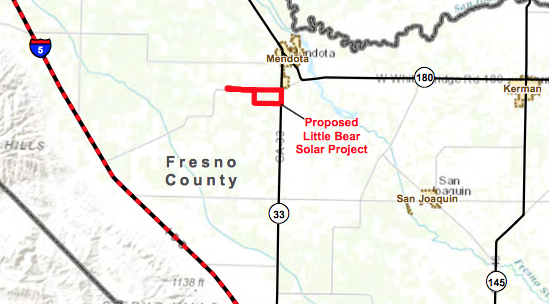
The second utility-scale project is the Little Bear Solar Project involving a 180 MW PV electricity generating facilities and associated infrastructure under Fresno County CUPs.

The solar facility would consist of up to five individual facilities with solar PV modules, support structures, electrical inverters, intermediate voltage transformers, an Energy Storage System, and other necessary infrastructure. The project also would involve installation of new and use of existing generation-tie lines to provide power to the grid via PG&E’s Mendota substation.

Last year, the developer of Little Bear – First Solar announced it had pre-sold 40 MW to a large community solar provider,MCE, based in the Bay Area. A not-for-profit, community-based electricity provider, MCE offers its customer base an opportunity source 50 to 100 percent of their energy from renewable sources like solar, wind and hydroelectricity at competitive rates throughout California. MCE also allows its customers to choose which kind of green energy they want, whether it be wind, solar or a combination without the initial high costs of leasing equipment and construction.

The Little Bear project, located on around 1300 acres, is set to break ground in 2019 and should be complete by 2020. After that MCE will have the option to expand – potentially growing to a 160-megawatts in size, they said in 2016. Right next door is the NorthStar solar project.
__

Tulare County May Add Solar Panels At All Major Buildings

Over 100 Megawatts Planned

Screen Shot 2017-09-16 at 7.05.32 AM


Tulare County has over 100 buildings. Now many of the largest may get solar panels helping to cut the annual electricity bill that now stands at $3 million currently. At their September 19 meeting, the Board of Supervisors may approve borrowing to $32 million in tax credit bonds to save $750,000 annually on the power bill. A proposal says putting panels on the largest buildings could generate 94MW, with energy storage devices adding another 12MW. Most of the panels would be placed on new parking lot shade structures at the major civic centers and Government Plaza, helping to cool employee and visitor cars as well.

Westlands Solar Park Files Notice They Will Downsize Plan

September 14,2017-

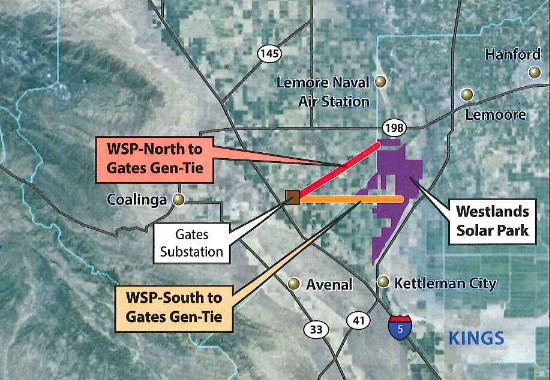
Screen Shot 2017-09-07 at 12.00.13 PMWestlands Solar Park(WSP) owners are working with Westlands Water District on a revised EIR for their mega-solar project. Filed August 31, the new plan would modestly reduce the size of the project from 24,000 acres to 21,000 acres. Power production would be reduced from 2400MW to 2000. Most of the huge solar farm would be located in Kings County, roughly around the Avenal Cutoff and Laurel Ave.

Proponents says the project will be incremental, over 12 years, averaging about 167MW each year. The revision of the EIR supersedes a 2013 plan.

Also new are plans to deliver some of the power to the federal Western Area Power Administration (WAPA) who confirm WSP submitted an interconnection request recently. A new power line would parallel I-5 up the Valley to the Dos Amigos Pumping Station south of San Luis Reservoir. The plan says two other transmission corridors (privately funded) would help distribute electricity into the Gates Substation.

The big project benefits Westlands WD by helping them continue to retire salt-impacted and impaired land in the district.