
International companies becoming players here
August 25,2018-
While the Atlantic Eastern seaboard is humming with a formidable pipeline of offshore wind projects, it’s been pretty quiet off the Pacific Coast of California this year. But that’s not because of a lack of interest here.
The Department of Energy said as of 2017 the US offshore wind project pipeline along the East Coast had reached a total of 25,464MW of capacity across 13 states, including the 30MW Block Island Wind Farm off Rd Island that was commissioned in 2016 where they could finally turn off those diesel generators to keep the lights on.
Although the US Department of Defense (DOD) appears ready to live with offshore wind along the Atlantic Coast, there has been distinct chill in the air over plans to erect wind turbines off the Pacific’s California Coast.
As we wrote last January the US Navy,really the DOD, published a map that shows virtually all of the California coast in a red zone, meaning those sectors were “not compatible” with Navy operations and “off limits” to ocean wind farms.
Sounded an awful lot like “no-go.”
That appeared put the kibosh on development plans that received a lot of attention along the Central Coast promoted by Seattle-based Trident Winds and other companies to build up to a 1000 megawatts of offshore wind power with giant 700ft floating wind turbines, out of view – some 30 miles off the Cambria coast.
Trident started working with government agencies over 3 years ago on the ambitious plan but has been stymied, at least to date.
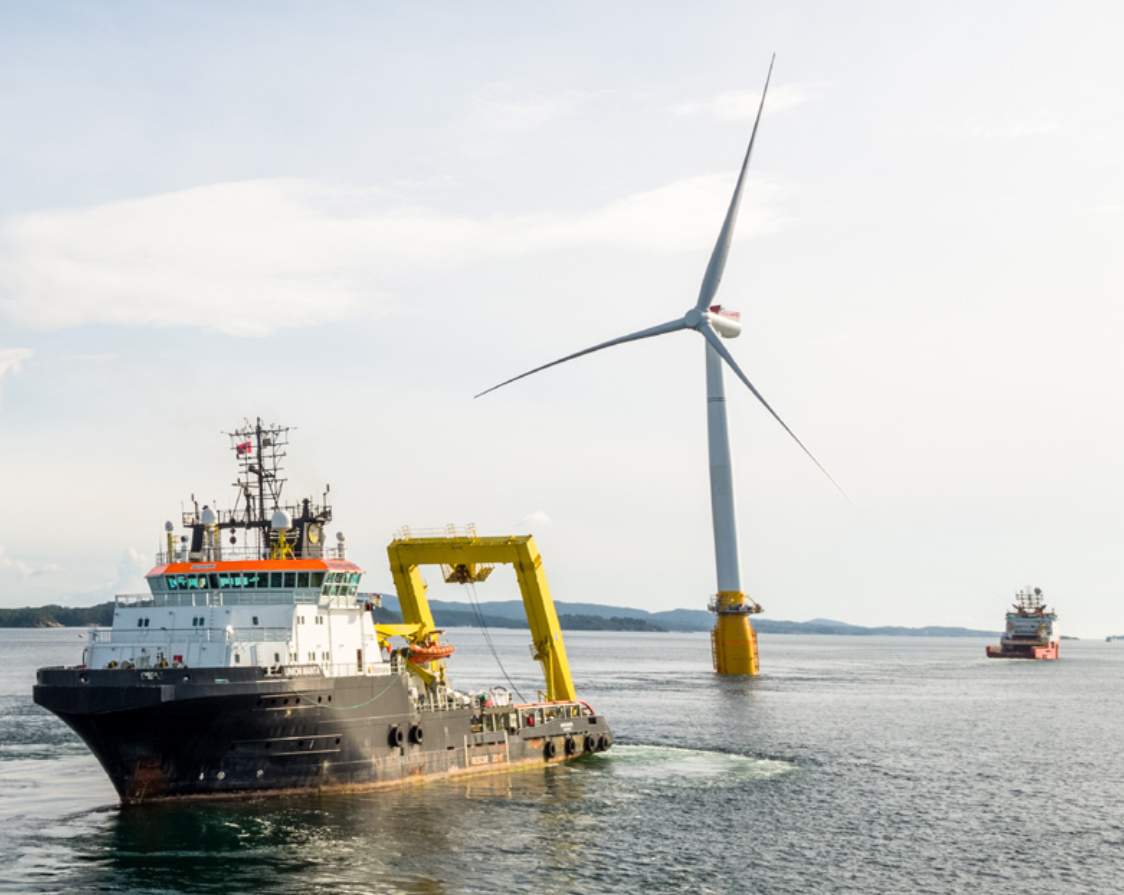
Unlike the Atlantic where wind turbines can anchor to the seabed, the best wind area out here is in federal waters that stretch 3 to 200 miles out, at several thousand foot depth requiring floating wind technology. That technology has been getting real world testing off the coast of Europe where a handful of companies are now generating power. A surge in new, larger offshore wind installations in Europe in 2017 is said to dramatically show the viability of a technology that has come of age. Europe is now home to more than 4,000 offshore wind turbines.
Now some those same European companies are looking here.
Despite a lack of news around here it turns out that behind the scenes, activity in California has been bubbling along after all; ”quite a bit of it” says Morro Bay city administrator Eric Endersby.
Endersby has been working to help Trident find a home in Morro Bay to launch the multimillion dollar project that would tie into the grid here – where the mothballed Dynegy power plant has sat idle since 2014.
Art of the possible
The gatekeeper for the Department of Defense for any renewable energy project off the coast is Steve Chun, Community Plans and Liaison Officer Navy Region Southwest, based in San Diego.
Chun in an interview this week said there “has been meetings with wind development interests on an active basis” in the past few months including two groups recently. Interest, he says, has been brisk.
”We have now received proposals to build wind farms at 14 different offshore sites to date.”
Instead of a flat ‘no’ Chun remarks that “the Department of Defense is trying to see just what the art of the possible is.”
Also behind the scenes, California represented by the California Energy Commission and the federal Bureau of Ocean Management (BOEM) have been waiting for DOD to work out its policy. Now for the first time in a year the BOEM/California Intergovernmental Renewable Energy Task Force plans to hold a public meeting in Sacramento on September 17 confirms spokesman Scott Flint.
Mr Chun, Gov Brown’s energy commission officials and BOEM staff will be meeting along with lots of industry players, a number of them with international ties.
International players
Case in point is Trident Winds itself, who now has new German partner as of June. EnBW North America and Trident Winds have formed a joint venture to advance the Morro Bay offshore wind project off the central coast of California with a grid connection in Morro Bay, it was announced this summer.
With 336 megawatts in operation, 610 megawatts under construction and an additional 900 megawatts under development, EnBW is becoming one of the leading developers and operators of offshore wind farms they say.” With a view to long-term growth, EnBW will invest over 5 billion euros in further expansion of renewables” they recently announced.
Now with a partner with operational experience, turbines already generating power and substantial capital to build a huge project, Trident’s joint venture may be ready for the next step.
For 2 years Trident has working with BOEM on what will be a competitive leasing of waters in the federal jurisdiction once the DOD and State of California a sign-off on pre-approved locations.
Asked about the coming September 17 meeting Trident Winds CEO Alla Weinstein says she is hopeful that “BOEM will announce designated wind areas and commence with the sales process shortly.”
Morro Bay plays a roll
Morro Bay’s Endersby says in the meantime, Trident has been meeting with the Morro Bay fishing community and appears to have an agreement in principle that would allow the turbines to be placed at a site away from the most important fishing areas.
In addition Endersby says the City of Morro Bay, eager to secure the economic development benefits, and Trident want to sign a MOU “sometime in September or October” that would help the company in the bidding process and demonstrate local backing for their application with BOEM once the process moves forward.
Norwegian energy giant Statoil also has also expressed interest and is thought to be ready to put up a competitive bid. They have spent little time in Morro Bay meeting with locals however.
Weinstein makes the point that Trident’s record of local cooperation and consultation should matter – saying she hopes “that the voice of the stakeholders will be given equal value to the value of money in selecting the winner of the auction.”
But what if DOD says ‘no’ after all?
“Either way we think Trident will move forward relocating out of DOD jurisdiction into the National Marine Sanctuary area off Monterey Bay if needed. Trident has held some discussions with them that seem favorable” says Endersby.
Another player who declines to be identified wants to build a small pilot project like they did off Rd Island to connect to the Central Coast figuring this would be substantially easier, quicker and more certain than a mega-project that could be stalled in any manner of ways.
Meanwhile other parts of California are in the running to host offshore wind farms, notably in the windy Humboldt area where a community-based utility,The Redwood Coast Energy Authority, is working with a Portuguese company, Principle Power, on a plans to displace a nat gas fired power plant in town that supplies all their power now. Redwood, like the state of California, favors and gives priority to renewable power over fossil fuel power. DOD’s Mr Chun says this area is being discussed as well even though the new Navy map also is colored red off the north coast too.
Now in a twist a new player Terra-Gen, with major wind power holdings in California already, wants to build an onshore wind farm capable of producing up to 135 megawatts of electricity, enough to power the 63,000 households in isolated Humboldt County. Humboldt’s current power source is Humboldt Bay Power Plant, which is powered by natural gas and diesel that produces 163MW. Terra-Gen is working with Humboldt’s Community Choice Aggregate, the Redwood Coast Energy Authority to see if a contract between the power producer and the power purchaser, can be developed.
If this land-based renewable project is built, the area will likely not need offshore wind with little infrastructure available to take what would be surplus power to the wider California grid and major urban centers in the state.
That’s an advantage that the Central Coast has, proximity to the state’s big north/south grid system. We are tied in with millions of dollars of already installed transmission lines and substations that just happen to be located to accept new offshore wind power. That is because the seaside Morro Bay power plant is kaput and the ocean-front Diablo Canon nuclear power plant soon will be.
By the way, just what will happen to the infrastructure at Diablo Canyon will be discussed at the upcoming Diablo Canyon facilities repurposing workshops to be held at Atascadero City Hall at 6500 Palma Ave.
• Friday, September 14, 8 a.m. – 5 p.m.
• Saturday, September 15, 8 a.m. – 5 p.m.