Energy updates – More solar for Kings Co/ SCE project/ Amazon order

-October 6,2019-

Screen Shot 2019-10-06 at 2.25.43 PM

More big solar projects for Kings County

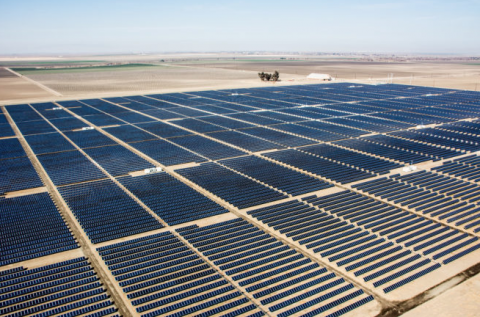
The Kings County Planning Commission is expected to approve two new solar farms October 7 that would add up to to 400 megawatts and bring the total approved by the commission this year to 4 solar projects adding up to just under 1000MW.

All are to be located along the Avenal Cutoff just east of I-5.

This month both projects are being proposed by Westlands Solar Park. One called Chestnut is 150 MW the includes battery storage to be built on 1040 acres of open ground. The other is called Westlands Solar Blue and is a 250MW project on 1895 acres of poor grid farmland.

Earlier in the year Westlands Aquamarine at 250 MW was approved. Recurrent Energy’s RE Slate was the fourth project approved in 2019 at 300MW.

Principal withe Westland Solar Park Daniel Kim says it their intention to start construction on one or more of their projects this year.

A major incentive to do that might be the pending expiration of the 30% federal investment tax credit set to  sunset by December 31.Unless Congress changes the law the 30% rate is available for systems placed in service only through December 31, 2019. The credit drops to 26% through the end of 2020, then 22% through 2021 before dropping to zero by the end of 2021.

Demand for more renewable power is coming from the rapid rise of Community Choice Aggregation(CCAs) agencies in the state who are negotiating with developers like Kim to supply their areas with power in the future  looking to reach the state mandate of 100% renewables.CCAs are programs that allow local governments to procure power on behalf of their residents, businesses, and municipal accounts from an alternative supplier while still receiving transmission and distribution service from their existing utility provider. CCAs are said to be an attractive option for communities that want more local control over their electricity sources, more green power than is offered by the default utility, and/or lower electricity prices. CAS are replacing the private utilities like PG&E from the Bay Area down to San Diego including on the Central Coast.

SCE building new $5.4 million Visalia maintenance office

The 15,800 square feet project located inside of Southern California Edison’s substation in Visalia will consist of office and warehouse space to support SCE’s maintenance, test and transmission operations. The groundbreaking diehard $5.4 million  project was in Sept. 2019 with an estimated completion date in the third quarter of 2020. There is no public access to the project site. The project should improve power reliability in the Visalia Industrial Park.

Amazon’s big order

Amazon recently announced the order of 100,000 electric delivery vehicles from Rivian, the largest order ever of electric delivery vehicles, with vans starting to deliver packages to customers in 2021. Amazon plans to have 10,000 of the new electric vehicles on the road as early as 2022 and all 100,000 vehicles on the road by 2030 – saving 4 million metric tons of carbon per year by 2030.

Energy news – zero emmission trucks on I-5?

Autonomous electric trucks may ply Hwy I-5

Screen Shot 2019-10-05 at 5.55.55 AMKings County Association of Government s(KCAG) is supporting use of carry over federal planning funds for a Valley wide I-5 Freight Zero Pilot Study. Kern County Council of Governments will be the fiscal agent for this study. The goal is to have autonomous electric trucks carry freight on I-5 from Fort Tejon to SR205, near Altamonte Pass.

The pilot  would support the effort to cut emissions from long haul big rig trucks, 97% of them running on diesel now.Changing how trucks are powered is essential to solving the problems of air pollution and climate change argues a Davis think tank.

The California Air Resources Board is in the process of proposing a new truck sales mandate that would require truck manufacturers to sell ZEV trucks, starting in 2024. How can we power such vehicles with zero emissions? 

At the Institute of Transportation Studies at UC Davis, they are working to answer this question from a research perspective by looking at four technologies designed to provide power to long-haul trucks while producing zero tailpipe emissions. These technologies are: a catenary system; hydrogen fuel cells; dynamic inductive chargers embedded in the roadway (capable of charging moving trucks); and battery electric vehicles (BEVs).

Preliminary results suggest three cleaner technologies are all within 30% of the cost of diesel but none quite match it. The preliminary results for BEVs (not shown), based on slightly different assumptions, indicate that their total costs in a long-haul situation could be on the low side, ranging from $0.45–0.82 per mile versus $0.58 per mile for diesel.

Five Points dairy gas pipeline getting funding

The California Energy Commission will help Fresno dairymen market their biogas for clean transpiration fuel offering $3.5 million to support their project at a October 14 meeting. The goal of this agreement is to construct a new facility to clean up and upgrade the gas in Fresno County to process diary biogas from five participating digesters

Price of shipping crude by tanker surges

The cost of chartering a very large crude carrier, or VLCC, to ferry oil from the U.S. Gulf Coast to Asia has surged to $10 million, or $5 a barrel—about twice the price before the attacks in Saudi Arabia, according to analysts reports the Wall Sat Journal.

Coal company faces default

(Bloomberg) — Murray Energy Corp., the U.S. coal giant that had pressed the Trump administration for help averting bankruptcy, may be headed toward default.

The largest closely held coal miner in America failed to make multiple payments to lenders this week, the company said in a statement on Wednesday. Creditors have agreed not to take legal action until Oct. 14, buying Murray some time to figure out how to shore up its balance sheet, the St. Clairsville, Ohio-based firm said.

Murray Energy is struggling to stay afloat, along with the rest of America’s coal miners, as cheap natural gas and renewable energy resources cut into coal’s share of the U.S. power market. At least four companies including Cloud Peak Energy Inc. and Blackjewel LLC have gone bankrupt this year, laying bare the decline of a fuel that once accounted for more than half of all U.S. power generation. Today it’s less than 25%.

Prices for thermal coal — the kind burned by power plants — have slumped, which may have left Murray short on cash, said Lucas Pipes, a coal analyst with B Riley FBR Inc. “You can’t make payments out of thin air if the money isn’t in the bank,” he said.

The company idled some of its mines in West Virginia last month, citing “severely depressed coal markets.”

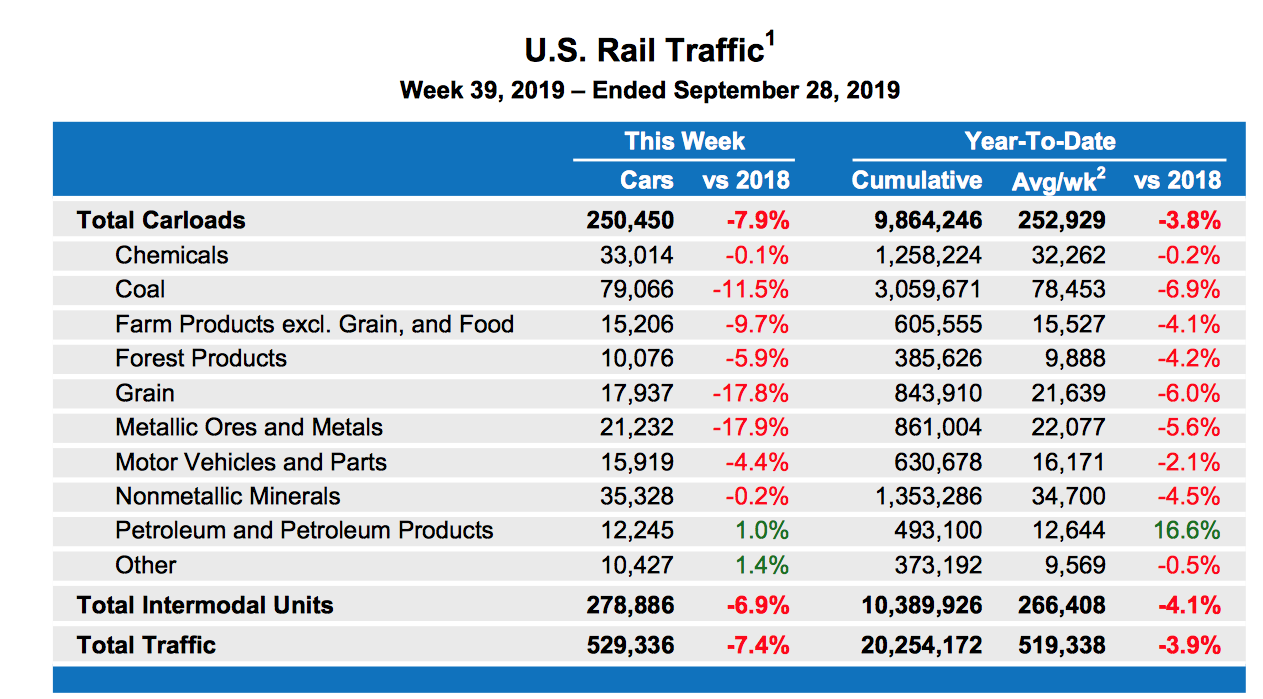
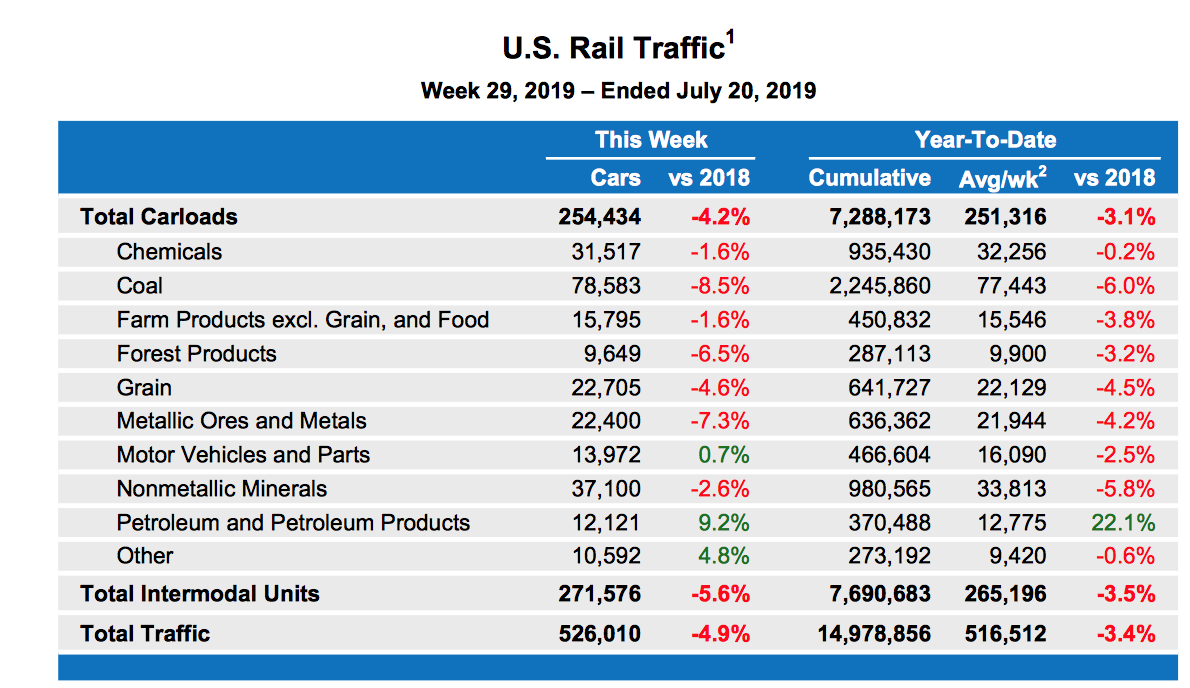
Rail Traffic Down 7.4%

Screen Shot 2019-10-05 at 6.43.11 AM

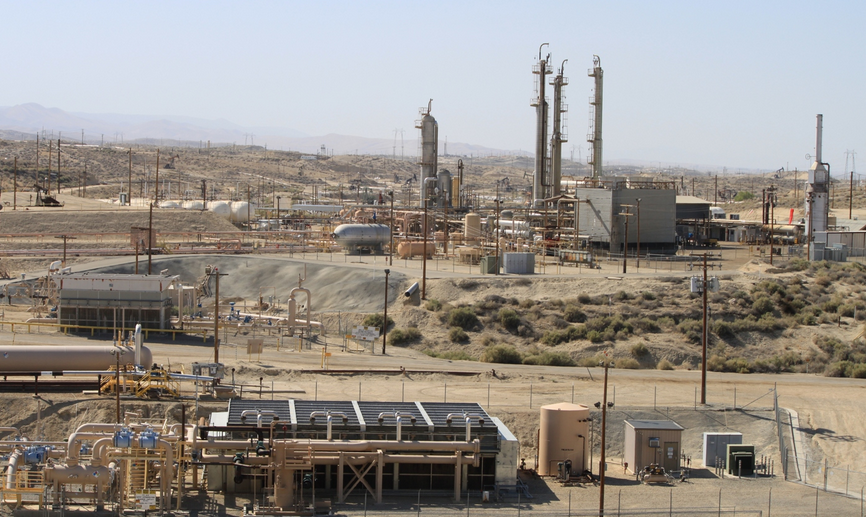
Study Indicates Oilfield Activities Have Increased Groundwater Salinity in Western Kern County

-September 23,2019-


Screen Shot 2019-09-23 at 5.41.54 PMSACRAMENTO
— A study performed by the U.S. Geological Survey (USGS) as part of a State Water Resources Control Board program that monitors regional groundwater quality in oil production areas has revealed higher than normal salinity levels in groundwater near three oil fields in western Kern County.

The results of the study released this month in a technical publication of the American Association of Petroleum Geologists, showed increased salinity above natural levels in groundwater near current and historic oilfield produced-water disposal areas in the Lost Hills, North Belridge, and South Belridge oil fields.

“These regional monitoring findings are essential in helping us gain a better understanding of how groundwater could be affected in areas of oil and gas production,” said Jonathan Bishop, Chief Deputy Director of the State Water Board.  “This study provides us new information that the agencies will use to evaluate if additional groundwater investigations are warranted.”

Based on data collected from oil production wells, underground injection wells, and groundwater monitoring wells, the study found that the salinity increases are related to the mixing of native groundwater with saline oilfield produced-water discharged to surface disposal ponds and underground injection wells.

While the groundwater near these oil fields currently is not a source of drinking water because it is naturally brackish (salty), some farmers use it for irrigation.

“This is the first time in this study we’ve seen direct evidence of disposed water migrating outwards from oilfield underground injection disposal wells in California,” says USGS geologist and study author Janice Gillespie.  “Mapping the natural groundwater salinity near the injection sites was the key to figuring out where changes had occurred.”


The USGS initiated the mapping in 2016 to document the salinity gradients within the aquifer system and record changes near produced water disposal ponds and injection wells. The USGS is conducting this research under contract with State Water Board, in accordance with Senate Bill 4 (Pavley, 2013), which requires the Board to develop and implement a regional groundwater monitoring program.


A follow-up publication is expected to be released in 2020 and will address salinity in shallow groundwater near oil fields and agricultural areas using different methods. The publication can be found through USGS study publication (AAPG Environmental Geosciences, v. 26, no. 3, pp. 1–23).

Visit the State Water Board regional groundwater monitoring program webpage and the USGS California Oil, Gas, and Groundwater websites for more information.


Tulare County biogas operation largest in US

-August 27,2019-

SoCal Gas to replace 5% of natural gas supply with RNG by 2022 

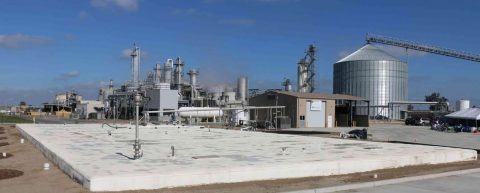
Southern California Gas Co & Calgren Dairy Fuels, state and local elected officials celebrated the completion of Calgren’s dairy renewable natural gas facility in Pxley recently.The project is the first of its kind in California and is expected to be the largest dairy biogas operation in the U.S as it expands late this year.

Calgren 2019-08-26 at 6.17.44 AMCalgren collects cow manure – a potent source of greenhouse gas emissions – from four local dairy farms and processes it in an anerobic digestor that accelerates the natural decomposition process. Methane emissions (biogas) from that process are captured and converted to make renewable vehicle fuels. Producing pipeline quality renewable natural gas (RNG) that is then injected into the SoCalGas pipeline system which allows Calgren to supply RNG to existing compressed natural gas (CNG) refueling facilities. Ultimately, this also has the potential to be delivered to customers to fuel ultra-low emissions trucks and buses, generate clean electricity, and heat homes and businesses.

Calgren plans to partner with eight additional dairy farms by the end of 2019, which will make the facility the largest dairy biogas project in the nation. At a ceremony in the past few weeks SoCalGas presented Calgren with a $5 million incentive check authorized by the California Public Utilities Commission (CPUC) to support the development of renewable energy projects.

Renewable gas to replace fossil fuel-based natural gas

“As part of our vision to be the cleanest natural gas company in North America, we have committed to replacing 20 percent of the natural gas we deliver today with renewable natural gas, primarily from organic sources, by 2030,” said Jeff Walker, vice president of customer solutions at SoCalGas. “Renewable natural gas is a ready, reliable and realistic way to reduce GHG emissions and pollution from heavy duty transportation and buildings and will help ensure that families and businesses have an affordable option for heating and cooking as California transitions to a clean energy future.”

“Calgren is proud to be the first facility in California to operate a dairy digester pipeline cluster and to work with both the dairies and SoCalGas to mitigate emissions,” said Walt Dwelle, principal owner of Calgren Renewable Fuels. “This facility alone will eventually capture methane produced from the manure of more than 75,000 cows, preventing about 130,000 tons of greenhouse gas from entering the atmosphere each year, the equivalent of taking more than 25,000 passenger cars off the road for a year.”

RNG is a renewable fuel produced from food waste, farms, landfills, and even sewer systems. It can rapidly cut greenhouse gas emissions (GHGs) because it takes more climate pollution out of the air than it emits as an energy source. RNG is already helping eliminate emissions from trucks and buses.

Research shows that replacing about 20 percent of California’s traditional natural gas supply with RNG would lower emissions equal to retrofitting every building in the state to run on electric only energy and at a fraction of the cost.

Over the last five years, RNG use as a transportation fuel has increased 577 percent, helping displace over seven million tons of carbon dioxide equivalent (how greenhouse gas emissions are measured). That’s equal to the total energy used by more than 868,000 homes for one year.

SoCalGas is working to build on RNG’s success in the transportation sector by making it available to fuel the homes of the company’s 21 million customers across Southern California. Earlier this year, SoCalGas’ committed to replace 20 percent of its traditional natural gas supply with renewable natural gas (RNG) by 2030 – as part of a broad, inclusive and integrated plan to help to help achieve California’s ambitious climate goals.

To kickstart the plan, SoCalGas will pursue regulatory authority to implement a broad renewable natural gas procurement program with a goal of replacing five percent of its natural gas supply with RNG by 2022.

SoCalGas also recently filed a request with the CPUC to allow customers to purchase renewable natural gas for their homes. SoCalGas seeks to have CPUC approval of its voluntary program by the end of the year.

Research shows that replacing about 20 percent of California’s traditional natural gas supply with RNG would lower emissions equal to retrofitting every building in the state to run on electric only energy and at a fraction of the cost.

Using RNG in buildings can be two to three times less expensive than any all-electric strategy and does not require families or businesses to purchase new appliances or take on costly construction projects.

Today organic waste from farms, landfills, and wastewater treatment plants account for 80 percent of methane emissions in California. A 2016 law requires 40 percent of methane from the state’s landfills and dairies to be captured, with provisions to deliver that energy to customers.

This will bolster the supply of RNG that is already growing rapidly as cities and towns across the country look to divert organic waste from landfills. In California, scientists at the University of California, Davis estimate that the state’s existing organic waste could produce enough RNG to meet the needs of 2.3 million homes.

“Renewable natural gas is a viable and cost-effective solution to achieving emissions reductions in this state,” said Tulare County Supervisor Pete Vander Poel. “Tulare County is the dairy capital of the world, and it’s fantastic to see industries working together to have a positive impact on our air and environment. Innovation like this will not only reduce greenhouse gases and improve air quality, it will provide job opportunities for county residents and economic growth.”

“Renewable natural gas is a smart way to address climate pollution,” said Assemblymember Devon Mathis (26th District). “It not only helps develop new businesses and economic opportunities, it also reduces emissions while allowing people to keep the option of using gas for home heating, cooking and other needs.”

Some 120 projects, mostly in Central Valley, planned

The dairy digesters in the Calgren project and others like it are also partly funded under California’s Dairy Digester Research and Development Program, which aims to reduce greenhouse gas emissions from manure generated at state dairy farms. The state currently has about 30 operational dairy RNG projects and 50 more in various stages of development that will result in more than 50 million metric tons of greenhouse gas reduction (CO2e) over the next 20 years, according to the industry group Dairy Cares. Experts estimate as many as 120 projects could be funded and operating in the next five years.

California’s Transition to Clean Energy

California uses 45% renewables to make electricity

By HOYU CHONG

Beacon Economics

Despite progress, California still has a long way to go before it hits the climate emergency brake. The state is going through rapid transitions, which will bring important changes to the way we fuel our cars, heat our homes, and power our industries in the coming decades.

RENEWABLES ARE PULLING AHEAD IN THE ELECTRICITY SECTOR

California’s shift toward renewables in the electricity sector has been unstoppable, to put it modestly, with significantly more renewable energy capacity being installed in recent years. Between 2012 and 2017, the state installed 9,383 megawatts of renewable portfolio standards (RPS) eligible1 nameplate capacity while fossil fuel2 installation name- plate capacity decreased 2,406 megawatts, mostly from a reduction in natural gas power generators.

Recurrent project in Kings County

In fact, California, along with Texas, is one of the nation’s ‘Big 2’ in terms of installed renewable energy capacity. In 2017, California had 20.5 gigawatts of nameplate capacity for RPS eligible projects installed, just behind Texas at 24.3 gigawatts. Unlike Texas, where most of the renewable capacity is concentrated around wind power, California has a more diverse portfolio of renewable nameplate capacity.

RENEWABLE ENERGY IS MAKING A DENT IN ELECTRICITY

California’s ambitious growth and investments in renewable electricity puts it far ahead of the United States as a whole. Excluding conventional hydropower, RPS eligible renewables represent almost 30% of the state’s electricity power-mix, compared to less than 10% of the nation’s mix. Inclusion of conventional hydroelectric adds 14.7% and 7.5% to the renewables’ share of electricity in California and United States, respectively.

Fossil fuel is still the dominant energy source in the United States, and even in California. While RPS eligible renew- ables are 44% of electricity in California, they represented just 8.3% of total energy consumption in 2016. In the United States overall, RPS eligible renewables represented just 6.5% of total energy consumption.

However, California has reduced its reliance on fossil fuels more than the nation as a whole. While fossil fuels comprise less than 40% of electricity but 73.5% of total energy consumption in California, that is less than the United States’ total consumption of 80.9%. Ironically, energy consumption in transportation, mostly from fossil fuel sources, makes up a significantly higher share in California (40%) than in the United States (29%). California’s efforts to decarbonize the electricity grid is offset by its relatively high energy consumption in transportation.

First offshore wind project could feed Vandenberg

-August 15,2019-

Turning rigs into reefs

25MW pilot project may get Department of Defense green light

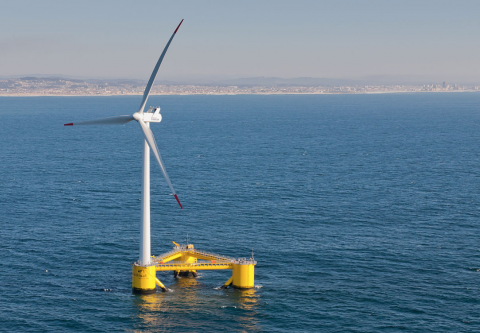
Prospects for California floating offshore wind projects have been stalled for several years largely because the US Navy has yet to find any place off the West Coast that does not pose a conflict with their seagoing operations.

Guarding the gate for the Navy is Steve Chung, Encroachment Program Director for the Navy, based in San Diego who offered a few days ago that despite the delay “discussion is underway at the highest level of the Department of Defense (DOD) leadership to see if something is possible.”

At least 11 international companies have lined up ready to bid on a potential lease if offered by the federal government.
Screen Shot 2019-08-08 at 7.36.54 AM

A second federal agency, the Bureau of Ocean Energy Management (BOEM) has announced they would like to offer leases offshore potentially in three areas including in federal waters (3 miles out) offshore of Diablo Canyon, Morro Bay/Cambria and off Humboldt in Northern California. But like the rest of us, they are waiting for word from Steve Chung.

Now there is a surprise development.

A French company Ideol has applied for a permit to do some wind speed testing in state waters – less than 3 miles out – off the Vandenberg Air Force base coast.That area on the Santa Barbara coast is not on the current BOEM list, at least not yet. Jurisdiction for state waters falls to the California State Lands Commission who will hear the new request at their August 23 meeting in LA.

Endorsing the pilot idea is Vandenberg AFB who is looking to diversify its power sources including more marine renewables. Already the base gets about 35% of their electricity from their new 22MW solar plant on the base, built by SunPower and in operation for about a year now.

“Vandenberg Air Force Base is supportive of the Ideol offshore wind energy project as an option to consider in its efforts to increase its overall energy resiliency.  These types of projects are assessed to ensure they have no adverse mission impacts and are also subject to U.S Air Force and U.S. Department of Defense considerations and approvals,” said Col. Michael Hunsberger, 30th Mission Support commander.

“Vandenberg Air Force Base is supportive of the Ideol offshore wind energy project as an option to consider in its efforts to increase its overall energy resiliency.  These types of projects are assessed to ensure they have no adverse mission impacts and are also subject to U.S Air Force and U.S. Department of Defense considerations and approvals,” said Col. Michael Hunsberger, 30th Mission Support commander.

Ideol is not the only company who has expressed interest in supplying offshore wind power to Vandenberg. Well aware of the new initiative is Steve Chung who says his office has received interest from several other companies.“in both wind and wave power” at the Vandenberg location.

Chung, after all represents all branches of the military as a DOD official and will be involved because of the likelihood energy operations could extend into federal waters as well as state waters.

“I will be there at the Lands Commission meeting“ and will likely be part of the discussion, he says.

Ideol on their website says they have installed a 2 MW floating wind turbine off the Atlantic Coast of France.The company has yet to respond for comment regards Vandenberg. During the first half of 2019 France’s first offshore wind turbine produced a total of 2.2 GWh and faced significant wave heights up to 38 feet, they reported.

But 2MW is actually small compared to the state of the art right now with GE selling a 12 MW offshore wind turbine with blades that reach past 2 football fields. It is not likely to stop there as the Dept of Defense is reportedly working on a 50MW  turbine with hinged blades so the units can be shipped on a truck.

The idea is that a few wind turbines off the Vandenberg coast could potentially supply the base with some 25MW of power that could double their renewable power and help make the base more “resilient” to potential energy disruptions- a major concern for military bases.

The plan to do a project off the Vandenberg coast is apparently no secret although the best of our knowledge, this is the first  news report.The well-connected Surfrider organization recently posted a white paper on offshore renewables and stated the following without citing a source.

“Vandenberg Pilot Project is a proposed 3-turbine floating offshore wind farm off the Vandenberg Air Force Base in Santa Barbara County, California. Working with multiple universities, this pilot project hopes to establish a “marine energy research area” off the coast, and then develop within those spatial limits.This wind energy project is also proposing to use the transmission cables currently used by an active oil rig, thus reducing the additional cost and environmental impact of laying new subsurface cables and onshore connections.”

Confirming the scenario, the Navy’s Steve Chung says to the degree a project would utilize existing infrastructure already in place – it would ease the navy’s concerns. “It would be less impactful if a renewable project utilized the cable that connects to the shore from Platform Irene” he says – some 5 miles off the Vandenberg coast. This is a oil platform that is expected to be shut down sooner or later with almost no production.Three other nearby oil platforms are scheduled to be mothballed as well.

The focus on utilizing Platform Irene’s footprint to site some wind turbines and connect to the shore involves both federal and state waters requiring officials from both jurisdictions to work together if something is going to happen.

Helping this pilot offshore wind project to be potentially first out of the chute is that it starts small with just a few turbines, does no new shore landings and uses the cable and pipelines that already connect to the shore as well. In addition it provides renewable power to an eager customer with plenty of clout – one that Steve Chung can salute as well. All this with few impacts that could trigger long delays.Unlike some of the other coastal areas being considered, this area has no Highway 1, has few residents or visitors on this stretch of the coast to complain about any view shed issues.

While it is possible this offshore wind project could happen sooner than others – Mr Chung may still give the green light to other areas on the West Coast as well, like the Morro Bay competition that has drawn so much wind industry interest and is large scale.But implementation remains years out, even if they get an OK.

Decade ago
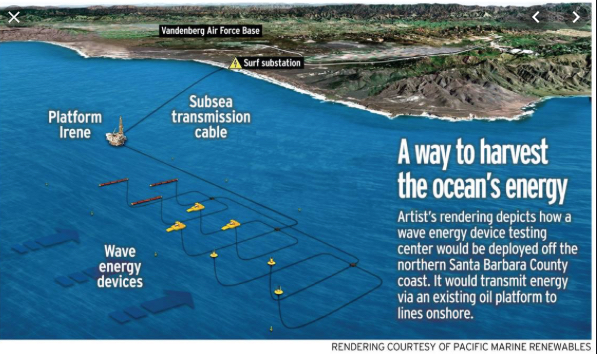
PG&E plan at 5.59.27 AMIf some of this discussion sounds familiar you might remember that PG&E did a multi-year wave study off the Vandenberg coast but decided to shelve the idea in 2011.

pictured:PG&E plan from 2008 to use the connection from Vandenberg to Platform Irene

The plan called Central Coast Wave Connect also hooked up to Platform Irene. More recently a 2016 National Renewable Energy Laboratory (NREL) study found the Vandenberg coast to be the “number one site in southern California for wave energy.”

It is possible a Vandenberg project could also involve waves or tides, in the early stages of commercial development that could be part of a demonstration project phase before any large-scale facilities are constructed.One company said to be interested also in bidding on the Vandenberg offshore wind project, UK-based Cierco who says they want to build three 15WW turbines offshore. Alternate bids could save the government money after all.

So why would oil companies want to participate at all in this funeral for fossil fuels?

Oil companies here face a huge cost to completely dismantle their oil rig platforms and might welcome the idea they could be converted to artificial reefs that promote diverse sea life at a far lower cost than complete demolition. One estimate is $100 million vs $5 million.A 2016 federal agency, the Bureau of Safety and Environmental Enforcement estimate was that the four offshore oil platforms off Vandenberg would cost $99 million,$74 million,$94 million and $37 million each to completely remove. Removing only the oil drilling equipment from the platform is a fraction of the cost, perhaps 5%.

Oil companies might notice – instead of causing harm to wildlife, they would be recognized for enhancing their habitat. The idea has been promoted as Rigs to Reefs, highlighted by some UC Santa Barbara research earlier this year.

“….these hulking structures, rising hundreds of feet from the ocean floor, provide a unique habitat. The complex shape of the rig’s support creates a 3-dimensional reef for animals to colonize and live near. And the rig’s open construction allows currents to pass through, bringing nutrients ….as far as the marine life is concerned, they already are reefs.”

Energy news:Tulare & Kings adding solar /more

-August 4,2019-

New 70MW solar farm planned in south Tulare County

Tulare County intends to adopt a Mitigated Negative Declaration for the Deer Creek Solar I Project. The project site is located on 378 acres of private land near Terra Bella in unincorporated southwestern Tulare County. Road 224 borders the west side of the property, Avenue 96 to the south, and SR 65/CR35 to the east.  The solar farm would generate approximately 70 mega-watt (MW) ac photovoltaic (PV) energy generation facility, battery energy storage system and associated infrastructure.It would transmit the power generated directly to Southern California Edison’s (SCE) 66kV Poplar-Terra Bella line. The power would then be sold to California investor-owned utilities, municipalities, or other purchasers.

Recurrent project in Kings County

Kings largest solar project gets hearing

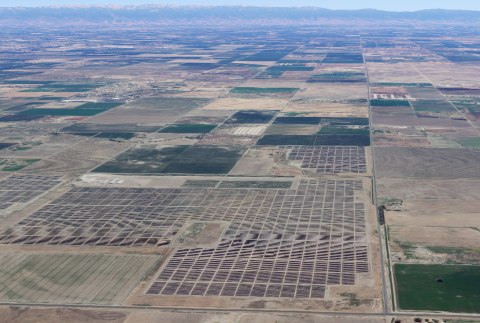
At an August 5th Panning Commission meeting Recurrent Solar is proposing to build RE Slate Solar Generation Project, a 300 Megawatt photovoltaic solar facility on 2,490 acres of privately-owned,mosly fallowed or pasture land in unincorporated Kings County.

The project site is generally bound by Avenal Cutoff Road to the northwest, Jackson Avenue to the north, the Kings River floodplain to the east which trends north-south between 22nd Avenue and 23rd Avenue, and Laurel Avenue to the south. 

This would be the largest solar farm by generation in Kings County built on land just east of I-5. A county staff report says the project site is located on low or very low priority farmland. 

The company’s’ operational statement says construction of the solar facility is expected to begin as early as October 2020 and could occur in phases. Project construction is expected to take 14 months. The project would operate year-round to generate solar electricity during daylight hours and would store and dispatch power at the energy storage system during both daylight and non-daylight hours. The anticipated operating life of the facility is up to40 years. Following the operating period, the facility would be either repowered or decommissioned. 

Property owners are Westlake Farms, C/O Ceil Howe III, Sandridge Partners, c/o John Vidovich  and Westlands Water District.

Power that will be generated by RE Slate will be bought by Silicon Valley Clean Energy (SVCE) who signed two long-term agreements for the largest utility-scale, solar-plus-storage projects to be built in California last fall. The agency is one of a dozen of state community choice energy providers that have sprung inCalifornia competing with the big utilities. The other solar project is in Kern County.

The contracts are the result of a competitive bidding process that began in September 2017. SVCE’s collaboration with its neighboring Community Choice Energy agency, Monterey Bay Community Power (MBCP) took advantage of economies of scale for the combined four counties, allowing for more purchasing power to invest in these long-term agreements. The two agencies issued a joint RFO which received over 80 offers for new projects that were in various stages of development. The overwhelming response represents the vast amount of interest in new renewable energy development that continues to grow..

 The community choice agencies will take 195MW o f that power from the 300MW Slate project. Communities who receive this power  could include San Luis Obispo  and Santa Barbara governments who recently  joined the Monterey group.

A second big solar project being filed by Westlands Solar Park – a 250MW project called Aquamarine  will likely be the subject of a Kings planning  hearing perhaps by September. The big renewable energy project sits on 2500 acres, also near the Avenal Cutoff.

Westlands Solar Park is actively working on permitting of two additional meg-solar projects nearby.

Westlands Solar Blue has filed a preliminary application at the beginning of this year for a 250MW project on 1950 acres located on Laurel in western Kings County.

The same developer filed for a project called Chestnut, a 150 MW solar farm on 980 acres located between the Avenal Cutoff and Hwy 41.

Westlands Solar Park has stated they hope to phase-build up to 2000MW of power in the area in the Westlands Water District on salt damaged land no longer fit for farming. They hope to have 700MW on line by 2021.

Westlands Solar Park was highlighted in the LA Times a few days ago. “The biggest solar project being planned in the Central Valley is Westlands Solar Park, where construction of the first 670 megawatts is scheduled to begin in the next few months, said Daniel Kim, vice president of regulatory and government affairs for the developer, Golden State Clean Energy. The project could eventually grow to 2,700 megawatts of power across 20,000 acres, which is larger than any solar power facility in the world today.

The massive solar project will be built on “drainage-impaired” farmlands served by Westlands Water District, where the soil has become loaded with crop-killing salts — and toxic selenium — because clay layers beneath the dirt prevent irrigation water from percolating down into the underground aquifer.”

Pacific Ethanol reports loss 

SACRAMENTO, Calif., July 31, 2019 (GLOBE NEWSWIRE) — Pacific Ethanol, Inc. (NASDAQ: PEIX), a leading producer and marketer of low-carbon renewable fuels and high-quality alcohol products in the United States, reported its financial results for the three and six months ended June 30, 2019.

Neil Koehler, Pacific Ethanol’s president and CEO, stated, “We continue to operate efficiently in the current poor margin environment by reducing our operating costs and targeting yield improvements, energy reductions, lower carbon intensities and increased sales of high-quality alcohol and feed products. The end result is that while crush margins improved only slightly in the second quarter our loss available to shareholders was $8.0 million, an improvement from a loss of $13.2 million in the first quarter and our adjusted EBITDA increased significantly to a positive $7.2 million in the second quarter, up from a positive $1.6 million in the first quarter.

“We are encouraged by the EPA’s final ruling on E15 in June to allow year-round sale and use of higher ethanol blends. The market is already experiencing some incremental demand as a result of this ruling, with material growth expected in the years to come. Long term, we remain confident that the compelling cost, octane and carbon benefits of ethanol will drive both new domestic and export demand and we are taking the necessary steps to best position Pacific Ethanol to benefit when market conditions improve.

More Central Valley prisons add more solar

The Department of General Services proposes a photovoltaic carport system be installed above an existing parking area located at the Department of Corrections and Rehabilitation, Pleasant Valley State Prison. The proposed Project will include the construction of 4.34 acres of single-story PV carport canopies above existing parking areas. The canopies will support solar panels that will produce approximately 2,306 kW of energy.

Also in the works is a similar solar parking  lot canopy project at Avenal State Prison.

More U.S. coal-fired power plants are decommissioning as retirements continue

-July 29,2019-

from the Energy Information Administration

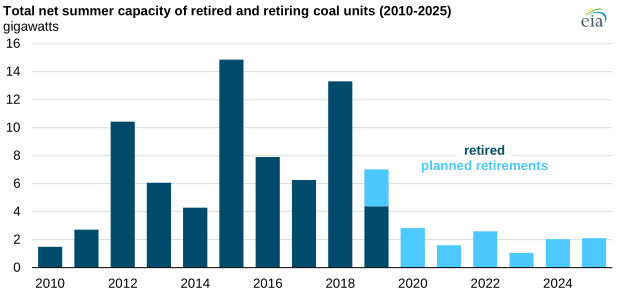
total net summer capacity of retired coal units


Between 2010 and the first quarter of 2019, U.S. power companies announced the retirement of more than 546 coal-fired power units, totaling about 102 gigawatts (GW) of generating capacity. Plant owners intend to retire another 17 GW of coal-fired capacity by 2025, according to the U.S. Energy Information Administration’s (EIA) Preliminary Monthly Electric Generator Inventory. After a coal unit retires, the power plant site goes through a complex, multi-year process that includes decommissioning, remediation, and redevelopment.

Coal-fired power plants in the United States remain under significant economic pressure. Many plant owners have retired their coal-fired units because of relatively flat electricity demand growth and increased competition from natural gas and renewables. In 2018, plant owners retired more than 13 GW of coal-fired generation capacity, which is the second-highest annual total for U.S. coal retirements in EIA’s dataset; the highest total for coal retirements, at 15 GW, occurred in 2015.

The annual number of retired U.S. coal units has declined since 2015, and the configuration of retired coal capacity has changed. Coal-fired units that retired after 2015 in the United States have generally been larger and younger than the units that retired before 2015. The U.S. coal units that retired in 2018 had an average capacity of 350 megawatts (MW) and an average age of 46 years, compared with an average capacity of 129 MW and average age of 56 years for the coal units that retired in 2015.


Rail shipments show coal’s decline 

Coal shipments by rail last week were down 8%.
Coal shipments by rail last week were down 8.5%.


California and major automakers reach groundbreaking framework agreement on clean emission standards

-July 25,2019-

SACRAMENTO – As the Trump administration prepares to roll back emission standards for light-duty cars and trucks, a consortium of automakers and California have agreed on a voluntary framework to reduce emissions that can serve as an alternative path forward for clean vehicle standards nationwide. Automakers who agreed to the framework are Ford, Honda, BMW of North America and Volkswagen Group of America.

Screen Shot 2019-07-25 at 11.52.35 AMThe framework supports continued annual reductions of vehicle greenhouse gas emissions through the 2026 model year, encourages innovation to accelerate the transition to electric vehicles, and provides industry the certainty needed to make investments and create jobs. This important commitment means that the auto companies party to the voluntary agreement will only sell cars in the United States that meet these standards.

“Few issues are more pressing than climate change, a global threat that endangers our lives and livelihoods. California, a coalition of states, and these automakers are leading the way on smart policies that make the air cleaner and safer for us all,” said Governor Gavin Newsom. “I now call on the rest of the auto industry to join us, and for the Trump administration to adopt this pragmatic compromise instead of pursuing its regressive rule change. It’s the right thing for our economy, our people and our planet.”

Under the framework, gasoline and diesel cars and light trucks will get cleaner through 2026 at about the same rate as the current program. It also supports a national program that will result in at least 30 percent more greenhouse gas emission reductions compared to splitting up the standards between those followed by California and 13 other states and the less stringent standards proposed by the Trump administration.

“This agreement represents a feasible and acceptable path to accomplishing the goals of California and the automobile industry,” said California Air Resources Board Chair Mary D. Nichols. “If the White House does not agree, we will move forward with our current standards but work with individual carmakers to implement these principles. At the same time, if the current federal vehicle standards proposal is finalized, we will continue to enforce our regulations and pursue legal challenges to the federal rule.”

The announcement comes as the Trump administration is preparing to roll back federal vehicle emission standards, effectively freezing them at the 2020 level through the 2026 model year. This move threatens air quality and health for millions of Americans, would increase costs to consumers, and promises to further set back U.S. efforts to combat climate change.

The rollback has faced growing opposition from a broad array of governors and mayors, auto companies, labor, consumer groups, public health organizations, and environmental groups. Earlier this month, a bipartisan coalition of 24 governors representing more than half the U.S. population came together in calling for a stronger, national clean car standard.

In a letter last month, 17 worldwide automakers appealed to the White House and California to work together on a single national standard, warning of uncertainty for the auto market and noting that auto industry jobs are at stake. Now four of these companies have agreed to a framework that includes annual emission reductions and would speed the transition to electric vehicles.

California urges the Trump administration to reflect the principles in the framework in the vehicle emissions rule it is finalizing. If that does not occur, discussions on the approach laid out in the framework will move ahead.

The terms of the framework will deliver the same greenhouse gas reductions in five years as the original Obama standards would have achieved in four. This provides a path forward that allows California and other states to meet their climate and clean air goals, and maintains a national approach for participating automakers who will sell these cleaner cars nationwide. The framework also supports the long-term electrification goals of California and the carmakers.

The terms of the framework also make it clear that California must maintain its authority under the Clean Air Act to establish emissions rules because of its unique air quality, public health and climate challenges. “California’s authority to set tough vehicle emission standards has been good for California and the country,” said Governor Newsom. “This agreement affirms the fact that retaining that authority is a crucial element in our ability to make progress with cleaner cars.”

The Framework

The framework agreed to by the automobile companies and California benefits the country by achieving continuous annual reductions in greenhouse gas emissions and criteria pollutants while saving consumers money. Its terms include the following:

•Extend the current 2025 model year standard until 2026 and smooth out the interim years from 2022 through 2025 to provide additional lead time and slightly less aggressive year-over-year reductions. (That is, changing the original year-over-year 4.7 percent GHG reduction over four years to 3.7 percent over five years.)

•Support the transition to electric vehicles by rewarding companies that sell more EVs with additional credits to meet the GHG standard for their entire fleet, while ensuring that gas and diesel vehicles also get progressively cleaner over time.

•Provide an incentive to car companies to install more GHG-reducing technologies (such as making the car more aerodynamic at highway speeds or improving the vehicle’s internal temperature control) by modestly revising limitations on their usage, and streamlining agency review and approval for new technologies.

•Simplify compliance by removing the requirement to consider upstream GHG emissions associated with the production of the electricity used by electric vehicles when calculating the GHG emissions for a car maker’s fleet.

•Participating companies are choosing to pursue a voluntary agreement in which California accepts these terms as compliance with its program, given its authority, rather than challenge California’s GHG and ZEV programs.

Vehicle Pollution and California

Vehicle emissions in California are responsible for nearly 40 percent of GHGs and more than 40 percent of smog-forming emissions. The stakes are high for the health of Californians, and the agreement on principles announced today will still allow the state to improve conditions that threaten public health. Those conditions include:

•32 million Californians breathe ozone or particle polluted air at some point each year.

•10 million Californians currently live in the only two “severe non-attainment” areas in the U.S. for ozone. They face higher risk of severe heart and breathing problems.

•A steadily warming climate, which drives drought and more intense wildfires and increases polluted air and the associated health risks.

California has fought hard for its air quality improvements over the past 50 years. In the Los Angeles area, 8-hour ozone levels have fallen 45 percent since 1990. But California still must achieve an 80 percent reduction in smog in the Los Angeles region and about a 50 percent reduction of smog in the San Joaquin Valley to achieve its health based goals, and federal air quality requirements.

Fresno/Kings & Tulare solar farms will supply community-based power providers ….. and more are coming

-July 1,2019-


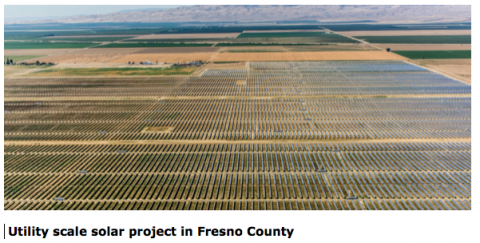
Screen Shot 2019-07-01 at 12.45.29 PMMore renewable power will be flowing to community-based power providers across the state from new solar and wind farms heading to construction in the San Joaquin Valley. These are typically new customers for Valley solar and wind developers who  in the past had to depend on power purchases from reluctant utility companies.

Just announced- the East Bay Community Energy (EBCE) board of directors has approved two power purchase agreements for a combined 157.5 megawatts from new wind and solar facilities, along with 30 megawatts of battery energy storage.

EBCE, a Community Choice energy Aggregation program serving most of Alameda County, approved the following contracts: a 20-year agreement to purchase 57.5 megawatts of wind from the Altamont Winds project in Alameda County and a 20-year agreement to purchase 100 megawatts of solar and 30 megawatts of energy storage from the Sonrisa Solar Park in Fresno County. In addition they have announced a preliminary deal to buy 56MW of solar energy from a proposed project in Tulare County called Luciana Solar.

Proposed new Central Valley utility-sale solar projects are more frequently selling their power to nearby Community Choice energy Aggregators vs power sales to traditional utilities like SCE or PG&E.There are now 19 not-for-profit Community Choice Aggregation (CCA) programs operating in California and the market is growing as more communities are deciding to adopt this form of electricity distribution. Hanford for example, is considering becoming a a CCA.

In this case, Alameda-based EBCE is a not-for-profit public agency that operates a Community Choice Energy program for Alameda County and eleven incorporated cities, serving more than 550,000 residential and commercial customers throughout the county.

Another example of the trend, just last year Japanese-owned Solar Frontier Americas was the winning bidder in two processes  acquiring a not-yet-built 56 megawatt project in Tulare County called Luciana and the proposed 210 MW Mustang Two solar project in Kings County from Canadian Solar’s development business Recurrent Energy. The deal was announced in December.

Located on 1,400 acres in Kings County, California, the Mustang Two project is expected to be operational in 2020. The project will then be operated by Solar Frontier Americas’ growing independent power producer business. Once this project is operational, the energy generated by the solar power facility will be split between two long-term power purchase agreements: Peninsula Clean Energy (the community choice energy agency which serves San Mateo County) is contracted to receive 100 MWac, and the Modesto Irrigation District will acquire 50 MWac. The combined energy generation will power 37,500 homes with clean electricity.

These CCAs, and other non-profit community-based energy providers including the East Bay group EBCE are eager for renewable energy their customers want as California moves to 100% renewables by 2045.

Wind Farm to replace 569 older turbines with 23 modern turbines

The Alameda group also looks to phase out fossil fuel power plants and older renewable technology.The Summit Wind Project located in  Altamont Pass near Livermore is located within EBCE’s territory and reflects the community choice provider’s commitment to invest in local, clean energy resources and deliver local benefits they say. The project will entail repowering (replacing) a former Altamont Pass wind farm which consisted of older less efficient wind turbines with ones that are state-of-the-art.San Diego-based Salk LLC will build the new wind farm and sell the energy to the East Bay customers. The 55-MW wind farm is just 35 miles outside Oakland.

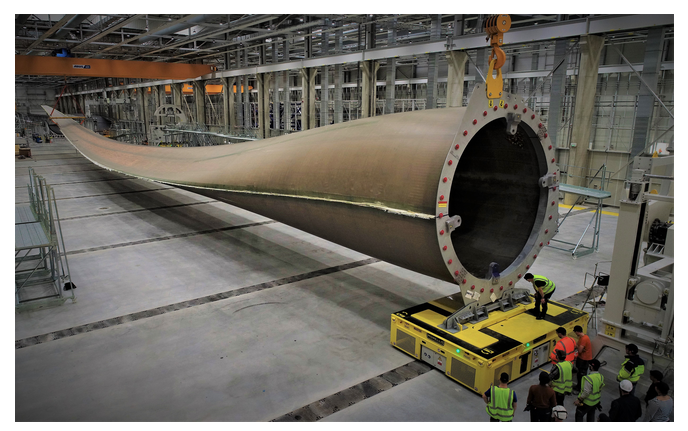
largest wind turbine under construction

Completion and operation of the Summit Wind Project is planned for late 2020. The repowering project will replace 569 one-hundred-kilowatt turbines with 23 modern turbines. Once completed, the repowered wind farm will generate more than 60 percent of its power for Alameda County during peak hours, including the afternoon and high-demand summer months, producing enough clean energy on average to power about 30,000 homes per year

“More and more, communities want to aggressively address climate change and reducing the use of fossil fuels in our power mix is a big part of that. EBCE is adding new renewable energy generation capacity to the grid that will, in time, serve to phase out our reliance on fossil fuel while also stabilizing our energy costs,” said County Supervisor and EBCE Board Chair, Scott Haggerty.

Renewable energy will also replace fossil fuel now in the heart of Oakland. On June 5th the EBC board approved a contract with Vistra Energy to receive resource adequacy capacity from a 20 MW battery energy storage project that is currently planned to be built as a  partial replacement for an aging, fossil fuel-fired power plant located in the heart of Oakland.

A boom in Valley-based projects

Spokesperson for the Alameda group Annie Henderson says demand for renewable power”is just exploding much faster than state mandates” require because of the proliferation of community-based power providers from LA to the Bay Area  “It is happening much faster than before” she says, noting her Alameda group will be announcing more power purchases from other new San Joaquin Valley solar projects in July.

The Alameda board also gave a green light to a 56MW solar PPA with Solar Frontier Americas for Luciana Solar to be located in Tulare County.The project will be built in southern Tulare County located near Richgrove along Highway 65 says county planner Mike Washam, new to an already operational 20MW solar farm.

Next door in Fresno County the Sonrisa Solar Park project will produce 100MW of solar energy and 30MW of energy storage for  a partnership of Spanish and Portuguese-based utilities who are busy doing renewables in the US.

The Sonrisa Solar Park project now owned by EDPR will be located near Tranquility in Fresno County. Construction on the Sonrisa Project will begin in December 2021 and be operational in 2022. It will be EDPR’s first large scale renewable project with storage.

EDPR is already one of the world’s largest wind energy producers and also wants to develop wind energy off the California coast.The company’s footprint in the state includes three phases of the Rising Tree Wind Farm in Kern County as well as two phases of the Lone Valley Solar Park in San Bernardino County.  These projects produce enough clean electricity to annually power more than 101,000 average California homes.

The combination of solar with energy storage system was designed to increase efficiency and provide greater balance in energy supply, says the company.

more on the way

Spokesperson for the Alameda group Annie Henderson says demand for renewable power”is just exploding much faster than state mandates” require because of the proliferation of community based power providers from LA to the Bay Area  “It is happening much faster than before” she says, noting her Alameda group will be announcing more power purchases from other new San Joaquin Valley solar projects in July.