
-May 11,2019-
From Milk Producers Council
Innovation in feed mixing leads to cleaner air, lower costs and better feed
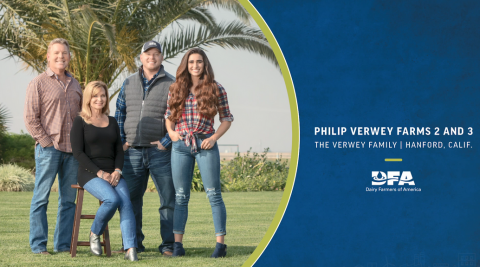 Driving home one afternoon, dairy farmer Philip Verwey started thinking about changes he could make to improve air quality. His on-road brainstorm led to changes that cut the dairy’s tractor-related emissions substantially, the equivalent of taking 7,800 passenger cars off the road.
“I thought maybe I could convert my diesel-powered feed-mixing operation to electric,” said Verwey, who milks 9,000 cows in Hanford, California. “I was aware of a pilot program at the air district that provided incentive funding for reducing emissions. We did the research, calculated the reductions and applied for the program.”
Philip Verwey Farms’ diesel-to-electric conversion was one of 56 funding applications – and the only dairy related project – to the San Joaquin Valley Air Pollution
Control District’s Technology Advancement Program. His idea:
Rather than blending feed ingredients for his cows in a mixing
The electric feed mixer is powered by electricity generated on the dairy from a manure digester. In addition to producing enough energy to meet the dairy’s electricity needs, 3,000 additional homes can be powered.
The electric feed mixer reduces oxides of nitrogen emissions from 22 tons annually to just 2, saving 90,000 gallons of diesel.
7,800
The number of cars one would need to remove from the road for equal emissions reductions to those achieved by the Philip Verwey Farms electric feed mixer conversion.
wagon powered by a diesel tractor, he would blend using an electric stationary mixer. This change significantly reduced the amount of run time by his diesel engines, lowering diesel consumption by 71% per month.
“In addition to being good for the environment, the change provided other positive benefits,” Verwey said. “Our feeding time went from 20 hours a day to seven and the texture and composition of the feed improved, which is good for our cows.”
Verwey’s idea reduced oxides of nitrogen (NOx) emissions by 90%, providing the inspiration and model for other dairy farmers to take similar action.
“The air district saw the success of our project and the positive difference it makes in air quality,” Verwey said. “That led to an expanded program that will fund up to 75% of the cost of future conversions to electric mixers for dairy feed.”
To date, 15 California dairy farms have submitted applications to the new program and four dairies are now under contract to begin converting their feed mixers to electricity. Combined with Philip Verwey Farms, the overall emissions reduction is roughly equivalent to removing 19,300 passenger vehicles from the road.
“I’m a true believer that you have to produce what the public wants, and that includes being green,” Verwey said. “We’re also doing that in a way that makes economic sense, which benefits everyone.