Drought Cuts California Field Crop Acreage This Year

April 22,2014

California Upland Cotton Acres At Record Low
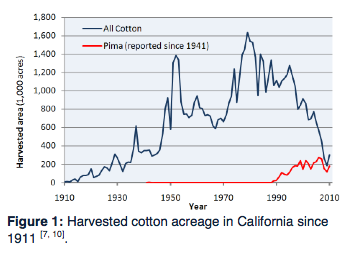
Screen Shot 2014-04-22 at 11.53.57 AMWith California farmers starring at a nasty drought a first look at field crop intentions in 2014 shows dramatically reduced acreage likely to be planted.
Hard hit this year will be upland cotton where USDA says cotton acreage is expected to be down 35% from acreage planted last year. Only 60,000 acres could be planted based on a March 1 survey. That would be a record low for upland that once saw plantings as high as 1.7 million acres in the state. For 2014 Pima type cotton may be down 28% to 135,000 acres.
Meanwhile corn acreage is likely to fall 28% to 430,000 acres in the state.Wheat acreage is down about 15%
Bucking the trend is expected hay production – slated to rise 1% this year with high prices and tight demand.
While California cotton acres are expected to be way down US cotton producers are saying they want to plant 7% more cotton.

More April Showers: That Could Mean…. May Water Allocation?

April 21,2014

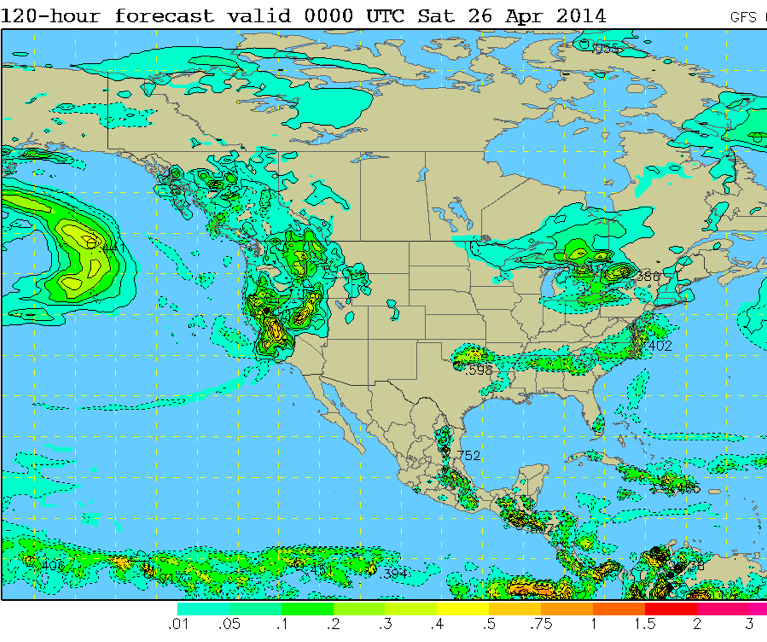
Model show rain adding up by Saturday
Model shows rain adding up by Saturday

After a dry few weeks the forecast for Redding California, next to Lake Shasta, the state’s most important  reservoir calls for rain over the next five days. The weather model GFS suggests next Friday and Saturday could see rain over much of the state,a welcome dose of perhaps one half inch in many parts and good news for Central Valley water contractors awaiting an upgrade from a zero water allocation from the big Central Valley Project.
The king pin of that project is Shasta where storage has built-up to 2.4 million acre ft this week and the promise of more.
“We think you can make the case that Shasta has enough water to supply the Valley Exchange Contractors with 75% of their annual allotment” metered out through the summer.That 75% is the trigger point that allows Friant water contractors further south to keep water stored above Friant Dam says Friant GM Ron Jacobsma.Less than that Friant has to back fill the the Exchange Contractors with some San Joaquin River water by long term agreement.
This past week the Bureau of Reclamation announced contractors north of Sacramento would get 75% allocation, up from 40%, due to the storms in March and early April.
Could the Exchange contractors around Los Banos get the same?
Jacobsma says he expects they will hear from the Bureau by the end this week.”We told them our people need to know to see if they are going to keep some trees alive or not” depending on if they they receive any irrigation water this spring and summer. Some irrigation districts have little or no groundwater.
Water engineer Dennis Keller says more storms could make a difference impacting run off.
While the Spring ski season may be over for most – Tahoe is expecting  some snow Tuesday and then again Friday with 6 to 9 inches and more than foot west of the Lake says forecaster Bryan Allegretto. NWS Hanford says the Central Sierra could get some snow  both days as well. Another system could follow or stay north and early May may could offer some rain as well.
Rain is expected Friday as far south as San Luis Obispo.
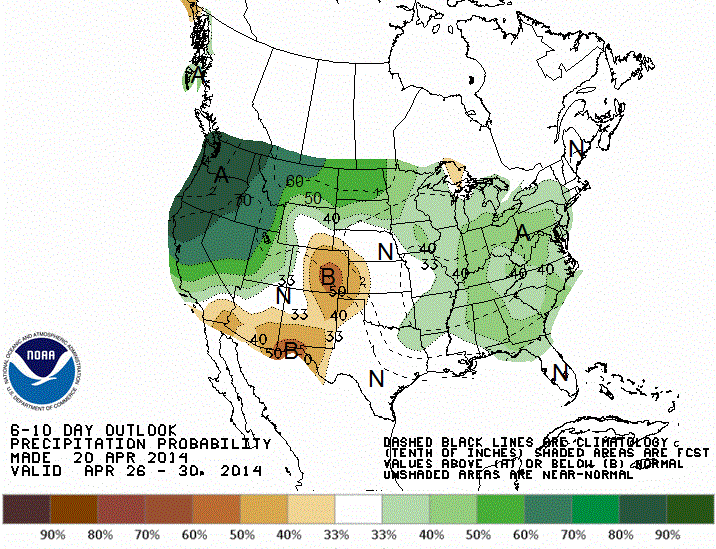
NOAA’s 6 to 10 day forecast, shown here, is promising.

Screen Shot 2014-04-21 at 9.15.46 AM


5 Percent Allocation to State Water Project Users


April 19.2014

Late Storms Allow 5 Percent Allocation to State Water Project Users

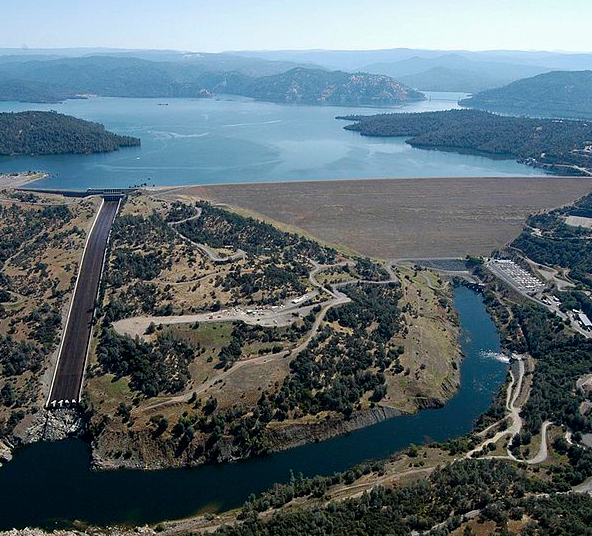
Oroville dam
Orville dam

SACRAMENTO – Rain and snow from February and March storms have allowed the Department of Water Resources (DWR) to increase water contract allocations for State Water Project (SWP) deliveries from zero to five percent. Precipitation from these recent storms also eliminates the current need for rock barriers to be constructed in the Delta to prevent saltwater intrusion. Additional flexibility in salinity control requirements is being sought as an alternative to the Delta rock barriers that is less harmful for fish, wildlife, and other Delta water users. The Department of Fish and Wildlife (DFW) announced that it will fast-track actions to manage and reduce the drought’s impact on fish.

Federal water contractors like Friant and Westlands are awaiting a  federal Bureau of Reclamation decision if they can receive an allocation as well. That news could come late next week.

“During February and March, state and federal water agencies worked together to capture storm runoff and increase our water supplies. As a result, the late spring storms have translated into much needed water supplies for communities, farmers and environmental habitat,” said DWR Director Mark Cowin. “As this drought continues, we need all Californians to remain vigilant and use every drop of water wisely.”

The most up-to-date runoff and snow pack data show that February and March storms have increased reservoir storage modestly. While this storm runoff is not nearly enough to take California out of the current extreme drought, this minimal increase in water supply will allow the SWP and the federal Central Valley Project (CVP) to limit saltwater intrusion into the inner Delta without immediately installing rock barriers in Delta channels, which have adverse impacts on fish and wildlife and worsen water quality for some agricultural users in the Delta. DWR will closely monitor key water quality and storage capacity data to determine whether barriers are needed later in the year to protect the quality of vital water supplies for Contra Costa, Alameda, and Santa Clara counties, as well as other water users who rely on drinking water supplies from the Delta. DWR is requesting the State Water Resources Control Board (State Water Board) to relocate a salinity control point from the Emmaton location slightly up the Delta to Three Mile Slough. This change would continue to ensure adequate salinity controls within the Delta and enables more flexible use of reservoir supplies for

purposes other than outflow to the Pacific Ocean.

“Thanks to early, bold action by the state and federal water agencies and recent water conservation by residents across the state, we are able to increase water allocations and avoid installing rock barriers at this time in the Delta,” said California Natural Resources Secretary John Laird. “Reducing the impact to iconic fish species that rely on the Delta continues to be central to our management efforts. Every Californian can help during this drought by doing their part to reduce their water usage in their homes and businesses”.”

The recently released Drought Operations Plan calls for DWR to reassess the need for barriers in the fall and early winter, if dry conditions persist. DWR will continue to closely monitor water quality and storage capacity data in case barriers are needed later in the year to protect vital water supplies.

Measures to protect various species of salmon, trout, smelt, and other fish that breed in or travel through the Sacramento and San Joaquin rivers and the Delta will continue be vital part of managing water during the drought. Robust and real-time monitoring systems to track the impact of the drought and related water management decisions is particularly important.

“Drought causes real and lasting impacts on California’s fish and wildlife. Important steps can be taken now to help,” said Chuck Bonham, Director of the California Department of Fish and Wildlife. “For example, we will move immediately to more closely monitor evolving drought impacts on protected fish. After fast tracking this additional monitoring, habitat and fish passage projects in the Upper Sacramento River system for the benefit of winter run, spring run, and fall run Chinook can be pursued later in the year.”

Allocations

As the current drought persisted into its third year, on January 31, DWR announced its first zero water allocation (water delivery estimate) ever for all State Water Project contractors. The SWP supplies water to 29 public agencies serving more than 25 million Californians and irrigates nearly a million acres of irrigated farmland.

Collectively, the 29 SWP “contractors” requested just over 4 million acre-feet of water to be delivered this calendar year. The increase to a five percent allocation will make a little more than 200,000 acre- feet available. An acre-foot is enough water to supply a family of four for approximately a year.

The only previous zero allocation in the 54-year history of the SWP was for agriculture in 1991, but cities and others that year received 30 percent of requested amounts. Allocations are no longer made separately for agriculture.

At this year’s “zero” allocation, only “carryover” water stored by local agencies, water transferred from willing sellers to buyers and supplies for drinking, sanitation and fire protection were guaranteed to be delivered.

Although nearly all areas served by the SWP also use other sources of water such as groundwater and water stored locally, a zero percent allocation translated to major harm to agricultural operations in the Central Valley.

Salinity Barriers

As discussed in the Drought Operations Plan, the temporary rock barriers would have blocked Sacramento River water from branching into Sutter and Steamboat sloughs near Courtland and prevented San Joaquin River water from flowing into False River near Oakley. The Sutter and

Steamboat barriers would have kept more fresh water in the main channel of the Sacramento River to more forcefully repel salt water coming from the San Francisco Bay, while the False River barrier would have controlled tidal salinity in the central Delta.

However, these barriers would have also worsened water quality conditions for some agricultural water users in the northern Delta, adversely affecting Delta fisheries and impacting boating and recreation in the Delta. DWR has concluded that it can avoid these impacts with the captured runoff from recent storms, at least in the short term, while reducing the amount of water needed from upstream reservoirs to control salinity in the Delta.

During the drought of 1976-77, Delta barriers were constructed that allowed operators to preserve water in reservoirs they otherwise would have had to release to maintain salinity standards in Delta channels. Instead of installing barriers this year, DWR will seek a modification of the State Water Board’s western Delta salinity requirements that will reduce the amount of water necessary for compliance, while maintaining adequate water quality in the interior Delta. DWR will provide the State Water Board with data to show that the requested modification will not harm municipal and agricultural users of water in the Delta.

Steps to Manage Drought Impacts on Fish and Wildlife

Working with the National Marine Fisheries Service and U.S. Fish and Wildlife Service, the California Department of Fish and Wildlife will “fast track” the development and implementation of a monitoring effort in the Sacramento River to, among other things, monitor and manage fish spawning, rearing, and stranding conditions, with a specific focus on closely watching temperature conditions and winter run Chinook.

The Department will also start immediately, in coordination with federal fish and wildlife agencies, to implement monitoring actions detailed in the Drought Operations Plan for Delta and long-fin smelt, green sturgeon, and salmon and steelhead. The Drought Operations Plan, as well as the California Water Action Plan, identified specific improvements to the biological and species’ monitoring needs in the Delta to utilize better technology for scientific monitoring such as new modeling, modern tracking systems, and improved marking of fish. This work will be done in collaboration with the U.S. Bureau of Reclamation and California Department of Water Resources, and will build on ongoing collaborative efforts with conservation organizations, scientific experts, and public water agencies.

Later this year, the Department plans to work with the National Marine Fisheries Service and U.S. Fish and Wildlife Service to complete restoration and fish passage projects for the benefit of several runs of salmon in the Upper Sacramento River and its tributaries.

Additional Drought Impacts, Reservoir Capacities

In addition to economic ripples caused by farmland fallowing and the loss of agricultural jobs, California is bracing for the impacts of a severe, drought-fueled wildfire season and some communities are taking emergency action to supply drinking water to homes.
Water content in the Sierra snowpack that normally provides about a third of the water for California cities and farms was at only 32 percent of its historical average in early April and with the spring melt underway now is down to 21 percent of its historical average for the date.

Even with most of the stormy season behind us, the state’s key reservoirs remain well below normal levels.

Lake Oroville in Butte County, the SWP’s principal reservoir, is at 52 percent of its 3.5 million acre-foot capacity (66 percent of its historical average for the date). Shasta Lake north of Redding, California’s

and the federal Central Valley Project’s (CVP) largest reservoir, is at 53 percent of its 4.5 million acre- foot capacity and 63 percent of its historical average for this time of year. San Luis Reservoir, a critical south-of-Delta pool for both the SWP and CVP, is at 46 percent of its 2 million acre-foot capacity (52 percent of normal for the date).

The final SWP allocation for calendar year 2013 was 35 percent of requested water amounts. In 2012, the final allocation was 65 percent. It was 80 percent in 2011, up dramatically from an initial allocation of 25 percent. The final allocation was 50 percent in 2010, 40 percent in 2009, 35 percent in 2008, and 60 percent in 2007. The last 100 percent allocation – difficult to achieve even in wet years because of Delta pumping restrictions to protect threatened and endangered fish – was in 2006.

The final allocation in 1991 is still the record low, not only for agriculture at zero but for others at 30 percent of requested amounts.

Governor Brown has called on all Californians to reduce their water use by 20 percent – visit SaveOurH2O.org for ideas about how to conserve, and visit Drought.CA.Gov to learn more about how California is dealing with the effects of the drought.

– 30 –

The Department of Water Resources operates and maintains the State Water Project, provides dam safety and flood control and inspection services, assists local water districts in water management and water conservation planning, and plans for future statewide water needs.

As Citrus Trees Bloom, ‘Dismal’ Water Year Looms

from CFB
By Kate Campbell

Screen Shot 2014-04-10 at 8.45.12 AM

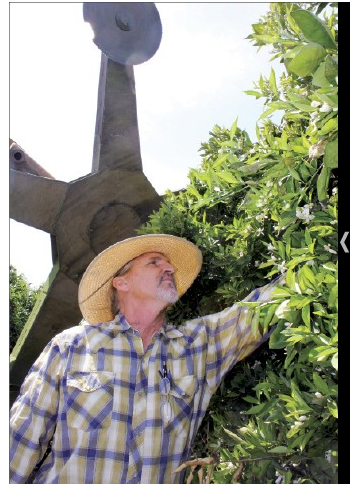
Tulare County citrus farmer Larry Peltzer prepares to top navel orange trees as a strong spring bloom subsides. He says topping trees makes management and harvest easier and safer, as well as reducing trees’ water needs.
Photo/Cecilia Parsons

April 10,2014
Blooms are popping open in California citrus groves, putting on a show with one of the strongest flowerings in recent memory. But farmers caution the early showing doesn’t necessarily translate into a large crop at harvest. Many variables come into play—and growers say an adequate water supply is their biggest concern right now.
“This year there’s a heavier bloom around the entire circumference of the trees,” said citrus farmer Larry Peltzer of Ivanhoe. “We call it a ‘popcorn bloom’ because flowers are popping out everywhere, engulfing the entire tree.”
Like many California farmers, Peltzer said lack of water is his biggest worry. His operation buys surface irrigation water from the U.S. Bureau of Reclamation Friant Division through the Ivanhoe Irrigation District. The district received a zero water allocation from the bureau, but will provide farmers with 0.18 acre-feet per acre from the Kaweah River, at a cost of $400 an acre-foot.
“That’s not enough to make a difference and we’re not counting on getting any more water,” Peltzer said, adding that it takes 3.2 acre-feet a year to sustain an acre of citrus trees. “We have wells, but some of them are weak and the water levels are dropping. We’ve been told we’ll have a 90-day run of water from the Kaweah River, but if it gets hot this summer, it won’t help us much.”
To prepare, Peltzer is now harvesting as much of his valencia orange crop as possible, to take the load off the trees.
“Everybody in our area is facing the same situation,” he said, referring to the 10,000 acres of citrus crops within the district. “It’s dismal.”
Peltzer said he’s using moisture sensor probes and monitoring irrigation schedules very carefully.
“Our trees are in great health, so if we can get through this summer, we can bring the 2014-15 crop to fruition,” he said. “That’s our goal.”
Citrus has been grown in the San Joaquin Valley for more than 100 years and production for the 250,000 acres of citrus trees statewide is valued at more than $2 billion a year.
This year’s drought comes on top of a freeze in early December 2013, when seven consecutive nights of subfreezing temperatures hit San Joaquin Valley citrus trees. California Citrus Mutual estimates valley citrus growers collectively spent $49 million to protect the 2013-14 crop, with Kern County citrus suffering the greatest amount of freeze damage. In addition, the organization said, the navel orange harvest will likely end in mid-May—more than a month earlier than usual—because of freeze damage.
The cold December weather may also have affected the spring citrus bloom.
“This year’s bloom is strong and early,” said citrus grower Rod Radke of Sanger. “I’m attributing some of that to the chilling hours we got during the freeze. While causing some serious damage, the extreme cold probably had the effect of resetting the trees.”
Radke said citrus growing conditions have been “ideal” so far this spring.
“I’m not a proponent of drought, but dry conditions mean we’ve been able to control things in the groves a little better, and we’re ahead on our pruning and trimming work,” he said.
“If we set 6 percent of the blossoms on the trees this year, it would be a huge crop,” Radke said. “But remember, these trees are very sensitive to fluctuations in the environment and a number of things can cause the tree to drop the fruit.”
The precise application of water to citrus trees is a moving target, he said, adding “we monitor all the time to stay within ranges related to temperatures, humidity and evapotranspiration to determine how much water to apply and when. It’s an area where science and art overlap.”
Radke said the trees are going into the spring with a robust look, but said he worries about the outlook for water.
Noting the strength of this spring’s bloom, California Citrus Mutual President Joel Nelsen said the sticking point is whether growers will have sufficient water to allow the immature fruit buds to stay on the trees.
“The existing zero water allocation for the east side of the San Joaquin Valley has the potential to put about 50,000 acres of citrus out of production,” Nelsen said. “That means navels, mandarins and lemons.”
After petal fall, he said, growers irrigate to ensure the immature fruit buds affix to the trees. A lot of the need for irrigation water depends on temperature: Hot and cold spikes can cause early fruit losses.
“A lot of factors come into play when you’re trying to produce a crop,” Tulare County citrus grower Keith Watkins said. “Ask me how things are going the first of November and I’ll be more confident about my answer.
“If we end up with an inadequate water supply—and the bigger the fruit, the bigger the demand on the trees—then some growers are talking about a late pruning to take crop off,” Watkins said, adding, “It’s going to be challenging to make it through with nothing but well water, and not all farmers have access to underground supplies.”
In Tulare County, the state’s largest citrus-producing county, citrus bloom has been officially declared, meaning that Agricultural Commissioner Marilyn Kinoshita has advised all citrus growers, pest control operators and beekeepers that bee-protection measures must be observed. County inspectors check the bloom in groves to determine when protections can be safely lifted.

Cal Poly Names Plant Experts to Lead R&D at Strawberry Sustainability Research and Education Center


April 9,2014
Renowned plant pathologists Gerald Holmes and Kelly Ivors have been named to head research and development efforts at the new Strawberry Sustainability Research and Education Center at Cal Poly, San Luis Obispo.

The Strawberry Sustainability Research and Education Center, a one-of-a-kind partnership between Cal Poly’s College of Food, Agriculture & Environmental Sciences (CAFES) and the California Strawberry Commission, is rooted in the hands-on learning model that defines the university. The center will focus on applied research that incorporates both teaching and learning experiences for Cal Poly students, faculty and California strawberry farmers.

Screen Shot 2014-04-09 at 3.37.14 PM“The strawberry industry is critical to the state of California, and the new Strawberry Sustainability Research and Education Center will play a leading role in ensuring its strength now and into the future,” said Andy Thulin, interim dean of the College of Agriculture, Food & Environmental Design. “Dr. Holmes brings the perfect mix of academic and private industry experience to this job.”

Rick Tomlinson, president of the California Strawberry Commission said, “We are thrilled to be part of this unique collaboration to address challenges facing California’s strawberry farmers. We are committed to a robust program focused on innovation and applied research to help keep strawberry farming viable in California.”

Applied research and innovation across multiple disciplines, coupled with access to real-world issues will enable Cal Poly and the California Strawberry Commission to achieve their shared vision of establishing a world-class center focused on the sustainability of California strawberry farming.

“This Cal Poly project is a landmark for California farming,” said state Senator Bill Monning. “I hope that the Strawberry Sustainability Center will serve as a model for how agriculture, academia and government can work together for mutual benefit. I applaud the state’s strawberry farmers for aggressively pursuing innovative practices and new technologies intended to promote sustainability and reduce any adverse impacts on the environment.”

SLO County Sees Deadly Citrus Pest

April 1,2014

San Luis Obispo, CA — The detection of an adult Asian Citrus Psyllid in an insect trap in a residential landscape near Arroyo Grande has prompted a high density trapping delimitation survey of the immediate and adjacent area. A quarantine restricting the movement of citrus nursery stock and citrus fruit will be established by the California Department of Food and Agriculture to prevent the spread of this serious plant pest. Efforts will take place in the near future to eradicate this pest.

Screen Shot 2013-09-12 at 12.04.10 PMThe first detection of the Asian Citrus Psyllid in California occurred in San Diego County in 2008. Since then, it has been found throughout southern California. “This insect pest is of serious concern to California’s commercial citrus because it is responsible for spreading Huanglongbing, also called citrus greening disease, a plant disease that is fatal to all types of citrus trees. This includes citrus trees in countless landscapes across the county as well as local commercial citrus orchards valued at over $13 million in 2013,” according to Martin Settevendemie, Agricultural Commissioner/Sealer for San Luis Obispo County. Over the past ten years nearly 50% of the commercial citrus groves in Florida have been killed by this disease. The University of Florida estimates the disease has tallied more than 6,600 lost jobs, $1.3 billion in lost revenue to growers and $3.6 billion in lost economic activity for the state. The disease does not affect human health.

A single orange tree infected with Huanglongbing was found in a Los Angeles County backyard in 2012. To date no additional detections of the disease in California have occurred.

Staff from the San Luis Obispo County Agricultural Commissioner’s office and officials from the California Department of Food and Agriculture continue to search for this pest by monitoring hundreds of insect traps placed in urban neighborhoods and commercial orchards throughout the county.

“It is difficult to close off all potential pest pathways into the county. An engaged community of all county residents is critical in successfully excluding pests such as Asian Citrus Psyllid,” said Settevendemie. Community members can do the following to protect backyard citrus trees and the local citrus industry:

  •   Buy Local! Purchase citrus trees from reputable local sources selling plants that have been routinely inspected by the Agricultural Commissioner’s staff.
  •   Do not transport citrus plants or plant parts into the county from quarantine areas. Call 805- 781-5910 for information about quarantine areas.
  •   Check residential landscaping often for signs of unusual symptoms or strange insects. Contact the local University of California Cooperative Extension’s Master Gardener Program at 805-781-5939 for help in identification of unusual plant symptoms or pests.
  •   If asked, allow the Agricultural Commissioner’s staff to place an insect trap in your yard and cooperate with officials if it becomes necessary to exclude or eliminate Asian Citrus Psyllid from San Luis Obispo County. For more information about the Asian Citrus Psyllid visit the California Department of Food and Agriculture website at http://www.cdfa.ca.gov or the San Luis Obispo County Agricultural Commissioner/Sealer’s website at: http://www.slocounty.ca.gov/agcomm/Pest_Prevention.htm.

Drilling Deeper

from ANR News Blog

Jeannette E. Warnert


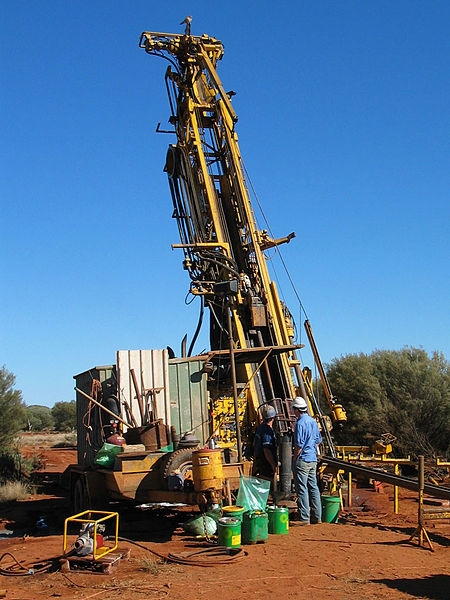
In light of severely reduced surface water deliveries this year due to the California drought, more San Joaquin Valley farmers are digging new wells or deepening current wells to tap more groundwater, reported Lisa M. Krieger in the San Jose Mercury News.But mining water that has been underground for thousands of years has many deeply worried.

“It’s our savings account, and we’re draining it,” said Phil Isenberg of the Public Policy Institute of California, a former Sacramento mayor and assemblyman. “At some point, there will be none left.”

Pumping groundwater is unregulated in California. Even Kansas and Texas prevent unlimited pumping, but most  California farmers and developers consider well-drilling a private property right, Krieger wrote. They blame environmental laws, such as the protection of endangered fish and the government’s unreliable water shipments, for their desperate situation. To reduce groundwater use, they say, more dams are needed to store water to help them get through dry years.

However, the article said, an increasing number of farmers concede that local, regional or state pressure might be the only way to preserve groundwater.

“Groundwater has always been a resource to fall back on when things are tight. But that’s not what is going on now,” said David Doll, UC Cooperative Extension advisor in Merced County. “Operations have become more reliant on it.”

One of the reasons farmers have become so dependent on groundwater is a move away from annual crops growing on land that can be fallowed in dry years, to permanent crops like almonds that need water year-round every year. For farmers, the nut crops are more profitable.

The profit from a single acre of almonds can deliver $3,510 a year, Doll said. From 2000 to 2010, the price per pound jumped from 97 cents to $1.67, and the number of acres planted in almonds increases by 20,000 to 30,000 acres every year, according to the Almond Board of California.


The California Drought Is Helping Return The Weather Pattern To Normal

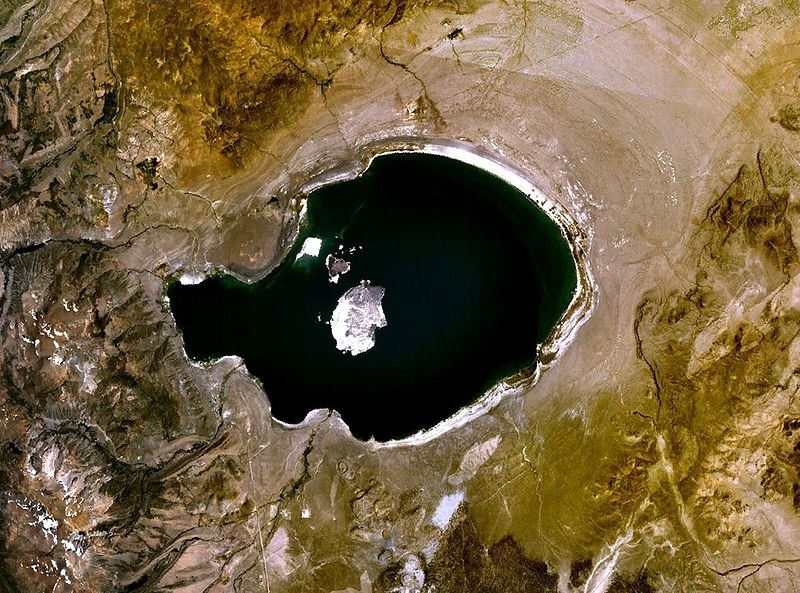
By studying the changing water level of Mono Lake, paleoclimatologists have learned California suffered a long dry spell from 1,800 to 600 years ago. (Photo: Wikimedia Commons)


March 31,2014

Scientists studying long-ago California climate have realized that the 20th century was abnormally wet and rainy, according to researcher Lynn Ingram, professor in the Department of Earth and Planetary Science at UC Berkeley.

“The past 150 years have been wetter than the past 2,000 years,” Ingram said. “And this is when our water development, population growth and agricultural industry were established.”

Ingram made the statement in a video presentation that is part of the UC California Institute for Water Resources new online video series. The series consists of presentations featuring UC and other experts speaking on topics aimed at helping farmers and all Californians better understand and cope with drought.

Precipitation during the last three years in California has been low by standards set since records were kept, which began in the late 1800s. However, the current drought appears to be well within normal fluctuations in the state’s climate, according to research by Ingram and other paleoclimatologists. A trend of gradually increasing temperature since the 1960s has been causing earlier spring snowmelt, decreased snowpack, and is predicted to cause more extreme droughts and floods.

In her 17-minute video, Ingram noted that her colleague Scott Stine of California State University East Bay found some of the first evidence of a medieval warm period in California by studying the water level of Mono Lake. The lake expands and contracts depending on the amount of runoff from the adjoining Sierra Nevada. Stine’s research reveals a dry spell from 1,800 to 600 years ago.

Ingram studies sediment cores at locations near the San Francisco Bay, which is fed by a watershed that covers 40 percent of California.

“The salinity reflects precipitation and runoff from a very large area of California,” she said. “As fresh water comes in, it mixes with salt water. Sediment records changes in salinity over time.”

Looking at the chemistry of the sediment layers and their fossil composition, she was able to tease out a record of past floods and droughts.

“There was a significant increase in salinity during the medieval warm period,” Ingram said. “Salinity increased from 15 to 22 parts per thousand in the dry period.”

The higher salinity suggests there was less fresh water flowing into the bay.


Ingram said scientists believe the current warming trend will continue into the future.


“The drier climate will increase evaporation, so drier soils, more frequent wildfires, increased dust levels,” Ingram said. “It’s also predicted that we will have more extreme climate; as the climate warms, you’re adding more energy and more water vapor in the atmosphere. That will produce larger floods and deeper droughts.”


Detailed information about California’s climate past and future may be found in a book Ingram wrote with Frances Malamud-Roam, The West without Water: What Past Floods, Droughts, and Other Climatic Clues Tell Us About Tomorrow.


Watch her talk here:

Watching Wet Pattern Over Next Two Weeks

Screen Shot 2014-03-27 at 8.47.50 AM


Northern California In Line For 8-10 Inches

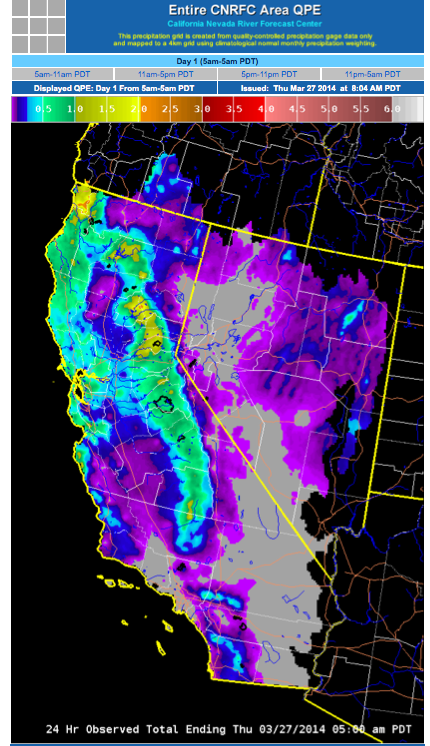
California got a sprinkle up to and over an inch of water from the storm this week, at least so far, with a promise of more over the next two weeks. Rain on the SJ Valley floor and across the Central Coast was mostly disappointing ( Fresno 0.17 and Los Osos 0.04) but several cold storms over the next few days offer some modest hope particularly for Northern California.
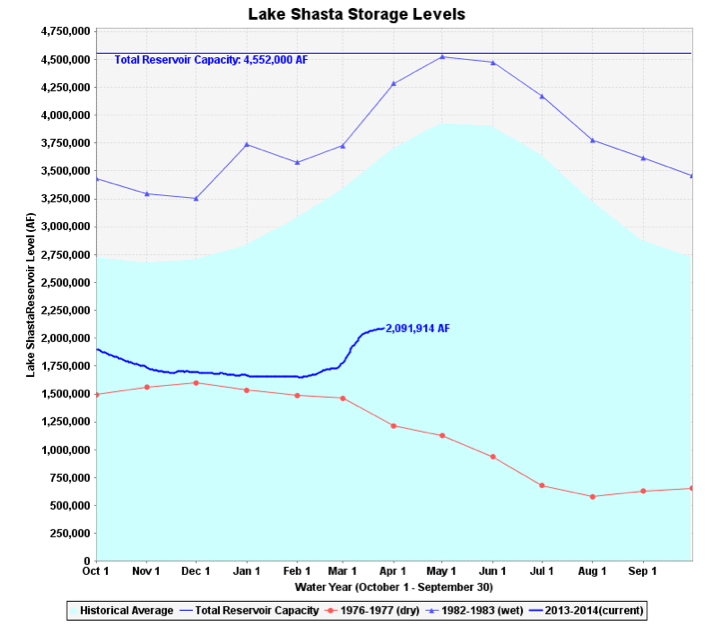
The 8 day forecast in Redding next to the state’s largest reservoir – Shasta, calls for rain over 6 of those days. Storage in Lake Shasta has been climbing this month instead of falling like it did in the 1977 drought (red line see pic). Shasta is at 58% of average for the date.

Here is what the NWS SF says today.
CALIFORNIA WILL KEEP UNSETTLED WEATHER CONDITIONS THROUGH THE WEEK. SHOWERS WILL CONTINUE  TO TAPER OFF THIS MORNING AS AN UPPER LEVEL DISTURBANCE MOVES
EAST OF THE REGION. THE NEXT STORM SYSTEM WILL BRING RAIN TO THE AREA SATURDAY. IT SHOULD BE MOSTLY DRY ON SUNDAY BUT ANOTHER STORM SYSTEM COULD AFFECT NORTHERN CALIFORNIA EARLY NEXT WEEK.

Good News For Skiers

Tahoe Snow Forecaster Bryan Allegretto blogged today the following report.

The ski resorts on the West side of the lake are reporting another 9-15 inches in the past 24 hours, and on the East side 2-7 inches.  That brings storm totals to 13-21 inches on the West side of the lake and 6-11 inches on the East side.  
Scattered snow showers should continue today and tomorrow, especially along the crest.  We should also see some breaks in the clouds with sun over the basin.  The next storm approaches tomorrow night and pushes heavy snow into the area by later Friday night into Saturday.  This storm has more moisture than the last one but snow levels will rise near 7000 ft. Friday into Friday night before coming back below lake level on Saturday.  That makes the lake level forecast tricky, but we could see several inches at lake level.  On the mountains 6-12 inches could fall on the East side of the lake with 12-24 inches possible on the West side.
Snow showers may linger again on Sunday and then another storm moves in Monday into Tuesday.  This will be a cold storm starting as snow down to lake level.  This storm could drop several more inches over the Tahoe Basin with up to a foot along the crest.  We could see a break next Wednesday before another system approaches the West Coast by Thursday.

Screen Shot 2014-03-27 at 8.54.06 AM


Looking at the Future; 8 to 10 Inches

SLO forecaster John Lindsey has some good numbers looking forward.
A 988 millibar Gulf of Alaska storm will move toward Northern
California early Saturday. The associated cold front will
pass over San Luis Obispo County Saturday evening with
increasing southerly winds, clouds and rain. Total rainfall
amounts are expected to range between 0.15 and 0.40 inches
by Saturday night.

Dry weather and mild temperatures return on Sunday, then
a vigorous low pressure system will produce moderate gale
-force to fresh gale-force (32- to 46-mph) southerly winds
and moderate to heavy rain Monday afternoon and night. Rain
showers will continue into Tuesday. Total rainfall amounts
are expected to range between 0.75 and 1.25 inches. Heavy
snow totals are expected in the Sierra on Monday with snow
levels around 3,000 feet.

Another weather system could cross the Central Coast Thursday
into Friday of next week with more rain.

Overall, over the next 10 days areas North of Sonoma County
are expected to receive between 8 to 10 inches of rain.
Further south in San Luis Obispo County, total rainfall
amounts are forecast to range between 0.75 and 2.25 inches. “

End Of Month Looks Wet

Friant Water Contractors Hold Out Hope
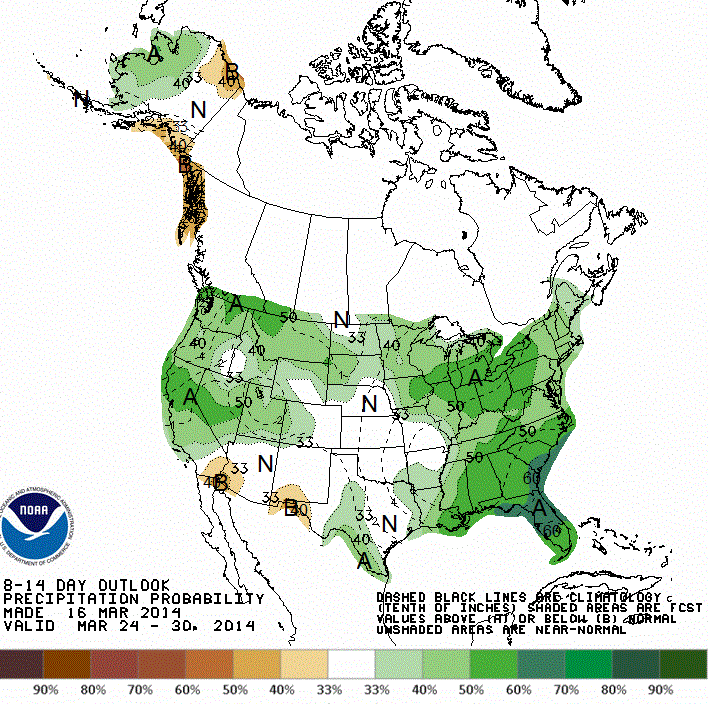
Screen Shot 2014-03-17 at 8.25.41 AMNational Weather Service has published this map showing the likelihood of wet weather in California from March 24 – 30th while other sources say it looks good for early April too.

PG&E forecaster John Lindsey confirms the opinion saying today “ The long-range models suggest a return to wet and unsettled  weather by the middle of next week. At this time, rain may develop by March 25.”

One factor – warming water temps in the Pacific are fueling expectations of an El Nino pattern.

California got a good dose of wet weather in February and early March but has been dry since. Farmers are desperate for these late storms to help bring the water-year up to some higher fraction of normal rainfall. Some farmers are in the position of receiving no surface water deliveries (zero allocation) this year.

The state says as of today California snowpack water content is 28% of normal for this date.

Friant Water Users general manager Ron Jacobsma says he holds out some small hope they can retain the water stored above Fresno ( about 200,000 acre ft ), to use in the Friant Kern Canal this year but only if the Exchange Contractors near Los Banos get water shipped south of the Delta by the Bureau of Reclamation. They are about 300,000 acre/ft short of that goal he says.

If that does not happen the Exchange Contractors will take some or all of Friant’s 200,000 acre feet since their water right precedes the construction of Fraint Dam. That could still leave Friant contractors where they are today – at a zero allocation. Friant irrigates about one million acres in Fresno,Tulare, and Kern counties, to some irrigation districts that have little or no ground water.

“We can get creative with 200,000 acre ft” says Jacobsma, with water trades to those who really need it to keep trees alive. “That’s more than we had in the 1977 drought year,” he says.

Without some relief “we may be looking as much as $1 billion in damages from the drought” he worries.

Besides more rain Jacobsma calls on all parties to allow pumping when water is available  rather than all of it go out to sea.“Achieving maximum flexibility in Delta export operations will be key in allowing the Bureau to meet Exchange Contractor substitute water supply operations, which is critical for Friant to be able to use whatever supplies may be generated in the upper San Joaquin River watershed,” Jacobsma said.
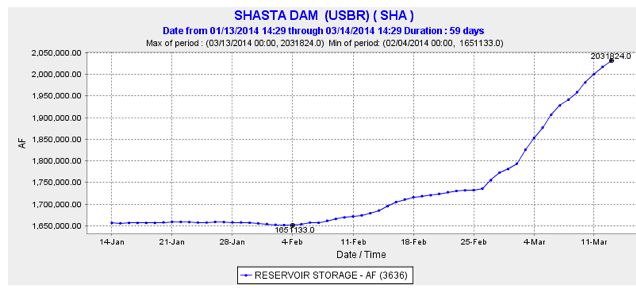
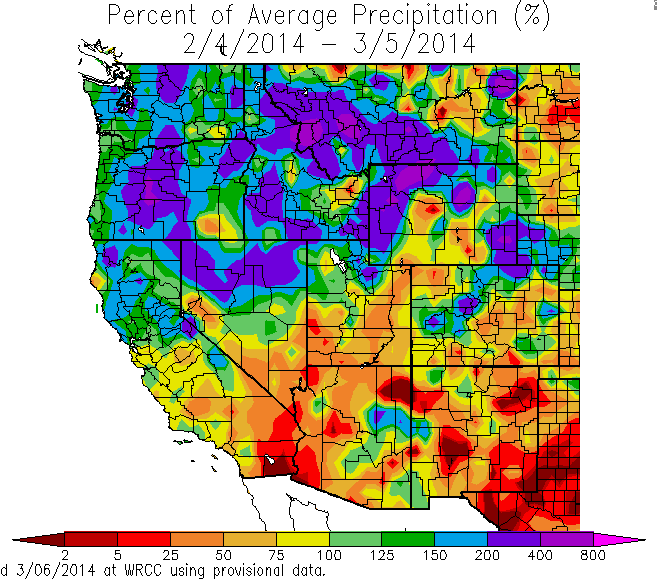
Screen Shot 2014-03-17 at 12.27.08 PMKey reservoirs to watch are Shasta where rainfall stood at 4 inches February 1 but climbed by 21 inches in 5 weeks. That reservoir has gained nearly 400,000 acre ft since. In Tahoe, February precipitation was 163% of average.
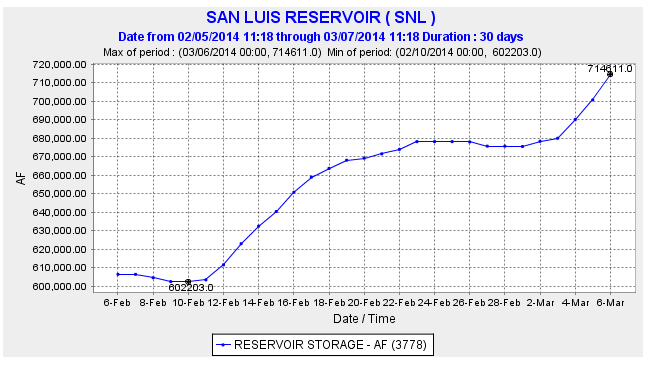
Screen Shot 2014-03-07 at 11.30.44 AM At San Luis Reservoir where water is stored after it is pumped from the Delta, the reservoir has gained nearly 200,000 acre ft since Feb 11. These are hopeful signs but these pending March and April storms could make the difference.

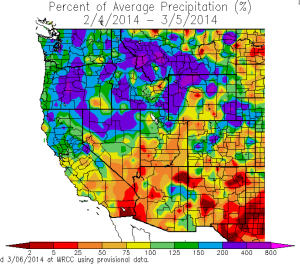
While California experiences drought – our neighbors to the north and even Arizona are looking much better now.

In Arizona,the Lake Powell reservoir, which provides water to parts of Nevada, Arizona and California, is now forecast to receive 109 percent of normal streamflow, up 15 percent from last month. When snow melts in the mountains, it flows down rivers and streams, and it will help relieve water shortages in those areas.

Northern California has seen above average rain  late in the season. Now it is the end of the season and it is do or die.
Screen Shot 2014-03-07 at 11.06.44 AM