Ag Beat: Grapes / Citrus / Cheese / GMO

Screen Shot 2014-03-14 at 2.33.50 PMCalifornia Grape Crop Climbs 7%

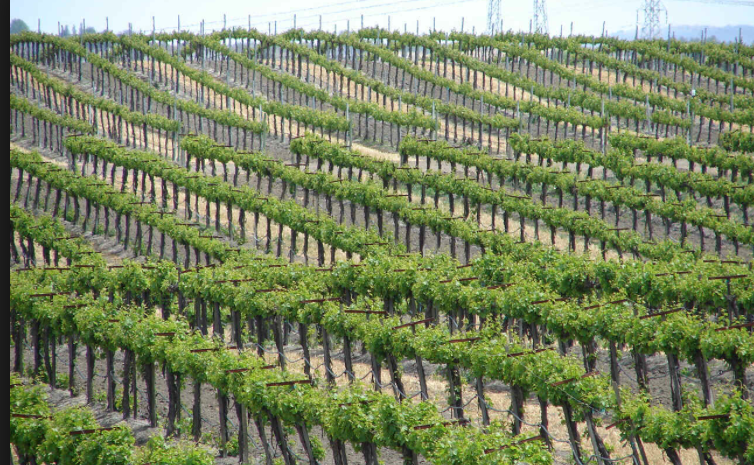
Last year’s California grape crush totaled nearly 4,7 million tons –  up 7 % from the previous 2012 high of 4.38 million tons says USDA.  Red wine varieties were more than half the volume  with tonnage climbing 5%. White grape tonnage increased 6%.

Florida Oranges Down Again

On March 11 the U.S. Department of Agriculture’s monthly forecast of the 2013-14 Florida orange crop decreased slightly to 114 million boxes. “Everybody in the industry understands fruit drop has been an issue this season with our earlier varieties,” Michael W. Sparks, executive vice president and chief executive officer of Florida Citrus Mutual, said in a press release.During the 2012-13 season, Florida produced 133.6 million boxes of oranges.

Cheese Export Record

The U.S. cheese industry deserves to take a bow for its 2013 export performance. It took only 11 months for U.S. suppliers to establish a new cheese export record. Shipments broke the 600-million-lb. mark in November on their way to an estimated 680 million pounds.America’s cheese suppliers hold the No.
1 global market share with exports triple what they were in 2007.

 Ben & Jerry’s Say No To GMO

Ben & Jerry’s, a Unilever brand, is re-launching its full line of flavors without bioengineered ingredients this year says an industry report. As of now 80% of the ice cream maker’s ingredients by volume in the United States and Canada are sourced non-G.M.O. The company said it expects to convert all of its ingredients by mid-2014. All of its products in Europe already are made without bioengineered ingredients.

Valencia Crop Unaffected By Freeze or Drought

Valencia 2014-03-10 at 3.07.50 PMA USDA estimate released this week suggests the California Valencia orange crop on the trees has been unaffected by either the drought or the freeze to date.

“Although the season has been very dry with an early December freeze in many areas, measurements are indicating that the crop has not been negatively impacted” says the report.

Not so with the current navel orange crop that is said to be down 5% according to a January estimate. A significant freeze in early December across California’s Central Valley impacted much of the citrus fruit.

The Valencia orange forecast in that same January report had been forecast at  23.0 million cartons – now a million cartons larger.

This year’s crop coming off the trees this Spring is forecast in this latest report at 24 million cartons, down one million cartons from last year. The set on trees is above the five year average but the land under production is 2000 fewer acres than the year before. More citrus growers are switching away from Valencias to newer tangerine and navel types.

The Valencia acreage has ben declining since 2000 when there were some 68,00 acres under production – now approaching half that. The diameter of the fruit this year is above average says USDA.

Often called summer oranges Valencia variety are actually available from February through October, with peak supplies in May, June and July. Valencia oranges are small to medium sized, and they may have a few seeds. They are usually thin-skinned and are popular for juice .

Northern California Saw Above Average Rainfall In February

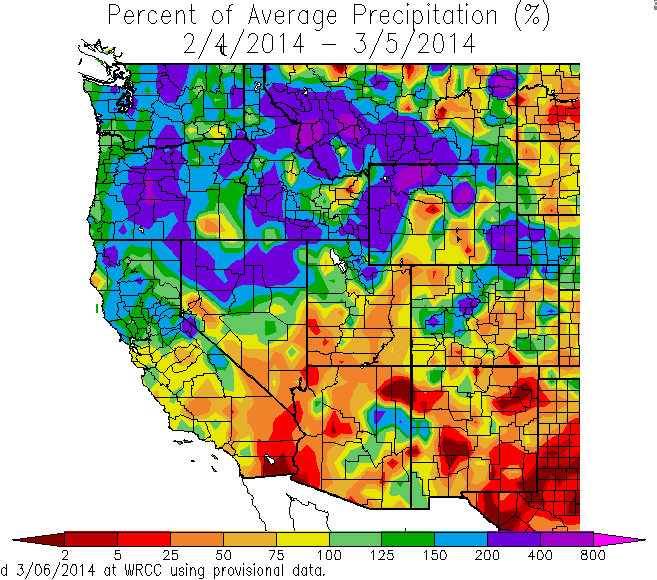
Above average rain in Northern California in the past month

Shasta Reservoir saw over 20 inches of rain in the past month compared to about 5 inches all winter through January. Tahoe ski resorts enjoyed 3 to 5ft of snow in the past week. All this is the first good news of this extraordinarily dry winter for the state as northern California experienced above average rain during February after almost none before. Even parts of the parched Central Coast got above 100% of average for the month with Santa Barbara mountains receiving up to 8 inches this past week . SB city’s Gibraltar Dam went from just 8% of normal rainfall to over 51% of normal.

It appears this is the new normal that when we get rain – we get a big gulp and we had better ready to capture it.

The culprit behind this drought appears to be a stubborn high pressure ridge notes an article in the most recent Friant Water News.

“How big is it? National Weather Service meteorologists have described the high pressure ridge as being four miles high and, at times, some 2,000 miles long, acting like a wall in bouncing Pacific storms toward Oregon, Washington, British Columbia and Alaska. That immense region has been drenched by rain and coated thickly with mountain snow while California has been mostly warm and dry.
The ridge has broken down briefly only a few times, and for very short periods, since December 2012, most recently as February came to an end. With the storm door opened, welcomed storms began spreading much-needed wetness across California February 26.
A forecaster with the National Weather Service in Monterey told the San Jose Mercury News that the high pressure ridge has been “like the Sierra – a mountain range just sitting off the West Coast – only bigger.”

But finally 10 days of storms have entered California driving up hope  the feds and the state might up water allocations promised to farms and communities that now stand as low as zero.
“We are aware of the storms” says Bureau of Reclamation spokesman Louis Moore.” We are still looking at the data and within a couple of weeks we should be making an announcement”. But” right now we’re not there yet.”

Friant GM Ron Jacobsma says if some of that water flowing down the Sacramento River to the ocean could be pumped to San Luis Reservoir, it could be used to supplement a 40% allocation to the Exchange Contractors who will take Friant’s water otherwise. That leaves farmers in Tulare County and elsewhere with no canal water this spring or summer.

But there are water quality issues that have any talk of more pumping on hold says Jacobsma. The state Water Quality Control Board will have to loosen water standards to allow water to be pumped south.
This is where the feds,state and water board appear to be trying to come up with a plan and soon. The issue is important for all water users south of the Delta.

Last week at a water hearing the dilemma was spotlighted.

“As we speak this very moment there’s 25,000 (cubic feet per second) flowing as outflow out to the ocean. At the same time, we’re pumping 4,400 cfs,” said Dan Nelson, head of the San Luis & Delta-Mendota Water Authority, at a drought meeting held at U.C. Merced yesterday, as reported by Stockton Record writer Alex Brietler.

San Luis Reservoir

“I ask you,” Nelson said, addressing State Water Resources Control Board Chair Felicia Marcus, “is this the balance that you anticipated? Is this the balance that you’re working for? I don’t think so. We knew this storm was going to happen last week. Why didn’t we prepare for it?”

Marcus responded that the state board is waiting for an emergency request from the state and federal water projects, which could alter how much water can be pumped south.

“My understanding is they’re talking about it,” she said. “We can’t do it on our own.”

But the spike in flows will probably last only another four or five days, Nelson countered. “While we set up forums to talk about it, water’s flowing to the ocean.”

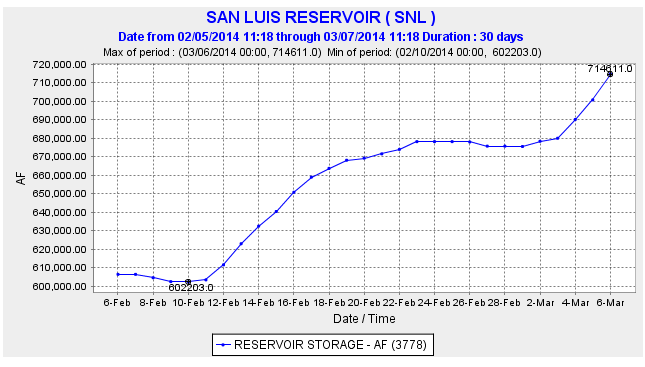
Screen Shot 2014-03-07 at 11.30.44 AMIts not clear if the message has been received but without any announcement San Luis Reservoir, south of the Delta,has gained about 25,000 acre ft in the past few days and over 100,000 acre feet in the past month.

The issue of how much water flowing through the Delta ought to be used beneficially is much debated. The 2005 ”Water Fact Book” published by the California Farm Water Coalition states that in an average year 26 million acre ft pass through the Delta with some 70%  flowing out to San Francisco Bay.

Friant Water adds the weather outlook for Fall may be better.

“There is growing hope among meteorologists that conditions may improve when the 2014-15 water year begins in October. Sea surface temperatures in the tropical Pacific are showing signs of possible development of an El Niño weather pattern beginning during the summer and continuing into the fall. In such a pattern, warmer than average sea surface temperatures often (but do not always) result in heavier than normal precipitation in much of California, a change that would be welcomed after three consecutive drought years.”

Meanwhile don’t give up on March that has started out well but now looks kind of dry until mid-month and then perhaps cold and snowy.
Also lawmakers are not letting this drought go to waste with a flurry of dam proposals in California surfacing in Washington and the likelihood of a state Water Bond on the November ballot in California.

Water Worries At Visalia Farm Conference

Screen Shot 2014-03-05 at 11.54.49 AM

Match 5, 2014

California Farm Bureau

Discussion of drought permeated the 2014 California Farm Bureau Federation Young Farmers and Ranchers Leadership Conference. The event, held in Visalia, drew record attendance of more than 200 Young Farmers and Ranchers members—farmers, ranchers and agricultural professionals ages 18 to 35.
CFBF Second Vice President Jamie Johansson, in addressing YF&R members, said he recognized the drought is on everyone’s mind.
“On the farm, there is a lot of pressure going on with the drought. The bottom line is, we just need more storage,” Johansson said. “California will have water security for our cities, for our environment and for our farms when we have water predictability. The only way for water predictability is storage.”
An olive farmer and former state YF&R chairman, Johansson told the young farmers and ranchers that it is the consumer who ultimately benefits from farm water use.
“The greatest water transfer in agriculture doesn’t happen by the State Water Project; it doesn’t happen in the delta; it doesn’t happen on the Colorado River; it doesn’t happen in Imperial County. It happens between the farmer and the consumer in the marketplace,” Johansson said.
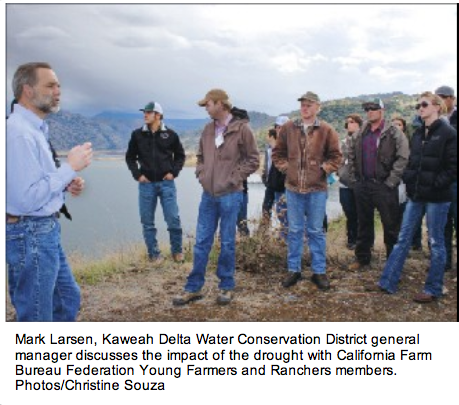
During a tour that preceded the conference, YF&R members heard Kaweah Delta Water Conservation District General Manager Mark Larsen describe the 2014 water situation as “very dismal.”
“This is all that’s come in,” Larsen said while pointing to low levels in Lake Kaweah. “It’s challenging times. Groundwater is dropping like a rock. Wells are going out of service all of the time. It’s a lot of challenges that are only going to get worse in a year like this.”
Sixth-generation rancher Levi Gill, whose family operates Gill Cattle Co., a stocker and cow/calf operation in Exeter, talked to his fellow YF&R members about how ranchers are affected by drought.
“In a drought year like this, we’re living off of the silage wagon. Many guys are turning it in, calling it quits,” Gill said. “This is our second drought year. You can withstand one (drought) year, but not two years in a row.”
More than half the water delivered to Tulare County crops comes from the federal Central Valley Project, which told farmers last month that most agricultural customers would receive no water from the project this year.
Tulare County YF&R member Matt Watkins, farm manager for Bee Sweet Citrus, a grower, packer and shipper of citrus in Fowler, said that will affect his business directly.
“Since the majority of our property is on the east side of the valley, it relies on the Friant-Kern Canal and Millerton Lake for our water supply. With a 0 percent allocation, the majority of my water districts currently have no plans to supply me any water,” Watkins said. “One water district said they were able to find us some water on the open market, at $1,200 an acre-foot. We bought enough to make sure that our trees would live.”
Watkins said some citrus growers who are faced with a shortage of water or a zero allocation are pushing out less-productive trees this year to plant other varieties such as mandarins, but other farmers do not have that ability.
On a more personal level, Watkins described how the drought impacts young farmers.
“Young farmers are the story because we haven’t really gone through this before. I’ve got a lot of supervisors who are young who I hired right out of college and they’ll come up and ask, ‘Am I going to lose my job?'” Watkins said. “Water is what we need in order for us to continue farming and continue the way of life here in the valley.”
Tulare County YF&R member Kyle Robertson, whose family operates a diversified farm near Tracy and grows processing tomatoes, walnuts, alfalfa, dried beans and wheat, said 2014 will be a difficult year regarding water.
“The upcoming year is going to be stressful once we get into the summer months,” said Robertson, who added his water supply is relatively good, compared to what some growers face. “If March is wet, we should be OK for the season, but that will put us back for the next few seasons because our water reserves aren’t very good at all.”
Engagement in the political process will be needed to improve the water system and address other local and regional issues—and the YF&R conference featured a panel discussion about seeking public office, moderated by CFBF Political Affairs Manager Casey Gudel.
Johansson, who served four years on the city council in his hometown of Oroville, said, “I’ve just always found myself involved. If you keep raising your hand, someone is going to call on you.”
“If you have no interest in politics, it doesn’t matter—because politics has an interest in you,” Johansson said.
YF&R member Mario de la Piedra of Camarillo, who announced his candidacy for state Assembly this week, noted that running for office involves raising money.
“It’s nice to see someone will write a check and say, ‘I believe in you,'” de la Piedra said.
A rancher and candidate for Tulare County Sheriff, David Whaley, told YF&R members that a candidate should run for the right reasons, such as serving one’s community.
“I urge you to become involved because it’s going to make a difference in your lifestyle and the life of your kids,” Whaley said.
For more information about YF&R in California, see www.cfbf.com/yfr or www.facebook.com/cayfr.
YF&R members earn honors during conference in Visalia
(Christine Souza is an assistant editor of Ag Alert. She may be contacted at csouza@cfbf.com.)
Permission for use is granted, however, credit must be made to the California Farm Bureau Federation when reprinting this item.

California Wine Exports Reach All-Time High in 2013

Screen Shot 2014-03-05 at 8.08.46 AMMarch 4, 2014
SAN FRANCISCO — U.S. wine exports, 90% from California, reached a record high $1.55 billion in winery revenues in 2013, up 16.4% compared to the previous year, an increase for the fourth consecutive year by value. Volume shipments reached 435.2 million liters or 48.4 million cases, up 7.5%.
“Consumers across the globe continue to recognize the quality, diversity and value of California wines, despite significant trade barriers and heavily subsidized foreign competitors,” said Wine Institute President and CEO Robert P. (Bobby) Koch. “While the U.S. remains our largest, most important market, California exports a fifth of its wine, and we are on track to reach our goal of $2 billion in exports by 2020. Our outstanding 2012 and 2013 California vintages, heralded for quality as well as quantity, were a record high so we have the ability to expand.”
Of the top export markets for California Wines, the European Union’s 28-member countries are the largest accounting for $617 million, up 31% compared to the previous year; followed by Canada, $454 million, up 12%; Japan, $102 million, down 7%; Hong Kong, $78 million, down 12%; China, $77 million, up 6%; Mexico, $22 million, up 21%; South Korea, $18 million, up 16%.
“We have an aggressive global marketing campaign underway that communicates California as an aspirational place with beautiful landscapes, iconic lifestyle, great wine and food, and as an environmental leader,” said Wine Institute Vice President International Marketing Linsey Gallagher. “Our activities in 25 countries convey these messages across the world through a full slate of activities including our global social media campaign and consumer website, www.discovercaliforniawines.com, which has been translated into Chinese and will soon be launched in seven other languages. Our programming in China has greatly expanded and allowed us to continue to show gains in that top priority market when our key competitors saw losses last year.”
“Wine Institute partners with the U.S. government to lower tariffs and eliminate unnecessary technical barriers in our key export markets. In particular, the Asia-Pacific Economic Cooperation ‘Wine Regulators Forum’ helps developing countries to implement science-based regulations and eliminate burdensome and duplicative regulations. This five-year project will help significantly reduce the costs of cross-border wine trade, stimulate demand and increase U.S. exports to this important region,” said Tom LaFaille, Wine Institute Vice President and International Trade Counsel.
Five of Wine Institute’s 15 Regional Trade Directors reported on key markets as follows:
Canada
”California wine sales continued to outpace the overall wine market in Canada last year with strong sales in all regions of the country,” according to Rick Slomka, Wine Institute Trade Director for Canada. “Much of the growth is a result of major retail promotions in the three largest provincial markets — Quebec, Ontario and British Columbia as well as booming retail sales in Alberta. A strong Canadian dollar during 2013 enabled California vintners to invest significantly in marketing programs during the year as well as making California wines very price competitive compared to other imports. California wines are popular with both new and sophisticated wine consumers and across a wide range of price segments.”
Continental Europe
”The renewed interest in California wines in Europe continued in 2013. A quarter of all California exports went to the European continent in 2013, up strongly from the 20% share in 2012. With very few exceptions, most markets posted solid gains,” said Paul Molleman, Wine Institute Trade Director for Continental Europe.
United Kingdom
”The United Kingdom wine market has a long and productive relationship with California, and recent changes to the structure of the UK market have produced further opportunities for growth and development. Having a consistent and abundant supply of quality wine will enable us to maximize those opportunities,” said Wine Institute United Kingdom Trade Director John McLaren.
Japan
”U.S. bulk wine exports to Japan have been growing as major Japanese importers are now importing popular-priced California wine brands in bulk and bottling in Japan. This reduces the burdensome import duty to a limited extent and makes inventory control easier. For bottled U.S. wine, Japan is now importing more expensive California wines than in the past. Unlike other New World wine exporting countries, California wine is well represented at high-end restaurants because of our successful annual restaurant promotion,” said Ken-ichi Hori, Japan Trade Director for Wine Institute. “Once the Trans-Pacific Partnership free trade agreement is finalized, the import duty on U.S. wines will likely be minimized and help the entire California category increase in Japan.”
China and Emerging Markets
”Asia’s emerging wine markets remained a growth engine for California wines in 2013 despite the detrimental effects on sales resulting from China’s new government austerity program. The value of California wine exports to China, our fifth largest export market worldwide, grew 6% in 2013, compared to the previous year. Other growth markets in Asia included South Korea, up 16% by value, which continued on its growth path following the successful completion of the U.S.–Korea Free Trade Agreement, and Singapore up 10%,” said Eric Pope, Wine Institute’s Regional Director, Emerging Markets. “In the America’s, Mexico continued its multi-year resurgence with exports growing 21% by value and Brazil saw value gains of 26%.”
Since 1985, Wine Institute has served as the administrator of the Market Access Program, a cost-share export promotion program managed by the USDA’s Foreign Agricultural Service. More than 150 wineries participate in Wine Institute’s California Wine Export Program and export to 125 countries.

Land O’Lakes Reports Record Sales Propelled By Dairy Profit

February 27,2014
Screen Shot 2014-02-27 at 6.33.06 AMRecord Year Includes 30 Percent Increase in Cash to Members
MINNEAPOLIS, Feb. 25, 2014 – Land O’Lakes, Inc., announced record annual sales of $14.2 billion, up 4.4 percent from the prior year, and record net earnings of almost $306 million, a 27 percent increase over the prior year. The company has a plant in Tulare.
The strong 2013 results continue a trend of significant growth during which the farmer-owned, Fortune 200 food and agriculture cooperative has more than doubled annual sales and grown net earnings by more than 330 percent over the last seven years.
“Our strong 2013 performance builds on our success of the last seven years,” said Land O’Lakes, Inc., President and CEO Chris Policinski. “The record-setting year in Dairy Foods, combined with the continued strong performance of WinField, exemplify our commitment to delivering the products, programs and services that provide the greatest value for our customers and members alike.”
Overall results for 2013 also included a record return of $147 million to members, representing a 30 percent increase in patronage compared to 2012. This is the fifth consecutive year cash to members has exceeded $100 million, bringing the seven-year total to more than $750 million.
A number of strong performances across Land O’Lakes’ core businesses drove the favorable year-end results including:
• Dairy Foods – 101 percent year-over-year growth in pretax earnings,
• Crop Inputs – Greater than $200 million in pretax earnings for second consecutive year and
• Feed – 12 percent annual sales growth in Companion Animal and $25 million annual sales increase in Lifestyle Feed compared to 2012
For the quarter ending December 31, 2013, Land O’Lakes delivered net earnings of $108 million, a 19 percent increase compared to Q4 2012. Fourth quarter pretax earnings were driven by a 306 percent increase in Feed, and a 421 percent increase in Layers compared to Q4 2012.
“Our strategic direction is clear: Deliver strong financial performance while continuing to enhance our capabilities for future growth,” Policinski said. “We will continue to make strategic investments in our core businesses – from agriculture to animal nutrition to the dairy case.”
Land O’Lakes, Inc. Businesses
Dairy Foods generated record pretax earnings of $75 million on sales of $4.5 billion, up 8 percent from 2012. This year’s results, Dairy Foods’ highest earnings ever, were driven by improved margins on milk powders and butter in Global Dairy Ingredients along with records in sales volume and earnings in our Retail Foods and Foodservice businesses.
Demonstrating continued success in the agriculture market, Crop Inputs, operated through WinField Solutions, delivered $218 million in pretax earnings on sales of $4.76 billion. The performance in Crop Inputs is a direct result of strategic decisions to focus on key business segments with strong margins such as herbicides, insecticides and fungicides; seed treatments, adjuvants, micronutrients and plant growth regulators; and corn and alfalfa seed.
Feed, operated through the Purina Animal Nutrition business, delivered $18 million in pretax earnings on sales of $4.77 billion, a 5 percent increase over 2012. While unfavorable commodity markets and trading results resulted in a decline in year-over-years pretax earnings, Purina’s overall volumes in the Lifestyle business increased, including strong advances in the Companion Animal business.
Layers, run by the Company’s subsidiary, Moark, LLC, recorded sales of $259 million. Pretax losses of $25 million in 2013 represent a $14 million year-over-year performance improvement compared to 2012. While challenges related to supply issues and high feed prices relative to egg prices impacted our Layers business, an extensive focus on cost savings and improved operational efficiency drove the financial improvements in 2013.

Bipartisan Water Bond Bill Emerges at Key Deadline

Matt Williams, 02/24/2014
from ACWA

Screen shot 2012-06-15 at 12.12.22 PMA bipartisan group of state lawmakers introduced legislation Friday that would place a $9.25 billion water bond on the November 2014 ballot.
AB 2686 by Assembly Henry T. Perea (D-Fresno) and co-authoring Assembly Members Adam Gray (D-Merced) and Rudy Salas (D-Bakersfield) along with Sen. Anthony Cannella (R-Ceres) would downsize the existing $11.14 billion bond to $9.25 billion. The legislation would include a $3 billion continuous appropriation for water storage projects, $2.25 billion for Delta sustainability, $1.5 billion for regional water management projects, $1.5 billion for protection of watersheds, lakes, streams and coastlines, along with another $1 billion toward projects ensuring clean and safe drinking water.
The bill’s author said one of the legislation’s distinguishing features is that it provides for continuous appropriation of storage with significant funding that’s locked in.
“Amongst the various water bond proposals, AB 2686 is the only proposal that offers a framework with the funding and priorities to properly plan for California’s water future,” Perea said in a statement issued Friday afternoon. “With surface storage, clean and safe drinking water, and Delta sustainability at the forefront of my proposal, Californians will keep their jobs and be able to put food on the table.  This bond goes beyond satisfying the immediate needs the drought has created – it provides for generations to come.”
Since the bill was just introduced, ACWA has not yet taken a position on AB 2686, but ACWA Executive Director Timothy Quinn provided an initial reaction.
“Because it has significant funding for Delta sustainability and storage, this water bond bill is a step in the right direction,” Quinn said. “We look forward to working with Assembly Member Perea on the measure.”
AB 2686 is one of a handful of bills related to the water bond that state lawmakers on both sides of aisle introduced ahead of Friday’s deadline for introducing new legislation.
On Thursday, Assembly Members Frank Bigelow (R-O’Neals) and Connie Conway (R-Tulare) and a group of co-authoring Republican Assembly members introduced AB 2043, a $7.935 billion bond to finance a safe drinking water and water supply reliability program. The billing includes $3 billion for water storage, $0.8 billion for groundwater protection and water quality, $1.5 billion for Delta sustainability, nearly $1.19 billion for regional water supply reliability, $1.05 billion for water recycling projects and advanced water treatment technology, and $395 million for drought relief, wastewater treatment, and safe drinking water.
Also last week State Sen. Ben Hueso (D-San Diego) introduced SB 1250, a water bond spot bill. On Wednesday, State Sen. Jean Fuller (R-Bakersfield) introduced SB 1080, another spot bill for the water bond.
A steady stream of water bond bills have been introduced since the beginning of the year.
SB 848 by Sen. Lois Wolk (D-Davis) would place a $6.825 billion water bond on the November ballot. It was approved by the Senate Environmental Quality Committee on a 6-2 vote. It will next be heard in the Senate Governance and Finance Committee, which is chaired by Wolk.
ACWA has taken an oppose-unless-amended position on SB 848 because it would dramatically reduce funding for water storage and Delta sustainability compared to the current version of the bond now set for the November 2014 ballot. The funding areas are seen as critical to achieving the coequal goals of ecosystem health and water supply reliability. SB 848 also fails to provide for continuous appropriation for storage, creating uncertainty for expanded water storage needed to improve water supply reliability.
In SB 927, State Sens. Anthony Cannella (R-Ceres) and Andy Vidak (R-Hanford) introduced a $9.217 billion bond proposal Jan. 29.
AB 1331, the Clean and Safe Drinking Water Act of 2014, was amended and reintroduced last month by Assembly Water, Parks and Wildlife Chair Anthony Rendon (D-Lakewood). AB 1331 would authorize a $6.5 billion bond measure.
AB 1445 by Assembly Member Dan Logue (R-Marysville) would put a $5.8 billion bond on the ballot, allocating $4.8 billion toward water storage and the remaining $1 billion for water quality projects.

Hanford Meat Plant Re Opens

Screen Shot 2014-02-19 at 12.57.35 PMUSDA has allowed Central Valley Meat Co in Hanford to reopen after the slaughterhouse was closed February 17 by the agency. Below is a statement  from the USDA Food Safety & Inspection Service.

“On Monday, FSIS withdrew inspectors and suspended operations due to insanitary conditions at the establishment. Since then, the company has taken corrective actions to address the issue. The plant’s suspension was lifted, and they are in operation today.”
On February 17, 2014, FSIS verbally informed Central Valley Meat Co. Inc., a Hanford, Calif., establishment, of suspension due to insanitary conditions.The FSIS withheld marks of inspection and pulled inspectors from the establishment, effectively suspending processing at this plant.

The Federal Meat Inspection Act provides FSIS with the authority to refuse inspection and indefinitely withdraw inspection from an establishment when sanitary conditions of a facility are not properly maintained.
The suspension remains in effect until FSIS is provided with adequate written assurances of corrective and preventive measures to assure that meat products will be produced under sanitary conditions according to regulations.
While Central Valley Meat is a supplier of ground beef to the National School Lunch Program, FSIS has received no reported illnesses to date.

Presently, there is no evidence to confirm that product is adulterated, as there was no direct product contamination. No recall of product is expected at this time.

USDA purchases of beef for Federal Nutrition Assistance Programs continue to meet high standards, including the requirement that it be produced under FSIS inspection and undergo additional product specification food safety and quality testing by AMS.

Drought Influences Dairy Farmers’ Feed Plans

Issue Date: February 19, 2014
By Ching Lee,California Farm Bureau

As the drought worsens, competition for hay and other feed crops has depleted inventories and driven up prices for dairy farmers such as Donny Rollin of Fresno County.

Just as milk prices are improving, fierce competition for hay and limited water supplies to


Poor range conditions due to drought have forced many beef cattle ranchers and sheep producers to feed more hay, depleting inventories and pushing prices up for dairy farmers, Fresno County dairyman Donny Rollin said.

“There’s not a lot out here right now, so everybody is scrambling for the same stuff,” he said.

He noted that even though he has purchased hay recently, scheduling a delivery has been difficult, as busy truck drivers hustle to drop off all the loads.

Tulare County dairy farmer Tom Barcellos said lack of surface water deliveries from the Friant Unit of the Central Water Project and inadequate groundwater supplies will likely force him to fallow 30 percent to 40 percent of his silage-crop acreage this summer. He said he may also have to abandon some of his alfalfa acreage in order to stretch his water supply to grow additional forage for next fall and winter.

“If we don’t get any rainfall, I don’t know what I’m going to do, because I don’t even know that the water table can sustain the wells that are going to water the cows and wash the milk barn down,” Barcellos said.

While a robust U.S. corn crop has helped to moderate corn-grain prices for dairy farmers, prices for other feed commodities such as soybean meal and cottonseed have continued to escalate. Now, California dairy producers can also expect to feel the pinch from local sources of feed, said Peter Robinson, a University of California Cooperative Extension dairy nutrition and management specialist.

He said he expects there will be reduced availability of all feed crops if drought conditions do not improve significantly. Dairy farmers will see their production costs increase, as they look to buy feed from out of state and maybe even offshore, he added.

He noted that winter wheat silage, which is planted in the fall in the San Joaquin Valley, is usually germinated by rainfall, but this year, many growers have had to irrigate to get the seeds to sprout. Because farmers probably won’t want to pump much water to support the crop, Robinson said, he expects there will be less production of winter wheat this year.

He said he also expects feed-crop acreage in the San Joaquin Valley to see a significant shift away from corn silage toward sorghum, a less thirsty crop.

“Unfortunately, sorghum doesn’t have the same nutritional value to dairy cows that corn does,” he said, and that will impact milk production.

Also, with water shortages to bring less cotton acreage in the valley, there will be reduced supplies of cottonseed, an important source of energy and fat in the dairy ration, Robinson noted. With cottonseed prices already elevated and expected to go higher, he added, dairy farmers may choose to feed more forage as a substitute.

“But if you’re also dumbing down the corn silage by converting it to sorghum, then you’re going to have problems formulating rations that continue to have high milk flows,” he said. “Overall, I don’t think there’s any way that we don’t see a reduction in milk production over the summer.”

Rollin said he already grows sorghum as part of the feed mix for his heifers but noted that corn silage and wheat silage are still the best forages for his milking herd. Over the years, he’s made use of alternative feeds such as culled fruits and


vegetables, including citrus, pomegranates, peaches, onions and asparagus, as well as bakery waste. This year, he’s also going to start feeding soy hull pellets, a byproduct of soybean processing.

“Farmers are pretty ingenious about figuring a way to feed cattle,” he said. “If there’s anything of any value anywhere, it’s getting gobbled up.”

But with orchard farmers trying to save water to keep their trees alive, Rollin said there will be fewer acres of vegetables and other row crops that have been a source of dairy feed.

Barcellos, who also planted sorghum last year due to tight water supplies, said dairy farmers do not normally compete with beef cattle ranchers for the same feed, because beef producers usually have plenty of grasses on rangeland to graze their cattle and they also supplement with feeds that work well for beef cattle but not necessarily for milk production.

“This time, we’re going to be in a situation where if there’s a bale of hay that’s got a string around it, everybody wants it,” he said.

One feed product for which dairy farmers might be competing head on with beef producers this year is almond hulls, which are a big part of the dairy feed mixture, Robinson said.

While some cattle ranchers have already begun to shrink their herds due to dry pastures and lack of available feed, Barcellos said he hopes he won’t need to make reductions on his dairy. But he noted that dairy farmers will have to make those considerations if they don’t have enough feed.

Concern about available forage supplies may pressure some dairies to scale back their cow numbers, but higher milk prices may also drive them to increase stocking density, Robinson said.

Even though Fresno County dairy farmer Steve Nash grows about 70 percent of his feed and describes his farming location as a good area for groundwater, he said he’s focused on maintaining his herd and trying to pay back some of the debt he’s incurred in recent years.

While some dairies may be expanding to take advantage of higher milk prices, Nash said he thinks many of them will be “holding back and trying to improve their financial situation.”

The Full-Fat Paradox: Whole Milk May Keep Us Lean

from NPR
by Allison Aubrey
February 12, 2014
Screen shot 2012-07-03 at 8.52.35 AMAlthough it may seem counterintuitive, there’s growing evidence that full-fat dairy is linked to reduced body weight.
I have to admit, I melt at the creaminess of full-fat yogurt.
It’s an indulgence that we’re told to resist. And I try to abide. (Stealing a bite of my daughter’s YoBaby doesn’t count, does it?)
The reason we’re told to limit dairy fat seems pretty straightforward. The extra calories packed into the fat are bad for our waistlines — that’s the assumption.
But what if dairy fat isn’t the dietary demon we’ve been led to believe it is? New research suggests we may want to look anew.
Consider the findings of two recent studies that conclude the consumption of whole-fat dairy is linked to reduced body fat.
In one , published by Swedish researchers in the Scandinavian Journal of Primary Health Care, middle-aged men who consumed high-fat milk, butter and cream were significantly less likely to become obese over a period of 12 years compared with men who never or rarely ate high-fat dairy.
Yep, that’s right. The butter and whole-milk eaters did better at keeping the pounds off.
“I would say it’s counterintuitive,” says , executive vice president of the National Dairy Council.
The second , published in the European Journal of Nutrition, is a meta-analysis of 16 observational studies. There has been a hypothesis that high-fat dairy foods contribute to obesity and heart disease risk, but the reviewers concluded that the evidence does not support this hypothesis. In fact, the reviewers found that in most of the studies, high-fat dairy was associated with a lower risk of obesity.
“We continue to see more and more data coming out [finding that] consumption of whole-milk dairy products is associated with reduced body fat,” Miller says.
It’s not clear what might explain this phenomenon. Lots of folks point to the satiety factor. The higher levels of fat in whole milk products may make us feel fuller, faster. And as a result, the thinking goes, we may end up eating less.
Or the explanation could be more complex. “There may be bioactive substances in the milk fat that may be altering our metabolism in a way that helps us utilize the fat and burn it for energy, rather than storing it in our bodies,” Miller says.
Whatever the mechanism, this association between higher dairy fat and lower body weight appears to hold up in children, too.