
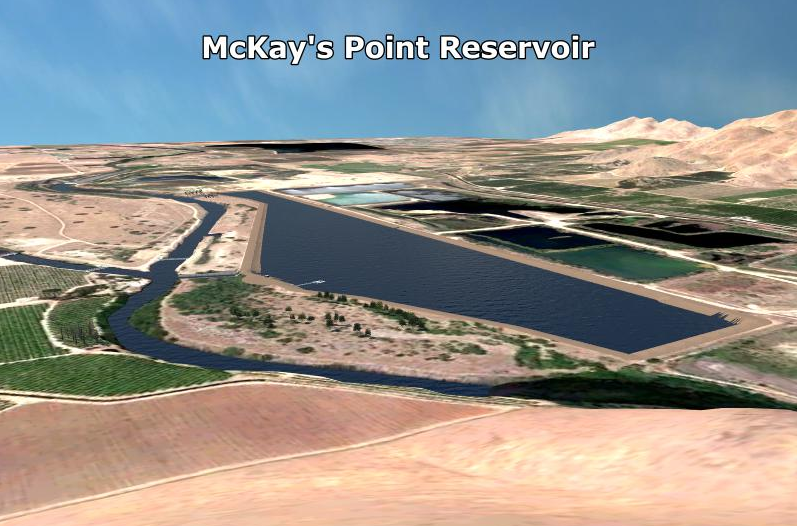
 TULARE – A new reservoir is proposed at McKay Point, near Lemon Cove and Woodlake, to provide new water storage, flood control and potential power generation.
The project is a joint venture of property owners Tulare Irrigation District, the
Consolidated Peoples Ditch Company and the Visalia & Kaweah Water Company.
CEMEX, an aggregates and building materials company with long-established local operations, will excavate the reservoir site and sell the materials. The owners will then receive a royalty on the sale of materials, which provides revenue that should make
the project financially feasible, explained Paul Hendrix, general manager of the Tulare Irrigation District.
Hendrix says the permitting on the big project could take a year or more and any utilization of the site to store water could come some 5 years later ”It will take 10 years or longer for the whole the whole site to be be ready” says Hendrix. Cemex will take that long to complete excavation and processing of product at their nearby Lemon Cove plant. Cemex is a worldwide building product company based in Mexico.
A series of public hearings will be held to allow Tulare Irrigation District to gather public
input on elements that residents feel need to be considered in the Environmental Impact
Report. Public comments must be submitted by Feb. 27.
The hearings will be held:
• Tuesday, Feb. 18, 5:30 p.m., Woodlake Council Chambers, 350 N. Valencia Blvd.
• Wednesday, Feb. 19, 1:30 p.m., Visalia Convention Center, 303 E. Acequia, Visalia
• Wednesday, Feb. 19, 5:30 p.m., Tulare Irrigation District Office, 6826 Ave. 240, Tulare
The key components of the project are:
• More efficient capture and distribution of water for ag use. The new reservoir,
and its water control features, will allow for water to be captured and more efficiently
distributed for agricultural use, when farmers need it. Currently, during times of flood
release from Terminus Dam, water not immediately needed is diverted to groundwater
recharge basins or discharged to the historic Tulare Lake Bed. The reservoir will allow
for increased upstream storage of this water.
• Flood control. During wet years, water will be diverted into the reservoir, thereby
lessening the risk of water backing up into the streets of downtown Visalia. Water would
be returned to the Lower Kaweah and the St. Johns rivers when it is safe and beneficial to do so.
• Power generation. The hydroelectric generators at the Terminus Dam outlets at Lake
Kaweah will be able to produce more power, especially during times of peak demand,
once the McKay Point reservoir is available. The resulting clean power may provide
revenue to support the maintenance of the reservoir and other projects as needed to
ensure continued delivery of water to support agriculture.
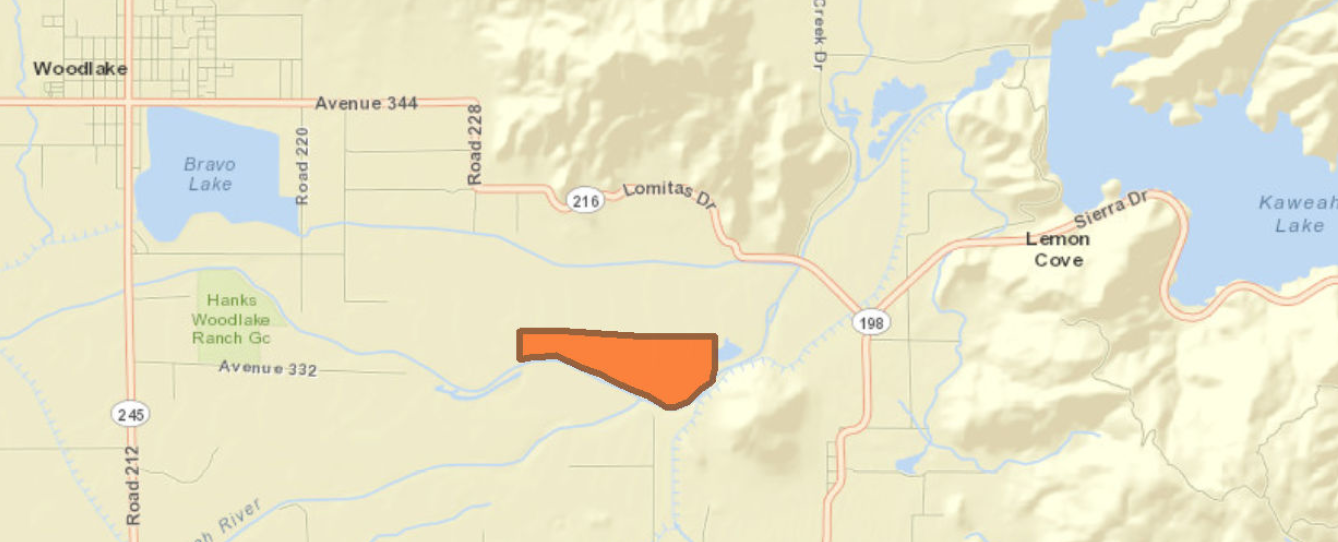 In coordination with this project Kaweah Power Authority that includes TID is planning to construct a 3 to5 MW hydroelectric plant that will generate power when the lake is low. As of now the existing 21 MW plant cannot generate power from May through September when the lake is drawn down.
• More water for local use. During wet years, floodwater from the Kaweah River, Dry
Creek and Yokohl Creek typically floods farmland and/or is diverted to the Friant-Kern
Canal for disposal in the Kern River near Bakersfield (assuming the Kern River has
capacity). The McKay Point Reservoir will capture some of this floodwater and hold it
until it can be safely released back into the Kaweah and St. Johns rivers for immediate
use or for groundwater recharge.
“The reservoir and its new water control structures will significantly improve how we
capture, store and distribute water,” Hendrix noted. “The partnership with CEMEX is
necessary in order for the owners to deliver an important service to the region at virtually no cost to the general public.”
The reservoir itself, to be located north of the separation of the Kaweah and St. Johns
rivers, is expected to take about 120 acres of the jointly owned 500 acres.
“McKay Point meets a real need,” Hendrix added. “It is an excellent example of
responsible and resourceful management of energy and water. In this increasingly water- short region, finding new ways to make good use of wet-year water and flood flows is critically important.”
Category: Agriculture

Ag Beat…CDI,Biogas Plant Agree..more
 CDI,Pixley Co Agree On Biogas Project
Tulare County economic development manager Mike Washam says at a planning commission hearing this week the $10 million Pixley Biogas project was finally approved with neighbor and past critic, California Dairies Inc, signaling approval as well.
“We don’t expect an appeal or a lawsuit “says Washam, who adds that the renewable energy project could be operational by September.
Pixley Biogas will relocate the enclosed plant farther away from the CDI milk plant. The facility will convert cow manure and other waste into biogas to help run the Calgren ethanol plant there. Using renewable gas to make ethanol will raise the value of the fuel in the marketplace since it helps cut greenhouse gas emissions. The company has been working on the project for almost 3 years and has received $5 million from the California Energy Commission.
Beef Exports Strong to Asia
U.S. beef exports through November are up 4 percent for the year, largely due to strong growth in exports to Asia. The volume of exports has risen most to Japan (+48 percent) as import restrictions were relaxed in 2013 to allow for imports of U.S. beef from cattle aged less than 30 months. While beef consumption is flat in Japan, relaxed import restrictions have allowed the United States to take some market share from Australia. Exports have also risen through November to Hong Kong (+71 percent), Taiwan (+82 percent), and Mexico (+9 percent). Exports to Mexico have increased this year as Mexican beef production declined. Due to stronger demand from Asia and Mexico, the estimate of 2013 U.S. exports was raised to 2.534 billion pounds.The 2014 forecast was raised to 2.335 billion pounds.
More Cattle Go To Slaughter in Drought
Cattle and calves on feed for slaughter in California feedlots totaled 510 thousand head on January 1, 2014, 1 percent higher than last month, and 6 percent higher than January 2013. During December,
placements of 59.0 thousand head were 18 percent above the previous year says USDA.
California’s production of red meat during December 2013 totaled 148.8 million pounds (dressed weight), 9 percent higher than the previous month, and 6 percent higher than December 2012.

California To See Rain Over Next 5 Days
February 5,2014
Parts of California should see rain and snow over the next five days starting tonight,Wednesday.
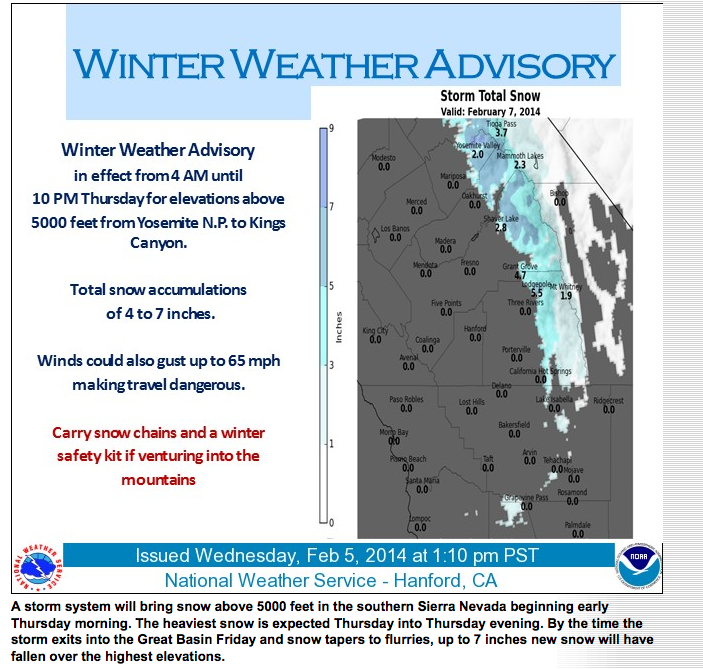 The town of Redding – next to the state’s largest reservoir- Lake Shasta expects rain through Monday with the most widespread storm across the state Thursday.NWS Hanford expects snow accumulation of up to 7inches from Yosemite down to Kings Canyon (see graphic).
For the Central Coast, SLO forecaster John Lindsey says on Thursday “Total rainfall amounts are expected to range from nearly three-quarters of an inch along the coast and one-quarter of an inch inland. Snow levels are expected to drop to 3,500 feet.”
“The long-term forecast for February calls for slightly above normal temperatures and below average rainfall for the Central Coast. March should feature slightly above normal precipitation and temperatures. April should be overall colder than average and wetter than normal.”
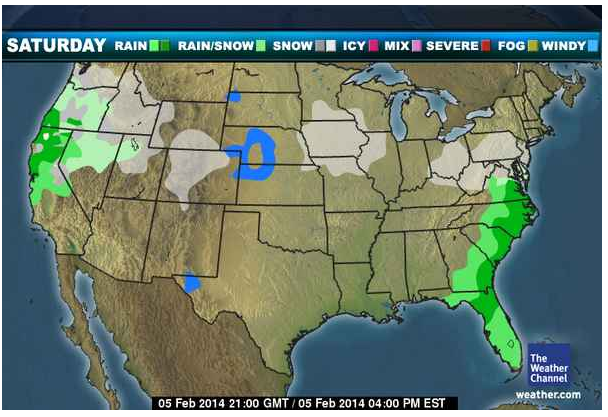
The adjacent map shows expected rain over the weekend including Sunday looking similar with the heaviest rain coming in Northern California including the Tahoe area where snow is starting to build up.
NWS Reno is calling the storm pattern an”atmospheric river” with subtropical moisture being aimed at norther California” like a fire hose.” Tahoe area could see over 4 ft of snow by end of weekend.

Visalia Milk Plant Making Dried Butterfat For Export
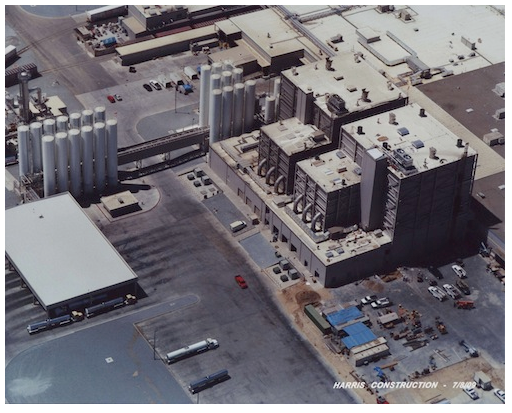
CDI Expands Product Portfolio
VISALIA, Calif. — February 4, 2014 — Building upon a successful powdered milk and butter export business, California Dairies, Inc. (CDI) has diversified its butterfat offerings with the addition of anhydrous milkfat (AMF) to its export product portfolio. The entry into a new export category demonstrates CDI’s progress in achieving its vision to become the leading source of dairy nutrition for a healthy world.
Responsive to a strong global demand for U.S. dairy products, CDI is consistently looking for ways to distinguish itself through the delivery of products that the world demands. The production of AMF is natural extension of CDI’s butter portfolio and meets the needs of its international customers for butterfat in a different form.
The product is being made at the CDI plant in Visalia.
“Expanding CDI’s product portfolio to include AMF is a natural fit and increases our presence in the global marketplace. Keeping the world healthy by delivering dairy ingredients and products of real benefit will grow market share and create value for CDI member-owners,” said Andrei Mikhalevsky, CDI CEO. “Building on existing strengths, we will continue to target attractive and attainable opportunities to preserve our autonomy and increase our growth prospects.”
AMF is 99.8 percent pure butter oil. Packaged for commercial use as a food ingredient, AMF has an extended shelf life and is an excellent form for storage and transportation of butterfat.
U.S. export of Anhydrous Milkfat have gone up 300% in 2013 compared to 2012 according to the Dairy Export Council.

47th Annual World Ag Expo Feb 11-13
February 3,2014
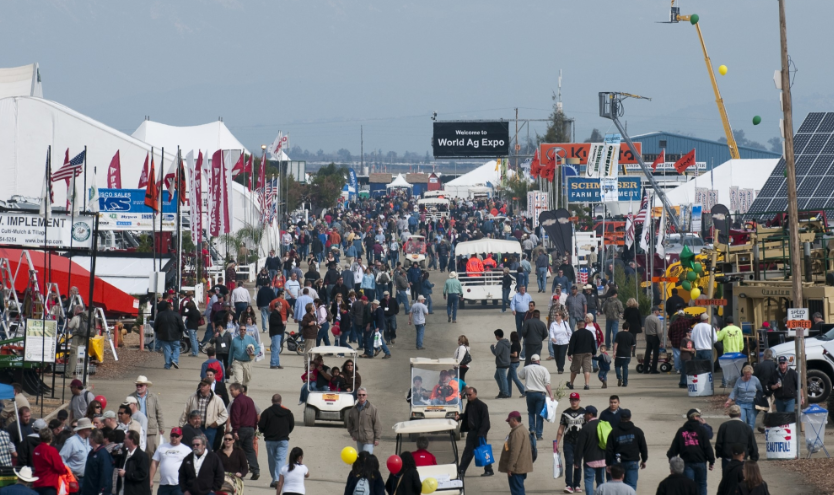 World Ag Expo will celebrate its 47th year on February 11-13, 2014 in Tulare, California. The largest annual agricultural exposition of its kind, World Ag Expo touts more than 1,500 exhibitors who display cutting-edge agricultural technology and equipment on 2.6 million square feet of show grounds. An estimated average of 100,000 individuals from 70 countries attend the Expo each year to learn about the latest advances in agriculture.
General admission at the gate is $15. Purchase tickets in advance at www.WorldAgExpo.org and use coupon code “WAE2014” to save $5 on each ticket.
More than 40 seminars will be offered in beef, dairy, hay and forage, international trade, irrigation and general agriculture categories. Seminars presented by professionals in the industry provide attendees with valuable information to improve their operations.
New for 2014 is the World Ag Expo Arena in the southwest area of the show grounds. The Arena, which is facilitated by Ritchie Bros. Auctioneers, will be home to daily Exhibitor Showcases. Attendees will enjoy watching the show from the comfort of their seats as exhibitors drive their equipment past the bleachers.
World Ag Expo attendees can get the latest news, information and updates about the show by downloading the new for 2014 mobile app. The free app provides mobile access to the schedule of events, an exhibitor directory, map of the show grounds and other visitor resources. The app is available for download by visiting the iTunes store or Android Marketplace, search for “World Ag Expo 2014”.
For a full schedule of events and more information about the show visit www.WorldAgExpo.org.

DWR Drops State Water Project Allocation to Zero
Severe Drought Leads to Worst-Ever Water
Supply Outlook
 To protect Californians’ health and safety from more
severe water shortages
in the months ahead, the California Department of
Water Resources (DWR)
today took actions to conserve the state’s precious
resources. As a result
, everyone – farmers, fish, and people in our cities and towns –
will get less water. DWR’s actions are in direct response to Governor
Edmund G. Brown Jr.’s drought State of Emergency. In the declaration, the
Governor directed
DWR and the State Water Resources Control Board (SWRCB) to act to modify
requirements
that hinder conservation of currently stored water and allow flexibility within
the state’ s
water system to maintain operations and meet environmental needs.
“The harsh weather leaves us little choice,” said DWR Director Mark Cowin.
“If we are to have any
hope of coping with continued dry weather and balancing multiple needs, we
must act now to preserve
what water remains in our reservoirs.”
Except for a small amount of carryover water from 2013, customers of the
State Water Project
(SWP) will get no deliveries in 2014 if current dry conditions persist and
deliveries to agricultural
districts with long-standing water rights in the Sacramento Valley may be cut
50 percent – the
maximum permitted by contract – depending upon future snow survey results.
It is important to note
that almost all areas served by the SWP have other sources of water, such as
groundwater, local reservoirs,
and other supplies.
“It is our duty to give State Water Project customers a realistic understanding
of how much water
they will receive from the Project,” said Director Cowin. “Simply put, there’s not
enough water in the
system right now for customers to expect any water this season from the project.”
DWR also has asked the SWRCB to adjust water permit terms that control State
Water Project and
federal Central Valley Project operations in order to preserve dwindling supplies
in upstream
reservoirs for farms, fisheries, and cities and towns as the drought continues.
While additional winter storms may provide a limited boost to reservoir storage
and water deliveries
, it would need to rain and snow heavily every other day from now until May to get
us back to average
annual rain and snowfall. Even then, California still would be in a drought, because
normally wet
December and January have been critically dry – and follow a record dry 2013 and
a dry 2012.

Fresno-based OnFarm is finalist for IBM’s Global Entrepreneur of the Year Award

Agriculture technology company OnFarm,a member of the Water, Energy & Technology Center at Fresno State, is one of eight finalists for the 2013 IBM Global Entrepreneur of the Year Award.
The Feb. 6 award ceremony in San Francisco will honor the company that is developing the most promising agricultural solution using cloud, big data, analytics, mobile and social technologies.
Part of the judging is a People’s Choice Award, which OnFarm won in the North American competition. Voting for the global award is in progress (http://bit.ly/vote-smartcamp-finals) and OnFarm is hoping for support from the Central Valley.
“I strongly encourage everyone to vote for OnFarm,” said Halle Petersen, director of the WET Center. “Not only will it be a win for OnFarm, but also for Fresno. It will definitely put our region on the map as a unique place for innovation and commercialization of technology in the ag sector.”
OnFarm, founded by 1990 Fresno State graduate Lance Donny, provides analytics and insights that can help farmers make better decisions about their crops. OnFarm’s intelligent dashboard provides tools and recommendations that help farmers save water, energy, labor and fertilizer while producing higher quality crops.
“I am very excited that one of our WET member companies is one of only two U.S. finalists in the competition,” Petersen said. “Founded and headquartered right here in Fresno, OnFarm has developed and commercialized what will be the gold standard in smart agriculture.”
Donny said the WET Center assisted his company in industry networking, developing speaking opportunities and promoting the company’s success.
“OnFarm’s rank as a top finalist of this prestigious international competition is a perfect example of the innovative local companies thriving in Fresno,” said Fresno Mayor Ashley Swearengin. “OnFarm is adding to the Fresno area’s expertise in water and energy technology, focusing efforts to potentially deliver highly accurate irrigation forecasting and recommendations, saving water and lowering crop failure rates.”
Joining OnFarm are finalists from around the world including Latin America, Eastern Europe, Australia, Southeast Asia, western Asia and North America. These eight finalists are still competing after 17 regional competitions involving thousands of prospective companies.
For more information, contact Helle Petersen at (559) 278-4541 or helle@cvbi.org.

Water Bond Hearing Set for Jan. 31 in Hanford
January 29,2014
 The Assembly Water, Parks and Wildlife Committee will hear testimony from local water managers and other stakeholders on the need for a 2014 water bond during an informational hearing Friday evening in Hanford.
David Orth, general manager of the Kings River Conservation District; Brent Walthall, assistant general manager of Kern County Water Agency and Mario Santoyo, executive director of the California Latino Water Coalition are among those who will give local perspectives.
Committee Chair Anthony Rendon (D-Lakewood); Rudy Salas (D-Bakersfield), chair of the Select Committee on Regional Approaches to Addressing the State’s Water Crisis; Assembly Member Jim Patterson (R-Fresno) and Assembly Mariko Yamada (D-Davis) also are scheduled to make comments.
The public meeting is Friday, Jan. 31, 5-7 p.m. at the Kings County Government Center Board of Supervisors Chambers, 1400 W. Lacey Boulevard in Hanford. For more information, go to http://awpw.assembly.ca.gov/waterbond.
The Assembly Water, Parks and Wildlife Committee has scheduled three more informational hearings on the water bond: Friday, Feb. 7, in the Humboldt County Board of Supervisors Chambers, 10 a.m.-2 p.m.; Feb. 20 in Fresno; and March 14 in Monterey Park in Los Angeles County.
From ACWA

Some Optimism High Pressure Over California Will Break
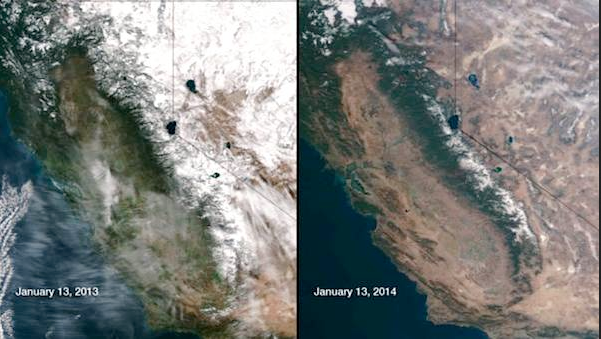
Forecasters are for the first time this year suggesting the persistent high pressure ridge that is keeping storms away from the state will dissipate as we head into February.
Lack of rain or snow this winter has crated a parched landscape across the Golden State that is rapidly turning an ugly gray. Here is how the drought looks from space on the same date this January and January a year ago (see photos).
But today here is what PG&E forecaster John Lindsey wrote. “The stubborn ridge of high pressure that has produced the drought is expected to move away from the West Coast and allow a more normal winter type of pattern to develop i early February. This condition could bring much needed precipitation to California.”
Weatherman Alan Fox, who advises avocado growers, says he expects some rain although from “ February 1 to 13 – The current pattern of sea surface temperature anomalies in the east and central north Pacific does not support a return to above normal rainfall. Although El Niño influence is expected to slowly increase, the current overall pattern still makes it difficult to realize a return to normal rainfall until after the typical end of the wet season.”
Some Storms
“February 1 to 13 – Southern California Avocado Region… On the whole, rainfall will continue to be below normal, but there should be some good storm events to increase the surface moisture a bit. February 8 to 15 has historically been an active time for rain in southern California.
Fox continues – “Seasonal Outlook/El Niño Update – February 15 to April 30… The El Niño will start to increase in February, March, and April. February could become more rainy, especially in central and southern California.”
Snow Forecaster Bryan Allegretto who comments for the ski industry watches different weather models says “No changes today as the models are still showing the mean ridge moving away from the West Coast and out towards the Aleutians by the end of the month. Looking through all the ensemble runs of the European, Canadian, and GFS they all have the trough spending more time along the West Coast than not to start the month of February.
The operational runs of the GFS and European have a system pushing in next Friday. Beyond that we’ll just look at the pattern vs. any storms. “
Wet February?
He adds “Taking a look at today’s CFS v2 runs for February they show 200% of average precip for February. They have been trending wetter. I’m not foolish enough to buy into that after the season we are having, but it’s another sign that the models are seeing good signals for the West Coast as we go into February. They have been showing a West Coast trough setting up at the end of the month for a week now so that’s good consistency.”
But NWS-SF remarks in their discussion” that models show the very real possibility there will no more rain this month.”
If that is the case worried Californians will be glad to say goodby to January.

Governor Brown Declares Drought State of Emergency
 Calls for Conservation Statewide, Directs State to Manage Water for Drought
Jan 17,2014
SAN FRANCISCO – With California facing water shortfalls in the driest year in recorded state history, Governor Edmund G. Brown Jr. today proclaimed a State of Emergency and directed state officials to take all necessary actions to prepare for these drought conditions.
“We can’t make it rain, but we can be much better prepared for the terrible consequences that California’s drought now threatens, including dramatically less water for our farms and communities and increased fires in both urban and rural areas,” said Governor Brown. “I’ve declared this emergency and I’m calling all Californians to conserve water in every way possible.”
In the State of Emergency declaration, Governor Brown directed state officials to assist farmers and communities that are economically impacted by dry conditions and to ensure the state can respond if Californians face drinking water shortages. The Governor also directed state agencies to use less water and hire more firefighters and initiated a greatly expanded water conservation public awareness campaign (details at saveourh2o.org).
In addition, the proclamation gives state water officials more flexibility to manage supply throughout California under drought conditions.
State water officials say that California’s river and reservoirs are below their record lows. Manual and electronic readings record the snowpack’s statewide water content at about 20 percent of normal average for this time of year.
The Governor’s drought State of Emergency follows a series of actions the administration has taken to ensure that California is prepared for record dry conditions. In May 2013, Governor Brown issued an Executive Order to direct state water officials to expedite the review and processing of voluntary transfers of water and water rights. In December, the Governor formed a Drought Task Force to review expected water allocations, California’s preparedness for water scarcity and whether conditions merit a drought declaration. Earlier this week, the Governor toured the Central Valley and spoke with growers and others impacted by California’s record dry conditions.
The full text of the emergency proclamation is below:
A PROCLAMATION OF A STATE OF EMERGENCY
WHEREAS the State of California is experiencing record dry conditions, with 2014 projected to become the driest year on record; and
WHEREAS the state’s water supplies have dipped to alarming levels, indicated by: snowpack in California’s mountains is approximately 20 percent of the normal average for this date; California’s largest water reservoirs have very low water levels for this time of year; California’s major river systems, including the Sacramento and San Joaquin rivers, have significantly reduced surface water flows; and groundwater levels throughout the state have dropped significantly; and
WHEREAS dry conditions and lack of precipitation present urgent problems: drinking water supplies are at risk in many California communities; fewer crops can be cultivated and farmers’ long-term investments are put at risk; low-income communities heavily dependent on agricultural employment will suffer heightened unemployment and economic hardship; animals and plants that rely on California’s rivers, including many species in danger of extinction, will be threatened; and the risk of wildfires across the state is greatly increased; and
WHEREAS extremely dry conditions have persisted since 2012 and may continue beyond this year and more regularly into the future, based on scientific projections regarding the impact of climate change on California’s snowpack; and
WHEREAS the magnitude of the severe drought conditions presents threats beyond the control of the services, personnel, equipment and facilities of any single local government and require the combined forces of a mutual aid region or regions to combat; and
WHEREAS under the provisions of section 8558(b) of the California Government Code, I find that conditions of extreme peril to the safety of persons and property exist in California due to water shortage and drought conditions with which local authority is unable to cope.
NOW, THEREFORE, I, EDMUND G. BROWN JR., Governor of the State of California, in accordance with the authority vested in me by the state Constitution and statutes, including the California Emergency Services Act, and in particular, section 8625 of the California Government Code HEREBY PROCLAIM A STATE OF EMERGENCY to exist in the State of California due to current drought conditions.
IT IS HEREBY ORDERED THAT:
1.State agencies, led by the Department of Water Resources, will execute a statewide water conservation campaign to make all Californians aware of the drought and encourage personal actions to reduce water usage. This campaign will be built on the existing Save Our Water campaign (www.saveourh20.org) and will coordinate with local water agencies. This campaign will call on Californians to reduce their water usage by 20 percent.
2.Local urban water suppliers and municipalities are called upon to implement their local water shortage contingency plans immediately in order to avoid or forestall outright restrictions that could become necessary later in the drought season. Local water agencies should also update their legally required urban and agricultural water management plans, which help plan for extended drought conditions. The Department of Water Resources will make the status of these updates publicly available.
3.State agencies, led by the Department of General Services, will immediately implement water use reduction plans for all state facilities. These plans will include immediate water conservation actions, and a moratorium will be placed on new, non-essential landscaping projects at state facilities and on state highways and roads.
4.The Department of Water Resources and the State Water Resources Control Board (Water Board) will expedite the processing of water transfers, as called for in Executive Order B-21-13. Voluntary water transfers from one water right holder to another enables water to flow where it is needed most.
5.The Water Board will immediately consider petitions requesting consolidation of the places of use of the State Water Project and Federal Central Valley Project, which would streamline water transfers and exchanges between water users within the areas of these two major water projects.
6.The Department of Water Resources and the Water Board will accelerate funding for water supply enhancement projects that can break ground this year and will explore if any existing unspent funds can be repurposed to enable near-term water conservation projects.
7.The Water Board will put water right holders throughout the state on notice that they may be directed to cease or reduce water diversions based on water shortages.
8.The Water Board will consider modifying requirements for reservoir releases or diversion limitations, where existing requirements were established to implement a water quality control plan. These changes would enable water to be conserved upstream later in the year to protect cold water pools for salmon and steelhead, maintain water supply, and improve water quality.
9.The Department of Water Resources and the Water Board will take actions necessary to make water immediately available, and, for purposes of carrying out directives 5 and 8, Water Code section 13247 and Division 13 (commencing with section 21000) of the Public Resources Code and regulations adopted pursuant to that Division are suspended on the basis that strict compliance with them will prevent, hinder, or delay the mitigation of the effects of the emergency. Department of Water Resources and the Water Board shall maintain on their websites a list of the activities or approvals for which these provisions are suspended.
10. The state’s Drinking Water Program will work with local agencies to identify communities that may run out of drinking water, and will provide technical and financial assistance to help these communities address drinking water shortages. It will also identify emergency interconnections that exist among the state’s public water systems that can help these threatened communities.
11.The Department of Water Resources will evaluate changing groundwater levels, land subsidence, and agricultural land fallowing as the drought persists and will provide a public update by April 30 that identifies groundwater basins with water shortages and details gaps in groundwater monitoring.
12.The Department of Water Resources will work with counties to help ensure that well drillers submit required groundwater well logs for newly constructed and deepened wells in a timely manner and the Office of Emergency Services will work with local authorities to enable early notice of areas experiencing problems with residential groundwater sources.
13.The California Department of Food and Agriculture will launch a one-stop website (www.cdfa.ca.gov/drought) that provides timely updates on the drought and connects farmers to state and federal programs that they can access during the drought.
14.The Department of Fish and Wildlife will evaluate and manage the changing impacts of drought on threatened and endangered species and species of special concern, and develop contingency plans for state Wildlife Areas and Ecological Reserves to manage reduced water resources in the public interest.
15. The Department of Fish and Wildlife will work with the Fish and Game Commission, using the best available science, to determine whether restricting fishing in certain areas will become necessary and prudent as drought conditions persist.
16.The Department of Water Resources will take necessary actions to protect water quality and water supply in the Delta, including installation of temporary barriers or temporary water supply connections as needed, and will coordinate with the Department of Fish and Wildlife to minimize impacts to affected aquatic species.
17.The Department of Water Resources will refine its seasonal climate forecasting and drought prediction by advancing new methodologies piloted in 2013.
18.The California Department of Forestry and Fire Protection will hire additional seasonal firefighters to suppress wildfires and take other needed actions to protect public safety during this time of elevated fire risk.
19.The state’s Drought Task Force will immediately develop a plan that can be executed as needed to provide emergency food supplies, financial assistance, and unemployment services in communities that suffer high levels of unemployment from the drought.
20.The Drought Task Force will monitor drought impacts on a daily basis and will advise me of subsequent actions that should be taken if drought conditions worsen.
I FURTHER DIRECT that as soon as hereafter possible, this Proclamation be filed in the Office of the Secretary of State and that widespread publicity and notice be given of this Proclamation.
IN WITNESS WHEREOF I have hereunto set my hand and caused the Great Seal of the State of California to be affixed this 17th day of January, 2014.
______________________________
EDMUND G. BROWN JR.,
Governor of California
ATTEST:
______________________________
DEBRA BOWEN,
Secretary of State
###


 Latest News


