Freeze Cuts Navel / Valencia Harvest

USDA reported that the December freeze cut Navel, Valencia and Lemon harvest estimates but a had a smaller effect on tangerines

Screen Shot 2013-09-12 at 12.04.10 PMOranges
– The 2013 – 2014 California Navel orange forecast is 84.0 million cartons, down
4.5 percent from both the October forecast and last season’s crop. The 2013-14 navel orange
harvest began in late October. A significant freeze in early December across the California
Central Valley impacted much of the citrus fruit. The 2013-2014 Valencia orange forecast is
23.0 million cartons, down 8 percent from both the October 2013 forecast and 2012-2013 crop,
respectively.
Lemons
– The 2013 – 2014 California lemon forecast is 40.0 million cartons, down 7.0 percent
from the October forecast and down 4.8 percent from last season’s final production.
Tangerines
– The 2013 – 2014 California tangerine forecast (including mandarins and tangelos)
is 26.4 million cartons. Production is up 1.5 percent from last season’s crop, but down
2.2 percent from the October forecast. In November, Satsumas, Fairchilds, and Clementines
were harvested in Southern California.
Grapefruit
– The 2013 – 2014 California grapefruit forecast is 8.0 million cartons, unchanged
from the October forecast and from last season’s crop. Significant freeze in early December
across the California Central Valley impacted much of the citrus fruit, although lemons were
least affected. The extent of freeze damage is not presently known.

BONE DRY & SCARED – Tulare County Faces Grim Water Prospects

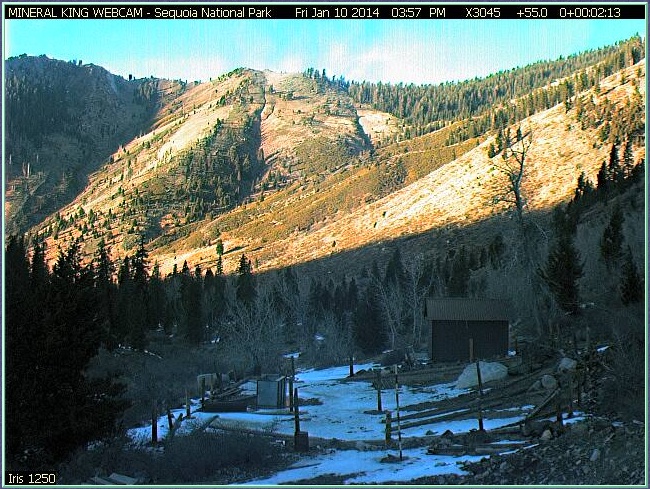
Mineral King 2014-01-11 at 8.09.06 AM


It’s the middle of January 2014 and the Kaweah River watershed and all of California is bone dry. This picture of the high country above Visalia tells the story.The Mineral King webcam at 9500 ft elevation provides a doss of reality for anyone who hopes to take a drink of water in June or wonders how we can irrigate 1.3 million acres of productive farmland this summer in Tulare County.

Last year on this date Farewell Gap meteorological station in Mineral King showed a foot and a half of snow on the ground.The site gets an average of 37 inches of water content by April 1 on average.

Reservoir storage is at historical lows with only a 11,500 acre ft puddle in Kaweah Lake that holds 174,166 af. Lake Success has just 5151 af with storage capacity of 82,314 af. Sprawling Pine Flat Lake on the Kings that can hold one million acre feet – has 174,166 af.

If the mountains are dry, the Valley floor is parched from 13 months of record drought. In the calendar year 2013 Visalia’s rainfall total was 3.25 inches,a record low according to the Western Regional Climate Center that lists the existing record low for Visalia in 1910 at 4.10 inches. So far 2014 is no better.

Typically,December and January are some of the biggest rainmakers  each year with an average in Visalia of 3.75 inches. This year December’s total for Visalia was 0.20 and nothing fell in January. Nor will there likely be any. So far this water year that started last July – the Dinuba tree fruit region area has received just 0.88 inches according to Alta Irrigation District.

It’s no wonder the Tulare County Board of Supervisors are expected to urge Governor Brown to declare an emergency drought declaration soon.

water rally 2014-01-09 at 1.37.38 PM“Maybe that’s what we need in the state to wake the average person to the crisis we have ” says county Ag Commissioner Marilyn Kinoshita who will be attending this week’s water rally in Sacramento January 16.

The Central Valley Latino Water Coalition is coordinating the rally hoping to turn out a big crowd to both find short term water supply solutions an support a new California Water Bond.

They favor both sustainability in the Delta and more water storage.

“Our whole economy depends on how much rain God gives us over the next two months” states Tulare city mayor David Macedo.”Right now the situation scares me death.”

“This the fourth driest December we have seen on the Tule River in over 100 years” says Dick Schafer, local water expert.  Schafer favors an emergency drought declaration that was called for the Tulare County Water Commission this week. Schafer is a member. The designation could allow some flexibility allowing more Delta exports.He also favors a bill by Congressman Devin Nunes to scrap the salmon restoration effort on the San Joaquin River that sends water down the river for habitat restoration.

Tulare County gets an important amount of its annual water supply not from our watersheds but the next watershed up the Sierra – from the San Joaquin River. Much of that water is sent along the Friant Kern Canal that hugs the foothills including about half to Tulare County farms and towns. The drought is threatening that supply as well.

Statewide it is no better.“This is my third extended drought period as president of the Association of California Water Agencies” says Tim Quinn and “more than any other – it is the scariest.” He says usually our reservoirs are down at the end of the water year. This January, mid term of the water year – our reservoirs are empty and the is no rain in sight.”

Quinn says water districts are going to rationing as the dry spell continues.”This is our third dry year in a row” adds Quinn and ”people need to wake up and stop watering those lawns.”

“The message has to get out  that we must conserve now and invest statewide in water storage and conveyance. ” Quinn notes that his old boss Metropolitan Water District is better off than most districts in the state “because they invested 10 years ago in water infrastructure.”

Visalia City Council member Greg Collins says the City of Visalia needs to be leader in calls for new conservation efforts.”We will be talking about at this next weekend’s council retreat. We have to do something.” Visalia loves their green lawns but Collins says he turned off home irrigation system last September. ”We may have to put with brown lawns while we try to save the trees.”

Quinn calls the stubborn high pressure system dominating the state’s weather pattern for months now a ”ridiculously resilient ridge” that is warding off the plentiful storms entering North America, pushing them tot he north or weakening like those series of storms this past week.

Saturday a report says Tahoe ski resorts got around 3 inches of snow  but like almost all recent storms – this one lacked the punch to bring much precipitation across the state. Hope that a pattern change comes in February seems to be ebbing in the latest models.

Climate Change?

PG&E forecaster John Lindsey had an interesting perspective this week on why it is so dry.

“For one reason, a large-scale, high-pressure ridge has continued to dominate our weather, never fluctuating far from the western edge of North America. This condition hasn’t allowed the normal wintertime storm systems to progress southward into California.

An area of high pressure about 3,700 miles away as the crow flies may be the culprit. This year’s drought pattern across California is related to a strong and persistent area of high pressure in the upper atmosphere near Greenland. The “Greenland Block” is a high-pressure ridge that has forced the polar jet stream south over the Midwest and East Coast.

There’s a growing amount of evidence that climate change may be altering the path of the jet stream, keeping storms farther to the north of California’s longitude.”

With no heavy downpour in coming weeks “The Governor is likely to declare a drought emergency after the February 1 Snow Survey” say officials.

The impact of the drought is being felt the worse in the Valley’s westside with less groundwater to rely on, In the Westlands water district hundreds of square miles may have to be left fallow if there are not a series of significant storms, said Jason Peltier, chief deputy general manager recently.

A formal drought emergency declaration could assist in a number of ways but as Brown has said the “government can’t make it rain.”

Brown visited Fresno this week and the Bee reported the following.

“The bishops are advising us to pray for rain,” he said later Monday at a Fresno City Hall news conference. “I am planning to go beyond that and do whatever we can in terms of water exchanges, working with local farmers and water districts to maximize the resources that we have. It is really serious and my staff and administration are preparing appropriate papers to do what is necessary.”

Asked specifically if he would be declaring a drought emergency in the state, Brown said “not today, but we’re working on it.”

So far this water year the rain pattern statewide is reverse what it has been historically when rain was more plentiful in the north and a surplus sent south to help farms and cities in Central and Southern California.

So far this water year Northern California has an average Snowpack or snow water equivalent of 1 inch or 7% normal for this date. The rain totals are just 3% of April 1 average The Southern Sierra stands at 25% normal for this date.

60 Year Old Deal

With low north state rain Central Valley farmers in the prosperous east side of the Valley including Tulare County farmers – stand to lose big time because of a water deal set up some 60 years ago.

As it looks now it is likely the federal government will not have an adequate supply of water north of the Delta to deliver to the “Exchange Contractors” north of Firebuagh triggering a call on San Joaquin River water stored in Millerton. That will come out of the hide of east side farmers who depend on Friant Kern Canal water – farmers in Fresno,Tulare and Kern counties who irrigate a million acres of mostly trees and vines.

“We hope the governor makes a drought declaration soon that could spell some relief from environmental restrictions that limit the Delta flows south.”  This could enable the Exchange Contractors to get more of their contracted supply so they would take less San Joaquin River water says Friant contractors General Manager Ron Jacobsma.

In normal years, the Exchange Contractors are guaranteed 100% of their contractual water allotment (840,000 acre feet) and in critical years the amount is 75% (650,000 af).

Also,the Bureau of Reclamation and Friant contractors are apparently discussing a possible delay in February’s restoration water release from Friant Dam that could save some 25,000 af and agree to pay it back later.

Jacobsma adds“ the bigger issue for us is the potential to have to contribute up to 200,000 af of San Joaquin River water to the Exchange Contractors because the Bureau can’t find enough north of the Delta. That could leave us with virtually nothing.”

A number of water districts in Tulare County have no groundwater supply.

“This would be the first time in 60 years that this happened” says Jacobsma. These districts claim senior rights and receive Delta water in “exchange” for their historic supply from the San Joaquin River. The districts northwest of Fresno gave up the San Joaquin supply when Friant Dam was built.

The Fresno Bee reported this past week “that U.S. Sen. Dianne Feinstein and Rep. Jim Costa, both Democrats from California, last month called on Brown to immediately declare a drought and to request a broad emergency declaration from President Barack Obama, which would expedite some water transfers, provide financial assistance and suspend some state and federal regulations.

Richard Stapler, a spokesman for the California Natural Resources Agency, said Brown’s task force is meeting weekly to address concerns related to the dry conditions and draw up plans for dealing with it. He said specific conditions must be met before an official drought is declared.

“We do have to see how the hydrological circumstances play out for the coming month. That said, you know, the long-range forecasts, we’re not optimistic,” he said.”

Some water districts may follow what happened in Paso Robles and consider a moratorium on new wells to save what groundwater supply that is there. Restrictions on pumping have been discussed in Tulare County as well where groundwater levels continue to plunge.”They are digging new wells like crazy in the Tipton/Pixley area” remarks David Macedo. Macedo a cattle auctioneer,also notes he “has never seen so many cull cows sent to auction in January because of a lack of foothill grass.”

While much of northern and central California remains parched the Pacific Northwest appears to be getting more rain after a dry spell. The Columbia River forecast is for 97% of average river run  with the Snake River at 95%.Eastern Oregon and Washington is dry like California however.
In Arizona on the Colorado River so far the southern Colorado River snowpack is 97% of average.Unregulated flow into Lake Powell is expected to 93% of average.

California gets 4.4 million af of water from the Colorado River. LA’s Metropolitan WD appears to have more water stored for this situation   and the is some talk that they ought to be neighborly and share some of the supply in a critical dry year like this.

One glimmer of hope. Dick Schafer says historically an early dry winter  often ends with a wet March that helps bring back the year to 50% of average. We have a way to go with the state saying they can only supply 5% to water contractors.


AG Update: Pacific Ethanol / Orange Scab / More

Diamond Foods Settles Claim With S.E.C.

The U.S. Securities and Exchange Commission on Jan. 9 charged Diamond Foods, Inc. and former executives Steven Neil and Michael Mendes for their roles in an accounting scheme to falsify walnut costs. Diamond Foods, without admitting or denying the allegations, agreed to pay $5 million to resolve the investigation, according to the company’s Jan. 9 filing with the S.E.C. The settlement terms are consistent with the $5 million expense recorded in the fiscal year’s first quarter ended Oct. 31, 2013.
The S.E.C. alleged Mr. Neil, then chief financial officer for the San Francisco-based snack foods company, directed an effort to fraudulently underreport money paid to walnut growers by delaying the recording of payments into later fiscal periods. Because of the manipulated walnut costs, Diamond Foods reported higher net income and inflated earnings to exceed analysts’ estimates for fiscal quarters in 2010 and 2011. The S.E.C.’s litigation continues against Mr. Neil.

Sweet Orange Scab
Sweet Orange Scab

Citrus Growers Have New Threat: Sweet Orange Scab

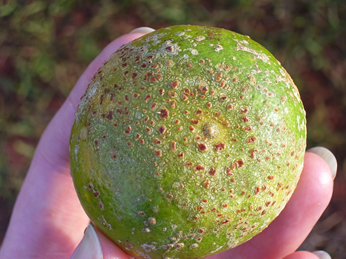
Sweet orange scab (SOS) is a disease caused by the fungus Elsinöe australis. This disease is aptly named as it results in scab-like lesions that develop primarily on the fruit rind and infrequently, on leaves and twigs. Although there is little affect on internal fruit quality, fruit are severely blemished rendering them unsellable in the fresh produce market. Further, the disease can cause premature fruit drop and stunt young nursery trees and new field plantings. The first detection in the United States occurred on July 23, 2010 in Spring, Texas, near Houston in residential lemon and tangerine trees. A widespread survey was launched immediately. SOS has now been confirmed in Louisiana, Florida, and most recently, Arizona.Now it has been discovered in southern e California.CDFA reports finds in two additional locations since the initial find in Imperial County in October. The new finds were on grapefruit collected in a residential area of Los Angeles County and from a commercial grapefruit grove in Riverside County on Nov. 1.

Federal Order For California Dairy Operators?

Western United Dairymen President Tom Barcellos has made arrangements to hold an informational meeting with Deputy USDA Administrator Dana Coale and her team in Tulare next Thursday, Jan. 16, at 1 pm.  Coale and her team will be available to answer questions about Federal Milk Marketing Orders that might be considered for the State of California following passage of a Farm Bill. The meeting will be open to the public and held at the Tulare County Ag Commissioner’s Auditorium located at 4437 S. Laspina Street in Tulare.

Pacific Ethanol On A Roll?

California-grown Pacific Ethanol Inc.’s stock reached the $6 level today up from just $2.50 as recently as mid-November. Pacific Ethanol Inc.’s stock is trading above its 50-day and 200-day moving averages of $3.85 and $3.98, respectively.So what’s going on? The biofuel company may finally be making a profit on low corn prices used to make ethanol. The company recently made an upbeat investor presentation in December.

CEO Neil Koehler said at that time “There has been quite a washout of probably ethanol companies, but we are definitely survivors. I would like to say we have done a very good job of protecting the art of survival and we are ready to take it to the next level.”

He noted that “ethanol (is)the lowest cost transportation fuel in the planet (and in )increasing demand globally and we are exporting that, which has not been (done) in the United States.”In addition, the company says they are moving toward cellulosic ethanol production that offers a better margin with installation of technology by a Visalia company – EdenIQ  – at their several PE plants.

Now there is the indication the company may re-open the idled Madera ethanol plant this year. The 40 million gallon plant was shuttered in January 2009 after operating for less than 3 years.
Clean up activity by a large work crew seen at the Madera facility this week had fueled the speculation of a restart. Spokesman Paul Koehler was quoted here last fall that “we’re getting closer to reopening the ethanol plant. ” Asked about the activity Koehler says there is no news about the plant reopening and that the crews were simply performing maintenance activity.

More Psyllid Finds In Tulare County

Screen shot 2012-05-11 at 8.49.02 AMFreeze Fails To Stop Citrus Pest

Tulare County Ag Commissioner Marilyn Kinoshita says the early December freeze does not seem to have slowed down the citrus pest Asian Citrus Psyllid around Tulare County.

“On December 23 we had 4 new ACP finds near the Richgrove area” south of Porterville,already in a CDFA quarantine zone.

“Then last Friday,January 3,there was a new find in a trap near the Odwalla Juice plant in Dinuba  and a new find at another juice plant in Tipton run by Ventura Coastal and Sunkist.”

”It seems the pest traveled in on juice plant loads.“ Kinoshita says it may not mean the pest comes from fruit that was picked in Tulare County since”this time of year fruit comes in from the southern California deserts” and all over.

Kinoshita says she is not surprised the freeze had not knocked down the psyllid population.”  Local citrus scientist “Beth Grafton-Cardwell told me the pest survived cold spells in Florida too.” The pest has carried greening disease in that state that has caused billions in damage. So far Tulare County has dodged the disease.

While the freeze did not knock out the pest population here, it did a number on the citrus crop. Kinoshita estimates that we lost “15 to 20% of the county’s orange crop.”

Meanwhile inspections of oranges at packing houses has sent 25,000 cartons of citrus to juice plants,meaning it was not suitable for the fresh market. ”We will definitely have a short year and packing houses will probably be out of fruit by March.”Yet to be determined is how the coming Valencia crop fared.

Orange Prices Rise $2/3 Per Box With Freeze,Paramount Cites Supply Issue

Screen Shot 2013-12-12 at 3.07.20 PMReports are still coming in as to the extent of the damage to the citrus crop in the Central Valley from the December 4-10 freeze.
Growers note the cold hit early in the season, when about 75 percent of the state’s citrus crop was still on trees. Luckily fruit had a high sugar content for this early in the year that is a plus in preserving the fruit in cold.
Still,in some areas of Tulare County, all fruit in mandarin groves was described as “toast,” whereas in many navel orange groves, damage appeared more limited. The variability of crop loss reflected factors such as farm location, frost protection methods used, citrus variety and crop maturity.
“We put in tough nights for more than a week or so, with temperatures dropping below 25, and that’s true for growing areas all over the valley,” said citrus grower Greg Kirkpatrick of Exeter, whose family grows citron, Kaffir limes, lemons and tangelos.
“I’m sure there’s damage to our lemons because they are so frost-sensitive and there’s undoubtedly significant damage to lemons throughout the citrus belt,” Kirkpatrick said. “Fortunately, our Satsuma mandarins were harvested before the freeze. Our late varieties—Shasta and Gold Nugget—didn’t have enough sugar to withstand the freeze. We still need to assess the damage, but it may be quite a lot.”
Tulare County officials agreed that mandarins probably didn’t withstand the freeze very well.
“We don’t have official numbers yet, percent of damage or value of crop loss,” said Tom Tucker, Tulare County assistant agricultural commissioner. “We’re still out cutting in the groves. Unfortunately, damage is across the board. There are several fields, especially navels with high sugar, that will show a percentage of damage. In some cases, damage is relatively minor.”
He said other groves are showing almost 100 percent loss, especially mandarins.
Citrus has been grown in the San Joaquin Valley for more than 100 years. The on-farm value of California-grown citrus fruit in 2012-13 totaled $1.5 billion.

Paramount Points to Navel Damage

The states largest citrus grower Paramount Farms sent out a December 20th letter to growers from Zak Laffite VP Supply Chain that said prices are rising reflecting a reduced supply of fruit.While some reports are suggesting damage to navels was minor in most places the Paramount letter says “frost damage on navels has been more extensive than initially thought and finding unaffected fruit is becoming increasingly difficult.”
As for Clementines damage is more scattered than navels the letter says.
Damaged fruit is being sent to the juice market quickly “before it loses its value.”
A substantial amount of Paramount’s holdings are in Kern County that appears to have been harder hit that warmer areas to the north.One press account says” Early inspections of freeze-damaged citrus in California’s Kern County pegged mandarin orange and lemon losses at around 20%, and navel losses at less than 5%.”

Helping to reduce damage seen in past decades is improvement in technology in the filed from irrigation micro emitters to more powerful wind machines.

“In the past decade the industry has made significant advances in technology at the packinghouse,” says Joel Nelsen, Citrus Mutual Board Chairman and General Manager of Orange Cove-Sanger Citrus Association. “We can now see, literally, what damage exists internally in each piece of fruit. This technology has cost most packinghouses hundreds of thousands of dollars, which will reap dividends this year.”

Nevertheless, damage assessment can be an arduous task. Starting in the field, extreme and identifiable damaged fruit will be eliminated from the fresh market and directly shipped to the juice plant. For California citrus, juice plants are, by design, a salvage operation for lower quality fruit. “Sending fruit to the juice plant is certainly not ideal for growers from a revenue perspective,” says Nelsen. “Generally speaking, the return for juiced fruit is only sufficient to cover harvesting costs.”

CCM Director of Industry Relations Bob Blakely says he has heard estimates ranging from 30 to 50% damage to the Valley’s navel crop. Making it worse it has been warm since the freeze , speeding up up deterioration of the fruit he says. Blakely says Kern damage was likely worse than Tulare County since most of the fruit there comes off early and they have not invested in wind machine technology as much.

Watching Prices

As to prices Blakely says he would not be surprised to see a 10% jump in prices noting that it is more expensive to harvest and sort the fruit. Nick Hill managing partner at Greenleaf Farms says he expects prices to rise $2 to 3 dollars a box, not enough to scare away demand.”We learned our lesson from past years that you can’t jack the price up too high.”

CCM says this was  the earliest severe freeze event in over 25 years for Valley citrus growers.

In Fresno County“the damage doesn’t seem widespread, but we are rejecting lots and bins that exceed the tolerance,” said Fred Rinder, Fresno County deputy agricultural commissioner. “Probably the most damage we’re seeing is in the cara cara navels and mandarins. Lemons are spotty and navels are hit and miss too.”
“We’ll be out there doing freeze (inspections) at least through late February,” Rinder said Dec. 19. “We haven’t even started our historically coldest period. We could easily have another freeze by the end of January that would throw everything caddywompus>”

California Farm Bureau contributed to this story

Outlook Turns More Positive For Dairy Farmers

Screen shot 2012-05-31 at 6.50.17 AMFrom California Farm Bureau


With feed costs declining and milk prices strengthening, California dairy farmers say their short-term economic outlook appears to be improving, but their frustration with the state’s current milk pricing system and Congress’ inability to pass a new farm bill projects a more sobering forecast.
Thanks to a bumper U.S. corn crop this year, dairy farmers have seen corn prices drop from a high of $330 a ton last year to the recent $215. This downward trend may help lower the cost of other feeds, said Tulare County dairy farmer Tom Barcellos, although he noted that prices of cottonseed, soybean meal and dry distillers grains have remained strong. Alfalfa hay prices are also still high but have begun to soften, he said.
But falling corn prices coupled with higher milk prices have definitely provided financial relief to producers, he said, even as some dairies are still struggling to stay in business. The current market situation has also allowed dairy farmers an opportunity to use risk management tools, such as locking in their feed cost, he said.
“On an input-and-return basis, there’s room to pay the bills, to have some money left over to catch up or try to weather the next dip in (milk) prices,” Barcellos said. “I’m confident that the outlook is positive. But outlook also changes.”
Corn, including corn grain, silage and gluten, represents 28 percent of a dairy’s total feed costs, according to the latest data from the California Department of Food and Agriculture. Alfalfa hay is about 17 percent, while cottonseed is 6.2 percent and soybean meal is 0.7 percent.
Barcellos said the concern with hay prices lowering too much is that it also increases export demand for hay.
“China is buying as much as they can,” said Michael Marsh, CEO of Western United Dairymen, “and so they’ve been in the marketplace helping to drive up prices for U.S. livestock operators with regard to hay.”
In addition, lack of rain has shortened this year’s California hay crop, keeping prices high, Marsh said. And with more farmland converting to trees and vines, there is also less alfalfa acreage planted to meet the growing demand for hay, Barcellos said.
Despite positive signs in the marketplace that have helped improve profit margins on the farm, dairy farmers said they remain discontented with how their milk price is determined under the state’s current milk pricing system, and are now moving forward with a plan to petition the U.S. Department of Agriculture to replace the state milk marketing order with a federal order.
Marsh said the state’s three dairy cooperatives, which represent 80 percent of California milk production, are now drafting language on such a proposed federal order. But they are waiting for passage of a new federal farm bill because the current House version contains language that would allow California producers to petition USDA and, more importantly, allow them to keep their quota system, which is valued at $1 billion.
Producers attempted through several hearings before CDFA this year to change how dry whey is valued in the state’s milk pricing formula, which they contend underpays them for Class 4b milk compared to what farmers in other states earn under the federal milk marketing order. Each time, the state implemented price increases that fell short of what producers requested.
Dairy farmers also turned to the state Legislature, sponsoring a couple of bills meant to address issues with Class 4b milk, which is used to manufacture cheese. The first one, AB 31, got stalled in the Assembly. The other, AB 1038, would formalize a dairy task force previously established by CDFA to propose changes to the state milk pooling and pricing system. That bill was approved by the Senate in September and moved to the inactive file in the Assembly.
In part because those bills haven’t progressed, Marsh said, he’s “seeing a lot of interest being paid in the producer community to this idea of a federal milk marketing order.” But he said his organization has not given up on trying to fix the milk pricing issue through state legislation, noting that the process to join the federal order could take two to three years.
Barcellos, who is on the CDFA dairy task force, said he is also not ready to throw in the towel with regard to the task force, even though “there’s not a lot of faith (among producers) in what might come out of there.”
The task force is scheduled to have its next meeting in January to discuss options.
CDFA Secretary Karen Ross previously said a group of technical experts has been working on potential alternative pricing scenarios and that the department has contracted University of California, Davis, economist Daniel Sumner to analyze those scenarios. She also indicated that CDFA staff would develop comprehensive pricing proposals by Dec. 15. CDFA spokesman Steve Lyle said those proposals are currently “under internal review” and that the department has yet to determine whether to share the information with the task force or make it public.
While passage of a new farm bill is important to dairy farmers as it relates to their efforts to join the federal order, Marsh said most of the programs in the nation’s farm policy also affect producers. He said farmers need surety on safety-net programs but also, for example, on conservation programs that offer cost-share incentives for air- and water-quality improvements.
But the House and the Senate still need to hammer out differences on the dairy portion of the farm bill. Key among them is a supply management program in the Senate version but not included in the House version.
Marsh and Barcellos agreed that the so-called “dairy cliff,” in which U.S. farm policy would revert to a permanent law established in 1949 if a new farm bill is not passed, is not a likely scenario. That law would require the U.S. government to buy dairy products at about twice the current market rate.
“In order for that to occur, USDA would have to spend several months in rulemaking just to devise the specifications that would be necessary to buy all that product and store it for an extended period of time. And so it’s just not going to happen,” Marsh said.
(Ching Lee is an assistant editor of Ag Alert. She may be contacted at clee@cfbf.com.)

Ag Beat: Orange Prices Rise With Freeze,Paramount Cites Supply Issue / More

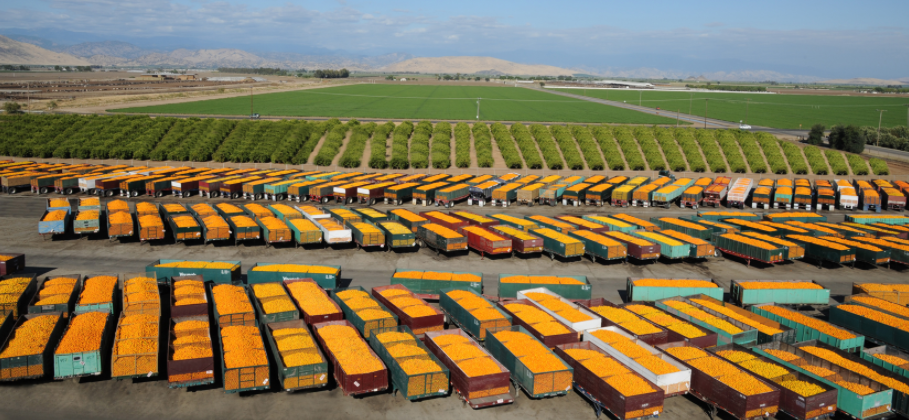
Ffeeze damaged citrus heads to the juice market in Tulare County - photo courtesy Ventura Coastal
Freeze damaged citrus heads to the juice market in Tulare County – photo courtesy Ventura Coastal

Orange Prices Rise With Freeze,Paramount Cites Supply Issue

Reports are still coming in as to the extent of the damage to the citrus crop in the Central Valley from the December 4-10 freeze.
Growers note the cold hit early in the season, when about 75 percent of the state’s citrus crop was still on trees. Luckily fruit had a high sugar content for this early in the year that is a plus in preserving the fruit in cold.
Still,in some areas of Tulare County, all fruit in mandarin groves was described as “toast,” whereas in many navel orange groves, damage appeared more limited. The variability of crop loss reflected factors such as farm location, frost protection methods used, citrus variety and crop maturity.
“We put in tough nights for more than a week or so, with temperatures dropping below 25, and that’s true for growing areas all over the valley,” said citrus grower Greg Kirkpatrick of Exeter, whose family grows citron, Kaffir limes, lemons and tangelos.
“I’m sure there’s damage to our lemons because they are so frost-sensitive and there’s undoubtedly significant damage to lemons throughout the citrus belt,” Kirkpatrick said. “Fortunately, our Satsuma mandarins were harvested before the freeze. Our late varieties—Shasta and Gold Nugget—didn’t have enough sugar to withstand the freeze. We still need to assess the damage, but it may be quite a lot.”
Tulare County officials agreed that mandarins probably didn’t withstand the freeze very well.
“We don’t have official numbers yet, percent of damage or value of crop loss,” said Tom Tucker, Tulare County assistant agricultural commissioner. “We’re still out cutting in the groves. Unfortunately, damage is across the board. There are several fields, especially navels with high sugar, that will show a percentage of damage. In some cases, damage is relatively minor.”
He said other groves are showing almost 100 percent loss, especially mandarins.
Citrus has been grown in the San Joaquin Valley for more than 100 years. The on-farm value of California-grown citrus fruit in 2012-13 totaled $1.5 billion.
Paramount Points to Navel Damage
The states largest citrus grower Paramount Farms sent out a December 20th letter to growers from Zak Laffite VP Supply Chain that said prices are rising reflecting a reduced supply of fruit.While some reports are suggesting damage to navels was minor in most places the Paramount letter says “frost damage on navels has been more extensive than initially thought and finding unaffected fruit is becoming increasingly difficult.”
As for Clementines damage is more scattered than navels the letter says.
Damaged fruit is being sent to the juice market quickly “before it loses its value.”
A substantial amount of Paramount’s holdings are in Kern County that appears to have been harder hit than warmer areas to the north.One press account says” Early inspections of freeze-damaged citrus in California’s Kern County pegged mandarin orange and lemon losses at around 20%, and navel losses at less than 5%.

”Helping to reduce damage seen in past decades is improvement in technology in the filed from irrigation micro emitters to more powerful wind machines.
“In the past decade the industry has made significant advances in technology at the packinghouse,” says Joel Nelsen, Citrus Mutual Board Chairman and General Manager of Orange Cove-Sanger Citrus Association. “We can now see, literally, what damage exists internally in each piece of fruit. This technology has cost most packinghouses hundreds of thousands of dollars, which will reap dividends this year.”
Nevertheless, damage assessment can be an arduous task. Starting in the field, extreme and identifiable damaged fruit will be eliminated from the fresh market and directly shipped to the juice plant. For California citrus, juice plants are, by design, a salvage operation for lower quality fruit. “Sending fruit to the juice plant is certainly not ideal for growers from a revenue perspective,” says Nelsen. “Generally speaking, the return for juiced fruit is only sufficient to cover harvesting costs.”

30 to 50%?
CCM Director of Industry Relations Bob Blakely says he has heard estimates ranging from 30 to 50% damage to the Valley’s navel crop. Making it worse it has been warm since the freeze , speeding up up deterioration of the fruit he says. Blakely says Kern damage was likely worse than Tulare County since most of the fruit there comes off early and they have not invested in wind machine technology as much.
As to prices Blakely says he would not be surprised to see a 10% jump in prices noting that it is more expensive  to harvest and sort the fruit.
CCM says this was  the earliest severe freeze event in over 25 years for Valley citrus growers.
In Fresno County“the damage doesn’t seem widespread, but we are rejecting lots and bins that exceed the tolerance,” said Fred Rinder, Fresno County deputy agricultural commissioner. “Probably the most damage we’re seeing is in the cara cara navels and mandarins. Lemons are spotty and navels are hit and miss too.”
“We’ll be out there doing freeze (inspections) at least through late February,” Rinder said Dec. 19. “We haven’t even started our historically coldest period. We could easily have another freeze by the end of January that would throw everything caddywompus>” CFB contributed to this report

Tulare/Kings Milk Production Rises

Milk production in Tulare County rose 2.7% in October 2013 compared to October 2012.Kings County production rose 3.3% says CDFA. Meanwhile milk production in San Bernardino continues to fall – down 21% from a year ago.

Chinese Market for US Apples/Oranges Could Open Up

WASHINGTON, Dec. 23, 2013 – Agriculture Secretary Tom Vilsack today reported progress on a number of trade issues with China as a result of the 24th U.S.-China Joint Commission on Commerce and Trade (JCCT), which wrapped up today in Beijing.
The JCCT is the highest level bilateral forum for the resolution of trade and investment issues between the United States and China. Commerce Secretary Penny Pritzker and U.S. Trade Representative Michael Froman co-chaired the JCCT with China’s Vice Premier Wang Yang.
“My discussions with Premier Li Keqiang and other Chinese leaders laid the groundwork for future cooperation related to our shared interests in food security, food safety, and sustainability, as well as the expansion of export opportunities for American farmers and ranchers,” Vilsack said.
At the JCCT, a number of high-priority issues for agriculture were discussed, including access for beef and horticultural products, the approval process for biotechnology products, and import suspensions for four states related to avian influenza.
On beef access, the United States and China reached consensus to continued dialogue, with the intention to restore market access by the middle of 2014.
On horticulture, the Secretary re-affirmed a pathway for re-opening China’s market for Washington apples and California citrus.

Reclamation Acquiring Lands for Endangered Species in Pixley National Wildlife Refuge

SACRAMENTO, Calif. – The Bureau of Reclamation today released environmental documents for the acquisition of lands for inclusion in the Pixley National Wildlife Refuge.
Reclamation is providing $649,250 from the Central Valley Project Conservation Program and the Habitat Restoration Program to help purchase 275 acres of uncultivated grassland and alkali scrub habitat on two parcels of unincorporated land adjacent to the Pixley NWR from voluntary sellers in Tulare County (the Lower Tule River and Pixley Irrigation District).
Upon completion of the acquisition, the parcels would immediately be included in the National Wildlife Refuge System as part of the Pixley NWR. The purchase would protect the federally listed endangered Tipton kangaroo rat, San Joaquin kit fox, and blunt-nosed leopard lizard, threatened vernal pool fairy shrimp, and other sensitive species.

Focus On Raisins At 2014 San Joaquin Valley Grape Symposium – Jan 8

Over the last 10 years, Fresno County farmers have reported increasing raisin moth populations in organic raisin vineyards. Addressing this concern, Kent Daane, UC Cooperative Extension specialist in the Department of Environmental Science, Policy and Management at UC Berkeley, will update growers on the pest’s biology, management and damage at the San Joaquin Valley Grape Symposium Jan. 8 in Easton.
Daane and his research associates followed moth populations in organic and conventional fields to document this observed change and determine if there were any specific causes for increases in raisin moth densities. In a 2013 season study, UC Kearney Agricultural Research and Extension Center entomologists found that spring to early summer pheromone trap catches of raisin moths were prevalent across numerous vineyards, regardless of management practices. However, overall seasonal damage in 2013 was low.
“The primary difference between vineyard sites with or without raisin moth damage appeared to be well-timed and effective insecticide sprays,” Daane said. “One problem for organic sites may be the availability of insecticide materials that have long enough residual activity to control the larvae of adult moths entering the vineyard, and once the larvae are deep inside the grape cluster they are difficult to control.”
In addition to Daane’s report, the San Joaquin Valley Grape Symposium includes the following research updates:
Rootstocks for raisin production by Sonet Von Zyl, Fresno State University
Raisin production canopy management by Matthew Fidelibus, UC Cooperative Extension specialist in the Department of Viticulture and Enology at UC Davis, based at the UC Kearney Ag REC in Parlier
Raisin grape breeding program by Craig Ledbetter, USDA Agricultural Research Service, based in Parlier
Economics of producing raisins, by Annette Levi, Fresno State University
Grapevine trunk diseases and grower survey
The symposium begins with registration at 7 a.m. and concludes following lunch at 1 p.m. at the C.P.D.E.S. Hall, 172 W. Jefferson Ave., Easton, Calif.
Registration is $15 in advance and includes lunch. Registration at the door is $20. To preregister, send the names of attendees and a check payable to UC Regents for $15 each to San Joaquin Valley Grape Symposium, 550 E. Shaw Ave., Suite 210-B, Fresno, CA 93710. To register with a credit card, fill out the online registration form at http://ucanr.edu/sjv2014.

Study: San Luis Reservoir Expansion Would Cost $360 Million

from ACWA
Submitted by Matt Williams on Thu, 12/12/2013 – 3:47pm

Screen Shot 2013-12-19 at 8.38.51 AMA U.S. Bureau of Reclamation report released earlier this month looks at how San Luis Reservoir could be enlarged while also improving the resiliency of B.F. Sisk Dam in the event of an earthquake.
Reclamation’s Draft Appraisal Report considers a scenario where a multi-faceted $360 million project would raise the dam by 20 feet in order to add 130,000 acre-feet to the reservoir’s current capacity of 2.04 million acre-feet. The construction would modify and retrofit the dam embankment and dikes, spillway, intake towers and access bridge.
For more than a decade officials have been exploring the idea that more capacity at the jointly-operated reservoir near Los Banos would help eliminate harmful algal blooms that sometimes occur when water levels are low, and also help California prepare for climate change that necessitates more surface storage. The project also could improve water reliability for farms, cities and other south-of-Delta contractors that receive water from the Central Valley Project (CVP) via the reservoir.
“An expansion of the dam and reservoir would address at least four factors affecting the reliability of CVP deliveries associated with San Luis Reservoir. These factors include water quality in the reservoir, seismic risk to the dam, Delta conditions and regulations affecting the timing and volume of water available to store in the reservoir, and timing and volume of demand for water stored in the reservoir,” Reclamation Mid-Pacific Regional Director David Murillo wrote in a letter about the San Luis expansion study.
Pumping restrictions in the Delta — put in place to protect smelt and other threatened fish — continue to limit how much water is pumped into San Luis and when those deliveries occur. Due to record-dry conditions during 2013 and the pumping restrictions, San Luis has been unusually low this year, just 26% full on Dec. 11, which is only 41% of average for the date.
A 2006 report from the Bureau concluded that B.F. Sisk Dam, completed in 1967, potentially could fail if seismic activity occurs due to its proximity to several faults. A follow-up study identified raising the dam as one potential fix.
Reclamation would like to work with its partners — the California Department of Water Resources, the Santa Clara Valley Water District and the San Luis & Delta-Mendota Water Authority — to further investigate how San Luis can be enlarged.
The Bureau is taking public comment on the Draft Appraisal Report until Jan. 17, 2014. Send your responses to William Aley, 2800 Cottage Way, Sacramento, CA 95825, or email waley@usbr.gov, or fax (916) 978-5094.

More Dairy Processing Investment Coming To Tulare County

Screen Shot 2013-12-06 at 2.32.16 PMWith the world in economic recovery Tulare County dairymen are finally getting some relief on improved milk prices.Meanwhile demand for milk from the nation’s number one dairy county is surprisingly  strong.

This month USDA said US dairy exports were up 52% in October with butter exports up 137%.

“It seems like we are doing something right with more milk powder sales going to export than to the domestic market domestic market  for the first time in 2013” says John Moons, dairyman and  board member of California Dairies Inc – based in Visalia.

The cooperative is making a $55 million dollar investment in the Plaza Drive plant’s third milk powder evaporator over the next few months with a hearing in front of the city planning commission this week.

“On top of that – our butter sales are best ever” says Moons noting that the long time marketing battle to get consumers to select butter over margarine is getting some help from the FDA worried about trans fats in food. Butter has high saturated fat but no transfats.

Increasingly, consumer are going for all-natural butter, especially this time of the year. U.S. per capita consumption of margarine in 2000 was 8.2 pounds, nearly double butter consumption at 4.6 pounds, according to USDA’s Agricultural Fact Book. By 2010 per capita margarine consumption had dropped 56 percent to 3.6 pounds, while butter consumption climbed 10.5 percent to 5 pounds. The co-op’s Tipton plant makes lots of butter for export.

With consumers drinking less fluid milk, dairy processors turn to either cheese and whey as co-products or alternatively, drying milk to powder and making butter with the cream that is left over.

Increasingly, they are turning to all the above.

Making more high grade milk powder is the goal of California Dairies installation of new technology to keep powder shipped to far away places stable on the shelf for longer.

It’s all about China and their surging demand for baby formula ingredients. China just announced that it would relax its one-child policy setting the stage for a renewed population boom in coming years. October dairy products sales to China were up 65% says USDA.

Chinese powder demand began in 2011 after that nation’s melamine-tainted milk powder scandal scared Chinese mothers. The US’s highly regulated industry assures confidence in a safe product.

CDI has more big plans in the works including a search for a site to build a second milk plant in the area says Bush. This would manufacture specific products in high demand like various ingredients used in baby formula.

“Made in the U.S.A.” carries special marketing clout on packages of dairy products in China notes the dairy publication Milkweed.

A recent Fresno State study says milk production employment in the county adds up to 5,858 jobs and labor income of $86.2 million.Domestic and foreign exports come to a cool $1.6 billion for the County.

USDA Providing $1 million to Jump Start Citrus Response Framework

WASHINGTON, December 12, 2013 – The U.S. Department of Agriculture today announced the creation of a new, unified emergency response framework to a (HLB), a serious disease of citrus that affects several U.S. states and territories. This new framework will allow USDA and its many partners to better coordinate HLB resources, share information and develop operational strategies to maximize effectiveness.”USDA listened to the citrus industry’s request for more urgency and greater coordination on the response to HLB and is implementing an emergency response structure,” said Secretary Tom Vilsack. “To jump start this initiative and affirm our commitment to industry, USDA is also providing $1 million to be used in support of research projects that can bring practical and short-term solutions to the growers in their efforts to combat this disease. Through the Specialty Crop Research Initiative of the Farm Bill, USDA has provided $9 million in research to blocking the ability of insects to spread HLB to healthy trees. We need Congress to quickly pass a new Farm, Food, and Jobs Bill that continues to support this kind of research to protect a crop worth more than $3 billion in the last harvest.”The new framework will bring together USDA’s Animal and Plant Health Inspection Service (APHIS), Agricultural Research Service (ARS) and National Institute of Food and Agriculture (NIFA), along with state departments of agriculture and the citrus industry into a Multi-Agency Coordination (MAC) Group for HLB. It will provide industry with a single contact for all the federal and state entities that work on citrus issues and better enable the collective to collaborate on policy decisions, establish priorities, allocate critical resources, and collect, analyze, and disseminate information.The HLB MAC Group will also help coordinate Federal research with industry’s efforts to complement and fill research gaps, reduce unnecessary duplication, speed progress and more quickly provide practical tools for citrus growers to use. HLB, also known as citrus greening, is named for the green, misshapen, and bitter-tasting fruit it causes. While this bacterial disease poses no danger to humans or animals, it has devastated millions of acres of citrus crops throughout the United States and abroad. In the United States, the entire States of Florida and Georgia are under quarantine for HLB, and portions of California, Louisiana, South Carolina and Texas are also under quarantine for the disease. The U.S. Territories of Puerto Rico and the U.S. Virgin Islands are under HLB quarantines as well.