Ag updates: dairy news / raisins / more

-May 1,2020-

Help for dairy industry

from WUD

Screen Shot 2020-05-01 at 7.49.56 AMCongressman Jim Costa worked on a proposal this week to assist the California dairy industry through the coronavirus crisis. The plan is very much in line with what IDFA/NMPF submitted to USDA a few weeks ago, and what WUD, CDC and MPC supported. The key component of Congressman Costa’s effort is to remove the cap of $125,000 per commodity. The second is to focus on a at direct payment of $3/cwt for dairies who demonstrate a reduction on in milk marketings of 10% from March 2020’s volume. The last focal point is to enhance the volumes of dairy products being purchased by USDA for distribution on to food banks and other feeding programs.
In a letter of support California cooperatives and trade groups wrote “Due to the perishability of raw milk, this sudden collapse in market demand leaves the industry with two sobering choices: (1) convert the milk into soaring inventories of storable, manufactured dairy products that will overhang the market for months (or even years) to come, extend- ing this industry crisis well into the future; or (2) dispose of the raw milk at a total loss to the farmers. The industry – both at the farmer and processor level – has come together in unprecedented fashion to explore alternative paths, including common sense proposals to both incentivize temporary reductions ons in on-farm production of milk and distribute built up inventories of excess products to food banks and other nonprofit feeding programs. “

Dry milk powder price slumps

from WUD

The past week USDA’s nonfat dry milk price lost 4.64 cents, to $0.8851/lb. CME prices, sadly, also continued their decline, losing 2 cents to $0.8050/lb. The unpleasant trend is also observed abroad. Ac- cording to DMN’s survey, the average skim milk powder price in Oceana dropped 11 cents in the last month. S ll, the price stands higher than ours at $1.12/lb. Europe is doing quite as well, losing 5 cents in the last month to $0.80/lb.

General Mills plans to close its Carson, Calif., yogurt manufacturing facility in the third quarter of fiscal 2020 as part of a broader set of restructuring actions approved by the Minneapolis-based company. Established in 1979, the Carson facility makes Yoplait and Mountain High yogurt products.

Dairy Farmers of America, the nation’s largest milk producer cooperative, has estimated as much as 8% of US daily milk output was being dumped in recent weeks.

Lowest price since 2009

The Class 4 #milk base price paid to #dairy farmers in April is $11.40 cwt. That is the lowest Class 4 price since Sept. 2009 at $11.15 cwt. The last time the Class 4 price was this low was in 2009 when it was $9.82.

Low milk price & surplus volume lead to increase in cattle slaughter

With the significant price drop coming to milk checks in April, and the request by many processors to curb milk production, it is not surprising to see that cattle slaughter was up in recent
weeks. In particular for Region 9 (which includes California, Arizona, Nevada and Hawaii), dairy cattle slaughter in the last few weeks was up an average of 26% year-over- year.

Raisins get low marks in pesticide survey

A twist to this year’s report from the Environmental Working Group is that it does no involve fresh produce. Rather it is focused on a dried fruit this year: raisins.

Of the non-organic raisins tested by the USDA 99 percent had residues of at least two pesticides, as did 91 percent of organic raisins, according to the EWG statement.

“If we included raisins in our calculations, they would be number one on the Dirty Dozen,” said EWG toxicologist Thomas Galligan. “Although raisins are a popular snack, consumers concerned about their pesticide consumption may want to consider buying fresh or frozen produce from our Clean Fifteen list instead.”
The groups’ annual report draws skepticism from the produce industry.

This year’s report says “Almost every sample of non-organic raisins tested – 99 percent – had residues of at least two pesticides. On the 2020 Dirty Dozen, raisins would rank worst of all fruits tested, including strawberries, nectarines, apples and cherries, all of which had residues of two or more pesticides on at least 90 percent of samples.”

Just the opposite of the Dirty Dozen in the ranking is what the EWG calls the “Clean Fifteen,” which were found to have the lowest amounts of pesticide residue. For example, less than 2% of conventional avocados and sweet corn had any pesticide residue.

One group which argues that pesticides do not present a significant risk to the consumer is the Alliance for Food and Farming, a California-based organization of commodity boards, major farm groups and individual growers. In a press release, the group said the list has the capacity to “invoke misplaced safety fears” and that it “causes misplaced concern about whether conventionally-grown fruits and vegetables are safe to eat.”

Visalia ag firm fined

WASHINGTON April 30, 2020 – As part of its efforts to enforce the Perishable Agricultural Commodities Act (PACA) and ensure fair trading practices within the U.S. produce industry, the U.S. Department of Agriculture (USDA) has filed an administrative complaint under the PACA against Old West Export Inc., BB #:206764 Visalia, CA.
The company, operating from California, allegedly failed to make payment promptly to five produce sellers in the amount of $1,059,875 from March 2018 through November 2018.


Ag briefs: not pretty

-April 17,2020

Politico reports that USDA is planning to spend nearly $2 billion to purchase agricultural commodities to help get surpluses to food banks

Screen Shot 2020-04-17 at 11.27.39 AM Screen Shot 2020-04-17 at 11.27.17 AM

Land O’Lakes has removed the image of a Native American woman from its label replacing it wth a scene from, of course, a lake.


LA ports report slowdown

Screen Shot 2020-04-17 at 11.29.36 AMThe Port of Long Beach continued to feel the economic effects of COVID-19 in March with more canceled sailings and a decline in cargo containers shipped through the nation’s second-busiest seaport.

Terminal operators and dockworkers moved 517,663 twenty-foot equivalent units (TEUs) last month, a 6.4% decline compared to March 2019. Imports were down 5% to 234,570 TEUs, while exports increased 10.7% to 145,442 TEUs. Empty containers shipped overseas dropped 21% to 137,652 TEUs.

Overseas health concerns over the coronavirus caused 19 canceled sailings to the Port of Long Beach during the opening quarter of 2020, which contributed to a 6.9% decline in cargo shipments compared to the first three months of 2019.

At the site Port of LA ,they moved 449,568 Twenty-Foot Equivalent Units (TEUs) in March, a 30.9% decrease compared to last year. For the first quarter of 2020, volumes have decreased 18.5% compared to 2019. It was the lowest amount of monthly cargo moving through the Port since February 2009.


“We’ve had two serious shocks to our supply chain system. First the trade war between the U.S. and China and now the COVID-19 pandemic,” said Gene Seroka, Executive Director of the Port of Los Angeles. “With U.S. retailers and cargo owners scaling back orders, volumes are soft even though factories in China are beginning to produce more. Amidst this public health crisis, there will be uncertain months ahead in the global supply chain.”

Tractor sales stall

Screen Shot 2020-04-17 at 11.31.33 AMUnit sales of agricultural tractors and self-propelled combines in March 2020 fell across the board in the U.S. and Canada according to the latest data from the Association of Equipment Manufacturers.
U.S. total farm tractor sales decreased 15.6 percent in March compared to 2019 while U.S. March self-propelled combine sales fell 11.9 percent. That includes decreases in all segments, with combines and 40-100hp tractors (-15.2 percent) performing the best.

When compared to similar industries, like the U.S. auto and light truck market where the U.S. Bureau of Economic Analysis shows March unit sales having fallen nearly 42 percent overall, and a similar drop in U.S. heavy truck sales according to the St. Louis Fed, farm tractors and self-propelled combine unit sales are in better shape.

“Although the March numbers were likely impacted by COVID-19, It is too soon to tell the long-term impact of the current crisis on at equipment sales,” said Curt Blades, senior vice president of Ag Services at the Association of Equipment Manufacturers. “AEM has been working diligently to ensure agriculture is declared an essential industry by the governments in North America.  As a result, our number one priority as an industry right now is doing what we can to meet the needs of farmers during planting time while keeping our employees and customers healthy.”

Ag beat updates: Gloomy outlook – Ag has stay-at-home remedies

Farmer Sentiment Plummets as Coronavirus Concerns Rise

Center for Commercial Agriculture

Screen Shot 2020-04-08 at 7.38.26 AM

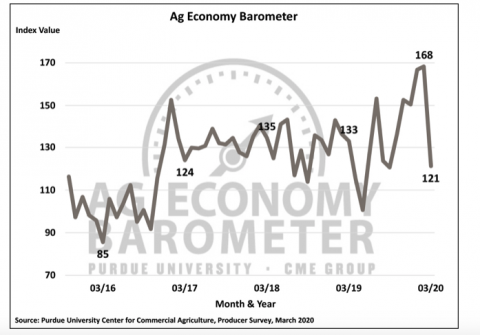
The Ag Economy Barometer plummeted in March, dipping 47 points (28%) from a month earlier to a reading of 121. The point drop was the largest one-month fall in the life of the index, which dates to October 2015. Declines in agricultural commodity prices and concerns about the coronavirus crisis impact on the U.S. economy and agricultural sector weighed heavily on farmer sentiment in March. This month’s decline in the barometer erased the sentiment improvement that took place this past fall and winter and leaves the index unchanged from its September 2019 reading. The Ag Economy Barometer is generated each month from 400 U.S. agricultural producers’ survey responses. This month’s survey was conducted from March 16-20, 2020 as the coronavirus crisis escalated in the U.S. and around the world.

Consumers at home – how to respond?

Panera announced the launch of Panera Grocery on Wednesday, selling high-demand staple items like milk, produce and bread. Customers can order the items alongside items from the Panera menu and have it delivered or made available for pickup. Panera At Home products are also available at the local grocer. Retailers like Walmart Inc. WMT, -3.23% and Kroger Co. KR, -2.36% have seen traffic to stores soar in the wake of the coronavirus pandemic, which has consumers staying, at eating, more in the home. Politico

Fruit processors work to keep up with rising demand
Shelf-stable foods such as canned peaches and pears have seen demand leap during the pandemic. The head of the California Canning Peach Association says retail demand the past month has been “unprecedented.” Processors have changed their operations to replenish depleted store shelves and ship products quickly to retail customers. School districts are using fruit cups in the “grab and go” school meals they provide to students. CFB
At nurseries, sales of edible plants jump sharply
The pandemic has brought a sharp shift in demand at retail nurseries and garden centers. Sales of landscaping plants have slumped, but sales of vegetables, herbs, fruit trees and other edible plants have skyrocketed. One nursery owner described sales of vegetable plants as “crazy—off the hook.” Nurseries say many of their sales have been to first-time gardeners who hope to avoid trips to the supermarket by growing more of their own food. CFB
Time spent on food preparation increases
Americans have already been devoting more time to food preparation, even before restaurants constricted operations and people were advised to stay at home. A new study by the U.S. Department of Agriculture says the amount of time people devoted to food preparation increased 18% in a decade’s time—to about 27 minutes a day. The time span for the study predates the COVID-19 crisis.CFB


Breakfast staples popular as consumers pile into comfort food at home

-April 3,2020-

Screen Shot 2020-04-03 at 8.11.56 AMMany farm commodities are hurting this week but not some familiar breakfast favorites – eggs, potatoes and orange juice. Consumers looking for comfort food to make at home have juiced up demand for these sunny-side favorites.
During the COVID-19 crisis with restaurant dining rooms shut down, consumers have more time to cook, and they’re turning to potatoes.It’s not just Idaho that grows spuds.

In 1980 there were 30,000 acres of potatoes grown in Kern County but that is down to around 15,000 acres – mostly reds, whites and golds with harvest beginning in just a few weeks.Shafter used to call itself “capital of the potato world.”

Likewise demand for eggs has shot up with some farmers reporting selling 150% of their average  shipments. Average retail  price in California  is close to $4 a dozen for large – if you can find them. “We expect that demand is starting to level off. The shelves are getting replenished,” said Marc Dresner, with the American Egg Board.

As the COVID-19 pandemic led people to rush to the store to buy essentials, including eggs, that drove both the supply of eggs down and the price of eggs up.

Red ink for milk, other farm commodities

Old McDonald still has a farm but wherever he looks he sees red ink this week…E-I-E-I-O. That’ moo-moo there’ is no help either.

Despite new consumer interest in fluid milk, milk futures on the CME for May are down to $12.70 per cwt compared to near $18 in February. One analyst says prices are so low “unless creditors are exceedingly patient, the industry is likely to suffer a tidal wave of sellouts.”The worst year for the Tulare County dairy industry was 2009 when the average milk price was $11.40 per cwt after a global financial meltdown.

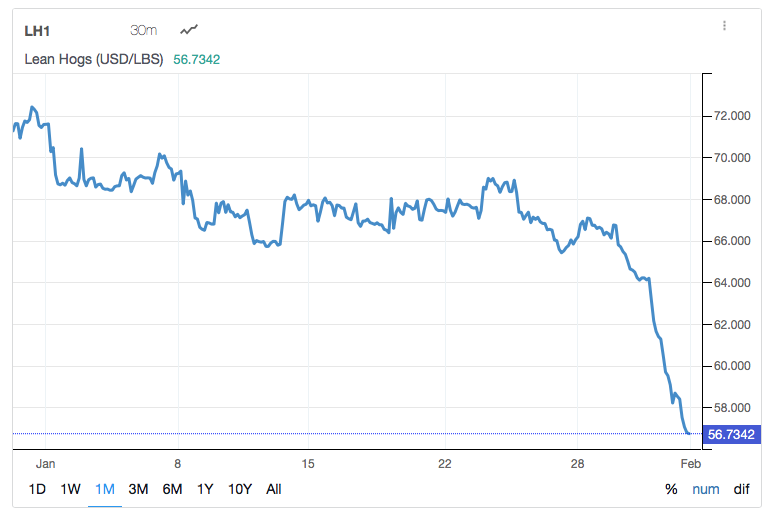
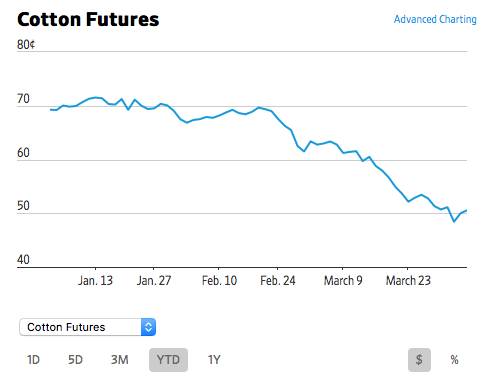
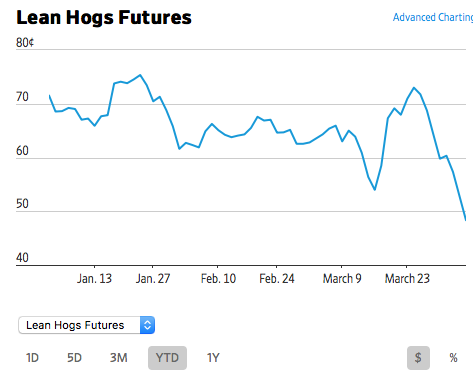
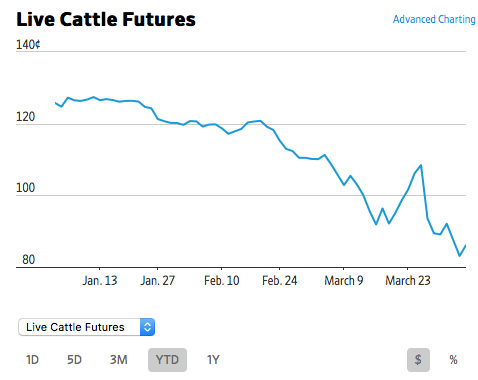
Most of the major ag commodities from cotton to corn, cattle to hogs are suffering multi-year lows this week as well. Her are the latest futures charts as of April 3.

Screen Shot 2020-04-03 at 7.35.56 AM

Screen Shot 2020-04-03 at 7.36.38 AM Screen Shot 2020-04-03 at 7.36.22 AM
Screen Shot 2020-04-03 at 7.35.07 AM

Freight rate up

From Food Business news

KANSAS CITY — Rates to move freight by truck have risen amid a surge in demand to move larger amounts of certain food staples and medical relief supplies quickly due to the coronavirus (COVID-19) pandemic. Restrictions on travel have both helped and hindered those efforts, while logistics play a key role in limiting the chaos caused by COVID-19.

“We’ve traded speed for price,” said Jim Ritchie, president and chief executive officer of Redstone Logistics, a North American truckload brokerage, logistics management and supply chain consulting service based in the Kansas City area. “If you want to move something fast, you turn to trucks.”

He said rail freight demand has dropped off while orders for truck freight have seen a net increase amid a shift in orders.

Trucking rates have increased about 7% to 8% during the pandemic, Mr. Ritchie said, although fluctuations have been common. Much higher increases for “immediate freight” have been noted in some cases. He expects freight demand and rates will moderate in coming weeks whether or not new cases of COVID-19 have peaked and panic buying subsides.

 Virus scare sends poultry workers home

CHICAGO, April 2 (Reuters) – U.S. poultry company Sanderson Farms Inc on Thursday said it is reducing chicken production in Georgia, the top U.S. chicken-producing state, after ordering more than 400 slaughterhouse workers who seem healthy to stay home as a precaution against infection by the novel coronavirus.

The move could eat into margins at the company and is an early sign of strain in the U.S. food supply chain at a time of surging consumer demand at grocery stores.

Sanderson Farms is cutting chicken processing to 1 million birds a week from 1.3 million over the next four weeks in Moultrie, Georgia, after telling 415 workers to stay home with pay, Chief Executive Joe Sanderson said on a conference call.

The workers live in Dougherty County, a “hotbed” of coronavirus cases, although there are no indications they are not healthy, he said.

Flower sales wilt

Amid cancellations, flower sales plummet

California Farm Bureau

Issue Date: April 1, 2020
By Kevin Hecteman

Allan Nishita, co-owner of Flora Fresh in Sacramento, looks over peach-blossom branches in one of his coolers. These branches would normally be used in decorative arrangements, but with events such as weddings being postponed or canceled because of the COVID-19 pandemic, sales have dropped and Nishita has been scrambling to keep his wholesale company’s doors open.
Photo/Kevin Hecteman

The COVID-19 pandemic has not been kind to California flower growers.

“Our sales are way down,” said Ivor Van Wingerden, who runs the Nipomo operations of Carpinteria-based flower grower Ocean Breeze. “We basically lost 90-95% of sales, and we’re starting to slowly move back up.”

His experience is typical, according to Dave Pruitt, chief executive of the California Cut Flower Commission.

“Many of my growers right now are functioning, or trying to function, with 15 to 20% of their business, max,” Pruitt said. “And that happened rapidly.”

Most retail florists have closed, and many events for which people would buy flowers have been postponed or canceled.

Allan Nishita, co-owner of flower wholesaler Flora Fresh in Sacramento, said business dropped particularly in the past two to three weeks, as wedding and event planners canceled orders.

“That’s why I have so much product, because all the weddings were canceled,” Nishita said. “Any kind of major gathering or event was canceled.”

California accounts for 80% of domestic flower production, Pruitt said, but some of the state’s 120 growers face closure due to pandemic-related losses.

“I have one company that just told me they’ve closed permanently,” he said, “and I will get more.”

Flower grower Mike Mellano of Oceanside has suspended most operations.

“This crisis couldn’t have hit at a worse time,” Mellano said. “We were on a record pace for sales, and within about three or four days, we went from record pace to less than 10% of historical.”

Coupled with that was “a tremendous amount of unpredictability,” he said, which led him to suspend most business activities except for irrigation and pest control.

“A big percentage of our crop mix are perennials that will be alive and viable a month from now, two months from now,” Mellano said. “The challenging part of it is, a big part of it won’t be sold because the sales that we’re missing in this window are not recoverable.”

Annuals, he noted, “are going by the wayside every day.”

Van Wingerden said wholesalers have also been hit hard.

“A lot of those guys are event-based, and events are nonexistent,” he said.

It got to the point where Nishita considered closing up shop before he changed his mind and kept the doors open for those customers still shopping for flowers. He’s practicing social distancing at the workplace and wiping down common areas, and noted that employees still working want to be there.

“A lot of people thought people in the flower business aren’t essential, but we’re part of agriculture, and I believe we are essential,” Nishita said.

Van Wingerden said work in his greenhouse continues, although he’s had to reduce hours to cope with the slowdown in sales.

“I grow lilies, which we basically plant three and a half to four months ahead,” he said. “We have gerbera daisies, which is a perennial crop that lasts about three years in the greenhouse. You have to keep harvesting the crop, or else you have issues with the plant later. We still have work to do.”

He said he’s worried about what should be the highlight of the season.

“What is Mother’s Day going to look like?” Van Wingerden said. “Mother’s Day is our busiest holiday of the year, and we plant a lot.”

Moving flowers to market is also proving difficult. Pruitt said most flowers travel by truck, and finding space has become difficult as motor carriers stop picking up flowers.

“The whole chain of distribution is breaking apart,” he said. “We can move product within California, and some of our growers are actually online providers, so they’re working with their online companies.”

Some farmers have online traffic, but rely more heavily on wholesale distribution to sell flowers; in addition, the major flower markets in San Francisco and Los Angeles have been forced to close because of local shelter-in-place orders, shutting off a major avenue of distribution.

Mellano said his business is monitoring markets and staying in touch with customers.

“As soon as we see some daylight, then we hope to start backfilling with staff and, on a limited basis, scale back up as the opportunities present themselves,” he said.

Van Wingerden said he’s looking at more direct-to-consumer sales; the pandemic has forced him and other growers to come up with new business models on the fly. The big unknown, he said, is how long this will last.

“We’re figuring stuff out,” Van Wingerden said. “We don’t have the answers. No one does.”

As a result, some farmers and wholesalers have resorted to giving the blooms away.

Van Wingerden said he found himself with 20,000 stems of gerbera daisies with nowhere to go, so he called a friend who works as an emergency-room doctor in Santa Maria.

“I brought a truck, and he knew a place we could park it,” Van Wingerden said. “He told all the nurses, ‘Hey, go over there after your shift and take as many gerberas as you want.’ That was great.”

He also left flowers on doorsteps near his Nipomo greenhouses, with notes.

“We prefer this to be in someone’s home than in the compost pile,” Van Wingerden said.

Nishita also cleared space in his coolers by holding a floral giveaway.

“We decided that, since it’s not going to move and it’s all beautiful product from California and around the world, that we’re just going to share the beauty,” Nishita said. “Hopefully, our customers will come here and pass it along, because these are dark, dreary times, and that’s one thing that we provide in this industry, is emotion and beauty and joy and a good feeling.”

The California Cut Flower Commission maintains a list of flower farms open and shipping to wholesalers and retailers at ccfc.org.

(Kevin Hecteman is an assistant editor of Ag Alert. He may be contacted at khecteman@cfbf.com.)

More winegrapes could go unsold, analysts believe

-March 3,2020-

From CFB

By Steve Adler

pastedGraphic.png

Harvest of the vineyard stopped partway through, right, when the grower reached his contract limit. The rows on the left were unharvested. This was not an isolated occurence in 2019. Photo/Jeff Bitter

With the amount of winegrapes that went unpicked in 2019, the message to grape growers from marketers and vineyard managers is clear: Without a winery contract, grapes could easily not have a buyer this year.

Winegrape experts such as Jeff Bitter of Allied Grape Growers; Duff Bevill, a vineyard manager in Healdsburg; and Dana Merrill, a vineyard manager in Paso Robles, all echoed the same message—there were more winegrapes left on the vine in 2019 than ever before.

“Growers with contracts, which I would say is probably the majority of winegrape growers, are probably in the black, and I wouldn’t be too concerned about them,” Bitter said. “The growers that do not have contracts and are on the spot market are going to be very challenged to operate in the black this year.”

Bevill cited an example: A grower with 100 rows of high quality grapes stopped picking after 86 rows, when he reached the winegrape tonnage amount called for in his contract.

“If a winery had a contract for 100 tons, they told the grower to not bring in 101 tons,” he said. “In 2019, there were just more grapes that didn’t have contracts. The supply chain was full. Growers in certain areas, like the Central Valley, had the option of taking out a vineyard and planting something like almonds.”

However, in regions such as the North Coast and Central Coast, such crop changes are not readily an option because of climate and topography.

The three analysts noted that in many instances, wineries are opting not to renew contracts and instead deciding to explore other options. That means winegrape growers whose contracts concluded in 2019 need to prepare for 2020 and beyond, they said.

“Of course, growers already knew that demand had diminished over the last two years,” Merrill said.

About halfway through last year, he said, it was pretty obvious the market was slow and growers became more focused about where they were going to have to make tough decisions.

“I don’t think that you can say a grape is a grape is a grape,” Merrill said, noting that in some instances farmers in a certain appellation or sub-region might grow a variety that “actually still has some decent demand and wineries might have specific needs that they want to fill.”

Wineries will pay higher prices for what they really want and need, but have become very selective, he said.

“If you have the right variety, vineyard, location and age of vines—virus free is critically important now—it is much easier than if you don’t,” Merrill said.

This year, he said, a number of farmers are deciding to step away for a year or two before deciding what to do next.

“So my message is that now is the time to pull diseased, old, lower-quality vineyards with no buyer. It is like having a modern, new, efficient factory versus trying to compete with an obsolete, inefficient factory in now more competitive times,” Merrill said.

Providing a general overview, Bitter said it is important for everyone in the business to realize the oversupply of wine is a statewide challenge and not specific to any particular region.

“I’ve seen a marked increase in vineyard removal in the coastal areas, but also in Lodi,” he said. “We’re estimating at least twice as many vineyards will come out of the Lodi area than have been pulled in recent years. In the Central Valley, we’ve been pulling at a pretty high rate over the last few years, and that’s going to continue.”

Bitter said the current wine surplus did not result from a decrease in wine sales.

“I guess part of the misconception about the wine industry is that people are maybe mischaracterizing what’s happening and thinking that we’re selling less wine. That’s not actually the case. We’re not necessarily selling less wine, we’re just not selling as fast as we have been for the past two decades,” he said.

That, Bitter said, has created the imbalance in supply and demand, as everyone had anticipated the status quo to continue.

“We’re just kind of flat now, but we’re not actually losing shipments year on year,” he said. “But the extra inventory that’s out there today in grapes and wine is providing an opportunity for negotiation to come in and purchase the supply cheap.”

He predicted that people will “see brands that you’ve never seen before, and they will be very affordable and they’ll probably be pretty good quality. But most likely, they’re going to be flash-in-the-pan brands, because as soon as the extra inventory dries up, they may go away.”

This year’s winegrape crop has just begun to develop, as growers report the beginning of budbreak on the vines.

With an early budbreak, another potential situation of concern looms: a late frost that could wreak havoc on tender, young shoots.

“If we get freezing cold, that could set us up for some devastating damage if we get a late frost with an early bud break—and that has happened in the past,” Bitter said.

Bevill noted that frost in his region could materialize as late as May 15.

“So, if you start bud break in February and May 15 is your last average frost, you may be losing sleep this spring,” he said. “It’s definitely very early in the season, so we’ll have to keep our eye on things, that’s for sure.

“And hopefully we get a lot of rain in March,” he said.

China to Exclude 301 Tariffs for Oranges

-February 26.2020-

From California Citrus Mutual –

Expected to drop from 70% to 35%

-The break the citrus industry needed is likely to come soon as China announced on Tuesday the tariff exemption process that will be effective March 2, 2020. The high tariffs going into China had been a significant impediment for exports, as well as further creating an oversupply situation on the domestic market. Up until a recent 5% reduction, citrus was facing additional tariffs of 50% going into China. The exclusion will allow importers relief on the 301 portion of the tariffs, which amounted to 35% of the additional tariff that was in place on September 1, 2019. After the exclusion process, the tariff going into China will amount to 26% plus the Value Added Tax (VAT), which is 9%.

With a major portion of the retaliatory tariffs removed for citrus and the Phase One commitment to purchase additional agricultural products, the remainder of the citrus season should see significant improvement. The major impediment to moving citrus to China will shift from the trade dispute to the coronavirus outbreak in China.

Orange Tariffs on September 1, 2019

Tariffs

Notes

11%

Existing Tariff

15%

232 case

25%

301

10%

Additional 301

9%

VAT

70%


Orange Tariffs after Exclusion March 2, 2020

Tariffs

Notes

11%

Existing Tariff

15%

232 case

9%

VAT

35%

Ag beat: Bankruptcies climb

-February 5,2020-

Oak trees may hold answer to devastating citrus disease

from CFB
Scientists have found that applying oak leaf extracts inhibits the bacterium that causes the devastating citrus crop disease huanglongbing, or HLB. The disease has reduced Florida’s citrus crop by 90% and led to plant quarantines in Southern California after being found in residential citrus trees. Scientists from the University of Florida and the U.S. Department of Agriculture investigated oaks after farmers observed citrus trees planted near oaks survived HLB.

Fluid milk/ice cream consumption shrinks again / Cheese saves the day

A new USDA report say fluid milk consumption in the US was down in 2018 to 146 pounds continuing a long trend downward from 150 pounds in 2017, 178 pounds in 2000 and 247 pounds per person in 1975. That is a drop of over 40% from 1975.

In the ice cream category it is a similar story.In 1975 per capital consumption stood at 18.2 pounds per person – now down to 11.8 pounds in 2018. That  too is around a 40% decrease.

So what dairy categories are up? Yogurt for one up from 2 pounds  per person in1975 to 13.4pounds in 2018. Speciality cheese including mozzarella is way up from 6 pounds in 1975 to 22.5 pounds per person in 2018. That  is almost a 4-fold increase. American cheese consumption has about doubled. 

China exports down  -Now what?

China imported $29 billion worth of farm commodities from the US in 2013, $24 billion in 2017, and less than $10 billion in 2019. President Trump in October 2019 said that China would import $50 billion worth of farm commodities a year by 2021, which experts say could happen only if China removes restrictions on US beef and pork.But this week White House National Economic Council Director Larry Kudlow said he expected the fallout from the deadly coronavirus to delay—but not derail—the economic boost the U.S. anticipated from the first phase of the trade deal with China.

State to offer 5% increase for Cooperative Extension

After snubbing the agency last year, Gov. Gavin Newsom has slipped a 5 percent increase for the University of California’s Division of Agriculture and Natural Resources into his $222 billion overall budget proposal for 2020-21.

The boost would mean an increase of $3.6 million annually for UCANR to begin rebuilding its ranks of researchers and educators working with growers, said Glenda Humiston, the division’s vice president.

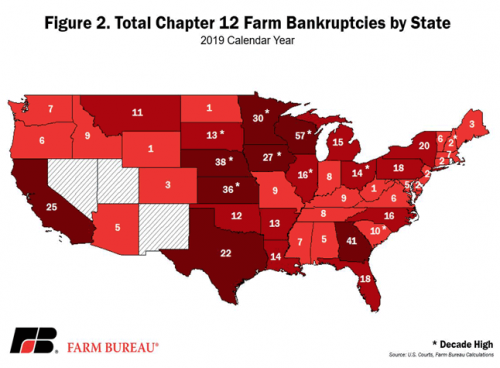
Farm bankruptcies climb 20%

Screen Shot 2020-02-05 at 7.09.42 AMOMAHA (DTN) — Though the number of farms filing Chapter 12 bankruptcy increased in 2019 from the previous year, an American Farm Bureau Federation analysis found the number of filings in the fourth quarter fell from the previous two quarters.

The agriculture economy is coming off five years of falling commodity prices and weather disasters on top of trade and federal biofuel policy uncertainties.

The AFBF analysis released on Wednesday shows overall Chapter 12 farm bankruptcy filings increased from 2018 to 2019 by about 20%. It is the largest increase in filings since 2010 when Chapter 12 filings increased by 33% coming off the recession of 2009.

There were 595 Chapter 12 filings in 2019, according to AFBF’s review of court data, or about 100 more than in 2018. The highest number of filings in recent years was in 2011, when 637 farms filed for Chapter 12.

So, in 2019, there were 2.95 bankruptcies per 10,000 farms, just below 2.99 in 2011. There are a little more than 2 million farms in the United States.

AFBF Chief Economist John Newton told DTN the group will continue to watch Chapter 12 filings closely.

“Until things start to show general signs of improvement, we’ll continue to do so,” he said.

The rate of filings was much higher in 1987, the year after the Chapter 12 provision was created. According to AFBF, the rate stood at a little higher than seven bankruptcies per 10,000 farms in 1987.

Are you better off?

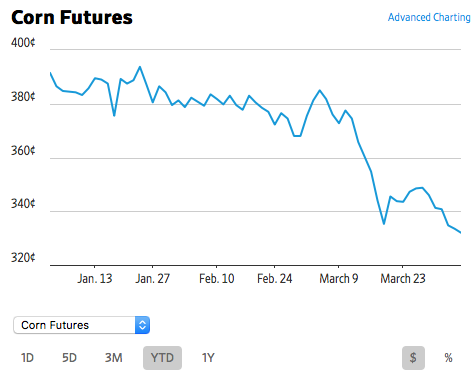
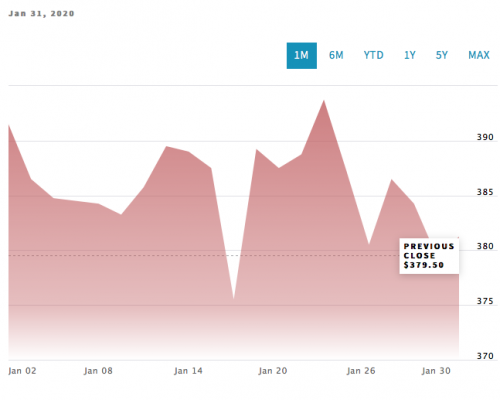
Screen Shot 2020-02-01 at 5.55.42 AMCORN

January 31,2020

Farmers asking a familiar question as crop futures head south

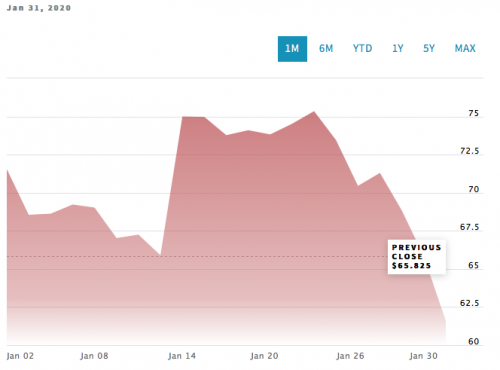
Farmers let out a  heart felt sigh of relief when President  Trump recently announced a pause in the two year old trade war with China , one of  our largest trade partners.  But since then the markets have signaled that they are concerned   this may not be the big relief they have waited patiently for. Here are the latest futures prices showing a similar pattern for corn, soybeans,cattle and and hogs – down.

LIVE CATTLE

Screen Shot 2020-02-01 at 5.57.30 AM

SOYBEANS

Screen Shot 2020-02-01 at 8.27.00 AM

Lack of employees slows peach pruning

from California Farm Bureau

-January 30,2020-

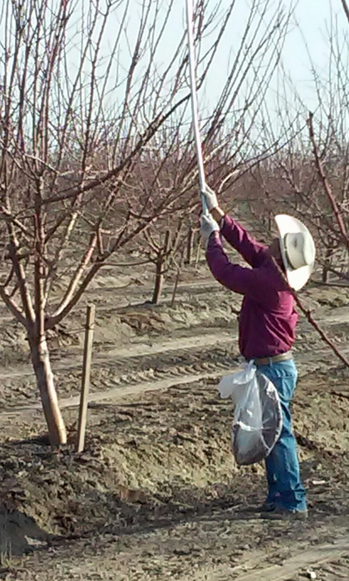
Screen Shot 2020-01-30 at 8.08.06 AMRising employment costs have added to the pressures on California canning-peach farmers, who say additional expenses and regulations complicate efforts to make growing the crop pencil out.

Stanislaus County farmer Eric Spycher, who grows cling peaches, almonds and walnuts in Ballico, said of his peach crop, “The biggest challenge is labor. I mean the cost and the availability are both equally challenging.”

Standing in an orchard of the Kingsburg Kling peach variety last week, Spycher checked in with employees who were undertaking the important job of pruning trees. Spycher said the pruning was about one-quarter complete, with a much smaller crew.

“We have about eight pruners and in the past we’ve had as many as 40, so we’re really careful with our schedules for pruning and are trying to keep the guys working all of the time,” he said. “We don’t have a lot of extra help.”

Sutter County peach farmer Ranjit Davit, who chairs the California Canning Peach Association board, described cling peaches as a labor-intensive crop, requiring trees to be pruned, thinned and harvested by hand—although processors have accepted some machine-harvested fruit in recent years. Davit said employment costs account for 70% of a cling peach grower’s total cultural cost.

“Since mechanization options are limited, our industry continues to be dependent on having a viable labor force available to us in a timely manner,” said Davit, who addressed growers and others last week at the association’s 98th annual meeting Sacramento.

He said the increasing California minimum wage and rules on agricultural overtime pay combine to restrict farmers’ options. In addition to increasing employment costs, Davit said, the workforce has changed considerably in recent years, adding, “We’ve seen decreases in both quality and productivity from the crews working in orchards.”

Mark Burrell, managing partner of the WestMark Group, a strategic consulting firm in Gold River specializing in agricultural business, emphasized that most people working in agriculture earn much more than the base minimum wage, but added, “As the minimum wage moves up, it raises the boat for everybody.”

“It is a fact that California is a high-cost, highly regulated business environment and it is becoming more so,” Burrell said. “It’s not simply the increase in minimum wage, it’s the reduction of the workweek from six to five (days) and the reduction of the workday, from 10 hours to eight hours, that impacts this as well.”

This business environment, he said, is forcing some production out of the country and driving investment in technology and innovation, particularly technology that can reduce employment needs.

“We don’t have a single client that’s not working as hard as they can to identify and adapt technology that’s relevant, that is proven and that will both increase productivity and reduce costs,” Burrell said.

California Canning Peach Association President and CEO Rich Hudgins said that for the cling peach business in California to survive, “Growers must be able to recover higher labor costs in the coming years or find new ways to offset these higher labor costs with more mechanization.” If this fails to happen, he said, “our industry will be doomed to follow the Hawaiian canned pineapple industry into oblivion.”

With an 8% increase in the state minimum wage as of Jan. 1, Hudgins said it is imperative for 2020 peach prices to reflect the higher employment costs growers are incurring. The 2019 grower price of $488 per ton was unchanged from 2018 pricing despite last year’s 9% employment cost increase, he said.

The ultimate key to profitability, Hudgins said, is achieving a more balanced supply/demand position.

“Growers whose contracts expire in 2020 will not have contracts renewed by either Del Monte or PCP following the 2020 harvest,” he said. “In addition, the association has nearly 400 acres of unsold orchards, most of which came out of contract following the 2019 season.”

Assuming additional acres are pulled out before the coming season, the association projects a total of 16,000 bearing acres of cling peaches for the 2020 harvest.

The Canning Peach Association has worked with the U.S. Department of Agriculture to have canned peaches included in a Bonus Buy Program for food-assistance programs. Hudgins said he is hopeful about plans for an additional Bonus Buy from the 2020 peach pack.

Hudgins said the association had helped secure a 25% tariff increase on canned peach imports from Greece, which he said should limit the volume of imports coming into the U.S.

“California peach growers will eventually pay the ultimate price as our domestic markets shrink due to unfairly priced Chinese and Greek canned fruit imports,” he said. “We will continue to be vigilant regarding retailer decisions on sourcing for their store brand products.”

Acknowledging that processors need to be profitable, Davit said growers must also experience profitability to sustain rising employment costs.

“The processors must understand that growers need to see higher pricing in the coming year to offset increases in our production costs and for our continued success,” Davit said, adding, “We must deliver fruit of the highest quality to processors to ensure their continued success.”