
-April 3,2020-
 Many farm commodities are hurting this week but not some familiar breakfast favorites – eggs, potatoes and orange juice. Consumers looking for comfort food to make at home have juiced up demand for these sunny-side favorites.
During the COVID-19 crisis with restaurant dining rooms shut down, consumers have more time to cook, and they’re turning to potatoes.It’s not just Idaho that grows spuds.
In 1980 there were 30,000 acres of potatoes grown in Kern County but that is down to around 15,000 acres – mostly reds, whites and golds with harvest beginning in just a few weeks.Shafter used to call itself “capital of the potato world.”
Likewise demand for eggs has shot up with some farmers reporting selling 150% of their average shipments. Average retail price in California is close to $4 a dozen for large – if you can find them. “We expect that demand is starting to level off. The shelves are getting replenished,” said Marc Dresner, with the American Egg Board.
As the COVID-19 pandemic led people to rush to the store to buy essentials, including eggs, that drove both the supply of eggs down and the price of eggs up.
Red ink for milk, other farm commodities
Old McDonald still has a farm but wherever he looks he sees red ink this week…E-I-E-I-O. That’ moo-moo there’ is no help either.
Despite new consumer interest in fluid milk, milk futures on the CME for May are down to $12.70 per cwt compared to near $18 in February. One analyst says prices are so low “unless creditors are exceedingly patient, the industry is likely to suffer a tidal wave of sellouts.”The worst year for the Tulare County dairy industry was 2009 when the average milk price was $11.40 per cwt after a global financial meltdown.
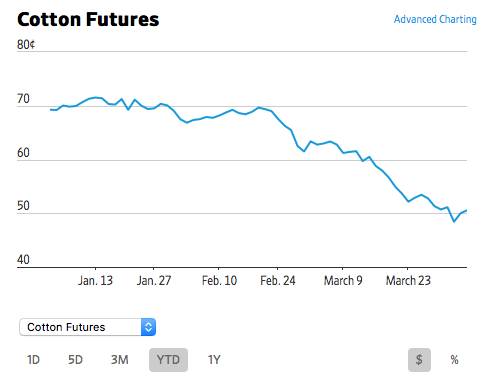
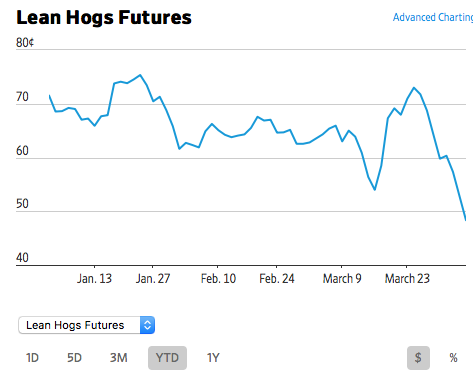
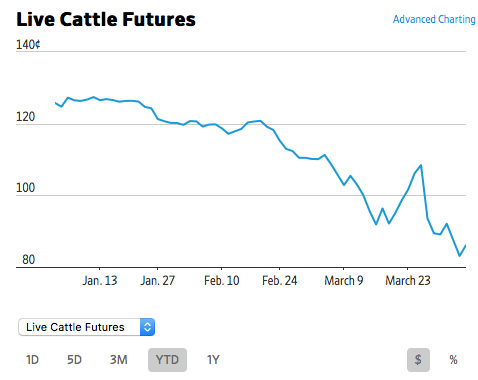
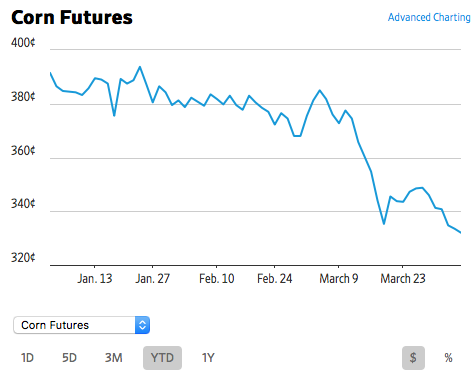
Most of the major ag commodities from cotton to corn, cattle to hogs are suffering multi-year lows this week as well. Her are the latest futures charts as of April 3.
Freight rate up
From Food Business news
KANSAS CITY — Rates to move freight by truck have risen amid a surge in demand to move larger amounts of certain food staples and medical relief supplies quickly due to the coronavirus (COVID-19) pandemic. Restrictions on travel have both helped and hindered those efforts, while logistics play a key role in limiting the chaos caused by COVID-19.
“We’ve traded speed for price,” said Jim Ritchie, president and chief executive officer of Redstone Logistics, a North American truckload brokerage, logistics management and supply chain consulting service based in the Kansas City area. “If you want to move something fast, you turn to trucks.”
He said rail freight demand has dropped off while orders for truck freight have seen a net increase amid a shift in orders.
Trucking rates have increased about 7% to 8% during the pandemic, Mr. Ritchie said, although fluctuations have been common. Much higher increases for “immediate freight” have been noted in some cases. He expects freight demand and rates will moderate in coming weeks whether or not new cases of COVID-19 have peaked and panic buying subsides.
Virus scare sends poultry workers home
CHICAGO, April 2 (Reuters) – U.S. poultry company Sanderson Farms Inc on Thursday said it is reducing chicken production in Georgia, the top U.S. chicken-producing state, after ordering more than 400 slaughterhouse workers who seem healthy to stay home as a precaution against infection by the novel coronavirus.
The move could eat into margins at the company and is an early sign of strain in the U.S. food supply chain at a time of surging consumer demand at grocery stores.
Sanderson Farms is cutting chicken processing to 1 million birds a week from 1.3 million over the next four weeks in Moultrie, Georgia, after telling 415 workers to stay home with pay, Chief Executive Joe Sanderson said on a conference call.
The workers live in Dougherty County, a “hotbed” of coronavirus cases, although there are no indications they are not healthy, he said.