
-April 17,2020
Politico reports that USDA is planning to spend nearly $2 billion to purchase agricultural commodities to help get surpluses to food banks


Land O’Lakes has removed the image of a Native American woman from its label replacing it wth a scene from, of course, a lake.
LA ports report slowdown
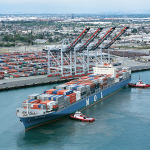 The Port of Long Beach continued to feel the economic effects of COVID-19 in March with more canceled sailings and a decline in cargo containers shipped through the nation’s second-busiest seaport.
Terminal operators and dockworkers moved 517,663 twenty-foot equivalent units (TEUs) last month, a 6.4% decline compared to March 2019. Imports were down 5% to 234,570 TEUs, while exports increased 10.7% to 145,442 TEUs. Empty containers shipped overseas dropped 21% to 137,652 TEUs.
Overseas health concerns over the coronavirus caused 19 canceled sailings to the Port of Long Beach during the opening quarter of 2020, which contributed to a 6.9% decline in cargo shipments compared to the first three months of 2019.
At the site Port of LA ,they moved 449,568 Twenty-Foot Equivalent Units (TEUs) in March, a 30.9% decrease compared to last year. For the first quarter of 2020, volumes have decreased 18.5% compared to 2019. It was the lowest amount of monthly cargo moving through the Port since February 2009.
“We’ve had two serious shocks to our supply chain system. First the trade war between the U.S. and China and now the COVID-19 pandemic,” said Gene Seroka, Executive Director of the Port of Los Angeles. “With U.S. retailers and cargo owners scaling back orders, volumes are soft even though factories in China are beginning to produce more. Amidst this public health crisis, there will be uncertain months ahead in the global supply chain.”
Tractor sales stall
 Unit sales of agricultural tractors and self-propelled combines in March 2020 fell across the board in the U.S. and Canada according to the latest data from the Association of Equipment Manufacturers.
U.S. total farm tractor sales decreased 15.6 percent in March compared to 2019 while U.S. March self-propelled combine sales fell 11.9 percent. That includes decreases in all segments, with combines and 40-100hp tractors (-15.2 percent) performing the best.
When compared to similar industries, like the U.S. auto and light truck market where the U.S. Bureau of Economic Analysis shows March unit sales having fallen nearly 42 percent overall, and a similar drop in U.S. heavy truck sales according to the St. Louis Fed, farm tractors and self-propelled combine unit sales are in better shape.
“Although the March numbers were likely impacted by COVID-19, It is too soon to tell the long-term impact of the current crisis on at equipment sales,” said Curt Blades, senior vice president of Ag Services at the Association of Equipment Manufacturers. “AEM has been working diligently to ensure agriculture is declared an essential industry by the governments in North America. As a result, our number one priority as an industry right now is doing what we can to meet the needs of farmers during planting time while keeping our employees and customers healthy.”