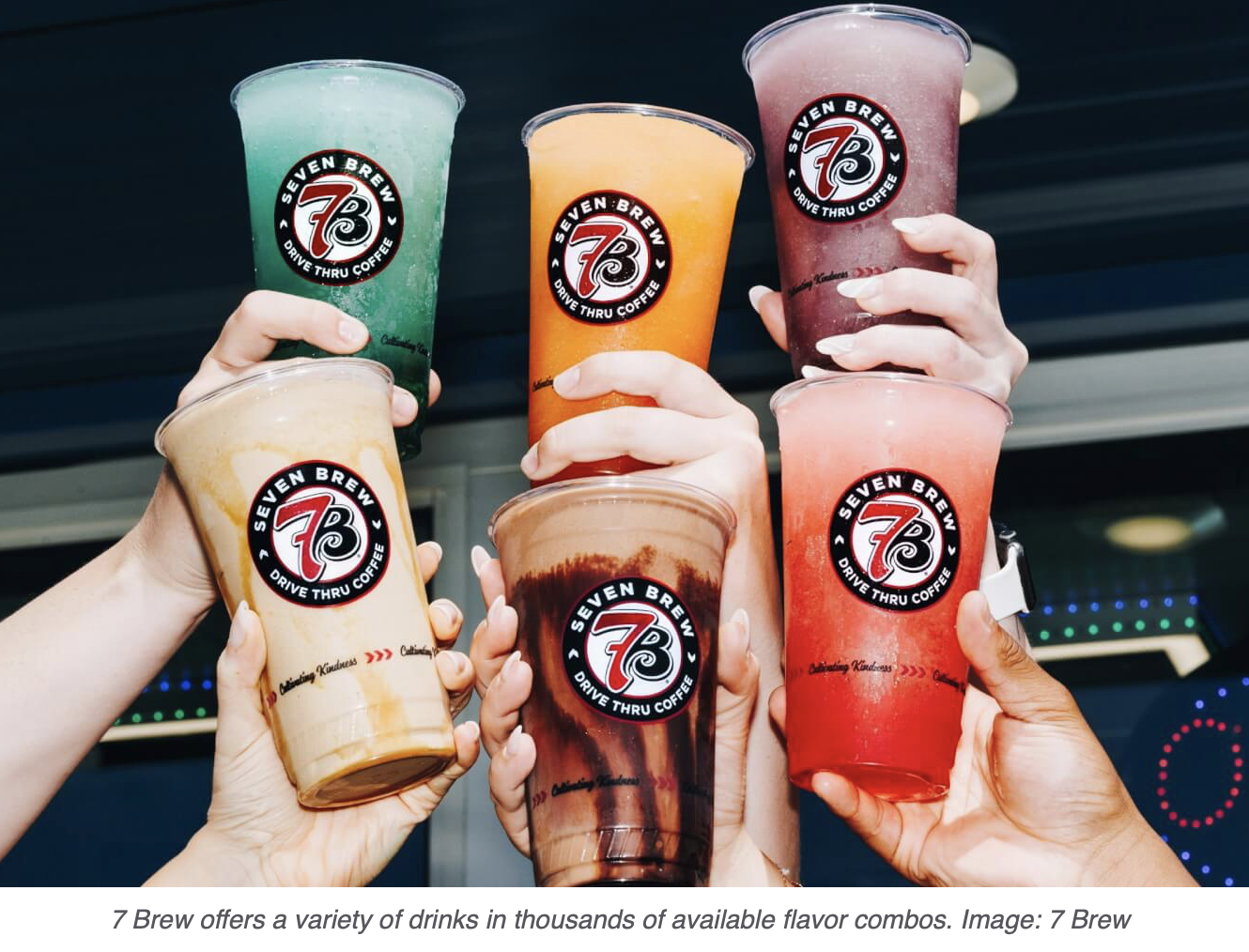
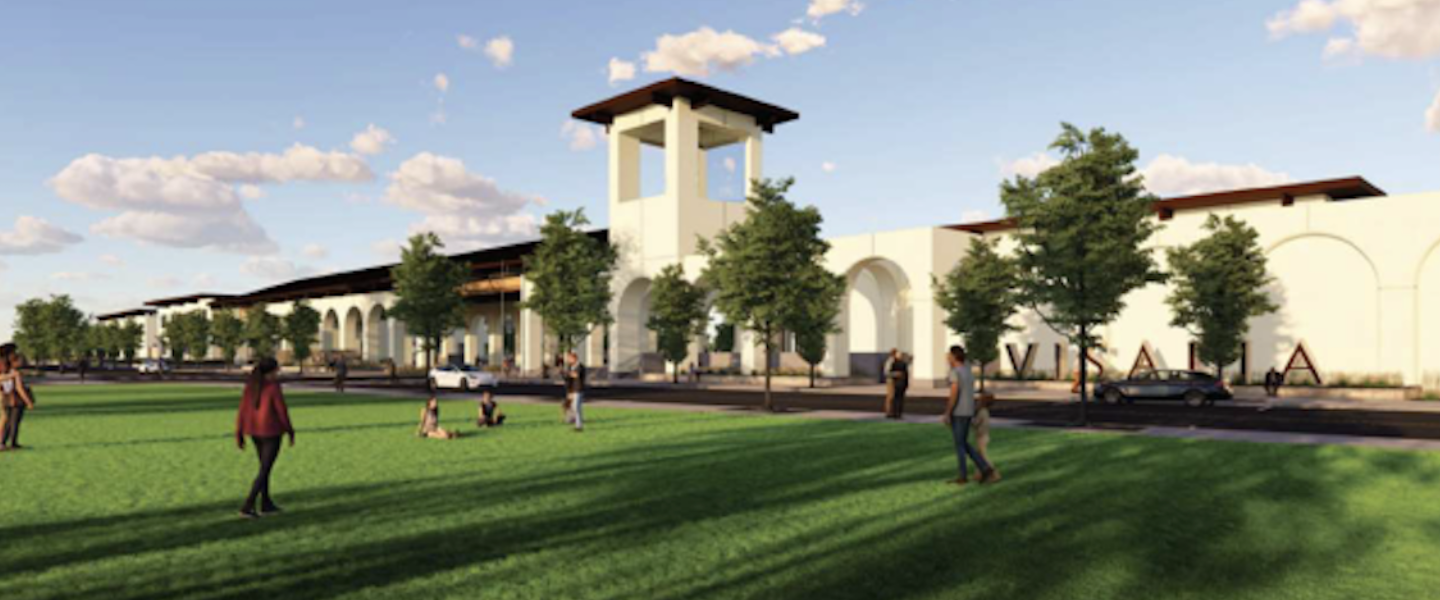
7 Brew coffee, a chain based in Arkansas was founded in 2017 but has attracted major Wall St financing and grown from 14 locations in 2019 to over 600 spots around the country in 2026. Now they have filed preliminary plans with the City of Visalia to replace the former Cask & Cleaver building, a once popular sit-down restaurant on South Mooney with what looks like a knock-off of another lively youth-oriented coffee place- Dutch Bros. The 7 Brew name comes from its original formula of offering 7 different coffee options, now with many more.”The 7 Originals,” now includes over 20,000 potential combinations including coffee, energy drinks, and smoothies, according to the company. Like other fast food chains, the emphasis is on speed, with high-energy service that includes loud music and roving baristas who take orders on a laptop. The property was once the site of a very popular steak house that closed in 2009 but has failed over 17 years to attract new investment in the sit-down restaurant format despite a short stint as a Mexican eatery. Now in 2026 it’s clear – the double drive-thru rules. Think Chick-Fil A. The property is owned by shopping center developer Dave Paynter who has the retail center anchored by Dicks. If 7 Brew plans to compete with Dutch Brothers in the Visalia marketplace, they’re likely to look for other locations to open up with competitor Dutch Brothers having 4 regional locations in Visalia.
Amazon Pharmacy will expand Same-Day prescription delivery to nearly 4,500 U.S. cities and towns by the end of 2026 says the company.adding nearly 2,000 new communities over the course of the year
Expansion addresses pharmacy closures, staffing shortages, and transportation barriers around the country t Amazon set a new Prime delivery speed record in 2025. Over 13 billion items arrived the same or next day around the world.
The expansion helps address growing medication access challenges. Pharmacy closures, staffing shortages, and transportation barriers are leaving millions of customers with fewer ways to get the medications they rely on. Amazon Pharmacy is filling that gap by bringing prescriptions directly to customers’ doors—often within hours.
Existing home sales drop 8.4% in January
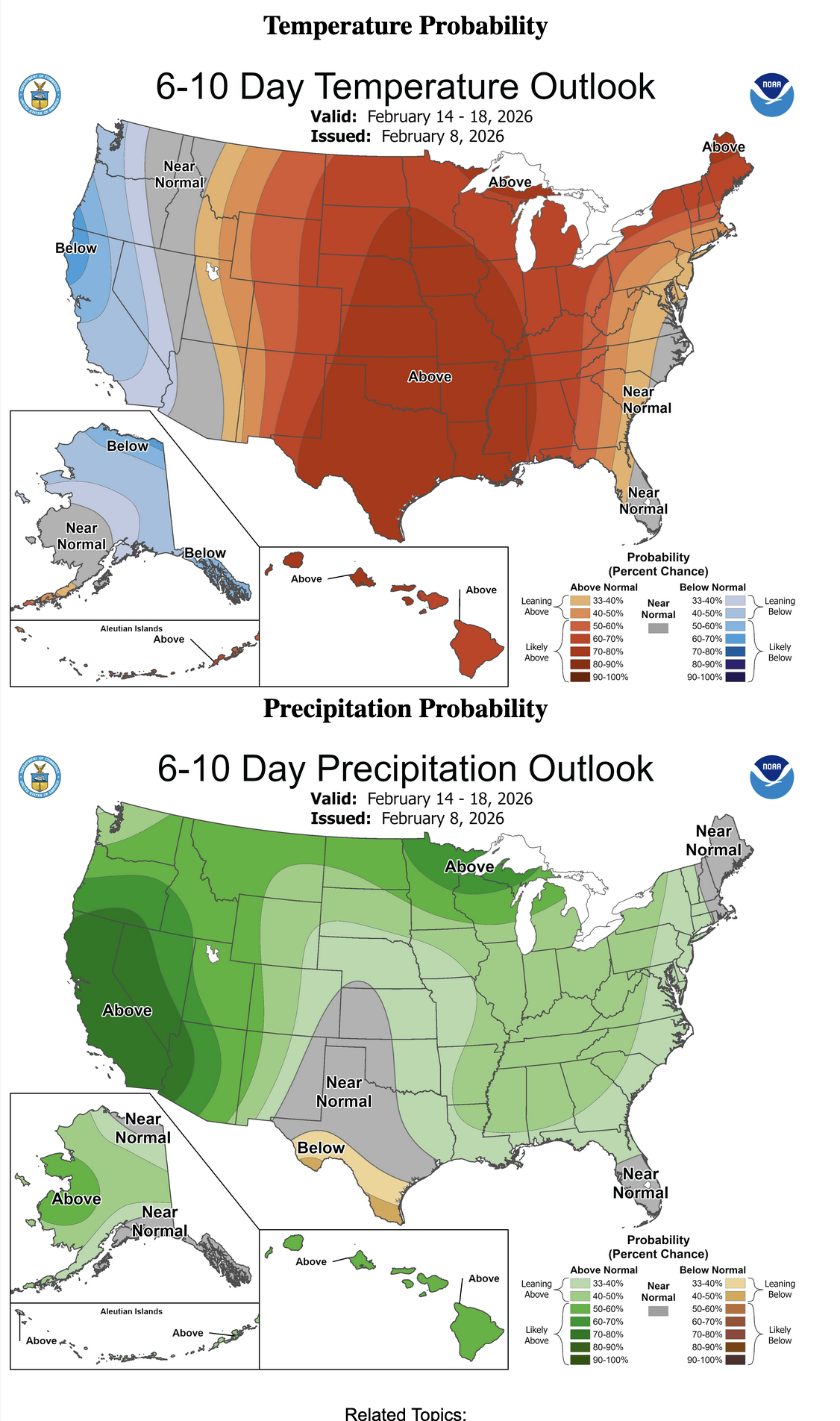
Existing home sales in the US decreased by 8.4% in January, says the National Association of Realtors this week. Month over month and year over year – sales fell in all regions.” The decrease in sales is disappointing” pointing to below normal temperatures and precipitation above normal said an economist with the organization.
In the Western US there was a 7.9% decrease in sales.
Tulare County home sales down, inventory up
The Tulare County Association of Realtors reports that existing home sales in February so far are down 5.7% for the same week a year ago.
Meanwhile, the number of listings for sale has climbed 10.8%.
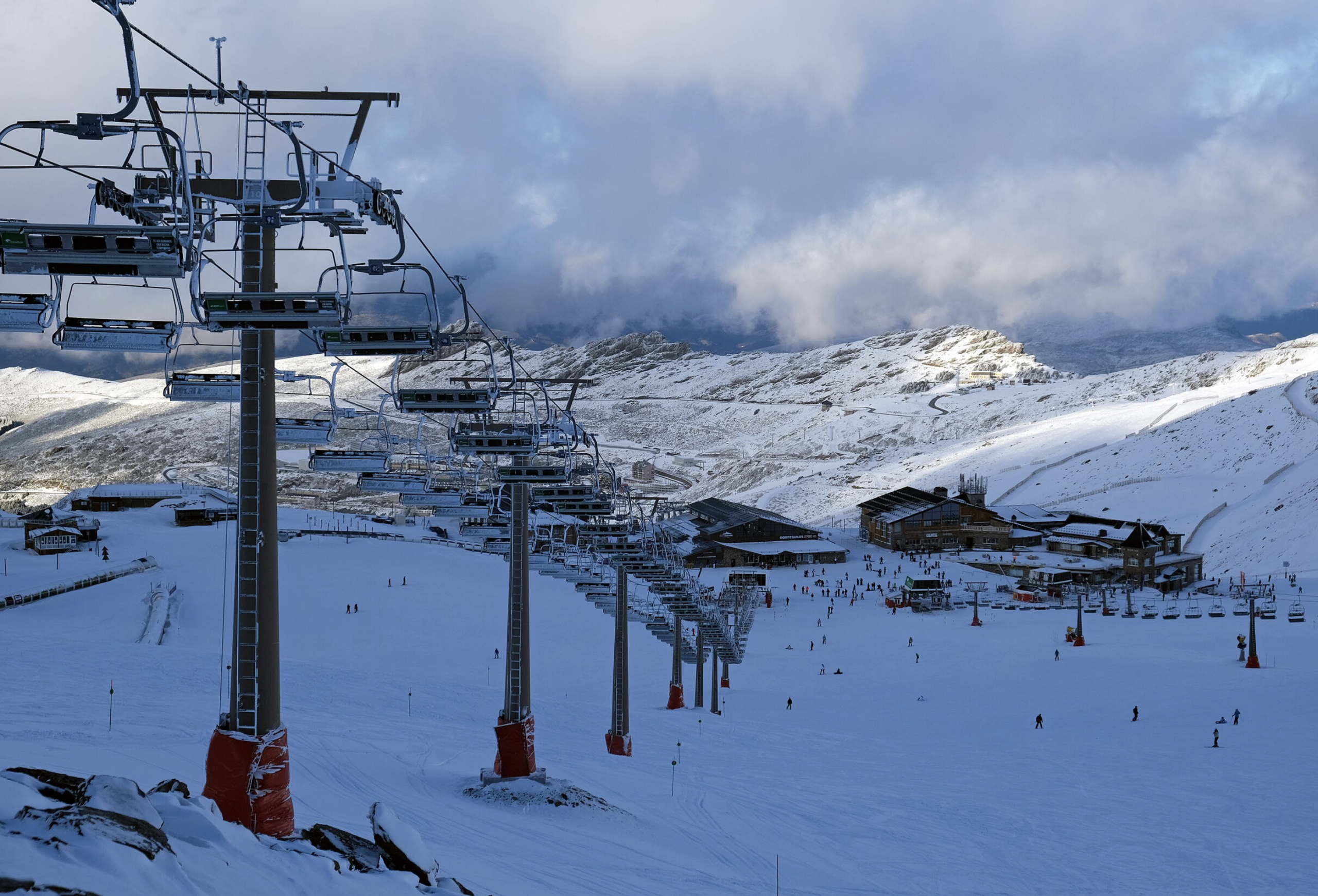
Feb 8,2026: After a full month of no rain and record hot temps, California weather will return to its regularly scheduled winter weather in the next few days. From hot and dry to Cool and wet. Forecast says you can mark down Monday, February 9 as the transformation day when the snow level is still at 9000 feet but dropping to 3500 feet February 12 and the first heavy rain and snow Sunday, February 15 in the region around the Feather River near Oroville.
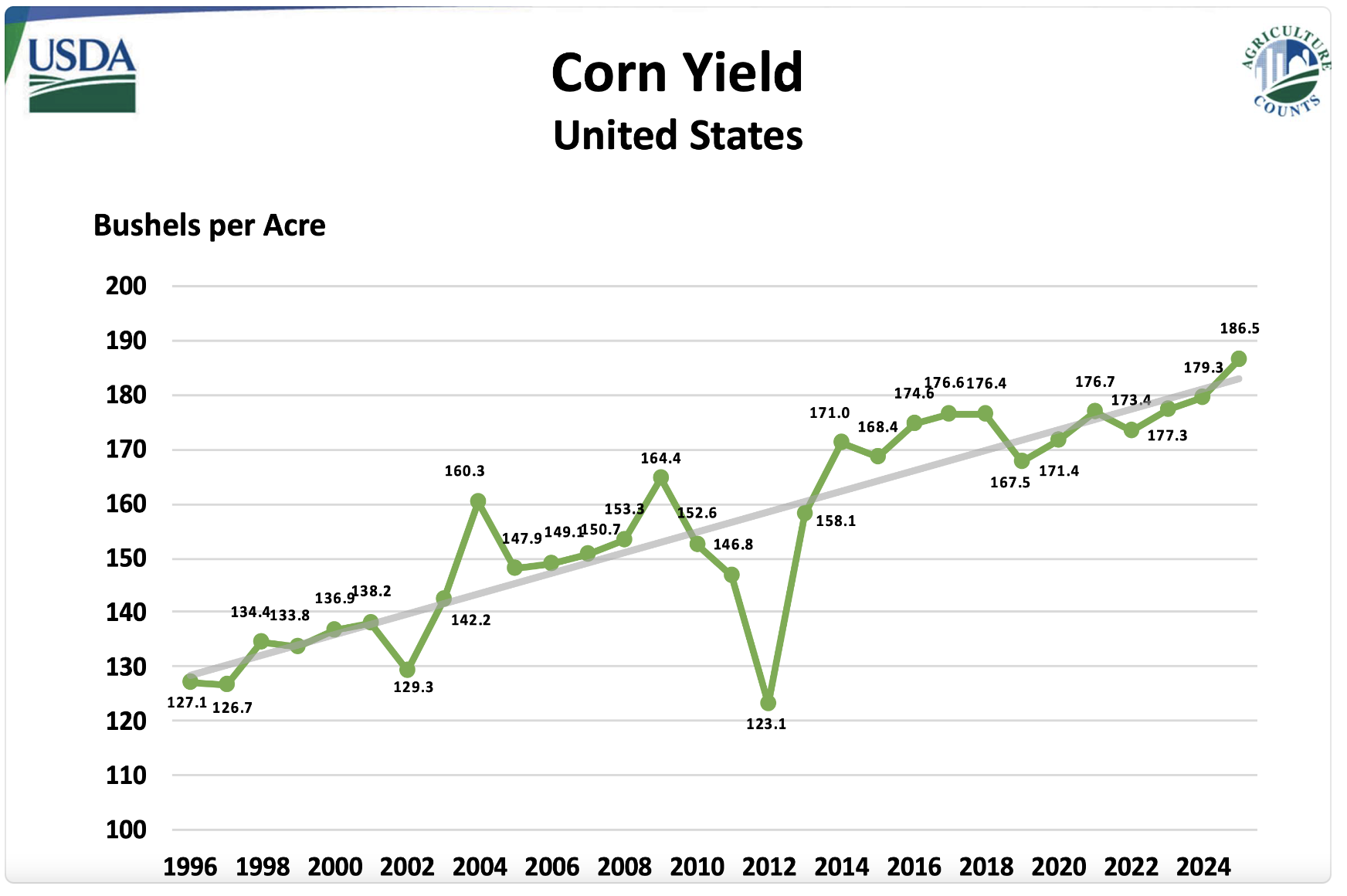
Farmers are a productive bunch harvesting more corn per acre than ever. Ditto for many other crops Water not the only factor farmers face in search of profit. Sometimes fewer acres are a plus
Listen to famers who worry that harvesting fewer acres due to requirements to pump less water with SGMA or receiving less surface water will result in big economic losses for both them and for the region’s economy. The cries are among the loudest from regions like western Fresno County where few natural water supplies exist including Westlands Water District.
But there are other factors in the discussion in search of profitability.
In multiple crops, farmers are far more efficient and productive year after year producing more corn and soybeans per acre, more milk per cow, more processing tomatoes with less water and a drop in labor needs.
Focus on yields for example.
Case in point is the California avocado industry that has seen its bearing acreage decline from 76,000 acres in 1988 to 49,000 acres in 2025. Does that mean we’re producing a whole bunch less avocados or that the industry is suffering economically?
Comparing 1989 to 2025 the avocado industry may have shrunk by 25% in terms of acres harvested but they produced 325.6 million pounds of avocados in 2025 compared to just 271 million pounds on more acres in 1989.
Statistics from the California avocado growers say the value of their crop in 2025 was $9562 per acre compared to $3233 in 1989.
California avocado farmers are harvesting more than triple the number of pounds of avocados per-acre compared to 1989. More production on less acreage. By the way, they taste way better than Mexico’s huge avocado volume and that contrast helps California sales. Now take a big crop grown here in the Central Valley – processing tomatoes – a tangy source for your salsa and pasta sauce.
In 2025 the California Tomato Growers Association said they had a bountiful tomato crop with an average yield of 55 tons per acre – an all time record eclipsing the 2018 record of 52.1 tons per acre. At the same time, acreage under contract to processors in 2025 was just 200,000 statewide, the lowest contracted amount on record back to 1975. Acreage is down from 300,000 acres in 1975 and because of technology like drip irrigation, farmers use less water to produce their 11 million ton crop, Processors have a leash on farmers to keep from growing more because that is all they can sell! Like many other crops, managing volume, limiting it, helps keep the price paid to growers profitable.
Dairy more efficient
An even bigger crop in the Valley is milk. Here too, farmers are more efficient in large part due to scientific breakthroughs in milk production testing, first launched in 1905, resulting in breed associations and artificial insemination.All that leads to higher volume cows. In modern times, production of milk per cow has improved from around 13,000lbs in 1960 to over 24,000lbs annually today. Meanwhile there are far fewer cows than in decades past. In the year 1900 the census found 37 million cows one year old or more.Today there’s about 9.5 million cows in the US.
Those 9.5 million cows produce around 228 billion pounds of milk – almost three times as much milk with half as many cows compared to 1920.The latest figures from USDA says the industry is boosting production up 4.2% year over year as of September.
Back in 1920, milking machines were starting to appear, but hand milking of 8-10 cows remained a standard for a single worker. Pasteurization, leading to safer milk, helped reinforce the growth of the industry based on increasing consumer confidence.
Today constant improvement in the handling of milk on the farm has lessened the spoilage factor by reducing the somatic cell count that leads to decay. Science in action.
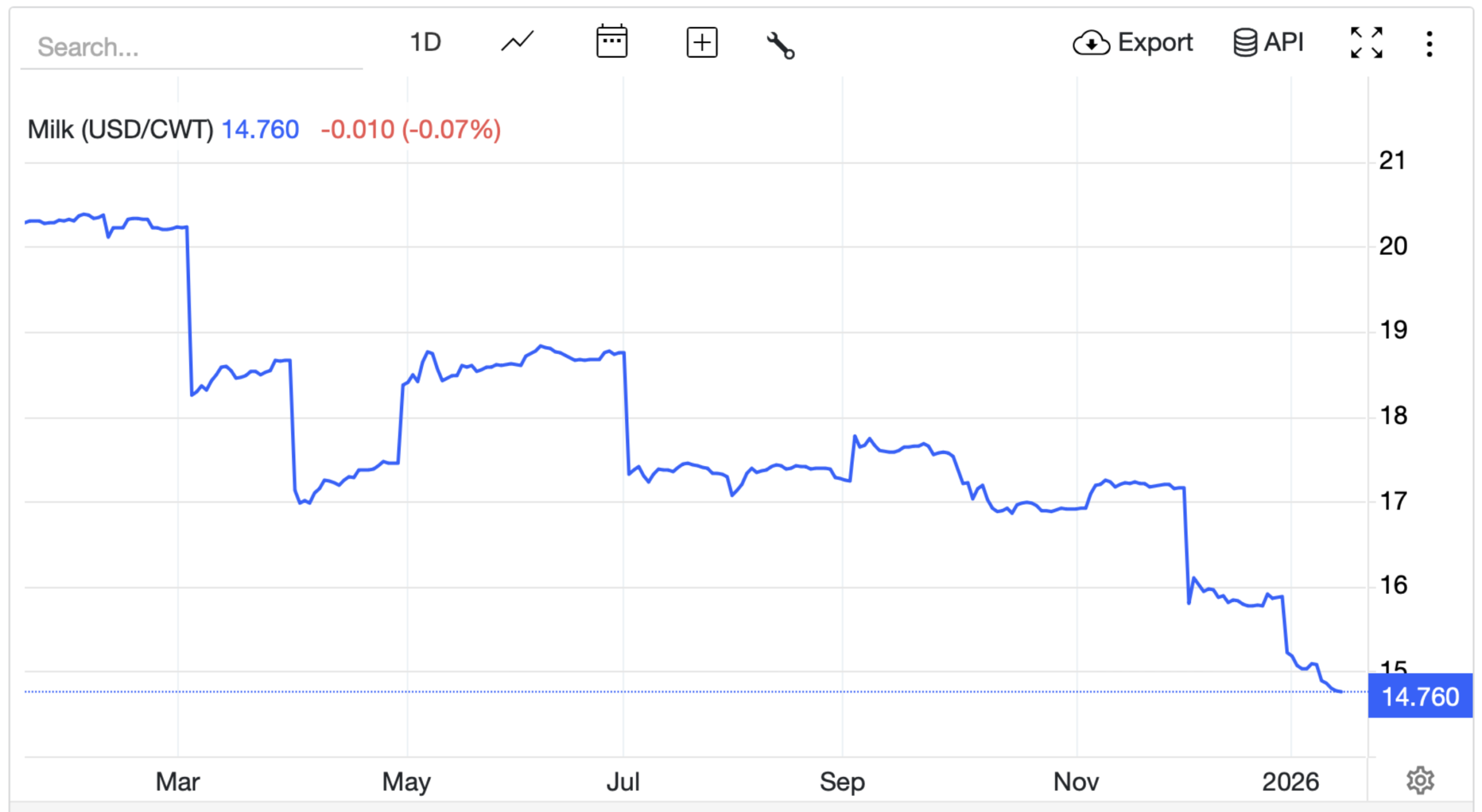
In recent years, the annual average production per cow has increased nearly every year. Overall production is up around 10% in the past decade. But now larger herds are leading to a dramatic drop in what dairymen are being paid for their milk due to what has been called a “gush” of milk in the marketplace.”Got Too Much Milk”. See chart of how much milk prices are down just this year to red ink levels.
Like in a number of crops, dairy farmers manage their volume through self-organized dairy cooperatives like California Dairies Inc and Dairy Farmers of America.USDA notes that in 2022, there were 89 dairy cooperatives in the United States, accounting for 87% of the market share for U.S. milk and milk products.The co-op manages flow of milk after it leaves the farm “balancing” the supply between products based on whether it can sell or not.
Co-ops adapt to market demand by shifting production between fluid milk, cheese or powders to handle perishability and price fluctuations. Co-op uses incentives for its members including penalizing excess production with lower pay as well as creating market programs that discourage oversupply.
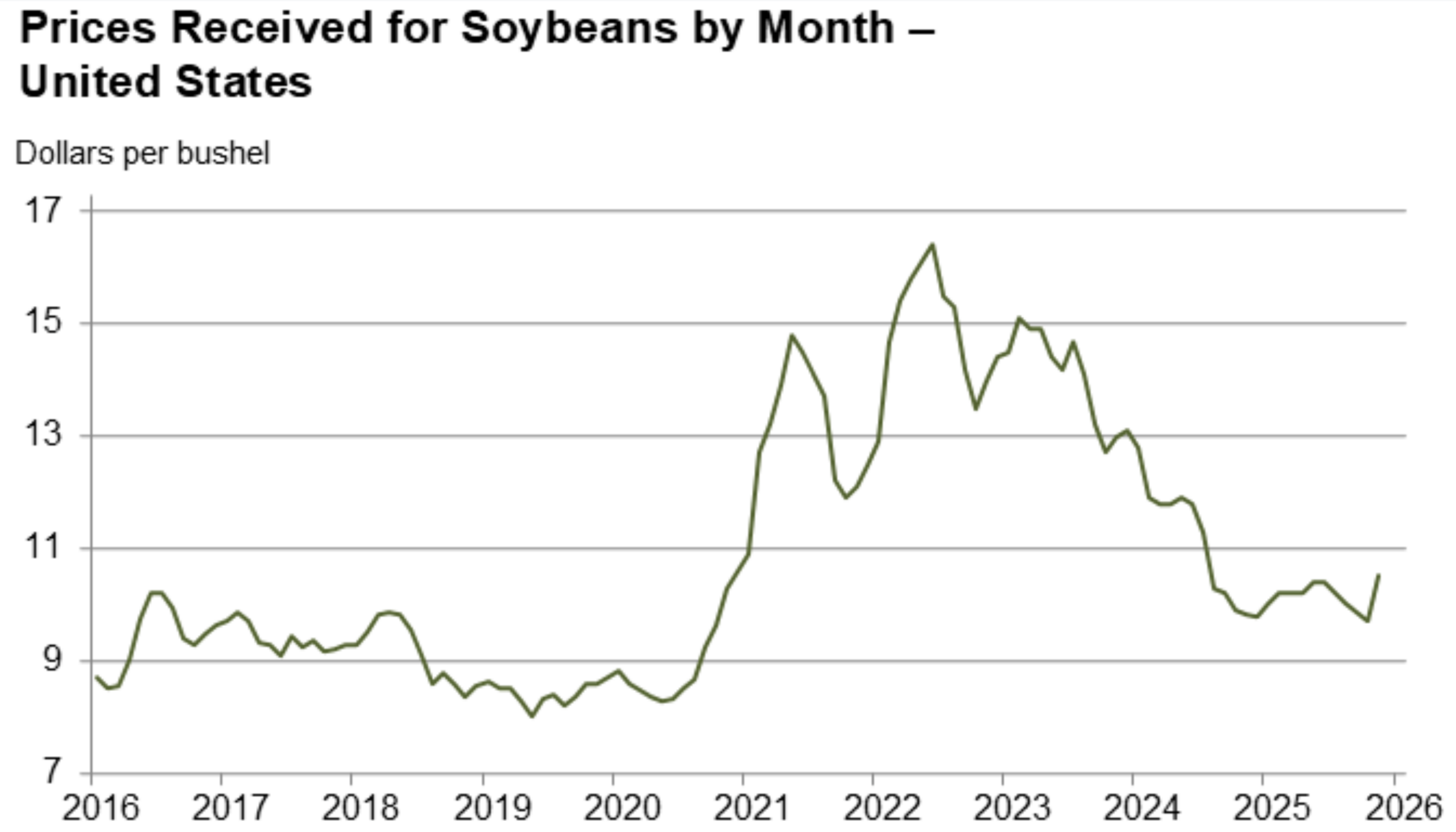
Speaking of too much of a commodity, both corn and soybeans, the nation’s largest crops, are in surplus right now based in part on President Trump’s tariff policy and retaliation from China and others who now choose to buy key food commodities from other countries instead of our farmers. Both big crops have seen a dramatic increase in yields according to USDA.
This year the Midwest soybean crop has seen record yields in Iowa, Minnesota, and Wisconsin, despite reduced total area compared to 2024, with an average yield of about 53.5 bushels per acre. But the average price paid to farmers has seen a downward trend.
The Trump administration has offered a subsidy of $30.88/acre for soybeans, but the American Soybean Assn argues that it “will not cover the significant financial damage soybean farmers sustained this year due to the high cost of production and losses sustained during the China trade war.” Back in California, the nation’s largest water district Westlands Water District has been very vocal in their argument that less water delivered to farmers is leading to lower incomes and regional economic damage including job losses.
They say that because of lower surface water deliveries there has been a fallowing of 200,000 acres in the sprawling westside district.
But water is not the only factor.
Westland publishes an annual crop report that shows over a 10 year period , 206,000 acres were idled in 2014 compared to 199,000 acres and 2024-about the same.
Fewer acres not a death knell
Westland farmers planted 42,000 acres of processing tomatoes in 2024 down from 67,000 acres in 2014 reflecting more production from fewer acres. In Fresno County the annual county crop report shows that back in 2000, farmers planted 95,000 acres of processing tomatoes. But the latest report for 2024 says we have a much bigger tonnage with about 55% of the acreage.
Although Westlands complains about lower revenue, Fresno County’s latest crop report for 2024 shows farmers generated $9 billion in sales in the nation’s biggest ag county, an all-time record. Farm receipts in Westlands itself are not published and like Fresno County as a whole – crop revenue is likely up- not down.
That crop report shows in Fresno County processing tomato acreage was 64,000 acres with a yield of 59 tons per acre and sales of $429 million in 2024.In 2018 Fresno County acreage was 77,140 acres with a yield of 52 tons per acre and a value of $296 million. So growers managed to make more money from 17% less land and that is 17% less land that needed to be irrigated, saving that water for someone else. Of course costs are up too, especially in California as been widely reported.
As wages have climbed there has been a huge change in the cropping pattern in the Westland’s district, reducing the need for hand labor to harvest the crop when vegetable fields are converted to tree nuts that are harvested mechanically.
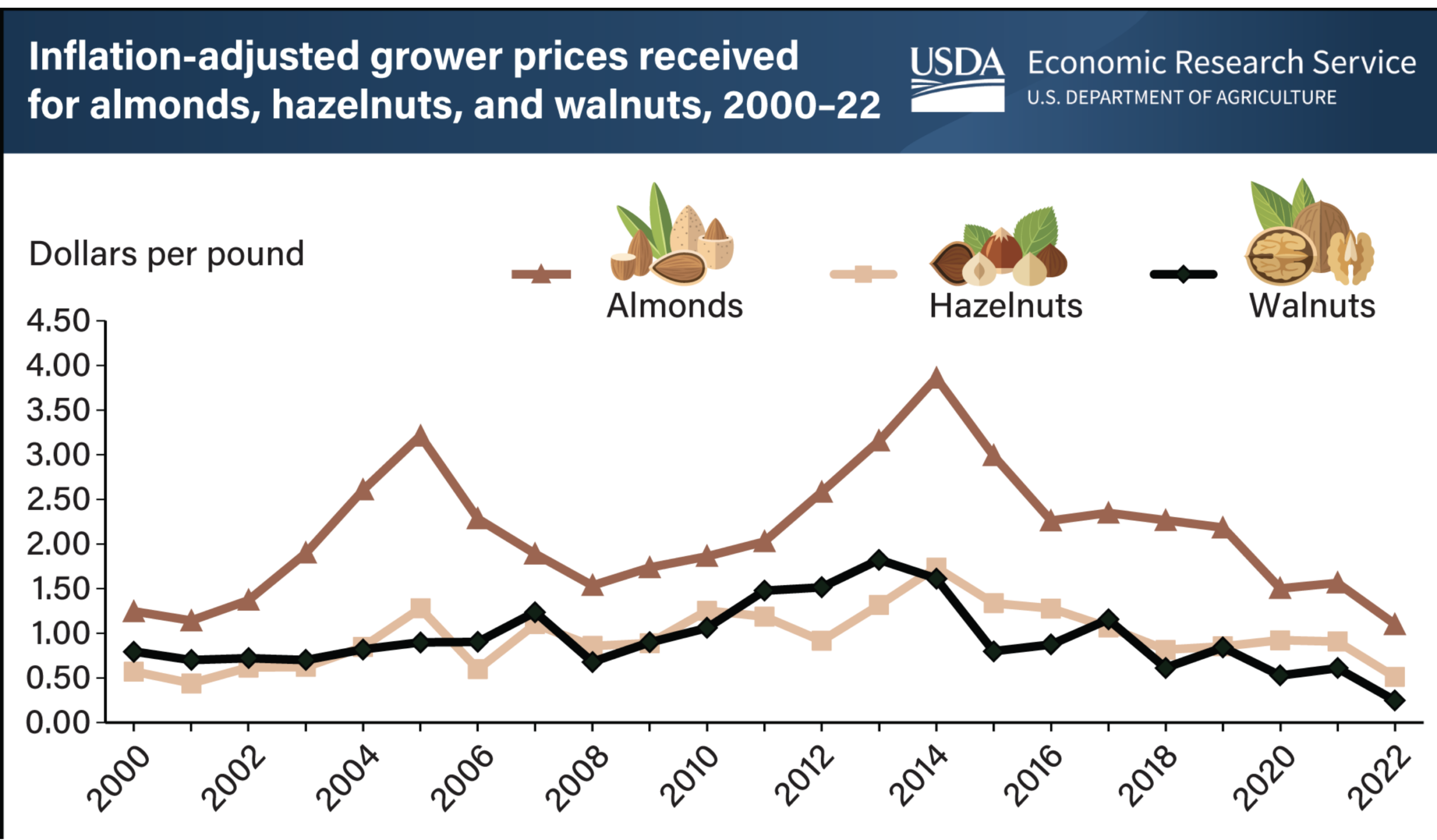
In 2000 Westlands had 19,000 acres of almonds. But by 2014 acreage had grown to 82,000 acres. It then dropped to 73,000 acres in 2024 following a trend statewide of reducing almond acreage in an effort to increase per pound price. It has been widely reported that the almond industry in California was in overproduction mode.
The upshot – reducing acreage helps lift the price for the whole group.Prices in 2025 have gone up to about $2.50 per pound.
There has been another major crop conversion in Westlands. In 2000 the district had just 5000 acres of pistachios, climbing to 34,000 acres in 2014 and 85,000 acres in 2024. Unlike almonds, pistachios are still selling well with farmers getting an average $2.10 per pound as world ‘s consumers can’t get enough. But the crop expansion certainly has reduced the need for farm labor in the district.
What about grapes?
In 2000 Westlands grew about 10,000 acres of grapes, mostly wine grapes according to their published crop report. In 2014 that grew to 18,000 acres. As of 2024 wine grapes acres were back down to 10,200 as district farmers fallowed unprofitable vines. Grape industry leaders have and still are arguing that growers need to pull acreage to reflect lower demand seen in the marketplace.Jeff Bitter, president of the Fresno-based Allied Grape Growers has told growers recently “the pain doesn’t go away,” he said, “until grapes go away.” Water is not the only issue.You have to have a customer to buy the stuff and fewer people are drinking wine and some are not drinking at all.
One huge crop has almost gone away here thanks to worldwide competition and a US surplus- a realty as big a factor as water. We are talking about cotton. Westlands grew 180,000 acres of upland cotton in 2000 reflecting a state that once grew a million acres of the fiber. In Westlands in 2024 the farmers there looked elsewhere for profit harvesting just 4,000 acres of upland- a 97% decline.
Lots of jobs were lost with scores of cotton gins all over the Valley going out of business.Water and drought were an issue for sure,but so was global competition, consumer taste for synthetic fibers and the prospect of better returns from nuts. Meanwhile, most US cotton that competes with Valley cotton is grown from rainfall. Farmers from other states don’t have to pay for water.Then there is price. The average price of upland cotton today hovers around 60 cents. USDA says this year global production is up nearly 1 percent year-over-year but consumption is flat.Like other US crops – yields are up around 15% in the past decade, says USDA. The upshot – there is a decline in cotton growing acres and that may not be a bad thing.
Westlands consultant Michael A. Shires, Ph.D, has highlighted two themes, including one that says less water delivered to the district has resulted in less economic activity and fewer jobs in the area. Back in 2014 the same consultant report pointed out that crop choices made by farmers in the district have resulted in conversion from labor intensive, hand-harvested crops to permanent plantings like nut trees. That has resulted in a decline in jobs. So it’s not just water.
Professor Shires 2016 study found ” the share of permanent crops within the district has risen dramatically— from less than 10 percent of crops in 2000, to 25 percent in 2011 to just under 50 percent in 2015. This has both short and long-term implications for employment within the region as farmers shift away from labor-intensive produce to invest in tree nut and wine grape crops. Both of these crops have very different long-term labor demands.”
The consultant published a chart that shows between 1993 and 2015 the shift to permanent crops in the district resulted in a decline from 10,000 jobs in 1993 down to 6000 in 2015.The study found a total effect including indirect job loss of 10,700 positions.Clearly there are other issues that affect the region’s bottom line.
Farm work in grapes has declined in a dramatic way in Fresno County in the past few decades based on a grower conversion to dried-on-the-vine raisins that use mechanical harvesting. The industry used 50,000 to 60,000 workers during harvest time in the 1990s when there were 270,000 acres that needed hand labor. Farmers found that there wasn’t enough labor to get the work done.Now the labor needed to harvest raisins requires just 10,000 to 15,000 workers as acreage has shrunk from 280,000 in 2000 to 90,000 acres statewide.
Statistics show that Fresno County grew 171,000 acres of raisin grapes in the year 2000, By 2019 raisin acreage in the county dropped to 82,000. Now in 2025 the county’s raisin industry has shrunk to 68,000 acres, once Fresno’s claim to fame. While you could claim water as a factor – it is consumer behavior that appears to be more important with consumption in the U.S. showing a long-term downward trend. Consumption dropped from a peak of over 2 pounds per person in the late 1980s to around 1.2-1.3 pounds annually due to competition from fresh fruit and other dried fruits. California growers compete with global exporters including Turkey, Iran, and Chile, supplying international markets like Europe. Again growing these grapes is not just a water supply issue.
The last factor that needs discussion, but not mentioned in the Westlands studies, is the fact that the location in this otherwise dry landscape is totally dependent on outside water supplies shipped in from far away with few local natural waterways. How farmers have managed this water supply has led to soil high in salt and other impurities like selenium that poisoned wildlife in ponding basins some years back. Soil health is a big issue in Westlands Water District.
From Mavens Notebook-water blog
What are we talking about?-Naturally Occurring Salts: Soils in the region naturally contain high levels of salts and boron, remnants of an ancient inland sea that once covered the area.-Inadequate Drainage: A low-permeability layer of clay known as the Corcoran clay, present beneath the surface, impedes the downward percolation of water, leading to a shallow water table and the accumulation of salts.-Irrigation Practices: The introduction of large-scale irrigated agriculture, coupled with the use of saltier imported water from the Central Valley Project, exacerbated the issue. Over time, irrigation water evaporates, leaving the salts behind in the soil and groundwater.-Lack of Freshwater: A lack of sufficient freshwater supply and rainfall to naturally flush the salts through the soil profile has intensified the problem. The upshot is that salinity threatens the long-term viability of agriculture in the region. High salt concentrations can damage crops, reduce yields, and in severe cases, render land unsuitable for farming.
Collapsing canals
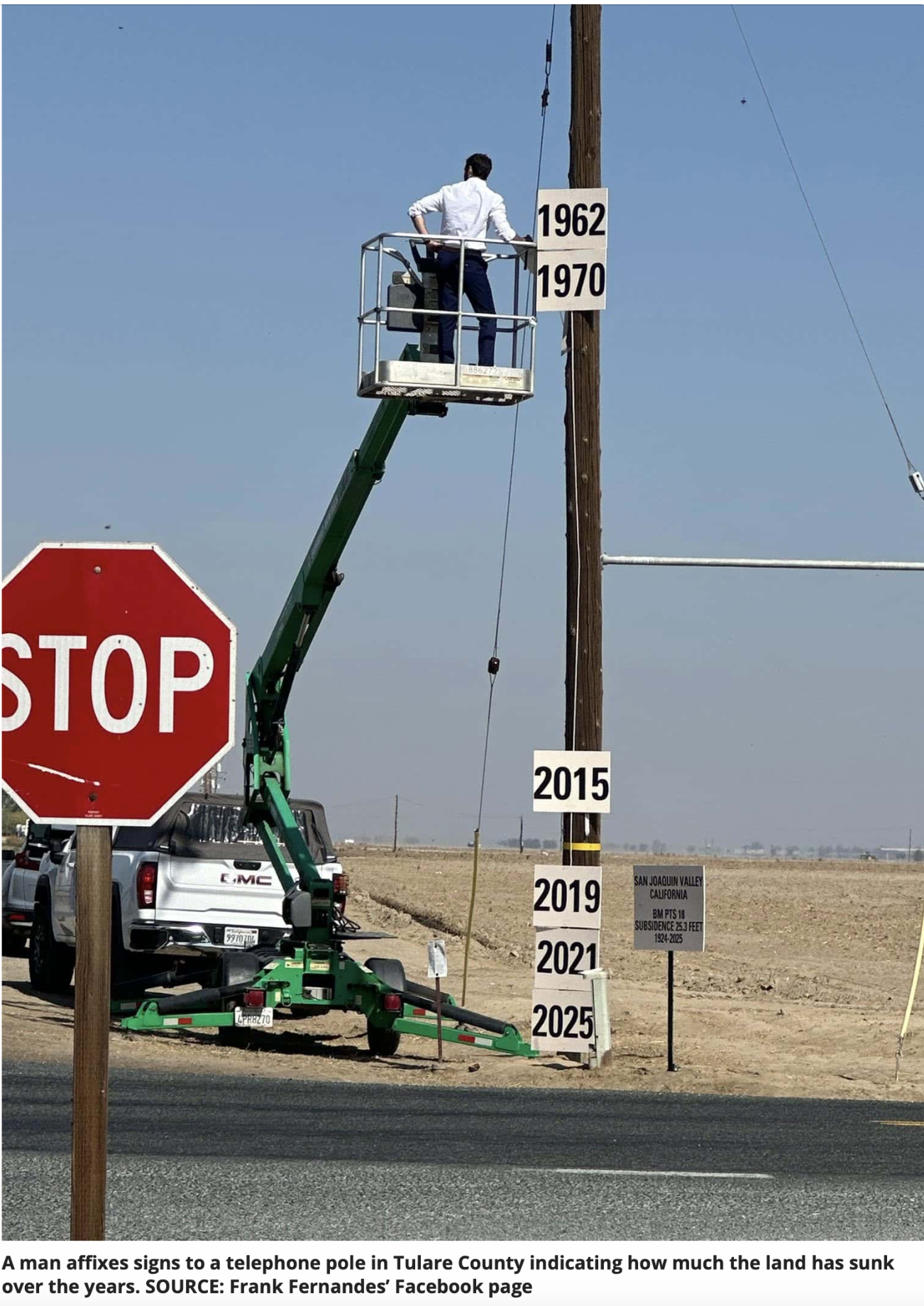
Still more threats. Farmers say they needed to pump more groundwater in recent decades because of drought and they claim – flawed water policy. That has led to subsidence in this area damaging the very water infrastructure farmers need to bring in water from northern California. It will take estimates of over $4 billion to repair collapsing canals like the California Aqueduct that supplies Westlands and Friant Kern Canal on the eastside.At a recent almond grower seminar, Paul Gosselin, deputy director at the California Department of Water Resources noted that capacity in the westside’s California Aqueduct was predicted to decline by 87% if subsidence was not corrected. That would devastate supplies for Kern County and the farmers that depend on those supplies.He did not mention LA, but Metropolitan WD is a major beneficiary. But with a price tag for a fix amounting to billions of dollars, who should pay?
Should public pay?
Here is the answer quoting from a recent article in an ag publication. “Nursery owner John Duarte argued that even if the farmers caused the problem, they simply do not have the capacity to pay.Duarte was direct in where the blame lies – subsidence is a direct result of failed environmental policies that depleted surface water supplies and forced farmers to turn to groundwater. On those grounds, the state and federal governments have the obligation to fix the choke points in the conveyance systems,” he maintains, reflecting farmers’ view. The huge aqueduct delivers water not just to Westlands, but farms and cities to the south through the State Water Project including millions of people in LA.
Farming kilowatts
So it is not surprising that the Westland’s Board of Directors recently approved a plan to develop 136,000 acres of fallowed land to be dedicated to building the nation’s largest solar farm producing kilowatts instead of cotton. The plan will mean both new income on what is idled land and water savings. The Valley Clean Infrastructure Plan calls for building up to 21 gigawatts of solar energy and an equivalent amount of battery storage on along with a series of high-voltage transmission lines to connect the electricity generated to the state’s grid.The project will take up to a decade to be completed. and could provide a quarter of the state’s clean energy needs by 2035. The developer is the same group that is building Westlands Solar Park in Kings County._________
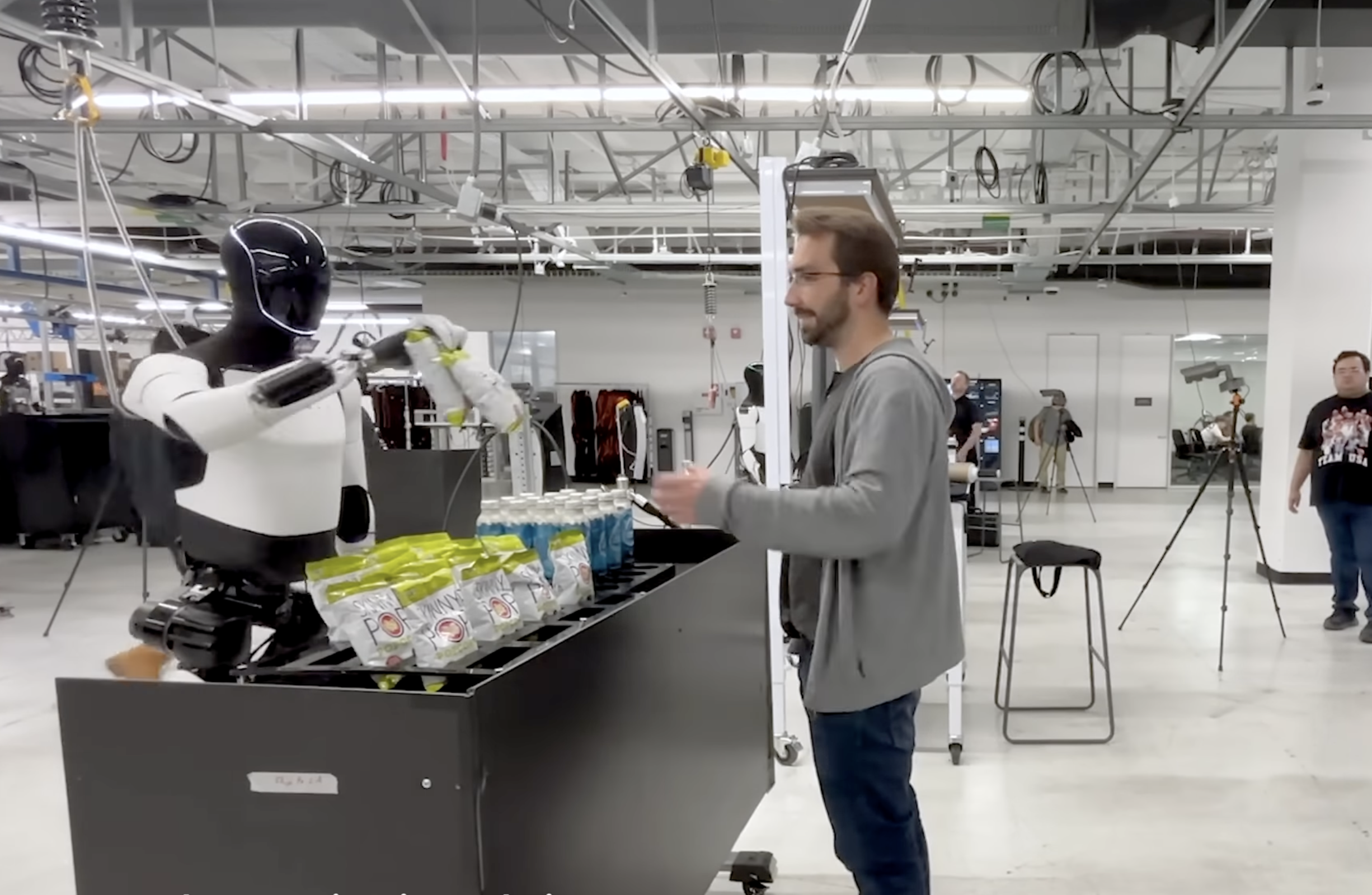
Two California car makers, one huge and one tiny, appear to be pivoting toward making robots at their California plants announced just in recent days. In Fremont, California in the Bay Area electric car maker Tesla announced they would produce robots at their only California plant targeting as many as 1 million units a year. The company announced that they would discontinue production of its Model X SUV and Model S full-size sedan made in Fremont However, a news release from the city of Fremont says Tesla will continue to make electric cars at the plant along with the new line there making Tesla’s Optimus robots.
“It’s time to basically bring the Model S and X programs to an end,” Elon Musk said. “We expect to wind down S and X production next quarter.” The company’s car business has been slumping and their earnings report suggests a “transition from a hardware-centric business to a physical AI company”.
The City of Fremont put out a news release January 28 that says” To be clear, Tesla is not ending vehicle production at its Fremont factory and reports suggesting otherwise are inaccurate. Tesla is sunsetting the Model S and Model X lines, which were produced exclusively in Fremont. However, the company will continue mass production of the refreshed Model 3 and Model Y in Fremont, in addition to the new Optimus robot and potential future vehicle programs. These vehicles represent the vast majority of the Fremont Factory’s manufacturing activity. Through production line improvements and operational efficiencies, Tesla expects to maintain current vehicle throughput at Fremont. As a result, Fremont will remain Tesla’s highest-output vehicle factory in North America.
Tesla is retooling a portion of the Fremont campus for Optimus robot production and they have stated that this retooling will not result in job losses, but that Fremont headcount may increase. Fremont was selected as Tesla’s Optimus hub due to the city’s proven ability to support large-scale, complex manufacturing operations, its highly skilled workforce, and a business-friendly and responsive city administration. The City of Fremont looks forward to supporting Tesla’s continued growth of both its physical footprint and employment base in Fremont for years to come.”
Faraday’s new future
Meanwhile, upstart electric car maker Faraday Future (FF) has announced they too will roll out their own new EAI robotics technology and begin selling the units at the upcoming February 4 & 5th auto show in Las Vegas. The company said they will display multiple embodied AI robots and also announce product pricing, sales and delivery timelines for the product expected to be made in Hanford California which is the company’s only manufacturing plant. FF said they will continue their plans to make the FX Super One lower price electric SUV in Hanford as well.
FF said its first FF EAI Robotics product completed U.S. regulatory certification and will begin sales in parallel with the launch; the Feb. 4 event is livestreamed at 3:30 PM PST and will include live product showcases, FX Super One sales/co-creation experiences, and partner recruitment
Earlier in January, Faraday Future announced they hope to reach positive cash flow after a decade of losses” within about three years with gross margins of around 20%”.
The company said FF’s “five-year cumulative production and sales target is 400,000–500,000 vehicles, primarily driven by FX Super One, the future FX 4 and planned models, aligned with its model introductions and production volumes.Alosd The Company also announced an EAI (Embodied AI) robotics strategy under its upgraded Global EAI Industry Bridge. This dual-track growth model could provide a new growth curve for FF.”
Super One roadmap
FF says “The first phase of delivery is expected to occur in Q2 of this year. It will primarily focus on deliveries to FX Par partners with a cap of 50 units. The second phase of delivery is expected to occur in Q3 of this year, delivering to industry leaders and B2B partners with a cap of 200 units. The third phase of delivery is expected to occur in Q4 of this year or Q1 of next year. This stage will initiate full-scale deliveries, marking the transition to FX’s broad market rollout in the U.S. From 2027 onwards, sales targets of Super One are anticipated to include both BEV and HEREV (hybrid extended range EV) models, driving its volume to about 4,900 units in 2027, 18,000 units in 2028, 38,000 units in 2029, and 55,000 units in 2030.Regulatory and compliance certifications for Super One are progressing smoothly and on schedule. Key component certifications have almost been completed, laying out a solid foundation for full vehicle certification by the third quarter of this year.”
As for their plunge into AI-inspired robot world “The goal is clear: to become a leading U.S. robotics company and one of the first U.S. companies to deliver humanoid robot products to the market. This dual-track growth model, driven by both EAI vehicles and EAI robotics, could define a new growth curve for Faraday Future. “
It seems clear FF and Tesla may compete for customers.
Cautionary notes
On a cautionary note the FF news release carries the warning that questions remain about” the Company’s ability to maintain its listing on Nasdaq; the availability of sufficient share capital to execute on its strategy, which the Company currently lacks.” The company stock is hovering just above the $1 a share – the legal low allowed by NASDAQ before they could lose their listing, needed to attract investors.The stock has dropped 25% in the past year.
A statement also advises more hurdles including the need to” enter into an engineering services agreement, which will be required for the Super One in the U.S.; the ability of B2B preorder companies to identify purchasers for the Super One; overall demand for the Super One; the ability to secure the necessary agreements to produce an FX 4 vehicle or any other planned future FX vehicles, none of which have been secured; the Company’s ability to secure an occupancy certificate for its Hanford facility; the Company’s ability to continue as a going concern and improve its liquidity and financial position; the Company’s ability to pay its outstanding obligations; the Company’s ability to remediate its material weaknesses in internal control over financial reporting and the risks related to the restatement of previously issued consolidated financial statements; the Company’s ability to successfully compete in the robotics business against other companies that have substantially greater funding, experience and name recognition; the Company’s limited operating history and the significant barriers to growth it faces; the Company’s history of losses and expectation of continued losses.”
The company’s track record in Hanford is nothing to brag about. The firm launched in 2014 has produced only 16 cars in all those years.
Both Tesla and Faraday future promised the communities they set up manufacturing plants in plenty of jobs and Tesla has come through while Faraday Future has produced very few jobs in Hanford.
On a more hopeful note Faraday Future says the well-known investor group BlackRock increased its stake in FF, citing a Schedule 13G filing that showed holdings of about 9.5 million shares as of December 31, 2025, up from about 6.8 million shares as of September 30, 2025, an increase of about 40%.
Called Amazon Fresh and Go grocery stores, more than 20 located mostly in S California urban areas will close permanently, says the company this week. These are all their stores in the state.
Some of the Fresh and Go stores will be converted into Whole Foods locations, says the company. Amazon said this week it plans to open more than 100 new Whole Foods Market stores over the next few years.
WARN notices have been posted announcing the pending closures showing store locations as follows.All sores would close April 28 says the WARN notice.
Cerritos: 11340 South St, Cerritos Citrus Heights: 5425 Sunrise Blvd, Citrus Heights Corona: 3941 Bedford Canyon Rd, Corona Encino: 16325 Ventura Blvd, Encino Elk Grove: 7530 Elk Grove Blvd, Elk Grove Fontana: 16188 South Highland Drive, Fontana Fountain Valley: 18100 Brookhurst St, Fountain Valley Fullerton: 1100 S Harbor Blvd, Fullerton Huntington Beach: 6911 Warner Ave, Huntington Beach Irvine: 13672 Jamboree Rd, Irvine Ladera Heights: 6855 S La Cienega Blvd, Los Angeles Long Beach: 6235 E Spring St, Long Beach Moorpark: 742 Los Angeles Ave, Moorpark Murrieta: 40485 Murrieta Hot Springs Rd, Murrieta North Hollywood: 5101 Lankershim Blvd, North Hollywood Northridge: 19340 Rinaldi St Pasadena: 3425 E Colorado Blvd Poway: 14837 Pomerado Rd. Roseville: 6780 Stanford Ranch Road, Roseville, Torrance : 21035 Hawthorne Blvd. Woodland Hills: 6245 Topanga Canyon Blvd, Woodland Hills Upland: 235 E Foothill Blvd, Upland
California’s EDD reports that jobs in key sectors like construction and manufacturing are down in the Central Valley in November, reflecting what is also a nationwide trend.
Kings County
Case in point is the latest employment report for Kings County for the month of November. The jobless rate in the county was 8.8%, some 6.1% higher than a year earlier. There were 900 fewer people working in the non-farm sector, but 500 more jobs were seen in agriculture from November to November. The biggest decline in non-farm jobs year over year was in manufacturing with the loss of 400 jobs. Healthcare jobs climbed 400 year over the same time.
Fresno
Meanwhile in Fresno County, the jobless rate was also up from 7.8% in November 2024 to 8.1% in November 2025.
Among the biggest sectors to lose jobs were in construction – down 700 people and manufacturing with a drop of 300 jobs.
Business services were down 700 jobs and transportation and warehouse jobs fell by 900. State government jobs declined by 900 as did federal jobs by the same number.
The big winner in Fresno County were healthcare jobs up a whopping 5700 jobs year over year.
Kern jobs
In Kern County the jobless rate fell year over year from 8% to 7.8%. But again the losses were seen in the same sectors.
Construction jobs were down 5% year over year and manufacturing jobs dropped by 2.3% in the county. Other significant drops were seen in department store jobs, down 4.2% in the past year. Again the sector that was positive was healthcare where jobs were up 6% in the year in Kern county.
Tulare jobs
In Tulare County the jobless rate declined year over year from 10.2% to 10% while the number of non-farm jobs were up by 400 in the past year. But it was the same sectors that showed weakness with construction jobs down 500 and manufacturing jobs down 400 – similar to other counties. Tulare County saw healthcare jobs jump by 1100 year-over-year.
Nationwide numbers
Economists have noted similar trends across the country with manufacturing soft and building activity down, hurting construction jobs.
Manufacturing drops 10 months in a row
Weakness is seen in the latest ISM manufacturing report for the nation that came out last week. The report says economic activity in the manufacturing sector contracted in December for the 10th consecutive month, following a two-month expansion preceded by 26 straight months of contraction.
American manufacturers shed about 8000 jobs in December, adds the Wall St Journal.
New residential construction in the U.S. saw a steep drop in the month of October, according to a report released by the Commerce Department on Friday.
Another report from the Census Bureau says housing starts in the United States fell by 4.6% from the previous month to a seasonally adjusted annualized rate of 1.246 million units, the lowest since the Covid pandemic triggered a plunge in starts in the second quarter of 2020. The decline was marked for housing with five or more units (-25.9% to 347,000), offsetting the increase for single-unit houses (5.4% to 874,000). Among different regions, housing starts fell sharply in the US West- down 21%.
Beacon Economics employment analysis for the state says “while growth remains positive in California, employment levels are down 120,900 over the past year, a 0.8% decline, without the gains in Health Care. California’s labor supply is growing slowly, expanding by just 43,200 from September to November. Since February 2020, the state’s labor force has grown by just 277,500 workers, a 1.4% increase. This trails the nation’s 4.3% growth over the same period. California’s chronic housing shortage continues to be the greatest constraint to labor supply growth.The recent ICE raids do not appear to be having a significant impact on California’s labor force, however the state’s chronic housing shortage continues to limit its ability to grow.”
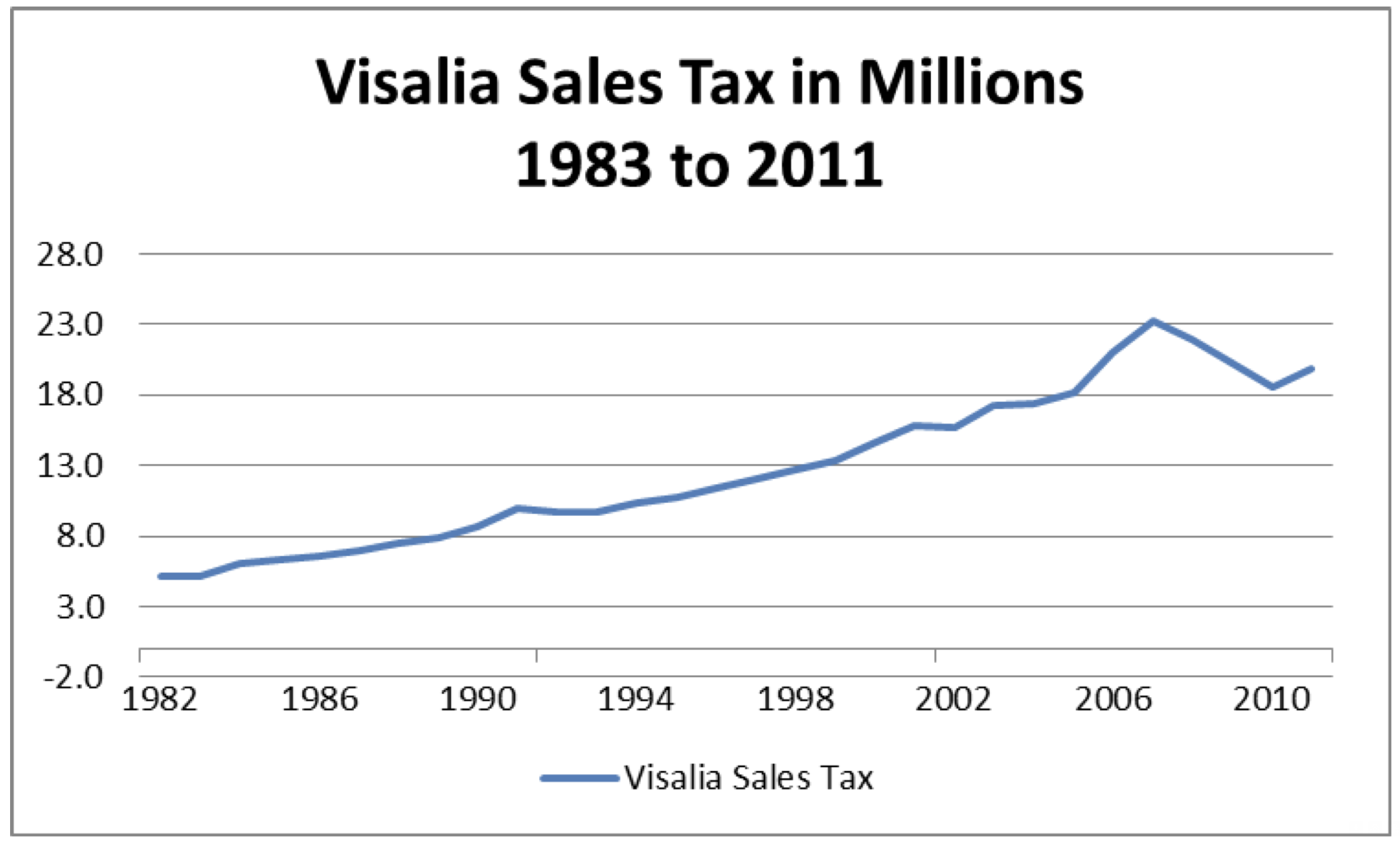
This City of Visalia has seen steady growth of sales tax revenues from 1983 to 2011 from- around $5 million back in 1983 and now, nearing $50 million. Information is from the latest financial report presented to the city council.
Visalia sales tax revenue has grown from around $17 million in 2012 to $39 million in 2021 and in the latest report , it is $48.6 million in fiscal year 2025. Chart below shows how this key revenue source grew.
The city’s general fund is largely dependent on both sales tax and property tax revenue.
The city’s property tax revenue has grown by meteoric levels as well from $22.3 million in 2010 to $27.9 million in 2021 and $37 million in the latest financial report for fiscal year 2025.
Besides these two key funds, the city’s hotel bed tax revenue (transient property tax) is now over $5 million annually, almost double what it was back in 2020.
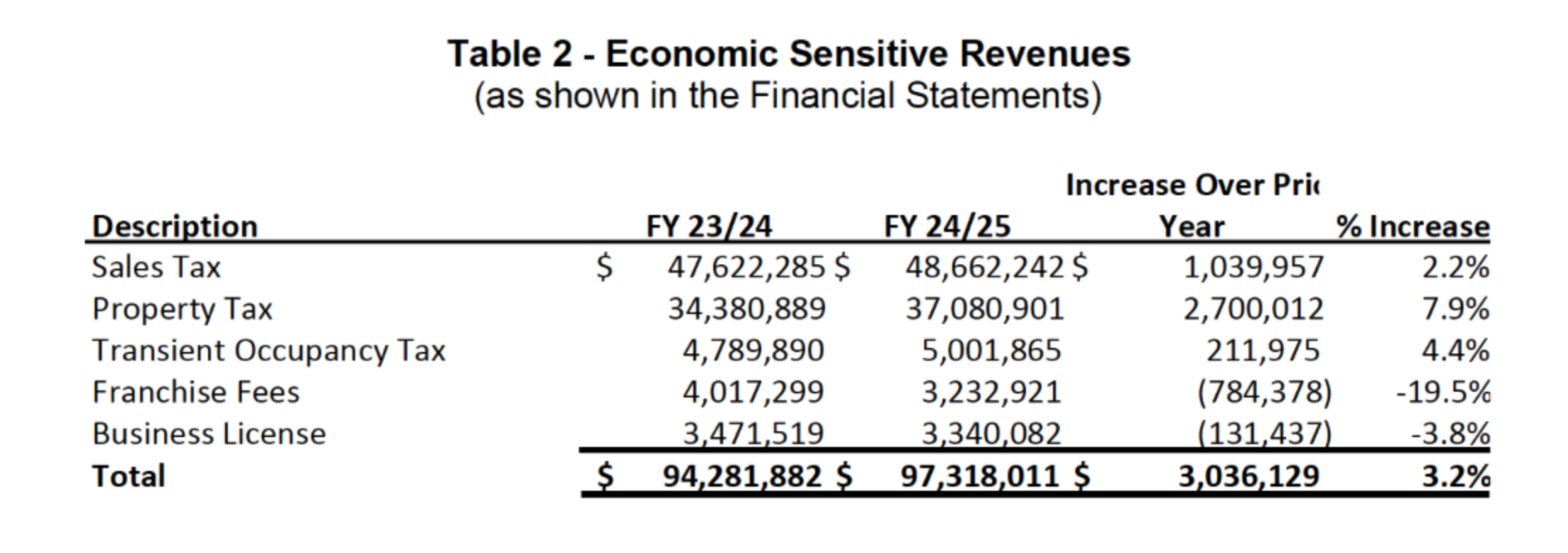
The report notes that fiscal year 2024-25 had growth in Visalia’s General Fund major revenue categories of Sales Tax, Property Tax, and Transient Occupancy Tax as of June 30, 2025.
Fiscal year 2024-25 ended the year with an overall increase of $3.0 million in the total economic-sensitive revenue category for the General Fund – Economic Sensitive Revenues. Most of this increase is from Property Tax which had a $2.7 million increase over the prior year.
Sales Tax for the year rebounded from last year’s contraction, ending fiscal year 2024-25 with a 2.2% increase. The addition of new businesses throughout the City and within our growing Industrial Park help contribute to the growth. The main areas of the increase in Sales Tax for Visalia were General Retail (department stores, apparel stores, furniture/appliance stores) which grew 2.30%, Food Products (restaurants, food markets, liquor stores) which grew 3.75%, and Transportation (new and used auto sales, service stations) which had a slight increase of .5%. Property Tax continued its trend increasing 7.9% as growth in property values remained strong; new development occurred; and the housing market continued to offer premium price levels. Travel stays to the area continued to grow for the year as we saw an increase of 4.4% in Transient Occupancy Tax (TOT) revenue.
Business license revenue decreased 3.8% when compared to last year as the implementation of a new online business license billing and receipt system resulted in adjustments that occurred due to the transition of systems.
More than 500 new businesses
But new business startups were seen.Visalia has 13,990 licensed businesses operating in the City, a net increase of 517 as compared to last year.These businesses include private manufacturing, technology research, retail and service businesses, educational services, healthcare and social assistance, consulting, arts and entertainment, hospitality services, along with non-profit institutions.
Construction activity in the City increased 5.4% (based on the number of all permits issued) in fiscal year 2024-25. The total valuation for all permits issued was $410 million, a 15% decrease from the prior year as the City added .7 million square feet of new commercial property and 1.6 million square feet of space overall. Issued single-family dwelling permits for fiscal year 2024-25 had a decrease of 7% when compared to the prior year.The construction value for 434 new single-family dwelling permits came in at $150 million, which was down 4% from the prior year valuation level.
For the calendar year however, the number of new home permits more than doubled numbering 562 in 2025 compared to 270 in 2024.
Total Revenue to the city in the last fiscal year came almost $11 million more than has been budgeted continuing the city’s conservative budgeting enjoying an upside surprise
Mooney Boulevard
Sequoia Mall is currently undergoing complete refurbishment. The next phases will include a conversion of the former Bed Bath and Beyond building into smaller suites. This follows completion of a new Sephora, Osh Kosh, Carter’s, and Sketchers which are all located near Hobby Lobby. Local favorite Orange Works is looking to open a new Mooney Boulevard restaurant in the former Crown Dry Cleaners located between Tulare Avenue and Walnut Avenue. The restaurant will also feature a drivethru. Downtown Tazzah, Coffee & Tea will open in the original Tulare Co. Farm Bureau historic building located at 112 East Oak Avenue. Owners of Sushi Kuu are going to be opening a new restaurant, Ramen Kuu, at 117 West Main Street in the former Metropolis Body Spa building. Moving forward this year is the Bridging Horizons Play Park project, Visalia’s first fully inclusive playground and park. The project is located just east of Imagine U Children’s Museum. North Visalia Development at Orchard Walk West located at Dinuba Boulevard and Riggin Avenue continues to progress. A new phase has been completed and includes Burlington Coat Factory, Ulta Beauty, and Five Below which are all now open. Raising Cane’s is now open in the Orchard Walk West center. Construction of a new Costco at the corner of North Shirk Street and Riggin Avenue has begun. The 159,352 square foot Costco will also offer a car wash and fuel facility. Costco intends to be open early 2026. Additional Visalia Developments A second Vallarta Supermarket is currently under construction near Lovers Lane and Noble Avenue. The 53,000 square foot space will anchor additional spaces including a 26,000 square foot space and several other retail and food spaces. Construction of a new Towneplace Suites by Marriott is nearing completion. It is located near the Holiday Inn Express in the Adventure Park area. A new 2,800 square foot drive-thru restaurant is being proposed at the southeast corner of Stonebrook Street and Caldwell Avenue across from The Human Bean.
The $11.4 million project will widen Riggin Avenue from Kelsey Street to Shirk Street converting it from an undivided two-lane road to a four-lane road with median. This will improve traffic mobility for the industrial park and surrounding businesses.
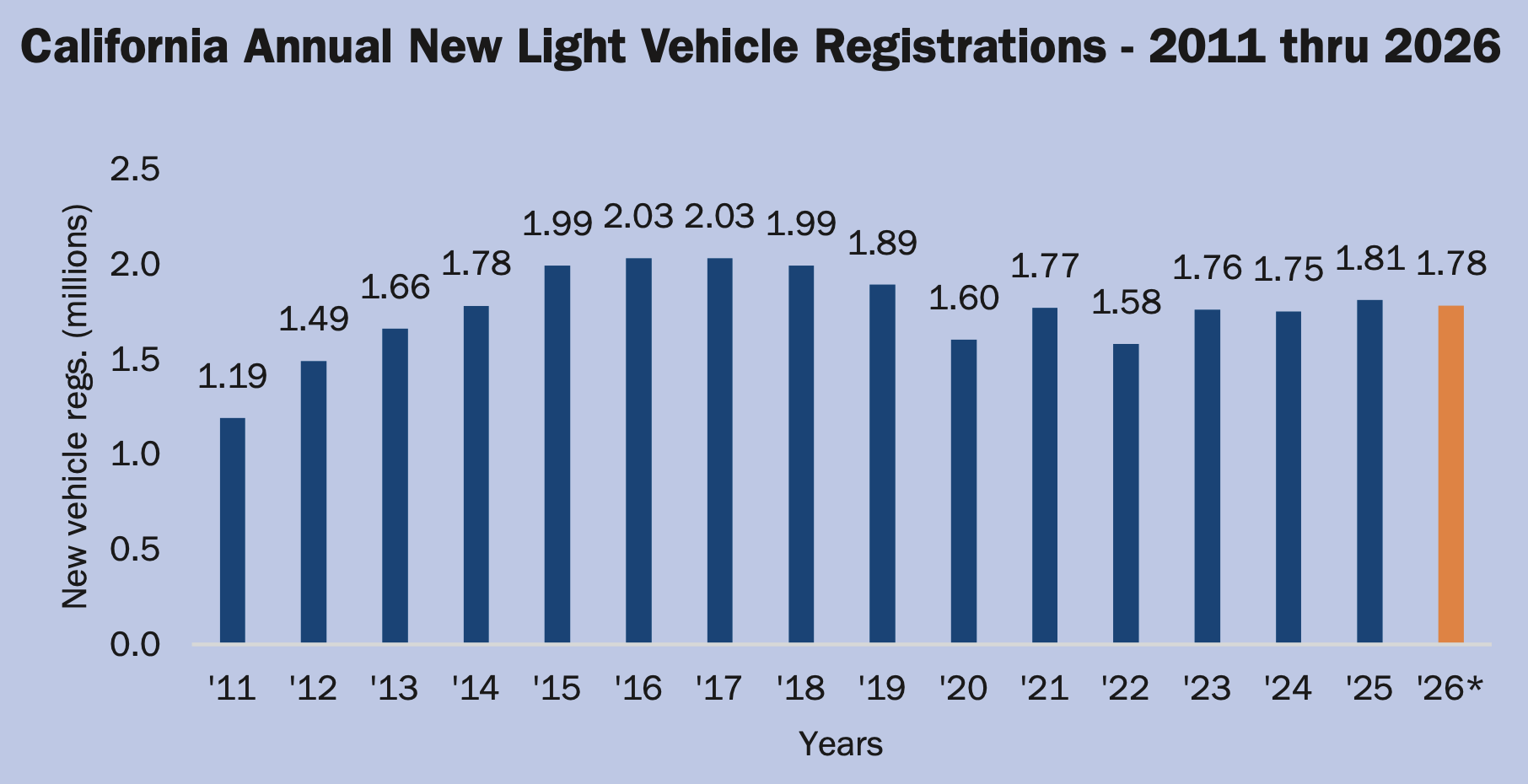
California new light vehicle registrations increased 3.3 percent from 2024 to 2025, slightly below the 4.2 percent improvement in the nation, says the annual report from the California New Car Dealers Association. As expected, the market declined in the fourth quarter, with registrations falling 1.9 percent versus the year earlier. Likewise in 2026 California new vehicle registrations are predicted to decline slightly, predicts the report.
Sticker shock
Transaction prices nearing $50,000 are making new vehicle purchases a stretch for many consumers.
Additionally, tariffs will almost certainly lead to rising vehicle prices, the labor market is weakening, and household incomes are barely keeping pace with inflation, says the report.
However, the news isn’t entirely bleak. The average age of vehicles on the road is at a record high, partly due to postponed purchases since the pandemic. This resulting pent-up demand, coupled with the prospects of lower interest rates, should limit any potential decline in sales in 2026.
New vehicle registrations this year are predicted to slip below 1.8 million units and fall 1.5 percent from 2025.
ZEV sales declined sharply at the end of 2025.
New registrations of zero emission vehicles headed lower during the last few months of 2025 due to the expiration of federal government tax credits. ZEV share of the new vehicle market was 22.2 percent during the first ten months of 2025 and declined to just 12.8 percent in November and December.California’s share of total U.S. ZEV registrations in 2025 was 28.5 percent. Hybrid registrations increased 36 percent last year, and market share reached 19.4 percent, up more than ten percentage points versus points three years earlier.
Notably, hybrid sales slightly outpaced ZEV sales in Q4 alone, capturing 20.4 percent of the market, reflecting sustained consumer interest in lower-emission options that do not require installation of charging infrastructure or major lifestyle changes.
Gas-powered vehicles remained the single largest segment of the market, accounting for more than half of all new vehicle registrations in 2025 (54 percent).
Model Rankings
California’s year-end model rankings underscore continued demand for both affordable and established, high-volume vehicles across passenger car and light truck segments.
The Toyota Camry remained the top-selling passenger car in California, widening its lead in 2025, posting 62,324 registrations and capturing 50.0 percent of the midsize and large car segment. The Honda Accord followed with 30,455 registrations (24.4 percent). In the small car segment, the Honda Civic led the market with 53,085 registrations, representing 30.4 percent of sales.
Among light trucks, the Tesla Model Y remained California’s top-selling model overall with 110,120 registrations, accounting for 8.2 percent of total light truck share. The Toyota RAV4 followed with 65,604 registrations while the Honda CR-V recorded 52,311 registrations.
Pickup demand remained strong. The Toyota Tacoma led compact and midsize pickups with 45,258 registrations (51.3 percent in that segment), while the Ford F-Series topped the full-size pickup segment with 39,502 registrations, followed by the Chevrolet Silverado at 33,634 registrations.
Toyota finished 2025 as California’s top-selling brand, with 17.8 percent market share, further widening its lead over competitors. Honda closed the year in second place, capturing 10.8 percent of the market.
Tesla sales drop
By contrast, Tesla registrations declined 11.4 percent in 2025 with market share dropping from 11.6 percent in 2024 to 9.9 percent in 2025 as it slipped to third place in the state. This extends a two-year downward trend for Tesla despite the temporary boost from federal incentives.
California farmers who grow fruit for canned products suffered a major setback last week as Del Monte Foods announced plans to close its only remaining cannery in the state.
The Walnut Creek-based company filed for bankruptcy in July, citing burdensome debt payments stemming from a prior acquisition of the company and missteps in long-term fruit purchasing commitments made when sales briefly spiked during the pandemic.
This month, following a lengthy court-supervised bidding process, Del Monte auctioned off many of its assets, but no buyer came forward to purchase the company’s cannery in Modesto.
“As a result, Del Monte Foods has made the difficult decision to begin an orderly wind-down of operations at the facility,” the company said in a statement. “We recognize the significant impact this decision will have on our team members, their families, and the community.”
The cannery’s closure will reportedly affect roughly 600 employees and 1,200 seasonal workers in Modesto.
The closure ends Del Monte’s more than 100-year history as a processor of California-grown fruits and vegetables, potentially leaving scores of farmers without a buyer for their produce.
“It’s difficult,” said Ranjit Davit, who grows cling peaches in Sutter County and chairs the California Canning Peach Association’s board of directors. “Growers are very upset about the situation.”
Farmers who planted fruit orchards under long-term contracts with Del Monte said they were weighing their options and bracing for steep losses.
Growers of cling peaches are especially impacted as the crop has no fresh market and is sold entirely to processors. In recent years, Del Monte contracted about 35% of California’s cling peaches, while Lodi-based Pacific Coast Producers contracted about 60% of the crop, with the rest purchased by a few smaller processors.
“It’s pretty devastating,” said Richard Lial, who grows cling peaches in San Joaquin County.
Cling peach growers typically plant new orchards—at a cost of several thousand dollars per acre—after securing contracts with processors that last 20 years, roughly the orchard’s lifespan. It can take close to a decade for a farmer to pay off the initial investment, and Del Monte’s exit from the sector means many growers may never make their money back.
A couple years ago, Lial tore out a productive almond orchard to clear the ground for 50 acres of peaches under a long-term contract with Del Monte. He planted the peach trees last year only to be left a year later with no buyer for the fruit.
“It’s horrible,” Lial said.
The third-generation grower farms a total of 105 acres of peaches, all of which was contracted with Del Monte. He said it may be possible to graft almond trees onto his young peach orchard, and to find a short-term buyer for some of the fruit from his bearing acreage, but neither outcome was certain.
The spacing in his peach orchard is “not ideal” for almonds, Lial said, and Del Monte’s departure will likely leave far more fruit on the market than other buyers can absorb.
“One of my options is just to take everything out,” he said. “It will be a total loss.”
Lial added that the closure of the Modesto cannery could have a “huge trickle-down effect” in the Central Valley, with impacts not only on cannery workers and farmers but on the farm workforce and agricultural supply companies. He said the loss of his peach acreage would likely force him to lay off two employees.
For decades, cling peach growers have faced declining demand due to the year-round availability of fresh fruit, while rising input costs and cheap imports have also challenged the sector. Since 1969, California’s bearing acreage declined from more than 63,000 to less than 14,000, according to the U.S. Department of Agriculture.
Chris Zanobini, executive director of the California Pear Advisory Board, said the state’s pear growers were similarly “concerned about whether they’ll be able to sell the fruit they grow” this year.
While pear growers have an important fresh market, most of the fruit is sold to canneries, with Del Monte purchasing more than 40% of the cannery tonnage last year.
Cling peach and pear growers alike said they were looking to PCP, the only major processor left in California, to potentially pick up their fruit.
The grower-owned cooperative purchased some assets from Del Monte during the bankruptcy sale, including unsold canned fruit inventory.
Mona Shulman, vice president of PCP, said the cooperative was also in the process of licensing some of Del Monte’s shelf-stable fruit product brands from Fresh Del Monte Produce Inc., a separate company that purchased the brands from Del Monte.
Shulman said PCP planned to contract more fruit acreage from farmers this year as the cooperative expands its private-label business to include Del Monte-branded products.
“We intend to market and sell the Del Monte brand going forward for shelf-stable fruits,” Shulman said. “In that mix, we will be acquiring more fruit than we currently process.”
As of this week, PCP, which processes fruit at a cannery in Oroville, was still assessing the volume and varieties it would need.
“We are in discussions currently for our peach supply needs with attention to varieties that deliver throughout the production season,” Shulman said, adding that PCP would procure fruit “to support a sustainable volume of Del Monte sales” but could not replace the company’s full production.
Unlike most fruit contracts, purchases made this year by PCP may represent a stopgap solution for growers rather than a long-term guarantee.
“It is possible that the contracts will be for a shorter term simply because we don’t know how this is going to work in the mix,” Shulman said. “To protect our company and not overcommit, it is likely a 20-year contract may not be the initial offering.”