Author Gary Soto to Host Ribbon-Cutting Ceremony and Book Signing at the Grand Opening at 9AM on Wednesday, January 31st, 2024
All you readers out there can finally celebrate the opening of a major bookstore in the region.
Barnes & Noble has announced they will open the doors of its new Visalia bookstore on Wednesday, January 31st. The new Barnes & Noble is located in The Sequoia Mall (3415 S Mooney Blvd, Visalia, CA 93277) next to Nordstrom Rack, near Hobby Lobby and Marshalls.
The bookstore will officially open to the public at 9AM PST on Wednesday the 31st, with Gary Soto, author of the children’s book -Puppy Love, cutting the ribbon. The new location showcases the highly lauded bookstore design seen in the most recent Barnes & Noble store openings, housing all the best books, toys, games and gifts that customers have come to expect from the nation’s premier bookseller. The new Visalia bookstore will also feature an updated B&N Café.
“The enduring appeal of real bookstores at a time of tremendous growth in reading means that Barnes & Noble is opening new bookstores at a pace not achieved in decades,” said James Daunt, CEO, Barnes & Noble. “Many of our new bookstores are smaller in size. Not so in Visalia where we open a stunning new store that is as expansive as the grandest of any Barnes & Noble. The glory days of bookstores are back.”
Barnes & Noble is enjoying a period of tremendous growth as the strategy to hand control of each bookstore to its local booksellers has proven so successful. The bookseller is enjoying exceptionally strong sales in its existing stores and has been opening many new stores after over 15 years of declining store numbers. In 2023, Barnes & Noble opened more new bookstores in a single year than it had in the whole decade from 2009 to 2019. The bookseller expects to open over 50 new bookstores in 2024.
The Visalia bookstore is one of two new Barnes & Noble locations to open their doors on the 31st, alongside a new store in Kalispell, MT. Another new Barnes & Noble bookstore is due to open the week after in Jonesboro, AR.
“Few parts of my job are more gratifying than opening a new bookstore,” said Store Manager Vicki Bailey, Barnes & Noble bookseller of 28 years. “While our look may have changed since I helped open our Fresno location in 2002, the core of good bookselling remains the same — beautiful, well-organized bookstores staffed by friendly and knowledgeable booksellers is a winning combination. We can’t wait to welcome you into your new Visalia Barnes & Noble.”
Forecasters are predicting a strong atmospheric river storm to hit the Central Coast, and much of middle California and the Bay Area around the first week of February. The strong El Niño storm now, a little over a week away, could bring over 6 inches of rain over several days in San Luis Obispo County and heavy snow to the Tahoe region. The storm could be reminiscent of last year’s heavy precipitation events that fell in short periods. This week the San Diego area was hit by flash flooding that carried away cars on January 22. These types of storms are possible with the strength of the jet stream, pushing the persistent highs of our coast as far down as Baja and allowing the storms to enter California instead of being shunted up to the Pacific Northwest.
Maps below show total rainfall as of Saturday, February 3 and the second map showing rain hitting the West Coast on February 4
Gannett-owned Visalia Times Delta will shut down their printing plant in March the company announced this week. A story in the Times Delta said that the paper will be printed elsewhere.
“The news and advertising teams will remain in Visalia and continue to serve the community.”
The story continued that “Production employees involved with printing and packaging in Visalia will be impacted by the transition as operations cease.”
“As our business becomes increasingly digital and subscription-focused, newspaper printing partnerships have become standard,” a Gannett spokesperson said. “We are making strategic decisions to ensure the future of local journalism and continue our service to the community.”
Some years back Gannett closed the Tulare printing plant when they bought the Advance Register newspaper.
The Visalia headquarters for the newspaper is at 303 N. West St. covering an entire block in downtown.
With the departure of the big printing press and associate employees is likely the Times Delta will not need their large 1.1 acre property with almost 29,000 ft. in favor of a smaller office space in town.
The newspaper in Hanford recently relocated their staff after selling their longtime building to Hanford school district.
With a glut of office buildings in California remaining vacant after COVID, cities are looking to fill that space with housing – in turn helping downtown districts..
Big radio station owner declares bankruptcy
Radio station owner Audacy has announced that it is filing f for Chapter 11 bankruptcyThe company, which owns more than 200 stations across the U.S.The company said the filing would result in a reduction of its debt by 80% from around $1.9 billion to about $350 million. The company owns numerous stations in California, including high profile on news stations in LA- KNX- and in San Francisco- KCBS.
Hospital will offer Crisis Stabilization Unit for youth
Kaweah Health wants to to establish a community based mental health crisis service facility (Crisis Stabilization Unit) for children and youth within an existing 18,295 square foot facility at 230 Northwest 3rd Avenue in Visalia.The site is the former Sequoia Boy Scouts location. The hospital is seeking approval from the Visalia Planning Commission this month.
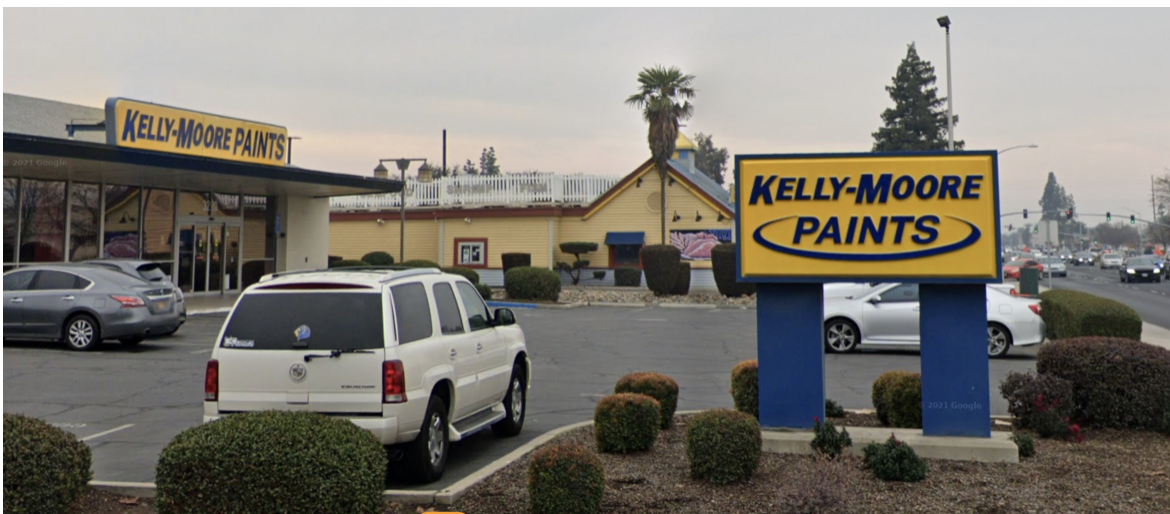
Nationwide paint chain lays off 700 Closes all Central and Northern California stores
Kelly Moore paint stores have shut their doors.
Founded about 80 years ago in the Bay Area, Kelly-Moore had 157 stores nationwide and around 70 of them in Central and Northern California.The chain, with headquarters and manufacturing in Texas, announced January 12 they would lay off 700 employees and go out of business.
Store closures are happening in the Central Valley towns of Visalia, Fresno, and Merced, and on the Central Coast in San Luis Obispo County, as well as a large cluster of about 60 stores from Stockton to Salinas and all over the Bay Area.
Company headquarters moved to Irving Texas, in 2023 from the Bay Area.In recent years company was under financial pressure because of lawsuits related to its use of asbestos in cement and texturing materials until 198. A news release highlight in the pressure.
“I’m extremely disappointed and saddened by this outcome, as the entire Kelly-Moore team made incredible efforts to continue innovating and serving the unique needs of professional painting contractors,” Kelly-Moore Paints CEO Charles Gassenheimer said. “The ownership group’s commitment from day one was to fix the business if we could. Sadly, no matter how great the Kelly-Moore team, products and reputation for service, we simply couldn’t overcome the massive legal and financial burdens that have been weighing on the Company for many years.”
The company said they will continue to fulfill remaining customer orders from a distribution facility in Union City.
In September 2022, Kelly Moore Paints was acquired by Flacks Group, a Miami, Florida-based investment firm that holds more than $2 billion of total assets. Flacks Group bought the paint company’s retailing, distributing and manufacturing units.After the acquisition, Charles Gassenheimer, managing partner of the Flacks Group, became the CEO of Kelly-Moore Paints.Kelly-Moore had $400 million in annual revenues and 1,200 employees at that time.
In 2021,Kelly-Moore Paints had an estimated 6.6% of total industry revenue behind,Sherwin-Williams and PPG Industries, each with over 11% market share.
Mix of tree heights enhances drought resilience in Sierra Nevada forests
In a paper published in Nature Communications, UC Merced Professor Roger Bales, collaborating with an international team, found that the height of neighboring trees strongly influenced whether a given tree survived California’s record 2012-15 drought. Using high-resolution maps developed from aircraft flights before and after the drought, the team determined the fate of more than 1 million conifer trees in the southern Sierra. They found that trees overshadowed by taller neighbors were less likely to suffer drought stress and die, mostly due to reduced sunlight and thus lower growth and water demand. A forest with a similar number of trees, but of more-uniform height, whether large or small, lacks this shading by neighbors, and is more vulnerable to competition for water and drought stress.
University Michigan Survey of community sentiment jumps
Consumer sentiment soared 13% in January to reach its highest level since July 2021, showing that the sharp increase in December was no fluke. Consumer views were supported by confidence that inflation has turned a corner and strengthening income expectations. Over the last two months, sentiment has climbed a cumulative 29%, the largest two-month increase since 1991 as a recession ended. For the second straight month, all five index components rose, with a 27% surge in the short-run outlook for business conditions and a 14% gain in current personal finances. Like December, there was a broad consensus of improved sentiment across age, income, education, and geography. Democrats and Republicans alike showed their most favorable readings since summer of 2021. Sentiment has now risen nearly 60% above the all-time low measured in June of 2022 and is likely to provide some positive momentum for the economy. Sentiment is now just 7% shy of the historical average since 1978.
Farm Bureau’s Duvall: Biggest problem facing agriculture is lack of labor
Congress must reform the guestworker program to ensure there are enough workers on the farm to produce America’s food, said the president of the largest U.S. farm group on Sunday. “It’s the biggest limiting factor that American agriculture has,” said president Zippy Duvall at the American Farm Bureau Federation convention in Salt Lake City. “Now we recognize the political environment is difficult in Washington, D.C. On Capitol Hill we cannot afford to wait for action on this important issue,” said Duvall. Reform of the H-2A visa program, which now provides seasonal workers, should allow year-round workers and it should set wages at a more affordable level for employers instead of the federally set rate that is galloping out of reach, he said. Duvall also called for passage of a new farm bill that provides “an updated safety net” that takes into account rising costs of production and the impact of inflation on the price of supplies. In addition, the AFBF is seeking a congressional override of California’s Proposition 12 animal welfare law, said AFBF officials. Lawmakers have clashed for years over comprehensive immigration reform and there are few signs of agreement with the presidential election on the horizon. The House passed a bipartisan ag labor bill in March 2021, with provisions to modernize the H-2A system and to give legal status to undocumented farmworkers, but it died in the Senate in 2022. The AFBF opposed the bill. Half of U.S. farmworkers are believed to be undocumented and many of them are reaching retirement age. For years, farmers have reported difficulty in recruiting workers for physically demanding work in the fields and handling livestock. “Because of the pandemic, the high inflation, rising costs of production, and disruptions around the globe, we need a new farm bill that provides an updated safety net to address those challenges,” said Duvall during a news conference. “Congress must also work on the guestworker program. We need a solution that meets the demands for both year-round and seasonal workers. We need a wage rate … that compensates workers fairly and also keep our farms economically sustainable.” The AFBF is among farm groups that want the farm bill to include higher reference prices, a key factor in calculating crop subsidies. Lawmakers have deadlocked for months over the idea. An increase would be expensive, and the most immediate way to pay for it would be to raid the $20 billion in climate funds. Senate Agriculture chairwoman Debbie Stabenow has rejected that idea. “We heard loud and clear from out members … that that is a priority,” said Sam Keiffer, the AFBF’s lead lobbyist, when asked what AFBF wanted on reference prices. Farm groups and their allies in Congress have been resolute in pushing for higher reference prices. By one estimate, a 10-percent increase in reference prices would cost $20 billion and a 20-percent increase would cost $50 billion. It’s difficult to negotiate legislation when farm groups have been reluctant to spell out their goals but will not yield on them, said an agriculture lobbyist who spoke on condition of anonymity. “They’re living in la-la land.
As inflation falls, ‘backwards pressure’ on food prices, analyst says
Compared to food price inflation of 11% in 2022, grocery price increases will be virtually nonexistent this year, said a Wells Fargo analyst Wednesday during a panel discussion on the 2024 outlook for the food and ag sector. A Rabobank analyst said that softer commodity prices would take the steam out of the hot farmland market.
“Consumers are going to be very happy” with low inflation in the food sector, said Michael Swanson, chief ag economist at , to the North American Agricultural Journalists. Food makers will face “backwards pressure” on prices from retailers and food service operators.
Grocery inflation at the start of this year would be 1 percent or slightly higher but trend downward to zero or into negative territory by the end of the year, he said. For the restaurant, fast-food, and cafeteria sectors, lumped together as food away from home, “we’re still closer to 6% right now,” said Swanson. Americans love to eat out, he said, but consumers are showing resistance to high menu prices. “It’s going to be interesting to see who wants to eat where.”
According to the Consumer Price Index, food inflation was 2.9% at the end of 2023. USDA economists forecast that grocery prices this year will be, on average, 0.6% lower than in 2023 and that the food-away-from-home inflation rate will be 4.9%.
Farmland prices have boomed this decade, thanks to strong commodity prices and the three best years on record for farm income, but they’re likely to flatten in the near term, said Roland Fumasi, the head of RaboResearch Food and Agribusiness. Land values accelerate during periods of high commodity prices and slacken when prices moderate. Agricultural economists in the private and government sectors anticipated somewhat lower commodity prices in coming years.
“Given the pullback that we’ve seen in crop prices, we’re probably going to take a little breather, and we’re not going to keep going up at these fast paces in terms of land values, like we have for the last few years,” said Fumasi. Land values might rise or fall by 1 or 2% in a year, he said, “but I think any change is going to be pretty muted.”
Agricultural land values in the Midwest rose 5% during 2023, the smallest gain in three years, said the Chicago Federal Reserve Bank in November. The Kansas City Fed said that while the national agricultural economy softened last fall, farm real estate values “held firm with ongoing support from a strong agricultural economy in recent years.”
In a list of key issues for the agricultural economy, Dan Sumner, an economist at the University of California-Davis, put China first. “We’ve got trouble with growth in China,” he said, with possible direct impact on U.S. agriculture, because China is the No. 1 market for U.S. food and ag exports.
A wet storm coming into California January 22 is boosting rainfall totals in the midstate and in the Sierra where snowpack is starting to build for the first time in the water year.But we have a ways to go can be seen by a few charts here.
Mammoth ski resorts is reporting new snow falling this week, but compare the current snowpack to last year and the difference is huge.
Of course, last year was a record what year with almost 400 inches of snow falling in Mammoth by the end of January 2023. So far this year through January 22, Mammoth has received about 86 inches of snow.
In the southern Sierra on the western slope at Giant Forest, precip so far this season is only 7 inches compared to 45 inches this time in January 2023. For the water year Giant Forest got a near record 92 inches of precipitation.
It’s a little better in Northern California at Shasta Reservoir where they have received about 25 inches for precip so far this water year compared to 40 this time last year, of course a record year for rain. We are about in the same place at Shasta Reservoir as it was in January 2020 and 2021. Some good news is that water storage in California’s largest reservoir at 3.3 million acre feet is more than it has been at this time for the past three years with good prospects ahead for a wet February.
Speaking of good news, here is the NOAA Climate Prediction Center’s 8 to 14 day forecast for California showing wet weather across all California through Feb 4.
After parting ways with its longtime jalapeño supplier, Sriracha Sauce maker Huy Fong Foods struggled to find a steady supply of fresh peppers. Recently, following two years of shortages, the popular condiment began reappearing in stores.
Over the past several months, a vegetable farmer in the Imperial Valley pulled off an improbable feat that may help solve an urgent supply shortage—at least for those who crave some extra heat in their rice, soup, noodles or stir-fry.
Shoppers who set out to buy a bottle of Huy Fong Foods’ Sriracha sauce in recent years likely went home empty-handed. That’s because in 2022, after churning out the sauce for decades, the company in Los Angeles County ran out of its key ingredient—red jalapeños—and shut down its processing plant.
For 28 years, Huy Fong sourced all of its peppers from Ventura County farmer Craig Underwood of Underwood Ranches. But in 2017, the partnership collapsed after a payment dispute that led to a jury awarding $23 million to the farmer.
Since then, Huy Fong, while secretive about its suppliers, has reportedly sourced jalapeños from farmers in Mexico and the southwestern U.S., but with mixed results. A couple years ago, the company announced a lack of inventory had left it “unable to produce any of our products.”
The “severe shortage” persisted for more than a year, leaving restaurants and hot sauce aficionados in dire straits. Last summer, third-party retailers were selling the iconic green-capped bottles, previously worth about $5, for as much as $150.
Huy Fong blamed its supply issues on drought-related crop disasters across multiple growing seasons, though other hot sauce brands that use jalapeños did not experience the same challenges.
A key reason for Huy Fong’s shortage, growers and pepper experts said, was that the company evidently failed to rebuild a supply network with enough farmers. For a pepper processor, “that is just absolutely critical,” said Stephanie Walker, co-director of the Chile Pepper Institute at New Mexico State University.
Jalapeños are difficult to grow because of their long growing season—typically about 80 days for transplanted crops. “When they’re in the ground longer, they’re going to be exposed to more risks,” such as pests, diseases and extreme weather, Walker said.
Red jalapeños, which are picked after the pepper turns from green to red—with a growing season of about 120 days—and must then be harvested within a short window, can be especially challenging.
“We learned over 28 years how to grow and harvest jalapeños,” Underwood said. At its peak, he grew 2,000 acres of jalapeños for Huy Fong, planting multiple crops each year. The farm even designed its own mechanical harvester and hauled the peppers from the field to Huy Fong’s facilities.
“What we did for them was rather complicated,” said Underwood, whose company still grows jalapeños and makes its own brand of Sriracha sauce.
Before Huy Fong’s inventory dried up, its Sriracha was the top-selling hot sauce in 31 states, according to consumer data from Instacart. Since then, Huy Fong lost market share as competitors and newcomers filled the void. A Huy Fong representative said no one from the company was available to comment.
To get back in business, Huy Fong needed peppers. But “finding really good pepper growers is challenging,” Walker said. In addition to pest and weather risks, labor costs caused many U.S. growers to abandon the crop. Where could Huy Fong go?
According to California pepper growers, last summer, a man described variously as “a broker,” “a gentleman” and “a guy in Coachella” sounded out farmers to grow large amounts of red jalapeños for an undisclosed processor.
“He was trying to put together a very quick, very large jalapeño program,” said Alex Jack of Jack Brothers, Inc., who farms in the Imperial Valley and received a call from the man in July.
When he got the call, the jalapeño seedlings were already growing in a greenhouse in Northern California, Jack said. The broker needed farmers to sign contracts and plant the peppers within a few weeks before they were too late to transplant.
It was an unusual approach. “Unless they have a grower or growers already lined up,” Walker said, “I’d consider it very risky to start a large number of transplants. My guess is that they were quite sure that they’d be able to get growers on board.”
It was mid-July, and the man wanted to know if Jack could plant 500 acres, using drip irrigation, by Aug. 15.
“They were doing things unconventionally,” Jack said, possibly “because they were in a predicament where they had to just get things rolling and hope it all worked out.”
The Jack family has farmed in the Imperial Valley for more than a century, and Jack has farmed there since 1989, but he had never grown jalapeños. Planting so many so fast “would be like a new NFL franchise winning the Super Bowl in its first season,” Jack said. “It’s crazy.”
To start with, at the height of the Imperial Valley’s sweltering summer, much of his team was away on vacation.
Jack called up his ranch manager and irrigation specialists, and hired more workers through a farm labor contractor. “We brought everyone back and we got it all planted,” he said. “It was a Herculean effort.”
Setting up the irrigation system in time was only possible, Jack added, with knowledge his family gained through generations of farming. “It’s a lot of years of experience from Jack Brothers doing drip irrigation that helped us put this whole program together,” he said.
High-value crops such as chili peppers are almost always grown on drip irrigation, Jack said, because the system, while expensive, enables farmers to “fine-tune the growing of the crop” by administering precise amounts of water and fertilizer.
The jalapeños benefited from underground piping for drip irrigation Jack already had on some of his fields. “We did about half the jalapeños on our permanent drip field, and we did half on portable systems,” he said. He estimated it took 25 people working full time for a month to plant the crop, finishing in late September.
Then came a massive storm from the Gulf of Mexico, followed by multiple days of triple-digit heat. “I thought we were in trouble, but the peppers came through with flying colors,” Jack said.
A fleet of mechanical harvesters, purchased by the client for this year’s crop, began harvesting the jalapeños just after Christmas. “Considering everything we went through and how little time we had to plan for it, the crop looks really good,” Jack said.
Growing the crop successfully has made him the confidential processor’s largest supplier, he said. With harvest wrapping up, Jack is preparing to plant 210 acres of jalapeños for the spring season. They should be ready to harvest in June.
Beyond that, Jack isn’t sure what the future holds. He does not have a long-term contract to continue growing peppers.
In November, Huy Fong said it had resumed production, noting in a statement, “We continue to have a limited supply that continues to affect product availability.”
In recent weeks, consumers began reporting lower prices for Sriracha and wider availability. Jack said he still doesn’t know with certainty where all his red jalapeños are going, though growers familiar with the scale and urgency of the program said it may be no great mystery.
California diesel price drops 70 cents since November
The price of diesel fuel has dropped $.70 since November says the federal Energy Information Agency.West Coast Pad 5 price that includes California was selling for $5.34 as of October 30 and as of January 15 it is selling for $4.58, more than a 70 cent drop.In June 2023 the average price in the state was $6.13 a gallon.
Oil analyst Tom Kloza in a “ Disinflation Update” offers this price comparison for average price of fuels nationwide.
Fuel Current Price Year Ago % Change Gasoline $3.08/gal $3.39/gal – 9.1% Diesel $3.92/gal $4.61/gal -15.0% Jet fuel $2.66/gal $3.92/gal -32.1%
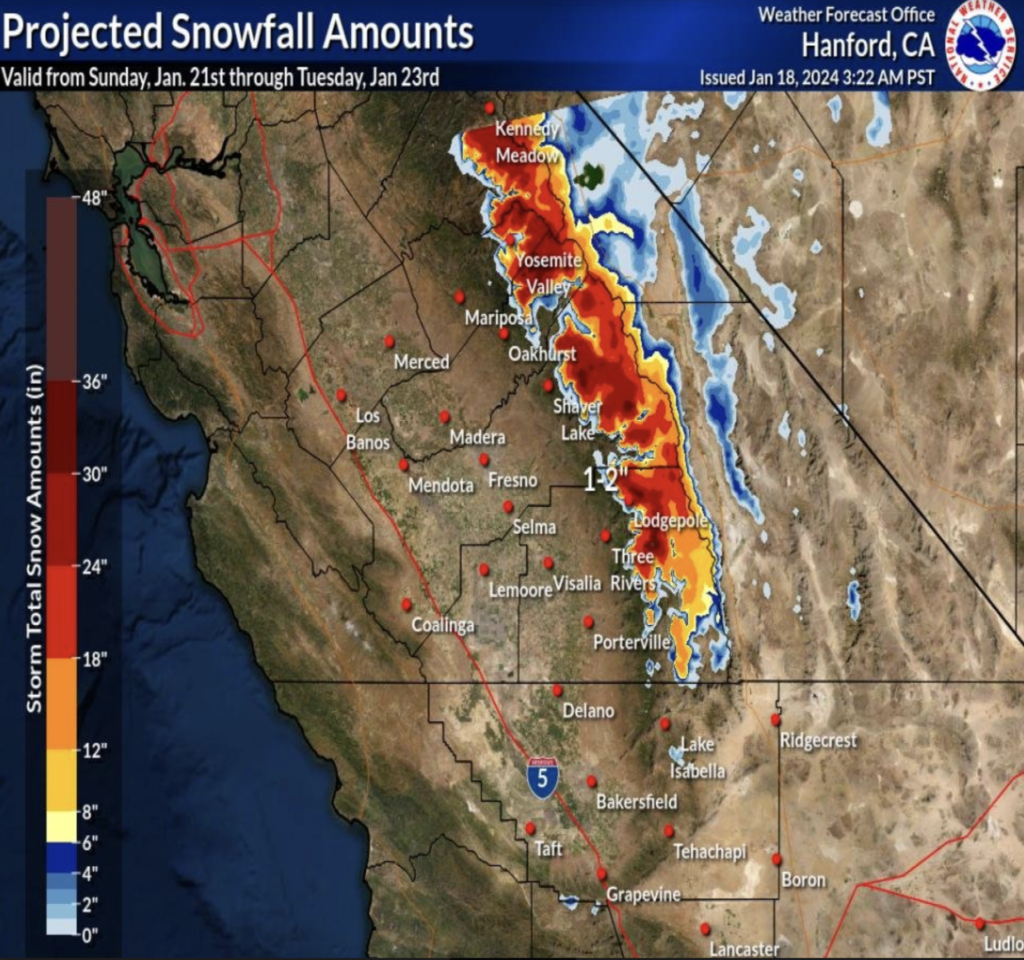
NWS Hanford says winter storms will move across California starting around the end of the week (Jan 19) and continuing into next week. Snow is expected to fall across the Sierra Nevada with up to 12 inches with the first storm and 30 or more inches with the second.
In the upper elevations of the Kaweah watershed they expect some 3 feet of the white stuff over the four day period, although the snow level will be high at around 7000 feet.
“This will be the strongest storm of the season so far” says forecaster Andy Bollenbacher.
“Lower elevations like around Giant Forest at 6000 feet could see a mix of rain and snow in the first storm but likely all rain in the second storm.” But at higher elevations in the Kaweah watershed
it will be a good snowmaker, the first of the season.
Hanford ’s weather service says “The first of two back to back systems will impact us Friday night through Sunday
morning, and will bring widespread rain to the San Joaquin Valley and snow to the Sierra Nevada, with the snow levels remaining consistent at around 7,000 feet.”
This system will be the weaker of the two, and there are probabilities for many areas in the Valley to see a quarter of an inch or more rain.
The second low pressure system will be the stronger of the two storms, says NWS. It will come in as the first system starts to weaken, so there will be little to no gap in rainfall and snowfall. As
with the last system, widespread rainfall and snowfall will fall in the San Joaquin Valley and the Sierra Nevada, respectively. Probabilities show a 40-60% chance of many areas in the
valley south of Kern County seeing a half inch of rain Sunday. Those probabilities drop slightly to 30-50% that the same areas will again see half an inch of rain on Monday. Preliminary
forecasted rainfall totals are an inch or more for much of the Valley.
As for snow, snow levels will stay constant at around 7,000 feet, but snow totals get much higher for this second system. There is a 60-80% chance that snow totals above 7,000
feet could see a foot or more of snow, with 18 or more inches possible in the highest elevations. Much of this rain and snow will fall late Sunday night through Monday afternoon. The storm
looks to conclude by Tuesday morning.
Andy says look for dry weather to follow perhaps through the end of the month in the Central Valley.
If you plan to visit Sequoia Park, remember to carry chains.Both lanes of Generals Highway are closed between Wolverton Road in the south and Montecito Lodge in the north. Giant Forest, the General Sherman Tree, and the Wolverton snow play area are accessible from the south. It is not possible to drive between the parks, from Grant Grove to Giant Forest.
caption: To appreciate the beauty of a snowflake it is necessary to stand out in the cold.” -Aristotle
2 Attachments
• Scanned by Gmail
The Anthony and Bob Brazil Dairy is holding a complete herd dispersal on January 17 at the A&M Livestock yard in Hanford.But the long time dairy is not going out of business says auctioneer Richard Martella.He explains that the dairy is selling their 300 familiar black and white Holstein cows to replace them with brown Jersey cows and continue their Hanford area operation which is already been in business for 87 years.
Jersey cows have become in-favor recently in the San Joaquin Valley based in part on the assertion that they need less feed to put out the milk volume. This factor is key for Central Valley dairies, who are under the gun to reduce their groundwater pumping under SGMA (Sustainable Groundwater Management Agency) as they plant feed crops like corn and alfalfa nearby for their cows.
One Jersey cow website boasts that ” Although smaller, Jerseys cows are incredibly efficient feed converters compared with other breeds. They have the unique biological ability to utilize the energy in feed for milk production, rather than expelling it as waste.
Jerseys deliver a quality product that you get paid for. Compared to average pooled milk, a glass of Jersey milk has 18% more protein, 29% more milkfat and 20% more calcium. It is also especially rich in vitamins.”
The formula is said to be good for cheese making. Jersey is a British breed of small dairy cattle from Jersey, in the British Channel Islands. The Holstein breed was exported from the Netherlands.
Martella points out that the cull value of a Holstein animal is far higher than a Jersey.
The US Holstein Association advocates just as vigorously for their breed pointing out “Holstein dairy cattle dominate this country’s milk production industry. The reason for their popularity is clear: unexcelled production, greater income over feed costs, unequaled genetic merit, and adaptability to a wide range of environmental conditions. Added up, this means more profit for the dairy producer who milks Holsteins. This point becomes even clearer when you consider that nine of every 10 dairy producers currently milk Holsteins.”
Certainly if you drive around Central Valley, you’ll see a lot more Holstein cows than Jerseys.
Jersey cows are brown and Holsteins are black and white




 In the upper elevations of the Kaweah watershed they expect some 3 feet of the white stuff over the four day period, although the snow level will be high at around 7000 feet.
 As for snow, snow levels will stay constant at around 7,000 feet, but snow totals get much higher for this second system. There is a 60-80% chance that snow totals above 7,000

 The Anthony and Bob Brazil Dairy is holding a complete herd dispersal on January 17 at the A&M Livestock yard in Hanford.But the long time dairy is not going out of business says auctioneer Richard Martella.He explains that the dairy is selling their 300 familiar black and white Holstein cows to replace them with brown Jersey cows and continue their Hanford area operation which is already been in business for 87 years.