Energy News : Oil By Rail To Kern Oil Patch / Nuke Layoffs / EPA Lowers Cellulosic Mandate

Nuclear in California: Southern California Edison (SCE) announced this week that its” staffing and costs are significantly higher than other similar dual unit, non-fleet nuclear power plants.”. As a result, SCE announced its intent to downsize the workforce to 1,500 – a reduction of approximately 730 employees – beginning fourth quarter of 2012.

“ The steam generator issues… require that SCE be prudent with its future spending while SCE and regulators review the long-term viability of the nuclear plant. The reality is that the Unit 3 reactor will not be operating for some time.” said the company.

Kern Getting Oil By Rail From North Dakota
California’s oil patch is getting shipments of oil from North Dakota in 100 car unit trains since last year. That may be good news for California consumers who face higher gasoline prices this month due to a fire at a Bay Area Chevron refinery.  The Bakersfield Californian  says Kern Oil and Refining is getting oil shipped in by rail from the booming  Bakken fields in the upper Midwest  despite all the ‘Black Gold’ in Kern county.
Bakken sweet crude is selling for about $10 more per barrel than Kern heavy crude and $16 more than Alaskan crude.
A second refinery in Bako that recently reopened – owned by Alon may bring crude from the Midwest as well.The competition is pressuring Kern oil prices and could mean lower prices at the pump for West Coast motorists in the future.
North Dakota recently passed California in oil production. North Dakota’s oil production averaged 660 thousand barrels per day in June 2012 -71% over June 2011 volumes. Production gains in the Bakken formation are the result of accelerated development activity, primarily horizontal drilling combined with hydraulic fracturing.  There are now in excess of 4000 oil wells -up 68% from June 2011.
Oil Rides The Rails
With all that oil and limited pipelines to carry it – the rail companies have stepped in.The U.S. Energy Information Administration says that rail deliveries of oil and petroleum products in the United States rose by 38 percent in the first half of 2012 compared to the same period last year with a rail tanker car carrying about 700 barrels.
California is not alone in receiving Midwest oil rail.Two large refiners in the state of Washington are gearing up.Tersoro who has also has refineries in Utah and LA and recently bought BP’s holdings in California – has announced it will replace Alaska crude oil with Midwest oil at its 120,000 bpd refinery in Anacortes, Washington.
Tesoro plans to begin shipments of up to 40,000 barrels per day of Bakken crude to the refinery in September 2012. BP’s Cherry point refinery may also bring in unit trains.Earlier this year that refinery also had a fire helping to spike West coast gas prices.
Unit trains can transport about 60,000 barrels of oil. Union Pacific and BNSF in the West are increasing their loads of oil even as their coal shipments decline.
A recent report suggests the ‘ shale to rail’ trend is nationwide.”Several companies have announced new investments to boost shipments of crude by rail. In April, terminal operator U.S. Development Group LLC said it finished its expansion of its St. James Rail Terminal, which receives shipments of crude from the Bakken and other regions, to handle 130,000 barrels a day of crude shipments. Union Pacific Corp. (UNP) CEO Jack Koraleski told investors last month he expects the company’s shale oil business to grow to almost 400,000 carloads this year. Recently, pipeline operator Plains All American Pipeline LP (PAA) said it is spending $125 million to build new rail facilities in Colorado and Virginia.”
Competition Works
“Competition is working  to reduce crude oil costs in the state” says Walt Dwelle of Nella Oil Co. Dwelle cites the Tesoro pipeline from  their Utah refinery to Las Vegas that is bringing in cheaper Midwest refined product to Nevada, a state that used to be supplied by California refiners. “That leaves more gallons of gasoline for California.”
Dwelle says the rise of Tesoro in recent years as major player in California is a turn around from a few years back when it was in financial straights.
Dwelle says gasoline futures that jumped 40 cents after the Aug 6 Chevron fire have now recovered about 25 cents of that and California gas prices should be stable to lower now with the end of summer driving season.He says Chevron has ordered stock to make gasoline at its Richmond plant even though the refinery could be shut 6 months.Oil is being shipped in by tanker.In addition the company has a plant in El Segundo that could crank.
If fracturing has helped North Dakota – California’s’ drillers hope the same thing happens in California once regulations are in place here.That would mean more cleaner burning sweet crude.

EPA Defends Decision to Reduce, Not Eliminate, 2012 Cellulosic Requirement
In a Monday, Aug 20 court filing, EPA defended its decision to massively reduce, but not eliminate, the 2012 cellulosic biofuel requirement of the renewable fuels standard (RFS2). 
   
For 2012, EPA reduced the cellulosic biofuel requirement from 500 million gal to 8.65 million gal.
   
”When projecting expected cellulosic biofuel production in the context of setting the 2012 applicable volume of cellulosic biofuel, EPA reasonably considered the production capacity likely to be developed throughout the year, while API [the American Petroleum Institute] would have EPA rely narrowly and solely on proven past cellulosic biofuel production,” EPA explained in its Aug. 20 filing with the U.S. Court of Appeals for the District of Columbia Circuit.
   
In March, API filed its challenge against what it viewed as EPA’s “unachievable” requirements for use of cellulosic biofuels in the 2012 RFS. API and other petroleum groups view the cellulosic biofuel mandate as a tax on manufacturers of gasoline. It wants EPA to set the cellulosic biofuel requirement at a realistic volume.
   
Specifically, API challenged EPA on whether the agency’s determination of the cellulosic biofuel that would be sold or introduced into commerce this year was “based on” an estimate provided by EIA and was reasonable, and whether EPA reasonably determined not to decrease the volume of advanced biofuel sold or introduced into commerce this year because other advanced biofuel sources would likely make up the expected shortfall in cellulosic biofuel production.
  
As EPA explained, its “projected volume of cellulosic biofuel is also reasonable and supported by the administrative record. EPA examined the most current sources of information regarding anticipated cellulosic biofuel production of each company with production potential, explained its reasoning, including why its estimates deviated from the EIA’s and reasonably concluded that 8.65 million gallons of cellulosic biofuel (or 10.45 million ethanol- equivalent gallons) would likely be available in 2012,” it noted.

Big Picture Weather Report: Dry But Promising

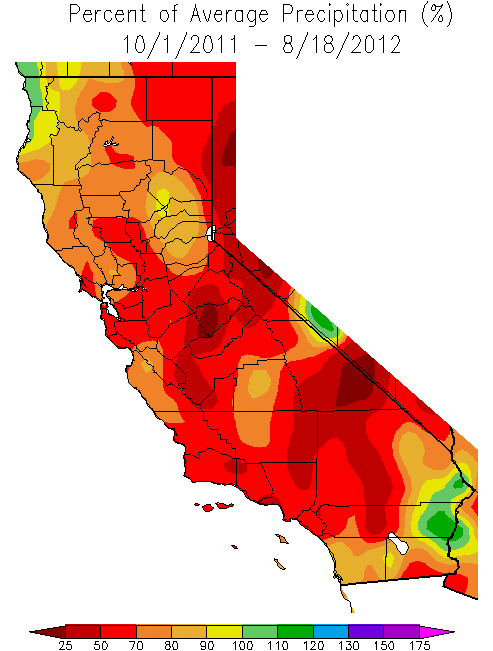
California has had a dry year says NOAA. The map here tells the story with most of the state at or below 70% of average rainfall this  past water year through now. Some parts of the state are at 50%, dark brown on map.
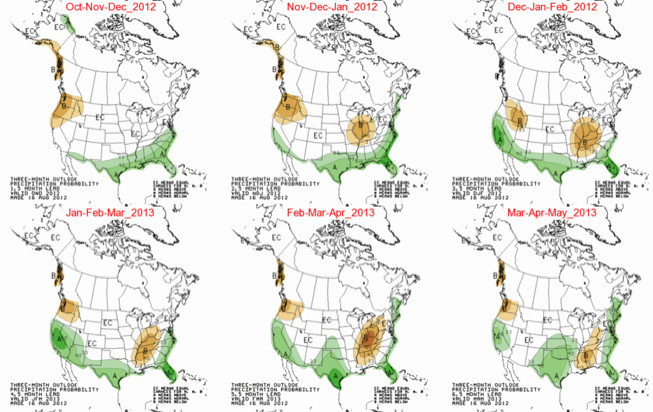
But looking forward, things look more promising, also according to NOAA’s Climate Prediction Center – see lower map.
On August 16,NOAA released these predictive maps showing the likelihood of precipitation this coming winter with each map labeled in red covering a 3 month period.
NOAA is predicting an El Nino weather pattern that should strengthen right when California typically gets the most rain. Notice how the green shading in California spreads from the first map covering the entire state by Dec-Jan-Feb map and dark green covering the mid-state by Jan-Feb-March – the rainy period in the state.El Nino should make this a dry year in the Pacific Northwest but wet in Texas. Also note that chances for a wet Spring in the drought-plagued Midwest improve( last two maps).


Buck Rock Lookout Open House and BBQ Over Labor Day

The Buck Rock Foundation hosts an Open House and Barbeque at the historic Buck Rock Fire Lookout in the Giant Sequoia National Monument.  This annual event, which is scheduled to take place on the Sunday of Labor Day weekend, commemorates the re-opening of the lookout in 2000, after years of closure.  

The open house begins with Native American elder, Eddie Tupishna Sartuche, leading a traditional ceremonial “blessing of the rock.” At the base of the lookout, an outdoor barbeque is fired up with all the fixings, and drinks and other goodies are available for people to purchase.  Booths featuring local history and wildlife, children’s activities, merchandise, and lookout memorabilia are displayed. Local artisans show their wares while Smokey Bear appears throughout the day.

Fire watchers are on hand to explain the workings of this active and historic fire lookout and lead tours to the top of the rock. Built in 1923 by the Forest Service, Buck Rock Lookout is one of the oldest remaining fire towers in the country.  Uniquely perched on top of a granite dome at 8,502′ high above the forest below, a visit to Buck Rock offers fresh mountain air, a glimpse into the past and spectacular views of Kings Canyon and the high peaks of the Sierra Nevada. 

Buck Rock is located in the Big Meadows area 8 miles south of Grant Grove, a short drive off the General’s Highway between Sequoia and Kings Canyon National Parks.  For the dates, times, directions and additional information, please check the Buck Rock Foundation website at www.buckrock.org.
Admission Fee (if any): The event is free; however there is a $20 admission fee to get into Sequoia/Kings Canyon NP.

Dollar Store Wars Hit Home In Tulare County

The Farmersville Planning Commission on August 15 will hear a proposal to build a 20,000 square foot outlet for fast growing retailer Dollar General who wants to build on Farmersville Blvd, behind Jack N The Box.

Dollar General would locate right across the street from the new 8000 sf Family Dollar store in town that opened only last month. Each will now compete with a Dollar Tree retail outlet down the street.

“Looks like the battle of the dollar stores” says city planner Karl Schoettler.

Farmersville is not the only Tulare County town where ‘dollar store wars’ are breaking out.

Tulare now has three proposed Family Dollar locations with permits pending at city hall even as Dollar General now has submitted plans for a store in town. Dollar Tree is already here.

In Woodlake, Dollar General has filed an application to build a 12,000 sf store on Naranjo, Hwy 216 at Pepper – that would replace the old Copeland Lumber quonset hut that now houses an auto parts store,says city planner Greg Collins Also,Family Dollar will open a new store in Woodlake next to First Choice Foods around Aug 9.

Exeter already has a Dollar Tree and 99 cent store, each on Farmersville Blvd. Rumored to be coming to Exeter is Family Dollar as well.

So what’s going on here?

Nationwide dollar stores are luring a lot more customers these days and it is not just rock bottom prices and the recession that is drawing  customers, experts say.

Consider that publicly-traded Dollar General plans to open hundreds of new stores in California this year after building their distribution warehouse at the base of the Grapevine earlier this year.

Analysts say dollar stores that used to be on the shabby side, have upgraded their stores and their merchandise to brand name items customers are familiar with.Dollar stores have proliferated to make it  convenient to shop without piling the family in the car for that longer trip to a Walmart or Kmart.

Some dollar stores like Dollar General are offering more food items – even a line of groceries at their larger stores like the proposed Farmersville store.

The neighborhood dollar store is becoming like the neighborhood drug store,likely to have a wide variety of every day supplies, health and beauty aids,gadgets and whatever.

Meanwhile it is not just families on a tight budget that want a bargain.

Today these stores are upgraded and poised to “have the greatest impact on the food and drug retailers, as the dollar stores’ convenience and competitive pricing gives consumers another option for making convenient purchases,” according to Deborah Weinswig’s Citi report, “Dollar Stores Well Positioned for Success.”

The stores’ popularity explain why their stock is doing well and why management continues a rapid expansion plan. Meanwhile, small towns like Farmersville,Exeter and Woodlake can expect 7 to 15 jobs per store at these upstart chains and these cites can keep more of their tax dollars at home.

Exeter’s Kaweah Delta Operations Expanding

Kaweah Delta Medical Center is expanding operations in the Exeter area over the next year say officials.The district continues to operate its rural health clinic out of four buildings on San Juan Ave – all part of the former hospital in town.

“We’re running out of room” says Dave Garrett who adds the rural clinics he oversees in Exeter, Woodlake and Lindsay – are each getting busier. The new Woodlake clinic opened this year is staffed by physician Rocio Medina, M.D.who went to Woodlake High and wanted to return to serve her community.

Helping to make more room at the Exeter clinic will be the relocation of their physical therapy clinic to a larger 2800 sf space in the Savemart shopping center on Visalia Rd this fall.

Kaweah Delta director of therapies Jag Batth, says the specialty clinic now called Exeter Specialty Therapists,will take over a former chiropractic office in the shopping center near Subway, at 1131 W Visalia Rd, when they move in as of November or December.

“This new space will be a nice upgrade for both patients and practitioners, with lots more visibility”suggests Batth. Services offered at the clinic will be physical,occupational and speech therapies with staffers for each.”We will have room to add more therapists too” he says.

All 3 Kaweah Delta physical therapy operations in other towns will be rebranded ‘Therapy Specialists.’

Garrett says the relocation of physical therapy will offer more room to expand the Exeter Draw Station at the clinic on San Juan Ave.

Speaking of new blood,most exciting long-term for Exeter is the coming of 6 graduate medical students to practice here in July of next year – the first cohort of student docs that will exclusively train in Exeter under the guidance of Kaweah Delta physicians. Over three years the number will increase to 18 (6 new docs a year) learning the art of rural oriented family practice in our town.

In February, Kaweah Delta received accreditation from the ACGME for its Family Medicine Residency Program, the first of five planned Graduate Medical Education (GME) Programs. The programs are affiliated with UC Irvine.

With the shortage of primary care physicians in Tulare County, the coming of  these resident physicians who have recently graduated medical school should help bring more expert practitioners here. By one estimate the county is short 15 primary care physicians for the population we have.

Garrett says his research shows about 60% of resident doctors who   train in an area – end up staying in that area when they settle down.

“People don’t understand the beauty of this part of California until you get off of Hwy 5 or 99” he adds.

Kaweah Delta will establish GME residency training programs in the areas of Family Practice and Emergency Medicine in 2013, followed by a Psychiatry Residency program in 2014, and a General Surgery and Transitional Year program in 2015.

The district’s existing physicians appear to be behind the program with as many as 100 physicians affiliated with the district expressing an interest in teaching or mentoring the residents.

Garrett says affiliation of primary care doctors with Kaweah Delta will mean better “coordinated care” for patients adding that when you need to go to the hospital – your physician will already know all about you since he will practice there as well.Better yet – you will know him, or her.

Drought’s Reverb…. Valley Growers Urged To Plant Sorghum For Biofuel

first published in Fresno Business Journal

The South Valley’s only ethanol production plant is encouraging local farmers to plant grain sorghum next Spring promising to buy the grain to make ethanol instead of using Midwest corn.

“We would love to buy all the sorghum they can produce” says Lyle Schlyer,president of Calgren Renewable Fuels near Pixley in Tulare County.

Currently,the 55mm gallon ethanol plant depends almost 100% on train loads of corn shipped from the Midwest to make the biofuel.”We could all benefit“ explains Schlyer – with the sky-high price of corn due to the record Midwest drought this summer, putting the hurt on the livestock industry, raising food prices and making for negative margins at most ethanol plants.

Meanwhile,ethanol makers are taking heat for high corn prices,blamed by dairymen and the livestock industry – now pressuring Washington to roll back renewable fuel requirements. Ironically, those fuel requirements were put in place to reduce carbon emissions that cause global warming,implicated in more extreme weather events like the drought.

Calgren has teamed up with the J.D. Heiskell grain company of Tulare and seed company Bill B. Vanola Grain & Seed of Stratford. Sales manager with Vanola, Jeff Chedester says 20 years ago there were  tens of thousands of acres of sorghum grown in the Valley but farmers converted mostly to corn.Today, Chedester estimates we grow only about 5000 acres of grain sorghum.

Crop Could Grow To 25,000 Acres

With a strong local buyer in the ethanol plant and the costs and water savings seen in planting sorghum vs corn “I don’t see any reason why we could not grow that crop to 25,000 acres plus“ argues Chedester who for the past month has talked up the idea with area growers with some success.

Chedester – as a result of discussions earlier this year – some 1100 new acres of the crop were planted by several local growers and later this fall that sorghum will be run through the Calgren plant with the theory being that no significant modifications will be needed in the facility to make ethanol.

“We’re pretty exited about it” states Schlyer adding that “we will do a test run through the plant this year” to make sure it processes as expected, likely from Chedester’s growers local crop. ”Our target would be to offset about 20% of the 20 million bushels of corn we need to bring in.If we did a lot more – we would have to figure out how to store it but we are not putting a cap on it.”

Sorghum is used to make biofuel in some states with a larger crop.Forty-three percent of the sorghum produced in Kansas and 23 percent of the sorghum produced in Texas is used to make ethanol says one industry source.

Chedester says benefits of producing sorghum include the fact that the grain will grow in high PH – salty soil,use one third the water that corn requires,uses half the fertilizer and the seed costs about 20% of the current seed price for corn.

On the production side, farmers will get around 3 tons per acre for sorghum vs 5 tons per acre for corn but with the lower input costs and lower water use, this really does pencil out.”

Josh Dejung of J.D. Heiskell says like with grain corn – the processing of sorghum at the ethanol plant puts out a distiller’s grain feed byproduct fed to cows,nutritious and cheaper than corn distiller’s grain that is an important part of ethanol plants’ margins. Dejung says he has been spending more time in Kern county talking to farmers now that his company has a grain facility near Bakersfield after they bought an old cotton gin.

Pixley is ideally located to take in grain from Kern,Kings and Tulare counties within a 20 to 30 mile radius.

Schlyer says buying local helps save transportation costs for everyone since all California ethanol makers must pay to bring most of the feedstock in 100 car trainloads from the Midwest. Pacific Ethanol’s Paul Koehler says their company’s Stockton plant now uses about 11% locally grown corn,however. Lowering the transportation distance also makes the fuel produced more green as new state rules are phased in.

Using grain sorghum instead of corn should ease concerns of the California livestock and dairy industry,Calgren’s neighbors,who complain that using corn to to make biofuel drives up the price of rolled corn they use to feed cattle.”This should help lower the price of corn” explains Chedester who is part of a larger nationwide effort to increase sorghum planting for renewable uses.

Chedester says to increase the certainty this will happen,his firm will contract with growers sometimes even before the crop is planted.

While California farmers have had a tight water year,it is not nearly as bad as the Midwest where they do not irrigate – depending on summer rain for their crop. Watching the impending drought in the Midwest developing earlier this summer, California farmers raced to plant a late corn crop say sources, looking to reap the harvest late this fall.

That’s just one of the reverberations from the Drought of 2012 that has engulfed half the country. Besides the impact on ethanol makers, the Valley’s dairies are reliving the tough times they saw in 2009 unable to even cover the cost of feed they say, and more will likely close their barn doors.

SLO County & State Jobless Rate Unchanged at 8.5%

San Luis Obispo County saw its jobless rate unchanged in July compared to June but below last July at 9.7%.

The EDD report shows 1330 more jobs in the county year over year but 400 fewer farm jobs than a year ago.

For July 2012 the biggest drop came in the government jobs category. “Those are seasonal jobs that go away every summer when school gets out” says analyst Juan Millan of the EDD.‘These are jobs that will come back in fall.”

Month over month job gains came in construction,transportation and in  the hospitality industry who added 200 jobs in the month.This category is up 600 jobs year over year as tourism has blossomed this summer in SLO.

Statewide,California’s unemployment rate was unchanged at 10.7 percent in July, and nonfarm payroll jobs increased by 25,200 during themonth for a total gain of 507,200 jobs since the recovery began in September2009, according to data released today by the California EmploymentDevelopment Department .

The U.S. unemployment rate increased in July to 8.3 percent.

In July 2011, the state’s unemployment rate was 11.9 percent. The unemployment rate is derived from a federal survey of 5,500 California households. Nonfarm jobs in California totaled 14,358,600 in July, an increase of 25,200 jobs over the month, according to a survey of businesses that is larger and less variable statistically. The survey of 42,000 California businesses measures jobs in the economy. The year-over-year change (July 2011 to July 2012) shows an increase of 365,100 jobs (up 2.6 percent).

EMPLOYMENT AND UNEMPLOYMENT IN CALIFORNIA
The federal survey of households, done with a smaller sample than the survey of
employers, shows a decrease in the number of employed people. It estimates the number of Californians holding jobs in July was 16,444,000, a decrease of 40,000 from June, but up 277,000 from the employment total in July of last year.

The number of people unemployed in California was 1,962,000 – down by 12,000 over the month, and down by 228,000 compared with July of last year.

EDD’s report on payroll employment (wage and salary jobs) in the nonfarm industries of California totaled 14,358,600 in July, a net gain of 25,200 jobs since the June survey.This followed a gain of 45,000 jobs (as revised) in June.

Six categories (financial activities; professional and business services; educational and health services; leisure and hospitality; other services; and government) added jobs over the month, gaining 41,300 jobs. Professional and business services posted the largest increase over the month, adding 15,200 jobs.

Tulare County General Plan Hearing Aug 28

Tulare County officials are seeking public input as they begin to
consider final approval of the Tulare County General Plan 2030 Update.

Notices have been published and mailed for Tulare County*s General
Plan Hearing, which is scheduled to begin 2 p.m. on Tuesday, Aug. 28,
2012 at the Board of Supervisors Chambers, located at 2800 W. Burrel
Ave. in Visalia.

During the General Plan Hearing, staff will provide a one to two hour
report then attendees are welcome to provide public comment. There will
be a break at 5 p.m. and the General Plan Hearing will reconvene at 7
p.m. The Board may take final action at the end of this process.

In addition to considering the proposed General Plan 2030 Update,
proposed Final Environmental Impact Report and proposed Climate Action
Plan, the Board of Supervisors will consider the Tulare County Planning
Commission*s recommendations regarding adoption of the proposed
General Plan 2030 Update and proposed Climate Action Plan.

Background

By a unanimous 7-0 vote in December 2011, the Tulare County Planning
Commission approved the following recommendations to the Board of
Supervisors: approve the certification of the proposed Final
Environmental Impact Report (FEIR) for the proposed General Plan 2030
Update and proposed Climate Action Plan; adoption of the proposed
General Plan 2030 Update; and adoption of the proposed Climate Action
Plan. The vote was not an approval or certification. The General Plan
Update and supporting documents will now be brought to the Board of
Supervisors for review and final approval.

The Tulare County General Plan 2030 Update provides a comprehensive,
long-term plan for the future land use and physical development of the
County though the year 2030.  The Plan promotes healthy sustainable
growth while protecting agricultural lands by directing growth to urban
areas. The General Plan Update consists of development policies that set
forth objectives, principles and standards that guide future land use
decisions within the County.

Tulare County Resource Management Agency staff has been working on the
General Plan Update since 2003. During the update process a series of 19
workshops, 11 public Board of Supervisors, 12 technical advisory
committee meetings and four joint Board of Supervisors and Planning
Commission meetings were held to discuss, review, recommend and provide
public input.

On March 25, 2010, staff released the General Plan Update documents
including a Revised Draft Environmental Impact Report (RDEIR) for a 60
day review period ending on May 27, 2010. A total of 44 letters were
received containing approximately 2,300 comments and 1,500 pages of
material. In response to these comments, staff has worked in conjunction
with consultants for more than a year to prepare a proposed FEIR
responding to these comments. During this time, staff conducted more
than 25 public outreach meetings to discuss the General Plan Update
materials and process.

The Planning Commission was informed on December 7, 2011, that
staff*s review of the additional written and verbal comments
received during the Planning Commission public hearing process did not
identify any new CEQA issues that would require additional environmental
studies.

For further information regarding this project, contact David Bryant,
Project Planner, at (559) 624-7000. Information is also available online
at http://generalplan.co.tulare.ca.us/.

Around Tulare County: Court Shakeup Ends Judge’s Contract

By the end of the month Tulare County Superior Court will permanently close the Tulare courthouse shifting more court business to Porterville and Visalia. The court announced in late June it faced a $3 million shortfall and would cut 15% of its budget due to the fiscal crisis in the state.

Although the cuts will mean at least 26 position cuts, that won’t change the workload of the court, explains Judge Lloyd Hicks.”I like what Judge Roper said the other day.You,member of the public,won’t be affected unless you have business here to collect a bill, get a divorce or need to evict someone.It is going to mean higher fees and longer wait times to get decisions. Loss of these jobs means someone else has to do the work.” Hicks says the court’s overall workload is going up,not down.

Hard hit is the juvenile dependency court that has now lost commissioner Charlotte Wittig in the shuffle. Wittig had served for 14 years.

Besides the loss of 26 long time employees, Judge Hicks says the system has also lost the services of long time Judge William Silveira.”His assignment was not renewed” says Hicks, putting the extra workload on 3 remaining judges.

Although Judge Silveira had officially”retired”in 2005 after 29 years on the bench – he was still working and had an active caseload.

Famed in the county for his service to family and youth court issues, Judge Silveira pioneered a “Model Youth Court” and after a series of tragic shootings – promoted a half-cent sales tax, paying himself for full page ads in the paper – to build a new juvenile detention center that was successful. The Tulare naive joined the bar here in 1968 was first appointed to the court in 1976.

The shortage of space should be relieved next year with the construction of the new courthouse in Porterville to open in fall of 2013.
The loss of the courthouse in Tulare was not unexpected although now sooner than anticiapted.”It has long been the court’s intent to close the major operations of the Tulare division upon completion of the South County Justice Center currently under construction in Porterville. However, due to the significant budget reductions in fiscal year 2012-13, the Court concluded that closing the entire Tulare Division now would realize a significant and immediate cost savings and that consolidating these operations into the Visalia and Porterville divisions would improve efficiency.” said a court statement.

San Luis Obispo Median Home Sales Price Rises 19% In July

With record low interest rates a housing recovery appears underway in SLO County.

The median price paid for an existing home in San Luis Obispo County rose 19.4% year over year and up from June of this year as well according to Data Quick. The June 2012 median was $382,50 and rose in July 2012 to $400,000 up from $335,000 in July 2011.

There was also good news on the sales volume – up 9.2% from a year earlier. Sales of new homes in SLO in July was positive as well at 32 compared to just 11 in July 2011 and 15 in June 2012.Condo sales were higher in July at 50 compared to 36 in June and 40 a year earlier.

Five Month Trend

The positive news in SLO County was reflected in statewide figures. The median price paid for a home in California last month was $281,000, up 2.6 percent from $274,000 in June, and up 11.5 percent from $252,000 in July 2011.

Last month’s median was the highest for any month since September 2008, when it was $283,000. July marked the fifth consecutive month in which the state’s median sale price rose year-over-year.

Across California ,home sales rose 13.9 percent from last year at 39,507 homes with the Bay Area up 22%.Sales in Southern California jumped to 20,588 homes, up 13.8 percent from 18,090 homes last year, DataQuick said. This is the seventh straight month that sales climbed year over year.
For the current housing cycle, the median hit a bottom of $221,000 in April 2009, while it peaked at $484,000 in early 2007.

Distressed property sales – the combination of foreclosure resales and “short sales” – made up 41.0 percent of the state’s resale market last month, down from 43.0 percent the month before and down from 51.8 percent a year earlier.
Even in hard hit Fresno County  the median price was up in July 8.5% to $146,500. In Santa Barbara County, the median price rose in July by 4.8% and sales surged 44% from 227 in July 2011 to 327 in July 2012.
Of the existing California homes sold in July, 22.0 percent were properties that had been foreclosed on during the past year. That was down from a revised 24.9 percent in June and down from 34.5 percent a year earlier. Last month’s figure was the lowest for any month since foreclosure resales
Watching interest rates , Freddie mac says 30-year fixed-rate mortgage (FRM) averaged 3.62 percent with an average 0.6 point for the week ending August 16, 2012, up from last week when it averaged 3.59 percent. Last year at this time, the 30-year FRM averaged 4.15 percent.