EIA’s January 2014 Short-Term Energy Outlook: Gasoline Prices Heading Down

Screen shot 2012-06-09 at 7.35.08 AMU.S. Energy Information Administration Administrator Adam Sieminski Offers Views:

Gasoline Prices:

“Gasoline prices are expected to trend downward over the next two years, averaging $3.46 per gallon in 2014 and $3.39 per gallon in 2015, driven down by continued growth in U.S. crude oil production and lower crude oil prices.”

Crude Oil Prices:

“December marked the sixth consecutive month in which Brent crude oil prices averaged between $108 per barrel and $112 per barrel. Brent oil’s annual average price was $109 per barrel in 2013, $3 lower than in 2012.”

“EIA expects the downward trend in Brent crude oil prices to continue over the next two years as growing non-OPEC oil supply continues to outpace world consumption, with Brent crude oil prices averaging $105 per barrel in 2014 and $102 per barrel in 2015.”

“The monthly average West Texas Intermediate crude oil price discount to Brent, which fell to as low as $3 per barrel in July of 2013, averaged $13 per barrel in December.  EIA expects this wide discount to persist in 2014 and 2015, averaging $12 per barrel in both years.”

Crude Oil Supply:

“EIA expects annual U.S. crude oil production to come close to setting a new record high in 2015.”

“Projected domestic crude oil production is set to increase by 1 million barrels per day this year to 8.5 million barrels per day, and then rise to 9.3 million barrels per day in 2015.  U.S. oil production in 2015 could be the highest since 1972.”

“The growth in domestic production has contributed to a significant decline in petroleum imports.  The share of total U.S. liquid fuels consumption met by net imports is expected to decline to 24% in 2015, which would be the lowest level since 1970.”

“Rising U.S. crude oil production will make a major contribution to the record 1.9 million barrel-per-day increase in global oil output expected from non-OPEC countries during 2014.”

Natural Gas:

“Following a cold December and several large weekly withdrawals of stored natural gas, EIA is revising downward its estimate of the amount of U.S. natural gas held in storage at the end of the winter heating season by more than 200 billion cubic feet. EIA now expects inventories will total about 1.5 trillion cubic feet at the end of this March.”

“U.S. onshore natural gas production is expected to continue increasing over the next two years, with strong output growth in the Marcellus Shale offsetting production declines in the Gulf of Mexico. Overall U.S. natural gas production is expected to grow 2.1% this year and 1.3% in 2015.”

Coal: 

“After two years of declining production, U.S coal output is expected to increase in 2014.”

“U.S. coal production this year is forecast to rise almost 4%, or 36 million short tons, as higher natural gas prices make coal more competitive for power generation.”

“The share of U.S. electricity generated by coal is expected to increase from 39.1% last year to 40.2% this year. However, coal’s share of generation falls to 38.6% in 2015 as more U.S. coal-fired power plants are retired.”

Electricity:

“Improvements in appliance and lighting energy efficiency have helped slow the growth in residential electricity use in recent years. Average household consumption is expected to decline  1.1% this year and another 0.4% in 2015.”

“While residential electricity consumption may decline because of more energy-efficient appliances and lighting, the improving economy will cause a boost in electricity use by the U.S. industrial sector, which is forecast to consume 2.2% more electricity this year and 2.5% more in 2015.”

Renewables:

“U.S. wind power generation capacity is forecast to increase 8.8% this year and grow another 15% in 2015.”

“Utility-scale solar power generation capacity is expected to rise 40% between the end of 2013 and the end of 2015.”

Making Electric Vehicles Part Of The Grid

Getting charged up in SLO

ISO Thinks Cars Could Store Power

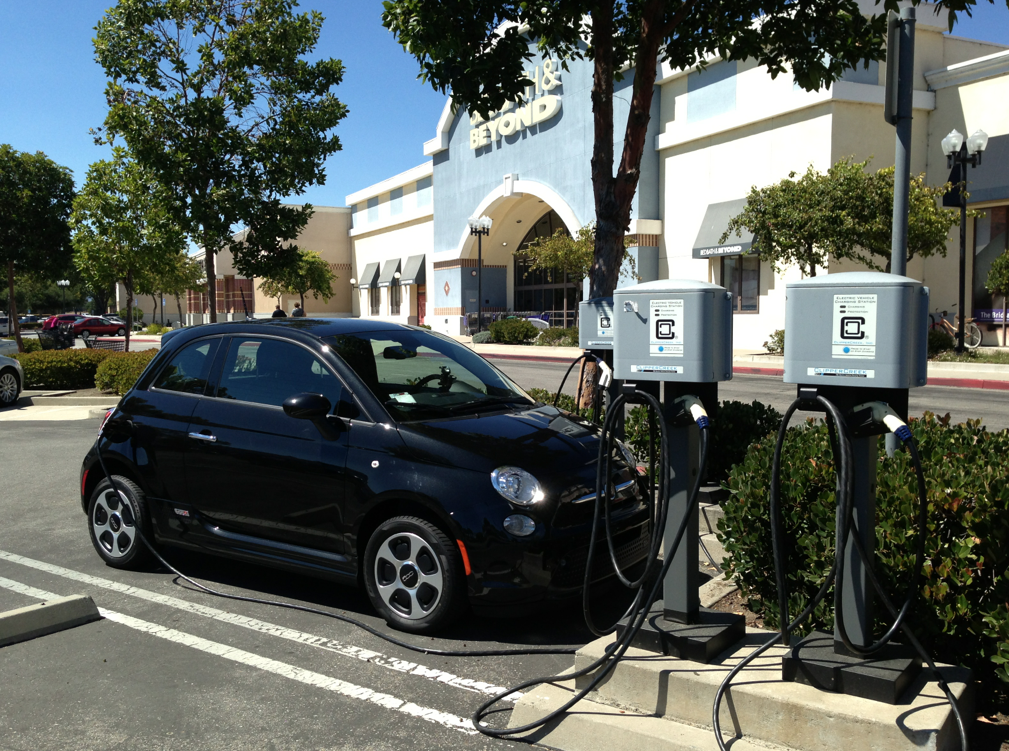
FOLSOM, Calif. – In another series of efforts to foster a new, sustainable energy future and further the state’s leadership in reducing greenhouse gas emissions, the California Independent System Operator Corporation (ISO) released a blueprint for integrating electric vehicles (EVs) into the grid.
The Vehicle-Grid Integration Roadmap: Enabling Vehicle-based Grid Services outlines three inter-dependent tracks to assess how consumer use of electric vehicles could benefit electric reliability, and to determine policies and technologies necessary to elicit that value through appropriate market signals for a more reliable, sustainable electric grid.
In 2012, California Governor Jerry Brown issued an executive order setting a target of 1.5 million zero-emission vehicles (ZEVs) on California roads by 2025. To realize this goal, the Governor’s Interagency Working Group on Zero-Emission Vehicles published a ZEV Action Plan. The Plan assigned the ISO to lead the coordinated roadmap effort in collaboration with the California Energy Commission, California Public Utilities Commission, the California Air Resources Board, the Governor’s office and industry stakeholders. The roadmap identifies actions that will advance the state’s ZEV goals.
“Vehicle electrification promises to not only help fight climate change, it presents an opportunity to provide grid services that complement other energy sources to meet the reliability needs of the grid,” said ISO President and CEO Steve Berberich.
Ideally, coordinating EV charging with grid conditions and providing a mechanism for aggregation of EVs to respond to the ISO’s signals will maximize the benefits to be gained from EV use. The VGI Roadmap also explores the potential for VGI services to be included in clean technology development such as demand response, energy storage and energy efficiency. While there is strong potential to supplement a symphony of new and diverse resources, it is important that EV grid products are harmonized with system operations. One example is creating the right incentive price signals to ensure EVs are charged during non-peak periods.
“As the electricity system in the state evolves, now is the time to advance coordination with state agencies and stakeholders to realize the untapped benefits from widespread use of electric vehicles,” said ISO Director of Regulatory Affairs Heather Sanders who managed the roadmap’s development.
The roadmap builds upon efforts already underway in both the private and public sectors to enable EV aggregations. Coordinating EV charging with grid conditions and providing a mechanism for EV aggregators to respond to the ISO’s market signals will maximize benefits gained from use of EVs. Relevant policy proceedings involving California and the ISO will contribute to this effort.
For more information, see “California Vehicle-Grid Integration Roadmap: Enabling Vehicle-based Grid Services” posted at www.caiso.com, or the VGI working group materials.
###
California ISO Media Hotline | 888.516.6397 250 Outcropping Way | Folsom, California 95630 | www.caiso.com

Pacific Ethanol and Sweetwater Energy Announce Deal to Supply Customized Industrial Sugars to Produce Cellulosic Ethanol

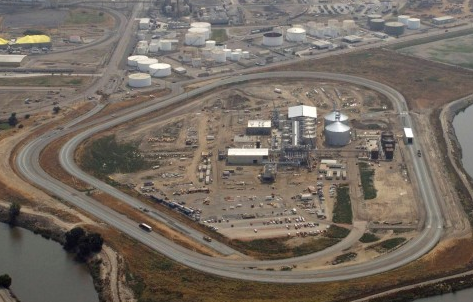
Stockton plant
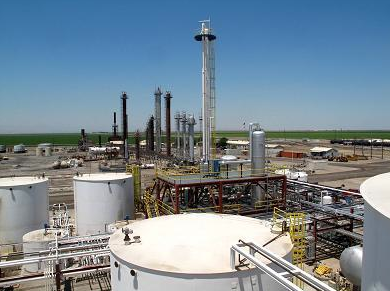
Stockton ethanol plant

December 18, 2013 – Sweetwater Energy, Inc., a Rochester, NY-based cellulosic sugar producer, and Pacific Ethanol, Inc. (NASDAQ: PEIX), the leading marketer and producer of low- carbon renewable fuels in the Western United States, announced an agreement to supply customized industrial sugars for the production of cellulosic ethanol. The agreement supports the construction of a cellulosic biorefinery at the Pacific Ethanol Stockton facility capable of producing up to 3.6 million gallons of cellulosic ethanol annually, contingent upon Sweetwater Energy obtaining the necessary financing and permits.

Sweetwater Energy will use its patented, decentralized process to convert locally available cellulosic material, such as crop residues, energy crops, and wood waste into a sugar solution, which Pacific Ethanol will ferment into cellulosic ethanol at its Stockton, CA refinery.

Neil Koehler, CEO of Pacific Ethanol, stated, “An important part of our growth strategy is to take advantage of the flexibility of our plant infrastructure to process diverse feedstocks such as sugar, corn, sorghum, and now sugars produced from cellulosic material. The Sweetwater platform moves us towards producing next-generation renewable fuels while providing additional flexibility in sourcing, reducing feedstock costs and enhancing plant operating margins.”

“We are very pleased to work with Pacific Ethanol on this project,” says Arunas Chesonis, Chairman and CEO of Sweetwater Energy. “We are going to start by supplying up to 6% of Pacific Ethanol Stockton’s feedstock requirements and, as our partnership grows we will evaluate increasing the amount.”

About Sweetwater Energy, Inc.

Sweetwater Energy uses a patented technology and patented business model to produce low-cost sugars from non-food plant materials in a decentralized manner. The company’s sugar solution is sold to refineries, which use it to produce biofuels, biochemicals, and bioplastics. Unlike petroleum-based technologies, Sweetwater Energy’s process uses renewable plant materials that are both grown domestically and significantly reduce greenhouse gas emissions.


Fuel Economy of New Vehicles Sets Record High

Screen Shot 2013-12-15 at 6.43.16 AMRelease Date: 12/12/2013

WASHINGTON – Today, EPA issued its annual report that tracks the average fuel economy of vehicles sold in the United States. The report shows that model year 2012 vehicles achieved an all-time high fuel economy of 23.6 miles per gallon (mpg). This represents a 1.2 mpg increase over the previous year, making it the second largest annual increase in the last 30 years. Fuel economy has now increased in seven of the last eight years.

“Today’s new vehicles are cleaner and more fuel efficient than ever, saving American families money at the gas pump and helping to keep the air that we breathe cleaner,” said Janet McCabe, Acting Assistant Administrator for EPA’s Office of Air and Radiation. “Each year new technologies are coming on line to keep driving these positive trends toward greater and greater efficiency.”

Fuel economy will continue to improve under the Obama administration’s historic National Clean Car Program standards. The program doubles fuel economy standards by 2025 and cuts vehicle greenhouse gas emissions by half. The standards will save American families $1.7 trillion dollars in fuel costs, and by 2025 will result in an average fuel savings of more than $8,000 per vehicle. The program will also save 12 billion barrels of oil, and by 2025 will reduce oil consumption by more than 2 million barrels a day – as much as half of the oil imported from OPEC every day.

The large fuel economy improvement in model year 2012 is consistent with longer-term trends. Fuel economy has increased by 2.6 mpg, or 12 percent, since 2008, and by 4.3 mpg, or 22 percent, since 2004. The average carbon dioxide emissions of 376 grams per mile in model year 2012 also represented a record low. While EPA does not yet have final data for model year 2013, preliminary projections are that fuel economy will rise by 0.4 mpg, and carbon dioxide emissions will decrease by 6 grams per mile in 2013.

EPA’s annual “Light-Duty Automotive Technology, Carbon Dioxide Emissions, and Fuel Economy Trends: 1975 through 2013” attributes much of the recent improvement to the rapid adoption of more efficient technologies such as gasoline direct injection engines, turbochargers, and advanced transmissions.

Consumers have many more high fuel economy choices due to these and other technologies, such as hybrid, diesel, electric, and plug-in hybrid electric vehicles. Consumers can choose from five times more car models with a combined city/highway fuel economy of 30 mpg or more, and from twice as many SUVs that achieve 25 mpg or more, compared to just five years ago.

The new report can be found at: http://epa.gov/otaq/fetrends.htm

ENERGY BRIEFS: Biodiesel / Mexico / Shale Oil / EIA Predictions

Screen Shot 2013-12-12 at 2.13.13 PMEnergy Commission Offers $5 Mil To Bako’ Biodiesel Co

At their December 19 meeting the California Energy Commission will be approving  CRIMSON RENEWABLE ENERGY for a $5 million grant to upgrade equipment at its existing facility near Bakersfield to increase biodiesel production from 10 million gallons per year to 17 million gallons per year and reduce the carbon intensity of the biodiesel produced to less than 14 grams of CO2 equivalent per megajoule.

Screen Shot 2013-12-12 at 2.17.00 PMMexico To Allow Foreign Firms To Produce Oil

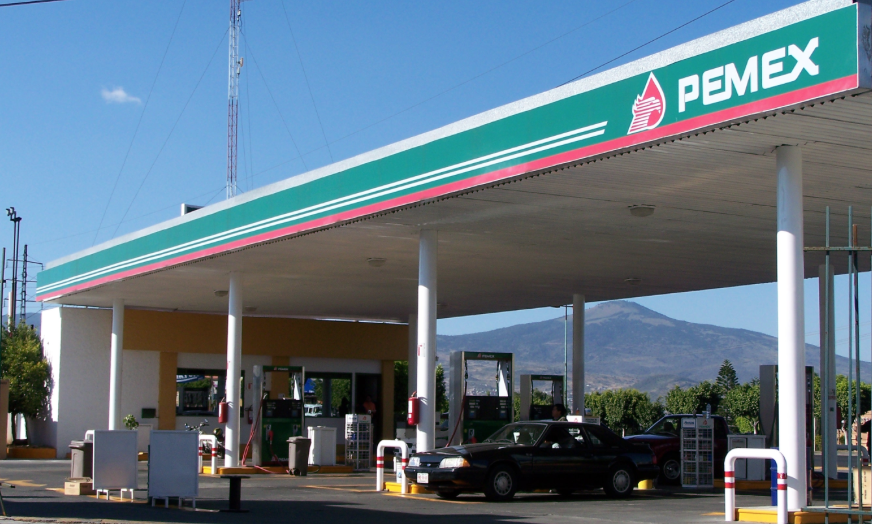
A vote in the Mexican legislature this week will end that country’s  75 year state monopoly  on development of its oil industry. Pemex, the national oil company has seen a drop in oil production of 25 % since it peaked in 2004.
The new law is expected to allow joint ventures for companies like Exxon Mobil to develop the country’s vast oil reserves both in the Gulf and  on land where shale oil might be tapped.The bill was backed by President Enrique Pena Nieto’s ruling Institutional Revolutionary Party. A financial report says that “the government says an energy overhaul would lift economic growth 1 percentage point by 2018 and reverse oil production losses.”

California’s Shale Oil May Not Be All Its Cracked Up To Be

Oil analyst Daniel Yergin is throwing cold water on the idea that California is poised for a new oil boom based on developing the Monterey Shale reserves in the San Joaquin Valley. Yergin’s firm  predicted last December  that returns may not be as big as imagined in a number of press reports. The SF Chronicle said ”A report issued last December by IHS CERA predicted that unconventional oil production in California – oil coming from shale formations – would have a negligible impact on the overall amount of petroleum pumped in the state through 2020.”

U.S. Exports of Distillate Fuel Rise 30% On Global Demand

The federal Energy Information Agency says U.S. exports of distillate fuel (mostly diesel) reached a monthly record of 1.4 million barrels per day in July, and averaged more than 1.3 million bbl/d during third-quarter 2013 . This level is up 30% from 1.0 million bbl/d during third-quarter 2012 and from 0.3 million bbl/d during that period in 2007.
“Almost all of this growth was driven by economic expansion in the emerging economies of the non-OECD countries. Distillate fuel use tends to be highly correlated with economic growth, especially in manufacturing” says the EIA.

“This global distillate demand growth has helped support U.S. refinery runs. U.S. refiners increased distillate exports in recent years partly because of the smaller domestic distillate market; however, exports have increased by more than demand has declined, and even with modest U.S. demand growth in 2013, exports have continued to increase. Increased distillate exports reflect the competitive advantage of U.S. Gulf Coast refiners, which have supplied almost 80% of U.S. distillate exports during the first nine months of 2013.”


Screen Shot 2013-12-12 at 2.10.01 PM

Oil Boom on Rails –  Who Needs Pipelines?

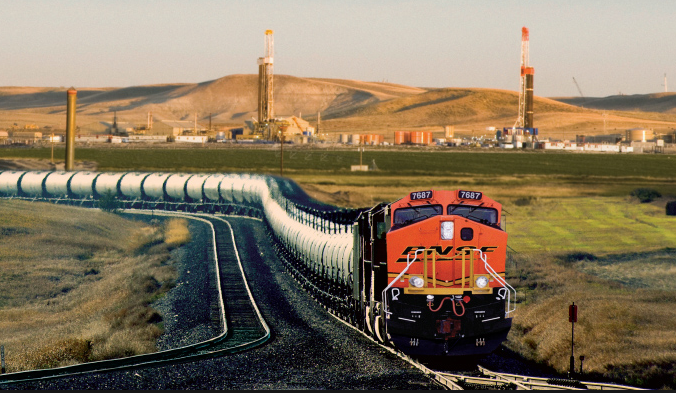
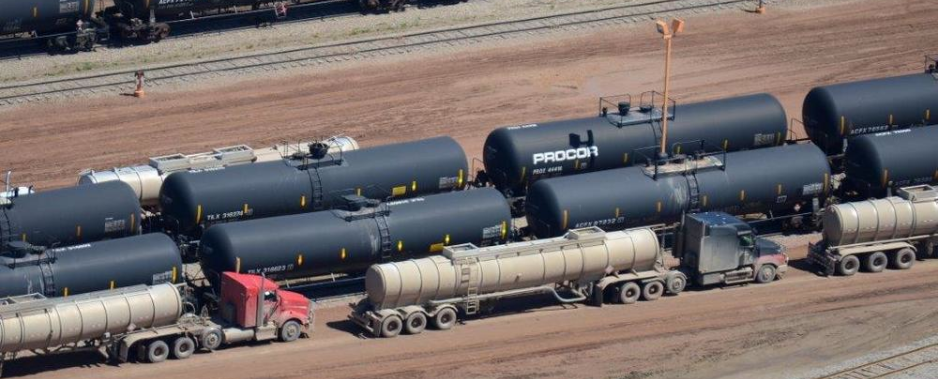
Oil is riding the rails across the country including to refineries on the West Coast.

Oil shipments by rail are up  are up 20% this year says the Assn of American Railroads. The Bakken oil boom would be bottle necked with a lack of pipelines capacity prompting the building of twenty new rail load terminals in North Dakota with nearly 1 million b/d of capacity in 2012.
A recent  report said that “US crude-by-rail shippers also adopted economies of scale by utilizing “unit” trains with 100 or more dedicated RTCs, reducing the freight cost compared with traditional smaller loads carried in manifest trains mixed with other freight. Data from the North Dakota Pipeline Authority show rail shipments of crude out of North Dakota carried 70% of production volumes by April 2013.”

All of this is fine with rail companies like BNSF and UP. These railroads are  eager for the traffic since coal deliveries, which accounted for 45% of US rail traffic in 2011, fell by nearly 11% last year as natural gas eroded coal’s share of power generation.  Meanwhile oil shipments by rail grew by 46% in 2012 says  the same report.

Fuel ethanol already rides the rails.

In California a proposed Valero Crude by Rail Project would allow the  Benicia refinery to take delivery of up to 70,000 barrels of North American crude oil each day.  On the Central Coast,SLO County is processing a permit to build a new rail spur near Nipomo/Santa Maria Phillips 66 refinery involving unloading of up to five unit trains per week – 80 cars each- with an annual maximum number of trains expected to be approximately 250 carrying 52,142 barrels of crude per day..”The feedstock would be sourced from oilfields throughout North America based on market economics and other factors. The most likely sources would be the Bakken field in North Dakota or Canada” says the SLO County EIR.
In Kern County the  Bakersfield Californian recently reported that “A pair of rail terminals planned near Bakersfield may soon give Kern County a central role in California’s shift from heavy reliance on foreign oil to greater use of domestic sources. Separate projects by Plains All American Pipeline LP and Alon USA Energy Inc. would offload a combined 220,000 barrels per day — providing 13 percent of the state’s current oil consumption compared to the less than 1 percent California now gets by rail — and redirect most of that into pipelines leading to Los Angeles County and Bay Area refineries.”

____________________________________________________________________________________________________________________________________________

Screen shot 2012-06-09 at 7.35.08 AMGovernment Report: US Oil Production To Rise to 8.5 Million BBD In 2014  / Gas Prices To Fall Average 7 Cents In New Year

-After falling by more than 40 cents per gallon from the beginning of September through mid-November, weekly U.S. average regular gasoline retail prices increased by 8 cents per gallon to reach $3.27 per gallon on December 2, 2013, due in part to unplanned refinery maintenance and higher crude oil prices. The annual average regular gasoline retail price, which was $3.63 per gallon in 2012, is expected to average $3.50 per gallon in 2013 and $3.43 per gallon in 2014.

-The North Sea Brent crude oil spot price averaged near $110 per barrel for the fifth consecutive month in November. EIA expects the Brent crude oil price to average $108 per barrel in December and decline gradually to $104 per barrel in 2014. Projected West Texas Intermediate (WTI) crude oil prices average $95 per barrel during 2014.
-The discount of the WTI crude oil spot price to Brent, which averaged more than $20 per barrel in February 2013 and fell below $4 per barrel in July, recovered to an average of $9 per barrel in October and $14 per barrel in November. In addition, the spot discount of Light Louisiana Sweet (LLS), a key Gulf Coast light sweet crude oil, to Brent increased from an average of $3 per barrel in September to almost $11 per barrel in November. The opening of a large LLS discount to Brent and the increasing convergence of LLS and WTI prices result from pipeline expansions and reversals that have reduced bottlenecks in the Midcontinent, continuing growth in domestic light oil production, and a seasonal decline in crude oil runs at U.S. Gulf Coast refineries. Brent crude oil prices continue to be supported by ongoing supply outages in Libya and tightness in global light crude oil markets. EIA expects the WTI discount to Brent to average $12 per barrel during the fourth quarter of 2013 and $9 per barrel in 2014.

-Estimated U.S. crude oil production averaged 8.0 million barrels per day (bbl/d) in November, the highest monthly level since November 1988. EIA expects U.S. crude oil production will average 7.5 million bbl/d in 2013 and 8.5 million bbl/d in 2014.

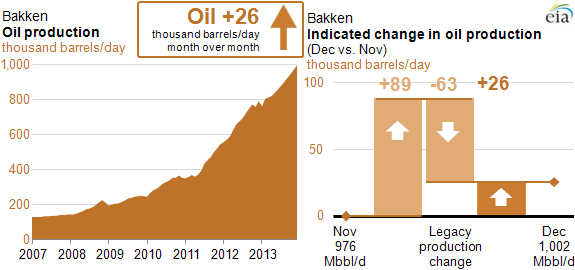
Bakken oil production forecast to top 1 million barrels per day next month


More cheap North Dakota crude is coming into California by rail at a $16 per barrel discount to WTI crude

November 15, 2013Screen Shot 2013-11-22 at 11.57.53 AM

Bakken oil production forecast to top 1 million barrels per day next month

graph of Bakken oil production from DPR, as explained in the article text

Source: U.S. Energy Information Administration, Drilling Productivity Report
Note: DPR data are estimates

Republished November 15, 2013, 1:50 p.m. to correct an error in the text.

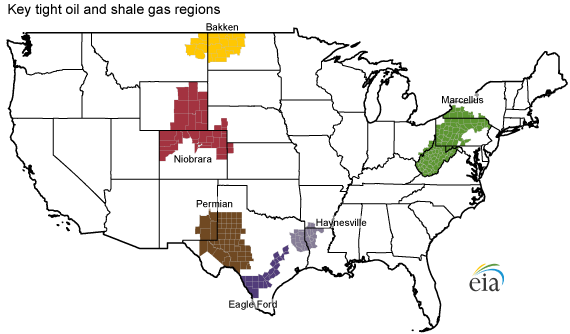
The latest monthly update of estimated crude oil production in the Bakken region of North Dakota and Montana shows total wellhead output topping 1 million barrels of oil per day (bbl/d) next month. The update appears in the most recent issue of the U.S. Energy Information Administration’s Drilling Productivity Report (DPR).

The Bakken region now accounts for a little over 10% of total U.S. oil production and is expected to be the fourth region (along with the Gulf of Mexico, Eagle Ford, and Permian basins) producing more than 1 million bbl/d in the nation in December.

Infrastructure improvements in the central part of the nation carried more of this oil to refineries in recent months, helping to narrow the price difference between the Bakken region and West Texas Intermediate, which is priced at Cushing, Oklahoma.

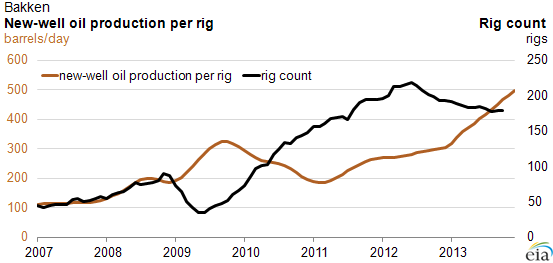
The growth of crude oil production in the Bakken region is part of a longer-term trend in drilling efficiency gains (see graph below) and has led North Dakota to rank second in crude oil production in the United States, behind only Texas. These production gains have led to increases in gross domestic product in the state as well as increased demand for electricity.

Graph of Bakken oil production per rig from DPR, as explained in the article text

Source: U.S. Energy Information Administration, Drilling Productivity Report
Note: DPR data are estimates


New Central Valley Power Line To Be Built

PG&E, MidAmerican Transmission, Citizens Energy Corporation to develop 70-mile electric transmission line

New 220kw line will bring power, much of it solar ,into Central Valley

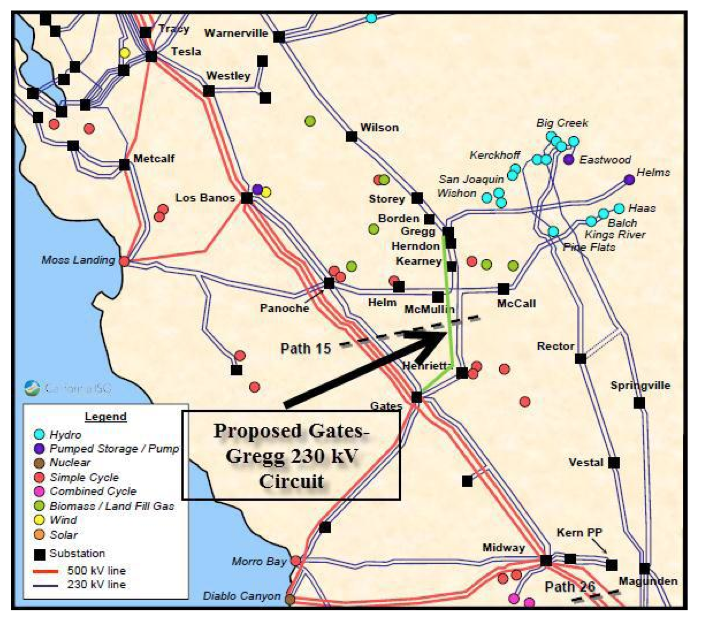
New 230kV line will bring power, much of it solar,into the Central Valley. Besides power generated west of the SJ Valley in SLO County for example, the new line will help move new planned solar power generated in the future in the Central  Valley itself – getting it to the population centers.

SAN FRANCISCO, Nov. 15, 2013 /PRNewswire/ — Pacific Gas and Electric Company (PG&E), MidAmerican Transmission, LLC (MidAmerican Transmission) and Citizens Energy Corporation (Citizens Energy) have been chosen by the California Independent System Operator Corporation (ISO) to develop, own and operate a new transmission line in the Central Valley region of California.

The 230-kilovolt (kV) line will span about 70 miles across Fresno, Madera and Kings counties, running from the Gates to Gregg substations, which are owned and operated by PG&E. Approved by the ISO to address the growing power demand in the greater Fresno area, the new line will help reduce the number and duration of power outages, create jobs and support economic development, and bolster efforts to integrate clean, renewable energy onto the grid. The transmission line would be operational no later than 2022, and could come on line earlier.

In their analysis the ISO said that:

This proposed transmission configuration will provide a reliable means to pump water at Helms during dry year conditions in order to generate the next day without jeopardizing load reliability during peak periods, it will also provide a great increase in Helms pumping window in order to facilitate with the daily load and renewable balancing cycle, while minimizing environmental impacts in the PG&E service territory.( see map)
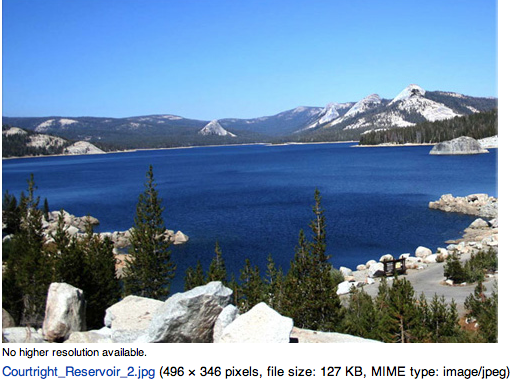
Courtright Reservoir

The Helms power plant above Fresno operates by moving water between two reservoirs, an upper and a lower. When energy demand is high, water is released from the upper reservoir to the plant where electricity is generated before the water is discharged into the lower reservoir. When demand is low at times such as night, water is then pumped back up to the upper reservoir to be used as stored energy for a later time. This is accomplished by pump-generators which serve a dual role as both pumps which can reverse into generators. The plant can go from a stand still to operational in eight minutes which allows it to meet peak energy demand. It consumes more electricity pumping versus generating electricity but pumping occurs during periods of low demand, making the plant economical.

“This new transmission line not only will enable PG&E to safely, reliably and affordably serve our customers in the Central Valley, it will create new much needed jobs in the region,” said Geisha Williams, executive vice president of electric operations at PG&E. “The greater Fresno area is recognized nationally as a leader in agricultural business, and PG&E is pleased to partner with MidAmerican Transmission and Citizens Energy to modernize the region’s electric system in order to enhance California’s long-term economic vitality.”

“Today’s energy infrastructure is adapting to meet the demands for greater renewable sources, while continuing the reliable service to customers,” said John Cupparo, president, MidAmerican Transmission. “This collaboration with PG&E and Citizens Energy is evidence of MidAmerican Transmission’s continued investment to ensure that California’s energy infrastructure keeps pace with these evolving demands.”

“We’re proud to work with PG&E and MidAmerican Transmission on this terrific project and look forward to sharing the benefits of our work with the low-income families of the Central Valley,” said Citizens Energy Chairman and President Joseph P. Kennedy II.

The ISO approved the project during its annual Transmission Planning Process in March. The ISO chose the consortium of PG&E, MidAmerican Transmission and Citizens Energy over four other qualified bidders in a competitive process. The project is the second to be approved under new ISO rules that require certain new transmission projects be subject to competition.

The project will need to undergo an approval process through the California Public Utilities Commission. PG&E, MidAmerican Transmission and Citizens Energy will work collaboratively with local stakeholders to determine the optimal routing of the line as part of the approval process.

—-

Pacific Gas and Electric Company, a subsidiary of PG&E Corporation (NYSE: PCG), is one of the largest combined natural gas and electric utilities in the United States. Based in San Francisco, with 20,000 employees, the company delivers some of the nation’s cleanest energy to 15 million people in Northern and Central California. For more information, visit http://www.pge.com/about/newsroom/ and www.pgecurrents.com.

MidAmerican Transmission, a wholly owned subsidiary of MidAmerican Energy Holdings Company, is engaged in the development of electric transmission facilities. MidAmerican Transmission has invested in transmission in several regions in the U.S. and is evaluating opportunities to further develop electric transmission facilities in organized and traditional markets in the U.S. and Canada. MidAmerican Transmission has formed a subsidiary, MidAmerican Central California Transco, to participate in the consortium. Additional information about MidAmerican Transmission is available at www.midamericantransmission.com.

Through its subsidiaries, MidAmerican Energy Holdings Company provides electric and natural gas service to more than 7 million customers worldwide, operates an extensive 18,000-mile electric transmission system, a natural gas local distribution system, and interstate natural gas pipeline systems totaling nearly 17,000 miles. Learn more at www.midamerican.com.

Citizens Energy Corporation was launched in 1979 by Joseph P. Kennedy II to use revenues from successful oil industry ventures to help lower the cost of heating for senior citizens and low-income families suffering from the petroleum price shocks of the time. The non-profit company expanded operations into the natural gas and electric power industries, all the while using its profits to help the poor. In addition, Citizens Energy started successful ventures in the pharmaceutical drug and health care fields, lowering the costs of life-saving drugs and medical care for ordinary working families. While still providing heating assistance in 26 states, Citizens has launched innovative wind, solar, and transmission businesses to help make life’s basic needs more affordable for the poor.

SOURCE Pacific Gas and Electric Company (PG&E)


Energy News: Biodiesel Awards / 20MW Solar In Tulare County / More

Work On New Solar Plant Will Start In Tulare County: Quanta Power Generation (QPG) has begun to prep for the next 20MW  solar project in Alpaugh in southwestern Tulare County – a project expected to last 4 to 6 months. Alpaugh is already home to the largest cluster of solar power in the county. with  some 110MW already producing power and another 90 MW of solar approved by the county. Most the facilities are owned by ConEdison. Sources say QPG will first put up the mobile structures, grade the land, begin receiving the equipment, pound the piles and then begin hiring for the module installation requiring about 120 workers by early February to late March 2014.

Crimson Renewables near Bakersfield

$10 Mil In Biodiesel Awards: California Energy Commission has announced awards of around $5 million each to two existing biodiesel plants in the state.One is near Bakersfield, the Crimson Renewables facility  that would expand and the Community Fuels plant at the Port of Stockton. A recent article about Community Fuels offers this perspective.”Biodiesel is enjoying strong demand in 2013 and has grown far past its beginnings as a boutique fuel. It has been incorporated into commercial fuel markets and is considered one of the most practical means of meeting obligations mandated by the federal renew- able fuel standard and California low carbon fuel standard.”

Hydro’s Future: Wall Street Journal article this month argues hydropower has a green future helping  to meet the world’s growing  demand for electricity. Most of the power would be from large new dams but a  good amount could be generated from a list of 54 existing US dams over the next 2 decades. Pumped storage  has a strong future as well it says.

First Solar to Sell Power to Southern California Cities :First Solar Inc. (FSLR), the largest builder of U.S. solar farms announced it would to sell electricity from a 40-megawatt plant in Southern California to four area cities. Pasadena, Riverside, Colton and Azusa, California, signed 20-year contracts for power from the Kingbird project in Kern County, First Solar said  .The plant near Rosamond may begin construction in 2014.

Solar Shines As Economic Powerhouse in Central Valley

Westlands Solar Farm – $38 Mil Project Breaking Ground
New EIR Would Build Valley’s Largest Solar Array Near Tranquility

“Go Solar man,it’s cool” was a phrase right out of 60s era. Today, it’s big business as the latest construction figures locally or Wall Street stock prices this week – can attest to.

Solar power projects from residential rooftop to utility-scale arrays are breaking ground at a record pace this year in the Central Valley. While the entire construction-based economy, from home building to new commercial activity has improved since the recession year of 2011 – the growth in the value of solar energy permits has been, well – going through the roof.

According to Construction Monitor reporting service, during the first ten month plus of 2011 (through Oct 19), there were 200 residential solar projects permitted valued at $3 million in the Central Valley in Fresno,Madera,Tulare and Kings Counties.

For the same period in 2012 the number of residential solar projects numbered 1639 with a value of $26 million.

residential solar permits are going through the roof

This year also through October 19, residential solar permits in the region number 2758 with a value of nearly $36 million.

On the commercial side – solar’s growth is also dramatic. In 2011 through the same date there were 6 commercial solar projects valued at a total of $3 million.

Accelerating Pace

In 2012 through mid-October, were 45 projects and the value jumped more than 10-fold to nearly $34 million. In 2013 the number has  accelerated again to 68 solar projects in the Central Valley so far this year – at a value $109.7 million.

That amounts to about one quarter of all the commercial building activity in the 4-county region this year.

Combine residential and commercial solar construction value in 2013 – it’s in excess of $144 million –  that’s more than ALL categories of building permit activity in the region in 2011 when we generated $129 million in building permits!

$38 Million Project

Some of this year’s solar permitting is based on a backlog of projects that have been slowed by opposition or other issues. Case in point is the 18MW Westland Solar Farm project – a $38 million solar farm on Fresno’s westside on 90 acres at 18393 W Jayne Ave.

The applicant’s permit had been held up by a lawsuit from the Farm Bureau challenging a Williamson Act ruling by Fresno County. Attorney for WSF – John Cardot of Coleman and Horowitt LLP says the Superior Court in Fresno ruled in favor of Westland Solar Farms granting the tax break last winter and grading on the project is now underway.

”We were granted our building permit last week and with construction starting- we expect to have the facility operational in February 2014.”

Tulare County too has seen a half dozen smaller utility-scale projects break ground  this year developed by Immodo adding up to $42 million and a few more are expected.

Meanwhile,scores of Central Valley industries and ag enterprises   looking to lower their utility bill and generate a power supply for themselves are making news this year adding self generation.This past few weeks 2 projects in Tulare County’s east side received their permits.

Woodlake’s Visalia Citrus Packing Group is installing a 1.1 megawatt solar unit at their Woodlake Packing house this fall. The ground mounted units are being installed by Sacramento-based Coldwell Solar and are valued at $3.6 million in their building permit.

The solar arrays will handle most of the power needs at the Ave 344 packing house and be in service by the end of this year.

Also last month Exeter’s International Paper is installing more solar power panels at their Anderson Rd cardboard box plant according to their building permit.The project is valued at $1.8 million as listed in the permit.The box maker already has some solar panels at their Exeter manufacturing plant and the additional units will enable more of their power to be supplied on site,saving them money. SPG Solar of Novato is the contractor.

And there are more in the pipeline.

On the smaller scale commercial enterprises in Tulare County now can use a new financing tool through the Tulare County PACE Program recently approved by the BOS.”California manufacturers already pay 50% higher electricity rates than the national average” say Mike Washam, director of the program in the county.

Indeed, both PG&E and SCE rates are higher than inflation says Washam (see chart). PACE offers 100% financing for up to 20 years.Washam says there is already $13 million in applications pending from Tulare County companies including a dairy and packing house.

On a larger scale, Tulare County is processing an EIR for Wellhead Solar near Ducor for an 80MW project

Tranquil scene near solar site

New EIR For Valley’s Largest Solar Farm

On a mega scale, San Francisco-based Recurrent Energy has just filed to begin an EIR process as of October 16 in Fresno County for a 400MW solar farm. The 3875 acre project is in Westlands Water District and is named Tranquility Solar. If things go right there will be plenty of activity in Tranquility.

The project was originally proposed in 2011 but the company pulled the application in 2012. Now its back and Recurrent, who has a good record of building what they propose – could begin construction in about a year.The non-prime, dry farm land is 5 miles east of Hwy 5 straddling Hwy 33 at Manning Ave. At 400MW this would be by far the largest Valley solar farm around – on the order of the big Carrizo Plain, SLO County projects being built. The Tranquillity project could boast as many as 2.5 million PV panels and be worth perhaps three quarters of a billion dollars.

Popularity of Solar

Solar has taken off based on a number of factors. The state mandates utilities buy renewable power to cut global warming.Solar panels costs and efficiencies have improved dramatically and a cadre of companies, large and small are ready to save both businesses and home owners money by putting up solar panels.

If saving money works for you, you might to to look into solar no matter if your politics are red or blue. One player that is the largest in the state in this category is SolarCity Corp, a publicly-traded solar installer with 7200 solar systems constructed in the state at homes, businesses and public institutions.

SolarCity Is Tops

In the Valley so far this year the company has installed 768 home solar projects at around $16 million by far and away the top solar contractor.

This week SolarCity’s stock has caught the eye of traders on Wall Street with the stock up from $9 a year ago to around $60 today.

Recently SolarCity made news locally when they got the nod to build solar panels at 12 Visalia schools saving the Visalia Unified School District $627,000 in electrical costs in its first year of operation. The systems combined will generate 2.35 MW.

Generating Energy From Forest Products

Screen Shot 2013-11-11 at 7.50.16 AMThinning a forest of woody materials has multiple objectives. It can increase the resiliency of the remaining trees from the effects of fire, drought, pest and disease; it can improve habitat quality for wildlife including watersheds; and it can make it easier for firefighters to protect human lives and livelihoods when a fire is burning.

There are several ways thinning is carried out:  cable logging, feller bunching, conventional tractor skidding, hand-thinning and piling, and mastication. One of the issues with thinning is the disposal of biomass that is non-merchantable (e.g., branches, tree tops, small diameter trees). Typically this material goes into large slash piles. For the most part, these piles are left in the forest to break down naturally under winter rain and snows, and are later burned. Because of strict air quality rules, forest managers have very small windows of opportunity to burn these piles, so they are often left on the landscape for many years, sometimes becoming a fire hazard themselves.

Forested communities are searching for ways to deal with this residual biomass that will improve the health of the forest ecosystem; improve and protect critical watersheds and wildlife habitat; reduce the amount of air pollution by removing the piles instead of burning them; and reduce the critical fire danger to their communities.

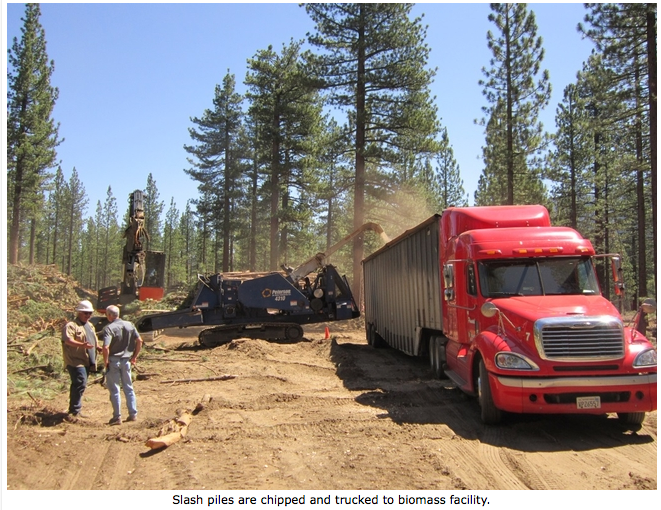
The Placer County Biomass Program is taking up this challenge by chipping the slash piles and trucking the chips to a biomass facility to be converted into electricity.

Outside of Foresthill, Calif., the Tahoe National Forest American River Ranger District and the Sierra Nevada Adaptive Management Project (SNAMP) have been collaborating on a study of forest fuels reduction treatments carried out on national forests.. Local contractors are hired to grind the material on-site, load the material into chip vans, and bring the material to market within 60 miles of the Last Chance site to create green, renewable electricity.

Placer County estimates that roughly 3,000 Bone Dry Tons (BDTs) of biomass can be removed. According to UC researchers, one BDT burned in a typical commercial boiler fuel will produce 10,000 pounds of steam and 10,000 pounds of steam will produce about 1,000 horsepower or generate 1 megawatt hour (MWH) of electricity.

The economics of this project will be used as part of the assessment of locating a biomass energy facility in the Foresthill area. The removal of these biomass piles will greatly reduce the possibility of catastrophic fire to the local communities on the Foresthill Divide.

The improved forest and watershed health will be noticed by the local community and the surrounding county which derives recreation and watershed benefits from the American River area. In addition, several tons of air pollutants will be avoided by removing the pile burns from this area which is currently a federal non-attainment basin that carries both business and health risks to the local population.