SACRAMENTO, Calif., Feb. 26, 2014 (GLOBE NEWSWIRE) — Pacific Ethanol, Inc. (Nasdaq:PEIX), the leading marketer and producer of low-carbon renewable fuels in the Western United States, announced plans to restart production at its 40 million gallon per year facility in Madera, California, which would bring the company’s total operating production capacity to 200 million gallons per year. The company expects to begin ethanol production at Madera during the second quarter of 2014.
Neil Koehler, the company’s president and CEO, stated: “We are excited to achieve this important milestone for the company. With all of our plants in production we can further benefit from strong industry fundamentals and help meet the growing demand for low-carbon fuels in California. We are pleased to be providing new jobs and economic development in the Central Valley of California.”
The plant has been idled since 2009 after operating three years.
About Pacific Ethanol, Inc.
Pacific Ethanol, Inc. (Nasdaq:PEIX) is the leading marketer and producer of low-carbon renewable fuels in the Western United States. Pacific Ethanol also sells co-products, including wet distillers grain (“WDG”), a nutritional animal feed. Serving integrated oil companies and gasoline marketers who blend ethanol into gasoline, Pacific Ethanol provides transportation, storage and delivery of ethanol through third-party service providers in the Western United States, primarily in California, Arizona, Nevada, Utah, Oregon, Colorado, Idaho and Washington. Pacific Ethanol has a 91% ownership interest in New PE Holdco LLC, the owner of four ethanol production facilities. Pacific Ethanol operates and manages the four ethanol production facilities, which have a combined annual production capacity of 200 million gallons. The facilities in operation are located in Boardman, Oregon, Burley, Idaho and Stockton, California, and one idled facility is located in Madera, California. The facilities are near their respective fuel and feed customers, offering significant timing, transportation cost and logistical advantages. Pacific Ethanol’s subsidiary, Kinergy Marketing LLC, markets ethanol from Pacific Ethanol’s managed plants and from other third-party production facilities, and another subsidiary, Pacific Ag. Products, LLC, markets WDG. For more information please visit www.pacificethanol.net.
ImMODO Energy Services, one of the largest solar project developers in
the San Joaquin Valley, is celebrating the commissioning of its first
portfolio of projects in Tulare County. ImMODO Energy Services
representatives will be joined by Tulare County 4th District Supervisor
Steve Worthley, Economic Development Manager Michael Washam, and others
for a ribbon cutting ceremony Feb 26 at their Kingsburg solar park near Hwy 99.
The portfolio will produce 22 megawatts (MW) of clean renewable energy
in Tulare County, enough to provide power to 5,809 homes. These projects
result in a reduction in greenhouse gases that is equivalent to taking
8,084 car of the road. All five project sites are roughly twenty acres
in size and distributed throughout Tulare County near the communities of
Kingsburg, Ivanhoe, Exeter, Lindsay and Tulare. The estimated
construction value of ImMODO projects permitted in 2013 ranks higher
than all other commercial developments in the Central San Joaquin
Valley.
The portfolio represents five of the nine projects slated for Tulare
County; the investment is roughly $40 million of ImMODO*s total
investment of more than $65 million. One of ImMODO’s defining qualities
is its commitment to hiring local which is achieved with many partners
in Tulare County, most notably the nonprofit training organization,
Proteus, Inc., whose staff will discuss its goal of training a local
workforce in the energy sector.
This event will celebrate the partnership between Tulare County and
ImMODO Energy Services as well as the future of ImMODO Solar and its
growing relationship within the agriculture industry.
U.S. electricity sales peaked in 2007 and have been declining modestly since then. Sales in 2012 were 1.9% lower than 2007 sales, and sales in the first ten months of 2013 are below the same period in 2012. While the economic recession is an obvious explanation for the decline in sales in 2008 and 2009, it is much less clear why sales have continued to decline since then, even as the economy began to recover. While some observers have attributed this stalled growth to the ongoing effects of the “Great Recession,” other observers suggest other factors may have played a role, such as erosion of manufacturing, more efficient buildings, lighting and appliances and increased use of on-site generation.
ACEEE has just completed an analysis on electricity-use trends since 1993 and we looked at changes in sales over the 2007-2012 period in particular. We found that no single factor can explain the change in electricity use over the 1993-2012 period. The factors that appear most significant were energy efficiency programs and policies, warmer weather, changes in gross domestic product (GDP), changes in electricity prices, and long-term trends.
Over the more recent period of 2007-2012, savings resulting from energy efficiency programs and policies, and from warmer winter weather, appear to be the most important contributors to declining electricity use in the residential and commercial sectors. This finding is consistent with the ramp-up of energy efficiency savings achieved from utility-sector energy efficiency programs, and from appliance and equipment efficiency standards that have taken effect since 2007. The other possible factors that we considered, such as GDP and electricity prices, did not change very much over the last six years and therefore do not appear to have had a significant effect on the recent decline in electricity use. The factors contributing to the decline in electricity use in the industrial sector are less clear but may include energy efficiency programs and policies as well.
From American Council For an Energy Efficient Economy
In a speech recently in Maryland, President Obama directed his administration to move forward with standards to make our tractor trailers and commercial vehicles more efficient. Already the administration has set historic standards for passenger vehicles of 54.5 miles per gallon by 2025 that will cut U.S. carbon pollution nearly 10 percent. These truck standards are another step to slash oil use, save Americans money and bring down carbon pollution.
Medium and heavy-duty vehicles, everything from 18-wheelers to delivery trucks, are the fastest growing source of oil consumption in the transportation sector. Even though these vehicles only make up seven percent of the vehicles on the road, they guzzle more than 25 percent of transportation fuel. Although new fuel-saving technologies are found in some trucks, most 18-wheelers on the road average around six miles per gallon (mpg) — about the same as they did decades ago.
In 2010 the Environmental Protection Agency (EPA) and the Department of Transportation (DOT) finalized the first-ever efficiency standards for medium and heavy-duty vehicles sold from 2014-2018. These standards will ensure that new engines are more efficient, and will reduce fuel consumption in semi-trucks by roughly 20 percent.
Developing the next round of efficiency standards now will allow manufacturers to innovate and develop new fuel saving technologies, such as aerodynamic trailers, higher-efficiency engines, advanced materials and lower rolling resistance tires. Last year Peterbilt and Cummins showcased a 10-mpg truck as a part of the DOT’s Super Truck program. While 10-miles-per-gallon might not sound like much, it’s a big deal. By increasing fuel economy 54 percent over today’s average trucks, this prototype could slash greenhouse gas emissions and save an average driver $25,000 in fuel costs annually.
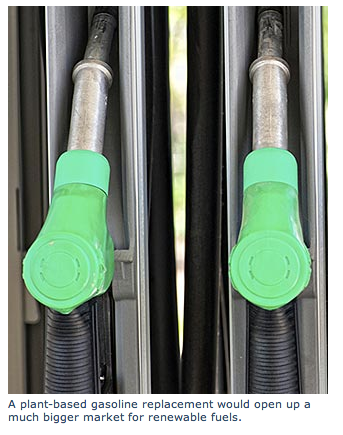
A plant-based gasoline replacement would open up a much bigger market for renewable fuel
Gasoline-like fuels can be made from cellulosic materials such as farm and forestry waste using a new process invented by chemists at the University of California, Davis. The process could open up new markets for plant-based fuels, beyond existing diesel substitutes.
“What’s exciting is that there are lots of processes to make linear hydrocarbons, but until now nobody has been able to make branched hydrocarbons with volatility in the gasoline range,” said Mark Mascal, professor of chemistry at UC Davis and lead author on the paper published Jan. 29 in the journal Angewandte Chemie.
Traditional diesel fuel is made up of long, straight chains of carbon atoms, while the molecules that make up gasoline are shorter and branched. That means gasoline and diesel evaporate at different temperatures and pressures, reflected in the different design of diesel and gasoline engines.
Biodiesel, refined from plant-based oils, is already commercially available to run modified diesel engines. A plant-based gasoline replacement would open up a much bigger market for renewable fuels.
The feedstock for the new process is levulinic acid, which can be produced by chemical processing of materials such as straw, corn stalks or even municipal green waste. It’s a cheap and practical starting point that can be produced from raw biomass with high yield, Mascal said.
“Essentially it could be any cellulosic material,” Mascal said. Because the process does not rely on fermentation, the cellulose does not have to be converted to sugars first.
UC Davis has filed provisional patents on the process. Coauthors on the paper are postdoctoral researchers Saikat Dutta and Inaki Gandarias
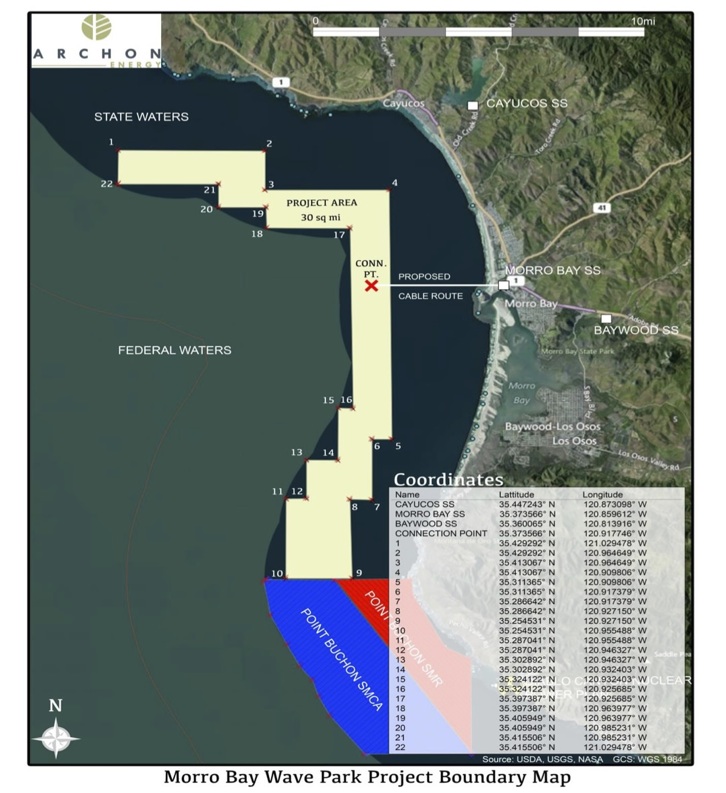
Suddenly wave power projects off the Central Coast are all the rage with preliminary plans announced last month by Florida-based Archon Energy to build a wave park 2 to 3 miles off the Morro Bay coast. Called the Morro Bay Wave Park the company has filed a permit request with the Federal Energy Regulatory Commission (FERC).
That news follows reports that CalPoly,with a federal grant in hand,will be studying the potential for wave energy of the California coast. At the same time with the expected retirement of the Morro Bay power plant, owner Dynegy said in their financial report last year that they were working with Greenwich Conn-based Starwood Energy to see if the natural gas fired plant could be re-purposed for some green power use. Starwood has experience with wave power projects.
Not Visible?
Archon filed their preliminary application to develop the Morro Bay Wave Park with the Federal Energy Regulatory Commission November 11,2013 saying it sought a priority application to carry on studies and evaluate the scale of a renewable energy project that could be a mile wide and 15 miles long, likely too far off the coast to be visible from the shore, they said.
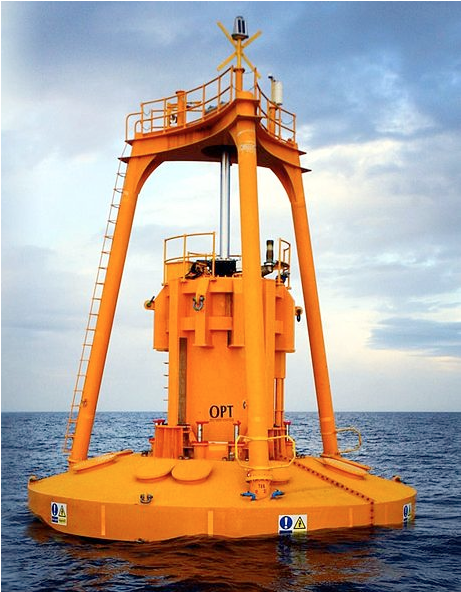
The project would install power generating buoys connected to convertors about 500ft apart anchored to the ocean floor and a power cable connected to the coast probably to the Morro Bay Power plant substation.
The application says they want to utilize “the power transmission corridor left behind after the future decommissioning of the 1002 MW Morro Bay Power Plant.”
The project could potentially generate 200 to 500MW of power upon build out but for now“the most likely scenario is we do a pilot plant rated at 5 to 10MW“says Paul Grist,President of Archon Energy.
”We are potentially 30 to 60 days away from approval on our application from FERC” that will start a 3 year feasibility study and environmental approval process. Grist says when the FERC preliminary permit is OK’d they will meet with local stakeholders – one on one.”
The Morro Bay project is not the only wave power park Archon plans to pursue. At Purisma Point – off Vandenberg AFB the company has filed for a similar preliminary permit with FERC on a 12 mies long wave park. That application was filed November 15,2013. Both projects were announced on the company website in December.
Also in December Congress member Lois Capps announced that Cal Poly’s Institute for Advanced Technology and Public Policy and its partners received a grant of $750,000 from the Department of Energy to evaluate the feasibility of a National Wave Energy Test Center off the coast of California.
“Cal Poly’s Institute for Advanced Technology and Public Policy will evaluate two potential sites off California’s coast, both of which offer a wide range of wave energy testing climates. Developing even a small fraction of the available wave energy could allow for millions of American homes to be powered by this clean form of renewable energy.
Cal Poly was one of only two universities in the nation to receive funding for the project.” The sites are off Santa Barbara County and off Humboldt County.
Grist says Archon has checked in with Cal Poly and that what the are working on does not conflict with what Cal Poly is investigating. They are studding different parts of the Santa Barbara coast as well.
The US Department of Energy has said they plan to allocate $25 to 50 million for wave energy testing at one West Coast facility.
“The biggest problem the industry has is that the technology is not quite there” admits Grist, who says it is close enough to be planning a wave park.
Grist notes that the Australian government has funded a $66 million wave park off their coast – now under construction.
Archon has experience on small energy projects around the country but not of this scale. Grist says as things progress, if they do, they will bring in a major partner, likely a utility, to enable the project to move forward.
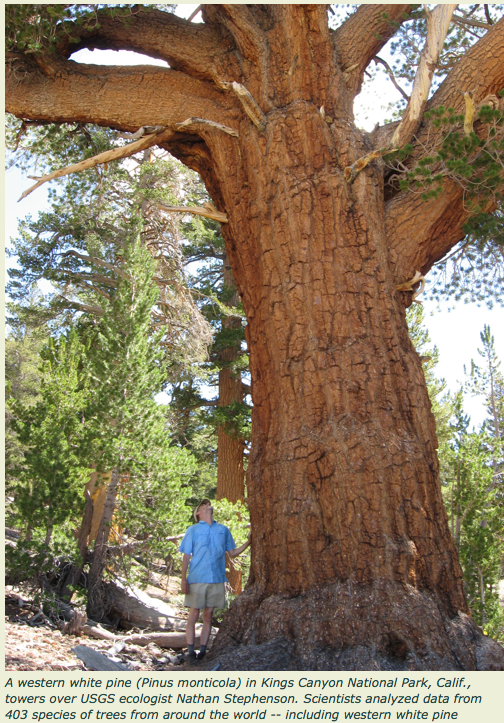
“This finding contradicts the usual assumption that tree growth eventually declines as trees get older and bigger,” says Nate Stephenson, the study’s lead author and a forest ecologist with the USGS Western Ecological Research Center. “It also means that big, old trees are better at absorbing carbon from the atmosphere than has been commonly assumed.”
An international team of researchers compiled growth measurements of 673,046 trees belonging to 403 tree species from tropical, subtropical and temperate regions across six continents, calculating the mass growth rates for each species and then analyzing for trends across the 403 species. The results showed that for most tree species, mass growth rate increases continuously with tree size — in some cases, large trees appear to be adding the carbon mass equivalent of an entire smaller tree each year.
“In human terms, it is as if our growth just keeps accelerating after adolescence, instead of slowing down,” explains Stephenson. “By that measure, humans could weigh half a ton by middle age, and well over a ton at retirement.”
This continuously increasing growth rate means that on an individual basis, large, old trees are better at absorbing carbon from the atmosphere. Carbon that is absorbed or “sequestered” through natural processes reduces the amount of carbon dioxide in the atmosphere, and can help counter-balance the amount of CO2 people generate.
However, the researchers are careful to note that the rapid absorption rate of individual trees does not necessarily translate into a net increase in carbon storage for an entire forest.
“Old trees, after all, can die and lose carbon back into the atmosphere as they decompose,” says Adrian Das, a USGS coauthor. “But our findings do suggest that while they are alive, large old trees play a disproportionately important role within a forest’s carbon dynamics. It is as if the star players on your favorite sports team were a bunch of 90-year-olds.”
The study was a collaboration of 38 researchers from research universities, government agencies and non-governmental organizations from the United States, Panama, Australia, United Kingdom, Germany, Colombia, Argentina, Thailand, Cameroon, Democratic Republic of Congo, France, China, Taiwan, Malaysia, New Zealand and Spain. The study was initiated by Stephenson and Das through the USGS Western Mountain Initiative and the USGS John Wesley Powell Center for Analysis and Synthesis.
A western white pine (Pinus monticola) in Kings Canyon National Park, Calif., towers over USGS ecologist Nathan Stephenson. Scientists analyzed data from 403 species of trees from around the world — including western white pine (Pinus monticola), pictured here — and learned that in general, a tree’s growth continues to accelerate as it ages. This finding reverses previous assumptions, and suggests that large old trees play an unexpectedly dynamic role in removing carbon from the atmosphere. (Image Credit: Rob Hayden)
FRESNO, Calif., Dec. 18, 2013 /PRNewswire/ — SunPower Corp. (NASDAQ: SPWR), a leading solar technology and global energy services provider, and Fresno-based SunPower Elite Dealer Pacific Solar announced today that they are donating a solar power system to the Fresno Chaffee Zoo, thanks to the first 50 Fresno area households that bought or financed SunPower systems during the company’s “Let’s Solar Fresno” campaign that launched in August.
As part of the campaign, SunPower and Pacific Solar agreed to donate one high efficiency solar panel to the zoo for each SunPower system sold or leased in Fresno in August, up to a total of 50 panels, and a majority of the cost of the installation.
“We’re grateful to the first 50 Fresno families who chose to go solar with SunPower and, as a result, are helping Fresno Chaffee Zoo go solar as well,” said Terri Mejorado, director of marketing at Fresno Chaffee Zoo. “We expect the system will allow us to lower our electricity bills, and use those savings to enhance the programs and services we offer the community.”
The donated system will be composed of 50 high-efficiency SunPower solar panels, the most efficient and reliable solar panels available on the market today.
“I’m impressed by how quickly Fresno families met this challenge to enable the zoo to benefit from clean, renewable solar power,” said Dave Wasemiller of Pacific Solar. “SunPower panels deliver more energy in less space, maximizing savings and peace of mind. This is an amazing opportunity for our community.”
The SunPower system will be installed in two arrays, one on the zoo’s education department building and one on the sea lion exhibit, “Sea Lion Cove.” According to estimates provided by the U.S. Environmental Protection Agency, the system is expected to offset the production of almost 13 tons of carbon dioxide emissions per year, which is equivalent to the automobile emissions produced through the consumption of about 1,300 gallons of gasoline.
“As the leading manufacturer of residential solar power systems in the U.S., SunPower is proud to support Fresno’s efforts to become the most solar community in America,” said SunPower Vice President Martin DeBono. “SunPower offers financing options customized for our customers’ needs, including cash purchase, leases and the SunPower Loan, which allows customers to go solar with no money down and low monthly payments while progressing towards owning their solar system.”
Pacific Solar offers all of SunPower’s financing options and works directly with customers to design customized energy and financing plans, and solar systems to fit each family’s needs. Fresno homeowners interested in buying or financing a SunPower system should visit letssolarfresno.com.
The new trading week is barely hours old and already oil prices are testing recent intraday lows, which could be a good sign for beleaguered motorists.
Oil prices currently have moved lower and are trading in the $91/bbl range, a price oil prices haven’t closed at since May 2013. And what that could mean- lower gasoline prices- may show up in the weeks ahead if oil prices continue to hold at these levels.
This comes as North Dakota is likely to surpass producing one million barrels per day as a state. The latest numbers show North Dakota producing some 29.2 million barrels per day in October, 2013, the latest month for which data is available.
Read more at http://blog.gasbuddy.com/#mHwi8LiEZ1yRWa5H.99
Today Feb oil futures were down to $91.5.
Also this week the average California gas price at the pump has fallen 4 cents in the past week to $3.61 a gallon.
CelA digests cellulose faster than enzymes from commercial preparations
January 2, 2014
root system of switchgrass
Researchers at the Energy Department’s National Renewable Energy Laboratory (NREL) have discovered that an enzyme from a microorganism first found in the Valley of Geysers on the Kamchatka Peninsula in Russia in 1990 can digest cellulose almost twice as fast as the current leading component cellulase enzyme on the market.
The bacterium first found in heated freshwater pools, Caldicellulosiruptor bescii, secretes the cellulase, CelA, which has the complex arrangement of two catalytic domains separated by linker peptides and cellulose binding modules.
NREL researchers put CelA to the test and found that it produced more sugars than the most abundant cellulase in the leading commercial mixtures, Cel7A, when acting on Avicel, which is an industry standard to test cellulose degradation. They found that CelA not only can digest cellulose in the more common surface removal, but that it also creates cavities in the material, which leads to greater synergy with more conventional cellulases, resulting in higher sugar release.
The bacteria that secrete the promising CelA thrive in temperatures of 75 to 90 degrees Celsius (167-194 degrees Farenheit).
“Microorganisms and cellulases operating at such high temperatures have several biotechnological advantages,” said NREL Scientist Yannick Bomble, one of the paper’s authors.
“CelA is the most efficient single cellulase we’ve ever studied – by a large margin,” Bomble said. “It is an amazingly complex enzyme, combining two catalytic domains with three binding modules. The fact that it has two complementary catalytic domains working in concert most likely makes it such a good cellulose degrader.”
Most commercial operations use enzyme cocktails, a combination of 15 to 20 different enzymes, to turn plant material into the sugars that are valuable to the biofuels industry. In most such cocktails, one type of enzyme, Cel7A, does the largest amount of work.
When researchers compared CelA to Cel7A, they discovered that at its optimal temperature of 50 degrees Celsius (122 degrees F), Cel7A achieves only 50% of the performance of CelA when converting Avicel.
CelA was discovered 15 years ago, but until this recent work, all that was known about this complex protein was its general architecture and that it had the ability to degrade cellulose.
This organism, initially grown on biomass by scientists from the University of Georgia, was used to produce extracellular enzymes (enzymes that function outside of the cell). Those extracellular enzymes later were purified and characterized at NREL using techniques including performance assays, advanced imaging, X-ray crystallography, and modeling on supercomputers.
NREL scientists found that CelA is not only very active on cellulose, but also attacks xylose. That could mean that levels of enzymes that specialize in removing xylose in commercial cocktails could be lowered, translating to lower costs.
If an enzyme can produce sugars more efficiently, it means lower cost for the enzyme cocktail, which is a major cost driver in the process of converting biomass into fuel.
The findings have important implications for industry, but also were fascinating for the scientists. “We are learning a lot about the evolution of these cellulases, how they can thrive in extreme environments, and how they operate on biomass,” NREL scientist and the paper’s lead author, Roman Brunecky, said.
“This discovery could reshape the landscape of commercial cellulase cocktail design,” said Paul Gilna, director of the BioEnergy Science Center, which provided the funding for this work. It is one of three Bioenergy Research Centers supported by the Office of Biological and Environmental Research in Energy Department’s Office of Science.
In addition to Brunecky, co-authors from NREL include Markus Alahuhta, Qi Xu, Bryon S. Donohoe, Michael F. Crowley, Michael G. Resch, Vladimir V. Lunin, Michael E. Himmel, and Bomble. Co-authors from the University of Georgia include Irina A. Kataeva, Sung-Jae Yang, and Michael W.W. Adams.
NREL is the U.S. Department of Energy’s primary national laboratory for renewable energy and energy efficiency research and development. NREL is operated for the Energy Department by the Alliance for Sustainable Energy, LLC.

 SACRAMENTO, Calif., Feb. 26, 2014 (GLOBE NEWSWIRE) — Pacific Ethanol, Inc. (Nasdaq:PEIX), the leading marketer and producer of low-carbon renewable fuels in the Western United States, announced plans to restart production at its 40 million gallon per year facility in Madera, California, which would bring the company’s total operating production capacity to 200 million gallons per year. The company expects to begin ethanol production at Madera during the second quarter of 2014.