Big Central Coast Solar Projects Moving Forward

April 22,2014

Whats shaking in Parkfield?

SLO County has two large solar projects built or under construction but 2 more Central Coast mega projects are in the works.
Near Jack Ranch in Monterey County the 280 MW California Flats Solar project is proposed on land owned by Hearst Corp. Owner is Element Power of Portland Oregon.The county is processing a draft EIR and staff says the company wants to have the project fully operational in three years. The site is near Parkfield.
Also there is the 40MW Cuyama Solar Array Project in Santa Barbara County. Kathy Pfeifer, county staffer says the county has received comments on the Draft Environmental Impact Report (DEIR). A 45-day public review comment period for the DEIR ended on March 13, 2014.A hearing is set in July and the project should go to BOS hearing in September..The solar array site is located on approximately 327 acres of agricultural land southeast of the town of Cuyama,in eastern SB County.

NREL’s Work for the U.S. Navy Illuminates Energy and Cost Savings

April 3, 2014

Screen Shot 2014-04-22 at 8.43.29 AMField demonstrations of newly proven energy efficient technologies are yielding valuable results for the U.S. Navy, helping it meet energy goals. In partnership with the Energy Department’s National Renewable Energy Laboratory (NREL), the Naval Facilities Engineering Command (NAVFAC) recently demonstrated eight technologies at installations in Hawaii and Guam, and the initial results have encouraged the Navy to move forward with broader implementation of several of the energy efficiency technologies.

In one instance, NREL identified advanced plug load controls and whole-building energy efficiency retrofits as good investments for the Navy. “Not only did this project validate performance of energy improvement technologies, it also encouraged them to replicate the successful technologies more broadly, substantially reducing energy costs and assisting the Navy in meeting energy efficiency goals,” NREL’s Department of Defense (DOD) Energy Program Director Steve Gorin said.

Advanced power strips, a plug load control technology that cuts power to devices plugged into electrical outlets when they are not in use, were installed in 30 residences and an office building with capacity for roughly 100 staff. While plug load savings depend on what can be turned off and for how long, the demonstration identified measurable savings. In the office setting, the elimination of unnecessary nighttime and weekend plug loads reduced overall plug load use by 28% and lowered the entire building’s energy consumption by 8%, saving the Navy 15 megawatt-hours/year. Given the small investment required, this office application will pay for itself in less than two years.

Considerable savings also were achieved by implementing energy efficiency retrofits in eight demonstration homes. The residential retrofits, such as more efficient hot water heaters and air conditioners coupled with programmable thermostats and low-flow shower heads, saved an average of 4,000 kilowatt-hours in air-conditioning use and 1,400 kilowatt-hours in water heating use per home. These projected energy savings are expected to repay the incrementally higher initial investment of the high efficiency equipment in less than three years.

“Thanks to the technical expertise provided by the NREL team, NAVFAC Pacific, NAVFAC Atlantic’s Engineering Criteria Office, and the component commands of NAVFAC Hawaii and NAVFAC Marianas, we are already in the process of transitioning the high-impact cost-saving energy technologies that were identified in this pilot program into our facilities where it makes sense,” Kevin Hurley, project engineer for the NAVFAC Chief Engineer’s Office-Energy, said.

The NREL-Navy collaboration began in August 2011 as part of a project focused on identifying underutilized commercial technologies that could help meet the Navy’s ambitious energy goals of producing at least 50% of shore-based energy from alternative sources and ensuring that 50% of Navy and Marine Corps installations will be net-zero energy. In addition, reducing energy costs, decreasing reliance on foreign oil and increasing energy security is part of the DOD mission.

“DOD is the biggest energy user in the United States — the agency accounts for 80% of federal energy use, spending $19.4 billion on energy in 2011,” said Gorin. “And the cost of energy has been a huge variable they can’t predict. This is particularly true in Hawaii and Guam, where the predominant source of electricity is imported petroleum that is traded in volatile world markets.”

The plug load and building retrofits were one component of the larger project that also addressed other efficiency measures, renewable energy generation, and energy systems integration. A coordinated effort by the NAVFAC-NREL integrated project team was key to successful technology demonstrations that met stringent Navy requirements, while providing credible performance data to help guide energy-related decisions.

“Through the plug load and retrofit projects, NREL assisted the Navy in identifying relatively small investments that will yield large energy savings over the years to come. Energy technology demonstrations at Navy installations managed by the NAVFAC-NREL integrated project team reduced risk in adopting new technologies and will help the Navy meet energy goals through replication of technologies that save energy, reduce costs, and improve energy security,” Gorin said.

To learn more about the demonstration projects, download the NAVFAC Hawaii and Guam Energy Improvement Technology Demonstration Project reports at nrel.gov or visit NREL’s Department of Defense Energy Programs.

NREL is the U.S. Department of Energy’s primary national laboratory for renewable energy and energy efficiency research and development. NREL is operated for the Energy Department by The Alliance for Sustainable Energy, LLC.

Dominion Acquires Central Valley Solar Projects

Combined Output – 139 Megawatts
April 1, 2014
Kansas 2014-04-01 at 11.06.37 AMRichmond Virginia-based energy company Dominion announced it had purchased six solar development projects from Recurrent Energy, one of North America’s largest developers of utility scale solar projects. Recurrent continues to develop solar projects in the Central Valley it will likely sell off once developed.
The solar project sites are located in Fresno, Kern and Kings counties.
The projects,all with power purchase agreements in place include the 34 MW Adams East project near Tranquility in Fresno County; Kent South,a 20 MW solar farm near Lemoore in Kings County and the 27 MW Kansas solar farm also near Lemoore. Three more are in Kern County -Old River ,Camelot and Colombia 2. Together they add up to 139 MW of power.
“This investment is another important step forward for Dominion as we expand our renewable energy portfolio,” said Dominion Chairman, President and Chief Executive Officer Thomas F. Farrell II. “These projects fit well within our portfolio of regulated and long-term contracted assets.”
Long-term power purchase, interconnection, engineering, procurement and construction – and operation and maintenance agreements have been executed for each of the projects. Recurrent Energy will continue to support Dominion through the completion of these projects.
Construction commenced in the first quarter of this year and all of the solar facilities are expected to reach commercial operation in late 2014 or early 2015. All of the projects are expected to qualify for the Federal Investment Tax Credit and support Dominion’s growth plan.
Dominion currently has 41 megawatts of solar energy at sites in Georgia, Connecticut and Indiana.
Dominion is one of the nation’s largest producers and transporters of energy, with a portfolio of approximately 23,600 megawatts of generation, 10,900 miles of natural gas transmission, gathering and storage pipeline, and 6,400 miles of electric transmission lines.  Dominion operates one of the nation’s largest natural gas storage systems with 947 billion cubic feet of storage capacity and serves utility and retail energy customers in 15 states. For more information about Dominion, visit the company’s website at www.dom.com.

USDA To Help With Methane Capture

WASHINGTON, March 28, 2014—Agriculture Secretary Tom Vilsack today released the following statement:”Across the country, farmers and ranchers are taking action to protect natural resources, and the Administration’s Methane Reduction Strategy provides additional voluntary actions producers can take to cut methane emissions. USDA will help producers implement these strategies, including methane capture technologies like anaerobic digesters and biogas systems, which create jobs and allow producers to tap into a $3 billion market for renewable energy. Since 2009, USDA has provided $62 million in support for 93 methane digester projects across the United States.The voluntary strategies outlined today expand USDA’s efforts to mitigate the negative impacts of climate change. USDA’s Climate Hubs conduct critical research to deliver practical tools and information to help farmers and ranchers. USDA and the Environmental Protection Agency have also challenged every American to do their part to reduce food thrown away at home to cut the amount of food waste in landfills producing greenhouse gases.

Collectively, these efforts will reduce the impact of climate change on farmers and ranchers, improve public health, and increase the security of our nation’s food supply.”

SUNEDISON MANUFACTURES OVER 1 GW OF PHOTOVOLTAIC SOLAR MODULES

1 GW milestone reached in less than 3 years

Screen Shot 2014-03-27 at 8.22.04 AMBELMONT, Calif. [March 27, 2014]— SunEdison (NYSE:SUNE), a leading solar technology manufacturer and provider of solar energy services announced today that they have shipped over 1 GW (gigawatt) of Silvantis™ Solar PV modules, making them one of the top 5 solar module manufacturers in the world.  Growth was driven by strong demand for high performance solar modules from SunEdison’s utility and commercial business groups and external customers. The company is based in the Bay Area.


“This is an exciting time for SunEdison because we have created a business model that leverages our innovations in silicon and module technology while minimizing capital requirements,” Gokul Krishnan, Module Business Unit General Manager, Solar Modules, SunEdison, said. “With our advanced silicon and crystal technology we were able to design highly efficient and reliable solar modules.  To limit capital outlay we partnered with experienced contract manufacturers who assemble our modules to specification, under rigorous quality control.  Hitting the 1 GW milestone in less than 3 years is a tremendous achievement.”

Production of solar modules is a key element in the vertical integration of SunEdison’s energy business. SunEdison produces the silicon, specifies the technology and production of solar modules, develops business across all key global market segments, and provides ongoing monitoring of completed solar power plants.

“The dedication and excellence of our team, our advanced technology, and the tremendous support of our partners has enabled us to achieve our production goals faster than planned” said Dave Ranhoff, president, Solar Materials, SunEdison.  “Our focus on delivering the most advanced, lowest cost solar modules, in the most capex efficient way, is unwavering.

About SunEdison

SunEdison is a global leader in semiconductor and solar technology. SunEdison’s semiconductor business has been a pioneer in the design and development of silicon wafer technologies for over 50 years. With R&D and manufacturing facilities in the U.S., Europe and Asia, SunEdison enables the next generation of high performance semiconductor devices. SunEdison’s solar business develops, finances, installs and operates distributed power plants, delivering predictably priced solar energy and services for its commercial, government and utility customers. SunEdison’s common stock is listed on the New York Stock Exchange under the symbol “SUNE.”  To learn more visit www.sunedison.com.


Central Coast Firm Awarded Patent for Zero-Fuel Solar Plastic Molding Technology

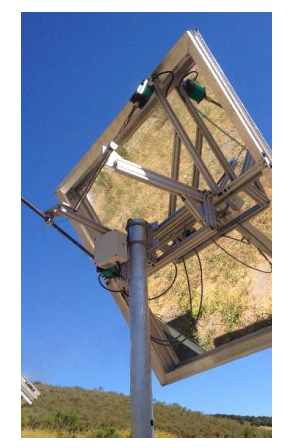
Unlimited heat and light for factories, offices, homes, and more! Heliostats are computer-controlled mirrors which keep the sun reflected on a target as the sun moves across the sky. The LightManufacturing H1 heliostat delivers over 2000 watts of energy to a target - or over 230,000 lumens for lighting applications.
Unlimited heat and light for factories, offices, homes, and more!
Heliostats are computer-controlled mirrors which keep the sun reflected on a target as the sun moves across the sky. The LightManufacturing H1 heliostat delivers over 2000 watts of energy to a target – or over 230,000 lumens for lighting applications.

PISMO BEACH, Calif., March 11, 2014 /PRNewswire/ — LightManufacturing LLC, a solar thermal technology company, today announced that the United States Patent and Trademark Office issued the firm US Patent 8,662,877 covering the use of concentrated solar thermal energy for molding plastic.   The proprietary technology allows low-cost manufacturing of large plastic objects like water tanks and boats without the use of fossil fuels.  The patent describes the use of heliostats (sun-tracking mirrors) to concentrate heat in a plastic molding system.
“Our technology eliminates the energy costs of roto-molding or vacuum-forming plastic parts”, says Karl von Kries, LightManufacturing Founder and CEO, “while offering opportunities to simplify and reduce the cost of the molding system”.  The company’s Solar Rotational Molding (SRM®) systems are delivered pre-integrated into 20′ ISO shipping containers, and can be dropped onto unimproved land.  No building, concrete pad, or grid energy connection is required.  “This ease of installation means customers can put inexpensive production capacity in new markets, or put manufacturing close to customers to reduce transport costs”, says von Kries.
Heat for melting the plastic comes from an array of the company’s “H1” heliostats, and a photovoltaic array on the roof of the container provides energy to rotate the molds and operate other equipment.  The company estimates that the now-patented processes can be deployed on over 49% of the Earth’s land area.
While many solar technology firms work on methods for generating electricity, LightManufacturing differs by concentrating solely on applying solar heat to manufacturing processes.  “Enormous opportunities exist to harness solar thermal energy for industrial applications”, says von Kries. “Many processes that burn natural gas or other fossil fuels to generate heat is a candidate for conversion to solar thermal, and the plastic molding processes covered by this patent happen to be two of the best first applications of our technology”.
The firm describes the process in detail with photos and video at http://www.lightmanufacturingsystems.com
About LightManufacturing
Founded in 2010, LightManufacturing researches and commercializes solar thermal technology, including Solar Vacuum-Forming and Solar Rotational Molding (SRM®).  The firm’s products include the H1 heliostat and turn-key SRM molding systems.   For more information visit:  http://www.lightmanufacturingsystems.com
Read more news from LightManufacturing LLC

Energy Briefs: Oil / Wood / Ethanol

Screen Shot 2014-03-27 at 8.05.37 AM


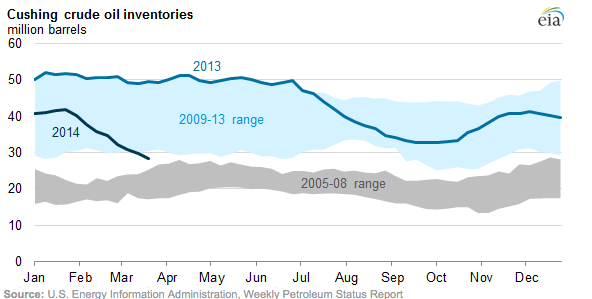
Crude oil inventories at Cushing, Oklahoma, hub down 32% over the past two months

Crude oil inventories at Cushing, Oklahoma, the primary crude oil storage location in the United States, decreased 13 million barrels (32%) over the past two months. On March 21, Cushing inventories were less than 29 million barrels, more than 20 million barrels lower than a year ago and the lowest level since early 2012. Cushing is the delivery location for the New York Mercantile Exchange (Nymex) West Texas Intermediate (WTI) crude oil futures contract.
The recent drawdown of stocks at Cushing resulted from three factors:
The startup of TransCanada’s Cushing Marketlink pipeline, which is now moving crude oil from Cushing to the U.S. Gulf Coast
Sustained high crude oil runs at refineries in Petroleum Administration for Defense Districts (PADD) 2 (Midwest) and 3 (Gulf Coast), which are partially supplied from Cushing
Expanded pipeline infrastructure and railroad shipments that have made it possible for crude oil to bypass Cushing storage and move directly to refining centers in PADDs 1 (East Coast), 3 (Gulf Coast), and 5 (West Coast)
Despite the considerable decline in Cushing inventories, crude oil stocks remain above the top of the 2005-08 range. Over the past several years, much of the crude oil production growth from tight oil formations in the Midcontinent was delivered to Cushing storage. Because takeaway capacity from Cushing storage was insufficient, inventories there rose. Currently, Cushing inventories have fallen to levels that reflect current market conditions, and although they are reduced, the levels remain consistent with crude oil supply requirements to meet regional refinery demand.

Back To Wood

The U.S. Energy Information Administration’s new “Today in Energy” brief looks at how more U.S. households are relying on wood at their primary heating source.
“In total, about 2.5 million households (2.1%) across the country use wood as the main fuel for home heating, up from 1.9 million households (1.7%) in 2005. An additional 9 million households (7.7%) use wood as a secondary heating fuel. This combination of main and secondary heating accounts for about 500 trillion British thermal units (Btu) of wood consumption per year in the residential sector, or about the same as propane consumption and slightly less than fuel oil consumption.”—EIA’s Today in Energy.

 Midwest  Ethanol Industry files to take LCFS fight to United States Supreme Court

(March 20, 2014) WASHINGTON — Following the January decision by the Ninth U.S. Circuit Court of Appeals to deny rehearing en banc in the litigation regarding California’s Low Carbon Fuel Standard (LCFS), the Renewable Fuels Association (RFA) and Growth Energy have petitioned the U.S. Supreme Court for certiorari to make a final determination relating to what they call, the constitutionally flawed LCFS.
“California, through adoption of the LCFS, has violated the most basic, structural features of interstate federalism. LCFS not only discriminates against out-of-state commerce, but it seeks to regulate conduct in other States in direct contravention of our constitutional structure and at the direct expense of Midwestern farmers and ethanol producers.”
RFA and Growth Energy moved forward with a Supreme Court challenge after a divided panel of the Ninth Circuit Court of Appeals reversed a District Court (O’Neill, J.) finding that the California LCFS discriminates against interstate commerce and constitutes extraterritorial regulation in violation of the Commerce Clause. By its own admission, California’s Low Carbon Fuel Standard (“LCFS”) seeks to regulate greenhouse gas (“GHG”) emissions occurring in other states by rewarding and punishing industrial and agricultural activity taking place outside California. And it bases the size of these rewards and penalties on whether production took place in “California” or in the “Midwest”—systematically favoring California. The Constitution denies states such authority they say.

Energy Notes: Madera Biofuel Restart / Hanford ‘ Independence’ Goal / SCE Street Lamps

Screen Shot 2014-03-12 at 3.35.44 PMMadera Ethanol Plant Re-Start Target May 1

Pacific Ethanol hopes to restart the shuttered Madera ethanol plant by May 1 says spokesman Paul Koehler.The plant that has been idle for 5 years will be run “far more efficiently” predicts Koehler.”We’ve learned a lot over those five years on how to operate an ethanol plant “says Koehler.The facility will employ 35 and Koehler says most of the staff has been hired.

Pacific Ethanol will install corn oil extraction technology at the plant later in the year as they have at other company facilities.

Koehler says the company wants to source a percentage of feedstock, perhaps 15%, of the corn and grain sorghum grown nearby as they are doing near Stockton.

Asked if margins are as healthy as they were last fall when the company reported a nice profit, Koehler says they are – noting high demand for exports of distillers grain is helping to improve profits at all ethanol plants.
The other good news for the company ”we are approaching 100% ownership” adding that“Madera was our first plant – so the restart is something special for us.”

Hanford Seeks “Energy Independence”

Hanford City Manager Darrell Pyle says the city has a goal to become “energy independent” installing up to 2.3 megawatts of solar power under a proposal by Chevron Energy Solutions. Pyle suggest the project will move forward with “permits likely by the end of June.” In late 2012 Chevron completed a solar installation expected to reduce energy costs at the city’s wastewater treatment plant and save more than $7 million over the program’s life. The installation uses a 1 MW ground-mounted single-axis solar tracking system, which automatically positions solar panels towards the sun. Now the city looks to make an an even larger deal with Phase 11 including the wastewater treatment plant. A public hearing will be held on March 18, 2014 at 7:00p.m.for the purpose of taking public comments on a new contract with the company. The contract calls for some $14 million in savings to the city over 25 years.

Tulare County Cities Want To Buy SCE Streets Lights

Visalia,Tulare and Porterville are negotiating with SCE to buy street lights in their communities. Visalia has 6200 street lights in the city and pays Edison up to $850,000 annually to use them. Buying the system and maintaining it themselves will save enough money the city expects, to convert them to energy savings LEDs. The other cities are on a similar track but behind Visalia on their time line. Visalia believes the price tag to buy the system will be $4 to 5 million.

CEC Approves Monies

The California Energy Commission this month approved more than $9.5 million in grants for two biogas projects, and $1.6 million for an electric vehicle power train conversion project:
Pixley Biogas LLC, in Pixley CA, has received $4.6 million to construct an anaerobic digestion facility that will produce biogas from dairy manure and will power the adjoining ethanol-producing Calgren Renewable Fuels Biorefinery. CEQA requirements have been completed, and this approval lets them move forward with the project.
Community Fuels, in Encinitas, CA, will receive $4.9 million to expand biodiesel production capacity at its Port of Stockton facility from 10 million to at least 15 million gallons per year.
Motiv Power Systems Inc., in Foster City, CA, will receive $1.6 million to convert older United Parcel Service and U.S. Postal Service medium-duty gas or diesel walk-in vans to use its electric power train.

New Report: U.S. Solar Market Grows 41%, Has Record Year in 2013

March 4, 2014

A majority of new solar was installed in Californa last year
A majority of new solar was installed in California last year

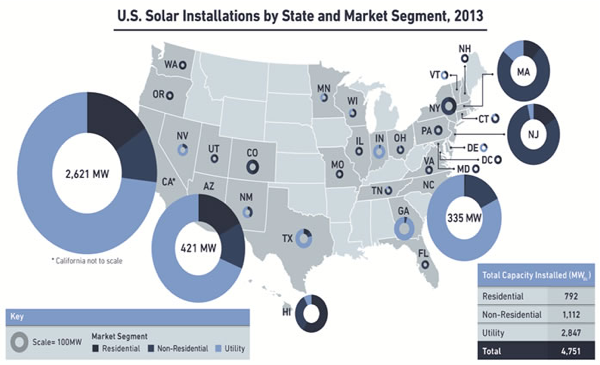
WASHINGTON D.C. AND BOSTON, MA – Continuing its explosive growth, the U.S. solar industry had a record-shattering year in 2013. According to GTM Research and the Solar Energy Industries Association’s (SEIA) Solar Market Insight Year in Review 2013, photovoltaic (PV) installations continued to proliferate, increasing 41% over 2012 to reach 4,751 megawatts (MW). In addition, 410 MW of concentrating solar power (CSP) came online. Solar was the second-largest source of new electricity generating capacity in the U.S., exceeded only by natural gas. Additionally, the cost to install solar fell throughout the year, ending the year 15% below the mark set at the end of 2012.
At the end of 2013 there were more than 440,000 operating solar electric systems in the U.S. totaling over 12,000 MW of PV and 918 MW of CSP.
The U.S. installed 2,106 megawatts in the fourth quarter alone, 44 percent of the annual total. This makes Q4 2013 by far the largest quarter in the history of the U.S. market, exceeding the next largest quarter by 60%.
“Perhaps more important than the numbers,” writes Shayle Kann, Senior Vice President at GTM Research, “2013 offered the U.S. solar market the first real glimpse of its path toward mainstream status. The combination of rapid customer adoption, grassroots support for solar, improved financing terms, and public market successes displayed clear gains for solar in the eyes of both the general population and the investment community.”
“Today, solar is the fastest-growing source of renewable energy in America, generating enough clean, reliable and affordable electricity to power more than 2.2 million homes – and we’re just beginning to scratch the surface of our industry’s enormous potential,” said SEIA President and CEO Rhone Resch.  “Last year alone, solar created tens of thousands of new American jobs and pumped tens of billions of dollars into the U.S. economy.  In fact, more solar has been installed in the U.S. in the last 18 months than in the 30 years prior.  That’s a remarkable record of achievement.”
California continues to lead the U.S. market and installed more than half of all U.S. solar in 2013. In fact, the state installed more solar last year than the entire United States did in 2011. Despite installing the second-most PV in 2013 with 421 megawatts, Arizona didn’t live up to its 2012 total of 710 megawatts. On the other side of the spectrum, North Carolina, Massachusetts, and Georgia had major growth years, installing a combined 663 megawatts, more than doubling their combined total from the year before. On the whole, the top five states (California, Arizona, North Carolina, Massachusetts, and New Jersey) accounted for 81% of all U.S. PV installations in 2013.

GTM Research and SEIA forecast another strong year in 2014 with 26% growth in the U.S. solar market. This will bring annual installations up to nearly 6 gigawatts and the cumulative total will be just shy of the twenty gigawatt milestone.
Report Key Findings:
The U.S. installed 4,751 MW of solar PV in 2013, up 41% over 2012 and nearly fifteen times the amount installed in 2008.
There is now a total of 12.1 GW of PV and 918 MW of CSP operating in the U.S
There were 140,000 individual solar installations in the U.S. in 2013, and a total of over 440,000 systems operating in total today.
More solar has been installed in the U.S. in the last 18 months than in the 30 years prior.
The market value of all PV installations completed in 2013 was $13.7 billion.
Solar accounted for 29% of all new electricity generation capacity in 2013, up from 10% in 2012. This made solar the second-largest source of new generating capacity behind natural gas.
Weighted average PV system prices fell 15% in 2013, reaching a new low of $2.59/W in the fourth quarter.
We forecast 26% PV installation growth in 2014, with installations reaching nearly 6 GW. Growth will occur in all segments but will be most rapid in the residential market.
The U.S. installed 410 MW of concentrating solar (CSP) in 2013, increasing total CSP capacity in the U.S. more than 80%
The wave of concentrating solar power installations slated for completion at the end of 2013 into 2014 kicked off with the 280 MWac Solana project and the Genesis Solar project’s initial 125 MWac phase. In early 2014, Brightsource’s iconic Ivanpah project also began operating and SolarReserve’s Crescent Dunes project began commissioning.

Pacific Ethanol, Inc. Reports Record Fourth Quarter and Year-End 2013 Financial Results

California Biofuel Maker Stock Surges

February 27,2014
SACRAMENTO, Calif., Feb. 26, 2014 (GLOBE NEWSWIRE) — Pacific Ethanol, Inc. (Nasdaq:PEIX), the leading marketer and producer of low-carbon renewable fuels in the Western United States, reported its financial results for the three- and twelve-months ended December 31, 2013.
Neil Koehler, the company’s president and CEO, stated: “Our fourth quarter 2013 results cap-off a year of record financial performance and significant progress for Pacific Ethanol. During 2013, we diversified our feedstock with sorghum and beet sugar, we added new revenue streams with corn oil separation, and we continued to drive cost efficiencies at the plants. These efforts, in combination with a better market environment for ethanol, translated into significant improvements in revenue, margins and Adjusted EBITDA on a year-over-year basis. In light of this progress, we plan to restart operations at our Madera, California ethanol facility in the second quarter of 2014.”

After the annoucment the company’s  stock that had been as low as $2.50 in November has steadily climbed and is trading today for over $12.

Stockton plant
Stockton plant

Financial Results for the Three Months Ended December 31, 2013
Net sales were $215.3 million for the fourth quarter of 2013, compared to $197.0 million for the fourth quarter of 2012. The increase in net sales was attributable to an increase in production gallons sold, slightly offset by a reduction in our average sales price per gallon.
Gross profit was a record $21.6 million for the fourth quarter of 2013, compared to a gross loss of $4.7 million in the fourth quarter of 2012. The improvement in gross profit was driven by significantly improved production margins and an increase in production gallons sold.
Selling, general and administrative (“SG&A”) expenses were $4.4 million in the fourth quarter of 2013, compared to $2.7 million in the fourth quarter of 2012. The increase in SG&A expenses reflect year-end compensation expense partially driven by higher margins and company profitability.
Operating income for the fourth quarter of 2013 was a record $17.2 million, compared to an operating loss of $7.4 million for the same period in 2012.
Income available to common stockholders for the fourth quarter of 2013 was $8.3 million, compared to a loss of $5.8 million for the fourth quarter of 2012.
Adjusted EBITDA improved to a record $18.3 million for the fourth quarter of 2013, compared to Adjusted EBITDA of negative $2.6 million in the fourth quarter of 2012.
Bryon McGregor, the company’s CFO, stated: “We continue to make significant progress in strengthening our balance sheet. During the fourth quarter, we retired a total of $13.3 million in debt and subsequently paid down another $10.4 million in plant debt. This deleveraging facilitates our ability to restart our Madera plant, lowers our cost of borrowing and improves our profitability. It also aids in our efforts to refinance our plant debt to further lower our cost of capital and improve liquidity.”
Financial Results for the Year Ended December 31, 2013
For the full year 2013, net sales were a record $908.4 million, compared to $816.0 million for the same period in 2012. Gross profit was a record $32.9 million for 2013, compared to a gross loss of $19.5 million for 2012. Operating income for 2013 was a record $18.9 million, compared to an operating loss of $31.7 million for the same period in 2012, representing an improvement of $50.6 million year-over-year. Loss available to common stockholders for the full year 2013 was $2.0 million, which included $3.0 million in loss on extinguishment of debt, compared to a loss of $20.3 million for the same period in 2012.
Adjusted EBITDA for the full year 2013 was a record $28.6 million, compared to Adjusted EBITDA of negative $7.5 million for the same period in 2012.
Q4 Results Conference Call
Management will host a conference call at 8:00 a.m. PT/11:00 a.m. ET on February 27, 2014. Neil Koehler, Chief Executive Officer, and Bryon McGregor, Chief Financial Officer, will deliver prepared remarks followed by a question and answer session. The webcast for the call can be accessed from Pacific Ethanol’s website at www.pacificethanol.net. Alternatively, you may dial the following number up to ten minutes prior to the scheduled conference call time: (877) 847-6066. International callers should dial 00-1-(970) 315-0267. The pass code will be 2279206#.
If you are unable to listen to the live call, the webcast will be archived for replay on Pacific Ethanol’s website for one year. In addition, a telephonic replay will be available at 2:00 p.m. Eastern Time on Thursday, February 27, 2014 through 11:59 p.m. Eastern Time on Thursday, March 6, 2014. To access the replay, please dial (855) 859-2056. International callers should dial 00-1-(404) 537-3406. The pass code will be 2279206#.
Reconciliation of Adjusted EBITDA to Net Income (Loss)
Management believes that certain financial measures not in accordance with generally accepted accounting principles (“GAAP”) are useful measures of operations. The company defines Adjusted EBITDA as unaudited earnings before interest, taxes, depreciation and amortization, noncash loss on extinguishments of debt and fair value adjustments and warrant inducements. The table at the end of this release provides a reconciliation of Adjusted EBITDA to net income (loss) attributed to Pacific Ethanol, Inc. Management provides an Adjusted EBITDA measure so that investors will have the same financial information that management uses, which may assist investors in properly assessing the company’s performance on a period-over-period basis. Adjusted EBITDA is not a measure of financial performance under GAAP, and should not be considered an alternative to net income (loss) or any other measure of performance under GAAP, or to cash flows from operating, investing or financing activities as an indicator of cash flows or as a measure of liquidity. Adjusted EBITDA has limitations as an analytical tool and you should not consider it in isolation or as a substitute for analysis of the company’s results as reported under GAAP.