June 17,2014 The Bureau of Ocean Energy Management (BOEM) is seeking public comment as it prepares an environmental assessment to analyze potential impacts of the proposed 30 MW WindFloat demonstration project offshore Coos Bay, Ore.
Principle Power and Deepwater Wind plan to build the floating wind farm, which will feature five 6 MW direct-drive wind turbines. The offshore project was one of three selected to receive up to $47 million each in follow-up grants from the U.S. Department of Energy (DOE). Principle Power had received an initial $4 million grant from the DOE in December 2012 and submitted an unsolicited request to BOEM for a commercial wind energy lease in May 2013.
BOEM has published a notice of intent to prepare an environmental assessment for the proposed project in the Federal Register, kick-starting a 60-day public comment period. The agency will accept comments through July 28 and also plans to host two public meetings in Coos Bay on June 17.
DES MOINES, Iowa, April 30 – MidAmerican Energy Holdings Company announced in late April it had changed its name to Berkshire Hathaway Energy.
This new name more accurately reflects our growing, diversified mix of businesses and the customers they serve. It also reinforces the company’s strategy to own and operate a portfolio of high-quality assets, grow and diversify through a disciplined acquisition strategy, and build and maintain strong stakeholder relationships. The businesses of Berkshire Hathaway Energy will continue to be managed locally, and the names and operations of our businesses will not be affected.
“Our new name reflects the benefits we gain from Berkshire Hathaway’s ownership, particularly our ability to reinvest in our businesses and take a long-term view of our customers’ needs, which have helped us become a leader in the global energy industry,” said Greg Abel, chairman, president and CEO. “Our vision remains unchanged – to be the best energy company in serving our customers, while delivering sustainable energy solutions.”
Pictured: Board chair Warren Buffett…ready to spend billions more
In Central California the company owns Topaz Solar Farms is a 550-megawatt solar power plant in San Luis Obispo County, California. Construction on the project began in November 2011 and is expected to run through 2015. It is among the world’s largest solar farms currently under construction and once complete will have more than eight million modules installed. The project is estimated to infuse $417 million into the local economy and create roughly 400 construction jobs over a three-year period.
This week Berkshire Hathaway chairman Warren Buffet in an Las Vegas news conference said “We’ve poured billions and billions and billions of dollars in retained earnings, and several billion of additional equity,” into the energy business, Buffett, 83, said today at the Edison Electric Institute’s annual convention in Las Vegas. “And we’re going to keep doing that as far as the eye can see.” A news account said” the business has committed $15 billion to renewable energy projects, like a solar farm in California that will be one of the world’s largest when it’s completed in 2015. Buffett said today that Berkshire could invest an additional $15 billion on such projects, aided by tax benefits as the U.S. strives to reduce carbon-dioxide emissions.”
About Berkshire Hathaway Energy
Berkshire Hathaway Energy owns a portfolio of locally managed businesses that share a vision for the energy future, make sustainable investments to achieve that vision, and had $70 billion of assets as of Dec. 31, 2013. These businesses deliver safe, reliable service each day to more than 8.4 million customers and end-users around the world and consistently rank high among energy companies in customer satisfaction. Berkshire Hathaway Energy is headquartered in Des Moines, Iowa, U.S.A. Learn more and see a complete list of our businesses at www.berkshirehathawayenergyco.com.
VISALIA, Calif. June 9, 2014 – Edeniq, Inc., a biomaterials and sustainable fuels company, today announced the successful performance of its PATHWAYTM Validation Facility. Edeniq’s PATHWAYTM Platform is a proprietary, integrated platform that produces cellulosic ethanol inside existing corn ethanol plants. The pilot facility showcases how Edeniq’s patented technologies – the CellunatorTM and PATHWAYTM Platform – convert starch and break down corn kernel fiber, releasing cellulosic sugars into the fermentation process, thereby increasing ethanol yield three to six percent. The pilot facility is located at the company’s headquarters in Visalia, California.
“The pilot facility confirms a necessary high-precision consistency in the PATHWAYTM Platform that is a first for our industry,” said Tom Griffin, Chief Technology Officer, Edeniq, Inc. “Our customers are looking for a way to generate and validate cellulosic ethanol production, and with Edeniq’s PATHWAYTM Platform coupled with this unique pilot facility, we have equipped them with the solution.”
Funded jointly by Flint Hills Resources Renewables, LLC, and Edeniq, the pilot facility showcases the PATHWAYTM Platform and allows ethanol producers to quantify the impact of PATHWAYTM on yield enhancement and cellulosic ethanol production at their plants.
“The PATHWAYTM Validation Facility was developed to provide our customers and partners with data to verify the increase in ethanol yield the technology provides,” said Brian Thome, President and CEO of Edeniq, Inc. “Edeniq is committed to increasing the bottom line for our customers and partners by allowing ethanol producers to improve their efficiency and migrate to cellulosic ethanol.”
The PATHWAYTM Validation Facility was designed and built exclusively by Edeniq engineers. “In an effort to maintain the highest level of precision and uphold the quality our customers expect, we chose to build the facility ourselves,” said Dr. Griffin. “Edeniq is a trailblazer in this effort and we wanted to make sure the facility showcased our technology and the expertise of our team appropriately.”
The PATHWAYTM Platform is currently in commercial testing and continues to demonstrate its ability to increase ethanol yield and boost customer profits.
About Edeniq
Edeniq delivers integrated process innovations that unlock sugars. These technological innovations uniquely combine mechanical and biological processes. Edeniq’s capital light and operationally efficient solutions can be easily integrated into existing biorefineries that produce ethanol, other biofuels, biochemicals, and/or bio-based products. Edeniq currently sells or licenses its technologies to biorefineries in the United States and Brazil. Edeniq was founded in 2008 and is headquartered in Visalia, California with locations in Omaha, Nebraska and São Paulo State, Brazil. More information can
be found at http://www.edeniq.com.
June 4,2014
Looking to meet state renewable energy requirements as well federal tax credit deadlines – a number of 20MW utility-size solar projects in the Central Valley are being built this summer and some very large ones expect to get underway by the end of the year.
A 30% federal tax credit will expire in 2016 lighting a fire under developers aiming to finish their multi-million dollar projects in time to collect.
If the developers are in a hurry, so is the California PUC – pushing the private utilities like PG&E to add the infrastructure to hook the arrays up to the grid and carry the power across the Valley in many cases.
The PUC is being driven by a state mandate to increase renewable energy generation to 33% in California by 2020 to cut carbon pollution.
Dry and spent farmland in the Central Valley is now growing panels instead of crops
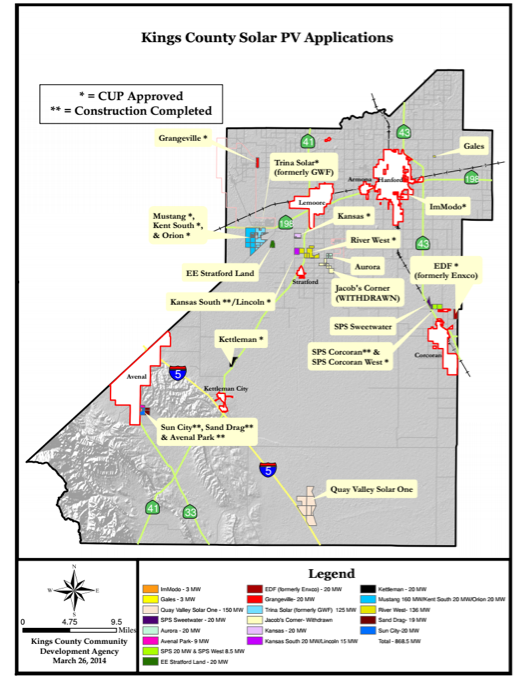
The timetable means over the next year and a half the Central Valley is likely to see a rush of solar panel construction across this sun drenched, four-county region from Kern to Tulare,Kings and Fresno counties, mostly on its western edge.
Not only is utility-size solar construction cooking, residential roof-top solar building permits in the Central Valley are blistering with year-to-date numbers more than double what they were during the same time last year, which was a busy year.
More than 2600 residential solar power permits have been issued so far this year in Madera,Kings,Fresno Tulare and Kern counties says Construction Monitor.
Workers getting trained in solar panel installation in Visalia
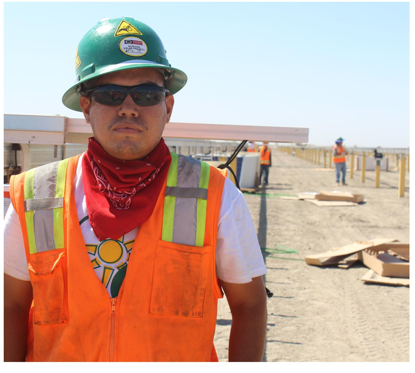
Nobody is watching the uptick in construction closer than Hector Uriarte Jr who works as leader of a job training program based in Visalia ”We were told one company – First Solar was looking for 600 workers to help build three solar plants this summer “ says Uriarte who is Proteus’s green jobs coordinator.The plants are being built in Kings and Fresno counties. The job training program offers a course in solar panel installation in Visalia and now they plan to open a Delano office to develop a green workforce in Kern County.
Some Valley developers like ImModo target smaller 1 to 7 MW utility-size projects (and under construction now) while others aim at a 20MW size, each with an advantage of time to construction over the mega solar projects that seem to take forever to happen.
The wait is for government permits, financing as well as power purchase agreements from a utility like PG&E. The big projects have an incredibly long lead time (and uncertainty) before they can pop the champagne.
700MW Project
Case in point is Fresno-based Granville Homes, owned by the Assemi family. Jeff Roberts, the company’s VP says they have been working five long years to be able to build a large 700MW project in southwest Kern County but are now near the finish line,he expects.
“We just got approval for the first solar Habitat Conservation Plan anywhere” says Roberts, noting there is a 90 day comment period through the US Fish and Wildlife Service before it is final. The plan is in compliance with the Endangered Species Act. ”Doing all this is not for a the feint of heart” he advises.
With all permits in place – the project – Maricopa Sun, is near ready to go to construction with the first two 150MW phases having already been sold to German utility E.ON who who wants to break ground by years end says Roberts. E.On is one of the largest utilities in Europe. The company reworked their business plan to switch to renewables after the German decision in 2011 to close all their nuclear power plants by 2022. Now the utility is focusing on growth markets around the world – like California.
The sprawling 6000 acre project was “actually Plan B” for this relatively flat farmland, says Roberts.”But with no water we decided to move forward on solar.” The land has been without a water supply for 10 years. The energy project has been well received, getting all permits in Kern County, moving out of the Williamson Act and even getting the support of the Sierra Club. The land near Taft is remote but close to where PGE can hook into the state power grid.In a CPUC notice in May, PGE has promised to begin the hook up process in September and be complete with power poll construction by December.
At build out, 700 MW Maricopa Sun would be one of the largest solar projects in the US.
Another large project nears ground breaking as well in Fresno County.
That is Recurrent Energy’s Tranquility Solar, a 3732 acre, 400 MW solar farm, 5.5 miles east of I-5 in Westlands Water District. The huge project’s draft EIR will be the subject of a public meeting June 25 says Fresno County planner Briza Grace Scholars. She adds that the company is eager to start building by the end of 2014 or early 2015.
The Tranquility project was originally proposed in 2011 but the company pulled the application in 2012. Now it’s back and Recurrent, who has a good record of building what they propose, is likely to move forward this winter. The Tranquility project could boast as many as 2.5 million PV panels and be worth perhaps three quarters of a billion dollars.
The project includes a switching station approved by the California Public Utilities Commission and owned and operated by PG&E.
Water Issue:
Some criticize large solar projects on farm land pointing the loss of prime ag land as an issue. “Much of the solar development is proposed for Kern, Tulare, Fresno and Kings counties, which are home to more than 400 crops that pump $30 billion into the economy and help sustain U.S. food security” cautions a recent Huffington Post article.
But the argument ignores the fact that almost all the the projects are located on non-prime land in areas like the Westlands Water District where the soils are salt and selenium laden and never will be farmed again.They are classified as “retired” farm land by the US government.
What Slow Down?
While some argue that the heyday of major solar development is fading (LA Times “Solar prospects now aren’t as sunny”). Indeed there are far fewer pending projects from a few years ago when 10 projects were proposed for every one built – but the numbers now are still impressive.
Just consider one fact. As of March of this year – solar provided a record 18 percent of California’s 22,700 megawatt (MW) demand. That’s just the solar part of the renewables. Add in the wind and hydro generation and there is steady progress in reaching the 33% renewables goal. Now EPA will be mandating a 30% cut in carbon emissions nationwide news reports say.
Since 2003, 7,627 MW of renewable generation capacity has achieved commercial operation under the state RPS program. More than 2,769 MW of renewable generation capacity came online in 2013, and another 2,721 MW of capacity is forecasted to reach commercial operation by the end of 2014. These numbers are the equivalent of adding the generation capacity of a Diablo Nuclear Power plant to the grid each year.
More mega projects in the Valley are still being actively worked on -notably Westland Solar Park – a 2300MW behemoth, a phased project in the Westlands WD in Kings County, also right off the Avenal Cutoff Rd. More news coming on this soon.
Also around Tulare,Fresno,Kern and Kings counties the panels are going up on a number of 20 to 100 MW solar farms. They include:
– Earlier this spring Richmond, Va-based energy firm Dominion announced it has purchased six local solar development projects from Recurrent Energy, one of North America’s largest developers of utility scale solar projects.Recurrent continues to develop solar projects in the Central Valley it will likely sell off once completed.The solar project sites are located in Fresno, Kern and Kings counties.
The projects, all with power purchase agreements in place, include the 34-megawatt Adams East project near Tranquility in Fresno County; Kent South, a 20-megawatt solar farm near Lemoore in Kings County and the 27-megawatt Kansas solar farm, also near Lemoore. Three more are in Kern County — Old River, Camelot and Colombia 2. Together they add up to 139 megawatts of output. All are being built or will be built in the next year.
To hook up a number of Recurrent projects in Kings County the developer is now building a new 2.7-acre 70 kilovolt switching station which it will transfer the ownership to PG&E when complete. The switching station is located approximately 150 feet northwest of the intersection of Avenal Cutoff Road and 25th Avenue. Construction started in May 2014.
– Recurrent also plans to build RE Mustang LLC – a 160 Megawatt solar photovoltaic energy facility located at 15866 25th Avenue, Lemoore, CA. The big project is one of several being proposed by the SF-based Recurrent Energy, owned by Sharp, a Japanese firm. The site is near the NAS Lemoore base.
–Henrietta Solar Project. Bids to build this 100MW solar farm owned by Bay Area-based SunPower will be taken in December for construction in 2015 says a report. The project is near the NAS Lemoore base in Kings County.
– First Solar plans to build 42.76MW for EDF Renewable Energy – a French owned firm.First Solar and EDF Renewable Energy have signed EPC agreements for the 19.76 Megawatt AC CID Solar Project, located in Corcoran in Kings County; and the 23MWAC Cottonwood Solar Project, consisting of two sites, one located in Kings County and the other in Kern County. The CID Solar Project has a Power Purchase Agreement with Pacific Gas and Electric Company. The Cottonwood project has a PPA with Marin Clean Energy.
Construction on these projects is expected to begin in the second quarter of 2014, with CID Solar anticipated completion in October 2014 and Cottonwood anticipated completion in the first quarter of 2015.
-Kern county has another major project going to construction on its western edge – Lost Hills Solar. Last year First Solar and and the City of Roseville, California announced they have signed a power purchase agreement (PPA) for 32MW of solar electricity to be generated at the Lost Hills photovoltaic power plant that First Solar is developing and will construct in Kern County. Construction is underway now. The site is near Hwys 33 and 46 with PG&E building a facility this October to accommodate the power hookup according to the PUC.
Alos in Kern County’s Valley region – SunEdison, North America’s largest solar energy services provider, is developing a 75 MW solar photovoltaic system . The system will be located on a 743-acre site about 11 miles southeast of Bakersfield, California. This project will likely move forward by 2015 as well.
-In Tulare County, Spanish-backed Immodo has been building 5 smaller 1 to 7MW solar projects investing more than $40 million. Now it is close to building solar facilities in Porterville and Farmersville and near Hanford. Local spokesman Don Watson says the company plans to remain in the county because of opportunity in the ag sector to build more business here. The county’s PACE program promises low cost financing. Now the city of Visalia has joined that program.
More in Tulare County: This week New York-based ConEd purchased another 20MW project with plans approved but yet to be constructed in the Alpaugh area. Several ConEd projects nearby already produce more than 70MW in this remote western part of the county. Another 20MW project there is already under construction.
One large 80MW project remains in the pipeline in Tulare County. The project site is located east of State Route 65 and south of Avenue 24.
PG&E Line Will Carry New Supply
A proposed Central Valley Power Connect project would span about 70 miles through Kings, Fresno and Madera Counties, connecting two existing PG&E substations, one east of Coalinga and the other north of Fresno. PG&E is partnering with MidAmerican Transmission and Citizens Energy on the project. MidAmerican owns a large solar project in SLO County. The Central Valley Power Connect is a proposed new 230,000 volt (230kV) electric transmission line connecting Gates Substation east of Coalinga and Gregg Substation northwest of Fresno. The California Independent System Operator (CAISO) estimates the cost to be approximately $115 to $145 million .
The line is needed to meet the growing demand for electricity in the Central Valley region, ensure that the Helms Pumped Storage hydroelectric Plant can continue to deliver clean, affordable electricity to nearly 900,000 average homes well into the future, and help integrate renewable solar and wind power onto the electric grid.
Bruce Taylor at his family business. UC Berkeley photo
PG&E gave notice this week that the are seeking final approval from the PUC for a proposed proposed sale of limited sole- customer public utility facilities to an expanding food processor in the south Salinas Valley.
Taylor Fresh Vegetables is more than doubling the size of its fresh-cut vegetable processing facility, bringing its new plant in Gonzales to a capacity of 135,000 square feet on 21 acres and creating an additional 300 new jobs for the local area.
The new plant will include state-of-the-art, commodity-specific processing equipment as well as a major focus on energy efficiency and renewable energy produced by wind and solar technologies. Taylor is installing a new primary voltage electric distribution system and as part of that system, PG&E and Taylor seek approval from the Commission for Taylor to purchase certain PG&E primary and secondary overhead and underground electric facilities that currently provide service to Taylor’s operations located at 100 Puente Del Monte Avenue in Gonzales, California.
The facilities being sold to Taylor include 12kV primary service facilities and 277/480 voltage secondary service facilities at 100 Puente Del Monte Avenue in Gonzales, California.
The notice says that by owning and operating its own internal distribution facilities, Taylor will be able to purchase power from PG&E at the Primary Rate, which will result in significant savings for Taylor.
May 30,2014 GEI Consultants, Inc.,one of the nation’s leading geotechnical, environmental, water resources, and ecological science and engineering firms, announced recently that it is providing certain Owner’s Engineer services for the proposed Sacramento Municipal Utility District (SMUD) Iowa Hill Pumped-Storage Development project. GEI is pleased to be a member of the Jacobs Associates team for the project. SMUD recently awarded the Jacobs Associates team the Owner’s Engineer services contract for preliminary design and construction services on their proposed Iowa Hill Pumped-Storage Project. If constructed, Iowa Hill would be a 400 megawatt pumped storage hydroelectric facility. GEI will lead the design of the 6,400 acre-foot upper reservoir, a lined impoundment that will be formed by an earth- and rock-fill dam with a maximum height of more than 200 feet and a crest length of 5,900 feet. The design of the dam and reservoir will be under the regulatory authority of the Federal Energy Regulatory Commission (FERC) and the California Division of Safety of Dams (DSOD).
The project would utilize an existing reservoir on the American River, from which water would be pumped up to a new 6,400 acre-foot capacity upper reservoir, where the water would be stored. During peak electrical demand periods, water would flow from the upper reservoir to the lower reservoir via a 1,000-foot-deep (305 m) shaft through 3,500 feet (1,067 m) of water tunnels. The electricity generated would connect the existing transmission line that connects SMUD’s existing Upper American River hydroelectric project with the District’s customers.
The team consists of Jacobs Associates (prime), GEI Consultants, HDR Engineering, AF-Consult of Switzerland, Carlton Engineering, AMEC, IEC Corporation, Northwest Hydraulic Consultants, Stillwater Sciences, Ascent Environmental, Crux Subsurface, and Foxfire Constructors.
May 28,2014 TURLOCK, Calif. – Today, the California Energy Commission on May 22,2014 joined the U.S. Department of Energy (DOE) to dedicate EnerVault Turlock, the first grid‐scale iron‐chromium redox flow battery deployed in the world. EnerVault designed and manufactured the long‐duration, grid‐scale energy storage system in Silicon Valley with a combination of private funding and research and development grants from the DOE and the Energy Commission.
Long‐duration energy storage systems are emerging as the lynchpin to efficient operations for resilient grids as aging conventional power plants are replaced by higher levels of solar and wind. Interconnected to the distribution grid, EnerVault Turlock is co‐located with a dual‐axis tracking solar photovoltaic system in an almond orchard in California’s Central Valley.
“With the support of DOE, the Energy Commission, our technical team and investors, EnerVault’s long‐ duration, grid‐scale energy storage systems are ready to participate in California’s ground‐breaking energy storage market in less than five years from our first round of funding,” said Jim Pape, EnerVault CEO. “EnerVault Turlock will demonstrate that our proprietary technology is inherently safe, reliable and cost effective. Using commodity equipment and materials, EnerVault can manufacture large scale systems quickly: no gigafactory required.”
“The EnerVault Turlock project solidifies California’s position as an incubator of companies that attract investment, and demonstrates the value of public‐sector investments in energy research and development,” said Robert B. Weisenmiller, chair of the Energy Commission. “This storage technology will help integrate renewable energy and improve the reliability of California’s evolving electricity system. Federal and State investments were critical to taking this project from laboratory prototypes to community‐scale, energy storage system in less than five years.”
“The EnerVault Turlock system demonstrates the viability of iron‐chromium redox flow batteries at the grid‐scale,” said Imre Gyuk, DOE Energy Storage Program Manager. “Long‐duration energy storage, like EnerVault’s, is the lynchpin to grid stability as we achieve high penetration of renewable energy. We are very proud of EnerVault’s success as a member of our DOE ARRA Storage Demonstration Program as it is the first battery of its class of grantees to reach field commissioning.”
“Thanks to the support of my legislative colleagues and Governor Jerry Brown, California is leading the redesign of our electricity system, reducing greenhouse gas emissions and incorporating efficiency, renewables, and distributed and customer‐sited resources,” said Assemblymember Nancy Skinner, author of AB 2514. “With direction from the legislature, the CPUC is now working with our utilities to incorporate a wide range of energy storage capabilities into the grid. I congratulate EnerVault Turlock as an innovative example of long‐duration, grid‐scale energy storage ready to enter our new energy storage marketplace.”
“The unique characteristics of storage devices mean they can respond quickly to supply energy to the grid when needed or store it for later use,” said Karen Edson, Vice President at the California Independent System Operator. “Storage is one of the most important emerging technologies for managing electricity production and delivery in the future, and creating a grid that is modern, flexible and can use renewable resources efficiently and effectively.”
“Energy storage has the potential to be a game changer for our electric grid, and our energy storage procurement proceeding aims to achieve improved grid optimization, integration of renewable energy, and reduction of greenhouse gas emissions to 80 percent below 1990 levels by 2050,” said Paul Clanon, Executive Director of the California Public Utilities Commission. “California’s multi‐year energy storage procurement target of 1,325 megawatts is specifically designed to encourage the scaling of new innovative technologies and reduce costs to ratepayers. We commend EnerVault for its success and welcome innovative technologies to bid into California’s energy storage marketplace.”
May 27,2014
By Sarah Yang, Media Relations |
BERKELEY —
California’s winter tule fog – hated by drivers, but needed by fruit and nut trees – has declined dramatically over the past three decades, raising a red flag for the state’s multibillion dollar agricultural industry, according to researchers at UC Berkeley.
Crops such as almonds, pistachios, cherries, apricots and peaches go through a necessary winter dormant period brought on and maintained by colder temperatures. Tule fog, a thick ground fog that descends upon the state’s Central Valley between late fall and early spring, helps contribute to this winter chill.
“The trees need this dormant time to rest so that they can later develop buds, flowers and fruit during the growing season,” said biometeorologist and study lead author Dennis Baldocchi, whose father grew almonds and walnuts in Antioch and Oakley. “An insufficient rest period impairs the ability of farmers to achieve high quality fruit yields.”
The study was published May 15 in the journal Geophysical Research Letters, a publication of the American Geophysical Union. The findings have implications for the entire country since many of these California crops account for 95 percent of U.S. production, the authors noted.
The researchers paired NASA and National Oceanic and Atmospheric Administration satellite records with data from a network of University of California weather stations, covering 32 consecutive winters. There was a great deal of variability from year to year, but on average, the researchers found a 46 percent drop in the number of fog days between the first of November and the end of February.
“The year-to-year variability we saw was likely influenced by whether the season was relatively wet or dry,” said Baldocchi, professor of Environmental Science, Policy and Management. “Generally, when conditions are too dry or too wet, we get less fog. If we’re in a drought, there isn’t enough moisture to condense in the air. During wet years, we need the rain to stop so that the fog can form.”
Other studies have marked the decline in the Central Valley of winter chill – the number of hours between 0 and 7 degrees Celsius. The number of hours of winter chill has dropped by several hundred since the 1950s, the study authors noted.
But ambient air temperature alone may not adequately reflect the heat experienced by the crops, said Baldocchi. Direct sunlight can heat the buds so that they are warmer than the surrounding air temperature. As a result, fog is important in shielding the buds from the sun and helping them accumulate winter chill.
Climate forecasts suggest that the accumulation of winter chill will continue to decrease in the Central Valley. Baldocchi said that fruit developers are already trying to develop cultivars that can tolerate less winter chill.
“Farmers may also need to consider adjusting the location of orchards to follow the fog, so to speak,” said Baldocchi. “Some regions along the foothills of the Sierra are candidates, for instance. That type of change is a slow and difficult process, so we need to start thinking about this now.”
The study was co-authored by Eric Waller, a UC Berkeley Ph.D. student in the Department of Environmental Science, Policy and Management.
The California Energy Commission supported this research.
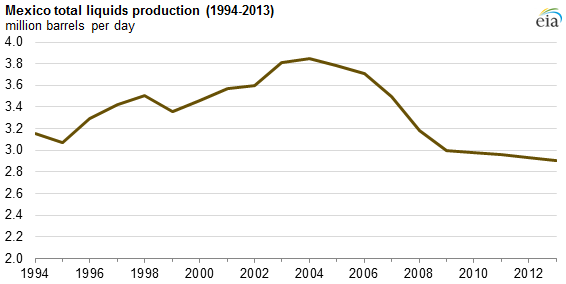
In late 2013, Mexico’s congress approved historic legislation that altered the 1938 ban on private sector participation in the Mexican energy sector. These reforms, that end the 75-year monopoly of Petroleos Mexicanos (Pemex) and allow for greater foreign investment, are the first to include constitutional change, and promise to address many of the challenges that have resulted in a decade-long decline in Mexico’s oil production.
Last year, Mexico produced 2.90 million barrels per day (bbl/d) of total liquids, continuing the decline from its peak of 3.85 million bbl/d in 2004. Crude oil is the most significant component of Mexico’s liquid fuels production, accounting for at least 85% of production in the past two decades. Preliminary estimates indicate April 2014 production of crude oil was about 2.5 million bbl/d, the lowest monthly average since 1995.
The new reforms include the following:
Create four oil and gas exploration and production contract models, including service contracts, production-sharing, profit-sharing, and licenses.
Give Pemex first refusal on developing Mexican resources before private companies begin bidding rounds (round zero), in which Pemex can provide financial and technical plans to develop the resources within three years.
Give regulatory authority over the oil and gas sectors to the Energy Regulatory Commission, the Secretary of Energy, and the National Hydrocarbon Commission, and create the new National Agency of Industrial Safety and Environmental Protection.
Keep Pemex as state-owned but with more administrative and budgetary autonomy, and allow the company to compete for bids with other firms on new projects.
Establish the Mexican Petroleum Fund to manage contract payments and oil revenue.
Before the reforms can take effect, Mexico’s legislature must finalize the secondary laws detailing the fiscal regime, including the contract terms for the exploration and production models and local content requirements. It is expected that Mexico will finalize the secondary legislation by early August.
Unlike the contract terms and local content requirements, which require legislative action to implement, Pemex is already moving forward with its proposal to retain oil and gas assets in the deepwater oil fields in the Perdido Fold Belt and offshore gas fields in Lakach. These proposals have been submitted to the energy ministry. A final decision will be announced in September.
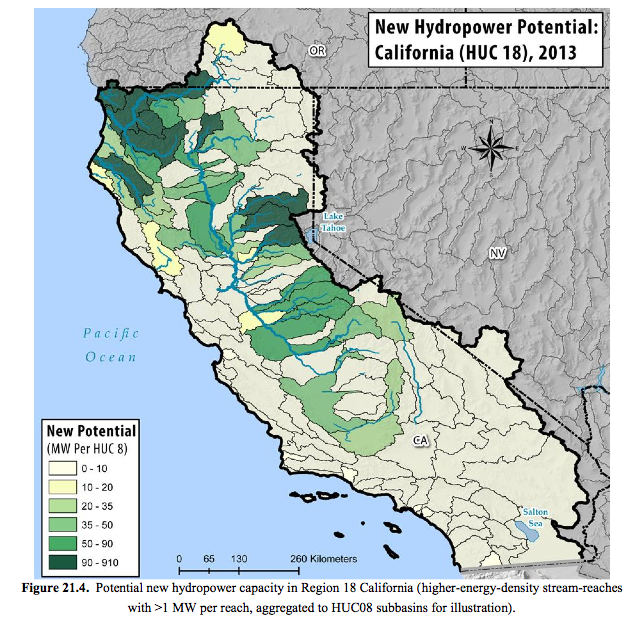
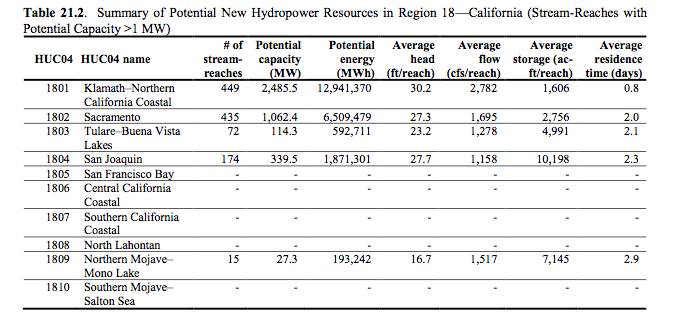
April 29,2014 WASHINGTON – Building on the Obama Administration’s commitment to an all-of-the-above energy strategy, the Energy Department and its Oak Ridge National Laboratory released a renewable energy resource assessment today detailing the potential to develop new electric power generation in waterways across the United States. The report estimates over 65 gigawatts (GW) of potential new hydropower development across more than three million U.S. rivers and streams – nearly equivalent to the current U.S. hydropower capacity. These findings demonstrate one of the ways the United States can further diversify its energy portfolio with sustainable and clean domestic power generation.
The study found in California the potential exists to add several thousand megawatts of hydro power ,mostly in northern California and the Sacramento area. However the Tulare Lake Basin and San Joaquin could add several hundred megawatts says the study (see chart).
“The United States has tremendous untapped clean energy resources and responsible development will help pave the way to a cleaner, more sustainable and diverse energy portfolio,” said Energy Secretary Ernest Moniz. “As the Energy Department works with industry, universities and state and local governments to advance innovative hydropower technologies, the resource assessment released today provides unparalleled insight into new hydropower opportunities throughout the country.”
Hydropower makes up seven percent of total U.S. electricity generation and continues to be the United States’ largest source of renewable electricity, avoiding over 200 million metric tons of carbon emissions each year. Hydropower also provides reliable baseload power day and night – providing greater flexibility and diversity to the electric grid and allowing utilities to integrate other renewable sources such as wind and solar power.
The New Stream-reach Development Assessment released today capitalizes on recent advancements in geospatial datasets and represents the most detailed evaluation of U.S. hydropower potential at undeveloped streams and rivers to date. The greatest hydropower potential was found in western U.S. states, including Alaska, California, Colorado, Idaho, Montana, Oregon and Washington. Kansas, Missouri, Pennsylvania and Wyoming led the rest of the country in new stream-reach hydropower potential.

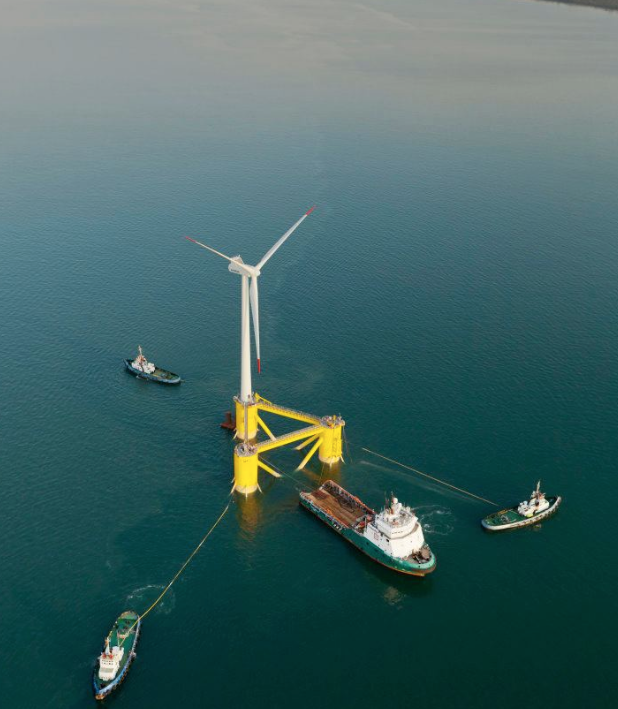 The Bureau of Ocean Energy Management (BOEM) is seeking public comment as it prepares an environmental assessment to analyze potential impacts of the proposed 30 MW WindFloat demonstration project offshore Coos Bay, Ore.