Morro Bay Wave Project Moves Forward

August 25,2014
Screen Shot 2014-08-25 at 4.19.14 PMDynegy, the company that owns the mothballed Morro Bay natural gas power plant,has applied for a permit with the Federal Energy Regulatory Commission (FERC) on July 22,2014 to pursue the Estero Bay Wave Project. The Houston-based company’s application says “first, under a demonstration phase, Dynegy plans to deploy a single approximately 1-megawatt (MW) GWAVE Power Generating Vessel (wave energy converter or WEC).

Second, under a potential commercial license, Dynegy plans to deploy 10 to 16 approximately 1-MW WEC’s. Third, Dynegy plans to seek authorization to deploy additional WEC’s with a total installed capacity of 650 MW” the application states. That is about the power capacity of  2 units at the Morro Bay power plant that was shut down earlier this year. (Two other long shuttered units would put the nameplate total capacity at 1056MW.)

That is not by accident. Dyngey has the exclusive use of 650MW “injection rights” through their company switchyard behind the current power plant. A preliminary permit would allow the company three years of exclusivity to look at the project’s feasibility followed by another application if the plan is deemed feasible.

The application says two or more high voltage submarine cables would transmit power to shore, interconnecting with Pacific Gas and Electric’s switchyard facilities at Morro Bay. The requested project boundary comprises approximately 2.73 square nautical miles (1.0-mile-wide by 2.73-miles-long) of coastal waters and lands located along the coast of San Luis Obispo County, California, near the town of Morro Bay.

The notice says the permit holder would be given priority to file a license application during the permit term.” A preliminary permit does not authorize the permit holder to perform any land disturbing or construction activities or to otherwise enter upon lands or waters owned by others without the owners’ express permission.”

The FERC application says interested parties have 60 days to comment on the plan putting the deadline in late September.

Another company Archon had applied to do a wave project in the same waters but was turned down by FERC allowing the Dynegy project to progress to this next level.”We believe they influenced our application with the FERC” says president Paul Grist noting the agency turned down Archon’s February permit request about a month ago.

Paul Grist says their company is still interested in pursuing a wave project but adds there are substantial hurdles the industry still faces.

“The world’s largest wave project scheduled for the coast of Australia by Ocean Power Technologies has been canceled and this has dampened enthusiasm for quick commercial application” says Grist.
A lawsuit is pending from stock buyers who say Ocean Power did not tell the whole story when they offered their stock.

“The plaintiff that defendants may have misstated the nature and/or circumstances of an agreement between the Australian Renewable Energy Agency and Victorian Wave Partners Pty Ltd related to a planned wave power station project off the coast of Australia, that the renewable energy project off the Australian coast was not commercially viable, and that as a result, defendants’ statements concerning the Victorian Wave Partners project, and positive statements about Ocean Power Technologies Inc’s business, operations and prospects, were allegedly materially false and misleading or lacked a reasonable basis” says a filing.

Grist claims Archon still wants to work off the Morro Bay coast but anyone who tries to do it faces 2 to 3 years of work to test it. Another hurdle is the lack of a federal tax credit for renewable wave and wind power technology that is pending in Congress.

Dyngey will use the New England-based GWAVE LLC technology developed by Glenn L. Beane. The US Patent Office shows a filing of an April 2014 patent.

Deadline for filing comments, motions to intervene, competing applications (without notices of intent), or notices of intent to file competing applications: 60 days from the issuance of this notice. Competing applications and notices of intent must meet the requirements of 18 CFR 4.36. Comments, motions to intervene, notices of intent, and competing applications may be filed electronically via the Internet. See 18 CFR 385.2001(a)(1)(iii) and the instructions on the Commission’s Web site (http://www.ferc.gov/docs-filing/ferconline.asp) under the “eFiling” link.
For a simpler method of submitting text only comments, click on “Quick Comment.” For assistance, please contact FERC Online Support at FERCOnlineSupport@ferc.gov; call toll-free at (866) 208-3676; or, for TTY, contact (202) 502-8659. Although the Commission strongly encourages electronic filing, documents may also be paper-filed. To paper-file, mail an original and 5 copies to: Kimberly D. Bose, Secretary, Federal Energy Regulatory Commission, 888 First Street NE., Washington, DC 20426.
More information about this project, including a copy of the application, can be viewed or printed on the “eLibrary” link of Commission’s Web site at http://www.ferc.gov/docs-filing/elibrary.asp. Enter the docket number (P-14585) in the docket number field to access the document


Energy Commission Studies Water & Energy Savings For Your Laundry

August 25,2014
In the midst of a drought, wouldn’t a water-free laundry be nice?  How about a clothes dryer that uses 20% less electricity? Turns out the California Energy Commission expects these devices to be in our near future.

CO2Nexus water-free laundry machine

Screen Shot 2014-08-25 at 3.50.45 PMWith a grant from the Energy Commission, CO2Nexus is wrapping up an experimental project to bring a water-free laundry machine to market. Aramark, a respected Fortune 500 company, is demonstrating the technology in Los Angeles and piloting a process that doesn’t use a drop of water and can cut operational costs by 50 percent.

The process uses carbon dioxide as a textile cleaner. Carbon dioxide is a naturally occurring and abundant gas that has excellent cleaning properties when converted to a liquid. When the carbon dioxide is returned to a gas, the fabric is clean and dry with minimal recyclable waste. Traditional dry cleaning is a similar process, but uses a petroleum or synthetic solvent and produces some emissions.

Results at the Aramark laundry, where the carbon dioxide process was used for “clean room” garments, found the process is gentler on fabric than a traditional wash-dry cycle, extending the life of clothing resulting in less shrinkage and wear.

While the process is designed for specialty garments, at one laundry, it is estimated the annual water savings would be 60 million gallons. That’s equal to the amount of water 850 homes would use in a year.

The process also uses less energy, cutting utility costs by nearly half.
Laundry is cleaned with the water-free system.

The Energy Commission funds research and development projects that reduce emissions and save money as well as use less energy.

Energy Efficient Cloths Dryer

Now that the cloths are clean – how about helping us dry them for less? Yes, I know I could just hang them up. What else?

The Energy Commission is funding a University of California Davis study to develop an energy-efficient clothes dryer.

This project will develop a low-cost, self-calibrating automatic controller to reduce energy use in gas clothes dryers by 20 percent or more through accurately terminating the drying cycle when the remaining moisture content of the load is two percent or less. If successful, this project will benefit California ratepayers by reducing the cost to operate clothes dryers.

Lower Oil & Gas Prices Help Boost Labor Day Travel

August 25,2014
Southern Californians will travel over this holiday weekend in bigger numbers than during any other Labor Day holiday since 2008, according to projections from the Automobile Club of Southern California. More than 2.48 million Southland residents are expected to take trips – a 1.6 percent increase over last year’s holiday.

Screen shot 2012-06-09 at 7.35.08 AMWith a boost fro abundant oil and gasoline supply and lower prices for both, travelers will enjoy pump prices at the lowest levels since February according to the Automobile Club of Southern California’s Weekend Gas Watch. The retail state average is $3.877 a gallon for regular lasr Thursday, 2.3 cents less than last week.

In the S2S reading area the Visalia Costco is down to $3.53 as are multiple Fresno stations. Some Bakersfield stations are posting around $3.45. On the Coast  the SLO Costco is selling gas for $3.84 and the Nipomo Vons is $3.63.

World oil prices have been falling including WTI down to $93 a a barrel on the futures market today,more than $10 lower than a month ago. US supply continues to grow from states  like North Dakota and Texas even as average consumption in the US falls.

More Travelers

AAA says nearly 80 percent of local travelers, or 1.98 million, are expected to drive to their destinations. That’s a 1.9 percent increase from last year. Air travelers are expected to increase by less than 1 percent, to 314,000 locally. And those going by bus, train, cruise ship or other means are projected to hold steady at 189,000.

Statewide, 3.99 million travelers are expected to get away this holiday weekend, compared to 3.93 million last year – also a 1.6 percent increase.  Of those, 3.19 million will drive, which is a 1.9 percent increase from last year’s 3.13 million, and 508,000 will fly, which is a 0.5 percent increase from last year’s 505,000 air travelers statewide. About 290,000 are expected to go by other modes of travel, almost the same number as last year.

“As the summer ends, we are entering the ‘shoulder’ travel season and even though Labor Day is a three-day weekend, it can often be a more affordable travel holiday than other peak times such as Christmas and July Fourth,” said Filomena Andre, the Auto Club’s vice president for travel products and services.

The all-time record for Southern California Labor Day holiday travel was set in 2008, when 3.2 million Southern Californians and 5.2 million statewide took holiday trips.
Nationally, more than 34.7 million Americans are projected to travel at least 50 miles away from home during the holiday period between Thursday and Monday. That’s a 1.3 percent increase from last year’s 34.2 million travelers.

Kings Co Power Plant Loses Appeal After 6-Year Battle

August 12,2014
Screen shot 2012-06-15 at 12.12.22 PMThe US 9th District Court of Appeals ruled August 12 in favor of environmental groups’ petition and against the EPA in the matter of a Kings County, 600 megawatt natural gas-fired power plant. The court said EPA could not approve the project using old air quality standards even though it was approved prior to the new standards taking effect.

The $600 million power plant called Avenal Power Center LLC has been in the works since 2008 but has been opposed at every permitting level by groups including the Sierra Club, Greenaction,Center On Race & Poverty and Earth Justice.

Located just east of Highway 5 in the City of Avenal the owners of the project feared they would lose lose their place in a long term queue to connect to the power grid and start approvals all over as litigation has dragged on – something that now appears to have come true. In fact this could be the death knell to the deal in a state that now wants to emphasize renewable energy projects.

The panel held that the EPA exceeded its authority under the Clean Air Act. The panel applied Chevron, U.S.A., Inc. v. Natural Resources Defense Council, Inc., 467 U.S. 837, 842 (1984), analysis, and held that the Clean Air Act unambiguously required Avenal Power to demonstrate that the Avenal Energy Project complied with the regulations in effect at the time the Permit was issued. The panel further held that because Congress had directly spoken on the issue, the EPA could not waive this requirement. The panel remanded for further proceedings meaning the project is back in front of the EPA if they want to continue the battle.

The court said they sympathize  with Avenal Power Center noting that “Finally, EPA relies heavily on the argument that the equities weigh in favor of Avenal Power. In short, we agree. Avenal Power filed its application over six years ago, and endeavored to work with EPA for years, even after filing suit, to obtain a final decision. But however regrettable EPA’s treatment of Avenal Power has been, we simply cannot disregard the plain language of the Clean Air Act…”

Pollution Fears

The court cited testimony of Avenal area residents to make the case.”Marciela Mares-Alatorre, the leader of El Pueblo para el Aire y Agua Limpio, lives in Kettleman City, which is located approximately 10 miles from the site of the Avenal Energy Project. She was recently diagnosed with breathing difficulty and symptoms that indicate asthma, problems she avers are exacerbated when the air is more polluted. She fears that the pollution expected from the Avenal Energy Project will impair her health. Likewise, Mavi Sandoval, a member of El Pueblo para el Aire y Agua Limpio, as well as Center for Biological Diversity, lives in Kettleman City, works in Avenal, and states that she is concerned that her respiratory problems will also be exacerbated by pollution from the proposed plant. Maria Saucedo, a member of Greenaction for Health and Environmental Justice, lives in Avenal and avers that her husband and daughter suffer from serious respiratory problems associated with air pollution. She believes that air pollution created by the proposed facility may further jeopardize the health of her family, and impact her husband’s ability to work. These health threats are credible, concrete, and, assuming the Project goes forward, imminent…”

Cellulosic Production Hits The Sweet Spot At Biofuel Facility

Madera Pacific Ethanol Will See New Sugar Plant Next Door

August12,2014
It’s better times for California’s ethanol producers and investment dollars are flowing with technology to make their production plants more efficient as well as multiple feed source plans to make low-carbon, cellulosic biofuel. “We are just about there” says Paul Koehler, spokesman for Sacramento-based Pacific Ethanol, referring to the long-time effort (and long criticized) to begin making ethanol from farm waste and nonfood feedstock.

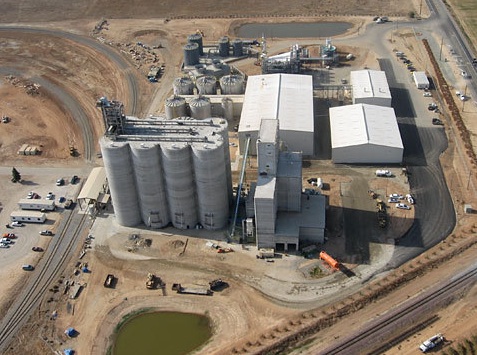
MADERA PE 2014-08-12 at 11.02.34 AMOne of the benefits of cellulosic ethanol is that it reduces greenhouse gas emissions by 85% over reformulated gasoline. Some feel  cellulosic ethanol’s potential is vast noting that the Department of Energy has identified 1.3 billion tons of harvestable cellulosic biomass in the US that could be used to meet more than one-third of domestic transportation fuel demand.

While critics decry mandates for the cleaner burning cellulosic fuel arguing that despite promises – to date there has been virtually none made – Koehler points to an investment of a billion dollars in 3 new Midwest ethanol plants that will make the fuel out of leaves, stalks and corn cobs being funded by major players like Dupont,Poet and Abengoa with production starting this fall, each with at least 25 million gallon capacity.

Now that is happening in California too on a smaller scale with a collaboration that may hit the sweet spot.

Last December Sweetwater Energy and Pacific Ethanol agreed that the the biofuel maker would buy industrial cellulosic sugars from Sweetwater to be produced at a new facility next to one of their ethanol plants. It was originally envisioned to be located at the PE Stockton plant. But in the past week Pacific Ethanol announced the Madera location using ample land the company owns around the their 40 MM gallon facility to build a new plant that will supply the waste based sugar for up to 3.6 million gallons of cellulosic ethanol annually.

“We are in the permitting stage for Sweetwater who will design and build their plant over the next 24 months and be in operation by the end of 2016” estimates Paul Koehler. Industrial sugars are said to 6X as efficient as corn in making ethanol. Koehler says to expect the new plant will employ 20 to 30.

“The Sweetwater platform furthers our initiative in producing next-generation fuels such as cellulosic ethanol while providing additional flexibility in sourcing, reducing feedstock costs and enhancing plant operating margins.” says CEO Neil Koehler.

In a second cellulosic initiative Pacific Ethanol is working with Visalia based Edeniq to use their patented enzyme that would convert corn stover to ethanol,a waste product now that is not used. Koehler adds that which PE plant will use the technology is not yet set.

Edeniq announced just weeks ago that the EPA ruled that corn kernel fiber qualifies as a cellulosic feedstock under the renewable fuel standard (“RFS”) program regulations. This rigorous determination will allow Edeniq’s PATHWAYTM Platform to be used by customers to produce cellulosic ethanol inside corn ethanol plants.

Edeniq’s patented PATHWAYTM Platform combines the CellunatorTM technology with an enzyme cocktail to break down corn kernel fiber, releasing cellulosic sugars into the fermentation process. Corn kernels contain approximately 13% cellulosic fiber that remains unconverted in a typical ethanol plant.
This is how cellulosic ethanol will be made here with so called “Bolt On” technology like Edeniq’s that enables existing corn ethnaol plants to also make ultra low carbon biofuel that fetches a higher price.
“Cellulosic ethanol produced from corn kernel fiber is one of the fastest and most cost-effective ways to improve the efficiency and sustainability of the ethanol industry in the United States,” said Brian Thome, President and CEO of Edeniq.
Edeniq is also working with a Chinese company to do cellulosic over there as well.In July Edeniq and Global Bio-chem said they intend to integrate their technologies in a commercial demonstration plant to produce 50,000 metric tons per year of industrial sugars from corn stover, and subsequently to form a joint venture to further develop and commercialize their technology platform. Global Bio-chem is currently working on modification of corn stover, consisting of leaves, stalks and cobs of corn at its facility in the Jilin Province of China.

More Investment In Madera

Still more; in Madera, Paul Koehler says their are also installing corn oil manufacturing by the end of this year. The process converts a by product into a valuable feed. Koehler also says Madera will install technology to make another feed product – Kornplex – on a small scale and ramping up later. Lastly, Koehler says they are studying possible cogeneration at their plants to make electricity.”We are a steam hog” jokes Koehler, and are exploring various strategies to make power in a state with sky high electricity costs.

All this investment is happening in Madera, a plant that had been idled for five years and was only restarted earlier this year after a major retooling.

Speaking of feed sources PE as well as two other California corn ethanol plants are sharing a energy commission grant
build up a local market to grow grain sorghum as an alternative to corn. Grain sorghum can be grown using less water and on more marginal land.

Return To Profitability

A few days ago PE released their second quarter fiscal results with net sales of $321.1 million, compared to $233.8 million in Q2’13 .Also – record total gallons sold at 132.2 million gallons, compared to 101.2 million in Q2 ’13.

Gross profit for the quarter was $33.6 million, up from $7 million during the second quarter of 2013.The report says” the improved gross profit is a result of significantly improved production margins and corn oil production. Operating income was $29.3 million, up from $3.8 million during the same three months of last year. Net income attributable to common stockholders was $15.3 million, or 68 cents per diluted share. During the same quarter of last year, Pacific Ethanol reported a net income available to common stockholders of $700,000, or 7 cents per diluted share.”

During a call to discuss the results,Neil Koehler noted the company has continued to perform exceptionally well. “The plants are operating at excellent margins, our marketing business continues to grow in both gallons sold and overall margin contribution, and we are reinvesting capital in our core production business to further reinforce our market position,” he said.

The results are a far cry from just a few years ago when this Fresno- born company went bankrupt closing their Madera plant between 2009 to 2014 and had to slowly rebuild to become profitable enabling these types of big dollar investments.

“Ethanol is still the cheapest fuels worldwide by far” boasts Paul Koehler.”That’s true locally as well pointing to a $2.99 a gallon sign for E-85 at a Tulare station this week.

With a big Midwest corn crop coming margins for California ethanol plants are expected to stay strong.

PE is not alone.Cupertino-based Aemetis Inc with a plant in Keyes California reported its operating income for the second quarter of 2014 was $7.8 million, compared to an operating loss of $0.4 million for the same period in 2013.The company also has biodiesel plant in  India and as of June is listed on Nasdaq as ” AMTX”.

Visalia Firm / Chinese Group Plan Bio-Product Joint Venture in China

Unique collaboration will combine leading technologies into a low-cost, commercial platform for converting corn stover to sugars for chemicals and fuels

July16,2014

corn stover
corn stover

VISALIA -Edeniq, Inc. a cellulosic sugar producer, announced it has signed a letter of intent with Global Bio-chem Technology Group Company Limited to develop and commercialize processes to convert corn stover( leaves and stalks) to industrial sugars for use in the production of chemicals, fuels, and other bio-based products.

“We believe our joint venture will offer an industry-leading, low-cost technology platform to biochemical and biofuel producers in China, the United States, and elsewhere, enabling significant market growth for bio-based products.”

Pursuant to the letter of intent, Edeniq and Global Bio-chem intend to integrate their technologies in a commercial demonstration plant to produce 50,000 metric tons per year of industrial sugars from corn stover, and subsequently to form a joint venture to further develop and commercialize their technology platform. Global Bio-chem is currently working on modification of corn stover, consisting of leaves, stalks and cobs of corn at its facility in the Jilin Province of China.

“This relationship with Global Bio-chem will accelerate the scale-up and commercialization of our continuous sugars process and build upon years of technology development at our pilot facilities in California,” said Mr. Brian Thome, President and CEO of Edeniq. “We believe our joint venture will offer an industry-leading, low-cost technology platform to biochemical and biofuel producers in China, the United States, and elsewhere, enabling significant market growth for bio-based products.”

Ms. Xu Ziyi, Executive Director of Global Bio-chem, said: “The Group is a pioneer in using corn stalk as raw material for further downstream processing, and has been working on fully utilizing other corn residues as well. Our collaboration with Edeniq is to focus on enhancing our technology to significantly reduce the production costs of corn stover-based sugar, and to enable us to expand into a variety of bio-based products with such biomass as raw material.”

The collaboration between Global Bio-chem and Edeniq has gained government support. “The Jilin provincial government is pleased to support Global Bio-chem-Edeniq partnership in its goal to develop processes to utilize the millions of metric tons per year of corn stover available in our province,” said Mr. Dawei Liu, Deputy Commissioner of Industry Department, Jilin Province Development and Reform Committee.

California Maintains Regulation of Carbon Intensity Of Motor Fuels

from EIA
July 16,2014
Screen shot 2012-06-09 at 7.35.08 AMThe U.S. Supreme Court has declined to review the Ninth U.S. Circuit Court of Appeal’s September 2013 ruling that upheld the constitutionality of California’s Low Carbon Fuel Standard (LCFS). The court on June 30, 2014 returned the case to a lower court for additional review and the California LCFS remains in effect.
The Ninth Circuit had overturned a finding by a lower court that the LCFS violated interstate commerce laws. The plaintiffs in the case contended that the California LCFS improperly discriminates against fuels produced outside of California and violates the U.S. Constitution’s commerce clause that prevents a state from regulating commerce outside its borders. Plaintiffs included farm groups (the Rocky Mountain Farmers Union and others), biofuels trade groups (Renewable Fuels Association and Growth Energy), and petroleum fuel manufacturers (American Fuel and Petrochemical Manufacturers).
The California LCFS is a state regulation designed to reduce by 10% the average lifecycle carbon intensity of the motor gasoline and diesel transportation fuel pool, including all petroleum and nonpetroleum components, sold for consumption in California from 2012 to 2020. The lifecycle carbon intensity of a fuel is a measure of greenhouse gas emissions associated with producing and consuming the fuel. Increased production and use of low-carbon-intensity fuels, such as renewable diesel and cellulosic ethanol, and petroleum fuels made from less carbon-intensive crude oil is expected to reduce lifecycle carbon intensity. In addition, providers of alternatives to liquid transportation fuels, such as natural gas and electricity, may opt-in to the LCFS program if they meet program requirements.
Fuel providers (generally, petroleum refineries and fuel importers) that sell motor gasoline or diesel fuel for consumption in California are classified as regulated parties under LCFS. These parties are required to report the carbon intensity of the fuels they sell in California and to ensure that such fuels meet regulatory targets. Regulated parties must determine the lifecycle carbon intensity of a particular fuel by calculating it using the CA-GREET computer model or by using a lookup table provided by CARB. Regulated parties that anticipate either under-satisfying or over-complying with the carbon intensity requirements can balance their requirement by trading LCFS credits with other regulated parties.
The LCFS carbon intensity targets for gasoline and diesel become progressively stricter through 2020. For example, using the carbon intensities from the CARB lookup table, the 2014 target for gasoline can be met with a blend of 90% CARBOB (which is a petroleum blendstock for gasoline that meets California specifications) and 10% sugarcane ethanol imported from Brazil. The 2020 target, however, will require gasoline blends made from less-carbon-intensive components, such as cellulosic drop-in biofuel or ethanol made in an extremely energy-efficient production facility.
Because the Supreme Court denied review of the Ninth Circuit ruling, the LCFS will remain in effect pending additional review by lower courts. In the meantime, CARB is proposing to readopt the LCFS in 2014 to implement administrative improvements to the original 2009 regulation. CARB also expects the 2014 readoption to “provide a stronger signal for investments in and production of the cleanest fuels, offer additional flexibility, update critical technical information, and provide for improved efficiency and enforcement of the regulation.”

Valley’s Solar Industrial Park Gets Major Backer

CIM Group Invests In Kings County’s Westlands Solar Park

July 3,2014
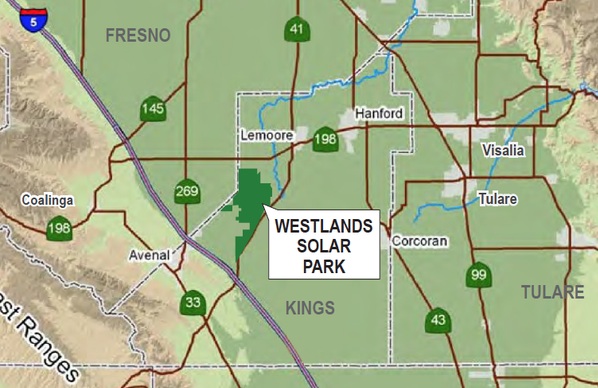
LOS ANGELES—CIM Group announced this week that it has partnered with Westside Holdings, LLC to invest in Westlands Solar Park – a master planned development in a state competitive renewable energy zone that covers 24,000 acres. That’s over 37 square miles of  treeless landscape with little water availability. Laden with selenium and salt from irrigation runoff -it’s a place where nary a critter stirs.

westlands solar park 2014-06-08 at 7.46.57 AMIn a word it may be the perfect place to assemble the power plant of the future.

The drainage-impaired ag lands are in Kings County in the Westlands Water District. Westside Holdings has their offices in Visalia California. The two groups announced a joint venture this week but did not offer details.

CIM may be an unfamiliar name but it is one of state’s largest real estate investment firms with billions tied up in commercial property across the US from Manhattan to San Francisco and LA. They own the former Kodak Theater in Hollywood now named the Dolby Theater where the Academy Awards are held.CIM owns some 1.7 million square feet nearby.The urban real estate and infrastructure investment firm,founded in 1994, has over $14.7 billion in assets under management according to their website.

CIM Group through it affiliate, SkyPower is also one of the largest developers of solar energy projects in the world with a portfolio of  1500 mw of solar projects in Canada and a $5 billion project in Africa.
Through several joint ventures SkyPower claims to have 25,000mw of solar projects in the pipeline and existing contracts with utilities worth $4 billion according to their website.

With little future as farm land – Westside Holdings has been working to master plan their land just east of Hwy I-5 since 2009 pushing to get regulators and the utilities to consider this mid-state location astride the state’s major north south transmission line.It is the right place, they argue, to build up to 2,400 MW of photovoltaic power over the next 10 or so years. It would be one of the world’s largest solar farms generating enough power to rival Diablo Power nuclear plant but without the negative baggage. The scale of what could happen at this one location has clearly intrigued the CIM people, a group founded by two former Israeli paratroopers.

City of Anaheim Commits

While the plan to build is phased over a long term – the solar park will get its first project next year at Avenal Cutoff and Ave 25 with phased construction of a 2MW project followed by a 20MW solar farm. The power for the first phase is being bought by the City of Anaheim the city confirmed this week, with the first current to be delivered in September 2015. So says Anaheim Assistant Manager for utilities Steve Sciortino. ”We are really excited about the purchase of what could be even more renewable power coming from the Fresno area.”   The city needs 700MW of power to keep the community, including Disneyland, lit up, with demand coming on strong right when the sun shines the most – summer. ”Like all utilities we need to keep buying more renewable power to comply with SB 32 and solar shines brightest in summer – when we need the peaking power.”

To build long term the Westland Solar Park EIR draft will continue to move forward.

No Mitigation Needed

Just where power projects get built in the state has been a thorny issue for years. While some developers favor the sunnier desert area – a number of key environmental groups object. Farm groups on the other hand have raised questions about building utility-size solar on prime Valley ag land. No such worries here.  Westlands Solar Park has built a coalition supported by local, statewide and federal environmental interests as well as farming groups. With few issues ,permitting will be quicker,challenges will be nil making financing easier.

One major advocate is Carl Zichella,Director of Western Transmission for the environmental group NRDC. Zichella representing NRDC along with the group Nature Conservancy are among those who have lobbied energy regulators to look at the Westland Solar Park model to build out this energy farm on “arguably the least environmentally sensitive place in the state”and yet creating opportunities “in one of the most economically distressed parts of the state” says Zichella.

Zichella adds that the state will need to approve more transmission coming from this area because this energy crossroads is already clogged.

With the news that CIM Group will be investing in the project Zichella says“this substantial financial backing is very big step toward making this happen.” He says he and others have been having conversations with the Brown administration who may also weigh in to support the Westlands Solar Park plan.

Zichella says he believes with a major backer in place another new trunk line up the spine of the westside could encourage development since power can be shipped off.

While the new partnership may set the stage – it will be the major players like SunPower and First Solar for example who will build the plants as they already doing nearby. PGE is erecting a local substation on the same Avenal Cutoff this summer.

For eastside Valley residents the Avenal Cutoff from NAS Lemoore is a favorite back road to the coast enabling you to watch the progress of solar panel construction over coming years as you head to the beach to cool off.

Sales of Fossil Fuels Produced from Federal and Indian Land Decline

June 20,2014

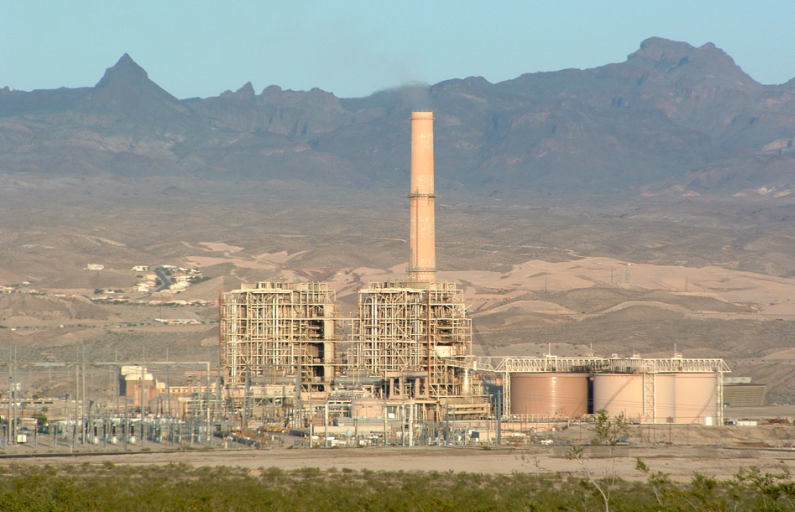
Nevada Coal plant
Nevada Coal plant

The US Energy Information Agency reports that total sales of fossil fuels from production decreased by 7% during fiscal year (FY) 2013.
Crude oil production on federal lands increased slightly in FY 2013, but that increase was more than offset by decreases in coal, natural gas, and natural gas plant liquids (NGPL) production.
Coal represented 51% of fossil fuel sales from production on federal lands in FY 2013, measured in common Btu units, followed by natural gas (25%), crude oil (22%), and NGPL (2%).
A 9% drop in federal onshore natural gas production, with most of that decrease in Wyoming.
A 9% drop in coal production.
Wyoming and the federal Gulf of Mexico together produced 73% of the federal and Indian lands fossil fuels total in FY 2013.

California Investing Millions to Build Hundreds of EV Charging Stations


Awards will also fund innovative natural gas fuel tank and filter system for wastewater treatment

June 20,2014

Getting charged up in SLO

SACRAMENTO – The California Energy Commission approved funding for cutting-edge clean energy projects at its monthly business meeting yesterday, including money for hundreds of electric vehicle charging stations, an innovative natural gas fuel tank, and emerging but proven technologies that are ready for the marketplace.
Electric Vehicle Fueling Infrastructure
To continue building the infrastructure needed to charge California’s growing number of electric vehicles, the Energy Commission approved 15 grants totaling more than $5 million to install 475 electric vehicle chargers in communities throughout California, including the cities of San Francisco, Burbank, Torrance and San Diego and the counties of Ventura, Santa Barbara, San Luis Obispo, Orange, Riverside and Los Angeles. These grants are funded by the Alternative and Renewable Fuel and Vehicle Technology Program (ARFVTP).
“The Alternative and Renewable Fuel and Vehicle Technology Program continues to support California’s goal of 1.5 million zero-emission vehicles on the road by 2025,” said Commissioner Janea A. Scott. “These community investments assist in building the network of charging stations needed, and help accelerate growth in the electric vehicle market.”
Natural Gas Advancements
To develop and demonstrate an advanced natural gas storage tank for light-duty vehicles, the Energy Commission approved a $1.2 million contract with BlackPak, Inc, funded by the Public Interest Energy Research (PIER) natural gas program. BlackPak plans to build a storage system from carbon materials that will allow natural gas to be stored at a lower pressure. The system would reduce complexity and cost. The material can be easily formed into a range of shapes, allowing designers to integrate the storage system into a vehicle’s design without sacrificing passenger space. The award provides financial support to develop a prototype of the technology, building upon funding provided by the Advanced Research Projects Agency-Energy (ARPA-E) for early research and development. The Commission also approved PIER grants to develop natural gas plug-in hybrid vehicles to Transportation Power Inc., Efficient Drivetrains Inc., and Gas Technology Institute for $900,000 each.
“Developing alternative and cleaner transportation fuels and technologies are essential if California is to achieve its long term greenhouse gas reduction goals” said Chair Robert B. Weisenmiller “Our federal partners, including ARPA-E, are key players in advancing these initiatives.”
Emerging Technologies
The Energy Commission approved $4.4 million in PIER grants for proposals demonstrating emerging energy efficiency technologies that are past the “proof-of-concept” stage and ready to be demonstrated in an industrial setting under “real-world” conditions. Grants include funds for:
A novel infrared technology for dry blanching fruits and vegetables on a commercial scale that is up to 40 percent more energy efficient compared to methods currently used to produce crisp fruit and vegetable snacks.
A filtration system for wastewater treatment that uses a chemical reaction instead of the current energy-intensive processes.
A combustion system that uses an energy-efficient low-swirl burner that can switch between natural gas, propane and biogas in real time — which could make use of biogas from small source generators economically viable.
Also approved at the business meeting:
Solar Photovoltaic (PV) System: A $2.3 million loan for South El Monte to install solar PV systems at city-owned facilities. Each year, the project is expected to produce a million kilowatts of electricity, reduce greenhouse gas emissions and save the city approximately $135,000 in utility expenses. The loan is funded by the Energy Conservation Assistance Act.
Biodiesel: A $5 million ARFVTP grant was approved for Crimson Renewable Energy. The money will be used to upgrade equipment at its existing facility and increase biodiesel production from 17 million gallons to 22 million gallons a year.
Alternative Fuel Readiness Plans: The Commission also approved two more ARFVTP projects to help various regions of the State develop strategies for the deployment of alternative fuel infrastructure.
View all items that were on the June business meeting agenda.