
 Thinning a forest of woody materials has multiple objectives. It can increase the resiliency of the remaining trees from the effects of fire, drought, pest and disease; it can improve habitat quality for wildlife including watersheds; and it can make it easier for firefighters to protect human lives and livelihoods when a fire is burning.
There are several ways thinning is carried out: cable logging, feller bunching, conventional tractor skidding, hand-thinning and piling, and mastication. One of the issues with thinning is the disposal of biomass that is non-merchantable (e.g., branches, tree tops, small diameter trees). Typically this material goes into large slash piles. For the most part, these piles are left in the forest to break down naturally under winter rain and snows, and are later burned. Because of strict air quality rules, forest managers have very small windows of opportunity to burn these piles, so they are often left on the landscape for many years, sometimes becoming a fire hazard themselves.
Forested communities are searching for ways to deal with this residual biomass that will improve the health of the forest ecosystem; improve and protect critical watersheds and wildlife habitat; reduce the amount of air pollution by removing the piles instead of burning them; and reduce the critical fire danger to their communities.
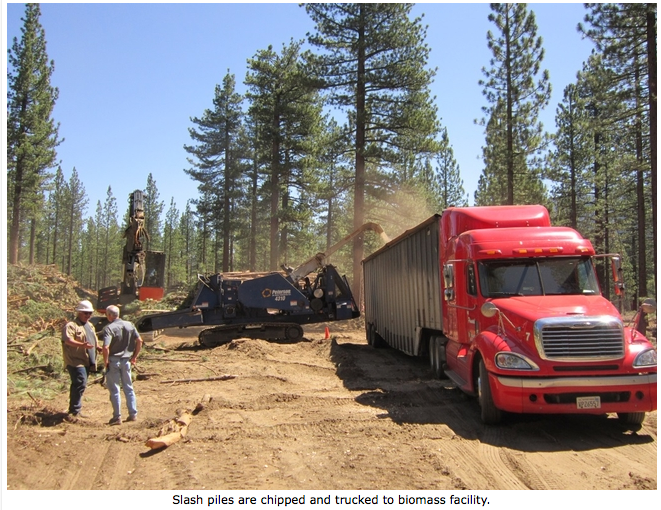
The Placer County Biomass Program is taking up this challenge by chipping the slash piles and trucking the chips to a biomass facility to be converted into electricity.
Outside of Foresthill, Calif., the Tahoe National Forest American River Ranger District and the Sierra Nevada Adaptive Management Project (SNAMP) have been collaborating on a study of forest fuels reduction treatments carried out on national forests.. Local contractors are hired to grind the material on-site, load the material into chip vans, and bring the material to market within 60 miles of the Last Chance site to create green, renewable electricity.
Placer County estimates that roughly 3,000 Bone Dry Tons (BDTs) of biomass can be removed. According to UC researchers, one BDT burned in a typical commercial boiler fuel will produce 10,000 pounds of steam and 10,000 pounds of steam will produce about 1,000 horsepower or generate 1 megawatt hour (MWH) of electricity.
The economics of this project will be used as part of the assessment of locating a biomass energy facility in the Foresthill area. The removal of these biomass piles will greatly reduce the possibility of catastrophic fire to the local communities on the Foresthill Divide.
The improved forest and watershed health will be noticed by the local community and the surrounding county which derives recreation and watershed benefits from the American River area. In addition, several tons of air pollutants will be avoided by removing the pile burns from this area which is currently a federal non-attainment basin that carries both business and health risks to the local population.