More Tulare County Dairies To Pipe Biogas To Hwy 99 Plant

New Valley Biodiesel Plants In Works

April19,2017-
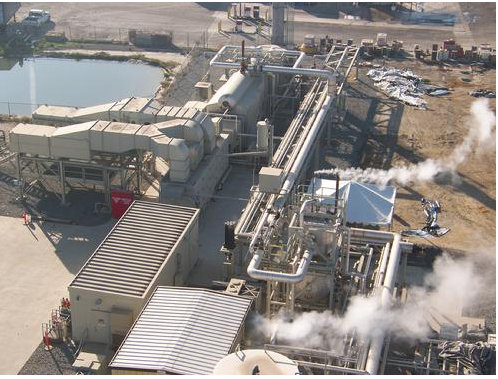
Screen Shot 2017-04-18 at 12.24.44 PMCalgren Renewable Fuels is permitting some 20 miles of new pipeline in Tulare County to connect Pixley-area dairies to Calgren’s biofuel production plant on Hwy 99.

Calgren president Lyle Schlyer says the company currently connects to just one dairy but will increase biogas volumes by as much as 20 times when the project connects to a number of nearby dairies up to several miles away by the end of 2017 and into next year.

The biogas, collected from covered lagoons at dairies, is both a problem for the diaries and “an opportunity for both of us” adds Schlyer – replacing fossil fuel natural gas for the boilers at the Calgren plant with biogas “lowering our carbon footprint.”

“This is the kind of project people talk about but we are going to get it done” says the Tulare County biofuel maker.

California dairies are under the gun to reduce their methane emissions with some operators looking to spend money for expensive on-site dairy digesters. But this approach to fighting climate change allows dairy operators to export the stuff to a much larger digester at the Calgren plant, allowing them to concentrate on what they know best- milk production.

Schlyer says the gas will be used at the plant for cogeneration, making electricity along with making ethanol. He says the firm is interested in other possible uses for the gas as a transport fuel, for example.

Biodiesel Plant In Works

Calgren is also building a $9 million biodiesel plant at their site using some $3.5 million in grant monies from the California Energy Commission (CEC) to help to pay for this new renewable diesel facility. Like the ethanol they produce the new biodiesel fuel will be sold into the Fresno market.

Schlyer says the plant will test new technology enabling them to handle tougher greases,difficult to process for most biodiesel producers.

Schlyer says the 5.4 million gallon biodiesel plant should be operating by years end. The waste heat from the biodiesel plant built on half an acre will be used at the plant making the whole operation more efficient says a state report.

The CEC is funding several other Valley biodiesel plants this year including two at the Lost Hills Wonderful nut processing plants using shells as a feedstock and in Bakersfield at the state’s largest biodiesel plant run by Crimson Renewables.

The CEC its also funding another dairy biogas collection concept in Kern County with 15 dairies supplying 1 billion cubic feet of biogas a year to a central digester plant.

The dairy industry in the Valley blasted the state for implementing the tougher rules on methane reduction – but now some good could be coming out of it.

Last year Jerry Brown signed a law aimed at cutting methane emissions from cattle operations, thought to be the largest source of heat-trapping methane in the state, mostly from dairy manure.The new law requires the livestock industry to cut methane emissions to a 40 percent of 2013 level by 2030. The state Air Resources Board mandates that 75 percent of the cut needs to come from the state’s dairies.

SLO Offshore Wind Forum Planned For April 13

March 29,2017-
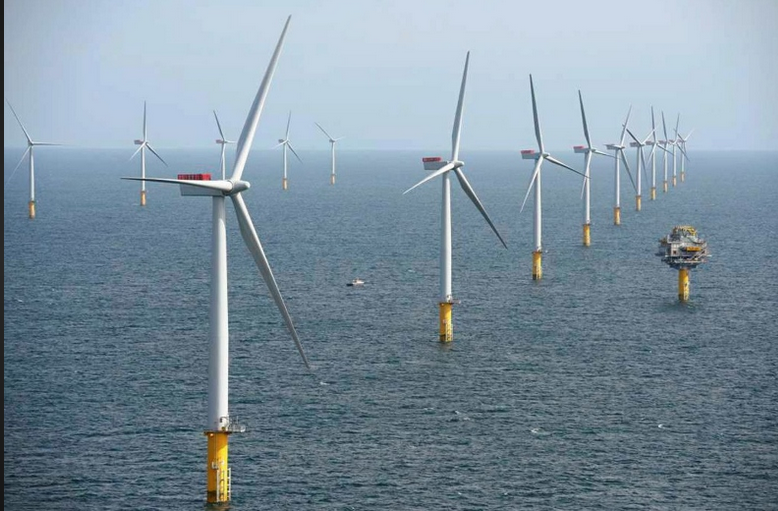
Screen Shot 2017-03-29 at 4.01.02 PMAt the invitation of California’s San Luis Obispo (SLO) County, the U.S. Department of Interior’s Bureau of Ocean Energy Management (BOEM) will join the State of California in sharing information on current planning activities for possible offshore wind development along California during a public information meeting on offshore wind energy on April 13, 2017 in San Luis Obispo, California. SLO County Supervisors Bruce Gibson (2nd District) and Adam Hill (3rd District) will host the meeting.

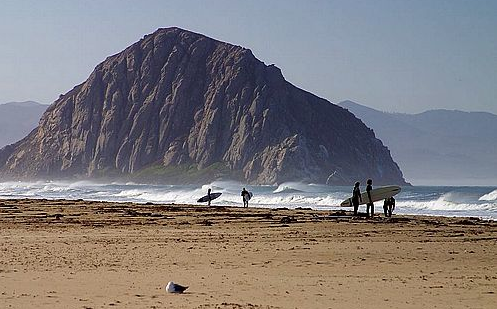
The forum will be held as two companies vie to build a multi-million dollar project off the Central Coast near Morro Bay. The two firms competing to lease the same offshore lands from BOEM are Trident Winds and Norway-based Statoil.

In October 2016, BOEM and the State of California convened the BOEM California Intergovernmental Renewable Energy Task Force (Task Force), a partnership of federal, state, local agencies and tribal governments, as a forum to provide information to the decision-making process for planning future offshore renewable energy development in federal waters offshore California.

BOEM and the State of California are currently gathering environmental information and ocean use data for the entire coast of California to inform the offshore wind planning process. Initial emphasis for this effort is on California’s Central Coast region due to viable wind energy resources, current commercial interest by offshore wind developers, and available existing transmission infrastructure.

SLO County Supervisor Gibson invited representatives of the Task Force to attend and share information about offshore wind planning activities with the local community. To that end, BOEM and the State of California will provide information on the planning timeline, discuss additional opportunities for public participation throughout the process, and provide a demonstration of the Data Basin Portal, a web-based spatial planning tool that will be used to collect and share information on offshore uses and resources that will inform future decision making. In addition, the public will have the opportunity to provide input and ask questions of the Task Force representatives.

This meeting is scheduled for:
Date:        Thursday, April 13, 2017
Time:        6:00 pm – 8:30 pm
Location:  San Luis Obispo County Government Center
Board
Chambers
1055 Monterey Street, Room D-170
San Luis Obispo, CA 93408
More information on the Task Force can be found a https://www.boem.gov/California/.
SLO County Supervisor Bruce Gibson represents the Second District which extends along the California coast from the Monterey County line in the north and past the City of Morro Bay and portions of the City of San Luis Obispo in the south.
SLO County Supervisor Adam Hill represents the Third District which extends along the California coast from Grover Beach in the south to areas northwest of Avila Beach.

Record precipitation, snowpack in California expected to increase hydro generation in 2017

March23,2016-

According to data from the California Independent System Operator (CAISO), the grid operator for much of the state, hydro generation in the CAISO service area so far in 2017 has been double that over the same period of 2016. Over the same time, natural gas generation has been down nearly 20%.

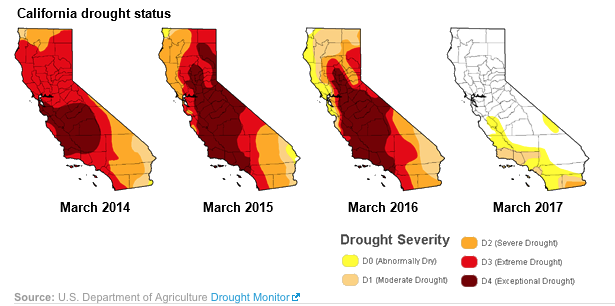
Screen Shot 2017-03-23 at 12.56.52 PMFor the first time since 2011, California’s drought is significantly weakening—a result of one of the wettest winters on record. California has experienced record levels of precipitation this winter, and unlike last winter, cooler temperatures over the 2016–2017 winter season have enabled the precipitation to build up snowpack (the total accumulated snow and ice on the ground). High precipitation and snowpack levels, both of which supply hydroelectric generators throughout the year, suggest that hydroelectric generation in California in 2017 will significantly exceed 2016 levels.
Although the drought state of emergency declared by California authorities in January 2014 is still in place, drought conditions have noticeably improved, and the northern half of the state is no longer classified in any stage of drought severity. The area of the state classified as being in exceptional drought (D4), the most extreme category, has dropped to zero, a significant improvement over the 40% and 35% of the state’s land area classified as being in exceptional drought in March 2015 and 2016, respectively. However, 8% of the state—mostly regions in the south—is still in a moderate drought (category D1) status or worse. Mandatory water restrictions, enacted for the first time in the state’s history in April 2015, remain in effect in California. State officials are expected to wait until the full winter season ends in April to amend or rescind the state’s emergency drought declaration.
Snowpack levels have increased significantly from the near-zero levels measured in the Sierra Nevada Mountains in April 2015. As of March 21, 2017, the California Department of Water Resources reported that statewide snowpack was 158% of normal for that date. A more important metric when considering snowpack is the snow water equivalent (SWE)—the total amount of water contained within the snowpack. California’s SWE levels have noticeably increased this year, and as of March 21, the California Department of Water Resources reported that the statewide snow water equivalent was also 158% of average for that date.

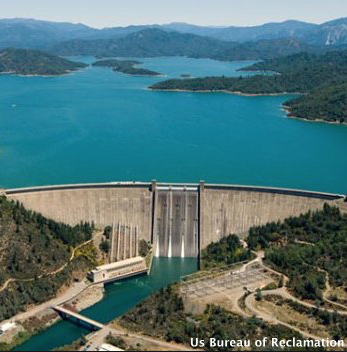
Screen Shot 2017-03-23 at 1.01.58 PMSnowpack and SWE are strong drivers of hydroelectric generation because runoff from melting snowpack feeds hydroelectric plants in the spring and summer months. California’s hydroelectric generation increased through most of 2016, especially toward the end of the year. Total 2016 hydroelectric generation in California was well above the 2013–2015 range and was nearly as high as the longer-term, pre-drought generation average over 2001–2010. High levels of SWE from the 2016–2017 winter suggest increases in hydroelectric generation in California later in 2017.

Source: U.S. Energy Information Administration, Electric Power Monthly, and California Department of Water Resources
Note: California snow water equivalent data for March 2017 is based on a partial set of monthly data.

Decreasing hydroelectric generation in California in recent years has been offset by increasing natural gas, wind, and solar generation. An increase in hydroelectric generation could decrease reliance on generation from other sources, particularly natural gas-fired generation, potentially helping to mitigate the ongoing limitations at the Aliso Canyon natural gas storage facility in Southern California. According to data from the California Independent System Operator (CAISO), the grid operator for much of the state, hydro generation in the CAISO service area so far in 2017 has been double that over the same period of 2016. Over the same time, natural gas generation has been down nearly 20%.

Kings County Getting First Battery Storage Plant

March15,2017-

“The future is going to overwhelmingly be solar plus battery. They go together like peanut butter and jelly.”
-Elon Musk

Screen Shot 2017-03-14 at 1.33.16 PM


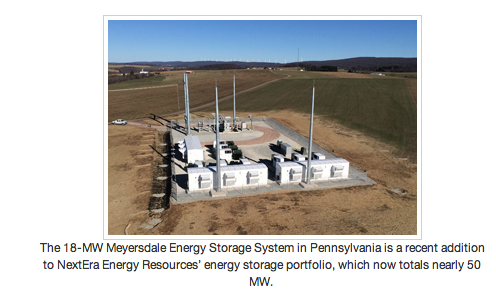
Kings County is processing a conditional-use permit to build a 20-acre, six phase battery storage facility, designed to work with nearby utility-size solar plants to save and deliver electric power to the grid in morning and evening hours. The logic of storage technology – one can save energy you produce for when it is needed the most. It works when the wind does not blow or the sun does not shine.

The California PUC has mandated that utilities contract to buy 1,325 MW of battery storage by 2020, and some of it right now. PG&E has awarded a contract to NY-based Convergent Energy for 10MW of DC powered batteries that will be set up at a site near the Henrietta substation near Lemoore, that is already surrounded by a sea of solar farms.

Criss-crossed by major transmission lines and popular with solar farm developers, Kings County is likely going to get more of these next generation of renewable energy facilities in coming years.

Henrietta D Energy Storage LLC, is a 10-MW distribution-connected,stand-alone zinc-air battery energy storage resource with a discharge duration of four hours. It will be located at 16885 25th Ave, near NAS Lemoore. The expected initial delivery date is May 1, 2020, with a term of 20 years.

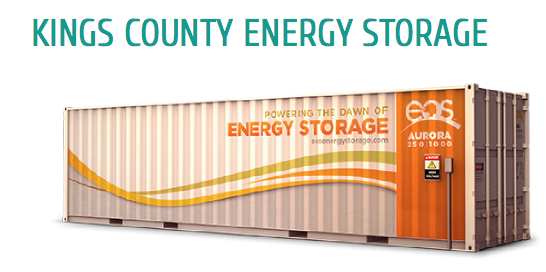
While the first phase of the project is a modest 10 megawatts, the conditional permit calls for up to 187 megawatts, some 760 boxcar-size power units, that will look like a white city from the Avenal Cutoff highway.

Kings County has been a hotbed of solar activity in the past few years with more coming. That includes several large Recurrent Energy solar farms near this proposed battery plant including the new NAS Lemoore 167MW solar facility on 930 acres at the base. In a nod to defense security, the Navy has favored battery storage technology for the base, home of the F-35C Joint Strike Fighter, to be more self-sufficient and to insure the lights stay on – even if the grid goes dark.

Convergent Energy spokesman Frank Genova, the firm’s CFO, says they have “big plans for the expansion of this site that will depend on how fast demand increases” for stored energy in the area. Genova says “technology improvements and increased production has driven battery costs down,” helping to spur moire installations, particularly in California.The oil and offshore renewable energy giant Statoil, recently made a large equity investment in Convergent.

Clearly falling prices are helping with one source saying the price of lithium ion batteries dropped 90% between 1990 and 2005, and has continued since. Meanwhile California has been the most aggressive at utilizing the new technology to help replace power from the shuttered San Onofre nuclear power plant, and coming soon- Diablo Canyon.

Helping to drive down the cost for batteries has been the construction of the Elon Musk-inspired Tesla Gigafactory in Nevada that opened in December. Tesla has been behind the opening of a new 80MW battery storage facility for SCE located near LA that fired up last year. It helped replace power lost from the big natural gas leak at the Sempra Energy’s Aliso Canyon storage facility in 2015 that backed up intermittent power from wind and solar farms.

Battery storage is only one type of storage technology. Pumped hydro has been used by PG&E in Sierra at the huge Helms plant for decades to store and release power when needed, moving water uphill when it is cheap at night.

In related news, PG&E also has announced it would contract with Amber Kinetics to build 20MW, four-hour duration Gen-2 Flywheel Systems. The company says it believes its steel flywheel technology will drive down pricing while enhancing operational safety and flexibility for utility-scale energy storage Until now, commercial flywheel system capabilities were measured in minutes, with limited usefulness to electric utilities seeking to integrate renewable energy at transmission and micro-grid levels.

Amber Kinetics’ technology offers critical advantages over batteries, says the firm. Even with unlimited cycling during their 30-year lifespan, the systems have no degradation. Because they are 98% steel by weight, they pose no risk of fire, chemical explosion or hazardous materials release. Most important, because they are manufactured from readily available, abundant raw materials and don’t need replacement at regular intervals, they are significantly more cost effective than batteries.

Energy Nuevo, Amber Kinetics’ 20 MW project located in the city of Fresno, was selected by PG&E in California’s first energy storage solicitation. It is believed to be one of the largest ever for a transmission level flywheel system. Energy Nuevo will provide energy storage beginning in 2020.

Also PG&E selected Hecate Energy for a 1MW lithium ion energy storage facility at the old Kearney substation.


Watch Out Below – Oil Prices Fall

March 9,2017-
Oil prices fell about 1 percent March 9, the biggest drop this year. Record U.S. crude inventories added to fears of a global glut on world oil markets.

Crude oil stocks in the United States surged last week to 528.4 million barrels, an all-time high and up 8.2 million barrels . Inventories are almost 8% higher than last year.

So far in 2017 the EIA says gasoline supplied is 5.4% lower versus 2016.

Even though we are using less gasoline – oil prices have been rising on the expectation that the US economy and the world would be using more oil.

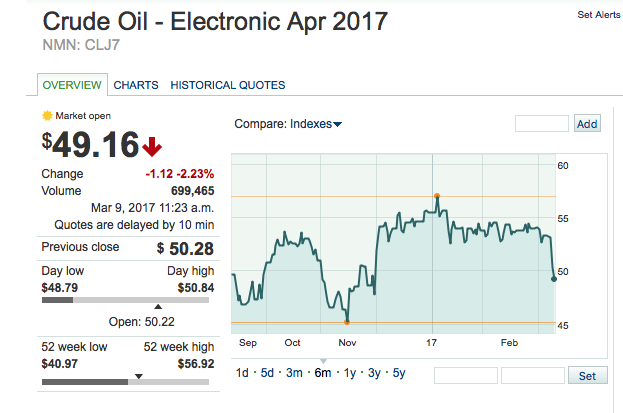
Screen Shot 2017-03-09 at 8.33.17 AMSentiment in the oil patch was bullish with the election of Donald Trump helping to push WTI oil prices up to the $55 level since the election from around $45.( see chart)

In the past few days oil has plunged to below $50 and “speculators are heading for the exits” according to press reports.

Trump has vowed to deregulate the oil and coal industries with the expectation this would help increase production and encourage the industries to hire more workers But that will work only in a rising price environment. Adding more oil to a to a satiated market is no unlike adding kerosene to a fire.

Baker Hughes says the US rig count was 392 a year ago but has increased 7 weeks in a row to 609.

While production is up in places like Texas the EIA says the largest production decline in 2016 on a percentage basis occurred in the Federal Offshore Pacific, where production declined 44% in 2015, due in part to a pipeline disruption in May 2015. Think Refugio were the pipeline connect to the offshore rigs is still shut down.

U.S. wind generating capacity surpasses hydro capacity at the end of 2016

March9,2017-
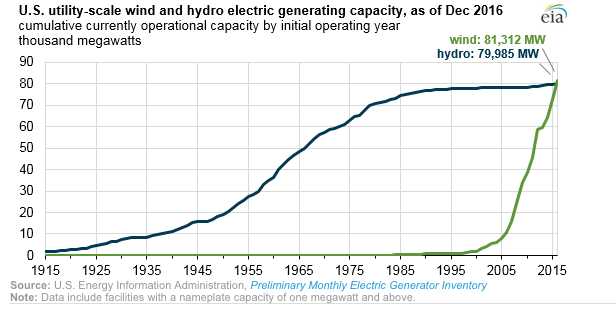
Screen Shot 2017-03-09 at 2.34.45 PMInstalled wind electric generating capacity in the United States surpassed conventional hydroelectric generating capacity, long the nation’s largest source of renewable electricity, after 8,727 megawatts (MW) of new wind capacity came online in 2016. However, given the hydro fleet’s higher average capacity factors and the above-normal precipitation on the West Coast so far this year, hydro generation will likely once again exceed wind generation in 2017.

Wind and hydro generation both follow strong seasonal patterns. Hydro generation typically reaches its seasonal peak in the spring and early summer, especially in the Pacific Northwest and California where about half of U.S. hydropower is produced. Across most of the country, wind generation typically peaks in the spring with a smaller peak in late fall and early winter. The Pacific Northwest and California have a slightly different seasonal pattern for wind resources, with generally only one peak in the early summer.
In the Southwest Power Pool (SPP) electric system, which extends from northern Texas to North Dakota and Montana, wind power recently supplied more than half of the system’s generation mix for a brief period, reaching 52.1% (11,419 MW) in the early hours of February 12, 2017—a first for any of the seven U.S. regional transmission organization (RTO) electric systems that together serve two-thirds of the country’s electricity consumption.
The Electric Reliability Council of Texas (ERCOT) system which covers most of Texas continues to set records for the highest level of wind generation on any U.S. electric system. ERCOT’s most recent record of 16,022 MW occurred on the morning of December 25, 2016, and accounted for slightly more than 47% of the generation mix at the time.

Dynegy Drops Plan For Morro Bay Wave Energy Farm

January 20,2017-

Screen Shot 2017-01-20 at 11.32.11 AMHouston-based Dynegy has dropped plans to build a wave energy farm off the coast of Central California near Morro Bay. The energy company, who owns the mothballed power plant in Morro Bay, filed a notice with the federal government a few months ago.The Federal Energy Regulatory Commission (FERC) said in two October 4 notices that the company decided to drop preliminary permits issued by FERC in 2014 for two wave energy projects in the Pacific Ocean off of California.
Under Project No. 14584, Dynegy Point Estero Wave Park LLC had proposed the Point Estero Wave Park Project.

Withe this news and the decision by the Department of Energy not to fund a $40 million CalPoly wave energy test project off Vandenberg – the ocean off the Central Coast still has two companies considering construction of an offshore wind farm near Morro Bay.

The federal Bureau of Ocean Energy Management (BOEM) is working with both Trident Winds and Statoil on a possible lease of lands offshore in federal waters.

Colony Energy Appeals To Tulare Council On Biogas Project

January 18,2017l

screen-shot-2016-12-06-at-7-51-56-amThe Tulare City Council heard an appeal from Colony Energy to take a second look at its proposed biogas project after the past city manager and staff balked at moving forward with the LA based firm. Managing partner Kent Hawkins will be making a presentation January 17 to the council including new members, about the advantages for Tulare moving forward with renewable energy project. Partner Matt Schmidt says will offer evidence of financial ability including a joint appearance by their equity partner bringing $10 million to the table. That would be added the $8 million in state grants in place to build the $23 million renewable energy project says a memo to the city.
City Public Works Director Joe Carlini has supported a plan to back a rival proposal from Fuel Cell Energy has last summer.
Colony says they have promised $1 million in annual revenue for the city once the project is operating. Revenue would come in part from sales of the flared gas at the WWT plant that now is wasted.

After the meeting this week the council is said to be interested.

Energy Storage Could Save Visalia $3 Million

January 18,2017-

Screen Shot 2017-01-18 at 3.33.27 PMA potential energy storage project could earn the City Of Visalia $3 million over 15 years and provide an additional 5 megawatts of power availability to the Water Conservation Plant. The Visalia City Council is expected to approve a plan to apply to SCE to lower city costs by reducing demand when power is most expensive. The energy firm NextEra proposes that they would make all of the investment that is needed that could include batteries promising to maintain the equipment and share the electrical savings in exchange for allowing NextEra to make the investment.One technique being used by a manufacturer  has the company’s  air conditioning devices make ice at night and use that ice to lessen the electricity demand during the day. The proposal is due at the end of January and would be non-binding. SCE is expected to take 60 to 90 days to select which proposal they would like to accept. The Water Conservation Plant is a major consumer of electricity.