Will gasoline prices drop with oil’s plunge?

-March 9,2020-

Gasoline futures are down around 80 cents today from a January high but there is some doubt you will see the same kind of  savings at the pump any time soon.

In our reading areas the cheapest price in Visalia is $2.86 at Costco and $2.55 a gallon at several Farmersville stations.

Screen Shot 2020-03-09 at 11.43.25 AMThe average gasoline price in San Luis Obispo is $3.67 a gallon  and $3.35 statewide – all priced before oil collapsed this Sunday/Monday .

Gas Buddy notes that when the global markets opened on Sunday evening, West Texas Intermediate (WTI) crude oil prices dipped below $30/bbl for the first time since 2016. The market plunge is in response to a lack of agreement between Organization of the Petroleum Exporting Countries (OPEC) and non-OPEC countries to cut production. The trend of pump prices facing downward pressure is likely to continue through the end of the winter driving season if crude remains cheap, especially amid concerns about the coronavirus.

Oil had been near $60 a barrel and now it is trading at $31 a barrel mid-day Monday.

A year ago California gas averaged $3.19 when oil sold for $63 a barrel. Gas sold for $2.80 a gallon in March 2017 when oil was $49 a barrel.

Today Chevron’s Kern crude oil price is $40 a barrel March 9 and likely to be in the $30s tomorrow. That ought to take the average fuel price in California in the next week plunging well below $3 statewide. We will see if it happens.

The last time gasoline was consistently below $3/gallon in 2016 when the average oil price was in the mid-$40s. Given oil’s new reality,  how about we see $2.50 gallon gas at my neighborhood filling station.

Energy Briefs

-February 17,2020-

WSJ–  Can Solar Power Compete With Coal? In India, It’s Gaining Ground- Electricity from sunlight costs less, a hopeful sign for developing nations building out their power grids

BHADLA, India—In a dusty northwest India desert dotted with cows and the occasional camel, a solar-power plant is producing some of the world’s cheapest energy.

Built in 2018 by India’s Acme Solar Holdings Ltd., it can generate 200 megawatts of electricity, enough to power all the homes in a middle-size U.S. town. Acme sells the electricity to distributors for 2.44 rupees (3.4 cents) a kilowatt-hour, a record low for solar power in India, a country that data trackers say has the world’s cheapest solar energy.Electricity from sunlight costs less to generate in India than from coal, a sign the clean-energy source will play a big role as developing nations build out their power grids. A driving force: China’s plunging solar-panel prices. 

Washington Post: Regulatory relief over mercury emissions? No Thank You says industry

Screen Shot 2020-02-17 at 1.12.47 PMFor more than three years, the Trump administration has prided itself on working with industry to unshackle companies from burdensome environmental regulations. But as the Environmental Protection Agency prepares to finalize the latest in a long line of rollbacks, the nation’s power sector has sent a different message:

Thanks, but no thanks.

Exelon, one of the nation’s largest utilities, told the EPA that its effort to change a rule that has cut emissions of mercury and other toxins is “an action that is entirely unnecessary, unreasonable, and universally opposed by the power generation sector.”

Kathy Robertson, a senior manager for environmental policy at the company, said the industry long ago complied with the rule.

AAA – PUMP PRICES DOWN : Since Monday Feb 10, the national average for a gallon of regular unleaded gasoline has decreased by a penny to $2.42. New data from the Energy Information Administration (EIA) helps to explain why: total domestic gasoline supplies remain high while demand remains low. For total domestic supply, although it took a minor step back by 100,000 bbl last week, it is still 2.7 million bbl higher than 2019’s level at this time. A higher stock level and lower demand – which EIA estimates fell from 8.93 million b/d to 8.72 million b/d last week – have helped to push pump prices lower across the country. These trends will likely continue through the end of the week and help to push pump prices lower.

The cheapest price for gas is again in Lemoore California selling regular for $2.52 a gallon at some places in town.

Nation’s largest solar farm planned south of Porterville

-February 17,2020-

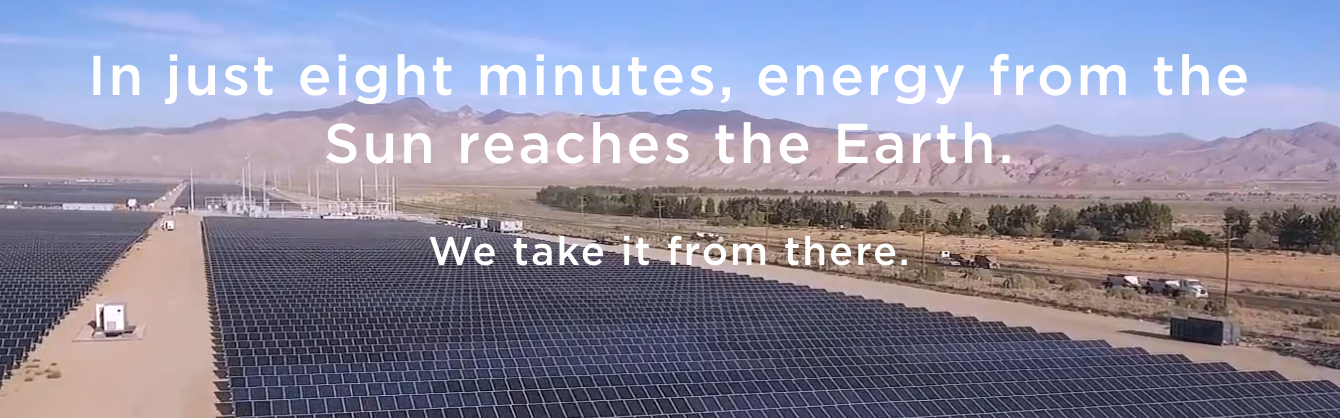
The nation’s largest solar farm is in the works to be built south of Porterville. The big facility would be erected on farmland that is in the area of water deficits, perhaps a glimpse of the future for some marginal ag land here.

Tulare County released a Notice of Preparation (NOP) Feb 14 announcing the big renewable energy project.

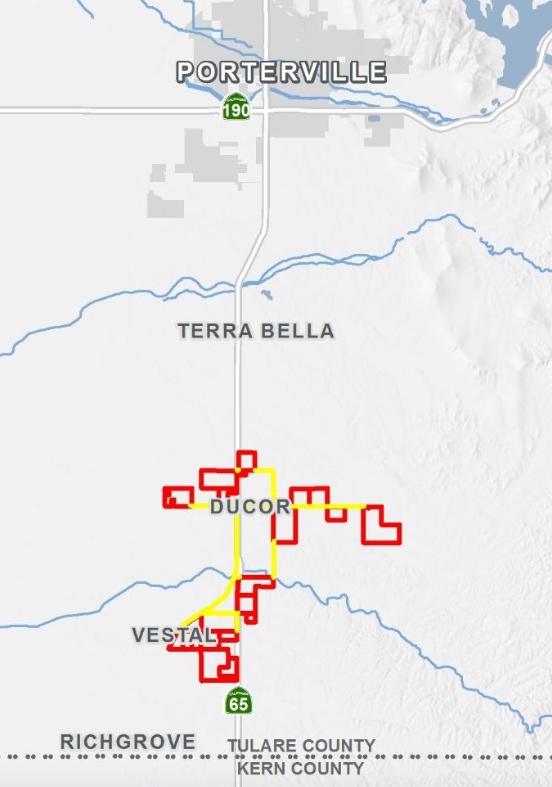
solar map 2020-02-15 at 6.43.35 AMBuilt on 3800 acres scattered near the town of Ducor, the Rexford Solar Farm will be rated at 700MW in addition to 700MW of energy storage. The solar arrays would eclipse the state’s biggest solar farm in San Luis Obispo – the 550MW Topaz facility built in 2011.

The solar farm is being proposed by a partnership that includes privately-held 8 minutenergy of Los Angeles who owns several large utility-scale solar farms in the West including 4 in Kern County. The company say they have a portfolio over over 14,000 megawatts including the 260 MW Mount Signal Solar Farm in Imperial County. It was founded by Tom Buttgenbach and Martin Hermann in 2009.

Last year the company signed a 25 year agreement to provide electricity to Los Angeles Department of Water and Power.

Rexford Solar Farm’s electricity would be transmitted to the Southern California Edison (SCE) Vestal Substation via an up to 230 kilovolt (kV) overhead and/or underground gen-tie line. The proposed transmission and/or collector lines would extend along existing roadway rights-of-way from various portions of the Project site (where substations are located) ultimately connecting to the Southern California Edison Vestal Substation. The transmission and/or collector lines would be located along portions of Road 232, Avenue 56, Avenue 64, Road 224, Road 240, Avenue 32, Richgrove Drive, and SR 65, or could possibly utilize additional nearby routings. The total length of the transmission and/or collector lines would be approximately 13 miles in length.

March 5 meeting

A scoping meeting is scheduled for Thursday, March 5, 2020 at 1:30 P.M. in the Main Conference Room of the Tulare County Resource Management Agency on Mooney in Visalia.

The historic Vestal substation near the project site connects the Big Creek hydro project in the Sierra above Fresno through the San Joaquin Valley to Los Angeles.

Screen Shot 2020-02-17 at 12.20.44 PMA full EIR for the Rexford project is expected.The NOP says the project is located in a generally rural area surrounded by existing agricultural uses including dry-land grain, irrigated crops, and grazing lands and scattered residential buildings. The placement of PV solar panels and associated structures would alter the existing character of the  site and vicinity says the report.

Southern Tulare County already has a water deficit problem and may be further affected by the state groundwater program.The area is expected to see idled land and issues with land subsidence.

The majority of the project site is bisected by State Route 65. Residents and travelers on adjacent roads would observe alterations to the existing landscape. The entire project site is designated as Farmland of Local Importance by the California Farmland Mapping and Monitoring Program. The majority of the project site is under Williamson Act contracts. The EIR will provide an assessment of potential project related impacts to agricultural resources.

Tulare County has another nearby solar project pending.Tulare Solar Center is rated at 80 MW is proposed on 1,144.33 acres. The site is on currently undeveloped farmland situated in south central Tulare County. Approximately 572 acres (or approximately 50%) of the proposed Project site is located east of State Route (SR) 65 and south of Avenue 24, with the remainder located west of SR 65 and north of Avenue 12.

Another solar project in the area got a hearing last year. The 70 MW Deer Creek Solar project would be located on the north side of Avenue 96 (Terra Bella Avenue), bounded on the west by Road 224 and on the east by Road 232, approximately 0.5 miles west of Terra Bella.

New push for Central Coast offshore wind has backing of Navy

-February 10.2020-

Carbajal working group makes progress in talks between feds, DOD and the state

The guy that said “no way” appears to be finding a way,afterall. A key gatekeeper with the US Navy says they are ready to move forward on plans for offshore wind along the Central Coast – particularly plans for floating turbines off of Morro Bay. 

Navy encroachment program director Steve Chung says a new collaboration that was launched last summer that included himself, the Assistant Secretary of Defense Robert  McMahon and the chair the California Energy Commission (CEC) has been working with local legislative leaders led by SLO Congressman Salud Carbajal on a monthly basis since. The working group is tasked to find a way to identify locations for offshore wind in federal waters off the Central Coast despite serious misgivings by the US Navy.

working group 2020-01-31 at 2.43.14 PM

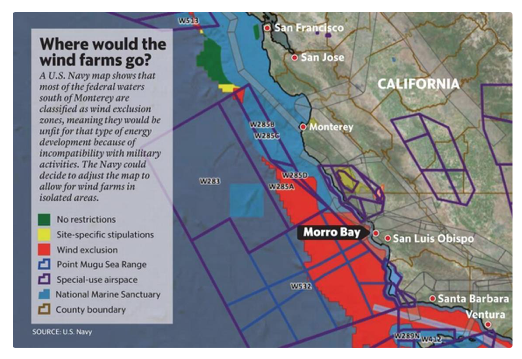
Chung has been adamant in the past that the Navy could not support virtually any project that sought to set up in the Navy’s wind exclusion zones  colored red on the map, where the Navy has operations.  Still Chung agreed in the last year to” keep talking.”

New map coming out

Overseeing the process on the federal side is the Bureau of Ocean Management ( BOEM) in charge of leases in federal waters – beyond three miles out. Spokesperson John Romero of BOEM says since last summer the  SLO-based working group “has made a lot of progress” that will now result in a new map being published in the next few days by the state CEC that could be the basis for the next step after four years of waiting.

“Nothing is ever easy” admits Romero who has watched the give and take the over the issue the whole time.

The map will identify locations the Navy and Department of Defense might accept – turning a red light into green for this new renewable energy industry.But details have to be worked out.

Romero adds that you can look for public meeting in Morro Bay to go over the working group’s map likely in late March or April.

existing Navy map says no off Morro Bay

A recent study suggested California has three areas where offshore wind might take hold.The waters off of Morro Bay, off Diablo Canyon and locations off of Northern California. The Navy has little objection to offshore projects in Northern California. But it lacks a robust and available transmission capacity despite ample wind.

The study concludes that “the three proposed BOEM lease areas (Morro Bay, Diablo Canyon, Humboldt Bay) and two additional zones in Northern California (Cape Mendocino and Del Norte)”  together “represent more than three times California’s current onshore wind capacity and, if developed to their maximum potential, could provide approximately 25 percent of the state’s future electricity needs.”

California aims to make  the grid operate with 100% renewable energy to fight global warming.

Romero says a key factor in favor of offshore wind on the Central Coast is the availability of transmission infrastructure that could supply much of the state already connected to the grid. That includes the transmission lines from the shuttered Moro Bay power plant. Likewise off Diablo Canyon, where the state’s only nuclear power plant may be idled in the next few year leaving these power lines open to receive some 2000 MW from wind farms off the coast. Applicants with code names have applied to the state agency. CAISO – the California Independent System Operator who oversees the operation of  California’s bulk electric  power system, transmission lines, and electricity market for use of both the Morro Bay and Diablo Canyon capacity.

Even if BOEM takes the next big step and calls for bids to set up in federal waters – it will be a competitive process . A dozen international companies have expressed interest in a lease including Castle Wind who have lobbied the City of Morro Bay and the fishing industry there to support them.

 Photo: L-R (Partial): California Energy Commission Chairman David Hochschild, SLO County Supervisor Adam Hill, California Assemblymember Jordan Cunningham, Assistant Secretary of Defense General Robert McMahon and Congressman Salud Carbajal, Unknown, DoD Representative Steve Chung…

Four more local dairies supply SoCal Gas

Calgren Dairy Fuels, Southern California Gas Co. announce expansion of California dairy renewable natural gas facility
-January 15,2020-

Calgren Dairy Fuels, based in Tulare County and Southern California Gas Co. announced Monday that four additional dairy farms began providing methane produced by cow manure to Calgren’s biogas facility in Pixley, California to SoCalGas’ system.

CALGREN 2020-01-15 at 1.12.17 PM“Over the last five years, renewable natural gas use in the transportation sector has grown by almost 600 percent,” Sharon Tomkins, SoCalGas vice president and chief environmental officer, said. “We’re looking to build on that success by delivering more renewable energy options to our customers, including renewable natural gas produced at farms, hydrogen made from surplus solar energy, and advanced fuel cell systems that can provide energy in extreme weather events. Each of these technologies will be essential to promoting the long-term reliability of our energy systems and to meeting California’s ambitious climate goals affordably.”

Calgren’s biogas operation in Pixley now collects methane from more than 66,000 cows at 10 dairy farms. The additional dairies are expected almost to double the amount of RNG produced at the facility.

“Calgren is leading efforts in California on this front, working with both dairies and SoCalGas to mitigate emissions,” Lyle Schlyer, president of Calgren Renewable Fuels, said. “This facility alone will eventually capture methane produced from the manure of more than 75,000 cows, preventing about 130,000 tons of greenhouse gas emissions from entering the atmosphere each year, the equivalent of taking more than 25,000 passenger cars off the road annually.”

East of Hwy 99?

Schlyer says the company is considering a plan to expand their network even more to the east side of Highway 99 where more dairies could hook up to the system, extending the pipeline under the highway.Currently all dairies  are located west of 99.

Calgren partnered with Maas Energy Works to develop the four new dairy digesters and the previous six dairy digesters, which have been in operation since 2018.

Attachments area

NREL: Growth in energy storage

-January 8,2020-

Screen Shot 2020-01-08 at 6.28.49 AMThe growth of renewables and their declining costs are driving this increase in energy storage, NREL noted. Approximately 18 percent of the electricity generated in the United States is from renewable sources, and that number is expected to continue to increase, NREL said.

According to estimates from NREL’s Renewable Electricity Futures Study, the continental United States would need 120 gigawatts of storage if 80 percent of electricity comes from renewable resources. The United States currently has 22 gigawatts of storage from pumped hydropower and another gigawatt from batteries.

“The declining cost of wind and solar and now batteries makes it conceivable to consider 100% renewables,” Paul Denholm, a principal energy analyst at NREL, said.

NREL noted that storage encompasses a wide range of technologies, including batteries, pumped hydropower, ice, chilled water, heat, and electrochemical, with other technologies currently under development.

“There’s a misunderstanding,” Adarsh Nagarajan, the group manager for Power System Design and Planning at NREL, said. “Storage is often looked upon as electrochemical storage or battery storage. Storage is beyond batteries. It’s beyond electrochemical. It’s much broader.”

“There is no one winner,” Nagarajan said. “All of them should work together in order to achieve a certain goal, which is grid stability and resilience and to fulfill customer needs.”

Energy Beat

-January 6,2020-

Tulare’s 2.8MW fuel cell plant operational

FuelCell Energy launched the commercial operation of the 2.8-megawatt fuel cell project at the wastewater treatment facility in Tulare, California as of late December 2019.

Screen Shot 2020-01-06 at 1.16.57 PMThe power plant is fueled by biogas, which is treated by Fuel Cell Energy’s cleanup technology that allows the plant to produce clean, renewable, carbon neutral power. 

The fuel cell uses a natural chemical reaction versus a combustion approach to generate energy, which significantly reduces carbon emissions.

FuelCell Energy has executed a 20-year power purchase agreement with the local electric utility, Southern California Edison, to purchase the renewable and carbon neutral power for supply to the California electric grid.

“I am proud of our team for delivering the Tulare Biogas Project. Globally, our solution delivers renewable and affordable power at a scale that is meaningful to communities and the utilities that serve them,” Jason Few, president and CEO at FuelCell Energy, said. “In addition to the significant environmental benefits of our solution, we also support our partners by providing a negative carbon footprint that supports offset emissions from their other forms of power generation.”

Fuel Cells run on wastewater digester gas, previously burned in a flare.  They generate about $3,200 worth of electricity per day.Four fuel cells cost $9.39 million. The city received $4.95 million incentive payment from Southern California Edison.

Three Rivers’ St Anthony’s Retreat goes solar

St. Anthony Retreat Center dedicated a new 2-megawatt solar array on Sunday, December 22, 2019. Bishop Joseph Brennan of the Roman Catholic Diocese of Fresno officiated at the dedication attended by staff, donors, and community members says a report in Kaweah Commonwealth.St. Anthony Retreat dedicates

The system is designed to meet 100 percent of the energy needs at the Retreat and the adjacent Santa Teresita Youth Conference Center, which are situated on a 62-acre property in Three Rivers, Calif. That will reduce operating expenses, and the clean energy capability will continue to support St. Anthony Retreat’s expansion for many years to come. 

Big Montana coal plants close

Montana’s Colstrip Units 1 and 2, one of the largest coal-fired power plants in the western U.S., will close by Jan. 5 or as soon as they run out of coal to burn reports Montana Public Radio . They will close two of its four units in coming days as the Montana facility edges toward an eventual total shutdown.

Colstrip Units 1 and 2 — built in the 1970s when massive strip mines were being developed across Montana and Wyoming 

The plant employs about 300 people and is the main driver of the economy for the surrounding town of Colstrip, which has about 2,300 people. But it’s been unable to compete with surging investments into renewable energy and cheap natural gas, as the coal plant’s operating costs have risen with the need for better pollution controls.

Kern oil patch suffering layoffs

Chevron cites oil glut

January 31,2019-
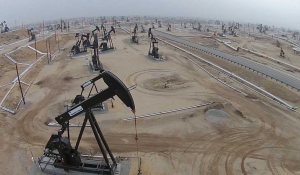
Screen Shot 2019-12-31 at 5.54.33 AMOil giant Halliburton is laying off some 73 employees at its Bakersfield plant in California according to a state notice filed in the past few days. The company had a round of job cuts this year, as the U.S. oilfield services firm struggles with falling profits  and a drop in oil and gas activity. They recently closed a plant in El Reno, Oklahoma laying off about 800 employees. Earlier in October, the company  also cut 650 jobs across Colorado, Wyoming, New Mexico and North Dakota, according to Reuters.

Kern oil officials blame some of their woes on tighter regulations  in California.The Bakersfield Californian reports that “Gov. Gavin Newsom’s regulatory crackdown on California oil production is beginning to take a toll on Kern County’s economy.”

Their news report continues “Bakersfield-based oil producer Aera Energy LLC said Friday it will remove one drilling rig from its earlier-planned lineup of six in 2020. That’s a 17 percent reduction the company said will take 90 direct jobs away from one of its local contractors, Golden State Drilling.

Aera attributed the reduction to two recent state regulatory changes: extra layers of permitting scrutiny for the well-stimulation technique known as fracking and a temporary ban on high-pressure steam injections. Both technologies are commonly used in western Kern.”

Heading in the other direction is Presidents Trump’s Bureau of Land Management (BLM)  that wants to open  more Valley lands to drilling  including in Tulare County. But Newsom says the state is  “at odds” with BLM.

“The president’s new oil drilling plan is completely at odds with our state’s priority to ensure the protection of our natural resources and the health and safety of our residents,” Newsom said. “California will continue to fight the Trump administration’s attacks on California’s environment, and this new assault on our natural resources is no exception.”

 Clearly the oil and gas slump is not just affecting California but  internationally with news  that Royal Dutch Shell PLC joined other of big oil companies that have recently  taken big financial hits because of a global glut of oil and gas.

The U.S. saw a sharp decline in support activities for mining in November, according to data released Friday from the U.S. Bureau of Labor Statistics (BLS).

The BLS, which categorizes oilfield services under “support activities for mining,” reported a loss of 5,700 jobs for the month.

The nation added 100 jobs in mining support activities in October, but has experienced declines every other month this year.

Additionally, jobs in oil and gas extraction declined by 800 in November after adding 300 in October.

Citing a challenging market environment, several upstream companies have continued to reduce their staff, including natural gas producer Range Resources, shale and gas producer Gulfport Energy and frac sand supplier U.S. Silica. 

The bottom line is there is too much oil chasing a decline in demand.The IEA still sees non-OPEC supply rising by 2.1 million barrels a day in 2020 — far outpacing projected global demand growth of 1.2 million barrels a day says a Forbes report.

The Wall St Journal reported this month that California biggest oil company Chevron- “Facing  Fossil Fuels Glut, Takes $10 Billion Charge”.They reported that “ Oil giant cuts the value of its holdings, including shale, citing low prices caused by oversupply.

On analysis says the natural “gas glut is particularly pronounced in North America where shale production is flooding local markets.”

How all this affects Kern County including state regulation may become clearer with plans by the Newsom  administration to visit the Kern Board of  Supervisors in January to discuss this. Kern County supplies three-quarters of in-state oil production.


Energy notes: battery prices, new solar projects / solar mandate

-December 30,2019

Battery prices down 87%

Shanghai and London, December 3, 2019 – Battery prices, which were above $1,100 per kilowatt-hour in 2010, have fallen 87% in real terms to $156/kWh in 2019. By 2023, average prices will be close to $100/kWh, according to the latest forecast from research company BloombergNEF (BNEF).
Cost reductions in 2019 are thanks to increasing order size, growth in battery electric vehicle sales and the continued penetration of high energy density cathodes. The introduction of new pack designs and falling manufacturing costs will drive prices down in the near term.

Solar projects

SunPower announced recently that construction is underway on the Lost Hills Solar Project, a 35-megawatt DC (29-megawatt AC) system that will deliver low-carbon electricity to Chevron‘s Lost Hills oil field in Kern County, California, under a power purchase agreement.
The Lost Hills Oil Field has been a source of energy since it was discovered in 1910, producing more than 460 million barrels of oil equivalent over the past 40 years. Once complete in early 2020, the solar project is expected to provide power to the Lost Hills production and processing facilities and offices, meeting approximately 80% of its energy needs. Goldman Sachs Renewable Power (GSRP) will own the system and Chevron will receive environmental credits under the state of California’s Low Carbon Fuel Standard (LCFS) program.

In front of the Kings County Planning Commission, Apex Energy Solutions of Folsom, California is proposing the Leo Solar Project on ±30 acres of a 40-acre parcel located near 25th Avenue 15 miles south of unincorporated Kettleman City, California along the Kings County/Kern County border, between California State Route (SR) 33 and Interstate 5 (I-5), approximately 0.5 mile east of 25th Avenue.

New home solar mandate

from Bloomberg reports

Screen Shot 2019-12-30 at 6.23.25 AMStarting in 2020, California will become the first U.S. state to require almost all new homes to draw some power from the sun. The solar mandate is part of a wide-ranging push by the world’s fifth-largest economy to combat climate change by weaning itself off fossil fuels.

California already leads the U.S. in home solar panels. Solar makes up about one-seventh of its electricity supply, and that’s expected to grow for the state to meet its goal of 100% carbon-free power by 2045. Others may follow: Massachusetts is weighing a similar mandate, as is Maryland’s Montgomery County. “California has provided the template for a lot of U.S. clean energy policy,” says Hugh Bromley, an analyst for BloombergNEF.

In California, housing affordability remains a key challenge. State regulators say adding solar panels will increase home costs by an average of $9,500, though they note that the systems’ lower energy costs will yield net savings of about $19,000 over 30 years. Only about 20% of California houses built in the past couple of years included solar panels, according to the California Building Industry Association, a trade group.

Energy updates: Vandenberg offshore wind- all the ships at sea /more

-December 26,2019-

Scottish company Cierco files wind turbine request off Vandenberg

The California State Lands Commission is still juggling two applications related to offshore wind projects in state waters near Vandenberg AFB. One, proposed on August 23, 2019 by Cierco Projects Corporation is for a floating offshore wind demonstration project titled “CADEMO”.
The staff report says Cierco proposes to install and operate up to four 12 MW floating offshore wind turbines moored to the sea floor. All turbines are proposed to link to each other and from one communication and transmission connection from the center turbine to a substation that could land south of Point Arguello on the Vandenberg Air Force Base. For this installation, the nearest turbine is proposed to be 2.9 miles seaward of the mean high tide line.
Staff reviewed the application and notified Cierco on September 20, 2019 that the application was incomplete and requested additional information. Since then, Cierco has provided additional information, but the application status remains incomplete.

The other project by IDEOL, a French firm was to be heard by the Commission but had been removed from the agenda at their December meeting.

from press reports

Lompoc wind farm moves forward

“On November 20, the Santa Barbara County Planning Commission voted unanimously to approve the installation of 29 wind turbines on 3,000 acres of land south of Lompoc, a project that would double Santa Barbara’s renewable energy production and provide for the electricity needs of 30 percent of the county’s households. The Strauss Wind Energy Project, proposed by Strauss Wind LLC, an affiliate of the German company BayWa LLC, is an updated version of the Lompoc Wind Energy Project that was approved in 2009 but then terminated before construction could begin due to economic conditions created by the Great Recession. The potential harm to local bird populations loomed large during the public comment section. Strauss proposed a number of practices that could be implemented to reduce risks to local bird populations, such as installing sensors that would halt turbine rotation whenever a large bird crosses into a zone surrounding the turbine.”

It would also provide $40 million in tax revenue to the county over 30 years.

Ships at sea to use cleaner fuel in New Year

Screen Shot 2019-12-26 at 8.57.28 AMThe International Maritime Organization (IMO) has announced their global regulation will substantially reduce harmful sulphur oxide (SOx) emissions from ships comes into effect from 1 January 2020, bringing significant benefits for both human health and the environment.
From 1 January 2020 the global upper limit on the sulphur content of ships’ fuel oil will be reduced to 0.50% (from 3.50%). Known as “IMO 2020”, the reduced limit is mandatory for all ships operating outside certain designated Emission Control Areas*, where the limit is already 0.10%.
The new limit will mean a 77% drop in overall SOx emissions from ships, equivalent to an annual reduction of approximately 8.5 million metric tonnes of SOx. Particulate matter – tiny harmful particles which form when fuel is burnt – will also be reduced.
As a result, reductions in stroke, asthma, lung cancer, cardiovascular and pulmonary diseases are expected. Cutting sulphur emissions from ships will also help prevent acid rain and ocean acidification, benefitting crops, forests and aquatic species.
The new limit is part of the International Convention for the Prevention of Pollution form ships (MARPOL), a key environmental treaty under the auspices of the International Maritime Organization (IMO) – the United Nations specialized agency responsible for developing and adopting standards for preventing pollution from ships, as well as shipping safety and efficiency, and maritime security.
The decision to cut the global limit for sulphur in ships fuel oil to 0.50% was made in 2008 and confirmed again in October 2016.