Mustard Family Member Seen as Biofuel Source

 from ARS

By Jan Suszkiw
August 13, 2020

Screen Shot 2020-08-19 at 7.14.42 AMLesquerella (a.k.a. Fendler’s bladderpod and Yellow Top) is a member of the mustard family that’s native to the U.S. Southwest. But Agricultural Research Service (ARS) scientists are now eyeing it as a home-grown source of butanol.

Butanol is a cleaner-burning alternative to gasoline that was produced worldwide until after World War II, when making this fuel from petroleum sources proved more efficient than fermenting it from corn and molasses.

Now, using the latest advances in fermentation and product-recovery technology, a team at ARS’ National Center for Agricultural Utilization Research in Peoria, Illinois, hopes to rekindle the production of butanol as a biobased fuel, among other groups.

Towards that end, they’ve conducted research to expand the list of butanol feedstocks that can be used—from fiber-rich crop residues like wheat straw, sweet sorghum bagasse and corn stover, to food wastes and processing byproducts like dried distillers grains and solubles and “presscake” (the crushed remains of lesquerella seed whose oil has been extracted).

The team’s efforts are part of a broader umbrella effort at the ARS center to create new, value-added markets for agricultural commodities, especially if they can serve as sustainable alternatives to petroleum-based fuels.

According to ARS chemical engineer Nasib Qureshi, the Peoria center also has a long history of investigating native or naturalized plants with potential development as new oilseed crops—pennycress, cuphea and meadowfoam among them.

Lesquerella first caught ARS researchers’ attention years ago for the high hydroxy fatty acid content of its oil, which is critical to making high-quality lubricants, paints and other products.

However, the resulting presscake can’t be fed to livestock because of its nutrient-blocking properties, and landfilling poses a waste disposal problem. This also presents a hurdle to commercialization. Fortunately, Qureshi’s team saw an untapped resource in the presscake, namely, a bevy of carbohydrates can be used to make butanol.

Together with ARS colleagues Rogers Harry-O’Kuru, Siqing Liu and Badal Saha, Qureshi used a multi-step process for pretreating the presscake and rendering it into a sugar-enriched broth that Clostridium beijerinckii bacteria can then ferment into not only butanol, but also acetone and ethanol (though, in lesser amounts).

In laboratory trials, the approach produced 11-14 grams of butanol per liter of presscake. The total chemical production (combined butanol, acetone and ethanol) was 19 to 29 grams per liter—a nearly 67 percent increase over using corn and glucose sources to produce these three same chemicals, noted Qureshi, whose team plans on scaling-up their experiments using two-liter bioreactors and, if successful, even larger ones.

Keeping feedstock costs down is key to making butanol competitive with gasoline, he added. At $25 a ton or less, lesquerella presscake would command a selling price of $2.27 or less a gallon, he estimated—about a dollar less than from sweet sorghum, another promising feedstock source.

Lesquerella’s potential to help “fuel” butanol’s comeback would also hinge on research to breed and cultivate the plant as a dedicated bioenergy crop.

Qureshi said that prospect isn’t so far-fetched considering the soybean’s rise from an obscure livestock forage in the late 1800s to the versatile U.S. cash crop it has become today—second only to corn.


Phillips 66 to transform San Francisco-area oil refinery biofuel plant

08/12/2020

Conversion is expected to reduce the plant’s greenhouse gas emissions by 50% 

Screen Shot 2020-08-12 at 12.30.19 PMHOUSTON–(BUSINESS WIRE)– Phillips 66 (NYSE: PSX), a diversified energy manufacturing and logistics company, announced today that it plans to reconfigure its San Francisco Refinery in Rodeo, California, to produce renewable fuels. The plant would no longer produce fuels from crude oil, but instead would make fuels from used cooking oil, fats, greases and soybean oils.

The Phillips 66 Rodeo Renewed project would produce 680 million gallons annually of renewable diesel, renewable gasoline, and sustainable jet fuel. Combined with the production of renewable fuels from an existing project in development, the plant would produce greater than 800 million gallons a year of renewable fuels, making it the world’s largest facility of its kind.

The project scope includes the construction of pre-treatment units and the repurposing of existing hydrocracking units to enable production of renewable fuels. The plant will utilize its flexible logistics infrastructure to bring in cooking oil, fats, greases and soybean oils from global sources and supply renewable fuels to the California market. This capital efficient investment is expected to deliver strong returns through the sale of high value products while lowering the plant’s operating costs.

“Phillips 66 is taking a significant step with RodeoRenewed to support demand for renewable fuels and help California meet its low carbon objectives,” said Greg Garland, chairman and CEO of Phillips 66. “We believe the world will require a mix of fuels to meet the growing need for affordable energy, and the renewable fuels from RodeoRenewed will be an important part of that mix. This project is a great example of how Phillips 66 is making investments in the energy transition that will create long term value for our shareholders.”

If approved by Contra Costa County officials and the Bay Area Air Quality Management District, renewable fuels production is expected to begin in early 2024. Once reconfigured, the plant will no longer transport or process crude oil.

The plant is expected to employ more than 400 jobs and up to 500 construction jobs, using local union labor, including the Contra Costa County Building & Construction Trades.

Phillips 66 also announced plans to shut down the Rodeo Carbon Plant and Santa Maria refining facility in Arroyo Grande, California, in 2023. Associated crude oil pipelines will be taken out of service in phases starting in 2023.

To learn more about the project, visit www.RodeoRenewed.com.

About Phillips 66

Phillips 66 is a diversified energy manufacturing and logistics company. With a portfolio of Midstream, Chemicals, Refining, and Marketing and Specialties businesses, the company processes, transports, stores and markets fuels and products globally. Phillips 66 Partners, the company’s master limited partnership, is integral to the portfolio. Headquartered in Houston, the company has 14,500 employees committed to safety and operating excellence. Phillips 66 had $55 billion of assets as of June 30, 2020. For more information, visit http://www.phillips66.com or follow us on Twitter @Phillips66Co.

Oil & ethanol blues/ SoCal Gas bets on hydrogen

-July 26,2020-

More layoffs in the Kern oil patch. Ensign United States Drilling Inc.has filed a WARN notice  they would permanently lay off 150 in Kern County.

Screen Shot 2020-07-26 at 7.12.26 AMMeanwhile the Bakersfield Californian reports that the bankruptcy of local oil producer California Resources Corp. “has drilled a nearly $26 million hole in Kern County’s fiscal 2019-20 property tax receipts.

CRC failed to pay taxes totaling that amount before the county’s April 10 deadline, thereby incurring a 10 percent penalty. An additional 1.5 percent per month was tacked on when the company neglected to settle the debt by July 1, Kern Treasurer-Tax Collector Jordan Kaufman said Wednesday.”

Also this past week, oilfield services company Schlumberger (NYSE:SLB) reported that its second quarter revenue dropped 35% compared to the year ago period as oil prices remain depressed and production and drilling activity have pulled back. North American revenue was down 58% compared to the second quarter of 2019, and down 48% compared to the first quarter of 2020.

The company, with several Kern County locations, announced that it has reduced its workforce by 21,000 employees, or about 20%. 

With about half US ethanol production off line the industry looks to to make lemonade out of the sour market for transportation fuel. They are focusing on  high-end alcohol . Sacramento based Pacific Ethanol is  also planning for leadership succession. The company’s board of directors has appointed current Chief Operating Officer Mike Kandris as co-president and co-CEO. Neil Koehler will retire as CEO and president Sept. 30. 

PEI Chairman Bill Jones said, “Demand for high-quality alcohol, the primary ingredient for hand sanitizers and disinfectants, has grown significantly since the onset of the COVID-19 pandemic. As COO, Mike has been a dynamic leader and was pivotal in implementing operational efficiencies and logistical modifications that increased the volume of high-quality alcohol at our Pekin, Illinois, campus. We are confident Mike will advance additional initiatives and drive the next phase of our diversified strategy.”


SoCalGas now powering facilities with fuel cells

Southern California Gas Co. is powering two of its largest facilities in the Los Angeles area with solid oxide fuel cells.

The fuel cells will reduce greenhouse gas emissions, air pollutants, and the cost of power. Plus, they will provide reliable electricity independent of the power grid.

The fuel cells, produced by Bloom Energy, could use natural gas, renewable natural gas, or hydrogen. They intake natural gas and oxygen, and through an electrochemical reaction, produce electricity without any combustion. Bloom Energy Servers can operate at 60 percent efficiency and are among the most efficient out there.

“Using Bloom Energy’s fuel cells for our facilities is yet another way that SoCalGas is demonstrating our commitment to be an industry leader supporting a 21st-century energy system,” Maryam Brown, president of SoCalGas. “These onsite generation systems will provide clean, affordable, and resilient energy to key facilities so that we can ensure safe and reliable service to our 22 million customers.”

The fuel cells will reduce carbon emissions by 683 metric tons per year while smog-forming pollutants and particulate matter are reduced by more than 99 percent.

Adoption of distributed power generation solutions, also called distributed energy resources, is a growing trend in the United States. These solutions can combine environmental benefits and the ability to provide uninterrupted power in the event of natural disasters or outages. While SoCalGas uses solar generation at six of its 113 facilities, the company selected the fuel cell solution for its Monterey Park and Pico Rivera facilities for their superior resiliency.

“The SoCalGas pipeline system is integral to many Bloom Energy Servers installed in central and southern California, so we were eager to team up again to bring fuel cells to SoCalGas’ own facilities,” Kris Kim, managing director of strategic development at Bloom Energy, said. “Fuel cells at utility-owned sites are a natural fit as we are both looking to the future of energy and prioritize qualities like fuel flexibility, emissions reductions, efficiency, and reliability.”

The Bloom Energy Servers at each of SoCalGas’ facilities total 950 kilowatts. They replace over 90 percent of the baseload power that would otherwise come from the grid. Bloom Energy has deployed its Servers at 600 sites globally, and more than 85 of those are microgrids.

“I am delighted to see SoCalGas has chosen Pico Rivera to showcase this exciting new technology,” said State Sen. Bob Archuleta (D-Pico Rivera), said. “It is no longer up for debate; hydrogen will be a part of California’s clean energy future.”

SoCalGas delivers gas service to 21.8 million customers across 24,000 square miles of Central and Southern California.

Carbajal amendment presses Navy to compromise over offshore wind

Navy secretary says ”no”- (CORRECTED”

Navy Secretary in article misidentified; Should be Secretary Williams. Sorry for the error

-July 10,2020-

European offshore wind

On July 1- the same day Central Coast Congressman Salud Carbahal’s staff was offering ideas at a public webinar hearing on new proposals to launch the offshore wind industry, the Congressman was offering an amendment to the Department of Defense’s (DOD) annual appropriation that was designed to bring the Navy to the table and allow wind turbines off Morro Bay.

The Navy and Carbajal have been negotiating since 2016 and in the past year a new-multi agency “working group” had been set up.The task force included  the California Energy Commission, federal agencies including the Bureau of Ocean Energy Management and the DOD, all looking to find a location off Carbajal’s district where the Navy could accept the placement of floating wind turbines.

DOD previously found that the plan was ”incompatible” with military operations saying they needed a wide area for maneuvers.

But in March of this year the working group suggested they were closer to a deal.

Now in a surprise announcement, Carbajal reported the Navy was again saying “no” to all proposals.

A few days ago at a Washington hearing for the National Defense Authorization Act for Fiscal Year 2021, Carbajal, a member of the House Armed Services Committee, offered an amendment that if it becomes law –  would require Navy cooperation in the talks.

On the House floor Carbajal noted the task force”had made great progress “to find a win-win solution that the Navy had signed off on earlier this year.

“Wind energy is critical for our 21st century clean energy goals” and” will create thousands  of jobs.” The issue is critical to the Central Coast “especially with the impending closure of Diablo Canyon nuclear power plant.“he added.

Referring to newly appointed Assistant Secretary of the Navy Gregory J. Slavonic, Carbajal said the Secretary recently “made it clear to myself that wind energy development may not be compatible with military activities.”

This “reversal” of the Navy position “came abruptly” and “without  any acknowledgment of commitments previously made.”

Looking to encourage the Navy to come back to the table, Carbajal’s amendment would require that the Defense Department not be able to “prematurely object to offshore wind off the Central Coast”and follow the clearing house process, he said.

“My amendment would require that the DOD brief” Carbajal or his assistant Greg Haas “on progress of the working group.

”I am confident we can work together.”

The amendment passed muster with this legislative committee and now m

Energy updates

-July 6,2020-

Grapevine solar project 

Pastoria Solar Project is a new 115MW solar farm to be located  near the Grapevine in Kern County. The company is seeking a conditional use permit that will include up to 80MW of energy storage. The site is 5 miles northeast of Lebec near the big Department of Water Resources’ Edmonston Pumping Plan

Gas station operators high margins

From WSJ

Drivers hitting the road over July Fourth weekend are poised to enjoy the cheapest holiday gasoline prices in years, but the gas stations are doing OK, too.

Fuel retailers have benefited from record margins on gasoline in recent months. The difference between the price U.S. consumers paid at the pump and the wholesale price of gasoline, less taxes and other costs, averaged about 41 cents a gallon during the first half of the year, the highest six-month average on record, according to analytics firm IHS Markit.

Wells Fargo goes renewable

Screen Shot 2020-07-06 at 6.56.50 AMWells Fargo recently announced agreements with Shell Energy North America (US), L.P. (Shell Energy) and its wholly owned subsidiary MP2 Energy LLC (MP2 Energy), to secure approximately 150,000 megawatt-hours of renewable energy annually. This energy addresses 100% of the energy consumption of approximately 1,200 Wells Fargo properties in California and the mid-Atlantic states, and meets 100% of the company’s eligible load in California, Delaware, Maryland, New Jersey, Illinois, Ohio, Pennsylvania, and the District of Columbia.

Community Choice groups sign up for Kern solar

8minute Solar Energy announced that the company has executed a power purchase agreement (PPA) with Monterey Bay Community Power Authority (MBCP) and Silicon Valley Clean Energy (SVCE), marking 8minute’s first contract with Community Choice Energy (CCE) providers. The 250-megawatt (250 MWdc / 200 MWac) Aratina Solar Center includes 150 megawatt-hours (MWh) of energy storage and will provide enough power for 93,000 homes.

“This large-scale, long-term solar project with storage launches us into an even stronger position in doing our part to reduce carbon emissions while meeting our customers’ needs.”

California power deals

Seventeen community choice aggregators in California purchased 16.4 million MWh of electricity in the first quarter of 2020, a year-on-year increase of 37.8%, showed quarterly data filed by power sellers to the Federal Energy Regulatory Commission and compiled by S&P Global Pl

Tulare County solar project filing

Special Use Permit No. has been filed for Angiola East, LLC,  a 40MW solar generation facility on a 277-acre site located one mile south of Alpaugh.

Virgin Trains will run on I-15 to Las Vegas

Zero emission transportation

from the Las Vegas Review-Journal

July 1,2020
Screen Shot 2020-07-01 at 3.05.51 PMVirgin Trains USA’s high speed train plans got another boost after the company entered into a lease agreement with California to use existing right of way along Interstate 15 for the project.
Virgin Trains announced the agreement for the planned $4.8 billion project Tuesday morning with the California Department of Transportation (Caltrans) on authority from the California State Transportation Agency.

Plans call for the 170-mile-long rail line between the Victor Valley region and Las Vegas to be constructed within the median of I-15 in California.

“This is a major milestone in connecting two world-class destinations — Southern California and Las Vegas — with high-speed passenger rail service,” Caltrans Director Toks Omishakin said in a statement. “The XpressWest (Virgin Trains) trains will provide a convenient alternative to driving to and from Las Vegas while reducing greenhouse gas emissions.”

Once the rail line enters into Nevada, it will shift to the east of the interstate. The Nevada Department of Transportation is not pursuing a right-of-way lease agreement but is requesting Virgin submit a right-of-way occupancy permit to have access to the I-15 corridor in the Silver State.

Ryan Wheeler, senior project manager with NDOT, said the two sides have executed a few agreements that state they’re working toward that right-of-way occupancy permit, and everything seems to be on track for that.

“They’ll have the ability to be within the I-15 corridor,” Wheeler said. “Things are moving forward; they have an aggressive schedule.”

The first 2 miles of the planned route in Nevada would run in the median. Then, about 2 miles past Primm, the tracks would shift to the east of I-15. The rail line would shift back to the median near where the Union Pacific tracks travel underneath I-15 and continue until it nears St. Rose Parkway, where it would return to the east side of I-15 for the remainder of the route.

“With most of our interchanges … the cross road goes over the top of the freeway; they’ll (Virgin) end up going underneath those crossroads,” Wheeler said. “They will have their own exclusive corridor where they don’t have any railroad crossings.”

The electric and zero-emission trains will reach top speeds of 200 mph, making the trip in 85 minutes.

Around 135 miles of the system will be in California with the remaining 35 miles in Nevada. The Las Vegas station is planned for Las Vegas Boulevard between El Dorado Lane and Robindale Road, while the California station would be located off I-15 in north Victorville.

The project will be privately financed, mainly via private activity bonds in Nevada and California and is expected to break ground by the end of 2020.

California approved the allocation of $600 million in tax-exempt bonds in April, while Virgin Trains is still waiting on Nevada’s decision on $200 million in bonds from the state’s debt limit allocation.

That decision could come down at the end of July or the first part of August, depending on board members’ schedules, according to Terry Reynolds, director of Nevada’s Department of Business.

Internal Revenue Service guidelines allow Virgin to market up to four times the combined $800 million in bonding from both states, for a total of $3.2 billion. In March, the U.S. Department of Transportation approved $1 billion in tax-free bonds for the project.

As Virgin awaits Nevada’s decision on the bonds, the company hopes to mirror the success it has had in California to get the bond-selling process in motion.

“At every stage of this project we have received tremendous support from California, which recognizes the need for car-free, emission-free transportation options,” said Sarah Watterson, chief development officer for Virgin Trains. “This agreement is a big step toward our ultimate goal of reinventing passenger rail in America and gets us closer to generating critical jobs for the region.”

By 2045, every new truck sold in California will be zero-emission.

-June 27,2020-

news release
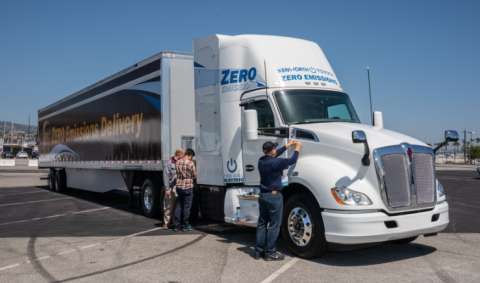
SACRAMENTO –  On June 25, the California Air Resources Board adopted a first-in-the-world rule requiring truck manufacturers to transition from diesel trucks and vans to electric zero-emission trucks beginning in 2024.  By 2045, every new truck sold in California will be zero-emission.

Screen Shot 2020-06-27 at 7.24.57 AMThis bold and timely move sets a clean-truck standard for the nation and the world, and marks the Newsom administration’s most important air pollution regulation to date. It zeroes in on air pollution in the state’s most disadvantaged and polluted communities.

“California is an innovation juggernaut that is going electric. We are showing the world that we can move goods, grow our economy and finally dump dirty diesel,” said Jared Blumenfeld, California’s Secretary for Environmental Protection.

Many California neighborhoods, especially Black and Brown, low-income and vulnerable communities, live, work, play and attend schools adjacent to the ports, railyards, distribution centers, and freight corridors and experience the heaviest truck traffic. This new rule directly addresses disproportionate risks and health and pollution burdens affecting these communities and puts California on the path for an all zero-emission short-haul drayage fleet in ports and railyards by 2035, and zero-emission “last-mile” delivery trucks and vans by 2040.

“For decades, while the automobile has grown cleaner and more efficient, the other half of our transportation system has barely moved the needle on clean air,” said CARB Chair Mary D. Nichols. “Diesel vehicles are the workhorses of the economy, and we need them to be part of the solution to persistent pockets of dirty air in some of our most disadvantaged communities. Now is the time – the technology is here and so is the need for investment.”

Heavy-truck charging stations planned along I-5 & 99

-June 19,2020-

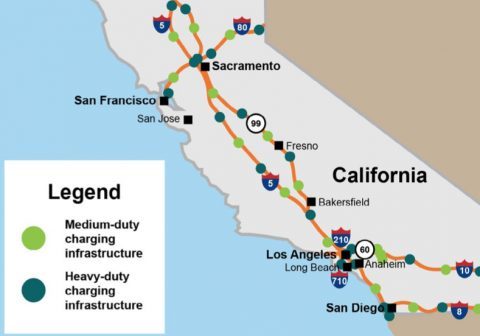
Electric utilities from three western states have outlined a plan to establish a string of charging stations designed to power electric heavy trucks hauling freight along Interstate 5. The first phase of the project would site 27 locations along the busy corridor.The initiative is meant to juice deployment of long-haul electric heavy duty trucks.

elec truck2020-06-18 at 6.36.48 AM
Over the same time period -by 2025 – 41 additional sites would be located at similar intervals and expanded in the same manner along the following arterial highways including State Route 99.

A study, released by the West Coast Clean Transit Corridor Initiative June 17 proposes establishing robust charging outlets along I-5 from the Mexican border to Canada and also along other key interstates and state highways that connect with the busy cargo route. The plan would allow truckers to re-power their vehicles at comfortable intervals and locations, including well-traveled existing truck stops.

“In talking to fleet customers, we understand that to accelerate deployment of EV (electric vehicle) trucks, they would like to see these public sites open to support their operations along the highway,” Katie Sloan, director of eMobility and Building Electrification for Southern California Edison.

A coalition of nine electric utilities and two municipal power agencies in California, Oregon, and Washington are working together on what specific infrastructure would be required to help accelerate the adoption of EV heavy trucks, which currently have an average range of more than 100 miles per charge and will eventually displace the trusty, but smoky diesel rigs that contribute to transportation emissions.

charging map 2020-06-18 at 6.46.12 AMBy 2030, it’s estimated that medium- and heavy-duty trucks could make up nearly 25% of MD trucks and 5% of HD for a total of 8% of all trucks on the road in California Oregon and Washington.

In addition to SCE, other sponsors of the study are Pacific Gas and Electric Company, Pacific Power, Portland General Electric, Puget Sound Energy, Seattle City Light, Sacramento Municipal Utility District, San Diego Gas & Electric, Los Angeles Department of Water & Power, Northern California Power Agency and Southern California Public Power Authority.

With states and utilities nationwide committed to significant reductions in their greenhouse-gas emissions, the transition to a “green” transportation sector relies heavily on having reliable charging capacity in place along heavily traveled roads in the same way that gas stations and truck stops currently serve cars and smaller trucks. The proposals outlined were considered an initial step in providing charging infrastructure for truckers.

“The electrical service that goes into large trucks is a lot larger than what we have had to do for light-duty trucks, so a truck plaza charging up to 10 trucks at a time requires a lot of energy,” said Bill Boyce, manager of Electric Transportation, Sacramento Municipal Utility District. “You need more time to plan for it and this study is to identify what we need and to get ahead of the curve.”

The California Air Resources Board this spring released the final draft of the Advanced Clean Trucks standard. The proposal will put roughly 100,000 and 300,000 electric trucks on California’s roads in 2030 and 2035, respectively, out of approximately 1.8 million and 1.9 million total trucks expected in those years.

In the more immediate timeframe, CARB’s proposal will require 4,000 electric trucks to be sold in 2024 out of roughly 75,000 total sales.

The charging station report concluded that the best strategy would be installing charging facilities at intervals of around every 50 miles along I-5 and also at points on various east-west highways, including Interstates 8, 80, and 710 in California; I-84 in Oregon, and I-90 in Washington.

“Electrifying delivery, freight and other commercial transportation on I-5 and adjoining highways will help bring us closer to achieving clean energy and environmental goals, and will mean major health benefits to the communities near those highways,” said Eva DeCesaro, senior product manager, Transportation Electrification for Pacific Power

The recommended first phase would be installing chargers at 27 locations to serve medium-duty delivery vans by 2025. Fourteen of these locations would be expanded to accommodate heavy-duty trucks by 2030, at which time it was estimated that 8 percent of the trucks on the road in California will run on electricity. It was estimated that the upgrades would average 10 2-megawatt charging ports per station and possibly on-site battery storage to help keep vehicles on the road at night.

Individual utilities have been active in building charging stations for EV passenger cars and also localized light-duty fleets, such as delivery vans, within their service territories; however, since semi-trucks travel longer distances and I-5 crosses state lines, a high level of coordination will be required to place charging infrastructure in the right places and also ensure that they can be connected to the appropriate electric transmission lines.

Construction starts on 12-phase Westlands Solar Park

Another 250MW Kings County project filed

-June 6,2020-

Screen Shot 2020-06-06 at 7.52.45 AMConstruction of the first phase of the ambitious Westlands Solar Park in Kings County has been launched as of March 2020 with development of their first major solar farm, the 250MW Aquamarine project.
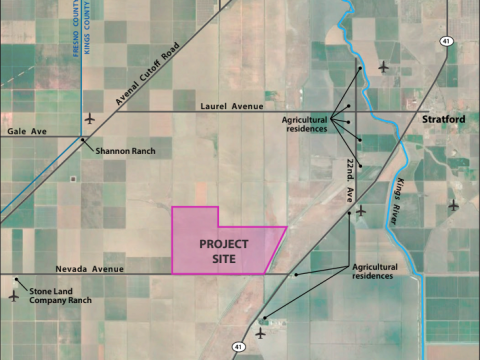

Like all of their projects, the location is on Westlands Water District land along the Avenal Cutoff road – east of I-5. Aquamarine is expected to start power generation in late 2021.

Owners of Westland Solar Park – the CIM Group and Westside Holdings – announced recently that 50MW of electricity generated from Aquamarine will be purchased by Valley Clean Energy Alliance, a local electricity provider, for supplying to Davis and Woodland cities and unincorporated portions of Yolo County.

The other 11 solar farms that are part of coming phases will follow in the next few years. Others that are named Westlands Solar Blue, Westlands Almond, Westlands Grape and Westlands Pomegranate with the capacity of 250MW each, as well as 150MW Westside Chestnut.

The Westlands Solar Park’s master plan area will house 12 solar photovoltaic generating facilities to be developed in phases over 12 years.

Latest filing

In the past few weeks plans for Westlands Grape have been filed with the Kings County Planning Commission starting the environmental review for this project on nearly 1800 acres along Nevada Ave between Hwy 41 and the Avenal Cutoff.

WSP Grape
WSP Grape

This Grapes Westlands Solar Park project joins three others either permitted, under construction or filed with Kings County including Aquamarine and Westlands Solar Blue that filed an application for a 250MW project on 1950 acres located on Laurel in western Kings County.The same developer filed for a project called Chestnut, a 150 MW solar farm on 980 acres located between the Avenal Cutoff and Hwy 41.

Westlands Solar Park has stated they hope to phase the build up to 2000MW of power in the area on salt damaged land no longer fit for farming. They hope to have 700MW on line by 2021.

The 2.7GW Westlands Solar Park would be one of the world’s largest solar power plants.The solar panels will be located across 20,000 acres of marginal land in western Fresno and Kings counties. Water shortages, salt and selenium contamination make this location attractive- astride the state’s largest power line corridor- for more solar development.

The project-repurposing of spent farmland for solar generation – is supported by major environmental groups because of its low impact on endangered species unlike some pristine desert projects. Several environmental and animal protection groups, including Defenders of Wildlife, Sierra Club, National Resources Defense Council and the Centre for Biological Diversity, have extended their support.

Taking the pulse – Gas sales still down


-May 28,2020

Screen Shot 2020-05-28 at 5.52.13 AMSeveral sources say Memorial Day 2020 gasoline demand was still not back to normal.Oil analyst Tom Kloza says “OPIS numbers suggest gasoline demand destruction in the 25-29% range. Either side of 7-million b/d as opposed to “normal” demand in the 9.4-million b/d range in 2016-2019.”

A Bloomberg story adds “While beaches were open and states across the country emerged from coronavirus-related lockdowns, demand for gasoline ended up falling over the Memorial Day weekend. That may have been because people kept their driving local, when in previous years they had traveled farther, according to Andy Lipow, president of Lipow Oil Associates LLC in Houston.

Filling up at Costco Friday before the Memorial Day weekend in San Luis Obispo we had no wait to get a pump – very unusual on any day.

For the first time in 20 years, AAA did not issue a Memorial Day travel forecast, but anecdotal reports suggest fewer people will hit the road compared to years past for what is considered the unofficial start of the summer travel season.

“Last year, 43 million Americans traveled for Memorial Day Weekend – the second-highest travel volume on record since AAA began tracking holiday travel volumes in 2000,” said Paula Twidale, senior vice president, AAA Travel. “With social distancing guidelines still in practice, this holiday weekend’s travel volume is likely to set a record low.”

Memorial Day 2009 currently holds the record for the lowest travel volume at nearly 31 million travelers, according to AAA. That holiday weekend, which came toward the end of the Great Recession, 26.4 million Americans traveled by car, 2.1 million by plane and nearly 2 million by other forms of transportation (train, cruise, etc.).