Next phase of Westlands Solar Park moving forward

-March 20,2021-
 
Kings County’s mega-solar project, Westlands Solar Park, continues to add more phases as it heads to 2000 megawatts spread over 21,000 acres.
 
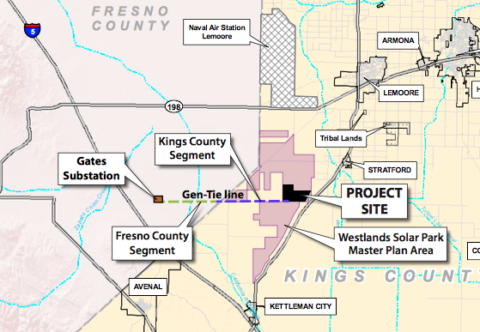
Screen Shot 2021-03-19 at 1.29.24 PMNext in line is Westlands Solar Grape -another 250MW solar farm planned  not far from the Avenal Cutoff.The 1759 acre project follows Westlands Solar Blue, Westlands Almond, Westlands Pomegranate all with a capacity of 250MW as well as 150MW Westside Chestnut.Grape will have a battery storage facility along with acres of arrays
 
The Kings County Planning Commission will hold a special public hearing by teleconference to consider the environmental documents for the proposed project. The special public hearing will be tentatively held on Monday, May 3, 2021 at 12:45 P.M. 
 
Like all of these western Kings County energy  projects they are not displacing good ag land but span previously selenium contaminated and drainage-impaired land in Fresno and Kings Counties.An LA-based real estate firm, CIM, is promoting the projects.
 
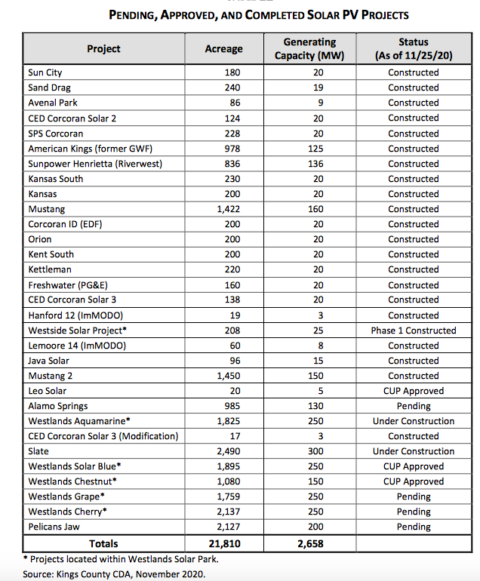
Looking at recent permit development, the scale is impressive. Kings County has 31 solar PV generating projects approved or pending with a total potential generating capacity of 2,658 MW. An additional four solar PV projects, with a potential generating capacity of 830 MW, have pending CUP applications with Kings County, including the subject 250 MW Grape Solar Project, the 250 MW Cherry Solar Project located across Nevada Avenue to the south, and the 130 MW Alamo Springs Solar Project and 200 MW Pelican’s Jaw Solar Project, both located in southern Kings County.
Screen Shot 2021-03-20 at 8.16.33 AM

Energy briefs

-February 24,2021-

Gasoline prices up 37 cents

As of February 22, gas prices are climbing for the 10th week says the California Energy Commission. Regular is higher than last week’s price by 10 cents. The average statewide price for regular is $3.45 compared to $3.08 just before New Year and up about a dollar per gallon from last April’s low. Lemoore’s Yokut Gas is among the lowest price leaders in the state at $2.84 a gallon. GasBuddy says the rapid rise  in prices was impacted by the freeze in Texas shutting down refineries. Warm weather may bring prices back down. But, says GasBuddy, “as we near spring weather, we’ll likely see another longer term rise in prices begin as refineries start to transition to summer gasoline, so motorists shouldn’t jump for joy just yet.” Another angle – with COVID cases shrinking – more of us are traveling.

WSJ: Texas Electric Bills Were $28 Billion Higher Under Deregulation

Texas’s deregulated electricity market left millions in the dark last week. For the past 20 years, its consumers have paid more for their electricity than state residents who are served by traditional utilities, a WSJ investigation found.

CEMEX awarded grant from Department of Energy to develop carbon capture technology  in California

World Cement
Screen Shot 2021-02-24 at 6.43.13 AMCEMEX has announced that its US operations have been awarded a grant from the United States Department of Energy to research, engineer and develop a pilot for a breakthrough carbon capture unit. The project, anchored to CEMEX’s Victorville, California cement plant, will also contemplate cost-competitive solutions to completely close the loop on current carbon emissions.
In this initiative led by RTI international (RTI), a non-profit research institute, CEMEX is joining forces with UK-based Carbon Clean and Oak Ridge National Laboratory. The goal of the consortium is to increase efficiencies and value in CEMEX’s overall building material fabrication process, while significantly reducing its CO2 footprint through the leverage of technological upgrades. The specific objectives of this project also include the development, optimisation and scaleup of specific CO2 capture process components, as well as incorporation of next-generation non-aqueous solvents. Integration aspects of the low-cost, modular, process intensification capture technology with CEMEX’s cement plant are also planned to be covered, together with subsequent cost evaluations and technical considerations for the transformation of captured CO2 into new marketable products.
“CEMEX is committed to being part of the solution to reduce carbon emissions globally and to deliver net-zero CO2 concrete to all of our customers by 2050,” said CEMEX USA President Jaime Muguiro. “We cannot achieve these without innovative technology and collaborative relationships with both public and private organisations who share a commitment to climate action. This grant gives us an excellent opportunity to further develop a new technology to help us all reach our goals.”
“With CEMEX being a project partner and technology stakeholder, the design and integration of the capture system with its cement plant, and subsequent use of the CO2 at its concrete plants are set to align with the industry’s needs”, said Paul Mobley, Research Chemical Engineer at RTI. “The development of this highly disruptive CO2 capture technology could accelerate industry adoption and thereby significantly reduce industrial emissions.”
“Oak Ridge National Laboratory is dedicated to translating science into industry solutions for addressing some of the most critical problems facing our nation,” said Xin Sun, interim associate laboratory director for energy science and technology at ORNL. “We look forward to applying our advanced manufacturing expertise to this project in support of a clean, efficient, flexible and secure energy future.”
Aniruddha Sharma, CEO of Carbon Clean, said: “CEMEX shares our mission to enable the net zero transition by developing affordable modularised carbon capture solutions. This latest grant from the US government endorses the importance of such work. We are looking forward to delivering this breakthrough project with CEMEX further strengthening our relationship and helping to decarbonise the cement industry.”
CEMEX announced in 2020 its Climate Action strategy, defining a global target of a 35% reduction of CO2 emissions per ton of cementitious products by 2030. To complement this strategy with a longer-term vision, CEMEX also established an ambition to deliver net-zero CO2 concrete to all its customers globally by 2050.
CEMEX is successfully introducing Vertua®, its low carbon and net-zero CO2 products, in the countries where it has a presence. Vertua is the result of the work done by the CEMEX’s Research and Development Centre in Switzerland, and it is a milestone towards carbon-neutral construction becoming a reality.

1.1-GW solar + 2,165-MWh storage project near Mojave begins construction

Renewables developer and operator Terra-Gen has hired Mortenson to construct the Edwards & Sanborn solar and energy storage project located in Kern County, California. The project, near Mojave ,consists of 1,118 MW of solar and 2,165 MWh of energy storage. It is currently the largest single solar + storage project to reach this milestone.
“Selecting the right partner to execute a project of this scale coupled with cutting edge battery experience was paramount for Terra-Gen, and Mortenson was a natural fit,” said Brian Gorda, Terra-Gen’s vice president of engineering. “Terra-Gen is excited to push the industry to new heights and build a plant that provides energy for all hours of demand.”
The Edwards & Sanborn project is located near several operating wind and solar projects in Kern County, California. Mortenson is the full EPC contractor on both the solar and energy storage scopes. Site construction will commence in Q1 2021 with expected completion in Q4 2022.
Solar production on the site will utilize more than 2.5 million modules and energy storage will utilize more than 110,000 lithium-ion battery modules.
“The Edwards & Sanborn solar and energy storage project is industry-changing and during this challenging 2020 will redefine the impact these systems will have on our clean energy future,” said Trent Mostaert, Mortenson’s vice president and general manager of solar. “We are proud to combine our solar and energy storage design and construction expertise with Terra-Gen’s development capabilities to deliver a world-class energy facility.”
At peak construction, more than 700 people will be employed on-site at the project.


PG&E Sells Kern Canyon Hydro Facility to Kern and Tule Hydro LLC

Tule River hydro sale pending

-January 28,2021-

Screen Shot 2021-01-11 at 12.42.43 PM
PG&E announced Dec. 30 that it has sold its Kern Canyon hydroelectric project to Kern and Tule Hydro LLC.

In mid-2018, PG&E issued a request for offers to solicit purchase proposals for the 11.5-megawatt facility, located near Highway 178 about 15 miles east of Bakersfield.

The Project is currently shut down, having sustained injury due to storm damage on January 5, 2017. However, the plant is reparable and has an active Federal Energy Regulatory Commission (FERC) license valid through January 1, 2039.

The CPUC has approved a negotiated price is $3 million and the transaction costs, primarily related to electrical interconnection, are estimated at $1.2 million.

The Kern Canyon Project, built in 1921, is no longer an economic source of electric generation for PG&E’s customers says the utility.

The Kern Canyon Project was built in 1921 and consists of a small diversion dam, a 1.6-mile tunnel and a penstock to the single generating unit at Kern Canyon powerhouse.. The sale also includes approximately 700 acres of land.

The PUC approved PG&E’s grant of a perpetual Land Conservation Easement  to the Sequoia Riverlands Trust in 2015.

Tule project pending

PG&E announced interest in selling another non-active hydroelectric project on the Tule River near Springville. The parties are still in negotiation on this facility

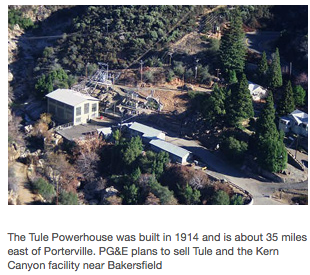
The Tule River project is located in Tulare County, 35 miles east of Porterville. A wildland fire in 2017 damaged the penstock headworks and the facility has not operated since. The project includes about 40 acres of land.

SCE also owns a hydro project on the Tule

Plan for pumped-storage reservoir in So Valley

January 1,2021
from Bakersfield Californian

By John Cox
Screen Shot 2021-01-01 at 12.04.45 PM
A $3 billion pumped-water energy storage project has been proposed along Isabella Lake that would help even out power delivery from California solar and wind farms at a volume and longevity dwarfing the large battery installations envisioned for eastern Kern.

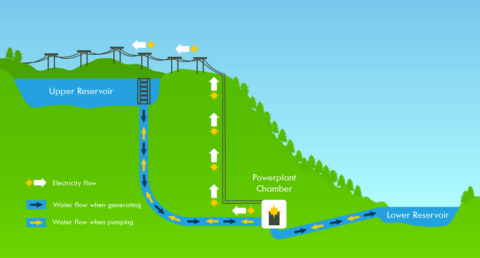
The Federal Energy Regulatory Commission is reviewing a Walnut engineering company’s plan to create a new reservoir above the lake then use pumps and underground pipes to turn it into a rechargeable dam and hydroelectric generator putting out a whopping 2,000 megawatts of power for up to 12 hours at a time.

Optimistically, the project could open within six years but remains in such an early stage that its environmental impacts haven’t been studied and its eventual owners or operators haven’t been identified, said the head of the company behind the proposal, Power Tech Engineers Inc., whose principals have experience with similar projects elsewhere.

President Victor Rojas suggested the installation might serve best as a government asset even as it would serve electric utilities and their customers.

He said the U.S. Department of Energy has offered to cover 70 percent of the project’s cost. The agency did not respond to an email Monday afternoon requesting confirmation of an offer of financial backing. Also, a FERC official reviewing Power Tech’s proposal could not be reached for comment.

PROS, CONS
Pumped-storage hydroelectric, as such projects are known, is among many forms of energy storage under consideration as California looks to provide clean, renewably sourced power even when solar and wind installations aren’t generating electricity.

Gravity-powered projects like Power Tech’s proposal offer benefits and drawbacks different from the kind of batteries proposed to be sited alongside massive solar arrays planned for eastern Kern.

Pumped-water storage offers huge scale and lifetime of maybe 100 years but it cannot instantaneously produce power and it disrupts large areas of habitat. Batteries immediately deliver when called on but have a relatively short life — generally less than two decades — and can’t provide electricity for more than a few hours at utility scale.

For size comparison, 8minute Solar Energy’s 400-megawatt, more than $1 billion Eland photovoltaic array proposed in eastern Kern would come with 1,200 megawatt-hours of energy storage — just 5 percent the capacity of Power Tech’s pumped-water project.

Kern River Master Dana Munn, who oversees water storage and flow at Isabella Lake, expressed concern Power Tech’s project would interfere with the flow of water from the lake down the river.

“A power plant will go on and it’ll essentially cause a fluctuation in the river,” he said.

CLOSED LOOP
Rojas disputed that interpretation, saying the project would use a “closed-loop” design that shouldn’t affect the lake or the river much once it is equipped with between 30,000 and 40,000 acre-feet of water.

Membrane would be installed beneath the water’s downward flow to reduce water loss to percolation, he said, and there would be a covering above, possibly including solar panels, to limit evaporation.

Rojas said three alternative sites are under consideration for siting the upper reservoir. If the “small lake” that would be created is deemed to have too great an impact on animals and plants there now, he said, “we’ll look somewhere else.” But his hope is that the benefit becomes clear.

“Without projects like this the renewable energy solution won’t be possible,” he said. “We have to have a way to store the energy when the sun is not shining (and) the wind is not blowing.” He added that informational workshops for the public will be scheduled later allowing people to learn more about the project.

He said Power Tech’s engineers, formerly with the Los Angeles Department of Water and power, have designed pumped-water energy projects in Castaic and elsewhere.

Rosemead-based utility Southern California Edison and the nonprofit California Independent System Operator, which operates the state’s power grid, said separately they were not familiar with Power Tech’s proposal but that they support a diverse mix of energy-storage projects.

Pacific Gas and Electric Co. declined to comment on the project.

Jim Cramer: Joe Biden Is the Counterintuitive Savior of the Oil Industry

The end of unbridled, pro-fossil fuel is over and, incredibly, that’s good news for oil and gas companies.

By JIM CRAMER Nov 24, 2020 | 06:03 AM ES

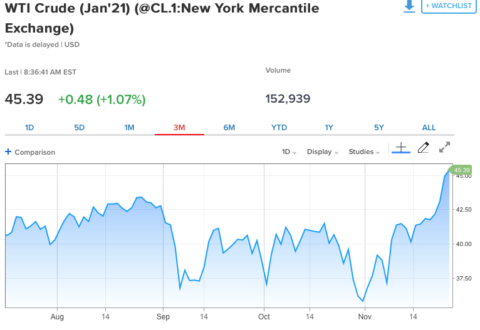
Biden wins -oil goes up

President Trump almost killed the oil industry and now President Biden’s going to save it. At least for now.

That’s what the stocks are saying and it makes sense when you think of it. Under President Trump we had unbridled drilling. It was almost embarrassing the lengths we were willing to go, including opening up the sacred Arctic National Wildlife Refuge for drilling.

It was all a part of a belief that we have abundant fossil fuels in this country, including coal, in some valuable states when it comes to the election, so why not exploit it.

The president didn’t believe in global warming and he apparently never gave a second thought to whether there would be environmental consequences, everything from methane flaring, to oil spills from pipelines to another Exxon (XOM) Valdez, the disastrous oil spill off the coast of Prince William Sound in Alaska in 1989. It is not at all clear to me that the president had even heard of that 31-year-old accident.

The result?

We witnessed an insane race to the bottom of all of the oil companies that bid up the price of land and at the same time overproduced to the point of saturation. As the late Aubrey McClendon of Chesapeake (CHKAQ) fame always told me, unlike any other industry, oil people will drill and produce regardless of price. It’s just who they are.

Well, they sure did it. As did the pipeline companies, which sensed a once-in-a-lifetime opportunity to build pipe out to pretty much any basin they would like.

Now, though, it looks like it is all coming to an end. A new, environmentalist president has been elected and he is thought to be ready to reverse these policies, many of which do not need congressional approval.

The betting is that he will curtail drilling, first on federal lands and then on non-federal lands, by making rules that forbid excess methane. That’s going to drastically cut the ability to drill because methane is a byproduct of oil exploration. If he makes federal rules about methane you can see fracking being almost obliterated.

The result?

Given that the U.S. is the swing producer, prices will go up and the industry will be preserved, especially because the Covid vaccine should encourage more driving and more economic activity. Biden as the savior of the oil companies. Why it is safe to buy Pioneer (PXD) and Chevron (CVX) for now.

Second, the new president will speed up the closing of all coal plants as a way to transition to a carbon-free utility complex. He won’t be able to do it yet. It will have to be bridged by natural gas, which, by the way ,is excellent for General Electric (GE) .

Third, he will make it very difficult to put up new pipelines as environmentalist Democrats despise pipelines. That will make the scarcity value of pipelines increase. You can see the master limited partnership stocks finally starting to go up after years of decline. That’s directly related to a belief that the era of pipeline buildout is over which should, theoretically, be good for the incumbent pipelines.

Now all of this is theoretical. We have no idea what Biden really has in store. But we do know this: the end of unbridled, pro-fossil fuel is over and, in an incredibly counterintuitive way, it’s good news for oil and gas because without more capital to feed the beast, the beast lives, not dies because it is no longer sowing the seeds of its own destruction.

Offshore Wind Research Buoys Float into California’s Waters

-October 14,2020-

Sites include Morro Bay
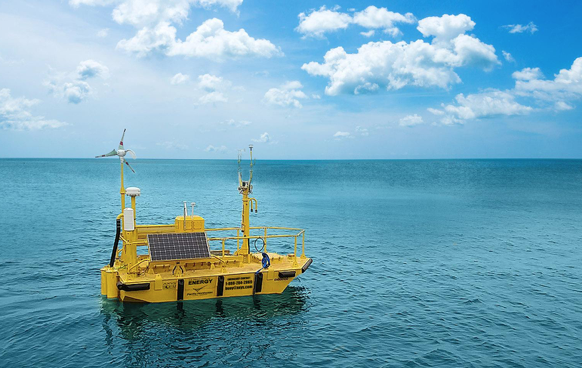
Two offshore wind research buoys managed by the U.S. Department of Energy’s Pacific Northwest National Laboratory  were deployed recently off the coast of California. This marks the first time the buoys have been launched to gather meteorological and oceanographic measurements off the West Coast.
Screen Shot 2020-10-14 at 3.01.57 PMThe pair of buoys were deployed by DOE’s Wind Energy Technologies Office, with this research funded by the Bureau of Ocean Energy Management—or BOEM. BOEM is gathering data to support decisions on potential leasing of wind energy sites off California’s coastline that will bring a new renewable energy source to the state.
One buoy is stationed in approximately 625 meters (more than 2,050 feet) of water off Humboldt County along the northern coast. The second buoy is deployed in about 1,000 meters (more than 3,280 feet) of water off Morro Bay along the central coastline.
“The buoys are stationed off the coast of California in deep water and will gather wind measurements for 12 months,” said PNNL’s Alicia Gorton, who oversees the buoys and the deployments. “The measurements they obtain will provide BOEM and offshore wind stakeholders with the most accurate and detailed information needed to make solid decisions regarding wind energy development, such as siting and design considerations.”
The answers are blowing in the wind
Each buoy is equipped with instrumentation to capture a suite of measurements, such as wind speed and direction at multiple heights, air and sea surface temperatures, ocean current speeds and directions, and wave heights and directions.
The buoys were deployed previously from 2014 through 2017 off the coasts of New Jersey and Virginia, providing data to support offshore wind development off the East Coast. They underwent a $1.3-million upgrade earlier this year, which included more powerful lidars that provide wind data up to 250 meters above the sea surface—where offshore wind turbines would operate. The upgrade, overseen by the PNNL team, also involved moving the associated data management system to an open-source platform for easier data access by the wind scientific community at large.

Following the upgrades, the buoys were validated against a reference lidar off the coast of Martha’s Vineyard, then were transported this summer to the West Coast for deployment.
Analysis of the buoy data will be used to validate wind models, improve the understanding of air-sea interactions, and reduce uncertainty and risk in characterizing offshore wind resources. The data will be stored in the Data Archive and Portal, also managed by the agency, where it will be publicly available to the wind research community.
Keeping an eye on bird and bat behavior, too
In the spring, the northern coast buoy will likely host a PNNL-developed avian measurement system, ThermalTracker.
The system consists of thermal cameras and software that uses stereo vision processing to provide three-dimensional flight data about birds and bats around wind turbines. The data from ThermalTracker—flight height, speed, and passage rates, for instance—will provide offshore wind developers with the information they need to understand avian behavior around wind technologies so they can best plan development and operations

LA,Ventura community power agency to buy Tulare County solar energy

-September 26,2020-

Screen Shot 2020-08-26 at 1.48.29 PMClean Power Alliance is California’s new, locally operated electricity provider for communities across Los Angeles and Ventura Counties.The new agency will buy power from Tulare County’s newest solar project owned by 8 Minute solar. 

Announced  this month 8minute Solar Energy has inked a 15-year power purchase agreement (PPA) with Clean Power Alliance (CPA) for the output of a 300-MW solar project in California that will be coupled with energy storage.

The off-take contract will support the construction of the 400-MW direct current (DC) Rexford 1 Solar & Storage Center, which will include a 180-MW/540-MWh battery energy storage system.

The developer will start building the solar park on private, low-productivity disturbed farmland in Tulare County in early 2022 creating more than 400 union construction jobs and about 1,000 indirect jobs.

The solar plant is expected to be completed in 2023. It will contribute more than USD 200 million to the local economy over its life, the developer estimates.

“The recent blackouts and continued wildfires in California offer sobering proof of the urgent need for more renewable and reliable energy generation that both fortifies our grid and fights climate change – and large-scale solar paired with energy storage is the most efficient, lowest-cost way to achieve just that,” commented Tom Buttgenbach, founder and CEO of 8minute.

The company said it has now contracted 4.5 GW of solar projects. The company has more than 18 GW of solar capacity and 24 GWh of storage under development across California, Texas and the southwestern part of the country.

California To Phase Out Gasoline-Powered Cars & Drastically Reduce Demand for Fossil Fuel

-September 23,2020-

Executive order directs state to require that, by 2035, all new cars and passenger trucks sold in California be zero-emission vehicles .Transportation currently accounts for more than 50 percent of California’s Greenhouse Gas Emissions.   

Zero-emission vehicles are a key part of California’s clean, innovation economy – already California’s second largest global export market  

Order also directs the state to take more actions to tackle the dirtiest oil extraction and support workers and job retention and creation as we make a just transition away from fossil fuels  

Screen Shot 2020-09-23 at 12.02.16 PMSACRAMENTO – Governor Gavin Newsom today announced that he will aggressively move the state further away from its reliance on climate change-causing fossil fuels while retaining and creating jobs and spurring economic growth – he issued an executive order requiring sales of all new passenger vehicles to be zero-emission by 2035 and additional measures to eliminate harmful emissions from the transportation sector.
The transportation sector is responsible for more than half of all of California’s carbon pollution, 80 percent of smog-forming pollution and 95 percent of toxic diesel emissions – all while communities in the Los Angeles Basin and Central Valley see some of the dirtiest and most toxic air in the country.

“This is the most impactful step our state can take to fight climate change,” said Governor Newsom. “For too many decades, we have allowed cars to pollute the air that our children and families breathe. Californians shouldn’t have to worry if our cars are giving our kids asthma. Our cars shouldn’t make wildfires worse – and create more days filled with smoky air. Cars shouldn’t melt glaciers or raise sea levels threatening our cherished beaches and coastlines.”

Following the order, the California Air Resources Board will develop regulations to mandate that 100 percent of in-state sales of new passenger cars and trucks are zero-emission by 2035 – a target which would achieve more than a 35 percent reduction in greenhouse gas emissions and an 80 percent improvement in oxides of nitrogen emissions from cars statewide. In addition, the Air Resources Board will develop regulations to mandate that all operations of medium- and heavy-duty vehicles shall be 100 percent zero emission by 2045 where feasible, with the mandate going into effect by 2035 for drayage trucks. To ensure needed infrastructure to support zero-emission vehicles, the order requires state agencies, in partnership with the private sector, to accelerate deployment of affordable fueling and charging options. It also requires support of new and used zero-emission vehicle markets to provide broad accessibility to zero-emission vehicles for all Californians. The executive order will not prevent Californians from owning gasoline-powered cars or selling them on the used car market.

California will be leading the nation in this effort – joining 15 countries that have already committed to phase out gasoline-powered cars and using our market power to push zero-emission vehicle innovation and drive down costs for everyone.

By the time the new rule goes into effect, zero-emission vehicles will almost certainly be cheaper and better than the traditional fossil fuel powered cars. The upfront cost of electric vehicles are projected to reach parity with conventional vehicles in just a matter of years, and the cost of owning the car – both in maintenance and how much it costs to power the car mile for mile – is far less than a fossil fuel burning vehicle.

The executive order sets clear deliverables for new health and safety regulations that protect workers and communities from the impacts of oil extraction. It supports companies who transition their upstream and downstream oil production operations to cleaner alternatives. It also directs the state to make sure taxpayers are not stuck with the bill to safely close and remediate former oil fields. To protect the health and safety of our communities and workers, the Governor is also asking the Legislature to end the issuance of new hydraulic fracturing permits by 2024.

The executive order directs state agencies to develop strategies for an integrated, statewide rail and transit network, and incorporate safe and accessible infrastructure into projects to support bicycle and pedestrian options, particularly in low-income and disadvantaged communities.

The text of today’s executive order can be found here and a copy can be found here.

This action continues the Governor’s commitment to strengthening California’s resilience while lowering carbon emissions – essential to meeting California’s air quality and climate goals. In the last six months alone, the California Air Resources Board has approved new regulations requiring truck manufacturers to transition to electric zero-emission trucks beginning in 2024 and the Governor signed an MOU with 14 other states to advance and accelerate the market for electric medium- and heavy-duty vehicles. Last fall, California led a multi-state coalition in filing a lawsuit challenging the U.S. Environmental Protection Agency’s attempt to revoke portions of a 2013 waiver that allows the state to implement its Advanced Clean Car Standards.

Last September, Governor Newsom took action to leverage the state’s transportation systems and purchasing power to strengthen climate mitigation and resiliency and to measure and manage climate risks across the state’s $700 billion pension investments. To mitigate climate threats to our communities and increase carbon sequestration, the Governor invested in forest health and fuel reduction and held utilities accountable for building resiliency. The Governor also directed state agencies to develop a comprehensive strategy to build a climate-resilient water system and made a historic investment to develop the workforce for California’s future carbon-neutral economy.

Western Fresno County’s impressive cluster of renewables

Westlands plans new 200MW solar project

-September 1,2020-

Fresno County is processing an application to build a 200MW solar plant and battery storage project in the western part of the county.The land is owned by Westlands Water District and has been dry farmed for 10 years. An environmental report is being prepared according to a Aug 28 notice.

Screen Shot 2020-09-01 at 6.01.50 AMCalled the Luna Valley Solar Project the 1300 acre site is near the big 1900 acre Tranquility Solar project and will connect to PGE’s Tranquility Switching Station.The site is bounded by State Route ( 33 to the east, West Dinuba Avenue to the south, South Bernardino Avenue to the west, and West South Avenue to the north. West Manning Avenue bisects the Project site from east to west;. The nearest communities to the Project site include Tranquillity, Mendota, and San Joaquin. Westlands Water District acquired the property as part of a 2002 settlement agreement in the Sumner Peck Ranch et al. v. Bureau of Reclamation et al. lawsuit, which prohibits irrigation on subject parcels.

Impressive solar cluster developing

A cluster of new Fresno County solar projects are either operational or in the works nearby totaling well over 1000 MW.
Not included in this number is a grouping of solar farms being developed by Westland Solar Park that adds up to 2700MW in Kings and Fresno counties and is located on Westlands Water District lands as well. CIM Group in collaboration with Westside Holdings is developing the solar park in phases. The construction of the first phase of the project began in March 2020 and is expected to start power generation in late 2021. Other phases are planned to be operational between 2023 and 2024.

Back in Fresno County the 205MW Tranquility Solar Project is operational. Next door Recurrent Energy‘s 400MW Scarlet Solar Project will also connect to the Tranquility substation and is anticipated to be online as early as late 2021 That site is 4,089 acres.

Also located on Wetlands WD land Little Bear Solar near Mendota is being built on 1300 acres. Construction has started on Little Bear Solar, comprising four separate solar projects totaling 215 MW.
Little Bear will sell energy and RECs to Marin Clean Energy (MCE) under 20-year busbar power purchase agreements (PPAs). The projects are expected to be completed by the end of the fourth quarter of 2020. In addition to creating approximately 500 jobs during the construction of the facility, the project will contribute over $2 million in sales and property taxes.

Fresno County is currently processing another project nearby- close to Huron- the Fifth Standard Solar Facility. RWE Solar Development, LLC (formerly known as EC&R Solar Development, LLC) (Applicant) has applied to the Fresno County Department of Public Works and Planning for three Unclassified Conditional Use Permits for a 150-megawatt (MW) solar photovoltaic (generation facility, an up to 20-MW solar generation facility, and an up to 100-MW energy storage facility.The project is being proposed on 1,600 acres.

Largest solar farm gets green light

So Tulare Co project would be built by 8 minute

Screen Shot 2020-08-26 at 1.48.29 PMThe nation’s largest solar farm got the green light from the Tulare County Planning commission this week to be built in southern Tulare County near Ducor.  The site is scattered over 3614 acres of mostly grazing and dry field crop farm land with majority of  bisected by Highway 65.

The  big project,called Rexford Solar Farm  to be built by LA based 8 Minute, a  privately-held developer of large utility scale solar projects. The company ,with several large solar farms in Kern County plans  to construct a 700 megawatt alternating current (MW AC) utility scale solar farm and an up to 700 MW AC energy storage system.

The project would involve the construction of both transmission and collector lines. Power generated by the proposed Project would be transmitted to the Southern California Edison (SCE) Vestal Substation via an up to 230 kilovolt (kV) overhead and/or underground gen-tie line.  The transmission lines would be  approximately 13 miles in length. The construction period for the Rexford Solar Project from site preparation through construction, testing, and commercial operation, is anticipated to commence as early as Q4 2021 and could encompass approximately 12 to 24 months.