
-June 19,2020-
Electric utilities from three western states have outlined a plan to establish a string of charging stations designed to power electric heavy trucks hauling freight along Interstate 5. The first phase of the project would site 27 locations along the busy corridor.The initiative is meant to juice deployment of long-haul electric heavy duty trucks.
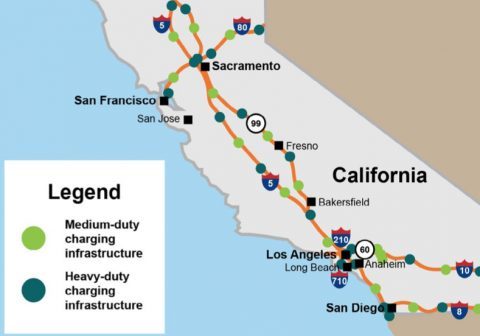
Over the same time period -by 2025 – 41 additional sites would be located at similar intervals and expanded in the same manner along the following arterial highways including State Route 99.
A study, released by the West Coast Clean Transit Corridor Initiative June 17 proposes establishing robust charging outlets along I-5 from the Mexican border to Canada and also along other key interstates and state highways that connect with the busy cargo route. The plan would allow truckers to re-power their vehicles at comfortable intervals and locations, including well-traveled existing truck stops.
“In talking to fleet customers, we understand that to accelerate deployment of EV (electric vehicle) trucks, they would like to see these public sites open to support their operations along the highway,” Katie Sloan, director of eMobility and Building Electrification for Southern California Edison.
A coalition of nine electric utilities and two municipal power agencies in California, Oregon, and Washington are working together on what specific infrastructure would be required to help accelerate the adoption of EV heavy trucks, which currently have an average range of more than 100 miles per charge and will eventually displace the trusty, but smoky diesel rigs that contribute to transportation emissions.
 By 2030, it’s estimated that medium- and heavy-duty trucks could make up nearly 25% of MD trucks and 5% of HD for a total of 8% of all trucks on the road in California Oregon and Washington.
In addition to SCE, other sponsors of the study are Pacific Gas and Electric Company, Pacific Power, Portland General Electric, Puget Sound Energy, Seattle City Light, Sacramento Municipal Utility District, San Diego Gas & Electric, Los Angeles Department of Water & Power, Northern California Power Agency and Southern California Public Power Authority.
With states and utilities nationwide committed to significant reductions in their greenhouse-gas emissions, the transition to a “green” transportation sector relies heavily on having reliable charging capacity in place along heavily traveled roads in the same way that gas stations and truck stops currently serve cars and smaller trucks. The proposals outlined were considered an initial step in providing charging infrastructure for truckers.
“The electrical service that goes into large trucks is a lot larger than what we have had to do for light-duty trucks, so a truck plaza charging up to 10 trucks at a time requires a lot of energy,” said Bill Boyce, manager of Electric Transportation, Sacramento Municipal Utility District. “You need more time to plan for it and this study is to identify what we need and to get ahead of the curve.”
The California Air Resources Board this spring released the final draft of the Advanced Clean Trucks standard. The proposal will put roughly 100,000 and 300,000 electric trucks on California’s roads in 2030 and 2035, respectively, out of approximately 1.8 million and 1.9 million total trucks expected in those years.
In the more immediate timeframe, CARB’s proposal will require 4,000 electric trucks to be sold in 2024 out of roughly 75,000 total sales.
The charging station report concluded that the best strategy would be installing charging facilities at intervals of around every 50 miles along I-5 and also at points on various east-west highways, including Interstates 8, 80, and 710 in California; I-84 in Oregon, and I-90 in Washington.
“Electrifying delivery, freight and other commercial transportation on I-5 and adjoining highways will help bring us closer to achieving clean energy and environmental goals, and will mean major health benefits to the communities near those highways,” said Eva DeCesaro, senior product manager, Transportation Electrification for Pacific Power
The recommended first phase would be installing chargers at 27 locations to serve medium-duty delivery vans by 2025. Fourteen of these locations would be expanded to accommodate heavy-duty trucks by 2030, at which time it was estimated that 8 percent of the trucks on the road in California will run on electricity. It was estimated that the upgrades would average 10 2-megawatt charging ports per station and possibly on-site battery storage to help keep vehicles on the road at night.
Individual utilities have been active in building charging stations for EV passenger cars and also localized light-duty fleets, such as delivery vans, within their service territories; however, since semi-trucks travel longer distances and I-5 crosses state lines, a high level of coordination will be required to place charging infrastructure in the right places and also ensure that they can be connected to the appropriate electric transmission lines.