Chinese Dairy Firm Has Old Lindsay Olive Plant In Escrow

Screen Shot 2014-04-11 at 10.46.55 AM300 Jobs Could Be Coming To Lindsay

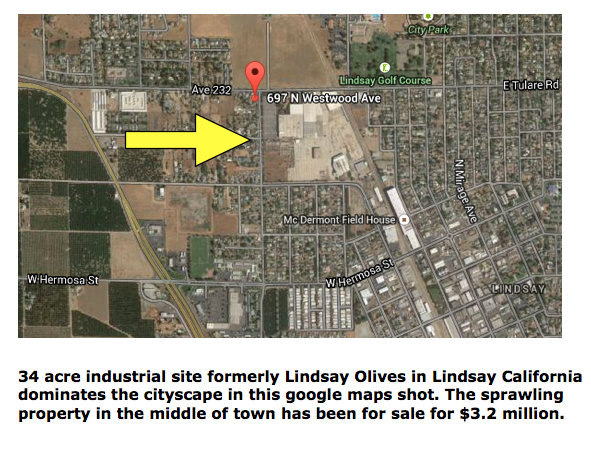
A Chinese dairy group has the former Lindsay Olive plant in Lindsay in escrow. The vacant 35 acre plant has been for sale for $3.5 million. The group is represented by Visalia realtor Mike Schuil who confirms that the unnamed company has a Tulare County facility under contract.

Lindsay Community Development Director Bill Zigler acknowledges a company is talking to the city about plans to occupy the sprawling plant but was asked not to mention names.

Lindsay City Council member Pam Kimball says the council is ”very encouraged that the former Lindsay Olive is in escrow and the company has indicated that would hire 300 people.”

Kimball confirms the dairy and Chinese connection.”They were in town today meet with our city manager. The company engineers are coming next week to visit the plant.”

Kimball says the group’s representative has told the city they hope to close escrow in August.

Other sources say the Chinese group is believed to be interested in processing Tulare County milk to be shipped back to China, perhaps in aseptic containers not needing refrigeration.

A Chinese company has been touring existing buildings in Tulare County to set up a manufacturing facility and a number of local realtors have showed the group’s representatives various buildings including some in Visalia.

The former Lindsay Olive plant was last occupied by Tulare Frozen Foods who closed their doors several years ago.The facility was a USDA approved food plant that includes a 90,000 sf building and 7 others along with rail access.

Kimball who has been on the city council for some 12 years remembers when “just about half the town used to work at Lindsay Olive” before it closed in1992. “We’re still trying to recover from that” she adds.

With Tulare County being the number one milk producing county in the US – it is not surprising a Chinese company might be interested in tapping our milk to ship home where supplies are scarce and demand is high.US dairy exports  were up 19% in January and China is  now importing double what it did a year ago.

Demand is China has been rising faster than that country’s dairy farmers can supply.On top of that Chinese consumers continue to not trust their own dairy industry that supplied tainted infant formula a few years ago. To make matter worse  the China’s dairy industry is undergoing a shrinking with up 40 per cent of farmers leaving the industry in the last two years, according to one estimate.The efforts to limit smaller dairy farms stemmed in part from the 2008 melamine scandal that killed at least six babies and sickened thousands more says a Chinese press report.
.
To date California farmers are selling milk to China in the form of powdered product trucked to the Port of Oakland and then loaded onto ships to China in bags with the American flag on it, a symbol of quality.

Our highly rated food safety record and regulations appears to be a badge of trust. Sending US-made product by ship works out well with Asian-bound ships full of Chinese exports to the US often returning to Asia empty.

China is today the world’s top dairy importer valued at $40 billion last year, 5X what it was 10 years ago.

A slew of recent affiliations,joint ventures and mergers by Chinese , Australian,New Zealand and European dairy product makers look to fill demand there. WhiteWave Foods Co.,a US food maker, recently announced such a merger.

All that demand has helped boost milk prices as well as stimulate plans to grow the diary industry in Tulare County recently after some very tough years. A new cheese plant, CaliCheese in Tulare plans to export products and California Dairies in Visalia is planning an expansion to make specialty powder to meet the surging demand in China for infant formula. Last week a local dairy group bought acreage in the Visalia Industrial Park for a new cheese plant.

On the price front – California dairymen who were crying in their milk a year ago are enjoying good times for change.

“I just got my largest milk check ever” says Tom Barcellos, Porterville dairyman and president of Western United Dairymen.


State Controller Releases March Cash Update

April 9,2014
Screen shot 2012-06-15 at 12.12.22 PMSACRAMENTO – State Controller John Chiang today released his monthly report covering California’s cash balance, receipts and disbursements in March 2014. Revenues for the month totaled $6.4 billion, surpassing estimates in the 2014-15 Governor’s Budget by $470.9 million, or 7.9 percent.
“As employment in California nears its pre-recession peak, the State is seeing positive gains in many of its primary revenue sources,” said Chiang. “As we enter the important month of April, all eyes will be on the State’s income tax receipts – and whether they size up against budget estimates.”
Total revenues for the fiscal year through March 31 were $66.2 billion, nearly $1.9 billion above the latest budget projections.
Last week, the Controller launched a new tax tracker site logging deposits from the State’s major taxes through the end of April. The site is updated multiple times a day, always using the latest figures available from tax collection agencies.
March income tax receipts exceeded the latest expectations by $231.6 million, or 8.6 percent. Corporate tax receipts came in ahead of estimates by $130.6 million, or 9.5 percent. Sales and use taxes were $22.4 million above, or 1.4 percent, expectations in the Governor’s 2014-15 proposed budget.
The State ended the month with a General Fund cash deficit of $16.7 billion, which was covered with both internal and external borrowing. That figure was up from last year, when the State faced a cash deficit of $15.2 billion at the end of March 2013.
For more details on today’s report, read the financial statement and summary analysis.
Read a version of this press release in Spanish.
For more news, please follow the Controller on Twitter at @CAController, and on Facebook at California State Controller’s Office.

Airport Passengers Numbers Higher In Early 2014

April 10,2014Screen Shot 2014-04-10 at 7.09.42 AM

The number of passengers using area airports are up in February 2014.

LAX reports international traffic climbed 8.6% and domestic travel was up 5.5%. For all of 2013 passenger numbers climbed 4.7% to a record 17.8 million visitors.

In Fresno passenger traffic climbed near 5% in February compared to the same month a year before.The airport now has ten carriers. Last year the airport did a record business handling 1.4 million passengers. This summer non-stop service to Honolulu on Allegiant Air will return as of June.

The big news from Bakersfield is that Frontier Airlines announced it would launch a Bakersfield to Denver flight in May on a 138 seat Airbus.

At San Luis Obispo airport traffic in February grew 10.6% year-over-year. Officials here are still trying to lure United to start up a SLO to Denver flight.

Hampering expansion dreams are a nationwide pilot shortage particularly for smaller carriers. Critics blame the low pay offered these positions for the lack of new pilots.

California’s Exports Regain Momentum

Screen shot 2012-06-15 at 12.12.22 PMApril 3, 2014 – California’s exporters turned in a strong showing in February, surging ahead by 8.3% over the same month one year earlier, according to a Beacon Economics’ analysis of foreign trade data released this morning by the U.S. Commerce Department.

“After a languid January, California’s export trade accelerated back to the sprightly growth rates we saw all through the second half of last year,” said Jock O’Connell, Beacon Economics’ International Trade Adviser.

 For the month of February, the state’s merchandise export trade totaled $13.76 billion, up from the $12.70 billion in exports recorded in February 2013. By comparison, overall U.S. merchandise exports increased by just 0.3% during the same period.

 February saw a 7.9% jump in California’s manufactured exports, which totaled $9.02 billion, up from $8.37 billion one year earlier. Leading the way was the state’s aerospace sector, manufacturers of communications gear, and oil refineries.

 Meanwhile, the state’s exports of non-manufactured goods (chiefly agricultural produce and raw materials) in February totaled $1.87 billion, up 12.7% from $1.66 billion in February 2013. Re-exports grew by 7.1% to $286 billion from $2.67 billion.

 “This is great news on many fronts,” said Christopher Thornberg, Founding Partner of Beacon Economics. “These numbers just represent physical goods more or less produced in California and shipped abroad – they miss service exports, such as software, royalties on movies and other entertainment products, and in-bound tourism.” Thornberg explained that “all these items are highly correlated with goods exports over time, implying that the boost to California’s economy is larger than the already impressive numbers imply. The return to global growth is good for us,” he said.

A Closer Look at the Numbers

As always, Beacon Economics cautions against reading too much into month-to-month fluctuations in state export statistics, especially when focusing on specific commodities or destinations. Significant variations may occur as the result of unusual developments or exceptional one-off trades and may not be indicative of underlying trends.

For that reason, Beacon Economics compares the latest three months for which data are available (i.e., December 2013 –February 2014) with the corresponding period one year earlier.

California’s merchandise exports during the latest December-February period totaled $41.23 billion, a nominal increase of 6.4% over the same period one year earlier.

Computer and Electronics Products remains by far the single largest category of California exports, accounting nearly one-quarter of the state’s merchandise export trade. In the most recent three-month period, exports of Computer and Electronics Products totaled $10.19 billion, up 2.3% from the same period one year earlier.

Exports of Transportation Equipment meanwhile increased by 19.7% to $4.51 billion, largely powered by a shipments of aerospace equipment to Canada, Japan, Taiwan, and Kuwait.

Other sizable gains were recorded in the latest three-month period for agricultural produce, up 7.1% to $3.37 billion and processed food products, up 12.4% to $2.62 billion. Exports of petroleum products continued to rise sharply, soaring by 49.2% to $2.05 billion.

Mexico remained California’s single largest export market during the latest three-month period, with the value of exports edging up by 8.0% to $5.80 billion. Exports to Canada rose by 16.0% to $4.54 billion, while shipments to China surged by 23.0% to $4.12 billion. Japan (down 7.1% to $2.98 billion) and the Republic of Korea (up 13.2% to $2.12 billion) rounded out California’s ‘Top Five’ export destinations in the latest three-month period.

Regionally, California’s exports to the Asia Pacific region (including Australia and New Zealand) edged up only 2.6% to $15.94 billion, despite surges in shipments to China and South Korea. Exports to the European Union rose by 7.4% to $6.96 billion. California exports to Latin America and the Caribbean (excluding Mexico) increased by 6.2% to $2.74 billion.

California’s export trade with sub-Saharan Africa totaled a comparatively negligible $186.9 million in the latest quarter.


California exports to Ukraine during the last three-month period ($35.1 million) were down by more than half from the same interval one year earlier. Meanwhile, the state’s merchandise exports to Russia during the latest three-month period totaled $238.4 million, off 4.5% from one year earlier.


California accounted for 10.8% of total U.S. merchandise exports over the past three months, up from its 10.3% share in the same period one year earlier.


By mode of transportation, 43.1% of California’s $41.23 billion merchandise export trade in the most recent three-month period was shipped by air, with Los Angeles International and San Francisco International Airports accounting for the vast majority of the state’s airborne trade. Seaports handled 34.03% of the state’s export trade, while the remaining 22.9% of the state’s exports of goods traveled overland by truck or rail to Canada and Mexico.


Beacon Economics’ outlook for exports anticipates healthy growth over the next several months. “Although we are fully cognizant of the challenges affecting merchandise trade worldwide, our confidence in the resourcefulness of California’s exporters remains undiminished,” O’Connell said.

China Peak Ski Resort Expects 2 Ft of Snow By Wednesday

After a tough season China Peak
ski resort above Fresno is getting a Spring Break,and so are skiers.

Here’s what they reported today after a series of storms in the past few days and more coming.

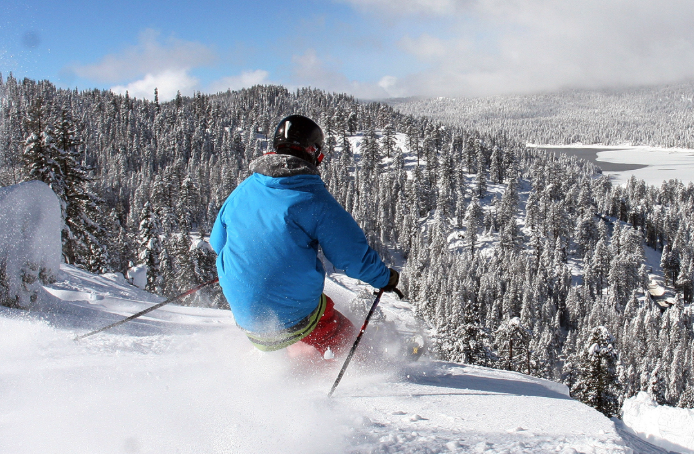
Screen Shot 2014-04-01 at 2.12.17 PM“Tuesday, April 1, 5:30 AM … 10 INCHES OF FRESH SNOW OVERNIGHT, CLEAR SKIES THIS MORNING, POWDER DAY @ CHINA PEAK, MORE SNOW ON THE WAY TONIGHT … NO FOOLIN’! 

The most recent forecast is calling for more snow tonight, with total accumulations up to two feet by Wednesday, a few snow showers later in the week, and then sunshine for the weekend.

We’ve received 25-30 inches of new snow in the past five days!

We are open daily at least through this Sunday, April 6, after that will depend on the weather, so come up soon to enjoy the new snow!

It’s very early to predict, but … they’re already calling for El Nino next winter.”

Wet Seal Plus-Size Store Heading For Visalia

Wet Seal  2014-03-31 at 11.45.57 AMAfter opening their first Plus-Only size store in Clovis last year Wet Seal is about to open their second Wet Seal + in Visalia’s Packwood Creek shopping center.  The popular teen retailer already has a store in the Visalia Mall that will be unaffected.The new Wet Seal Plus Only store is under construction at 4021 S Mooney near Cameron on the westside of Mooney

Tenant improvements are going in with the contractor needing about  6 weeks to finish up he says, meaning the store will be likely open before this summer.

Last year the retailer, typically located in malls,had announced it would increase its plus-size offerings a their stores that were previously available only on-line. Collections include skirts, sweaters,dresses, belts and more.

Wet Seal has been struggling to earn a profit recently,reporting an operating loss of $27.3 million in the latest quarter after a loss of $25.5 million the same quarter a year earlier.

For the year same store sales declined 4.1%.

CEO John Goodman said a few days ago said that the retailer made  “substantial progress” on their “turnaround strategy” that includes “significant opportunity we see in the the plus size market.”

In Packwood Creek shopping center competitor Lane Bryant also is selling plus-size clothes in an existing store.

Center developer Patrick Orosco said “we are pleased to expand the soft goods store lineup at Packwod Creek” noting the  shopping center has about a half dozen national apparel stores.

Around Tulare County: Food Fight In Dinuba / More

Visalia General Fund Shows Nice Surplus

Visalia’s economy seems to be recovering from the economic downturn like the rest of the State. Last fiscal year was the first time in 5 years the projected revenues exceeded operating expenditures. The city’s General Fund is projected to have a surplus of $4.0 million for fiscal year 13/14 and $1.8 million in 14/15.The main reason for this improvement says a city memo, has been the larger than expected growth in sales tax. The growth is being driven by several factors, namely: increased auto sales, Industrial Park sales tax growth from existing and new businesses and general improvement of retail sales.

Bryce ,Fred and Kim in happier times; SBA photo

Court Battle:Bryce Ruiz vs Ruiz Food Products Inc

Tulare County’s largest private company,Dinuba’s Ruiz Foods Products  Inc, is in the middle of a family feud of sorts. Founded by Fred Ruiz  in 1965, the Mexican frozen food company is in a now public dispute involving Fred’s son Bryce, the former CEO from 2009 to 2012, who is suing the company in Tulare County Superior Court.
Bryce says in court documents that he had a severance agreement with the firm that was breached. Bryce claims he still owns one third of the shares of Ruiz Foods Products. He seeks a non-voluntary  dissolving of the corporation after he claims the bylaws were violated. A judge decided this week in favor of Bryce in a preliminary ruling that will take the matter to a court hearing. To protect “trade secrets” some matters are sealed. One 2010 estimate listed annual sales of the private food maker at $453 million with a staff of 2500.

County Seeks To Pare Rural Subdivisions

Two rural subdivisions,one near Woodlake and another near Springville have been rejected by the county Planning Commission but could still see the light of day. The Tulare County Board of Supervisors will hear a staff recommendation next Tuesday not to reject a a planned 68 unit home subdivision near River Island above Porterville but to reduce its size before it is approved.It is possible that could happen to a project near Woodlake on Colvin Mountain too. Called Elderwood Heights, this subdivision was denied by the Planing Commission March 12. But the PC rulings are advisory and the BOS will have the final word. Neighbors near both projects raise concerns over water and traffic. Ironically the Woodlake project would use a fraction of the water an orange grove does says a staff report.

County Jobless Rate Falls

The unemployment rate in the Tulare County was 15.1 percent in February 2014, down from a revised 15.2 percent in January 2014, and below the year-ago estimate of 15.7 percent. Year-over-year farm jobs fell by 2000,perhaps the first sign the drought may hurt ag jobs. But non-farm jobs increased by more.

Mugs & Beans To Open Eatery Near Hospital

A new restaurant will open in the 202 Willow, the five story medical building next to Kaweah Delta. The eatery – Mugs & Beans seeks a conditional use permit through the city Planning Commission April 11 says realtor Marty Zeeb.

February Hotel Receipts Up

Room revenue for hotels in Tulare County were up 7.6% in February compared to the same month a year ago according to Smith Travel. The average daily rate climbed from $93.64 a year ago to $98.38.

Existing Home Sales Decline,Median Price Up

Tulare County’s existing home sales fell in February from 282 to 246 while the median value of homes sold climbed 18.1%, over that year, from $133,000 to $155,000.

Self-Help May Build Multi-Family Project in Visalia

Home building has rebounded in the recovery but not in the multi-family category.There have been no multi-family permits issued in Visalia since 2011 when 3 projects with a total of 10 units were permitted. Now Self Help Enterprise is planning to build a 36 unit complex on Highland near Fairview School.”We hope to start building it later this year” says vice president Tom Collishaw.The non-profit has helped people build about 80 single-family homes in town but this would be the first apartment project. Self Help recently reached the remarkable milestone of 6,000 homes built since they started in 1965. Collishaw is expected to replace Peter Carey as CEO in July. Carey served more than 40 years with the organization.

Holy Cow! Record Cheese Prices

Dairy food prices are soaring on record export demand, some good news for Tulare County – the nation’s number one milk producing  county.This week block cheese prices reached a record $2.43 per lb. on the CME.

From California To Canada, Millions Of West Coast Salmon Expected

March 14,2014
Source: NW Fishletter

Screen Shot 2014-03-14 at 12.27.14 PMFrom California to Canada, this year’s salmon season is expected to be big. In some places, like B.C.’s Fraser River, fish managers may be counting sockeye in the tens of millions.
Earlier this month, the Pacific Fishery Management Council said nearly 635,000 fall chinook are expected to return to the Sacramento Basin. That’s about 200,000 fish shy of last year’s prediction, which ended up very close to actual estimated harvest and escapement (97 percent). Back in 2010, only 40,000 returned. Fish conservation groups blamed the poor returns on the lack of water during the juvenile migration phase, but an expert panel later concluded that the stock had been victimized by poor ocean conditions.
Further north, The Klamath River is estimated to see nearly 300,000 returning chinook. Last year’s return of 165,000 was about 47 percent lower than the 2013 preseason prediction.
NW Fishletter has already reported on this year’s high expectations for fall chinook returning to the Columbia River’s Hanford Reach, but the PFMC’s preseason report put the estimates in real perspective. It says the preliminary forecast of 973,300 adults is about 124 percent of last year’s return and more than 300 percent of the recent 10-year average of 311,970.
“This forecast is a record high forecast and slightly higher than the 2013 record high return to the Columbia River of 784,100,” said the report, which noted the expected return is “well above” managers’ conservation objective of 39,625 natural area spawners in the Hanford Reach, Yakima River, and areas above Priest Rapids Dam, “and should allow opportunity for both ocean and in-river fisheries.”
Ocean Conditions
Also ,a new study says that large sockeye returns to the Columbia Basin in recent years correlated best with early upwelling off the Northwest coast, and an annual collection of precipitation and temperatures called the Pacific Northwest Index [PNI]. Freshwater conditions like flow and percentage of spill at dams, however, didn’t carry much weight at all.
The peer-reviewed paper, “Influence of Ocean and Freshwater Conditions on Columbia River Sockeye Salmon Adult Return Rates,” was published Feb. 27, 2014 in Fisheries Oceanography. It was written by recently retired NOAA Fisheries scientist John Williams and eight co-authors.
Further North
The PFMC report said Puget Sound spring Chinook runs are expected to remain “depressed,” but summer/fall stocks are predicted in the 270,000-fish range, up considerably from 2013’s preseason forecast. Managers expect 37,000 natural fall Chinook, compared to last year’s 16,100-fish forecast (2013 PS returns have not been finalized).
Coho are on the upswing as well–the Oregon production index hatchery (OPIH) forecast calls for 983,100 coho, that’s nearly twice the 2013 prediction and about 3 times the preliminary 2013 postseason estimate, according to the PFMC report, which also noted that last year’s preseason estimate was 66 percent higher that last year’s return estimate.
Puget Sound coho (hatchery and natural) are expected to return in the 859,800-fish range, compared to a 2013 forecast of 882,100. According to the report, the hatchery coho forecast is 378,600, about 40,000 fish lower than the 2013 forecast, and the natural coho forecast for 2014 of 481,200 is much higher than the 2012 forecast of 464,900.
It’s an off-year for pinks in the Northwest, but last year was a blockbuster in both Puget Sound and the Fraser River, where somewhere around 26 million returned. However, the Fraser may see another big sockeye year in 2014, progeny of 2010’s monster 28-million-fish return.
Canada’s Department of Fisheries and Oceans’ analysis has estimated a 50-percent chance that about 23 million sockeye will return to the Fraser in 2014, in a range of estimates that run from 7-million to 72-million fish. DFO says there is a 10 percent probability the run will come in at or below 7 million, and a 90-percent probability that it will come in at or below 72-million fish.
Canadian biologists reported that the 2010 sockeye escapement to major Fraser tributaries was very high, and subsequent egg-to-smolt, and smolt survival was also very good, with large numbers leaving for marine areas in 2012–surveys off the B.C. coast that year saw the highest number of juvenile sockeye since the smolt surveys began in 1988. Returning jack counts were also reported high.
Some optimistic voices in the Canadian press have pointed out that 2010’s preseason forecast for Fraser sockeye estimated a 50-percent probability that the run would come in around 10 million fish, so returns this year could be much better than predicted, especially after 2013’s huge pink return signaled good ocean conditions. However, last year, DFO analysts also predicted a 50-percent probability that the 2013 sockeye return would be in the 4.8-million-fish range, and it came in a million fish lower.
The DFO estimate for this year’s return is more uncertain, says the official analysis, because the numbers of spawners seen in some Fraser tributaries in 2010 were higher than fitted escapement values in the model. “As a result, the 2014 return forecasts produced by biological spawner-recruit models are extrapolated beyond the range of fitted escapement values, thereby increasing their uncertainty.”
The Washington Department of Fish and Wildlife announced March 3 that Baker Lake, in the Skagit Basin, is expected to see a sockeye return of 35,000 fish this year, and managers expect to open a fishery on the run again this year. But the Lake Washington sockeye run, which was originally planted with fish from Baker Lake, is predicted at 167,000, way short of the 350,000 needed to return before any recreational fishery would be allowed.

Safeway and Albertsons Announce Definitive Merger Agreement

Screen Shot 2014-03-06 at 2.55.26 PMPLEASANTON, Calif. and BOISE, Idaho, March 6, 2014 /PRNewswire/ — Safeway Inc. (NYSE: SWY) and Albertsons announced today a definitive agreement under which AB Acquisition LLC (“AB Acquisition”) will acquire all outstanding shares of Safeway (the “Merger”). The merger agreement was unanimously approved by the Board of Directors of Safeway.
AB Acquisition is the owner of Albertson’s LLC and New Albertson’s, Inc. (collectively “Albertsons”) and is controlled by a Cerberus Capital Management, L.P. (“Cerberus”)-led investor group, which also includes Kimco Realty Corporation (NYSE:KIM), Klaff Realty LP, Lubert-Adler Partners LP, and Schottenstein Stores Corporation.
As a result of the Merger, plus other actions to be taken by the Safeway Board of Directors as described below, including the separate sales of certain other primarily non-core assets, and the distribution of Blackhawk shares, Safeway shareholders are expected to receive total value estimated at $40 per share.
Albertsons’ Chief Executive Officer Bob Miller stated, “This transaction offers us the opportunity to better serve customers by adapting more quickly to evolving shopping preferences in diverse regions across the country. It also brings together two great organizations with talented management teams. Robert Edwards and his team have done an outstanding job in positioning Safeway’s core business for success, by investing in its stores and creating innovative strategic marketing programs that contribute to shareholder value. Working together will enable us to create cost savings that translate into price reductions for our customers. Together, we will be able to respond to local needs more quickly and deliver outstanding products at the lowest possible price, more efficiently than ever before.”
“This Merger is one of several actions we have taken in recent months as a result of our strategic business review. The combined value of the transactions described above is expected to deliver a premium to Safeway’s shareholders of 72% from one year ago, and 56% over the share price six months ago,” said Robert Edwards, President & Chief Executive Officer of Safeway Inc. “Safeway has been focused on better meeting shoppers’ diverse needs through local, relevant assortment, an improved price/value proposition and a great shopping experience that has driven improved sales trends. We are excited about continuing this momentum as a combined organization. We look forward to working with Bob Miller and the rest of the Albertsons team as we proceed together on a path towards becoming an even stronger organization.”
The Merger will create a diversified network that includes over 2,400 stores, 27 distribution facilities and 20 manufacturing plants with over 250,000 dedicated and loyal employees. No store closures are expected as a result of this transaction.Bob Miller, Albertsons current Chief Executive Officer, will become Executive Chairman. Robert Edwards, Safeway’s current President and Chief Executive Officer, will become President and Chief Executive Officer of the combined company.
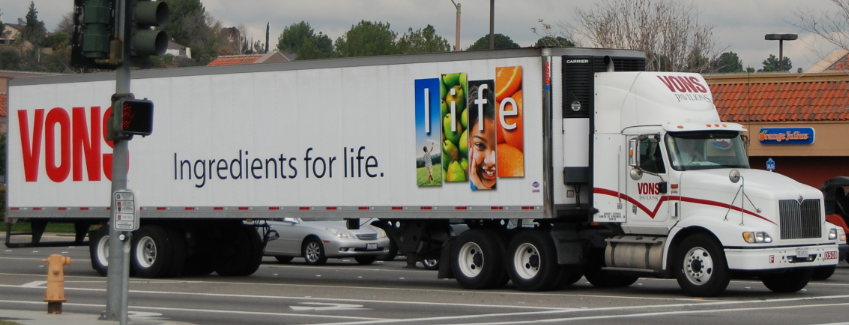
Banners will include Safeway, Vons, Pavilions, Randalls, Tom Thumb, Carrs, Albertsons, ACME, Jewel-Osco, Lucky, Shaw’s, Star Market, Super Saver, United Supermarkets, Market Street and Amigos.