Fitch Downgrades Tulare Local Health Care District Revs to ‘B’; Placed on Negative Watch

Screen Shot 2014-03-05 at 3.24.28 PMTurn Around Plans Detailed  

February 28, 2014
New York- based Fitch Ratings has downgraded to ‘B’ from ‘B+’ the rating on $15,230,000 series 2007 fixed rate bonds issued by the Tulare Local Health Care District d/b/a Tulare Regional Medical Center (TRMC).
The bonds have been placed on Rating Watch Negative.
SECURITY
Debt payments are secured by a pledge of the gross revenues of Tulare Local Health Care District. A fully funded debt service reserve fund provides additional security for bondholders.
KEY RATING DRIVERS
SUSTAINED OPERATING LOSSES: The downgrade to ‘B’ reflects a continued trend of operating losses driven by declining revenues from persisting challenges in patient utilization. Operating losses were sustained in the fiscal year ended (FYE) June 30, 2013 and through the interim period ended Dec. 31, 2013, though somewhat improved from 2012 levels. Due to negative cash flow, TRMC violated its debt service covenant in fiscal 2012, and a ‘going concern’ was expressed in the last two audited financial statements.
VERY WEAK LIQUIDITY: TRMC’s liquidity position is very weak, resulting from negative cash flow and complications with its ongoing construction project. Unrestricted cash and investments were $6.3 million at Dec. 31, 2013 compared to $10.5 million at Dec. 31, 2012 and $24.4 million at FYE 2010. Management indicated that a large part of the decline through the interim period was due to timing of intergovernmental transfers (IGTs), and reported an unrestricted cash balance of $9.8 million at the end of Feb. 2014.
OPERATIONAL TURNAROUND EXPECTED: In Jan. 2014, TRMC entered into a management agreement with HealthCare Conglomerate Associates (HCCA), an organization that was formed specifically to address operational and construction challenges at TRMC. HCCA recruited a number of industry experts in operational, financial, clinical, and construction efforts, and began operating TRMC on Jan. 13, 2014 under a short-term management contract. HCCA is projecting TRMC to break even by the end of calendar year 2014, which Fitch believes is relatively attainable.
ONGOING CONSTRUCTION DELAYS: The completion of the new bed tower that was initially scheduled for Oct. 2012 has yet to be completed. The remaining cost and sources of funding for the project is unknown at this time but will likely pose a significant demand on already weak liquidity. TRMC is leveraging HCCA’s expertise to renegotiate contracts and develop a recovery schedule.
RATING SENSITIVITIES
CLARITY ON CONSTRUCTION PLANS: The Negative Watch reflects the uncertainty around the timing and funding sources of the construction project. Management expects to have a construction completion plan in the next 60 days which is expected to provide greater clarity on TRMC’s ability to meet all its financial commitments.
CREDIT PROFILE
Tulare Local Health Care District, d/b/a Tulare Regional Medical Center owns and operates a 112-bed hospital in the city of Tulare, California. Total operating revenue in FYE June 30, 2013 was $76.4 million (exclusive of tax revenues related to GO bonds debt service).
Sustained Operating Losses from Erosion in Patient Volume
TRMC posted operating losses for the second year in 2013 with an operating loss of $2.3 million, which includes annual district tax revenues of approximately $1.5 million that can be used to support operations and debt service requirements. This is significantly improved from a loss of $9.9 million in fiscal 2012, from significant expense reductions in areas such as labor and supply costs. As a result, operating margin improved to a negative 3.1% in fiscal 2013 compared to a negative 13% in fiscal 2012. Similarly, operating EBITDA margin improved to a positive 3.3% in 2013 compared to a negative 7.8% in 2012. As a result of its poor financial profile, a ‘going concern’ on the ability to continue hospital operations was expressed in 2012 and 2013 in the audited financial statements.
Significant losses continued through the six-month interim period ended Dec. 31, 2013, with operating and operating EBITDA margins of negative 12% and negative 3.8%, respectively, compared to a negative 10% and negative 4.5% in the prior year period. A number of financial improvement plans are in place, with a goal of arriving at breakeven performance within this calendar year.
Management Agreement with HealthCare Conglomerate Associates
In December 2013, the board of TRMC selected HCCA as an affiliation partner. HCCA is a management organization formed with the purpose of addressing the issues at TRMC, including financial and operational turnaround, improving physician relationships, and completing its construction project. Under a 12-month management contract, HCCA began managing TRMC in Jan. 2014 with the goal of entering into a long-term lease within this calendar year. As the potential transaction is in its early stages and no details were provided, Fitch’s analysis assumes the bonds will remain outstanding in its current form.
Under the management contract, HCCA has several executives on-site that will manage the day-to-day operations. The turnaround plan focuses on three key areas – operational/financial, clinical, and construction. A chief restructuring officer from HCCA is at TRMC full-time, assuming the responsibilities of CEO, as well as several other professionals focusing on physician integration and construction management.
A thorough review of revenues and expenditures began once HCCA came onsite in Jan. 2014, and several initiatives are being executed to improve operating profitability. Projected growth in revenue is estimated at 5% for this calendar year, with a focus on recovering patient volumes and improving clinical documentation and revenue cycle. Targeted expense reductions total 8%, which is distributed across most expense items including labor, supplies, and maintenance. Management believes these targets are achievable, and should bring TRMC back to near breakeven operations in the next 12 months. Fitch believes financial improvements will largely be driven by TRMC’s ability to recover physician relationships and patient volume. While somewhat optimistic, Fitch believes these targets are reasonably attainable over time with a well-executed strategy, especially given TRMC’s historical utilization and profitability.
Weak Liquidity
TRMC’s liquidity has weakened over the last four audited periods driven by IT investments, other capital spending, and negative cash flow. Unrestricted cash and investments totaled $6.3 million at Dec. 31, 2013, compared to $10.6 million at Dec. 31, 2012 and $24.4 million at FYE 2010. Days cash on hand of 34 days, cushion ratio of 2.5x, and cash to debt of 33.2% reflect a sizable decline from 48.5 days, 4.1x, and 51.2% one year ago, and are very weak compared to Fitch’s median for below investment-grade ratings. Given ongoing operating expenditures, other infrastructure investments, and future spending needs related to the construction project, Fitch believes the ongoing demand on liquidity poses a serious threat to the solvency of the organization.
According to management, a large part of the year-over-year decline is due to the timing of IGT receipts. Management indicated that roughly $3.2 million of matching IGT funds were delayed this year, negatively impacting liquidity at Dec 31, 2013. The IGT matching funds were subsequently received, and as of Feb. 26, 2014, management reported unrestricted cash and investments of $9.8 million.
Fitch also notes a debt service reserve account is in place for the series 2007 bonds, with approximately $1.3 million held by a Trustee.

_______________________________________________________________________________________________________________________________________________________________

As of Dec. 31, 2013, there was approximately $6.8 million of restricted funds remaining for the construction project, which Fitch believes is insufficient to complete the project. TRMC will likely need to procure additional funding in addition to existing funds to complete the project.

______________________________________________________________________________________________________________________________________________________________

Ongoing Construction DelaysTulare has a major construction project in progress, which plans to feature a 24-bed emergency department, a new diagnostic department, a 16-bed obstetric unit, four surgery suites, and 27 new private patient rooms meeting seismic requirements. This new expansion tower was initially slated to open Oct. 2012, but suffered disruptions due to delamination issues. Renegotiating with contractors and putting a makeup schedule in place is one of HCCA’s priorities, and is expected to be complete in the next two months.
As of Dec. 31, 2013, there was approximately $6.8 million of restricted funds remaining for the construction project, which Fitch believes is insufficient to complete the project. TRMC will likely need to procure additional funding in addition to existing funds to complete the project. The Negative Watch reflects the uncertainties around construction completion and funding, and the impact on TRMC’s solvency. Fitch will evaluate the impact of the new construction plan and new debt, if any, after plans are finalized in the next two months.
Weak Debt Metrics Despite Moderate Debt Burden
At Dec. 31, 2013, Tulare’s revenue supported debt burden totaled $19.1 million, consisting of $15.2 million in series 2007 bonds and $3.9 million in capital leases. The debt is all fixed rate and produces a maximum annual debt service (MADS) of $2.5 million, which declines to $1.3 million in fiscal 2017 following the final payment on the capital lease.
Debt burden is relatively low, as measured by debt to capitalization of 27.3%. However, due to poor cash flow, MADS coverage was very low at negative 2.1x in 2012, positive 1.4x in 2013, and negative 0.8x through the six-month interim period, compared to the average of 4x in 2009-2011. TRMC violated its debt service covenant in 2012, which resulted in a consultant-call in. The debt service covenant was met in fiscal 2013, but the ability to pass in fiscal 2014 is uncertain. Fitch believes TRMC has sufficient resources to pay its obligations over the next year.
Not included in Fitch’s calculation of Tulare’s long-term debt are $85 million in general obligation (GO) bonds, which are not rated by Fitch. Since Tulare’s GO debt is secured by a special assessment on property taxes in the district, Fitch’s calculation of financial ratios excludes Tulare’s GO debt and related receipts.

Weather Report: No Drought Buster But Hopeful Rain Totals & Predictions

Screen Shot 2014-02-28 at 10.57.55 AMCan California Snowpack Rally?

Shasta Dam, the state’s most important reservoir saw just 5.4 inches of rain by by February 1. Now with a few days left in February the rain gauge is up 18.64 this month. The reservoir has gained 100,000 acre feet of water over that time.

Over the same period New Melones Dam started this month with only 2.4 inches of rain in the bucket but that number has climbed to 6.04 in today as this winter’s  total.

On the parched upper San Joaquin River watershed at Kaiser Point they had received only at 5.50 in of rain as of Feb 1. But some 28 days later the rainfall totals stand at 11.64 in with more than 2.5 inches falling in the past few days.

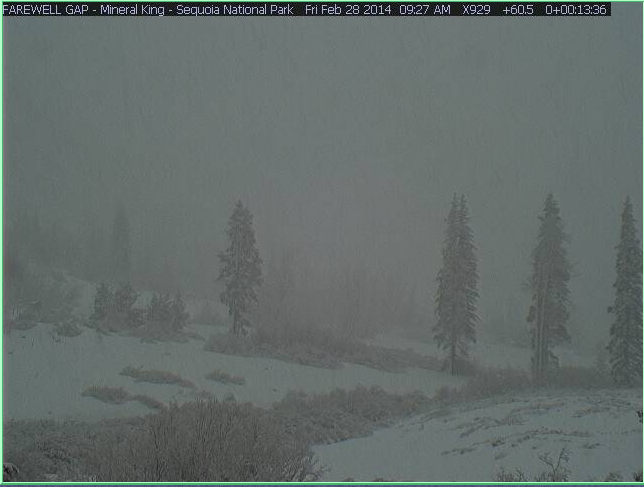
On the Kaweah River – Hockett Meadow rain totals stood at 7.4 in before this most recent storm but increased to 9.5 inches at 10.45 today. Mineral King webcam shows a snowy scene today with 10 inches of snow on the ground.

On the upper Tule,Quaking Aspen rain totals jumped 2.5 inches in the past two days.

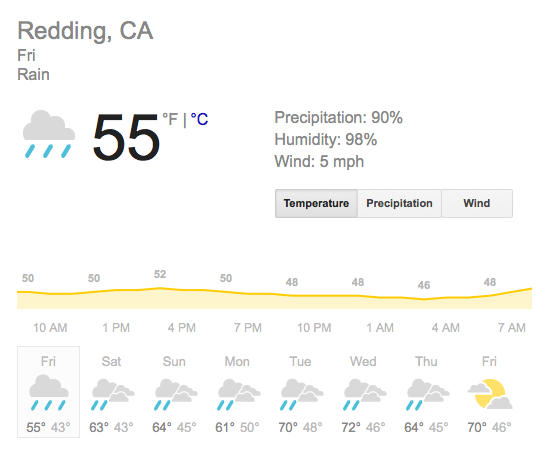
California is in for more rain this weekend and next week say forecasters. In Northern California – here is the 10 day forecast for Redding.

Screen Shot 2014-02-28 at 10.49.39 AM

Sierra ski resorts are reporting a good dumping of snow with China Peak above Fresno stating on their website this AM –
“The snow level is right at our base area, 7,000 feet, so it will be a wet and snowy day, expected to continue for the next 24 hours.
Forecasts continue to vary as to amount, but it looks like an additional foot or more (in addition to the 9-12 inches since yesterday) before it begins to wind down either late tonight or early Saturday morning, should be ideal timing for the weekend.
We will evaluate Chair 7 after today and tonight’s weather, hope to have it open at some point Saturday morning, will be slightly delayed in any case. With enough snow we might be able to open China Bowl, accessing from Chair 2, but we’ll see in the morning.”

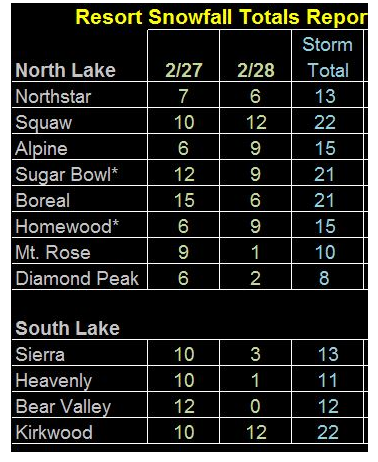
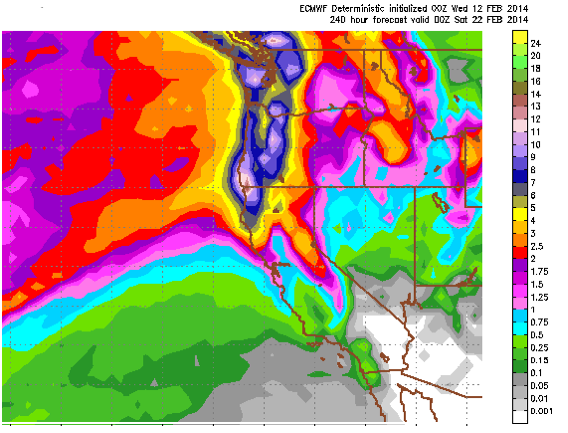
Here is what snow forecaster Bryan Allegretto shows on his blog today (see chart). Models show next Wed/Thurs could be wet for both the Tahoe area, the Central Coast and the key upper San Joaquin river watershed, headwater for the important Friant Kern canal.Screen Shot 2014-02-28 at 10.53.49 AM

It’s been good news on the Central Coast as well as Los Osos (our home base) seeing 2.5 inches in the past few days with plenty of rain still to come. Regards SLO County PG&E forecaster John Lindsey just wrote the following this AM: ”Total rainfall amounts today into Saturday will range between 1.5 and 3.5 inches. Higher amounts of rain could develop along the southwesterly facing mountains where up to 5 inches of rain could fall. Snow levels will  remain at between 5,000 and 6,00 feet with up to 2 feet of new snow in the Sierra. At the moment, current models indicate we will be under the influence of a subtropical moisture plume that will keep temperatures mild, mainly in the 60’s and 70’s and skies partly to mostly cloudy with the threat of sprinkles/light rain showers on Sunday and Monday. Mostly dry and partly cloudy weather is forecast on Tuesday
and Wednesday.

A cold front is expected to pass over San Luis Obispo County Thursday morning with rain showers, followed by increasing northwesterly winds Thursday afternoon through next Friday.”

Wear Your Rally Hat

Earlier this week weatherman Scott Sistek wrote an article asking “Can California’s Snowpack Rally like Washington’s?” He points out that the state of Washington was at 50 to 60% of normal as of February 7 but is now around 100% of normal. California needs 12 to 15 inches of rain to make up the drought or 120 to 150 inches of mountain snow.

By way of comparison Northstar ski resort in Tahoe has received 62 inches of new snow in February,more than all that had fallen earlier. A wet March with similar snow total would take it over 120 inches.

It seems clear that California is following the adage that ‘when it rains – it pours’, with these tropical banana express, atmospheric river events making the difference whether this drought will continue to be extreme or less so.
These weather patterns also calls for more storage in the state to capture storm water as it comes, saving it for a (non) rainy day.

Tesla Gigafactory Wont Be In California

February 26,2014

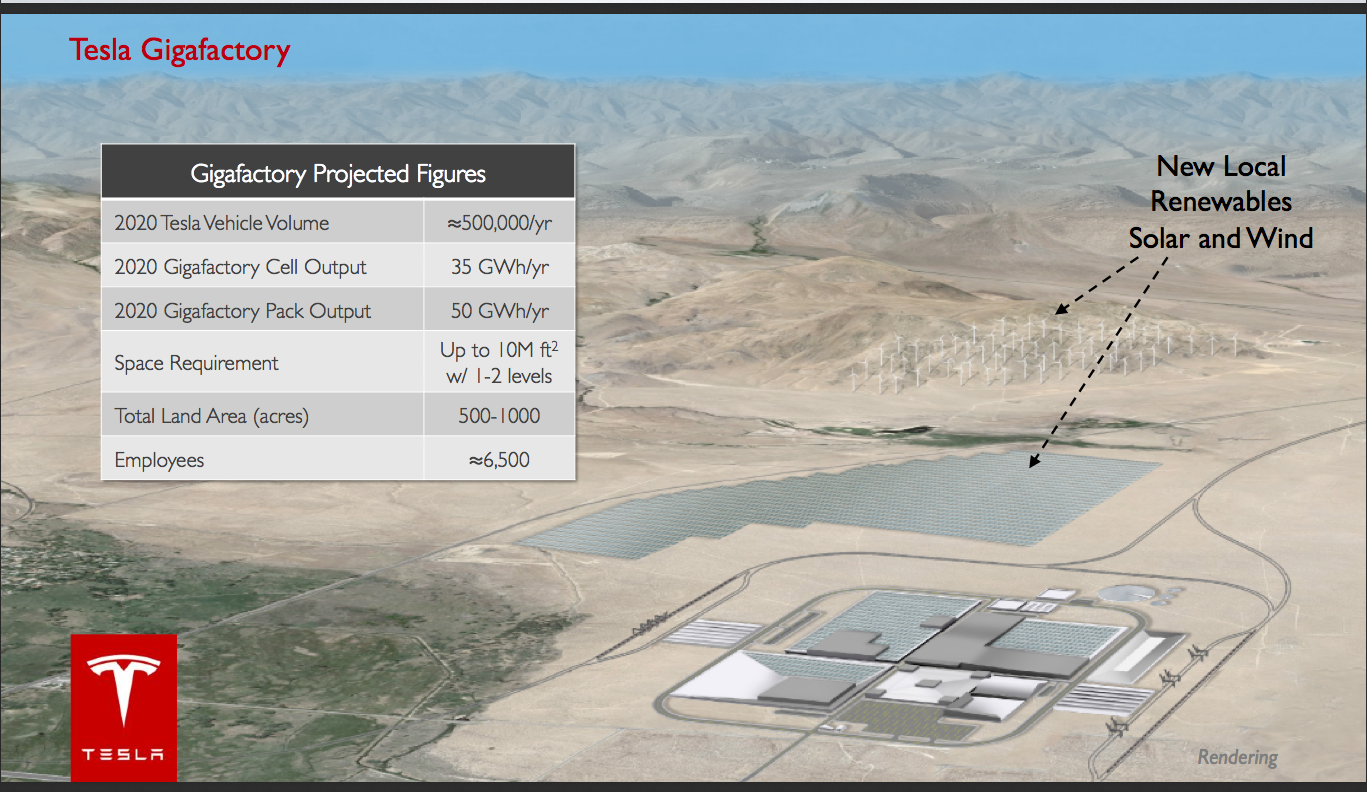
Screen Shot 2014-02-26 at 2.26.31 PMToday Tesla Motors based in Palo Alto revealed details about their proposed $2 billion gigafactory to make Lithium-ion batteries.
The headline for California is that our state is not in the running to site the 6500 employee plant. In the running are Nevada, New Mexico ,Arizona and Texas.

No word yet if Jerry Brown has given Elon Musk a call.

Here is what Tesla  said to in a blog on their website.
“As we at Tesla reach for our goal of producing a mass market electric car in approximately three years, we have an opportunity to leverage our projected demand for lithium ion batteries to reduce their cost faster than previously thought possible. In cooperation with strategic battery manufacturing partners, we’re planning to build a large scale factory that will allow us to achieve economies of scale and minimize costs through innovative manufacturing, reduction of logistics waste, optimization of co-located processes and reduced overhead.”

“The Gigafactory is designed to reduce cell costs much faster than the status quo and, by 2020, produce more lithium ion batteries annually than were produced worldwide in 2013. By the end of the first year of volume production of our mass market vehicle, we expect the Gigafactory will have driven down the per kWh cost of our battery pack by more than 30 percent.”

The good new for California is that according to the flow chart of the plant located in the Southwest, the batteries will be shipped back to the Tesla plant in Fremont California for assembly into vehicles with enough batteries to produce 500,000 vehicles in the year 2020.  That compares to annual production today of 34,000 in 2014 at the same plant.

Here is a rendering of how the plant site will look fed by renewable energy at a site that could be just as easily be Kettleman City or Arvin in the middle of California.That’s a lot closer to Fremont than Texas. Tesla wants to have construction of the plant completed by the end of 2015 meaning they will likely select the site soon. Clearly they have no time to waste,which is the point.

Perhaps it comes as no big surprise they would not choose to do this time sensitive mega battery plant in the Golden State considering our reputation for legal challenges at the drop of a hat

Consider what Kings County EDC director John Lehn says about how long it has taken for  Chemical Waste Management to get a permit to expand their facility in the Kettleman Hills.”I attended  another permitting hearing for the project that has taken 9 years to get a potential approval to expand the life the facility for just another eight years.” The still don’t have that permit.

Tesla wants to bring in raw materials like lithium from brine deposits in the southwest that may include Nevada and SW Wyoming.

Besides supplying Tesla Motors the new longer life batteries will be put to use by another Elon Musk company Solar City. According to their website “ SolarCity® (Nasdaq:SCTY) provides clean energy. We are disrupting the century-old energy industry by providing renewable electricity directly to homeowners, businesses and government organizations for less than they spend on utility bills. SolarCity gives customers control of their energy costs to protect them from rising rates. We offer solar power, energy efficiency and electric vehicle services, and make clean energy easy by taking care of everything from design and permitting to monitoring and maintenance. We currently serve 14 states and sign a new customer every three minutes.”

Adding storage to renewable energy enables customers to use the power when they need it – bypassing the utility.

Fresno Firm Lands Contract for High-Speed Rail Work

Blair Church & Flynn is a Native-American-Owned Small Business

Feb 24,2014
HS Rail2014-02-17 at 8.48.42 AMFRESNO, Calif. – In an effort to ensure that local small businesses are able to compete on the high-speed rail project, the California High-Speed Rail Authority (Authority) and the design-build contractor, Tutor-Perini/Zachary/Parsons (TPZP) announced the execution of a contract with Clovis-based Blair Church & Flynn Consulting Engineers (BC&F) for utility re-location design work in the Central Valley. As a Native-American-owned small business, this contract contributes towards the Authority’s small business participation goals.

The $1.6 million contract is for utility relocation design work within the first construction package (CP1), which runs from Avenue 17 in Madera to East American Avenue in Fresno. Plans and specifications for the relocation of existing facilities will be prepared by BC&F for Madera Irrigation District, Fresno Irrigation District, Fresno Metropolitan Flood Control District, and the City of Fresno. Typical utilities to be relocated will include irrigation facilities, storm drain lines, and water and sewer mains.

“We are committed to ensuring that Central Valley companies are a part of designing and building this transformative project,” said the Authority’s Central Valley Regional Director Diana Gomez. “Valley companies provide valuable local expertise and we are serious about making an effort get businesses in the Central Valley to work.”

”Our firm is a natural fit, offering a local, proven resource with more than 55 years of experience providing civil engineering to the Fresno area and key utility stakeholders,” said David Mowry President and CEO of BC&F. “The utility relocation work involves long-term clients we care deeply about. We understand their infrastructure and know first-hand how important reliable utility service is to our community.”

The Authority is meeting and exceeding goals set out in a small business program which includes a 30 percent participation goal for small businesses competing for contracts with the Authority. The small business program also includes a 10 percent participation goal for Disadvantaged Business Enterprises and a 3 percent participation goal for Disabled Veteran Business Enterprises.

California’s New Vehicle Market Improved by 11.9 Percent in 2013

From Calif New Car Dealers Assn
February 14,2014
Screen Shot 2014-02-14 at 7.30.49 AM

top selling car
top selling car

The California new vehicle market continued its steady recovery from the recessionary low point in sales that occurred in 2009. New light vehicle registrations in the state increased 9.0 percent in the Fourth Quarter of 2013 versus a year earlier. The percentage improvement slipped from recent quarters, but registrations still reached 422,313 units in the Fourth Quarter of last year, about 35,000 units higher than the Fourth Quarter of 2012. Total registrations in 2013 exceeded 1.71 million units, up 11.9 percent from 2012 and 65 percent from 2009!

Auto Outlook is predicting that registrations in 2014 will approach 1.8 million units, a 5.2 percent increase from 2013. Other key trends in the state market:
Among the top 15 selling brands, Subaru, Dodge, Mazda, Lexus, Chevrolet, Nissan, Ford, and BMW had the biggest percentage increases last year. New registrations for each of the eight brands increased by more than 15 percent (see page 4).
Detroit Three registrations increased 17.4 percent in 2013 and market share increased 1.3 points. Korean brands had a small decline and market share fell by 0.9 of a point. Japanese brands steadily increased by 12.7%.
Hybrid vehicle market share (excluding plug ins) increased to 6.8 per- cent last year, well above the 2012 level. Electric vehicle market share was 1.3 percent.
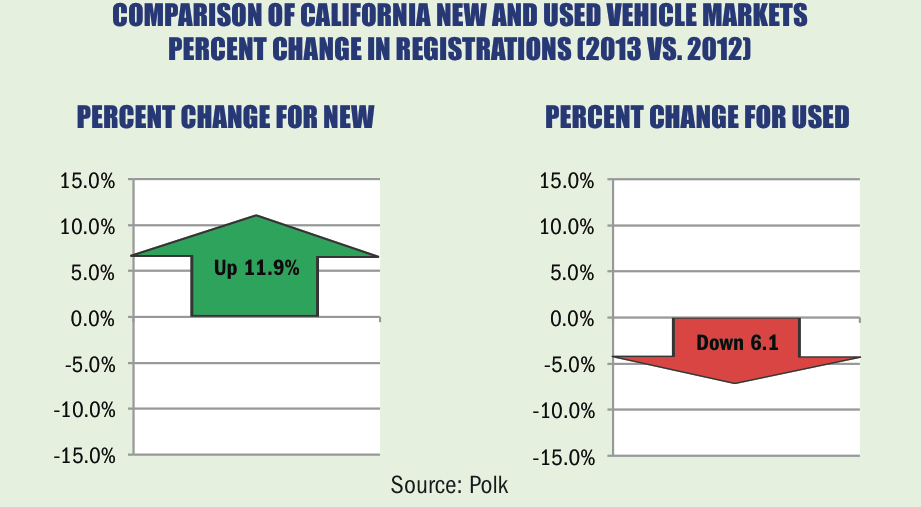
Used vehicle registrations fell 6.1 percent. Three year old or newer vehicles were up 12.9 percent, as supply shortages are easing.

Among other  interesting stats Toyota Prius remains the top selling car; California  improvement exceed the US increase in sales by 11.9% to 7.2%.

Also new car registrations were up 11.9% compared to a 6.1% decline for used vehicles.


More Rain In Northern California Could Free Up Water For South Valley

one forecast for rain over next 10 days

This last week as much as 10 inches of precipitation fell in the Sacramento Valley area and northern California. It was the most this winter in another year of extremely low rainfall totals.

Now there is some hope that more rain in the north could spell relief for south Valley farmers facing possible zero allocation from the big Friant project that irrigates a million acres of farm land from Madera to Kern County.

“It’s possible if it keeps raining there will be enough water to deliver at least some of the contracted supplies to the Exchange Contractors and free up our water stored in Millerton“says Paul Hendrix, general manager at one of the Friant districts – Tulare Irrigation District (TID).

The so-called Exchange Contractors based in the Los Banos area – gave up their right to San Joaquin River (Millerton) water as long as the federal Bureau of Reclamation can deliver water they historically  received from the San Joaquin with water from north of the Delta.

High & Dry?

Their water right preceded the construction of Friant Dam. Until the latest storms that was looking tough to accomplish and there are real concerns the Exchange Contractors would make a call for Millerton water this year, for the first time ever, leaving farms in Tulare County and elsewhere along the 152 mile Friant Kern Canal high and dry.

Hendrix says even if TID gets some of their Class 1 contract this year it likely with an agreement in place with Lindsay Strathmore Irrigation District (LSID),that this district will make a call on it since they are in worse shape than many districts. LSID needs water for both crops and people and have little groundwater. They trade water in a wet year for dry years like this.

That would make 2014 the second year in a row TID did not have an irrigation run for their farmers. Hendrix says the district’s  groundwater levels have been going down 20 feet a year for the past two years and “could go down more than that this year.”

The US Bureau of Reclamation is expected to make an announcement  in late February how it will manage the needs of both the Exchange  Contractors and the Friant water interests.

The Valley’s westside farmers appear to be in worse shape  scrambling to get water wherever they can.One big farmer – John Harris recently bid $1,350 per acre/ft for water from a Buttonwillow district who will fallow land this year. Most of it was bought be Paramount Farms, who bid $1100 per acre ft to buy 10,000 acre/ft for a cost of $11 million. These high spot market water prices compare to $30 to $50 per acre/feet for eastside contracted water.

Still,between more rain and a new state policy to save water in the system rather than let it go out to sea – may mean thousands of acre feet of additional water this Spring.

10 Day Forecast

On the rain front there is some hope. While the southern part of the state is looking at mostly sunny skies over the next 10 days the 10 day forecast for Redding California, next to Shasta Lake – calls for rain over 7 of the next 10 days. Shasta reservoir gained nearly 7 in of rain since the beginning of this month and the reservoir height has increased about a foot over that time, the first time this winter it has gone up instead of down..

At Folsom near Sacramento, storage has gone from 32% of average to 52% since the first of the month. At Blue Canyon on the American  they have received 13 inches of rain this month.

Meanwhile the rain and snow falling in the upper San Joaquin watershed has been more modest at 2 to 3 inches so far this month.

Still, for the north part of the state it looks promising. Weather caster John Lindsey writes todays that “A series of weather systems with plenty of subtropical moisture will move through Northern California and bring rain as far south as Big Sur over the next few days.”

Saving Water in Reservoirs

On the regulatory front as of January 31 the Department of Water Resources and the federal Bureau of Reclamation requested a change to water quality requirements that govern outflows in the
Delta and operation of the Delta Cross Channel gates. These requirements, in place since 1995, help control salinity in the Delta and protect water quality for municipal and industrial, agricultural, and fish and wildlife uses.

The State Water Board’s order approving the petition makes temporary urgency changes in the required amount of outflows into the Delta, enabling water to be conserved in reservoirs in case of continued drought.

The petition submitted to the Water Board also requests flexible operation of the Delta Cross Channel gates, which will enable greater protection against salt water intrusion to the interior portion of the delta while protecting fish populations. These gates typically remain closed during the late winter and spring, which protects fish from straying into the central Delta. However, due to low water flows, keeping gates closed prevents high quality fresh water to flow through the central Delta, reducing saltwater intrusion. The State Water Board’s order approving the petition provides flexibility to operate the gates based on evolving water quality conditions and fish migration information.

As a result of the order, the state and federal water projects will save approximately 150,000 acre feet of water in upstream reservoirs in February. The saved water will be available later in the year for uses in the public interest. If dry conditions persist, and this order is amended, an additional 150,000 acre feet of water will be preserved in March and an even greater amount in April.”

Sierra Gets Welcome Snow

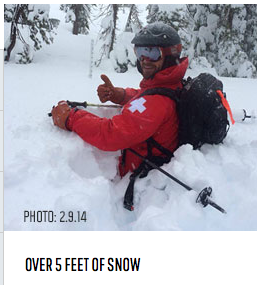
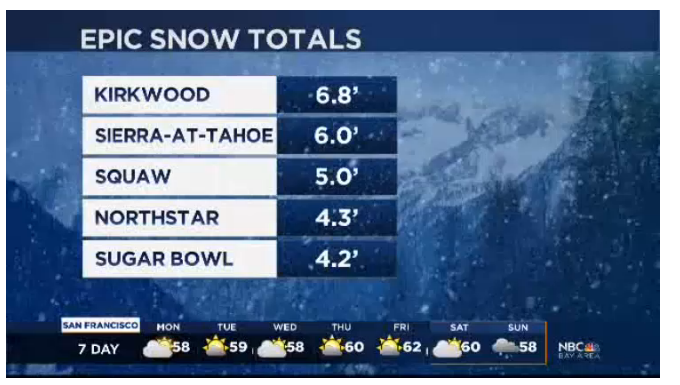
Screen Shot 2014-02-10 at 2.29.22 PMSkiers visiting Squaw Valley in the Tahoe area are being treated to over 5 feet of new snow this week after a multi-day series of wet storms pounded this part of the Sierra(see photo).  Nearby Kirkwood was said to get 6.8 feet of snow, NBC reported.

Around California the rain cheered residents desperate for moisture after months of waiting for winter weather to start. In Redding on Sunday the city recorded 0.82 in of rain breaking a record with twice as much falling as it did for all of January.

Bay Area communities reported as high as 10 inches of rain from the storms that were a result of an Atmospheric River, a Pineapple Express of moisture that flowed into the state up to today – likened to a fire hose effect with Tahoe as the bulls eye.

In Central California rain totals were less impressive but still widespread and significant.    Yosemite Visitors Center recorded 2.76 inches says NWS. Case Mountain above Three Rivers got 1.85 in and Ash Mountain got 0.50. Lodgepole recorded 0.22 in of water. On the Tule – Peppermint Mountain received 1.32 in. Hanford got just 0.06 while Visalia saw 0.11.

Screen Shot 2014-02-10 at 2.26.08 PMOn the snow front China Peak reports 15 inches of snow in the past week.

The Central Coast saw multiple days of sprinkles with hard hit Cambria with water restrictions in place getting a good dose – 2.25 inches of rain since Feb 2 – 9 Los Osos added nearly 1.5 inches to just 0.6 in for the water year up to then.

Regards state reservoirs – they got bigger with Oroville climbing 7 feet in the last week.  The state says we have just climbed above the 1976/77 average for this time of  the year, still very dry forecast but not as bad as a week ago.

The statewide snowpack water content is now estimated to be about 28% of normal for the date, up from 12% on Jan. 30.

Though the precipitation is clearly welcome, the Department of Water Resources says it would take rain and snowfall of near record-breaking proportions through the rest of the winter to bring California to average statewide precipitation for the season.

If California has been experiencing a drought the snowpack that feeds the all  important Colorado River looking pretty good with the basin snowpack at 112% of average as of Feb 10 according to the Bureau of Reclamation.


California Exporters On Hot Streak, Set New Record for 2013

February 6, 2014

By posting another strong performance in December, California companies set a new record for merchandise exports in 2013, according to a Beacon Economics’ analysis of foreign trade data released this morning by the U.S. Commerce Department.
For the year, California’s merchandise export trade was valued at $168.13 billion, up 4% over the 2012 total. “Even after adjusting for inflation, that tops any pre-recession year,” said Jock O’Connell, Beacon Economics’ International Trade Adviser.
For the month of December, the state’s merchandise export trade totaled $14.60 billion, a nominal 9.3% increase over the $13.36 billion in exports recorded in December 2012. By contrast, overall U.S. merchandise exports increased by only 0.2% over the same period.
Screen shot 2012-06-15 at 12.12.22 PMThe December gains in California were led by a solid jump in manufactured exports, which rose by 10.6% to $9.58 billion from $8.66 billion in December 2012.
“California has even started to add back manufacturing jobs,” said Beacon Economics’ Director of Economic Research Jordan Levine. “Although other parts of the nation saw manufacturing jobs bounce back sooner, California created nearly 1,000 new manufacturing positions in 2013 after nearly two decades of steady declines – demand from the rest of the world has certainly helped to fuel the turnaround.”
Meanwhile, the state’s exports of non-manufactured goods (chiefly agricultural produce and raw materials) in December totaled $1.92 billion, up 5.1% from $1.89 billion in December 2012. Re-exports increased 10.3% to $3.10 billion from $2.81 billion in December 2012.
The Annual Totals
California’s merchandise export trade for all of 2013 totaled $168.13 billion, easily finishing ahead of the $161.70 billion recorded in 2012. By comparison, total U.S. merchandise exports last year rose by 2.1% from 2012.
The state’s exports of manufactured goods amounted to $109.24 billion in 2013, up 4.6% from $104.43 billion the preceding year. Non-manufactured goods were valued at $21.62 billion, up 7.1% from $20.19 billion in 2012, while re-exports amounted to $37.27 billion, a narrow 0.5% increase over $37.08 billion in the previous year.
“For California’s exporters, 2013 was pretty much the story of a second-half rally,” O’Connell said. “In the first six months of the year, exports were actually trailing the 2012 numbers.”
A Closer Look at the Numbers
As always, Beacon Economics’ foreign trade analysis cautions against reading too much into month-to-month fluctuations in state export statistics. Significant variations may occur as the result of unusual or exceptional one-off trades and may not be indicative of underlying trends. For that reason, Beacon Economics compares the latest three months (i.e., October-December) for which data are available with the corresponding period in the previous year.
California’s merchandise exports during the October-December period of 2013 totaled $45.17 billion, a nominal increase of 11.1% over the last quarter of 2012.
Computer and Electronics Products remains by far the single largest category of California exports, accounting for $11.33 billion in shipments in the latest three-month period. That represented an increase of 4.5% in the final quarter of 2012.
Exports of Transportation Equipment meanwhile increased by 11.6% to $5.04 billion, largely powered by a resurgence of exports from the civilian aerospace sector.
Other sizable gains were recorded in the latest three-month period for farm produce, up 23.6% to $4.50 billion and processed food products, up 20.5% to $2.77 billion. Exports of petroleum products were up sharply, soaring by 46.2% to $2.12 billion.
Mexico remained California’s single largest export market during the latest three-month period, with the value of exports edging up by 5.1% to $6.24 billion. Exports to Canada were up 18.2% to $5.32 billion, while shipments to China surged by 29.8% to $4.54 billion. Japan (up 1.4% to $3.26 billion) and the Republic of Korea (up 24.1% to $2.30 billion) rounded out California’s ‘Top Five’ export destinations in the latest three-month period.
Regionally, California’s exports to the Asia Pacific region (including Australia and New Zealand) grew by 14.3% to $17.77 billion. And despite Europe’s prolonged affinity for austerity, exports to the European Union nonetheless rose by 9.2% to $7.41 billion. California exports to Latin America and the Caribbean (excluding Mexico) increased by 13.5% to $2.83 billion. California’s export trade with sub-Saharan Africa was comparatively negligible $210.3 million over the latest quarter.
California currently accounts for 11% of total U.S. merchandise exports. Not surprisingly, its share of U.S. exports to markets in the Asia Pacific region is larger (16.4%) than that of any other state.
Seaports are popularly regarded as the state’s principal international trade gateways. However, on a dollar-value basis, more of California’s merchandise export trade in the latest quarter went by air (42.1%) than by sea (35.1%). Another 22.8% of the state’s exports of goods travels overland by truck or rail to Canada and Mexico.
Beacon Economics’ outlook going into 2014 remains essentially buoyant. “Although many of the major forecasting institutions have been getting jitterish lately in the face of a slowdown in China’s economy and weaknesses in several developing economies, we continue to have confidence in the resourcefulness of California’s exporters,” O’Connell said.

Citrus Loss Estimates Top $441 Million

Screen shot 2013-01-17 at 7.33.00 AM

February 3,2014:

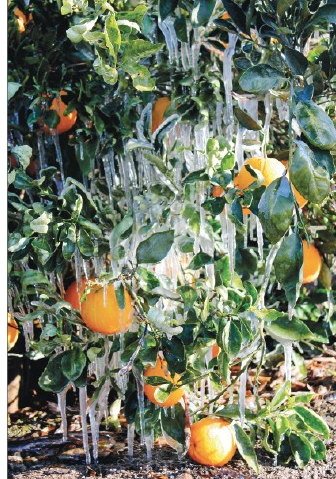
Exeter-based California Citrus Mutual estimates that San Joaquin Valley citrus growers have suffered around US$441 million in revenue losses due to a seven-day freeze that hit the region in early December, 2013.
The industry organization adds that citrus growers spent US$49 million to protect the 2013-14 crop, “What has made this year complicated for assessing damage is that Mother Nature did not treat all areas and producers equally,” California Citrus Mutual chairman Kevin Severns said in a release.
“There are areas in Kern and Madera Counties where the Mandarins are completely wiped out, and others where damage is as great as 40-50%.”
Severns added the same could be said for orange crops, which have been a “mixed bag”.
“We know of one grower who lost 100% of his tonnage, whereas most producers lost 10-20%,” he said.
Out of the estimated US$441 million in losses to the industry, US$150 million in losses have been felt by mandarin growers, who had harvested just a fifth of their crop at the time of the freeze and lost around 40% of the remaining trees to frost damages.
The loss for the orange industry has been even greater at US$260 million, representing a damage of 30% of crops.
California Citrus Mutual said lemon farmers in the area fared much better with just a 20% loss, accounting for about $24 million in foregone revenue.
“The industry is now faced with increased costs associated with quality inspections,” Severns said
“Fruit is moving through the packinghouses at a much slower rate as we employ freeze detection technology as well as human inspection protocol.
“The California citrus industry is known for producing high quality fruit, and that is a reputation the industry is going to lengths to protect.”

Shippers Grow Rail Competition

January 31,2014:
Western Milling Buying IGM:

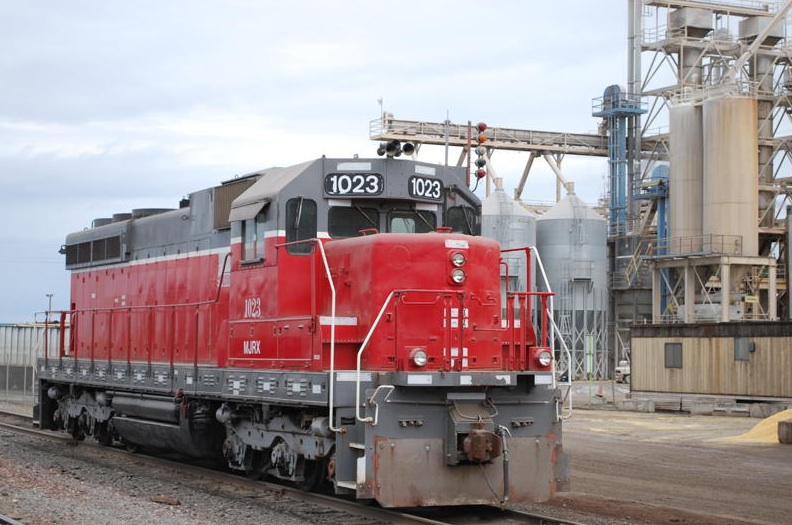
IGM -Hanford 2014-01-27 at 11.01.02 AMBefore the turn of the century Valley farmers realized it was in their best interest to  encourage competition shipping and receiving goods to distant markets. Since the late 1880s the Central Valley has had two rail lines who run roughly parallel north and south connecting to their nationwide network of tracks – Union Pacific (UP) and Burlington Northern Santa Fe (BNSF).

Through Tulare and Kings counties the two lines are at most 20 miles apart and often closer (see map).

Even in 2014 grain companies and their local customers who use corn being shipped in from the Midwest for cattle, cows,poultry and pigs as well as ethanol makers – all depend more than ever on nurturing a competitive atmosphere.

So it should come as no surprise that shippers who rely on those 110 car unit trains full of corn might seek whatever advantage they can muster including buying a feed storage location on multiple lines to foster that competition.

Pictured above: IGM feed mill site in Hanford

“It just makes sense to have a presence on both railroads” say Scot Hillman owner of J.D Heiskell company, based in Tulare. “That’s why we bought a feed mill in Guernsey (near Hanford) about four years ago” says Hillman whose other local mills are on the UP line.

IGM Sale Told

Screen Shot 2014-01-21 at 10.11.22 AMThis week the news is that Goshen-based Western Milling, with units on the UP line, will buy Integrated Grain & Milling in Hanford on the BNSF track. Western Milling owner Kevin Kruse says the deal, set to close January 31,“will allow us to choose where we get grain shipped in for our customers” hopefully saving money.

Western Milling would purchase IGM, buying out Zacky Farms but continuing a partnership IGM has with Harris Farms says Kruse. The new unit will no longer carry the IGM name. The mill is located at 10495 Idaho Ave, Hanford, CA, in the Hanford Industrial Park.

According to the IGM website “IGM entered the steam-flaked grain business in 1995 with the purchase of a rolling facility located near Hanford, CA. The Hanford facility sits on the BNSF Railroad.  It handles bulk commodities and can receive 110-unit trains.  There is nearly 45,000 tons of storage capacity at this location.  The rolling operation can produce 2,500 tons of steam-flaked corn per day.  This acquisition allowed IGM to increase its product and commodity offerings to the dairy and livestock producers in our region.”

Fostering more competition for feed figures in the recent purchases by Sanger-based Pitman Family Farms of 2 feed mill sites in Hanford in the past year including the former Cargill plant. On the second site Pitman plans to build a new 110 train car circular track to receive grain for their Valley poultry business. Pitman’s other feed mill was on the UP tracks in Madera.

JD Heiskell’s Scot Hillman says feed savings “get passed onto the customer” and taking advantage of the economics can save $2 to 4 a ton on some shipments of 10,000 tons.

“The BNSF is often less expensive than the UP but lately there has been a shortage of cars with BNSF shipping in all that oil from North Dakota.”

The Zacky Farms poultry empire filed for Chapter 11 bankruptcy protection in October 2012  and blamed it in part on high feed costs following the worst drought in half a century in the Midwest. Some family members retain the company now but will no longer be the feed business, at least in the Hanford area.