Restaurant Sales Up 3.6% In 2013

January 16, 2014

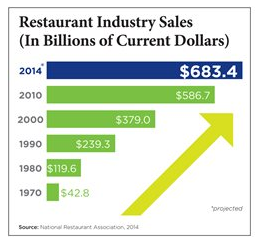
Screen Shot 2014-01-17 at 12.14.49 PMThis will mark the fifth consecutive year of real sales growth for the restaurant industry despite a continued challenging economic landscape, aaccording to the National Restaurant Association’s 2014 Restaurant Industry Forecast released today. Industry sales are projected to exceed $683 billion in 2014, up 3.6 percent over 2013 (1.2 percent when adjusted for inflation).

2014 also will mark the 15th straight year in which restaurant industry employment growth will outpace overall employment growth. The industry will continue to be the nation’s second-largest private employer with nearly one million restaurants employing 13.5 million individuals, or about one in 10 working Americans.
“As our nation continues its road to recovery, the restaurant industry will remain a key driver of economic growth and a leading jobs creator,” said Dawn Sweeney, president and CEO of the National Restaurant Association. “Restaurants touch every community across the U.S., and 2014 will be a year of growth and innovation as the industry focuses on inspired new ways to meet consumer demand while providing valuable careers to millions of American

New Report Shows California’s Recidivism Rate Declined Again

January 15, 2014

California’s recidivism rate is now 61.0 percent

SACRAMENTO – The California Department of Corrections and Rehabilitation (CDCR) today released its 2013 Outcome Evaluation Report, the fourth in a series of annual reports tracking and analyzing the recidivism – or reoffending – rates of adult felons released from state prison.  The report shows that the total three-year recidivism rate for all felons released during fiscal year 2008-2009 is 61.0 percent, down from 63.7 percent last year and down from 67.5 percent four years ago.

“The continuing improvement in the state’s recidivism rate is encouraging news for all Californians,” CDCR Secretary Jeff Beard said. “When former offenders are leading productive, law abiding lives, our communities are safer. As we move forward and both CDCR and counties utilize state funds to invest more in evidence-based rehabilitation efforts, I’m confident we will see recidivism rates continue to decline.”

CDCR measures recidivism by arrests, convictions and returns to prison and uses the latter measure – returns to prison – as its primary measure of recidivism. CDCR’s return-to-prison measure includes offenders released from prison after having served their sentence for a crime as well as offenders released from prison after having served their term for a parole violation. All felons are tracked for the full three-year follow-up period, regardless of their status on parole or if they have discharged.

In fiscal year 2008-2009, 112,877 people were released or re-released from state prison and recidivated at a rate of 61.0 percent within three years.

The 2013 report focuses on the 68,803 inmates who returned to custody within three years of release. It also looks at demographics, including gender, age, ethnicity, offense, mental health status, length of stay, risk category and other factors and offers data and insights to CDCR executives, policy makers and correctional stakeholders.

The report’s findings include:

•    Nearly 50 percent of inmates who recidivate within three years do so within the first six           months.
•    Women recidivate at a lower rate (48.9 percent) than men (62.4 percent).
•    Although few in number, inmates released after serving an indeterminate sentence recidivate at a much lower rate (11.5 percent) than those who served a determinate sentence (61.0 percent).

Package Delivery Firm Adding 70 Jobs In Visalia

January 17,2014

Screen Shot 2014-01-15 at 2.11.07 PMOnTrac, a service offering regional overnight package delivery, is expanding its operation in Visalia says the company. OnTrac has leased 90,000 sf in the Visalia Industrial Park at 9860 W. Ferguson says broker Doug Burr.

The new building will consolidate the existing Fresno, Visalia, and Kettleman City operations under a single roof and will be OnTrac’s largest facility in the Central Valley.

“We are truly excited about the increased capabilities that this new facility brings to us,”
Regional General Manager Ian Burton said. “The consolidation of operations will optimize service by increasing efficiency and will provide our customers the high standard of service they expect from a regional carrier. We are confident that these increased capabilities will give us the ability to both reduce cost and improve service.”

The facility includes four times as many dock doors as the previous Visalia operation, enabling OnTrac to move packages more efficiently and offer its customers faster service. From Visalia, OnTrac is able to reach every ZIP Code in California and the major metropolitan areas in Nevada  overnight, with two-day shipping to Arizona, Washington, Oregon, Utah, Colorado and Idaho.

“The City of Visalia welcomes OnTrac’s new 90,000 square foot facility to our Industrial Park, the largest in the region for the overnight package delivery company,” Visalia Mayor Steve Nelsen said. “The additional 70 employees OnTrac will bring to the City is a welcome boost to the local economy.”

OnTrac is a Chandler, Arizona-based company that provides overnight shipping at ground rates to businesses and consumers in the major metropolitan areas of California, Arizona.Washington, Oregon, Utah, Nevada, Colorado and Idaho.

Tulare Cheese Plant Steps Closer

Screen Shot 2014-01-14 at 2.37.47 PM
City Council To Weigh 5 Month Delay To Buy Land

Start-up firm CaliCheese Co says they are steps closer to building a new 300,000 sq ft cheese plant on land owned by the City of Tulare but need more time to complete all financing arraignments.“We will be making a request at the January 21 Tulare City Council meeting asking for an extension of time” to buy 60 acres from the city where they will build the plant. As it is, the company was supposed to have completed the purchase of the site by January 15, 2014.The new date would be June 30, 2014.
“We’re close to completing the development process that is the prerequisite to its securing the required total of $350 million non-recourse financing” says President and Manager Project Development Jeffrey F. Lee.Mr. Lee also announced “We are very pleased to have secured a letter of intent for the supply of the 4 million pounds of milk that the plant will process each day into 153 million pounds of American cheese, 10 million pounds of whey protein concentrate, and 73 million pounds per year of dried permeate.” The deal with an unnamed milk cooperative helps CaliCheese secure construction financing.
“We are equally pleased to have secured advance commitments for the purchase of the totality of the cheese” that will be made.Asked if he would favor the extension of the agreement made a year ago,Tulare Mayor David Macedo said “ with a project this big I am not surprised there might be a delay. Since we don’t have money tied up I don’t see a reason why we should say no.”  After all,Tulare “could use the jobs.” The big plant would employ over 200.
The company will be meeting with identified sources of senior debt and subordinated debt by the end of the month, and has provisional commitments for the complementary project finance equity. It expects to close the $350 million financing by June 30 at the latest, and for ONEsource Facility Solutions, its lead engineer/constructor, to complete the engineering and commence site preparation,to be followed by construction.The $250 million plant with over 200 personnel in what is called “well-paying jobs” will start operations in 2Q 2016.
The nearly 60 acres of industrial and would sell for around $2.1 million. The property near the city Wastewater Treatment  Plant was the subject of a lengthy environmental impact report and then an extended lawsuit as the city sought approval for a meat packing plant. That plant never materialized but the final EIR was close enough in scope to the proposed cheese plant impacts to be used for CEQA approvals for this project.CaliCheese has been talking to the city since mid 2012 and offer appreciation to both the city and the county EDC for their efforts says Lee.
The city agreed more than year ago to reduce sewer hookup fees to help the project move forward.“No other company is bidding for this land” reasons Macedo.The fortunes of cheese makers in the state are on the rise as booming export demand and US consumption continues to climb. Better prices for dairy products is “allowing the local dairy industry to heal” says Macedo who works in the industry. New processing capacity in the area will offer another way to add value to the billions of dollars of milk made locally.
Meanwhile Tulare “continues to think about the future” adds Macedo acknowledging that the city is wanting to purchase another 90 acres nearby for future uses.

A Big Month For California Exporters

Screen Shot 2014-01-07 at 8.01.30 PMJanuary 7, 2014 – California’s exporters turned in a particularly exuberant performance in November, according to Beacon Economics’ analysis of foreign trade data released this morning by the U.S. Commerce Department.
For the month of November, the state’s merchandise export trade totaled $15.22 billion, a nominal 14.2% increase over the $13.33 billion in exports recorded in November 2012. By comparison, overall U.S. merchandise exports rose by 5.9% over the same period.
The uptick in California was led by a solid $1.38 billion jump in manufactured exports, which rose by 16.8% to $9.63 billion from $8.25 billion in November 2012.
Meanwhile, the state’s exports of non-manufactured goods (chiefly agricultural produce and raw materials) totaled $2.45 billion, up $489.7 million or 25% from $1.96 billion in November 2012. Re-exports were comparatively unchanged, from $3.12 billion in November 2012 to $3.14 billion this past November, an increase of just 0.6%.
California’s year-to-date $153.53 billion merchandise export trade for 2013 is running handily ahead of the $148.34 billion recorded in 2012. “After a sputtering start to the year, California’s exporters are finishing 2013 with a remarkably strong surge,” said Jock O’Connell, Beacon Economics’ International Trade Adviser. “I’d have said they were going like gangbusters, except that no one recalls that expression.”
The uptick in manufactured exports is also helping to bolster California’s overall economy. “After a slow start relative to the rest of the nation, California stepped up and added 4,300 new manufacturing positions over the past year,” said Jordan Levine, Beacon Economics’ Director of Economic Research. “It’s a positive sign after several decades of decline associated with the loss of much of our aerospace industry in the 1990s and the technological change that has accompanied the computer age.”
A Closer Look At The Numbers
As always, Beacon Economics’ foreign trade analysis cautions against reading too much into month-to-month fluctuations in state export statistics. Significant variations may occur as the result of unusual or exceptional one-off trades and may not be indicative of underlying trends. For that reason, Beacon Economics compares the latest three months (i.e., September-November) for which data are available with the corresponding period in the previous year.
California’s merchandise exports during the September-November period of 2013 totaled $44.35 billion, a nominal increase of 10.7% over the same period in 2012.
Computer and Electronics Products remains the single largest category of California exports, accounting for $11.01 billion in shipments in the latest three-month period. However, growth in this category was comparatively lackluster at 1.5% growth over the same period a year earlier.
Exports of Transportation Equipment meanwhile increased by 12.8% to $4.80 billion, largely powered by a resurgence of exports from the civilian aerospace sector.
Other sizable gains were recorded in the latest three-month period for farm produce, up 18.1% to $4.50 billion, and processed food products, up 17.8% to $2.71 billion. Similarly, exports of petroleum products rose 21.2% to $1.76 billion.
Mexico remained California’s single largest export market during the latest three-month period, with the value of exports edging up by 5.0% to $6.25 billion. Exports to Canada were up 12.2% to $5.21 billion, while shipments to China surged by 19.9% to $4.08 billion. Japan (up 5.2% to $3.34 billion) and Hong Kong (up 10.5% to $2.32 billion) rounded out California’s ‘Top Five’ export destinations in the latest three-month period.
Regionally, California’s exports to the Asia Pacific region (including Australia and New Zealand) grew by 13.7% to $17.49 billion. And despite Europe’s prolonged affinity for austerity, exports to the European Union nonetheless rose by 9.6% to $7.35 billion. California exports to Latin America and the Caribbean (excluding Mexico) increased by 5.3% to $2.53 billion, while exports to India rose 15.5% to $1.06 billion. California’s export trade with sub-Saharan Africa was comparatively negligible $207.6 million over the past three months.
California currently accounts for 10.9% of total U.S. merchandise exports. Not surprisingly, its share of U.S. exports to markets in the Asia Pacific region is larger (16.8%) than that of any other state.
Seaports are popularly regarded as the state’s principal international trade gateways. However, on a dollar-value basis, more of California’s merchandise export trade in the latest three quarters went by air (45.1%) than by sea (32.1%). Another 22.8% of the state’s exports of goods travels overland by truck or rail to Canada and Mexico.
Beacon Economics’ outlook for the winter months remains upbeat. “The resourcefulness and performance of California exporters lead us to stand a bit against the tide of many major forecasting organizations who have been cautioning about the effects of slowing global economic growth,” O’Connell said.

Tahoe Area To See Some Snow This Week

Screen Shot 2014-01-07 at 12.16.39 PMStorms keep knocking on the door in California in 2014 but high pressure continues to push the storms and the rain they carry to the north. That leaves storms strong enough to push on through very weak.Still snow forecaster Bryan Allegtetto who reports models he relies on for his the ski angle blog says the Tahoe area is in for several rounds of snow Wednesday/Thursday and again Saturday with about an inch of snow Wed/Thursday and 1 to 3 inches over the weekend. NWS says rainfall totals in the Bay Area will be very light and in the SLO area we get zippo.
NWS SF says after the 20th of January chances for a better storm improve.
NWS suggests how dry we are this new water-year that started in October 2013.
“WITH JUST 1.30″ OF RAIN SO FAR FOR THE CURRENT WATER YEAR, SANTA CRUZ IS HAVING ITS DRIEST START ON RECORD. IN A TYPICAL YEAR, 12.55″ WOULD ALREADY BE RECORDED.”

Economy Watch: Rain &Trains

Will It Rain? The latest NOAA climate forecast expects ENSO-nuetral conditions through Spring but an El Nino pattern in summer.That would be bullish for rainfall next water year but not this one. After a record dry 2013 calendar year, January 2014 doesn’t look a bunch better but it does look “like the wettest month we have had in the past 12 months ” says one forecaster. Still, rain is expected to come into the state  January 7-10 but the extent of the predicted rain varies by experts models from a a piddle to a potential multi- day”atmospheric river, or ‘pineapple express’ – what we really need. Stay tuned next few days.

Here is the Farmers Almanack prediction for January in LA.Looks like they messed up on the first week for sure.”JANUARY 2014: temperature 53° (1° below avg.); precipitation 8″ (5″ above avg.); Jan 1-3: Clouds and occasional drizzle, cool; Jan 4-10: Heavy rain, then sunny, chilly; Jan 11-14: Heavy rain, mild; Jan 15-16: Showers; Jan 17-19: Heavy rain, mild; Jan 20-24: Rainy periods, cold; Jan 25-27: Sunny, cool; Jan 28-31: Rainy, cool.”

Dry 2014 could lead to plenty of fallow ground in the San Joaquin Valley to preserve what H2O there is  for  all those new permanent plantings. That could mean lots less cotton, grains and forage crops and high prices for alfalfa for the dairies.

Screen Shot 2013-12-30 at 7.14.28 AMAnother dry year could lead to increased land subsidence in the Valley in the west Fresno County area. One big problem: the canals are sinking,cracking(see pic).

Mixed Weekly Rail Traffic Moving More Petroleum and Less Coal

WASHINGTON, D.C. – Dec. 26, 2013 – The Association of American Railroads (AAR) today reported mixed U.S. rail traffic for the week ending Dec. 21, 2013 with 289,528 total U.S. carloads, down 0.3 percent compared with the same week last year. Total U.S. weekly intermodal volume was 255,456 units, up 6.4 percent compared with the same week last year.   Total combined U.S. weekly rail traffic was 544,984 carloads and intermodal units, up 2.8 percent compared with the same week last year.

Five of the 10 carload commodity groups posted increases compared with the same week in 2012, including petroleum and petroleum products with 15,501 carloads, up 12.7 percent; and grain with 21,030 carloads, up 5.0 percent. Commodities showing a decrease compared with the same week last year included metallic ores and metals with 24,754 carloads, down 6.5 percent; and coal with 113,070 carloads, down 2.9 percent.

For the first 51 weeks of 2013, U.S. railroads reported cumulative volume of 14,376,905 carloads, down 0.7 percent from the same point last year, and 12,659,296 intermodal units, up 4.5 percent from last year. Total combined U.S. traffic for the first 51 weeks of 2013 was 27,036,201 carloads and intermodal units, up 1.7 percent from last year.

RailEx Project Will Mean 300 More Jobs For Valley

Screen Shot 2013-12-13 at 2.45.55 PMRailEx Co who sends refrigerated produce unit trains from Delano and Washington to the East Coast will double the number number of trains moving once a new 10,500 ft rail spur is built to their 225,000sf Delano cold storage complex. The City of Delano received a $1.8 million grant to build the $3.5 million rail spur last September.

When built the big project will add 302 jobs in Delano over the next 6 years says Economic Development Specialist Angelica Castro.

A city report says the Delano RailEx already employs 180 and would add payroll worth $15 million annually with the additional jobs.

The report says the company ships about 4500 rail cars annually and wants to increase shipments to 15,000 refrigerated cars per year by 2015.

The new rail spur – off the main Union Pacific line – will not just feed RailEx but be connected to more city-owned industrial land available for development says Castro. In this way, the spur will act as an incentive to get more jobs for the community says Castro.

RailEx says the added trains will head to a new Florida hub being built by RailEx – adding this destination to the NY hub they already have.

Castro says the new Delano rail spur should break ground by April in and be ready to use by harvest season. The new Jacksonville Florida hub is expected to open by June.They also plan a new Midwest hub offering more opportunity for local growers to get to market.

RailEx offers express five-day coast-to-coast service for produce shippers helping California grown produce to get to Eastern and now South Eastern population centers faster and with fewer emissions.

Sierra Gets Some Snow

New snow at China Peak

The latest California storm did not hold a lot of moisture at lower elevations for Central California but it did coat the Sierra with enough snow to allow many of the popular ski resorts  to open for the season.

The  winter storm – now they have names like Hurricanes –  called Dion slid down the Sierra overnight into Saturday dumping  12-15 inches of snow in the Tahoe area Saturday. Skiers ra are celebrating the opening of the season in time for the Holidays.

Dion is doing lot more damage now heading East.

Northstar says they got 23 inches over the last 48 hrs,30 inches at Heavenly Valley and Kirkwood says they got 36 inches as of Saturday.

Bear Mountain is open with 12 inches of snow depth. Further south Bear Valley expects to open by 12/21 with a dozen other resorts not yet open.

Above Fresno China Peak reports 14 inches as of 12/8 with the resort now open for business this weekend. Badger Pass is not yet open but is expecting to open 12/13 their website says.

Across the Sierra at Mammoth they are open with 12-16” of new snow.Their cross country trails opened this weekend.

Unfortunately the forecast looks dry for California for the next week with some hope for a storm after that – perhaps around December 20. SLO saw 0.39 inches while Fresno received 0.15. Hanford recorded 0.12 inches on 12/7.

Best Performance Of 2013 For State Exporters

December 4, 2013 – California’s exporters turned in their best performance of the year in October, according to a Beacon Economics’ analysis of foreign trade data released this morning by the U.S. Commerce Department.

Screen shot 2012-06-15 at 12.12.22 PMAG EXPORTS CLIMB 19%

For the month of October, the state’s merchandise export trade totaled $15.35 billion, a nominal 10.7% increase over the $13.87 billion in exports recorded in October 2012. By comparison, overall U.S. merchandise exports rose by 5.9% over the same period..The uptick in California was led by a solid $727 million increase in manufactured exports, which rose by 8.16% to $9.66 billion from $8.93 billion last October.Meanwhile, the state’s exports of non-manufactured goods (chiefly agricultural produce and raw materials) totaled $2.35 billion, up $376 million or 19.0% from $1.98 billion last October. Re-exports were up by $379 million, from $2.96 billion last year to $3.34 billion this year, an increase of 12.8%.
After a sluggish start, California’s year-to-date $138.31 billion merchandise export trade is running slightly ahead of the $135.01 billion recorded in the same period last year.
“With the surge in California’s export trade in recent months, the state’s exporters ought to be feeling a pretty healthy endorphin rush,” said Jock O’Connell, Beacon Economics’ International Trade Adviser.
And the fact that things are picking up a bit shouldn’t be a surprise, said Christopher Thornberg, Founding Partner of Beacon Economics. “Europe saw a modest positive uptick in the 2nd and 3rd quarter of this year, and the rest of the world economy seems to be gaining traction as well,” said Thornberg. “This shouldn’t imply that Europe’s problems are fixed, but at least the drag they were creating on global growth and trade is gone, and clearly this is good news for local exporters.”
Regionally, California’s exports to Pacific Rim markets grew by 7.5% to $16.21 billion. Despite Europe’s embrace of austerity, exports to the European Union rose by 12.3% to $6.88 billion. California exports to Latin America and the Caribbean (excluding Mexico) rose just 2.7% to $2.59 billion, while exports to India jumped 65.5% to $1.67 billion. California’s export trade with sub-Saharan Africa is comparatively negligible at $0.23 billion during the last quarter.
A Closer Look At The Numbers
As always, Beacon Economics’ foreign trade analysis cautions against reading too much into month-to-month fluctuations in state export statistics. Significant variations may occur as the result of unusual or exceptional one-off trades and may not be indicative of underlying trends. For that reason, Beacon Economics compares the latest three months (i.e., August-October) for which data are available with the corresponding period in the previous year.
California’s merchandise exports during the August-October period of 2013 totaled $43.41 billion, an increase of 8.5% over the same period in 2012.
Computer and Electronics Products remains the single largest category of California exports, accounting for $10.77 billion in shipments in the latest three-month period. However, there was absolutely no growth in this category over the same period a year earlier.
Exports of Transportation Equipment meanwhile increased by 19.1% to $4.93 billion, largely powered by a spurt in exports from the aerospace sector.
Other sizable gains were recorded in the latest three-month period for farm produce, up 21.7% to $3.74 billion, and processed food products, up 20.8% to $2.65 billion. Similarly, exports of petroleum products rose 27.8% to $1.71 billion.
Mexico remained California’s single largest export market during the latest three-month period, even though exports were up by just 1.3% to $6.33 billion. Exports to Canada were up 12.9% to $5.11 billion, while shipments to China surged by 21.8% to $5.11 billion. Japan (up 1.3% to $3.19 billion) and Hong Kong (up 2.16% to $2.16 billion) rounded out California’s ‘Top Five’ export destinations in the latest three-month period.
Regionally, California’s exports to the Asia Pacific region (including Australia and New Zealand) grew by 11.6% to $17.04 billion. And despite Europe’s lingering infatuation with austerity, exports to the European Union, while slowing lately, still rose by 8.6% to $7.06 billion. California exports to South America fell by 7.6% to $1.83 billion, while exports to India jumped 36.0% to $1.37 billion. California’s export trade with sub-Saharan Africa is comparatively negligible at $193 million over the past three months.
California currently accounts for 10.6% of total U.S. merchandise exports. Not surprisingly, its share of U.S. exports to markets in the Asia Pacific region is larger (17.2%), while the percentage of U.S. exports to South America originating in California is just 5.8%.
Seaports are often regarded as the state’s principal international trade gateways. However, on a value basis, approximately 45% of California’s merchandise export trade actually goes by air. By contrast, seaports handle about 32% of the state’s exports by value. The balance travels overland to Canada and Mexico.
Beacon Economics’ outlook for the remaining two months of 2013 remains essentially buoyant. “Although almost every major forecasting institution has been ratcheting back their expectations for global economic growth, we continue to place our bets on the resourcefulness of California’s exporters,” O’Connell said.