California New Car Sales Up 5.4% In 2014

 Honda Accord was Best-Selling Model in California During First Quarter of 2014  
May 16,2014
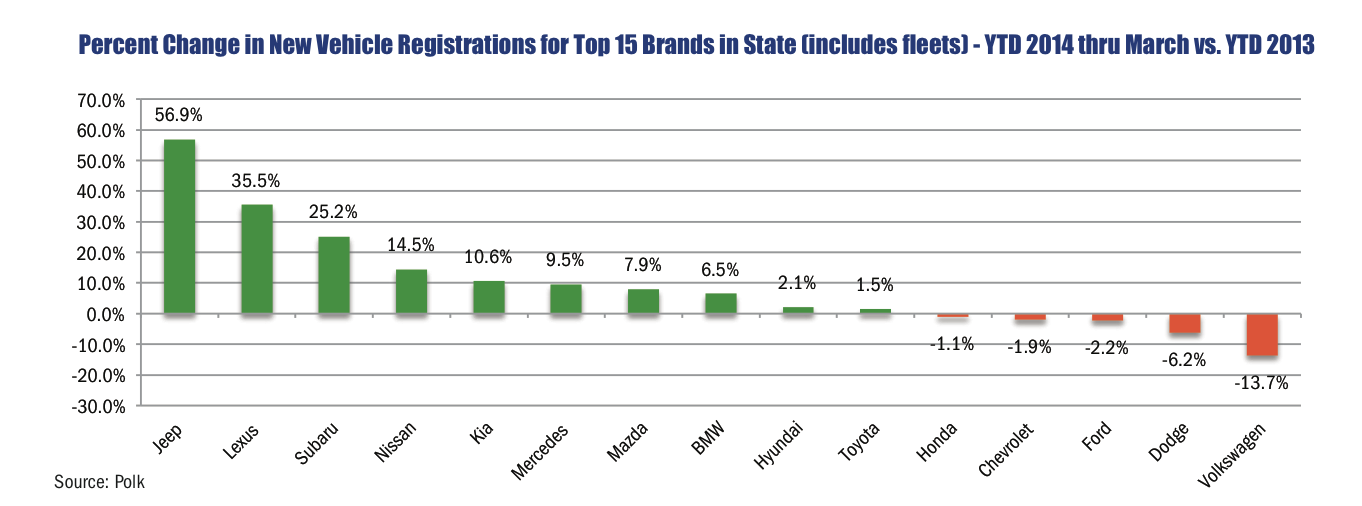
The California new vehicle market improved again during the first three months of this year says the California New Car Dealers Association. New light vehicle registrations in the state increased 5.4 percent in the First Quarter of 2014 versus a year earlier, the 14th consecutive increase.
As expected, the percentage improvement was lower than in recent quarters, but unit registrations were up by nearly 22,000 units. The slower rate of improvement is expected to continue for the rest of this year. Annual registrations in 2014 are predicted to increase to 1.793 million units, up 4.8 percent from 2013, but below the 11.9 percent increase last year. Other key trends in the state market:
Among the top 15 selling brands, Jeep, Lexus, Subaru, Nissan, and Kia had the biggest percentage increases in the First Quarter of this year. New registrations for each of the five brands increased by more than 10 percent.
Screen Shot 2014-05-17 at 7.02.34 PM
Japanese brand registrations increased 7.2 percent in the First Quarter and market share increased 0.8 points.
Hybrid vehicle market share (excluding plug ins) slipped to 6.0 percent during the first three months of this year, down from 6.8 percent in 2013.
Screen Shot 2014-05-17 at 7.06.04 PM
Used vehicle registrations increased 2.4 percent. Three year old or newer vehicles were up 11.5 percent, as supply shortages are easing.

ObamaCare’s Central California Numbers Announced

May 8,2014
Screen Shot 2014-05-08 at 3.18.48 PMSACRAMENTO, Calif. — Covered California™ and the California Department of Health Care Services (DHCS) announced May 7 that from Oct. 1, 2013, to March 31, 2014, under the Patient Protection and Affordable Care Act, 95,499 consumers in six Central Coast counties enrolled in subsidized and non-subsidized Covered California health insurance plans. The new total represents a 55 percent increase from the 61,474 enrollments recorded through Feb. 28.

The total for San Luis Obispo County was 12,256,mostly eligible for a subsidy through the program.

In other Central California counties Tulare County saw 9832 sign up with the program through March 31 of which 9374 were eligible to get a subsidy. Fresno County signed up 23,164 and Kern County numbers were 18,083. Some 2,160 from Kings County signed up.

Statewide almost 1.4 million are enrolled.

For the Central Coast the six-month Covered California total also represents 293 percent of the base projection of 32,602 enrollments the agency estimated for the region during the entire six-month open-enrollment period.

Along the Central Coast 49.1% of enrollees signed up with Anthem Blue Cross and 43.2 % selected Blue Shield. Some 7.7% picked Kaiser.
In the San Joaquin Valley 69.8% picked Anthem with 11.3% for Blue Shield.

Although open enrollment has ended, consumers who experience a qualifying life event can still enroll in a health insurance plan through Covered California.

Qualifying life events include losing health coverage through a job, getting married or entering into a domestic partnership, having or adopting a child, changing where a person permanently lives or gaining citizenship. For a list of common types of qualifying events, visit www.CoveredCA.com.

The next open-enrollment period will be in the fall of 2014. Also, Californians can enroll in Medi-Cal year-round.

The Central Coast counties of Santa Cruz, Monterey, San Benito, San Luis Obispo, Santa Barbara and Ventura represent about 7 percent of the statewide enrollment. The local total includes 85,153 consumers eligible for financial subsidies. These counties encompass Covered California pricing regions 9 and 12.

For the six-month open-enrollment period that ended March 31*, 1,395,929 consumers enrolled in plans statewide. The total increased 58.6 percent from the 880,082 consumers who enrolled by the end of Feb. 28. Covered California reached 1 million consumers enrolled on March 14.

About Covered California
Covered California is the state’s marketplace for the federal Patient Protection and Affordable Care Act. Covered California, in partnership with the California Department of Health Care Services, was charged with creating a new health insurance marketplace in which individuals and small businesses can get access to affordable health insurance plans. With coverage starting in 2014, Covered California helps individuals determine whether they are eligible for premium assistance that is available on a sliding-scale basis to reduce insurance costs or whether they are eligible for low-cost or no-cost Medi-Cal. Consumers can then compare health insurance plans and choose the plan that works best for their health needs and budget. Small businesses can purchase competitively priced health insurance plans and offer their employees the ability to choose from an array of plans and may qualify for federal tax credits.

Small Business More Optimistic

Eighty-Seven Percent Say Their Company Will Grow Over the Next Year with More Investment Expected in Technology, Equipment, Online Marketing and Social Media
Screen Shot 2014-05-07 at 10.19.16 AMSan Diego, CA, May 6, 2014 – According to the third-annual California Bank & Trust Small Business survey, an overwhelming majority of respondents (86%) felt that their business was moving in the right direction with 87% expecting growth over the next year and 65% expecting growth of 5% or more over the next 12 months. Additionally, 63% of respondents expected growth to increase year-over-year. Interestingly, the Los Angeles region is slightly more bullish than the Bay Area and San Diego, with 43% of small business owners expecting a growth rate of more than 10% over the next 12 months compared to 38% in the Bay Area and 26% in the San Diego region.
California Bank & Trust fielded its third-annual benchmark survey to gauge the thoughts and opinions of California’s small business owners. More than 680 small business owners throughout the state of California shared their opinions during the survey conducted in April 2014.
California Bank & Trust also surveyed small businesses on current regulatory and environmental conditions and the impact of these circumstances on their business. Nearly two-thirds of respondents (63%) in this year’s survey said the Affordable Care Act has had a neutral or positive impact on their business. In addition, 72% of small businesses said the rise in the minimum wage would have a neutral or positive effect on their business while 59% said the drought would have no affect on their business.
“What our 2014 small business survey illustrates is that many California small businesses are in a unique position to capitalize on growth opportunities and weather larger macroeconomic changes,” said Tory Nixon, Executive Vice President, Small Business Lending, California Bank & Trust. “Small businesses are shrugging off these regulatory changes and environmental concerns and are quite optimistic about the future growth of their business.”
“The growth rates echo what we are experiencing with our banking businesses throughout California,” added Nixon. “We are seeing increased demand across the board for commercial and small business lending, cash management, international banking, merchant services, online and mobile banking and wealth management services. This activity underscores an increased need for capital to support the growth plans of small businesses.”
Additional highlights from the survey include:
Areas of Investment. Small businesses are planning to make significant capital investments over the next 12 months. Eighty-four percent of small businesses surveyed are planning to invest more or the same amount in technology over the next 12 months, just over 70% in both online marketing and equipment, and 66% in social media.
Hiring. More than half of small businesses surveyed plan to hire additional employees in 2014. Ninety-two percent plan to hire 1-10 additional workers with one-quarter or 25% of this group planning to hire 5-10 employees.
E-Commerce & Online Presence. An online presence continues to be significant for small businesses throughout the State. Ninety-six percent of respondents have a website, just over 60% currently use digital marketing techniques to promote their business and over 52% said an e-commerce online presence was “extremely important” or “very important.” Interestingly, when asked the primary source of sales growth, an overwhelming majority (74%) said traditional sales.
Social Media. Nearly 60% of respondents maintain a social media presence for their business and 34% are increasing their investment in this communication medium.
Succession Planning. Almost 90% of those surveyed have a succession plan in place, saying they would pass on their business to a friend or family member (30%), sell business to employees (16%) and sell their business to the highest bidder (43%).
Financing. Close to 35% of small businesses surveyed are expected to need financing over the next 12 months with 49% saying that bank loans are their primary source of funding.
Banking. The most common usage of online banking includes accessing account information/resources (78%) and conducting transactions (67%). In addition, “competitive rates,” “customer service” and “payment and term options” were the most important factors when looking for a loan provider, above “industry knowledge”, “regional knowledge” and well beyond “government backing.”
International Sales. Thirty-eight percent of California small businesses derive sales from international markets with 9% saying international markets accounted for over 25% of their sales.
“The comprehensive results of our survey showcase a clearly different environment in California for small businesses than 2013,” added Nixon. “Businesses are optimistic, expect healthy grow rates, are making capital investments and leveraging new technologies to market and sell their products

California Export Growth Tops Nation As A Whole

Screen shot 2012-06-15 at 12.12.22 PMMay 6, 2014 – California’s exporters once again posted impressive numbers in March, with the value of the state’s merchandise export trade surging ahead by 9.6% over the same month one year earlier, according to a Beacon Economics’ analysis of foreign trade data released this morning by the U.S. Commerce Department.
For the month of March, the state’s merchandise export trade totaled $15.43 billion, up from $14.07 billion in March 2013. By comparison, overall U.S. merchandise exports increased by just 4.1% over the same period.
“The state’s manufacturers, growers, and trading companies continue to providence abundant evidence of the competitiveness of California’s economy in today’s global marketplace,” said Jock O’Connell, Beacon Economics’ International Trade Adviser. “After years of economic travail, the term “Golden State” is starting to sound less and less ironic.”
Beacon Economics’ Founding Partner Christopher Thornberg added that while the state’s business climate could use some work, the fundamentals of California’s competitiveness are often overlooked or dismissed. ”These data show how the state’s entrepreneurs and corporate leaders not only can but are succeeding in a highly competitive marketplace,” Thornberg said. “We need to persist in pushing for substantial reforms in California, but in the meantime we expect the state’s growth to continue.”
March also saw an 11.3% jump in California’s manufactured exports, which totaled $10.29 billion, up from $9.25 billion one year earlier.
Meanwhile, the state’s exports of non-manufactured goods (chiefly agricultural produce and raw materials) in March totaled $1.93 billion, up 8.4% from $1.78 billion the previous March. Re-exports grew by 5.3% to $3.21 billion from $3.05 billion.
Through this year’s first quarter, the state’s export trade was running 6.8% ahead of the first three months of 2013, rising to $42.05 billion. By contrast, overall U.S. merchandise exports rose by just 2.6% during the same period.
Manufactured exports from California were up 6.2% to $27.57 billion. The state’s first quarter exports of non-manufactured goods totaled $5.49 billion, a gain of 11.3%, while re-exports increased 6.2% to $8.99 billion.
The following table shows the year-to-date export trade value, and the year-over-year change in that value, for the United States and the top 20 U.S. states. “Looking comparatively, California is second only to Texas in terms of the value of exported goods,” said Thornberg. “Moreover, the state’s exports grew at 3 times the national pace for the first quarter of the year.” Beginning this month, Beacon Economics’ monthly trade analysis will include broader comparisons to other states and to the nation as a whole.

Climate Change Threatens To Worsen U.S. Ozone Pollution

May 05, 2014

BOULDER—Ozone pollution across the continental United States will become far more difficult to keep in check as temperatures rise, according to new research led by the National Center for Atmospheric Research (NCAR). The detailed study shows that Americans face the risk of a 70 percent increase in unhealthy summertime ozone levels by 2050.

This is because warmer temperatures and other changes in the atmosphere related to a changing climate, including higher atmospheric levels of methane, spur chemical reactions that lead to ozone.

Smoggy skies in Los Angeles as viewed from the Getty Museum

Unless emissions of specific pollutants that are associated with the formation of ozone are sharply cut, almost all of the continental United States will experience at least a few days with unhealthy air during the summers, the research shows. Heavily polluted locations in parts of the East, Midwest, and West Coast in which ozone already frequently exceeds recommended levels could face unhealthy air during most of the summer.

“It doesn’t matter where you are in the United States—climate change has the potential to make your air worse,” said NCAR scientist Gabriele Pfister, the lead author of the new study. “A warming planet doesn’t just mean rising temperatures, it also means risking more summertime pollution and the health impacts that come with it.”

However, the research also showed that a sharp reduction in the emissions of certain pollutants would lead to dramatically decreased levels of ozone even as temperatures warm.

The detailed research is one of the first of its type to be conducted with new, highly advanced geoscience supercomputing capabilities. It will be published online this week in the Journal of Geophysical Research-Atmospheres, a journal of the American Geophysical Union.

The work was funded by the National Science Foundation (NSF), which is NCAR’s sponsor, and the U.S. Department of Energy. In addition to NCAR, the study co-authors are from the Pacific Northwest National Laboratory; University of Colorado, Boulder; and North-West University in South Africa.

Ozone and heat

Ozone pollution is not emitted directly, but instead forms as a result of chemical reactions that take place between nitrogen oxides and volatile organic compounds in the presence of sunlight. These gases come from human activities such as combustion of coal and oil as well as natural sources such as emissions from plants.

Unlike ozone in the stratosphere, which benefits life on Earth by blocking ultraviolet radiation from the Sun, ground-level ozone can trigger a number of health problems. These range from coughing and throat irritation to more serious problems, including aggravation of asthma, bronchitis, and emphysema. Even short periods of unhealthy ozone levels can cause local death rates to rise. Ozone pollution also damages crops and other plants.

To examine the impacts of climate change on ozone pollution, Pfister and her colleagues looked at two scenarios. In one, emissions of nitrogen oxides and volatile organic compounds from human activities would continue at current levels through 2050. In the other, emissions would be cut by 60-70 percent. Both scenarios assumed continued greenhouse gas emissions with significant warming.

The researchers found that, if emissions continue at present-day rates, the number of eight-hour periods in which ozone would exceed 75 parts per billion (ppb) would jump by 70 percent on average across the United States by 2050. The 75 ppb level over eight hours is the threshold that is considered unhealthy by the Environmental Protection Agency. (The agency is considering tightening the standard to a value between 65 and 70 ppb over eight hours.)

Overall, the study found that, 90 percent of the time, ozone levels would range from 30 to 87 ppb in 2050 compared with an estimated 31 to 79 ppb in the present. Although the range itself shifts only slightly, the result is a much larger number of days above the threshold now considered unhealthy.

There are three primary reasons for the increase in ozone with climate change:

  • Chemical reactions in the atmosphere that produce ozone occur more rapidly at higher temperatures.
  • Plants emit more volatile organic compounds at higher temperatures, which can increase ozone formation if mixed with pollutants from human sources.
  • Methane, which is increasing in the atmosphere, contributes to increased ozone globally and will enhance baseline levels of surface ozone across the United States.

In the second scenario, Pfister and her colleagues found that sharp reductions in nitrogen oxides and volatile organic compounds could reduce ozone pollution even as the climate warms. In fact, 90 percent of the time, ozone levels would range from 27 to 55 ppb. The number of instances when ozone pollution would exceed the 75 ppb level dropped to less than 1 percent of current cases.

“Our work confirms that reducing emissions of ozone precursors would have an enormous effect on the air we all breathe,” Pfister said.

Pfister and a nationwide scientific team expect to learn more about the sources, chemistry, and movement of air pollutants this summer when they launch a major field experiment known as FRAPPÉ along Colorado’s Front Range.

The role of supercomputing

The new study was among the first conducted on the new 1.5-petaflop Yellowstone supercomputer. The IBM system, operated by NCAR and supported by funding from the NSF and the University of Wyoming, is one of the world’s most powerful computers specifically dedicated to research in the atmospheric and related sciences.

Thanks to its computing power, the scientists were able to simulate pollution levels hour by hour for 39 hypothetical summers. This allowed the team to account for year-to-year variations in meteorological conditions, such as hot and dry vs. cool and wet, thereby getting a more detailed and statistically significant picture of future pollution levels.

To simulate the interplay of global climate with regional pollution conditions, the scientists turned to two of the world’s leading atmospheric models, both based at NCAR and developed through broad collaborations with the atmospheric science community. They used the Community Earth System Model, funded primarily by the Department of Energy and NSF, to simulate global climate as well as atmospheric chemistry conditions. They also used an air chemistry version of the multiagency Weather Research and Forecasting model to obtain a more detailed picture of regional ozone levels.

Even with Yellowstone’s advanced computing speed, it took months to complete the complex simulations.

“This research would not have been possible even just a couple of years ago,” said Pfister. “Without the new computing power made possible by Yellowstone, you cannot depict the necessary detail of future changes in air chemistry over small areas, including the urban centers where most Americans live.”

 

Cargill Fresno Expansion To Add 300 Jobs

April 30,2014

Cargill  2014-04-29 at 10.00.34 AMA $50 million dollar expansion at the Cargill Meat Solutions Corporation facility will improve their 57 acre West Fresno plant adding 300 jobs to the 1000 person workforce already employed there.

Cargill has applied for a permit for expansion with the County and a public hearing has been tentatively set for May 22.

Cargill, on the receiving edge of bad press here in the past, says the modernizing of the Fresno operation will improve its environmental footprint cutting air emissions,improving water quality and reducing odors.

Significantly the plant expansion calls for construction of a new 80,000 sf cold storage facility that would replace 87 diesel-powered refrigerated storage trailers at the plant improving air quality nearby. Additional environmental benefits include adding a new water wells that will replace two wells high in nitrates.

Changes planned at the plant will also reduce odors says a company report, specifically to how hides are processed. A new facility will be built. Also, instead of the company selling the hides to a firm in Modesto the hide work will be retained in Fresno says the company. That will add $2 million to the local tax base.

A county report says the plant, on the west edge of Fresno city has had no complaints about odors to date.The plant has ag land on one side and residential on the other.

The county is processing the environmental impact of the big project as a negative declaration meaning there are no serous issues.

The expansion will also affect the firm’s ground beef production operation tripling the building size from 22,400sf to 67,200sf.

Cargill is the nation’s largest privately held corporation based in Minnesota  with 2013 revenues of $136.7 billion.

Cargill acquired the Fresno plant from Beef Packers Inc in 2006. In 2009 in two separate cases more than 800,000 pounds of ground beef  were recalled because of concerns the meat might be linked to a salmonella outbreak.

Cargill’s plant location was cited in a LA Times story in recent days suggesting low income areas of Fresno like West Fresno were burdened by pollutants from the plant.

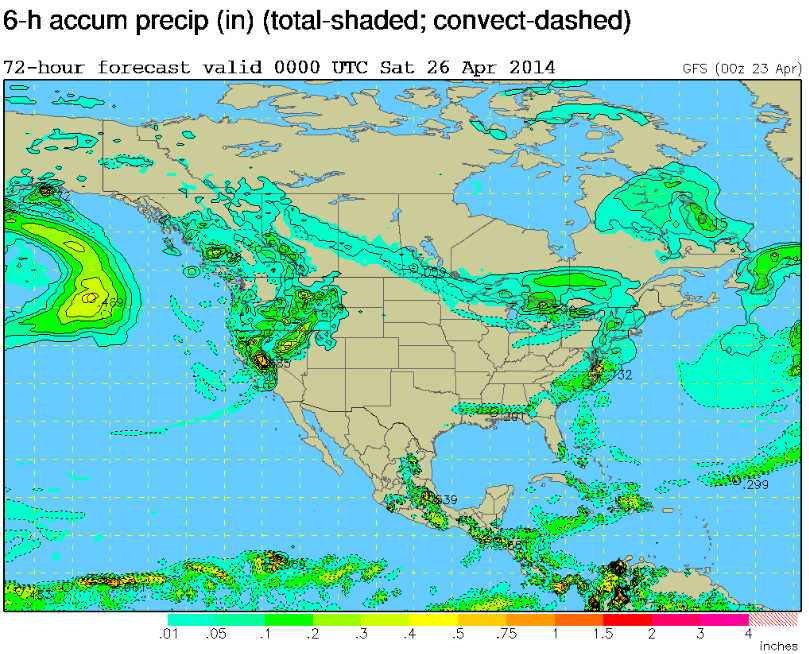
Model Says Cold Storm Coming This Weekend

Friday/Saturday's Cold Storm Could Offer Fresno Almost An Inch Of Rain

Here is what the NWS /Hanford says today about this coming weekend's cold
storm that could bring some snow to the 4000 ft level. The news release
references the model GFS used to predict future rainfall. 

"BUT THE NEW 06Z RUN GIVES YOSEMITE VALLEY 1.64 INCH WITH
NEARLY ALL FALLING BY 12Z /0500 PDT/ SATURDAY. THE NEW GFS
ALSO GIVES FRESNO 0.89 INCH OF RAIN. /THE 22/00Z RUN HAD GIVEN
FRESNO 0.45 INCH./ HOWEVER...IT MUST BE NOTED THAT INITIALLY
THE MODELS HAD FORECAST MEASURABLE RAINFALL WITH  TUESDAY/S
SYSTEM BUT PROVED TO HAVE GREATLY OVERFORECAST THE STORM
STRENGTH. THEREFORE..WILL HOLD OFF ON ANY WINTER HEADLINES
AT THIS TIME."
Here is the model for Saturday.
weekend rain and snow expected


Whole Foods vs Cracker Barrel

From Rural Migration News

April 21,2014

gravy with your lunch at Cracker Barrel

The Wall Street Journal reported on March 21, 2014 that 75 percent of rural Americans are represented by Republicans in the House of Representatives, while the 80 percent of Americans who live in urban areas have about half Democratic and half Republican representatives.

The change from Democratic to Republican representation of rural America occurred after the mid-1990s. In 1993, over half of rural Americans were represented by Democrats in the House. In 2012, Mitt Romney’s margin of victory in the 50 least-dense US counties was over 50 points, much higher than George Bush’s almost 20-point margin of victory in 1992.

Some political analysts say that the driving forces in politics are culture and lifestyle, not policy differences. Rural residents are more likely to go to church and to hunt, and many hold fewer middle-class jobs in areas with declining populations. One analysis found that President Obama in 2012 won the popular vote in 77 percent of US counties with a Whole Foods store, but won in only 29 percent of counties with a Cracker Barrel restaurant.

Rain, Money & Gas

Northern California Rain Chances

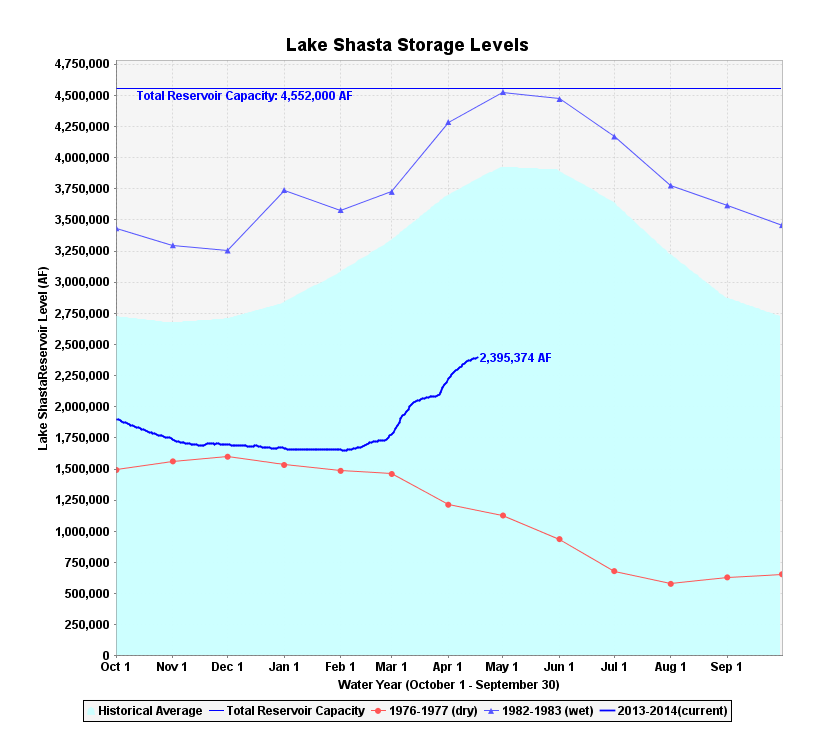
NWS reports northern California could  get a couple of bouts with rain next week coming late Monday and Tuesday with Sierra snowfall of a few inches with a chance again in midweek. The following weekend there is a chance for a cold storm with a”shot at significant snow accumulations in the higher elevations” in the Central Sierra.That rain could help Central Valley farmers who are trying to convince the Bureau of Reclamation that Shasta reservoir has enough water to give them an allocation. They are getting zero so far. (see chart below)
Walmart Doing Money Transfers

Walmart, moving closer to banking service unveiled a new service, Walmart-2-Walmart, which will allow customers to send and receive up to $900 at a time at more than 4,000 stores. The new service applies only to payments that are sent and received in the U.S. says the Wall Street Journal

Uptick In Gasoline Usage

California’s gasoline consumption rose 1.6 percent in the fourth quarter 2013, faster than any quarter since 2004, associated with relatively low prices and an improving economy, according to California State Board of Equalization Member George Runner.
“It’s a good sign for our economy and jobs when Californians put more gas in their vehicles,” says Mr. Runner. “I hope we’ll see continued growth in activity and travel when lower gas taxes take effect this summer.”

nearly 2.4 million acre feet stored this week in Shasta
Nearly 2.4 million acre feet stored this week in Shasta.

Rail Traffic Up In April

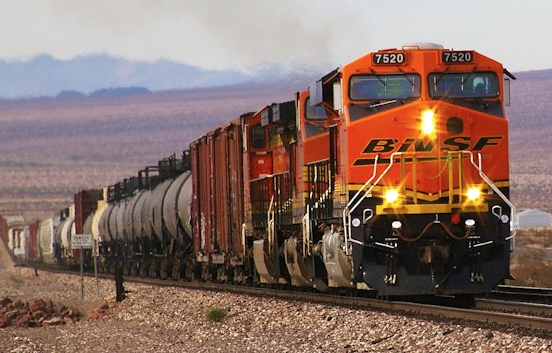
Screen Shot 2014-04-11 at 3.30.39 PMWASHINGTON, D.C. – April 10, 2014 – The Association of American Railroads (AAR) today reported increased U.S. rail traffic for the week ending April 5, 2014 with 296,039 total U.S. carloads, up 5.4 percent compared with the same week last year. Total U.S. weekly intermodal volume was 261,084 units, up 12.6 percent compared with the same week last year. Total combined U.S. weekly rail traffic was 557,123 carloads and intermodal units, up 8.7 percent compared with the same week last year.
Nine of the 10 carload commodity groups posted increases compared with the same week in 2013, including grain with 19,741 carloads, up 16.8 percent, and petroleum and petroleum products with 14,779 carloads, up 11 percent. The commodity showing a decrease compared with the same week last year was forest products with 10,948 carloads, down 0.7 percent.
For the first 14 weeks of 2014, U.S. railroads reported cumulative volume of 3,898,778 carloads, up 1.2 percent compared with the same point last year, and 3,464,083 intermodal units, up 4.4 percent from last year. Total combined U.S. traffic for the first 14 weeks of 2014 was 7,362,861 carloads and intermodal units, up 2.7 percent from last year.