Tesla Releases Patents For All To See

June 12,2014

Screen Shot 2014-06-12 at 1.43.39 PMIn a bid to speed up adoption of electric cars Tesla CEO  Elon Musk penned this letter explaining why the company has released company patents for all to see.

“Yesterday, there was a wall of Tesla patents in the lobby of our Palo Alto headquarters. That is no longer the case. They have been removed, in the spirit of the open source movement, for the advancement of electric vehicle technology.

Tesla Motors was created to accelerate the advent of sustainable transport. If we clear a path to the creation of compelling electric vehicles, but then lay intellectual property landmines behind us to inhibit others, we are acting in a manner contrary to that goal. Tesla will not initiate patent lawsuits against anyone who, in good faith, wants to use our technology.

When I started out with my first company, Zip2, I thought patents were a good thing and worked hard to obtain them. And maybe they were good long ago, but too often these days they serve merely to stifle progress, entrench the positions of giant corporations and enrich those in the legal profession, rather than the actual inventors. After Zip2, when I realized that receiving a patent really just meant that you bought a lottery ticket to a lawsuit, I avoided them whenever possible.

At Tesla, however, we felt compelled to create patents out of concern that the big car companies would copy our technology and then use their massive manufacturing, sales and marketing power to overwhelm Tesla. We couldn’t have been more wrong. The unfortunate reality is the opposite: electric car programs (or programs for any vehicle that doesn’t burn hydrocarbons) at the major manufacturers are small to non-existent, constituting an average of far less than 1% of their total vehicle sales.

At best, the large automakers are producing electric cars with limited range in limited volume. Some produce no zero emission cars at all.

Given that annual new vehicle production is approaching 100 million per year and the global fleet is approximately 2 billion cars, it is impossible for Tesla to build electric cars fast enough to address the carbon crisis. By the same token, it means the market is enormous. Our true competition is not the small trickle of non-Tesla electric cars being produced, but rather the enormous flood of gasoline cars pouring out of the world’s factories every day.

We believe that Tesla, other companies making electric cars, and the world would all benefit from a common, rapidly-evolving technology platform.

Technology leadership is not defined by patents, which history has repeatedly shown to be small protection indeed against a determined competitor, but rather by the ability of a company to attract and motivate the world’s most talented engineers. We believe that applying the open source philosophy to our patents will strengthen rather than diminish Tesla’s position in this regard.”

SunEdison Partners With Rosedale Union School District To Deliver 1.8 MW Of Solar Power


Project Expected to Save District More Than $2 Million


BELMONT, Calif., May 21, 2014 /PRNewswire/ — SunEdison (NYSE: SUNE), a leading solar technology manufacturer and provider of solar energy services today announced a partnership with Rosedale Union School District (RUSD) in Bakersfield, Calif. to install, monitor and manage 1.8 MW of solar at the district’s nine schools. This solar energy and efficiency project is expected to save the district approximately $55,000 in year one and more than $2 million in energy costs over 20 years.

Solar shade canopies will be constructed in parking lots at the district’s schools, taking advantage of underutilized space to produce clean solar energy and provide needed shade for parking.  Scheduled for completion by the end of this year, the project is expected to significantly reduce electricity usage, freeing up funds for important academic and enrichment programs across the district. SunEdison will install, monitor and maintain the solar system at no additional expense to the district.

“Our partnership with SunEdison will allow Rosedale Union School District to maximize our use of clean energy, and significantly reduce our utility expenses from day one, while providing us with a fixed cost of energy for the next 20 years,” said John G. Mendiburu, Ed.D, Superintendent, Rosedale Union School District. “In addition to the cost savings and added value to the classroom, this project helps reduce our carbon footprint and create a sustainable and brighter future for our children.”

“Leaders of the Rosedale Union School District have shown forward-looking vision in meeting the energy needs of their growing community,” said Bob Hopper, Vice President Distributed Generation Origination & Strategy at SunEdison. “SunEdison works with progressive school districts across California to reduce energy costs and we look forward to partnering with other districts to realize energy efficiencies and funnel those savings back to the classroom.”

Nearly 5,000 SunEdison Silvantis™ modules will be installed as part of this project scheduled to begin in the summer of 2014. Once operational, the solar systems will be managed by the SunEdison Renewable Operation Center (ROC), which provides global 24/7 asset management, monitoring and reporting services. Data collected from the ROC is used to continuously improve the company’s products, project designs and service offerings.

About Rosedale Union School District
The Rosedale Union School District (RUSD) is located in the northwest of Bakersfield, California and encompasses approximately twenty-eight square miles. The District provides kindergarten through eighth grade education services through seven elementary and two middle schools serving more than 5,400 students. Several schools within the District have been recognized by the California Department of Education as California Distinguished Schools.

About SunEdison
SunEdison is a global leader in semiconductor and solar technology. SunEdison’s semiconductor business has been a pioneer in the design and development of silicon wafer technologies for over 50 years. With R&D and manufacturing facilities in the U.S., Europe and Asia, SunEdison enables the next generation of high performance semiconductor devices. SunEdison’s solar business develops,  finances, installs and operates distributed power plants, delivering predictably priced solar energy and services for its commercial, government and utility customers. SunEdison’s common stock is listed on the New York Stock Exchange under the symbol “SUNE.”  To learn more visit www.sunedison.com.

Increased Rail Traffic For May

Screen Shot 2014-04-11 at 3.30.39 PMWASHINGTON, D.C. – June 5, 2014 –The Association of American Railroads (AAR) today reports U.S. Class I railroads originated 110,164 carloads of crude oil in the first quarter of 2014, 1.4 percent more than in the fourth quarter of 2013 and, by 1,559 carloads, the most ever in any quarter.  In the first quarter of 2014, crude oil accounted for 1.6 percent of total originated carloads for U.S. rail traffic.

AAR also reported increased U.S. rail traffic for May 2014, with both carload and intermodal volumes increasing compared with May 2013. Intermodal traffic in May totaled 1,045,880 containers and trailers, up 8 percent (77,526 units) compared with May 2013, and the 54th-consecutive year-over-year monthly increase for intermodal volume.  The weekly average of 261,470 intermodal units on U.S. railroads in May 2014 was the third-highest average for any month in history.

 Meanwhile, U.S. carload originations totaled 1,186,314 in May 2014, up 6.1 percent (68,301 carloads) over May 2013. Total carloads averaged 296,579 per week in May, the highest weekly average for May since 2008 and the highest weekly average for any month since October 2011.

 “If you’re looking for a sign that the economy is shaking off its first quarter lethargy, rail traffic in May could be that sign,” said AAR Senior Vice President John T. Gray.

Seventeen of the 20 commodity categories tracked by the AAR each month saw year-over-year carload increases in May. Commodities with the biggest carload increases included grain, up 18,612 carloads, or 29.7 percent; crushed stone, sand and gravel, up 12,256 carloads, or 14.6 percent; and coal, up 12,196 carloads, or 2.8 percent. May marked the seventh straight double-digit year-over-year gain for grain. Railroads have not had a month with 17 of 20 commodity categories increased since the spring of 2010, when the country was just beginning to rebound from the most severe stages of the recession.

Commodity categories with carload declines last month included food products, down 948 carloads, or 3.7 percent; coke, down 666 carloads, or 4.3 percent; and nonmetallic minerals, down 457 carloads, or 2.1 percent.

Excluding coal and grain, carloads were up 37,493 carloads, or 6 percent in May, the biggest such percentage increase since December 2012.

“If you’re looking for a sign that the economy is shaking off its first quarter lethargy, rail traffic in May could be that sign,” said AAR Senior Vice President John T. Gray. “Crushed stone, steel, motor vehicles, lumber, chemicals— the list of commodities showing carload gains in May goes on and on. And intermodal continues to surge. All in all, there’s very little to dislike about May’s rail traffic figures.  We hope it really is a sign that the economy is beginning a period of solid growth.”

AAR today also reported increased rail traffic for the week ending May 31, 2014. U.S. railroads originated 289,633 carloads last week, up 7.6 percent compared with the same week last year, while intermodal volume for the week totaled 242,092 units, up 9.1 percent compared with the same week last year.

California’s Aerospace Exports Surge

June 4, 2014

Screen Shot 2014-06-04 at 2.35.40 PMCalifornia’s exporters turned in another formidable performance in April, according to a Beacon Economics’ analysis of foreign trade data released this morning by the U.S. Commerce Department.
For the month of April, the state’s merchandise export trade totaled $14.09 billion, up 7.8% from the $13.07 billion in exports recorded in April 2013.
California’s exports of manufactured goods jumped by 11% in April, increasing to $9.41 billion from $8.48 billion in April of last year. Foreign shipments by the state’s aerospace industry sector continued to surge.
“Our exports of aerospace products now exceed our exports of computer equipment,” said Jock O’Connell, Beacon Economics’ International Trade Adviser.”
Overall, California’s growth rate eclipsed the U.S. growth rate of 2.8%—as products that the state produces are in high demand in today’s global economy.
April’s U.S. number did come with a disappointing twist however: Despite export growth, the trade deficit widened sharply with a 6% growth in imports. “This is not too surprising given that the U.S. economy is one of the bright lights for growth in the world right now,” said Beacon Economics’ Founding Partner Christopher Thornberg. “ But with the US dollar still 25% cheaper in real terms than it was one decade ago, we expect exports to again grow faster than imports by the end of the year.”
Meanwhile, the state’s exports of non-manufactured goods (chiefly agricultural produce and raw materials) in April totaled $1.81 billion, up 19.1% from $1.52 billion in April 2013. Re-exports, however, declined by 6.7% to $2.87 billion from $3.08 billion.

California Experiences Another Significant Drop in Births to Teens

Tulare County Still Number One

June 4,2014
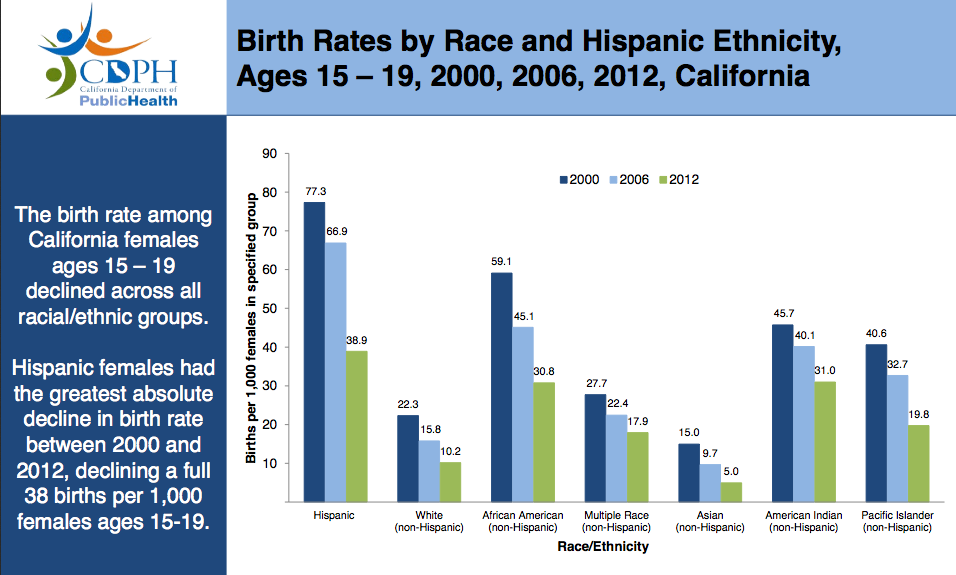
California’s teen birth rate has continued to decline to a record-low of 25.7 births per every 1,000 females ages 15-19, announced Dr. Ron Chapman, director of the California Department of Public Health (CDPH) and the state public health officer. The 2012 rate reflects an 8 percent decline from the 2011 rate of 28.0. 
 
”I am very pleased with the positive strides California is making in reducing teen pregnancy,” Chapman said. “By encouraging positive and sensible choices for our young men and women, we can inspire our youth to strive for successful futures.”
 
Teen birth rates decreased among all racial and ethnic groups between 2000 and 2012. While Hispanic adolescents continue to have the highest birth rate at 38.9 births per 1,000 females ages 15-19, they also had the greatest decline down from a 77.3 in 2000 – a 49.7 percent drop.

Screen Shot 2014-06-04 at 6.31.03 AM
From 2000 to 2012, the number of births per 1,000 females ages 15-19 also dropped among African Americans from 59.1 to 30.8, among Whites from 22.3 to 10.2, and among Asians from 15.0 to 5.0.
Tulare County continues to lead the state with the highest birthrate per 1000 females with a rate of 53.7 – about double the state average.The number of repeat  births is 20.8.

Big Benefits

Delaying childbearing until adulthood can improve both maternal and infant outcomes, and increase youth opportunities for educational and career success. California has a number of programs and policies aimed at preventing adolescent pregnancy and improving outcomes of such pregnancies. Some of the key components of the State’s multi-pronged approach include:
 
• State laws requiring school-based and other state-funded sexuality education to be comprehensive, medically accurate, and age-and culturally-appropriate.
• Community-based education programs that provide sexual health information, skill development, and supportive environments and opportunities for youth.
• Services and supports for expectant and parenting adolescents to empower young families to be successful and thrive. 
 
CDPH funds the Information and Education Program, the Personal Responsibility Education Program authorized through the Affordable Care Act of 2010, and the Adolescent Family Life Program for expectant and parenting adolescents. In addition, the State provides no-cost family planning services to eligible males and females, including youth, through the Family PACT Program.

The Tulare County Economic Development Corporation Reaccredited by the International Economic Development Council

June 2, 2014 [Washington, DC] – The International Economic Development Council (IEDC) announces that the Tulare County Economic Development Corporation (EDC) has once again been recognized as one of 41 economic development organizations accredited by IEDC as an Accredited Economic Development Organization (AEDO). Originally accredited in 2001, the organization was reaccredited by IEDC following three (3) successful years of activity as an AEDO member.

“The Tulare County EDC displays the professionalism, commitment, and technical expertise that is deserving of this honor”, said IEDC President and CEO Jeff Finkle.

 The AEDO program is a comprehensive peer review process that measures economic development organizations against commonly held standards in the profession. The program consists of two phases: a documentation review and an onsite visit. Each phase is designed to evaluate information about the structure, organization, funding, program, and staff of the candidate economic development organization.

 Maintenance of the AEDO status is required every three years and is accomplished through documentation submission and onsite visits by a team of the AEDO subcommittee. The Site Visit Team, consisting of Brett Doney, President & CEO of the Great Falls (MT) Development Authority and Dan Henderson, Director of Real Estate & Economic Development for the Town of Gilbert AZ, conducted a three day visit and assessment of the EDC May 7-9.  In making their unconditional recommendation for reaccreditation, the team stated that the EDC “exemplifies the AEDO standard and the organization not only follows best practices but develops new best practices for other agencies and organizations to follow”.  The team further commented that the EDC developed an advertisement with the tagline “California’s Most Innovative Economic Development Organization” and “the AEDO Review Team believes the organization has earned the right to say so”.

 “Achieving reaccreditation for the EDC was a major goal of the EDC Board of Directors this year and is a testament to their leadership, commitment and focus of creating jobs for our residents through the recruitment of new businesses to our communities” stated Nick Seals, EDC Board Chairman.  EDC Board Vice Chairman Craig Vejvoda added that “earning the AEDO accreditation tells the community and prospects that the EDC attained a measure of excellence assuring that their trust is well placed and their business is in good hands”.

 The AEDO status will remain in effect until May 31, 2017.  The formal presentation of the AEDO designation will be made at the August 27 annual meeting of the EDC Board of Directors.

Screen Shot 2014-06-02 at 3.31.29 PM


###


About the EDC:  Formed in 1983 by elected officials from throughout Tulare County, the EDC’s mission and focus is to create new jobs through the creation and support of businesses and industry on behalf of the communities in Tulare County.  The EDC has assisted hundreds of businesses who have brought thousands of jobs to Tulare County communities during the EDC’s 31 history.


About IEDC: The International Economic Development Council is the largest membership association serving economic and community development professionals in the world. With over 4,400 members nationwide and abroad, IEDC offers the economic development profession one source for information and professional development, one voice for the profession and one force for advocacy

Appeals Court Questions Lower Court Ruling on HSR

May 24,2014
Screen Shot 2014-05-25 at 7.06.54 AMTwo of the three appeals court judges questioned a lower court ruling blocking the $8.6 billion in state bond funding for high speed rail this past week. The judges heard testimony from both sides but did not rule on the appeal of the Sacramento trial court. Still, their comments spoke volumes on the expected outcome.

Farmers from Kings County – backed by the county itself – have stymied efforts to move the project forward with several favorable rulings from trail court judge Michael Kenny. Now there is speculation that those decisions may be overturned when the 3rd District Court of Appeal rules in the next 90 days.

Governor Jerry Brown had urged the higher court to allow the big project to move forward.

Bloomberg reported the court proceedings Friday.

“The court doesn’t have any right to question an appropriation made by the Legislature,” Justice Ronald Robie said during a hearing in Sacramento, the state capital. “I think there is a serious separation-of-powers issue here.”

Judge Kenny had ruled last November that the controversial bullet train did not comply with Prop 1A – passed by the legislature and then the voters, and that the Authority had to start over to come up with a new funding plan.
Lawyers for the California High Speed Rail Authority argued that Judge Kenny’s ruling was incorrect since no bond money was being spent.

Another appeal court judge appeared to agree.

Justice Vance Raye today questioned the timing of efforts to halt the project before bonds are issued.

“The proper time to raise those objections is at the time that the money is going to be spent,” Raye said.

Another press account offered this.

The lawsuits filed by Kings County and landowners there are premature because the state is not yet seeking to spend any of the bond money and only the state Legislature can determine whether there was enough detail in the funding plan, Deputy Attorney General Ross Moody told a three-judge panel of the California 3rd District Court of Appeal.

“We can’t get this project off the ground. We’re stopped because of this misreading of Proposition 1A,” Moody said. “… We’re at the precipice of actually getting this project into the next phase and we are stopped, we’re being told to go back. We don’t think it’s a proper reading of the law.”

Lawmakers approved the first phase of the planned 800-mile rail line in 2012. That allowed the state to begin selling bonds for construction of the first 130-mile stretch and tap $3.3 billion in federal matching funds.

The panel seemed skeptical about overturning the Legislature’s approval.

A third report summarized what happened.

“Today, the California High-Speed Rail Authority’s plans for the first bullet-train in the US appeared to be back on track when it sought approval from an appeals court regarding the issuance of $8 billion worth of bonds to fund the ambitious project.”

Kings County Loses One In Their Own Backyard

Kings County has been ground-zero in stubborn opposition to the project. But also on Friday Kings County lost another lawsuit in their own superior court, a battle over access to county public right-of-way for soil testing. The county had blocked efforts for the past year for the CHSRA to do normally routine survey and geotechnical work within their jurisdiction.  A visiting judge gave the state the right to take access May 23.

In preparation to build the route through Kings County the survey work will now begin in the next few weeks says a CHSRA spokesperson.   The EIR on the route was certified by the CHSRA – running east of Hanford few weeks ago.  Not that there won’t be more hurdles even if the appeal court rules favorably for the train in coming weeks. Last week the Bakersfield city council took steps to sue the Authority over the latest EIR citing dissatisfaction with the planned route it takes.

State Approves Expansion Of Kettleman Hills Waste Facility

 Facility operating near capacity

May21,2014

Screen Shot 2014-05-21 at 1.39.08 PMSACRAMENTO, Calif. – The Department of Toxic Substances Control (DTSC) today finalized a permit modification for the Chemical Waste Management, Inc., Kettleman Hills hazardous waste facility. This modification increases the hazardous waste landfill’s capacity by about five million cubic yards, while strengthening environmental safeguards and reporting and public information requirements. The facility is currently operating near capacity.

“This decision protects public health and provides California with a safe disposal facility,” said DTSC’s Director Debbie Raphael. “We conducted a comprehensive review of the permit application and the facility’s history. We considered a tremendous amount of public input and ensured all needed safeguards are in place. We have looked at this permit application from every angle over a five-year period to ensure it is the right decision.”

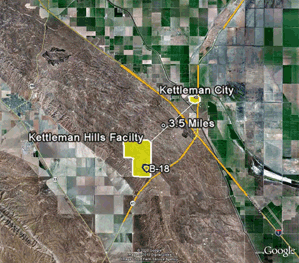
DTSC’s review included the findings of multiple health studies, air and groundwater monitoring data and the facility’s compliance and enforcement records. The process included an extensive public comment period, which DTSC extended at the request of community members. Public involvement also included 23 public meetings and interview sessions with people in communities closest to the facility, which is located about three and a half miles from Kettleman City. DTSC reviewed and considered more than 5,500 comments submitted during the public comment period.

Public involvement played a key role in the final permit conditions. As a result, the permit modification includes extensive and stringent conditions that protect public health and the environment:

Increased monitoring for PCBs that detects very low concentrations in air
Enhanced air monitoring for all other contaminants
from the facility’s operations Expanded sampling and analysis of liquids captured by the landfill’s subsurface collection system
Required that trucks using the facility meet stricter diesel-emission standards
Required a containment system to control spills
Required annual aerial and land surveys to verify Chemical Waste M
anagement Inc.’s estimates of remaining landfill capacity
Increased inspections

For more information about the decision, including the modified permit, DTSC’s official Response to Comments, which addresses comments received during the Public Comment Period, and details on the appeals process, please click here.

Summer Air Travel to Reach Highest Level in Six Years

WASHINGTON, May 15, 2014 – Airlines for America (A4A), the industry trade organization for the leading U.S. airlines, today delivered its Summer Air Travel Forecast and first-quarter 2014 results for U.S. passenger airlines, which achieved strong operational performance and modest profitability in the face of one of the harshest winters in memory.A4A projects summer 2014 air travel to rise to its highest level in six years, with a record number of passengers traveling internationally on U.S. carriers. Approximately 210 million passengers (2.28 million per day) are expected to fly U.S. airlines from June 1 – August 31, up 1.5 percent from 2013. This includes 29.9 million travelers (325,000 per day) on international flights – an all-time high. Published airline schedules show Canada, Mexico, the United Kingdom, Germany and Japan, respectively, as the top five nonstop destinations from the United States.

“It’s a great time to fly, as air travel remains one of the best consumer bargains in America, given its superior speed and affordability,” said John Heimlich, A4A Vice President and Chief Economist. “U.S. airlines are well prepared to accommodate the increased travel demand in the summer months by adding seats and continuing to make customer-focused investments in their product.”

Improving Finances Benefiting Customers, Employees, Investors and the Overall U.S. Economy

During the first quarter of 2014, nine publicly traded U.S. passenger carriers collectively reported a Generally Accepted Accounting Principles (GAAP) net profit of $401 million, resulting in a 1.1 percent net profit margin, improved from a collective net loss of $552 million during the same period in 2013. Operating revenues rose 3.7 percent year-over-year due in large part to a 1.1 percent increase in the number of air travelers, the equivalent of an additional 21,000 passengers per day. Fuel remained the largest and most volatile cost for airlines, accounting for 33 percent of overall operating expenses.

Despite entering 2014 with approximately $72 billion of debt and coping with some of the worst winter weather on record, modest financial progress enabled carriers to continue significant levels of reinvestment to further enhance the customer experience. First-quarter capital expenditures for the nation’s airlines totaled $3 billion, on track to meet the $12 billion in reinvestment expected for the full year. Advancements include 1,751 new aircraft, of which 255 are scheduled for delivery in 2014 or the equivalent of roughly one aircraft received every weekday of the year.

“The modest margins are enabling airlines to shore up their balance sheets while accelerating reinvestment in people, products and technologies that enhance the overall travel experience,” said Heimlich.  “In the first quarter, airlines did a great job meeting the needs of their customers despite facing severe winter weather, including two of the worst aviation weather days ever recorded.”

Heimlich noted that, while U.S. airline finances are steadily improving, the industry still faces significant financial challenges including paying down debt, pursuing investment-grade credit and seeking margins on par with or better than the S&P 500 average.

1Q 2014 Financial Summary

  • Net profit: The $401 million profit, or $484 million excluding one-time items, reflects the results of nine U.S. passenger airlines – Alaska Airlines, Allegiant Air, American Airlines, Delta Air Lines, Hawaiian Airlines, JetBlue Airways, Southwest Airlines, Spirit Airlines and United Airlines.
  • Operating Revenues and Expenses: While revenues increased 3.7 percent year-over-year, fuel costs declined 4.3 percent. Lower fuel costs largely offset sharp increases in labor, airport-related and aircraft costs. Jet fuel remains the U.S. airlines’ largest and most volatile expense. Every penny increase per gallon annually costs airlines an additional $180 million.
  • Capital Expenditures (CapEx): U.S. airlines reinvested $3 billion in the product and customer experience during the first quarter, which equates to about $18 per enplaned passenger. Airline CapEx rose 141 percent from 2010 to 2013; a total of $12 billion of reinvestment is expected in 2014.


WeatherWatch…May Storms / El Nino Could Mean Late Summer Rain

May 19.2014

Wednesday could mean Sierra snow, thunderstorms
Tuesday/Wednesday  could mean Sierra snow, thunderstorms

California Could Get Some Sierra Snow ,Thundershowers This Week

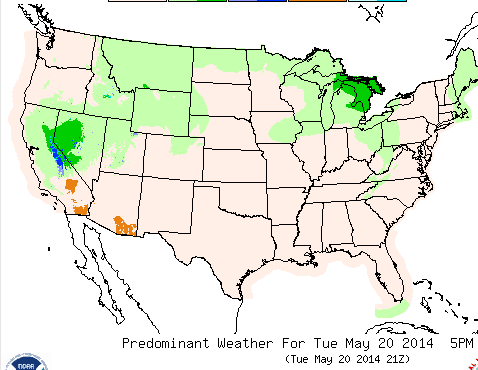
NWS says rain could visit some parts of California most of this week with the Central Sierra getting some snow Tuesday  and Wednesday.The unsettled weather could move slowly down the state through the week. Regarding the system SLO forecaster John Lindsey says today in his blog”An upper-level low pressure (551-dm) system will drop out of the Pacific Northwest and slide across Central California on Tuesday into Wednesday. This system will give below-average temperatures band plenty of marine low clouds, fog and drizzle during the night and morning hours. The system will also produce cumulus cloudsbalong with a chance rain showers and afternoon thunderstorms over far eastern San Luis Obispo County. However, This system will give showers and afternoon thundershowers over much of the Sierra Nevada.”


El Nino effect?
El Nino effect?

El Nino Could Bring Late Summer Rains To So Cal

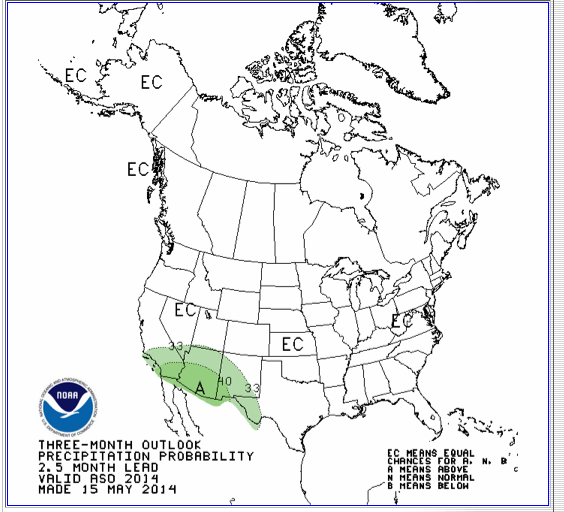
A NOAA forecast map produced May 15 predicts the probability of wet weather across the southwest including southern California late this summer due to a strengthening El Nino. The probability map shown is for the months of August,September and October. NOAA cautions that this far out it is impossible to offer specifics but the El Nino in the So Pacific typically drives this pattern that could also bring plenty of moisture this summer to Arizona.