Home Builder Buys Out Rival In Visalia

New Home Permits Up

Visalia’s new home permits continued strong in July with 51 new homes compared to 31 for July 2013. Year-to-date new home permits are up 20% and their value is up 28%. Meanwhile residential remodels for existing homes is are 29% higher this year vs last – good news at for the home improvement stores in town.

Screen Shot 2014-08-08 at 11.23.06 AMWathen-Castanos Buys McMillin Home Lots In Visalia

Fresno-based homebuilder Wathen Castanos has purchased the remaining 84 lots owned by McMillin Homes in Visalia this month. Peter Castanos says the family firm will be building in the Riggin and Roeben area on some 24 estate-size lots right away and 60 other lots by next spring.The company is also developing 55 lots it acquired from Pulte Homes north of Riggin, a gated community called Avalon with home  prices starting below $200,000.
Castano says the Visalia marketplace has been “very competitive” with a half dozen large builders going toe to toe at least when they entered the market last fall.The company purchased the assets of Visalia builder Mangano Homes with some lots here and more on the Coast and Andy Mangano sitting on the their board.
McMillin,based in San Diego,had its big push into Visalia in 2002 when they acquired Richard Allen’s residential division.
The departure of McMillin as well as the exit of Pulte adds up to fewer players in the business here.
Visalia developer Harvey May says he remembers when most of the builders in town were locals.Then came the influx of national builders and now mostly Fresno home builders along with Centex and Lennar are the dominant firms. “There just are not any of the local guys left ” shrugs May.

Oil/Gas Prices Head Lower

Oil prices are down to $97.60 per barrel – a $8 drop since late June. Meanwhile California gas prices peaked around Memorial Day dropping from a high of $4.27 average to $3.90 as of this week according to Gas Buddy. A few stations in Tulare County are selling gas for $3.50 this week.

How Dry Are We?

Hard to blame Congress or anyone but Mother Nature for this. Kaweah Delta Water Conservation District says April through July Kaweah runoff is just 26% of average as measured over the past 110 years, the 4th driest on record. For the ”water year” measured from October to September – KDWCD fears we will fall to 24% of average, the third worst showing says operations manger Vic Hernandez. Not only is there less water, the river is hotter than usual with the website Kaweah River Page noting a June 18 temp of 81 degrees at Pumpkin Hollow and 85F at Dinely Bridge. This week the high is 77F at Pumpkin Hollow. Warm temps encourage algae growth.

One Too Many Family Dollar Stores

Tulare’s Family Dollar store at 1277 N Cherry is closing with 2 more  company stores in town staying open.

Screen Shot 2014-08-08 at 11.20.06 AMSunset Highlights Local Visitor Favorites

Popular Sunset magazine’s July cover story on Mountain Escapes includes 2 Sequoia Park spots in their Best of the Sierra category. On the list is Best Peak featuring the hike up Alta Peak overlooking the Kaweah Middle Fork as well as Best Campground featuring Cold Springs in Mineral King with tent sites on the river.Nearby is Silver City Resort, famous for pies. Both locations are seeing an influx of new visitors as a result say reports.


California Exports Outpace Nation

California’s exporters turned in another strong performance in June, according to a Beacon Economics’ analysis of foreign trade data released this morning by the U.S. Commerce Department.

August 6,2014

Screen shot 2012-06-15 at 12.12.22 PMFor the month of June, the state’s merchandise export trade totaled $15.77 billion, up 3.5% over the $15.23 billion in exports recorded in June 2013.

The state’s exports of manufactured goods edged up 1.5% in June, increasing to $9.96 billion from $9.81 billion in June of last year.

Meanwhile, the state’s exports of non-manufactured goods (chiefly agricultural produce and raw materials) in June totaled $1.95 billion, up 18.9% from $1.64 billion in June 2013. Re-exports also grew by 1.8% to $3.86 billion from $3.79 billion.

For the first half of this year, California’s merchandise export trade was up 6.3% over the same period last year, while overall U.S. exports edged ahead by just 2.9%.

“Constrained by the recent strengthening of the U.S. dollar and the slackening pace of economic growth being reported in several key foreign markets, California’s merchandise export trade has slowed but not faltered,” said Jock O’Connell, Beacon Economics’ International Trade Advisor.

Moreover, Director of Economic Research Jordan Levine says the state’s broader economy is starting to accelerate after the winter lull. “Nonfarm jobs in California are back to their pre-recession peak and the Manufacturing sector has started to post job gains again,” said Levine. “Demand for California goods across the globe are certainly helping to fuel those increases.”

A Closer Look At The Numbers

As always, Beacon Economics cautions against reading too much into month-to-month fluctuations in state export statistics, especially when focusing on specific commodities or destinations. Significant variations may occur as the result of unusual developments or exceptional one-off trades and may not be indicative of underlying trends.

For that reason, Beacon Economics compares the latest three months for which data are available (i.e., April-June) with the corresponding period one year earlier.

California’s merchandise exports during the latest April-June period totaled $44.09 billion, a nominal increase of 6.0% over the same period a year earlier. The state accounted for 10.7% of total U.S. merchandise exports over the past three months.

California’s export trade is highly diversified, with eleven different categories of goods each accounting for at least $1 billion in exports during this year’s second quarter.

Performance, however, was highly variable, with six categories showing declines in exports from the same quarter last year. Topping the export list in this year’s second quarter was Miscellaneous Manufactured Commodities, a catch-all category of merchandise ranging from medical equipment to sporting goods, with $2.92 billion in exports in the latest quarter, down 0.6% from the same period one year earlier. Aerospace Products and Parts ($2.42 billion, -2.0%); Navigational and Measuring Instruments ($2.42 billion, -9.1%); Semiconductors and Other Electronic Components ($2.37 billion, -10.1%); and Communications Equipment ($2.35 billion, +6.5%) were the next largest categories of exports.

On a more positive note, strong growth was reported in exports of Fruits and Tree Nuts ($2.31 billion, +17.4%) and Petroleum and Coal Products ($1.85, +32.7%).

Mexico remained California’s single largest export market during the latest three-month period, with the value of exports edging up by 3.6% to $6.27 billion. Exports to Canada slipped by 5.4% to $4.39 billion, while shipments to China rose by a mere 0.8% to $4.21 billion. Japan (up 0.1% to $3.11 billion) and Hong Kong ($2.37 billion, up 33.8%) rounded out California’s ‘Top Five’ export destinations in the latest three-month period.

Regionally, California’s exports to the Asia Pacific region (including Australia and New Zealand) rose by 5.3% to $17.01 billion. Exports to the European Union grew by 6.7% to $7.59 billion. California exports to Latin America and the Caribbean (excluding Mexico) vaulted by 44.2% to $2.95 billion, powered by a tripling of refined petroleum exports to region. The state’s exports to Sub-Saharan Africa amounted to $194.0 million, down 8.9% from the second quarter of last year.

By mode of transportation, 45.3% of California’s $44.09 billion merchandise export trade in the most recent three-month period was shipped by air, with Los Angeles International and San Francisco International Airports accounting for the vast majority of the state’s airborne trade. Seaports handled 32.6% of the state’s export trade, while the remaining 22.1% of the state’s exports of goods traveled overland by truck or rail to Canada and Mexico.

California Exports: The Near Term Outlook

Beacon Economics expects California’s export trade to continue growing at a slower pace over the next several months. “While we have confidence in the resourcefulness of California’s exporters and the strong appeal of the goods Californians produce, the slowing, if not anemic, economic growth rates we’re seeing in a number of key overseas markets plus the effects of a stronger dollar will likely result in relatively modest growth in California’s export trade in the second half of this year,” O’Connell said.


Home Sales Perk Up in June

Lower interest rates perk up California home sales in June; market more balanced

SLO Median Price Climbs Over $500k

LOS ANGELES (July 16) – Lower interest rates and stabilizing home prices combined to boost home sales in June, the CALIFORNIA ASSOCIATION OF REALTORS® (C.A.R.) said today.  However, diminished home affordability remains a challenge for buyers, particularly in high cost areas of the state.

Closed escrow sales of existing, single-family detached homes in California totaled a seasonally adjusted annualized rate of 394,930 units in June, according to information collected by C.A.R. from more than 90 local REALTOR® associations and MLSs statewide.  June marked the eighth straight month that sales were below the 400,000 level and the eleventh straight decline on a year-over-year basis.  Sales in June increased 1.5 percent from a revised 389,060 in May but were down 4.8 percent from a revised 414,830 in June 2013.  The statewide sales figure represents what would be the total number of homes sold during 2014 if sales maintained the June pace throughout the year.  It is adjusted to account for seasonal factors that typically influence home sales.

“While June home sales rose at the statewide level, the market is still constrained by tight supply and low housing affordability in areas of high demand, where job growth is robust and international buyers have a strong presence,” said C.A.R. President Kevin Brown.  “Overall, however, with inventory improving and home sales slowly moving back up, the market is more balanced, and we could see further market normalization in the upcoming months as interest rates remain at the lowest levels we’ve seen so far this year.”

Screen shot 2012-07-05 at 7.20.30 AM
Local Numbers

In the Sierra2thesea reading area SLO County sales were down 9.3% month to month  and down 13.8% year to year. The county’s median price climbed 3.2.% MTM and 8.8% YTY to $503,250. That is huge jump from April when it $419,500  up from $390,000 a year earlier.The county median was highest in 2006 at $580,000.

Read more here: http://www.sanluisobispo.com/2014/05/16/3067594/slo-countys-median-home-price.html#storylink=cpy

In Tulare County sales MTM fell 0.7% but rose 4.7% YTY. The county median price was down 0.4% MTM but up 11.2% year over year to $176,520.

The statewide median price of an existing, single-family detached home slipped 2 percent from May’s median price of $466,320 to $457,160 but was up 6.6 percent from the revised $428,700 recorded in June 2013.  The statewide median home price has increased year over year for the previous 28 months, marking more than two full years of consecutive year-over-year price increases. The median sales price is the point at which half of homes sold for more and half sold for less; it is influenced by the types of homes selling as well as a general change in values.
“Home prices are finally increasing at a healthier pace, and the smallest year-over-year price gain in more than two years suggests that prices are stabilizing,” said C.A.R. Vice President and Chief Economist Leslie Appleton-Young.  “Last year’s frenzied market of multiple offers, which drove sales prices above listing prices, has tapered off as the sales-to-list price ratio has dropped to a more normal level at nearly 99 percent, which signals a return to a more balanced market.”

Other key facts from C.A.R.’s June 2014 resale housing report include:
Housing inventory edged slightly higher in June, with the available supply of existing, single-family detached homes for sale increasing from 3.6 months in May to 3.7 months in June. The index was 2.9 months in June 2013.  The index indicates the number of months needed to sell the supply of homes on the market at the current sales rate.  A six- to seven-month supply is considered typical in a normal market.
• The median number of days it took to sell a single-family home also rose in June, up from 31.6 days in May to 33.9 days in June and up from 27.8 days in June 2013. 
• Mortgage rates dipped in June, with the 30-year, fixed-mortgage interest rate averaging 4.16 percent, down from 4.19 percent in May but up from 4.07 percent in June 2013, according to Freddie Mac.  Adjustable-mortgage interest rates in June averaged 2.40 percent, down from 2.43 percent in May and down from 2.60 percent in June 2013.

Valley Biz Briefs: July 15 – Fresno County Rail Vote / More

Screen Shot 2014-07-15 at 8.35.59 AMHigh Speed Rail Vote In Fresno County

Led by Supervisor Debbie Poochigian the Fresno County Board of Supervisors is expected to pass a resolution expressing “ strong concerns” about the California High Speed Rail project , a project that broke ground in Fresno only yesterday. Poochigian’s measure claims the project has faced delays,higher costs  and now an uncertain future with a flawed plan. The board backed the project in2007. Now the resolution calls the bullet train  a “boondoggle”.
Fresno County’s BOS would join Kings County and Kern County in opposition with each of those boards actually filing legal action.
County supervisor Henry Perea, a strong supporter says “it is unlikely that Fresno County’s action will have any effect on the project’s fate except to put in question whether the county is awarded the 1500 job Heavy Maintenance  Station location. ”This is a job killer akin to the resolution  that pushed UC to go Merced County some years ago.” The issue of whether the rail project complies with Prop 1A is expected to be settled in the next week or so when an appellate court rules on a Kings County lawsuit. “Why not wait to vote until we hear what the court says in the next few days” asks Perea. A nose count suggests the  board will oppose the project.

 
California Mortgage Rates Up to 4.07%

Zillow Mortgage Marketplace’s current mortgage rates in California for mortgages increased 6 basis points from 4.01% to 4.07%. State mortgage rates today ranged from the lowest rate of 3.94% (NE) to the highest rate of 4.13% (MD, NV). California mortgage rates today are 3 basis points higher than the national average rate of 4.04%.
The California mortgage interest rate on July 15, 2014 is up 3 basis points from from last week’s average California rate of 4.04%.

Corn / Oil Trade Lower

Screen Shot 2014-07-15 at 6.36.01 AMKey commodities are trading lower today – both bullish for the California economy. Corn for September delivery is trading at $3.74 and WTI Oil for August has dropped to $99.69 – falling $1.22 so far today.The price has dropped from nearly $107 in mid-June as the world was fearful of Middle East turmoil.

Friant Districts Get 13,500 AF

Water starved Friant Water District in the the Central Valley got a surprise pulse of water this week as the San Joaquin River Exchange Contractors let lose of 13,500 af they would have taken from Millerton that instead will delivered to water districts down the Fraint Kern Canal. The price was right too says Friant GM Ron Jacobsma compared to the exorbitant prices some are paying to get water trades. The water is being delivered this week to Terra Bella, Orange Cove, Stone Corral,Lindmore and Kern/Tulare IDs. Jacobsma says the district is still lobbying the Bureau of Reclamation to make some Northern California water available to the South Valley districts t who have been offered a zero supply allocation this year. “There is serious anxiety as summer wares on.”

Leprino Expanding Whey Plant

Leprino West cheese plant in Lemoore is expanding its whey production plant according to a city permit valued at $800,000. The facility will be expanded by a modest 10,000 sf.

SCE Power Line To Complete Construction
Southern California Edison is nearing completion of the controversial Cross Valley Loop project – an electric transmission circuit between its Big Creek hydroelectric facility in the Sierra Nevada Mountains with its Rector Substation near Visalia.

Bill DeLain, Region Manager for SCE’s Local Public Affairs says the big project first approved in 2008 should wind up early this Fall. After years of planning and public hearings the  18.5 mile construction work started in 2012. The route passes through the county’s citrus belt from Ivanhoe through Elderwood and up to the Big Creek power line in the foothills.SCE is erecting  63 ft tall power lines along a 100 ft right of way.

Tulare’s Cartmill Interchange To Break Ground

Tulare will hold a ceremony this Wednesday to launch construction of the $25 million remodel of the the Cartmill Interchange. The  project is expected to set the stage for commercial activity on the city’s north end and should wind up in November 2015.

Retail News / Gas Pain Relief

July 11,2014

Screen Shot 2014-07-11 at 12.32.56 PMTulare To Get Forever 21 Store

The community of Tulare will get a Forever 21 clothing store at the outlet mall. Bidding on tenant improvements on a remodel of a 7618sf store  – the former Ralph Lauren Polo space at the mall – has been completed as of July 9 with the store expected to open late this summer. Polo closed their location in Tulare in March.

Hanford Costco To Get Hearing July 24

Hanford City Manager Darrel Pyle says the city Planning Commission will take up the final EIR for the new Costco shopping center at Hyws 43 and 198 on the east side of town on July 24. That will be followed by a City Council hearing in August. Pyle expects construction to start by year end with the popular retailer to open in fall 2015.

Tulare Digester Could Start Construction in September

Colony Energy VP Matt Schmitt says the $25 million anaerobic digester  project near the WWT plant in Tulare could start construction by the end of summer. “We are finalizing the site plan with the City of Tulare  as well as the ground lease.” Schmitt says the biogas project could take about year. “We will be one of the first to inject biogas into the pipeline grid.” The biomethane,used in transportation – will be sought after by companies wanting to lower their greenhouse gas footprint. The biogas will be produced from a mix of green waste, food waste and cow manure.

Gas Pains Relief

Local wholesale price drops have finally brought a little gas price relief in many areas of Southern California, according to the Automobile Club of Southern California. The retail state average is $4.128 a gallon for regular today, 1.2 cents less than last week.
Gas Buddy says statewide the average price has dropped about 2 cents in recent days. Several stations in Tulare are selling gas for $3.75.
Helping to lower the pump price is falling oil futures this week as concern over the Iraq war have eased fears it would affect supply here. Bloomberg says “new U.S. pipelines and a revival in Libyan supply are increasing the likelihood that oil prices will slump through year-end after climbing in the first six months.
Wall Street analysts tracked by Bloomberg predict West Texas Intermediate oil will average $100 a barrel in the fourth quarter, down 5.1 percent from June 30.”
“Wholesale gasoline prices have dropped locally by more than 30 cents a gallon in the last two weeks, indicating a more steady fuel supply,” said Auto Club spokesman Jeffrey Spring this week. “If this trend holds, we can expect to see more drops at the pump.”

Chinese Lead U.S. Home Sales to Foreigners

RealtyTrac reports that international buyers spent $92.2 billion in 2013 on U.S. properties, up from $68.2 billion a year earlier, a 35 percent jump, according to the National Association of Realtors.
The increase in international sales was fueled by a 72 percent increase in activity from Chinese buyers, who purchased $22 billion in U.S. real estate, or 24 percent of total foreign sales.The report — titled “2014 Profile of International Home Buying Activity” — found that Chinese buyers’ favorite state is California, which accounted for 35 percent of sales.

Visalia Watch: Developer Plans Over 400,000 Sq Feet Of New Industrial Buildings

July 9,2014

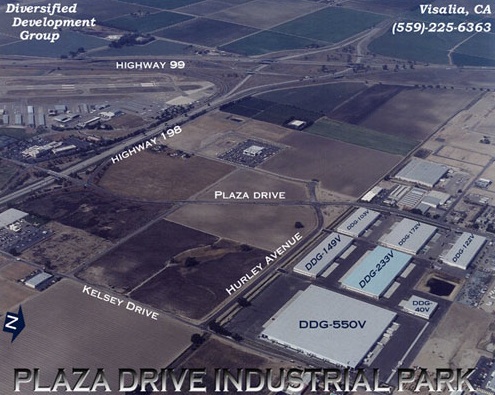
Visalia Ind Park 2014-07-09 at 3.35.10 PMFresno developer John Brelsford has submitted preliminary plans to build 402,000 square feet of new industrial building in the Visalia Industrial Park. Brelsford’s company – Diversified Development Group –   already built some 1.5 million sf in Visalia that is nearly filled with tenants.”This will be the first new buildings in either Visalia or our Fresno properties that we have undertaken in five years” remarks Brelsford,a sign of how tough the past few years have been in the region’s economy.

“We recently signed up two new tenants totaling 172,000sf at our Plaza Industrial Park says associate Marcus Pignotti – Ashley Furniture and Perfection Foods. All we have left is around 30,000sf.”

“Visalia’s industrial vacancy rate has definitely come down quite a bit this year” he adds.

Brelsford says the new “spec” buildings, constructed without any firm commitments from tenants, will be 142,000sf,166,000sf and 93,000sf, – all tilt-up concrete buildings that go up fast.

The location is next to the giant VF Corp facility at Riggin and Ave 76. Brelsford acquired 20 acres there last February out of bankruptcy from Bank Of America. The land had been owned by the Allen Group. Brelsford owns another vacant parcel acquired the same way at the southeast corner of Plaza and Riggin – about 34 acres.

Pictured: DDG’s existing industrial  park in Visalia

“We expect to be under construction by October” Brelsford says.
Regards the recessionary times we have seen in the economy Brelsford notes that his Visalia industrial space has stayed at 92% occupancy even during the tough times.

“We build when we see there is market demand and we see that now.” He adds that around 60% of demand comes from local companies who find they need more space.

Great News

Visalia Economic Development specialist Devon Jones. who started his position with the city in February said “we are excited that Diversified wants to develop their property.”

Visalia Mayor Steve Nelsen called the plan “great news for the city and the industrial park” adding that “our central location makes it possible to ship overnight all over the state.”

Adding 400,000 sf of new commercial in the industrial park will be the largest space built in the park since 2011 when VWR was permitted at 500,000 sf.The heyday of industrial construction came in 2005,2006 and 2007 when the city added a combined total of more than 5.2 million sf of new commercial buildings in town,largely in the industrial park.

Visalia has devoted more than 1,500 acres of the northwestern portion of the city to support industrial growth and employment. An estimated 5,000 people work in the industrial park at distribution centers and manufacturing and food processing plants.
Located in Fresno, CA, Diversified Development Group(DDG) is a real estate development corporation that was formed in 1979 to develop industrial and commercial properties in Central California. Over the past 30 years DDG has developed in excess of 8 million sq.ft. of projects throughout Central California.

Biz Briefs: Mortgage Rates / Corn / Let’s Eat

July 3,2014

California thirty-year fixed mortgage rates go up to 4.05%

Zillow Mortgage Marketplace’s current mortgage rates in California for mortgages increased 1 basis point from 4.04% to 4.05%. State mortgage rates today ranged from the lowest rate of 3.94% (NH) to the highest rate of 4.16% (IN). California mortgage rates today are 3 basis points higher than the national average rate of 4.02%.
The California mortgage interest rate on July 3, 2014 is down 2 basis points from from last week’s average California rate of 4.07%

Corn Prices Head Toward $4

Corn for September delivery fell to $4.17 a bushel on the CME this week after USDA said a big corn crop us coming this fall. It was not that long ago that the Midwest drought pushed corn prices to the $8 level, a killer for dairymen and livestock owners in recent years. The low corn prices should also help ethanol prices low and thus gas prices but keep biofuel makers margins at a high level. Farmers across the country planted around 91 million acres of corn this spring –  the lowest in the past four years. Wet conditions have analysts predicting that this year’s fall corn harvest will surpass last year’s crop.

Screen Shot 2014-07-03 at 7.35.57 AMRestaurant Performance Index Heads Higher

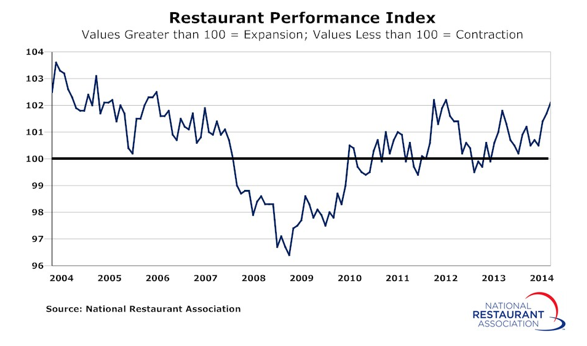
The National Restaurant Association’s Restaurant Performance Index (RPI) is a monthly composite index that tracks the health of and the outlook for the U.S. restaurant industry. Launched in 2002, the RPI is released on the last business day of each month.
Latest RPI (released June 30, 2014)
Driven by stronger sales and traffic levels and an increasingly optimistic outlook among restaurant operators, the RPI rose to its highest level in more than two years.  The RPI stood at 102.1 in May, up 0.4 percent from April’s level.

The Current Situation Index stood at 102.0 in May – up 0.7 percent from April’s level of 101.3.  In addition, May represented the third consecutive month that the Current Situation Index stood above 100, which signifies expansion in the current situation indicators.
The Expectations Index stood at 102.2 in May, unchanged from April’s level. May represented the 19th consecutive month in which the Expectations Index stood above 100,  indicating that restaurant operators remain optimistic about future business conditions.

State Awards $29 Mil In Tax Credits For Companies To Expand

Dinuba Firm, Imperial Valley Ethanol Plant Among The Awardees

Fresh Select LLC operation

Governor Brown’s replacement for the state Enterprise Zone program, an agency called called California Competes awarded $29 million in tax credits to to 31 companies in California this week. Some 200  companies asked more than $500 million although just $30 million was available to be spent this fiscal year. However next fiscal year that starts in July, the agency will have a budget of $150 million.

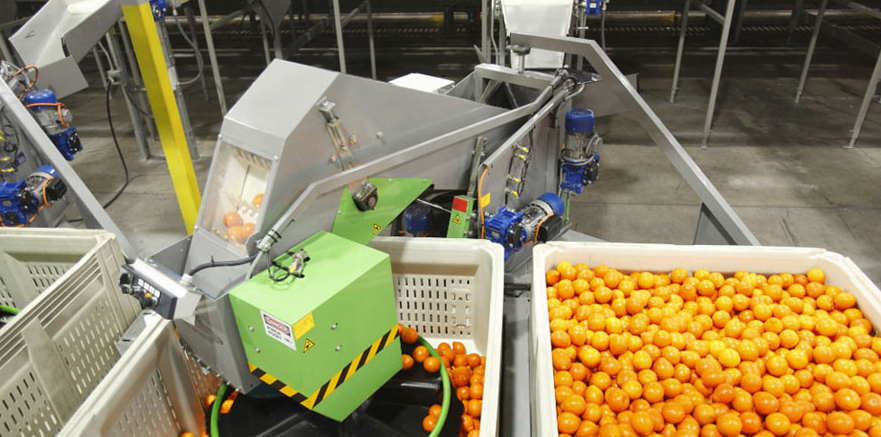
Among the awardees is Dinuba-based Fresh Select,LLC who proposes to increase full time employment over the next few years by 341 according to their application.  Their investment is just under $6 million in new equipment and facilities with an award by the state of $500,000 in tax credits.The company prepares fruit for global distribution. Specifically the company agreed to add  11 employees in2014, and that grows to  total of 33 in 2105, up to 77 in 2106,165 by 2017 and up to 341 by 2018.

Other Valley companies include Duarte Nursery in Hughson ,south of Modesto adding 33 employees and receiving a $250,000 tax credit. Also Modesto-based Flowers Bakery expects to add 121 employees and received a $300,000 tax credit.

The tax credits are overseen by the Governor’s GO-BIZ office
________________________________________________________________________________________________________________________________________________
From OPIS

California Ethanol and Power Gets $3.1 Million Tax Credit

Prospective ethanol producer California Ethanol and Power (CE&P) was approved this week for a tax credit of $3.1 million through the California Competes program.

CE&P is proposing to build the first sugarcane ethanol plant in the U.S. in Brawley, Calif. Previous statements from the company indicated the plant will have a capacity of 66 million gal/year, and it will begin operations in 2016.

According to an application filed with the state, CE&P plans to invest more than
$526 million on the plant, with the largest investment ($506 million) in tax year 2016. By 2018, the company says it will be providing an estimated 222 full- time-equivalent jobs.

Farmers in the Imperial Valley in California who have contracted with CE&P have been planting, with the goal of being able to harvest in a year, and then having five or six years of harvesting, CE&P CEO David Rubenstein told OPIS in December 2013. For the most part, the sugarcane will be planted in marginal fields that have been growing alfalfa and sudan grass, he added.

At a meeting on June 19, the California Competes Tax Credit Committee approved the 31 tax credits that have been recommended, including CE&P’s. Some $29 million in grants were approved to spur development and job creation in the state.

New Economic Study Casts South San Joaquin Valley As California “Success Story”

June 20,2014Business sample image

A new study about the South San Joaquin Valley has found that contrary to popular belief, the region has actually outperformed most other areas of the state in its long-term job expansion, as well as other key measures of growth.  The results of the report will be presented at the Doubletree Hotel in Bakersfield at 9 am on Friday June 20th, in a public meeting co-sponsored by California State University, Bakersfield.  The report will be presented in Fresno County at a community event in July.

Published by the Pat Brown Institute for Public Affairs at Cal State L.A. with funding from The California Endowment, the study by independent research firm Beacon Economics finds that between 1990 and March 2014, the South San Joaquin Valley expanded its employment base by 50% – the 8th largest expansion among the state’s 26 metropolitan areas. Over the long term, this job growth exceeds that of the state’s most famous economic powerhouses, San Francisco and the Silicon Valley.

“Beacon Economics knows our region well and it is evident by the thorough analysis and findings generated in this report.  Our region is recovering and as Beacon notes, we have many, many positive attributes that will continue to contribute to positive economic growth in 2014 and beyond.  We are confident that the forecast Beacon has issued will be achieved or exceeded.” — Paul M. Saldana, CEcD, President & CEO, Economic Development Corporation

The South San Joaquin Valley has one of the fastest growing populations in the state – an indicator not consistent with an economy in decline. Since 1990, the number of local residents in the region has grown by 50% compared to a roughly 28% population expansion in the rest of the state.

“Many of the study’s findings may surprise people given pessimistic perceptions about the future of the South San Joaquin Valley’s economy,” said Dr. Raphael Sonenshein, Executive Director of the Pat Brown Institute. “The authors show that the region has not only been  a long term driver of economic growth in the state, but more recently, that it has largely recovered from devastating damage caused by the recession.”

The Beacon analysis finds that although the South San Joaquin Valley was hit harder by the recession than most of the rest of the state, it has now recovered all the jobs it lost, and consumer and business spending has surpassed its pre-recession peak.

The Pat Brown Institute partnered with CSU Bakersfield to bring the findings of the report to the Kern County community.  “With one of California’s fastest growing populations and many challenges ahead, bringing accurate and well-reasoned analysis about the successes and future direction of the South San Joaquin Valley to the forefront of public discussion has never been more important,” said Dr. Horace Mitchell, President of CSU Bakersfield. “The study brings applied research to an often misunderstood area of California and will hopefully foster dialogue about how to address our local challenges and opportunities.”

Things are not all rosy.  The report notes the impact of pollution and the continuing drought.  Indeed, drought faces California’s colossal agriculture industry with a major threat to the region and the state. “The South San Joaquin Valley represents a much larger share of the California economy than it used to, growing in relative not just absolute terms,” said Christopher Thornberg, Founding Partner of Beacon Economics and one of the study’s lead authors. “As an increasingly vital part of the larger economy, effects here will leak out to the rest of the state making it all the more important to address serious challenges, including what may be the worst drought on record.”

Economy Watch: Freight Moves Faster

June 17,204
Foreclosures Fall
Realty Trac says in May the number of properties that received a foreclosure filing in U.S. was 5% lower than the previous month and 26% lower than the same time last year.

Screen Shot 2014-06-17 at 7.06.26 AM


Freight Index Higher
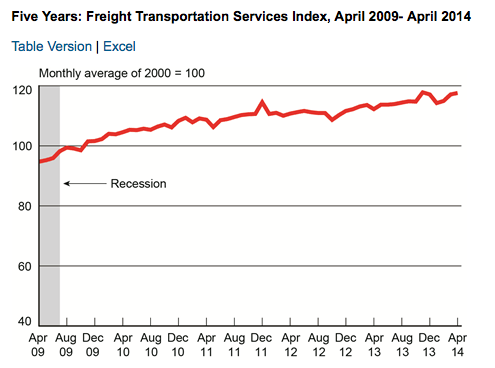
The amount of freight carried by the for-hire transportation industry rose 0.4 percent in April from March, rising for the third consecutive month, according to the U.S. Department of Transportation’s Bureau of Transportation Statistics’ (BTS) Freight Transportation Services Index (TSI) . The April 2014 index level (117.6) was 24.1 percent above the April 2009 low during the most recent recession The level of freight shipments in April measured by the seasonally-adjusted Freight TSI (117.6) was at the second highest all-time level and 0.1 percent below the all-time high level of 117.8 in November 2013.

Cargo Numbers Edge Up in Long Beach
Modest rise brings busiest May since 2007
June 16, 2014
Cargo container numbers edged up 2.7 percent last month at the Port of Long Beach, making for the Southern California seaport’s busiest May since 2007 by reaching nearly 600,000 container units.

Terminals handled 599,509 TEUs (twenty-foot equivalent units) overall in May, including 312,439 TEUs of imports, which is a 2.3 percent increase compared to May 2013. Exports were flat with a slight decline of 0.3 percent to 146,702 TEUs. Empty containers rose 7.1 percent to 140,368 TEUs. With imports exceeding exports, empty containers are sent back overseas to be refilled with consumer goods.

While May was the second consecutive month of increasing volume, Long Beach has seen an increase of just 1.3 percent for the first five months of 2014 compared to the same period last year.

Last year, against which 2014 is being compared, was the third-busiest year in port history with a total of 6.73 million TEUs.

With an ongoing $4 billion program to modernize its facilities, the Port of Long Beach continues to invest in long-term, environmentally sustainable growth.

IGM -Hanford 2014-01-27 at 11.01.02 AMWeekly Rail Traffic Up 5.3 Percent
WASHINGTON, D.C. – June 12, 2014 – The Association of American Railroads (AAR) today reported increased U.S. rail traffic for the week ending June 7, 2014 with 292,924 total carloads, up 5.3 percent compared with the same week last year. Total U.S. weekly intermodal volume was 269,823 units, up 6.8 percent compared with the same week last year. Total combined U.S. weekly rail traffic was 562,747 carloads and intermodal units, up 6 percent compared with the same week last year.
Nine of the 10 carload commodity groups posted increases compared with the same week in 2013, including grain with 17,568 carloads, up 15.5 percent; nonmetallic minerals and products with 39,577 carloads, up 12.2 percent; and motor vehicles and parts with 18,343 carloads, up 8.9 percent.