
March 14,2014
Source: NW Fishletter
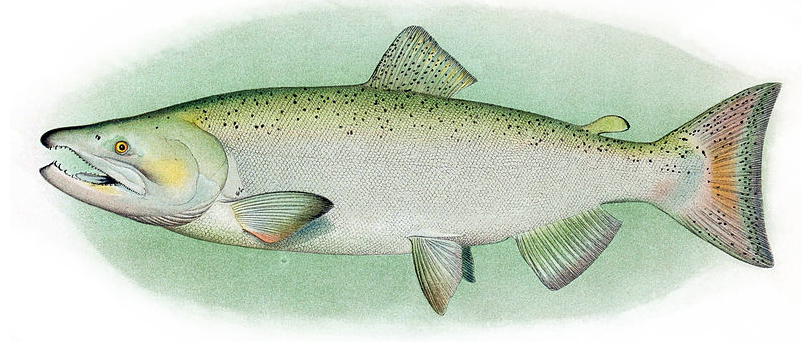 From California to Canada, this year’s salmon season is expected to be big. In some places, like B.C.’s Fraser River, fish managers may be counting sockeye in the tens of millions.
Earlier this month, the Pacific Fishery Management Council said nearly 635,000 fall chinook are expected to return to the Sacramento Basin. That’s about 200,000 fish shy of last year’s prediction, which ended up very close to actual estimated harvest and escapement (97 percent). Back in 2010, only 40,000 returned. Fish conservation groups blamed the poor returns on the lack of water during the juvenile migration phase, but an expert panel later concluded that the stock had been victimized by poor ocean conditions.
Further north, The Klamath River is estimated to see nearly 300,000 returning chinook. Last year’s return of 165,000 was about 47 percent lower than the 2013 preseason prediction.
NW Fishletter has already reported on this year’s high expectations for fall chinook returning to the Columbia River’s Hanford Reach, but the PFMC’s preseason report put the estimates in real perspective. It says the preliminary forecast of 973,300 adults is about 124 percent of last year’s return and more than 300 percent of the recent 10-year average of 311,970.
“This forecast is a record high forecast and slightly higher than the 2013 record high return to the Columbia River of 784,100,” said the report, which noted the expected return is “well above” managers’ conservation objective of 39,625 natural area spawners in the Hanford Reach, Yakima River, and areas above Priest Rapids Dam, “and should allow opportunity for both ocean and in-river fisheries.”
Ocean Conditions
Also ,a new study says that large sockeye returns to the Columbia Basin in recent years correlated best with early upwelling off the Northwest coast, and an annual collection of precipitation and temperatures called the Pacific Northwest Index [PNI]. Freshwater conditions like flow and percentage of spill at dams, however, didn’t carry much weight at all.
The peer-reviewed paper, “Influence of Ocean and Freshwater Conditions on Columbia River Sockeye Salmon Adult Return Rates,” was published Feb. 27, 2014 in Fisheries Oceanography. It was written by recently retired NOAA Fisheries scientist John Williams and eight co-authors.
Further North
The PFMC report said Puget Sound spring Chinook runs are expected to remain “depressed,” but summer/fall stocks are predicted in the 270,000-fish range, up considerably from 2013’s preseason forecast. Managers expect 37,000 natural fall Chinook, compared to last year’s 16,100-fish forecast (2013 PS returns have not been finalized).
Coho are on the upswing as well–the Oregon production index hatchery (OPIH) forecast calls for 983,100 coho, that’s nearly twice the 2013 prediction and about 3 times the preliminary 2013 postseason estimate, according to the PFMC report, which also noted that last year’s preseason estimate was 66 percent higher that last year’s return estimate.
Puget Sound coho (hatchery and natural) are expected to return in the 859,800-fish range, compared to a 2013 forecast of 882,100. According to the report, the hatchery coho forecast is 378,600, about 40,000 fish lower than the 2013 forecast, and the natural coho forecast for 2014 of 481,200 is much higher than the 2012 forecast of 464,900.
It’s an off-year for pinks in the Northwest, but last year was a blockbuster in both Puget Sound and the Fraser River, where somewhere around 26 million returned. However, the Fraser may see another big sockeye year in 2014, progeny of 2010’s monster 28-million-fish return.
Canada’s Department of Fisheries and Oceans’ analysis has estimated a 50-percent chance that about 23 million sockeye will return to the Fraser in 2014, in a range of estimates that run from 7-million to 72-million fish. DFO says there is a 10 percent probability the run will come in at or below 7 million, and a 90-percent probability that it will come in at or below 72-million fish.
Canadian biologists reported that the 2010 sockeye escapement to major Fraser tributaries was very high, and subsequent egg-to-smolt, and smolt survival was also very good, with large numbers leaving for marine areas in 2012–surveys off the B.C. coast that year saw the highest number of juvenile sockeye since the smolt surveys began in 1988. Returning jack counts were also reported high.
Some optimistic voices in the Canadian press have pointed out that 2010’s preseason forecast for Fraser sockeye estimated a 50-percent probability that the run would come in around 10 million fish, so returns this year could be much better than predicted, especially after 2013’s huge pink return signaled good ocean conditions. However, last year, DFO analysts also predicted a 50-percent probability that the 2013 sockeye return would be in the 4.8-million-fish range, and it came in a million fish lower.
The DFO estimate for this year’s return is more uncertain, says the official analysis, because the numbers of spawners seen in some Fraser tributaries in 2010 were higher than fitted escapement values in the model. “As a result, the 2014 return forecasts produced by biological spawner-recruit models are extrapolated beyond the range of fitted escapement values, thereby increasing their uncertainty.”
The Washington Department of Fish and Wildlife announced March 3 that Baker Lake, in the Skagit Basin, is expected to see a sockeye return of 35,000 fish this year, and managers expect to open a fishery on the run again this year. But the Lake Washington sockeye run, which was originally planted with fish from Baker Lake, is predicted at 167,000, way short of the 350,000 needed to return before any recreational fishery would be allowed.