Tulare Co Number One Ag County

July 15,2014

cows -07-08 at 12.06.50 PMFor the first  time ever Tulare County is the number one agricultural county in the US. The news came today as Fresno County released their crop report for 2013 showing a decline in their value last year – down to $6.4 billion.

Tulare County’s 2013 crop report came in at $7.8 billion in 2013, a 25% increase on strong returns for fruit and nuts as well as milk. The county is also the number one milk producing county.

Milk Headlines

July 11,2014

Screen Shot 2014-07-11 at 2.30.23 PMFalling Corn Prices Buoy Local Dairy/Livestock Industry

A big Midwestern corn crop promises to boost margins for livestock owners including the local dairy industry here. The news this week is that corn futures for delivery this December have now dropped below $4 a bushel compared to $6 to 7 in past years.The price fell Friday to the $3.91 level. High feed costs coupled with low milk prices from 2009 to 2012 pushed many dairy operators to the brink and scores of local dairy farms shut down. But in mid-2014 the cream is rising for milk producers with prices buoyed by strong exports. The latest Tulare County crop report says dairymen got an average of $16 per cwt in 2012 rising to $18.40 in 2013. This year the price has jumped to around $21.”Dairymen are finally making money” says Visalia broker John Grimmius. ”There were three years that we did not.” Grimmius says while there have been survivors of the tough years a number of operators did not survive.”We are seeing smaller dairy facilities sell for about the same as  open ground where people are now talking about planting trees.” Indeed the latest county crop report shows some 4080 acres of nonbearing pistachio trees have been planted in recent years.

Milk Powder Sales – New Record High

U.S. exports of nonfat dry milk and skim milk powder increased 10% in May from April – a new all-time monthly high. In May, exporters sent 60,358 metric tons, or 133 million pounds, of nonfat dry milk and skim milk powder to destinations overseas, a 7.8% jump from May 2013 according to USDA. One of the largest producers is California Dairies in Visalia.

Tulare Council Will Discuss CaliCheese Project

The Tulare City Council will discuss the sale of 59 acres to CaliCheese July 15 asking for an additional $10,000 from the company to cover staff time on extending an exclusive right to negotiate the purchase.

Tulare County Crop Values Climb 25.7 Percent in 2013

July 8,2014

cows -07-08 at 12.06.50 PMTulare County’s  2013 crop report was presented to the county Board of Supervisors this week by county ag commissioner Marilyn Kinoshita. Kinoshita reports that total gross production climbed a hefty 25.7% in 2013 to $7.8 billion. That is a jump of nearly $1.6 billion.

Kinoshita says while milk continues or be the leading crop and increased in value by 14.9% the headline commodities are the county’s fruit and nut crop that increased to over $4 billion- a jump of 43%. Field crops values fell by 6.5% while nursery products climbed 6.1%

Tulare County is the nation’s number one dairy county at $2.1 billion in milk production.

Star crops in gains included nectarines jumping in value by nearly double,oranges increasing by over $150 million,walnuts increasing by $80 million,pistachios by around 80 million and honey more than doubling in value. Cattle increased by more than $100 million and milk jumped by $200 million.

There were more than 40,000 additional fruit and nut acres harvested in 2013 compared to 2012.

ASIAN CITRUS PSYLLID QUARANTINE EXPANSION IN TULARE COUNTY

Screen Shot 2013-08-05 at 6.51.51 AMSACRAMENTO, June 19, 2014 – An additional portion of Tulare County has been placed under quarantine for the Asian citrus psyllid (ACP) following the detection of one psyllid west of Exeter near the community of Farmersville in Tulare County.  This brings the total quarantine area in Tulare County to 870 square miles.
The new quarantine zone measure 14 square miles in Tulare County, bordered on the north by W. Main Street; on the east by Road 132; on the south by Avenue 224; and on the west by Road 124.  This area is in addition to the previously announced quarantine areas in Tulare County.  A map is available online at:  www.cdfa.ca.gov/plant/go/acp-quarantine

In addition to quarantines in portions of Tulare, Fresno, Kern, and San Luis Obispo counties, ACP entire- county quarantines remain in place in Imperial, Los Angeles, Orange, Riverside, San Bernardino, San Diego, Santa Barbara, and Ventura counties.

The ACP is an invasive species of grave concern because it can carry the disease huanglongbing (HLB), also known as citrus greening.  All citrus and closely related species are susceptible hosts for both the insect and the disease.  There is no cure once a tree becomes infected.  The diseased tree will decline in health until it dies.  HLB has been detected just once in California – in 2012 on a single residential property in Hacienda Heights, Los Angeles County.  HLB is known to be present in Mexico and in parts of the southern U.S.  Florida first detected the pest in 1998 and the disease in 2005, and the two have been detected in all 30 citrus-producing counties in that state.  The University of Florida estimates the disease has tallied more than 6,600 lost jobs, $1.3 billion in lost revenue to growers and $3.6 billion in lost economic activity.  The disease is present in Georgia, Louisiana, South Carolina, and Texas.  The states of Alabama, Arizona, Hawaii, and Mississippi have detected the pest but not the disease.

Residents in the area who think they may have seen the Asian citrus psyllid are urged to call CDFA’s Pest Hotline at 1-800-491-1899.  For more information on the Asian citrus psyllid and huanglongbing disease, please visit: www.cdfa.ca.gov/go/acp.

Ag Beat: Nuts / OLAM / POM / Stone Fruit / Processed Cheese

June 16,2014

Screen Shot 2014-06-16 at 5.09.55 PMNut Exports Stay Strong In May

California walnut shipments to the world export markets stayed strong in May along with other nuts shipped in record amounts from the Golden State.
May walnut shipments  totaled 30,660 tons and 426,280 tons for the marketing year – September through May. Last May saw 27,809 tons of walnuts shipped and 432,592 tons through May of last year.
Almond shipments are up 15% in the expanding export market while total shipments year to date  are up 9.2%.
Pistachio shipments to date are down slightly with tonnage at 159,531 compared to 166,463 the year before.Pistachios are alternate bearing and 2014 is a light volume year.
Nuts are particularly popular in Europe and the Far East where exponential growth is expected.The U.S. Department of Agriculture’s Foreign Agricultural Office has estimated that demand for all food will double by 2050 because of increasing populations and rising incomes.

Opening of Australian Market For US Stone Fruit Good News

The ten year battle to open the Australian market to California stone fruit is good news here in California where exports will now grow in volume to consumers Down Under. Shipments have to get a methyl bromide dosing to enter the market but it will be worth it considering  the business is expected to grow to $50 million within five years according to the USDA.

OLAM Supports Research At Fresno State

Global agribusiness leader Olam Spices and Vegetable Ingredients (SVI) has established a $200,000 endowment with the Jordan College of Agricultural Sciences and Technology at Fresno State to support interdisciplinary research of food and wine.
University President Joseph I. Castro announced the gift June 13 during a groundbreaking ceremony for the Jordan Research Center, a new 30,000-square-foot interdisciplinary research center designed to foster collaboration among students and faculty in agricultural sciences and technology, engineering and science and mathematics.

Supreme Court Says Pom Can Sue Over Pomegranate Label

The Supreme Court in a  a unanimous decision a few days ago gave Pom Wonderful permission to sue Coke for false advertising.
The ruling says  the label on Coke’s Minute Maid brand “Pomegranate Blueberry” beverage are misleading since the juice has only a “minuscule amount of pomegranate and blueberry juices.”
Justice Kennedy wrote that the product actually contained “99.4% apple and grape juices, 0.3% pomegranate juice, 0.2% blueberry juice and 0.1% raspberry juice.”
Processed Cheese Exports Build

Demand overseas for processed  cheese from the US has room to grow says a Dairy Export Council report.This variety of cheese  – typically re manufactured close to the market once it arrives is the most consumed cheese in the world.

“New Zealand traditionally dominates raw material supply, but the United States has steadily raised its profile. We have moved into a strong No. 2 position, as our share of cheddar exports to the 10 nations jumped from 8 percent in 2008 to 26 percent in 2013.
With demand rising and market leader New Zealand signaling that cheddar for processing has taken a back seat to milk powder and other products, we now have a golden opportunity to take over the No. 1 position—if we decide to go after it.”

Teamsters Cite Abuses At Salad Processor’s Temp Hiring Policy

State Senate Labor Committee Approves Legislation to
Hold Companies Accountable for Labor Suppliers’ Violations
JUNE 12,2014

Screen Shot 2014-06-12 at 12.06.25 PM(SACRAMENTO) – The Senate Labor Committee yesterday approved AB 1897, a bill already approved by the Assembly that would hold companies accountable for serious violations of the rights of workers on their premises that are committed by their own labor suppliers.

Like similar legislation that is already law in Illinois, the bill would address a rapidly spreading corporate shell game in which companies claim that the men and women who do their work are not really employees but “temporary” workers for labor contractors or agencies. This scam allows corporations to deny responsibility for compliance with basic worker rights standards involving pay, benefits, and working conditions. The bill is authored by Assemblymember Roger Hernandez and co-sponsored by the California Labor Federation.

“This shell game is a significant contributor to the crisis in our economy today,” said Teamsters General President Jim Hoffa. “More and more people are working harder with less to show for it. Their low wages, unhealthy working conditions, and lack of benefits subsidize the greatest wealth at the top in the history of the world. Holding corporations accountable for violations of basic worker rights on their premises would be an important step in the right direction.”

Hoffa was joined today by workers from Taylor Farms, a California company where abuses of worker rights dramatize the need for the new law.

Taylor Farms is the world’s largest salad processor, supplying to McDonalds, KFC, Pizza Hut, Dominos, Subway, Darden Restaurants (Olive Garden and Red Lobster), and many other restaurant and food chains. At its processing plant in Tracy, a majority of the people who do the work actually are employed by two temporary staffing agencies and not by Taylor Farms. One of these agencies, known as Slingshot, has its office on the company’s premises, and Taylor is its only customer.

“I have been a temp worker for the last ten years, ever since I received my first paycheck,” said Jose Gonzalez, who works at Taylor Farms, but is employed by a labor contractor called Slingshot. “To me this is hurtful. I am being robbed of the fruits of my labor every hour I work. Why not pay me the money going to the temporary agency for my labor? As a temp worker I have no health care, sick or vacation pay or retirement security. I have no future. It’s like I’m a modern-day slave.”

While its workers generated $1.8 billion in revenue for the company in 2012 — 4 ½ times the company’s revenue just seven years before — Taylor claims that it has no responsibility for how its “temporary” workers are treated:

Many workers are paid a minimum wage of $8 an hour with no benefits and no guarantee that they will have a job the next day. Many have reported wage theft and there is currently a wage theft lawsuit pending against the company.
Workers have been fired once they become injured or ill; as a result, others fear reporting injuries.
They may be denied days off to care for a sick child or family member.
They face ethnic discrimination, sexual harassment, and discrimination based on sexual orientation.
Workers are confronted by dangerous working conditions every day. Some work in rooms with temperatures as low as 34 degrees. Taylor Farms fails to provide workers with protective gear to shield them from fumes that cause dizziness and gagging. Workers often have to provide their own safety equipment like gloves and warm clothes. Workers have been ordered to remove bio-hazards without protective gear.
Workers are denied breaks to use the bathroom.

“Currently, there’s no law to stop corporations from playing a shell game that exploits low-wage workers and their families. With AB 1897, that’s going to change,” said California Labor Federation executive secretary-treasurer Art Pulaski. “This bill ensures unscrupulous companies are held accountable for violations of workers’ rights committed by their labor contractors. It’s the right thing to do, and a fair way to do it.”

Fed up with the low pay, dangerous working conditions, and a lack of opportunity, 900 workers at Taylor Farms, many of them Latino immigrants, have joined together to form a union. The workers in Tracy know the benefits a union can bring because Taylor Farms workers at a facility in nearby Salinas, Calif. have been members of the Teamsters Union for 17 years.

While the work is similar, pay and working conditions are much better in Salinas. The 2,500 workers in Salinas earn an average of $2.50 an hour more than in Tracy. They also have access to good healthcare, a 401(k) plan, paid vacation, and paid sick days.

Besides trying to form a union, Taylor Farms workers in Tracy have filed complaints with Cal/OSHA, and the state Labor Commissioner is investigating working conditions and wage theft at their facility.
There is also an ongoing lawsuit in federal court over the failure to pay wages for all hours worked at the plant.

“Food processing workers are joining fast food, Walmart, car wash and warehouse workers in standing up for themselves,” Hoffa said. “They are standing up for an America where people who work can support themselves and raise a family.”


Ongoing Water Crisis Takes Toll On Citrus

June 11,2014

By Steve Adler

Screen Shot 2014-06-11 at 10.04.33 AM

The disconcerting rumble of bulldozer engines and snapping tree limbs has replaced the harmonious sounds of orchard tractors in some San Joaquin Valley citrus groves, as unprecedented water shortages force farmers into difficult decisions. Some farmers have decided to bulldoze groves; others will pay many times the usual price for water, in some cases just enough water to keep their trees alive.
In the prime citrus-growing region of Terra Bella, which is nestled just below the foothills in eastern Tulare County, growers face the harsh reality that they will have access to none of their federal contract water—the first time this has happened since the Terra Bella Irrigation District was formed more than 60 years ago.
“This is the worst we’ve ever seen it,” said citrus grower Matt Fisher of Terra Bella. “My dad has been doing this for about 40 years and he has never seen it this bad. He has a cousin who has been farming for almost 50 years and it is the same story. They both said this is far and away the most difficult year they have ever seen in our business.”
Fisher has decided to purchase enough water to produce a crop this year, but he had to pay 10 times the amount he normally spends each year on irrigating his groves.
“I am fortunate because TBID has secured a bunch of emergency water for us at $1,200 an acre-foot,” Fisher said. “If we didn’t have that, we would have no water and our trees would die. It is incredibly expensive, but we will be able to grow a crop with that and I am hopeful that we can make it one more year. Next year if we get no water, I will not be able to do that again.”
In a complex water swap that involved several agencies, the Terra Bella Irrigation District secured 5,400 acre-feet of emergency water, about half of the district’s normal allocation for use by its 600 farmers.
“Even though we got zero water from the government, we have been able to go out and get some water at very high prices to secure a supply of water to keep trees alive,” TBID General Manager Sean Geivet said.
While a few growers did as Fisher did by purchasing enough water to produce a crop, others bought just enough to keep their trees alive, and still others have elected to push out groves to make water available for their more productive trees.
Ed Chambers, who manages groves from Exeter to Kern County, including two in Terra Bella, said he spent $38,000 to purchase enough water to produce a crop from one 30-acre citrus grove. He said he also plans to push out a 100-year-old Valencia orange grove once he receives the go-ahead from the estate that owns the property.
“It has made money, but it is not a super-profitable grove. The owners and I have decided that in this situation, there is no future in buying $1,200 an acre-foot water to keep it alive when we can’t get enough to make a crop anyway,” he said.
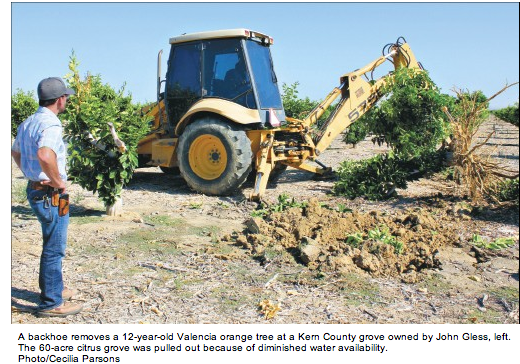
At a news conference in Kern County last Friday, public officials and farm-group leaders watched as a citrus grove owned by John Gless was pushed out by bulldozers because Gless does not have the water needed to keep the trees alive.
Gless, who grows citrus in Kern and Riverside counties, made the difficult decision to push out 60 acres of 12-year-old Valencia trees that had been budded over to a seedless variety two years ago.
He said that comparing his available water with the amount of water needed for irrigation, it was clear there was not enough to go around. Without adequate water, the trees would die or suffer such a setback they would never recover enough to produce a good crop, he said.
“You can’t stress citrus for water this time of year when they are setting a crop,” Gless said.
Joel Nelsen, president of California Citrus Mutual, said the organization has identified approximately 50,000 acres of citrus trees that are vulnerable because of the lack of surface water.
“They didn’t have wells for a couple reasons. One, they don’t sit on an aquifer, or two, they have never needed to have groundwater in the past because they have always had plenty of surface water being provided by their irrigation districts,” Nelsen said.
When the U.S. Bureau of Reclamation initially announced that no water would be available for farmers in the Friant Unit of the Central Valley Project, it said it would re-evaluate later in the season. Heavy rains that fell on the state in March fueled growers’ hopes that some water would be provided through the federal project.
“Nobody was going to be made whole; we are in a drought and everyone understands that. But since it rained so much in March, there was more than 1.2 million acre-feet of additional water placed in storage, some of which everyone believed could have been made available to south-of-the-delta producers,” Nelsen said. “But the Bureau of Reclamation and National Marine Fisheries Service decided that they needed to hold onto the water for a variety of reasons.”
He pointed to the “unbalanced policy which favors fish over the production of food and fiber” for worsening water shortages.
“We aren’t trying to take water away from the environment; we aren’t trying to take water away from the fish. But there has to be a balanced approach,” Nelsen said.
(Steve Adler is associate editor of Ag Alert. He may be contacted at sadler@cfbf.com. Reporter Cecilia Parsons contributed to this story.)

AG NEWS ROUNDUP: Visalia Firm Puts Their Eggs In Investment Basket

June 5,2014

Screen Shot 2014-06-05 at 6.34.05 AM
Opal Foods Acquires Moark’s Midwest Egg Production Assets

Opal Foods, an entity created by AGR Partners of Visalia, in association with Rose Acre Farms and Weaver Brothers, has purchased Moark’s Midwest egg production assets.
Opal Foods expects annual revenues to exceed $200 million with its operations in Missouri and Colorado, as well as a new cage-free farm in Neosho. Many of the farms purchased were recently renovated to comply with California’s future production standards, and some will be among the most modern in the country.
Opal Foods’ company headquarters will be in Neosho, Missouri, and the company will retain all 250+ employees previously employed by Moark in the Midwest. Opal Foods will be a franchisee of Eggland’s Best and will continue serving the same customers.

Eggland brand promises eggs that are are higher in Vitamin E, Omega 3 and Lutein and lower in cholesterol and saturated fat.

Jerry Welch, general manager of Opal Foods said, “Opal Foods is proud to continue to supply customers with the highest quality eggs to help meet the category’s strong and growing demand. Opal Foods’ stewardship will provide its customers and end consumers with a sustainable source of protein and valuable nutrition for years to come.”
Opal Foods is interested in growth opportunities in egg production operations and recognizes the shift to healthier diets as a catalyst to the growth of the egg industry, as individuals and restaurants embrace the trend to increase protein consumption and expand breakfast and lunch menus that include eggs.
AGR Partners pursues non-controlling investments and seeks to partner with best-in-class management teams and business owners. Rose Acre Farms and Weaver Brothers are strategic partners in the creation of Opal Foods. The partners will assist Opal Foods and its management team in building an industry leader in the production and distribution of fresh eggs that meet the nation’s needs for a healthy source of protein. Ejnar Knudsen, managing member of AGR Partners and a director of Opal Foods said, “The AGR team is grateful to be working with such a strong team in Opal, supported by great partners with all the resources and expertise from their respective organizations.”
For further details on the investment, see AGR’s case study.

About AGR Partners:
AGR Partners is a private equity firm based in Visalia, CA, with capital provided by institutional pension investors. The firm is dedicated to the pursuit of long-term investments in the food and agriculture value-chain and seeks non-controlling equity or convertible debt structures, to facilitate late-stage growth, strategic acquisitions, and ownership transitions. AGR Partners also recently purchased a 20% stake in the Ridley Corporation, Australia’s largest animal feed and renderer for $56 million.

Egg Prices Up On Exports

USDA says egg prices rose 0.5 percent from March to April and have increased 9.3 percent since this time last year. The recent increases in egg prices, driven in part by a sharp increase in exports, have been larger than what is seasonally expected. Additionally, egg farm prices have continued to increase substantially. ERS has revised its forecast for the egg CPI upward to 5 to 6 percent for 2014.

Screen Shot 2014-06-03 at 6.02.34 PM
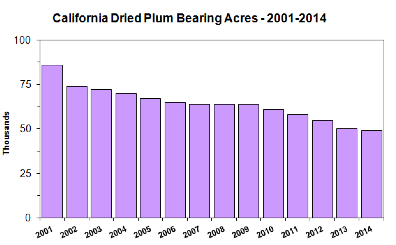
 Prune Crop Up 12 Percent / Acreage Down

The 2014 California dried plum (prune) crop is forecast at 95 thousand tons, up
12 percent from the 85 thousand tons produced in 2013. Total 2014 bearing
acreage is estimated at 49,000. Dried plum trees were pulled after the 2013
harvest, reducing acreage by 2 percent for the 2014 season. The French prune
variety accounts for virtually all dried plum acreage grown in California. The
production forecast is based on a survey of dried plum growers conducted by the
USDA, NASS, Pacific Regional Office from May 6-27, 2014.

 Mites May Be Issue In Bee Deaths

from Quartz

Finally, some good news from the frontlines of the beeapocalypse: Significantly fewer
honey bees died in the winter of 2013-2014 in the US than in previous years, according to a survey released today. Better yet, scientists think they know a simple way to minimize the devastation that has led to a $10 billion die-off of bees that pollinate one-third of the world’s food supply.

A host of factors have been fingered as culprits in bee deaths—from pesticides and a dearth of nutritious food to stress and even automotive exhaust. But researchers at the University of Maryland found that a well-known bee parasite, the Varroa mite, was the No. 1 killer last winter. “Our field data suggests mites are playing a very large role here,” Dennis vanEngelsdorp, a University of Maryland entomology professor who led the study, told Quartz.

Fall Midwest Corn Crop Looks Good

Learning To Love El Nino

May 27.2014

Screen Shot 2014-05-27 at 12.11.26 PM

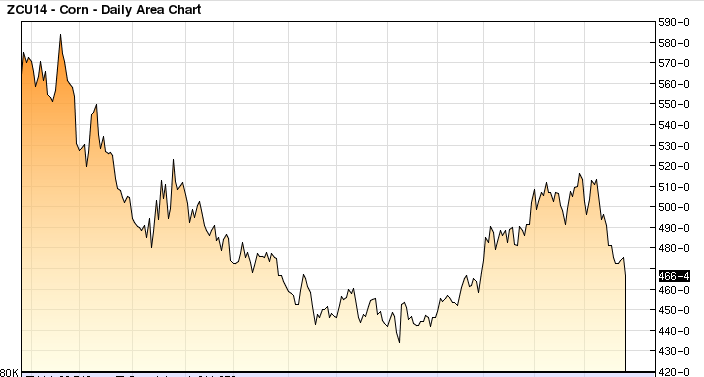
Above: 1 Year  Chart of Corn Futures for Sept delivery down to $4.66 today

Good news for Valley livestock owners – Corn futures for this autumn are falling this week with good planting weather in the Midwest and the prospect of an El Nino weather pattern. That pattern could bring abundant rainfall to Midwest say some experts.

California farmers arr warming to the idea of an El Nino weather pattern that  could bring abundant rain to at least the southern half of the state as well as Colorado and Arizona  this fall and winter says the Climate Prediction Center. But good moisture in the Midwest is a big boost for the California economy as well

There is a 65 percent chance of El Nino weather conditions developing  early this summer according to the U.S. Climate Prediction Center. That pattern probably will lead to favorable moisture for Midwest crops without sustained heat says Commodity Weather Group in Bethesda, Maryland, in a report.
Today, corn futures dropped to the lowest price since March and soybeans fell the most in almost four weeks as planting accelerated in the U.S., the world’s biggest largest producer. Corn futures for July delivery fell 1.4 percent to $4.715 a bushel on the Chicago Board of Trade. September futures are at $4.66.
During the  Midwest drought livestock owners who need corn for their animals were paying as much as double that price,forcing a good number out of business
One report says “about 88 percent of the corn crop was sown as of May 25, up from 73 percent a week earlier, and soybean seeding jumped to 57 percent from 33 percent, according to a Bloomberg survey of analysts.”

What Drought? State Tomato Production To Climb 17.6%

Screen Shot 2014-05-26 at 2.56.29 PM

May 26,2014

What Drought? California Tomato Growers Expect To Increase Production 17.6% This Year

California tomato processors say they contracted with the state’s tomato growers for 14 million tons of processing tomatoes in 2014, up 17.6% over last year. They are doing that by planting 285,000 acres statewide compared 259,000 acres last year. The 2014 acreage is the highest since 2009.
Is not the drought cutting plantings? It is in hard hit Fresno County with plantings in 2014 at 90,000 acres compared 98,000 acres in 2013 USDA says. Next door in Kings County – acreage will climb this year from 26,000 to 32,000. It will also climb in better watered  north Valley counties like Colusa,Merced,San Joaquin,Yolo and Sutter.

Walnut Acreage Up 8% Statewide

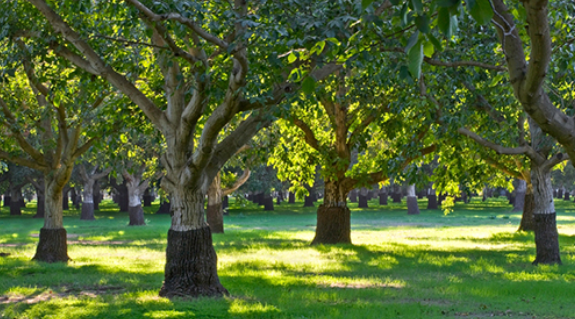
USDA reports that nonbearing acreage of walnuts climbed 10,000 acres in the past year to brining total walnut acreage to 325,000 acres in 2013.That is up 8%.
San Joaquin County remains the top walnut producing county with 37,074 acres of which 4204 acres are nonbearing,new trees yet to produce. Tulare County is number three statewide with 27,094 acres including 2232 acres listed as nonbearing.
The USDA reports record per-acre return in 2012 of $3,030 per ton.